Blog Archives
JenREES 4-1-18
Hope you had a blessed Easter! The Wheat Stem Maggot in Cover Crop Webinar can now be viewed at: https://www.youtube.com/watch?v=XGjuzMlrjhQ&feature=youtu.be. The link for the survey mentioned in the webinar is no longer available but you are welcome to contact Dr. Justin McMechan for additional comments/questions. He goes through a number of insects to watch for and his ultimate message is to scout to determine termination timing.
Cover Crop Interseeding: A few weeks ago I attended the interseeding cover crops field day which had a really good attendance for March! For those of you considering this, I learned it’s best to start earlier than V6…consider V3 and if it’s wet, you have a better chance of actually getting interseeding accomplished by V6. This is year 3 of their study. The first year they used a spreader to seed the mixes. The second year they found utilizing insecticide boxes for the seeding when they cultivated worked the best. The third year they used a Hiniker inter-row seeder which they purchased.
Regarding mixes, most of them included annual ryegrass or cereal rye. There’s a Penn State mix (27# total of annual ryegrass, red clover, and hairy vetch) that has been successful in northern U.S. states. Very little cover was observable this spring, but from a photo provided, it appeared growth came on during corn senescence and after harvest last year. Fall biomass wasn’t measured last year which will hopefully be measured in the future to obtain more data on the success of the mixes. My take, if your goal is early spring grazing or early spring cover, I’m unsure that much can beat cereal rye, even if it was dormant seeded. If you’re looking for a way to get some cover established prior to corn harvest for either fall grazing or just fall soil cover, interseeding with a mix containing the annual ryegrass looked good from the pictures they showed. If you’re interested in any cover crop or other on-farm research studies this year, please let me know!
Tree Care Workshop: Trees are very valuable in our landscapes. They provide us with beauty, shade, oxygen, and better resale on our homes. These trees need our help to ensure they have healthy growth. When they have a disease or insect problem, it is up to us to manage those pests to help them live many years. On Wednesday, April 18th from 5:30-7 p.m. at the Fairgrounds in Clay Center, Nicole Stoner will teach us what to do with our trees. Nicole is a Horticulture Educator from Gage County. This tree program is $5.00 and will cover light refreshments and your educational materials. Nicole will cover watering, insect and disease problems, general care, and planting of trees. Please pre-register by April 13th with Nebraska Extension in Clay County by calling 402-762-3644 or emailing dpeshek2@unl.edu.
Spring Affair Plant Sale: Spring Affair, the Midwest’s largest plant sale and gardening event, will be Saturday, April 28 at the Lancaster Event Center in Lincoln from 9 a.m. to 2 p.m. More than 700 different varieties of perennials, herbs, grasses, trees, shrubs and other plants will be available. They are selected for regional suitability, uniqueness, popular demand and provided by Bluebird Nursery, Inc., of Clarkson, Neb. It is sponsored by the Nebraska Statewide Arboretum as an educational tool, fundraising event and to promote regional plants. For information and inspiration, half hour plant talks will be offered at:
- 10:00 – “Nebraska Native Plants for Birds” by Jason St. Sauver, Spring Creek Prairie Audubon Center
- 11:00 – “Gardening 101: I’ve got my plants, now what?” by Justin Evertson, Green Infrastructure Coordinator for the Nebraska Statewide Arboretum
- 12:00 – “The Guilt-free Garden” by Mark Canney, Park Planner & Designer for Lincoln Parks & Recreation
Admission to the sale is free. The plant sale, presentations, educational booths and vendors of garden-related items are all in Pavilion I of the Lancaster Event Center with plenty of free parking. For more information, visit https://plantnebraska.org/spring-affair.
DriftWatch/BeeCheck: Nebraska Department of Ag (NDA) encourages pesticide applicators to check out DriftWatch/BeeCheck at http://driftwatch.org to minimize pesticide drift. It’s important for those with sensitive sites such as organic, bees, vegetables, grapes, etc. to add them to this website and important for all applicators to check this website for sensitive locations around our fields. Several states have been added to DriftWatch/BeeCheck in the last year and a few more are in the works, making it more beneficial to applicators working near the state line or those working in multiple states. FieldWatch, the company that manages DriftWatch/BeeCheck, now offers data subscriptions for obtaining data files for GIS maps or live stream data through several mapping software providers. It will be rolling out a new mobile app very soon, FieldCheck, for applicators who have registered as an applicator (which is free to do). You can also view the most recent edition of NDA’s Plant Health Protection Update at: https://us14.campaign-archive.com/home/?u=eb13611bfcca17410ce5c5f52&id=10756f8d33.
JenREES 3-18-18
On-Farm Research: It’s been fun discussing on-farm research projects and putting together protocols with growers the past few weeks! Some have asked if there’s already projects for which we need cooperators. We do have those and we also custom develop protocols depending on the question(s) you wish to look at. For those curious about protocols developed, you can view some at: https://cropwatch.unl.edu/farmresearch/extensionprotocols.
One question I’ve received quite a bit the past few years is about establishing cover crops into V5-6 corn. We don’t have on-farm research data yet for this study topic, but perhaps this year a few of you will consider it! The thought is to get the cover established, even though it won’t grow much during growing season, and hopefully provide for faster growth after harvest. I have developed an on-farm research protocol if growers are interested in trying this (it can be found at the same website listed above). In our brainstorming session, growers talked about interseeding via retrofitting equipment to put seed on similar to Y-drops, using a coulter, or seeding during cultivation. There is also a field day on March 21 to discuss what one farmer has tried the past three years regarding different seeding mixes and ways of establishing the cover at V6. If you’re interested in attending, it will be held at 4th Ave and 1/4 mile north on Arthur Road near St. Libory, NE from 1:30-3:30 p.m. The following website has more information regarding this field day: http://cpnrd.org/wp-content/uploads/2018/03/Cover-Crop-Field-Day-Flyer-March21.pdf. If you’re interested in attending, please RSVP Dean Krull: dkrull1@unl.edu. Please let me know if you’re interested in the V6 cover crop protocol as well! Also just a note, this protocol can also be adapted for any of you looking at applying nutrients during that V5-V6 time-frame. The plot pattern would be the same; the objective and perhaps some of the data collection would change.
Soil Moisture Status in Non-Irrigated Fields: This week I plan to install soil moisture sensors into some non-irrigated fields in the southern area of counties I serve. I’m just curious where we’re truly at for soil moisture deeper in the soil profile knowing Kansas is in drought and moisture this winter has been spotty. I did this in 2013 as well to see where we were at after the drought of 2012; it showed we didn’t have a full soil profile going into the growing season. If you have moisture sensors, you may wish to consider doing this as well for your fields or pastures to know where you’re at. It may influence cropping decisions for 2018. If you connect sensors to dataloggers, you will want to also install a temperature sensor to allow the datalogger to base the moisture readings on the current soil temperature.
Check out this week’s UNL CropWatch at http://cropwatch.unl.edu for information on averaged land values dropped by 3% from 2017, negotiating fair leases, assessing alfalfa winterkill, interseeding into thin alfalfa stands, and more.
Innovative Youth Corn Challenge: Nebraska Extension and the Nebraska Corn Board are offering the seventh Innovative Youth Corn Challenge contest. This contest, open to 4-H members (age 10 & older as of Jan. 1st) or FFA members (in-school members), guides participants through all aspects of corn production, as well as agricultural careers related to corn production. As a team (2 or more participants), youth will be challenged to implement a production practice different than normal to determine if they increased their yield. Economics and sustainability of the practice will also be considered. Yields, cropping history, and production information will be collected in the Corn Yield Challenge management summary. Cash prizes and plaques are given. First place receives $1,000, second place receives $500, and third place receives $250. Sustainability, crop scouting and “extra mile” awards are also given as cash awards. To participate in 2018, youth must complete and return an entry form by APRIL 1st to the Fillmore County Extension Office in Geneva, NE. Forms can be downloaded at https://cropwatch.unl.edu/youth/cornchallenge. For more information, contact Brandy VanDeWalle at brandy.vandewalle@unl.edu.
Horticulture Information from Kelly Feehan, Platte County: “Interested in getting an early start on vegetable gardening? You don’t need a greenhouse; just check out row covers that can be placed over plants to provide some protection from cold temperatures. Row covers are spun-bonded or woven polyester or polypropylene material that can be placed over plants to extend the growing season by retaining heat. Row covers are permeable and allow in light, water and air for plant growth. Depending on the weight of material used, between 2 and 8 degrees of frost protection can be gained, allowing earlier planting in spring or later planting in fall to move the harvest season up by a week or two or extend it a week or two later in the fall. Row covers can be draped over plants and secured with bricks; or they can supported by hoops, in which case they’re called low tunnels. Low tunnels are an easy and good season extender for home gardeners to use.
Rhubarb is a perennial that can live for years; however, plants should be dug and divided every 5 to 10 years. This is best done from late March into early April. Dig rhubarb plants, then use a sharp knife or axe to cut crowns into sections, each containing two pinkish buds. Incorporate organic matter into soil; then replant divisions 2 to 3 feet apart. Plant shallow so buds are only one-half to one inch below soil. Do not harvest newly divided or planted rhubarb the first year to allow plants to establish roots and recover from division or transplanting. During the second season, harvest only a few stalks to allow plants to continue to build up energy reserves. For three year or older plants, the harvest season can last up to 8 weeks. Harvest the largest rhubarb stalks by pulling them slightly to the side so they break away from the plant. Avoid harvesting more than one-third of rhubarb stalks at one time so plants are not weakened.”
JenREES 2-25-18
On-Farm Research: Last week a team of us did a series of meetings throughout the State regarding on-farm research updates. It’s always great to have the farmers presenting their research and adding in additional details that we didn’t have when the results booklet was published! Two more meetings continue in western Nebraska this week.
Perhaps my biggest reason for strongly promoting on-farm research is because there often is no better way to obtain answers to some of the questions you all have. These types of studies are often difficult to obtain funding (or can take months to obtain funding, resulting in a lost window of opportunity) and by conducting this research on your farms, we obtain the answers for your specific situations. Sometimes challenges such as storm damage also become opportunities to answer a question via on-farm research. Growers tend to appreciate research conducted on other growers’ farms when we share this research at various meetings, field days, and in articles. A variety of topics are researched every year including nutrient management, various products, row spacing, and new technologies including multi-hybrid planters, use of drone sensors, etc.
In this week’s UNL CropWatch at http://cropwatch.unl.edu, three on-farm research cooperators are featured. One of these is Ken Herz along with sons Zach and Aaron in the Lawrence, NE area as first-time cooperators. Ken approached me with several questions the winter of 2015. As growers with a non-irrigated, no-till wheat/corn/soybean rotation and a cattle operation, his family was curious about the impacts of grazing cover crops for cattle gains and improving soil organic matter. They were also curious about the trade-offs of the cover crop vs. any soil moisture loss or impact on the successive corn yield. They also wanted this study to be something that would be applicable to what farmers in this area did and something they could all learn from together. Thus, it was decided to not plant cover crops into the corn or soybean residue as that isn’t common and this would need to be a long-term study. Dr. Mary Drewnoski and I met with the Herz family to develop a plan for this study. Also thankful for Dr. Suat Irmak for his help in providing additional soil moisture equipment and advice I needed, to the Little Blue NRD in partnering with reduced cost of soil moisture equipment and also for the partnership of Green Cover Seed.
In 2016-2017, this study evaluated four treatments on the effects of successive corn yield: 1-ungrazed wheat stubble 2-grazed wheat stubble 3-ungrazed cover crop 4-grazed cover crop. Wheat was harvested July of 2016 and a five-species cover crop mix of spring triticale, winter peas, oats, collards, and purple top turnips was planted August 14, 2016 (they wanted a mix that would winter-kill). The cover crop received moisture within a week of planting that allowed for germination. Some additional fall moisture allowed for good growth and cover crop biomass was measured (3401 lb/ac) prior to grazing 28 (1100 lb) first-calf heifers for 22 days resulting in the cover crop carrying 2.4 animal unit months (AUM)/ac. The goal was not to graze too heavy to allow for ground cover and any long-term soil improvements, thus 2177 lb/ac of biomass was present post-grazing. Soil moisture was monitored from after cover crop planting through corn harvest. The soil was so dry after wheat harvest prior to planting the cover crop that it took using a drill to install the second and third foot moisture sensors. Beginning soil health parameters were also taken to be compared long-term in this study.
Corn was planted May 15, 2017. Prior to planting the corn, the soil moisture where the grazed and ungrazed cover crop plots were located were at 35% depletion (top three feet) compared to at field capacity (full soil moisture profile) in the grazed and ungrazed wheat stubble plots. Eight inches of rain in May evened out the soil profile allowing all plots to be at a full profile (top four feet) at the beginning of the corn growing season. As the season progressed, the grazing treatments started separating out from the ungrazed treatments from July through end of the season. I don’t know how to explain that yet.
Corn was harvested the Thursday of the major wind event with a calibrated grain wagon. Yields were not statistically different and were 218 bu/ac, 211 bu/ac, and 213 bu/ac for the ungrazed wheat stubble, grazed cover crop, and ungrazed cover crop respectively. The grazed wheat stubble treatment yielded 212 bu/ac but only had two reps at the end of the growing season so was not included in the statistical analysis. Economically, grazing the cover crop was as competitive as the ungrazed wheat stubble treatment when it came to ensuing corn yields and the spring rains made all the difference in beginning soil moisture. Because of the crop rotation, there wasn’t an opportunity to add a cover crop in this field Fall 2017. The Herz’ feel they lost an opportunity as environmental conditions vary so much every year, and this year, cover crops didn’t have as much growth in area fields. Thus, they’ve chosen to dedicate three fields to this study topic in the future, allowing for one of the fields each year to have wheat/cover crop/grazing to account for environmental variation. Continuing this for the next 5-7 years will better answer their questions while benefiting all of us with what is learned. Perhaps other growers are interested in some variation of this study for your farms?
Most studies are not this in depth and this is just one example of how growers are answering questions they have for themselves via on-farm research. It can take extra time at planting, harvest or other times of the season depending on the study. I believe most growers I’ve worked with would say the effort has been worth it to scientifically answer their questions for themselves. Truly am grateful for all of you I’ve had the opportunity to work with via on-farm research! So, if you’re thinking about a question you’d like to answer on your farm this year, consider reaching out to me or your local Extension educator and we’d be happy to talk with you now about how to set up your study. It is important to talk this through, especially if this is your first time conducting research. If you’d like to learn more about on-farm research, view some protocols, or view results from previous studies, please check out our website at http://cropwatch.unl.edu/farmresearch.
Bake and Take Month: March is Bake & Take month, a time when wheat organizations encourage others to bake a wheat good and share it with family, friends, neighbors, co-workers and shut-ins. In honor of the month, the Nebraska Wheat Board (NWB) is again sponsoring recipe cards and stickers for any 4-H groups or other organizations that wish to participate. This year’s recipes are mini dessert tacos and crockpot cherry chocolate lava cake. Those interested in participating or who have questions can contact the NWB office at (402) 471-2358 or wheat.board@nebraska.gov. There is no cost for the supplies, and no limit on the number that can be requested. Those wishing to preview the recipes before requesting materials can find them listed at http://wheat.nebraska.gov starting March 1.
York County Fair Volunteers: Gary Zoubek asked me to mention he’s looking for a few volunteers that could help with 4-H and Open Class primarily on entry and judging day in Ag Hall on July 31 and August 1st. If you’re interested, please contact Gary at 402-326-8185 or email gary.zoubek@unl.edu.

This study was conducted on a 40 acre field. Plot sizes are the same other than the grazed wheat stubble area which will not be included in the future. Aerial imagery was also taken throughout the growing season. The corn received hail damage on June 12, 2016 but recovered well.


Photo taken Sept. 21, 2016

Photo showing corner of 4 plots after grazing. Cattle were hard on my dataloggers but I had chosen to not fence them off as I wanted the true grazing data! Grazed treatments in background and ungrazed in forefront (cover crop left side and wheat stubble right). The cattle didn’t really graze the wheat stubble-tended to lay there as it wasn’t bumpy like cover crop area. Ultimately this led to bare soil in this area and we will not have this treatment in future years.

Observation showing importance of bare soil on Palmer germination: the grazed wheat stubble treatment turned to bare soil from where the cattle lay (not intended and something we learned). Could tell the treatment difference to the line even at harvest. June 8th: few Palmer plants in ungrazed wheat stubble (forefront) compared to in bare soil area (foreground). June 15 (3 days after June 12 hail storm): still only a few Palmer plants in ungrazed wheat stubble but it exploded in the bare soil area. These observations show what research has also shown regarding importance of light on Palmer germination and bare soil. There was minimal Palmer in the grazed cover crop area and was comparable to the ungrazed wheat stubble and cover crop areas. The Palmer put on 2 leaves from June 12-June 15. The corn barely grew in the whorl in that same time-frame. Corn dicamba product did a great job in killing the Palmer after allowing the corn plants to recover a few days & this situation was common throughout the area in 2017.

Always learning with on-farm research! I didn’t ask how corn fertilizer occurred so we had to remove sensors and re-install upon spring anhydrous application. Beginning soil moisture data shown here is from anhydrous app to day before planting. Cover crop treatments were at or close to 35% depletion (where we would typically trigger irrigation for silt-loam soils). Wheat stubble treatments had full soil moisture profile this entire time period.

Late April and May rain events (8″ of moisture in May) allowed for a full soil profile at corn planting for all treatments with separation of treatments not occurring till mid-July.

2017 vs. 10 year average rainfall for this area of the State-blessed with rainfall in 2017.
Herbicide Grazing Restrictions
Forage Feed Grazing Restrictions
Replant Options Rotation Restrictions-long
Grateful for a nice week for harvesting and for the good yields being reported! It’s also good to see cattle being turned into cornstalks. A reminder to read herbicide labels to understand if there’s any grazing restrictions from corn and soybean herbicides applied in-season.
It’s also important to look for any grazing restrictions on fall-applied herbicides to control marestail and other germinating weeds. These restrictions can also be found in the Forage Feed Grazing Restrictions in the UNL Guide for Weed Management. The forage, feed, and grazing restriction only applies to the crop for which the herbicide was applied. When it comes to grazing cover crops planted into these residues, one must use the replant/rotation restriction guidelines found on the herbicide label and in the UNL Weed Guide: Replant Options Rotation Restrictions-long. I apologize as these scanned blurry; hopefully you can zoom in ok to read what you need.
If the label doesn’t specify any restrictions, then it should be ok. If you want to be on the safe side, a rule of thumb is to use the pre-harvest interval for the amount of time to wait before grazing stalks. Some labels will say that residue should not be grazed or baled and fed to livestock. Sometimes studies were actually conducted to know there is a safety concern. In other cases, the chemical company may not choose to conduct all the studies the Environmental Protection Agency (EPA) required for labeling due to high costs. If that’s the case, the EPA requires the strongest restrictive language be placed on the label. Regardless, if it says there’s a grazing restriction on the label, the label needs to be followed as it is a legal document and the law.
As you plan for next year’s herbicide program, if you’re thinking about fall cover crops, the following NebGuide may be of benefit to you as it goes through the grazing restrictions of various herbicides.
Weed Management/Cover Crops Field Day — Views from VanDeWalle

During the summer, our crops extension team has some great field days to share research and management strategies to farmers. One of those opportunities to learn more about weed management and cover crops will be on June 28 at the South Central Agricultural Laboratory near Clay Center. There is no charge for the field day […]
via Weed Management/Cover Crops Field Day — Views from VanDeWalle
Ag Reflections from 2014
Happy New Year! Wishing all of you and your families a wonderful 2015! As I look back at 2014, there are several ag-related observations that I noted throughout the year.
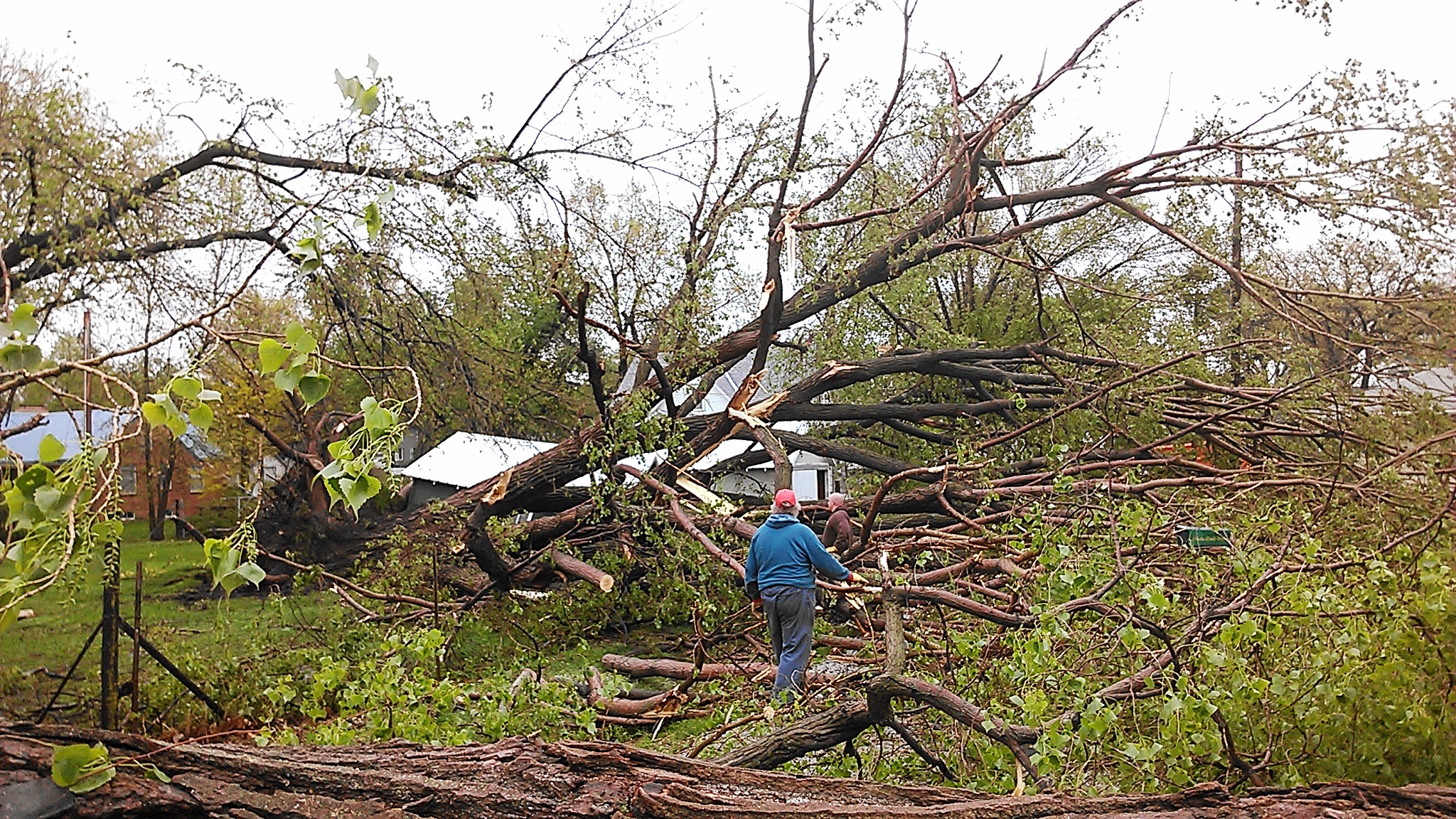
Cleanup after the tornado in Sutton on Mother’s Day 2014.
The first observation continues to be the way communities and people in this County/area pull together in difficult times. Whether after tornadoes/wind storms or helping other farm families who had an injured family member or had lost a family member, it’s just a blessing to see the way people pull together to help each other in time of need. It was also a blessing for many who were unable to harvest in 2013 due to the August 1st storm, to harvest fields in 2014, and for many in the area to experience really good irrigated and dryland yields this year.
The dry winter of 2013/14 allowed for very mellow ground during planting time. Often seeding depth ended up ½-1” deeper than intended. The dry winter also didn’t allow for good residue decomposition leading to problems during planting and ensuing stand emergence. Cutting off residue and high rains in May led to unintended consequences of replant situations when residue was moved off of farmers’ fields onto neighboring fields, suffocating emerged plants in portions of fields. I’m not sure what the solution is for the future other than it really needs to be something worked out with neighboring farmers, but perhaps mentioning it here opens an opportunity for future conversations.
Cover crops have been incorporated into more operations in recent years, yet the ultimate goal for using them remains important in determining what species/crops are used in the fields. We also realized the importance of determining amount grazed prior to turning cattle into fields (whether for grazing cover crops or crop residue), as high winds in winter 2013/14 in overgrazed fields led to soil blowing throughout the winter.
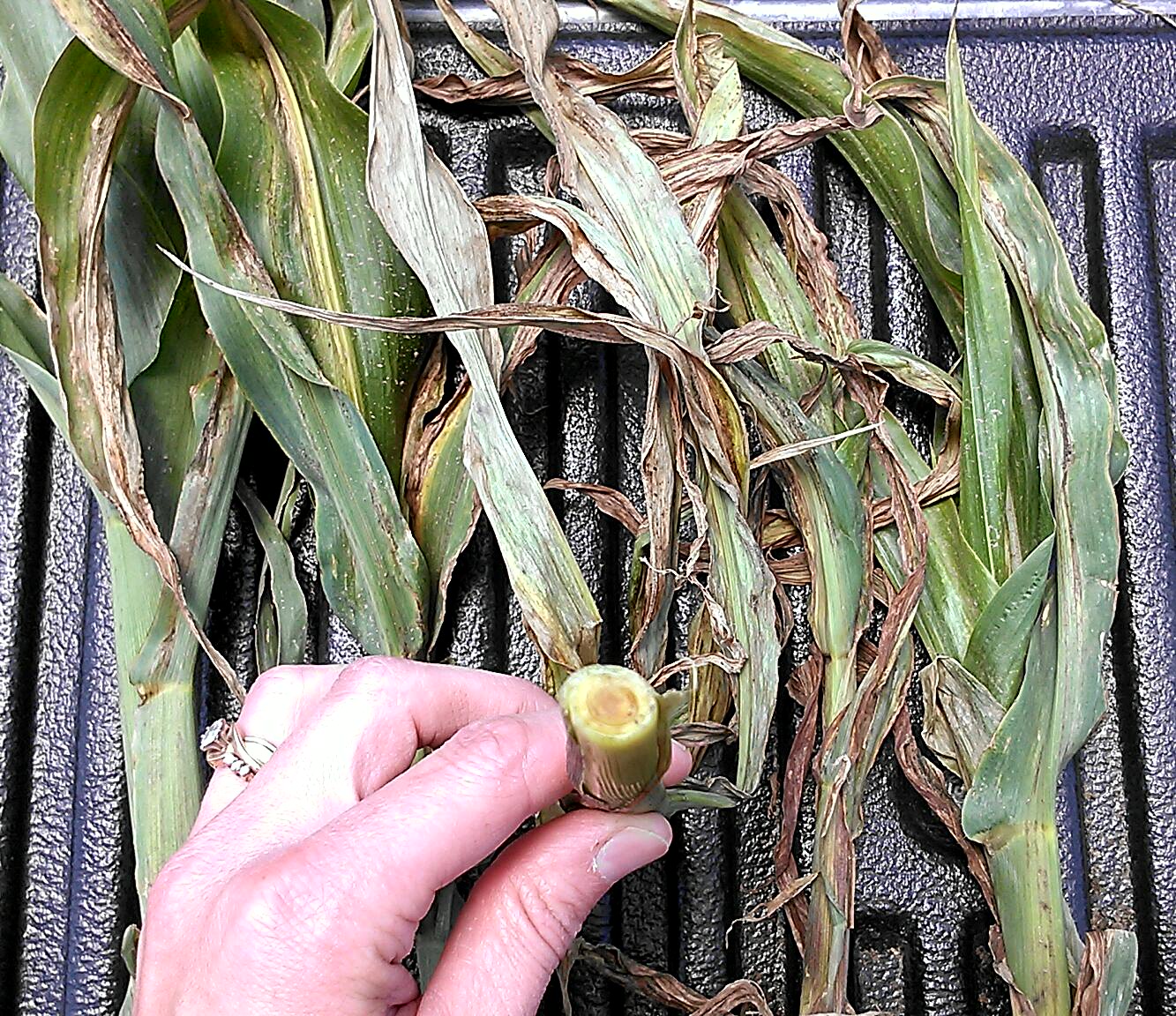
Systemic Goss’ wilt showed up in some fields that were hail and/or frost damaged by V6.
The May frost showed us emerged soybeans at the cotyledon stage held up well to the frost compared to the corn. We also again watched Goss’ wilt show up systemically by 6 leaf corn that was injured early by frost or hail in fields where Goss’ wilt had been a problem in the past. We need more research/understanding of this disease. Wheat continues to show us its resiliency as it winterkilled in portions of fields, withstood drought-stress, and then made up yield in the last 4-6 weeks.
Perfect pollination conditions coupled with high solar radiation, low night-time temperatures, and timely rain events were keys to the bountiful corn crop we experienced this year. Soybeans were more of a mixed bag. In walking fields and in conversations with farmers, I think the disappointment in some irrigated yields could be attributed to early/over-irrigation, disease problems, and planting date. UNL on-farm research showed on average a 3 bu/ac yield increase when soybeans were planted in late April to first week of May (regardless if growing season was warm/dry or cold/wet like it was this year) and those I’ve talked to who achieved 80+ bu/ac in the area this year planted in that time-frame. I’m curious if there’s something to planting a 2.4-2.5 maturity early vs. a 3.0+ maturity early as some area producers are seeing strong yields from a shorter season hybrid planted early the past few years. So if you’ve also seen this and/or are interested, that will be an on-farm research project to try next year. Please let me know if you’re interested!
Here’s wishing you a healthy and prosperous 2015!
Soil and Water Conference
Hope you can join us for our Soil and Water Conference tomorrow in Clay Center!

Planting Cover Crops into Storm-Damaged Fields
A common question lately has been “I’m considering planting cover crops into areas of corn and soybean fields with hail damage. What are my next steps?”
First, it’s important to consult your crop insurance provider to determine if you can do anything before the adjuster examines the field.
 In some areas hail stripped corn and soybean plants to the ground, leaving just stems standing. Cover crops offer an opportunity to rescue nitrogen already in the field to achieve other goals.
Next, look at your cover crop options, based on potential herbicide carryover from the previous crop and what your end goal is for the cover crop.
Herbicide Carryover
Herbicide carryover from the corn or soybean crop also can be a concern. Check out the herbicide carryover replant options in UNL Extension’s Guide for Weed Management with Insecticide and Fungicide Information on pages 160-171.
To determine if herbicide carryover is a concern for your fields, first check the herbicide label(s) for potential problems. If a rotation (waiting) interval is a concern, contact the chemical manufacturer and explain your conditions. Although the label is the law, companies have conducted extensive research on their products. Sometimes, they can give you a percentage survival chance for planting a crop within a cropping interval. Producers will assume the risk if the germination of the next crop is severely affected, but it may be worth a small calculated risk to potentially get a cover crop established.
Home germination tests also can be conducted. (Planting delays with cover crops, though, may be a concern). Simply take soil samples from the hailed fields and place into containers such as plastic cups with holes in the bottom. Plant about 20 seeds per cup of whichever cover crops you are interested in and wait 7-14 days to determine percent germination. If you don’t have seed, check a cover crop seed supplier to request some free seeds for testing.
Select Seed to Match Your Need
Know what your goal is for the cover crop in order to determine what to plant. Do you want to capture the nitrogen already in these fields? Both legume and non-legume cover crops can capture soil profile nitrogen in their plant tissues for release in subsequent seasons. Late summer or early fall seeded cover crops favor the brassicas (turnips; oilseed radishes including Tillage Radishes®; and canola) for nitrogen trapping for the next crop. Oats make a good complement to seed with the brassicas, since the oats provide quick, weed-suppressing biomass while taking up excess soil nutrients. These plants can survive a light frost and keep on growing.
If reducing compaction is your concern, turnips may help with surface compaction while radishes provide a longer taproot to work through deeper compaction.
If forage is needed for haying or grazing, good choices would be winter annual grasses such as cold-tolerant “winter” oats, cereal rye, winter triticale, and winter wheat. Winter legumes such as yellow sweetclover and winterpeas also may be included in a mix with winter triticale to increase protein content; however, these legumes will need to be planted before early September to provide grazing benefits.
Corn and soybean fields also can be used for forage instead of grain. Silage is probably the best option when the moisture drops to 60%. Currently, the immature hailed corn fields are still about 80% moisture, so producers will either have to wait for the crop to dry or mix dry forages such as straw with the wetter silage in the right proportion. Conversely, if the plants get too dry, it will be hard to pack the silage. To check the moisture, harvest several stalks and chop into smaller pieces with a corn knife, and then test for moisture content. Usually, the feeding value of immature, hailed silage is similar to prairie hay based on nutrient content.
Grazing the hailed fields is another option. However, acidosis may be a concern if cows graze primarily on the immature ears. Cows should be fed some grain for a few days prior to turn out on the hailed fields to help their rumens adjust to a higher carbohydrate diet.
Haying and earlage also may be options, but forage curing is difficult with the cooler days, especially if ears don’t dry well on damaged stalks. Bruce Anderson, UNL Forage specialist, says that it takes 10-14 days longer to dry the damaged corn stalks after crimping than drying cane hay. So, the risk for mold potential on the forage is higher than moving the forage into silage.
Thanks to Todd Whitney, UNL Extension Educator, for his contributions to this article!
Also check out:
Cover Crops after Harvest
The past few months I’ve received several questions on cover crop options particularly after corn or soybean harvest.
Key highlights from this CropWatch article from 
- Most cover crops need at least 30 days of growth to start being effective and many should have 60 days or more days to provide full benefits.
- Cover crop cocktails should be used as much as possible. The diversity in the mixture builds microbial and physical soil function and reduces the risk of failure.
- Check with your local USDA FSA Office and your crop insurance provider regarding the use of cover crops with your farm programs.
How many of you are planting cover crops this year? Which cover crops are you planting? What reasons did you decide to plant cover crops?
Cover Crops & Fall/Spring Forage Options
With corn being harvested for silage, corn maturing early, and livestock producers looking for forage options, I’ve received questions about seeding cover crops or forage options. Mike Burgert from the Clay County Natural Resources Conservation Service also wanted me to share the concern of the loss of reside and the increased likelihood of soil erosion. He said if harvesting crops for forage takes place on a USDA program participant’s “highly erodible” acres, this would likely not be an approved conservation system and could cause ineligibility for USDA programs on all of their land in programs. He also said they have cost share for drought related practices (cover crops for forage on cropland, stock water well/pipe/cross fencing/water facility, etc.).
Dr. Bruce Anderson shared the following information: Before planting anything, review your herbicide history. Prior use of contact herbicides like glyphosate won’t cause any problems, but some herbicides have a long soil residual effect that could prevent successful establishment of some crops. Double crop choice is likely to be different for rainfed and irrigated conditions. One ton (dry weight) of forage production is likely to use 4-5 inches of water. For rainfed conditions, a crop that will winter kill is preferred in order to accumulate soil water from snow melt and spring rainfall for the next crop. For irrigated conditions, forage production will be more with a crop that survives winter and is spring harvested—although irrigation for the forage and following crop will likely need to be increased compared with no double cropping.
Fall Forage options: Determine when the forage crop is to be harvested and how it will be used. For fall-harvested hay or silage, oats or other spring cereals will outyield all other options. Plant about 100 lb. of seed per acre. Various legumes like hairy vetch, field peas, or winter peas can be added to increase protein concentration a percentage point or two, but they are unlikely to increase dry matter yield; the forage from the cereal alone will meet most cattle protein needs. Also be wary of spending more for the seed than the extra protein might be worth. For grazing this fall and winter, turnips and oats (separately or in a mixture) usually will provide the most feed.
Early planting and emergence (irrigation or soil moisture must be available immediately) is essential for successful fall forage. Plantings after Labor Day rarely produce sufficient growth for mechanical harvest in the fall and the amount of fall grazing becomes negligible for plantings made after mid-September. Even earlier planting dates may be needed for sites north of the Platte River. Later plantings should consist of winter cereals. Also, the chances for successful establishment are low unless soil is sufficiently moist to at least an eight-inch depth at time of planting.
Spring Forage Options: For spring forage, the winter cereals rye, triticale, and wheat tend to be the best choices. Rye is your best choice for early spring pasture and produces much growth before being terminated for timely planting of a row crop. Some rye varieties also provide enough fall growth for some light grazing if planted early enough. Rye also may be the most reliable crop when planted under stressful conditions. Rye has some drawbacks. It turns stemmy and matures much earlier than triticale or wheat, with a loss in feed value and palatability, although this should not be an issue if harvest ends in time for spring planting of a row crop. Also, it should not be used in fields that will be used to grow grain wheat due to potential contamination that could lead to discounts/dockage when wheat grain is sold.
Triticale holds on to its feed value best into late spring. This makes it well suited for hay and silage, or for stretching grazing well into June if grazing begins two or three weeks later than it could begin with rye. Triticale often is more susceptible to winter injury than rye and wheat.
Winter wheat will provide very little grazing for fall. During spring, forage quality and acceptance is very high but forage yield is less than rye and triticale. It can be grazed and then allowed to produce grain if grazing ends when plants begin to joint and elongate.
Mixtures often can be desirable and can be designed for individual needs. For example, an early planting of 30 lb. of oats plus 75 lb. of winter rye per acre may provide both fall grazing from the oats and spring grazing from the rye.


 JenResources