Blog Archives
Crazy?
Crazy? Perhaps! Which according to one of my farmer friends is a little typical of me when I put my mind to figuring out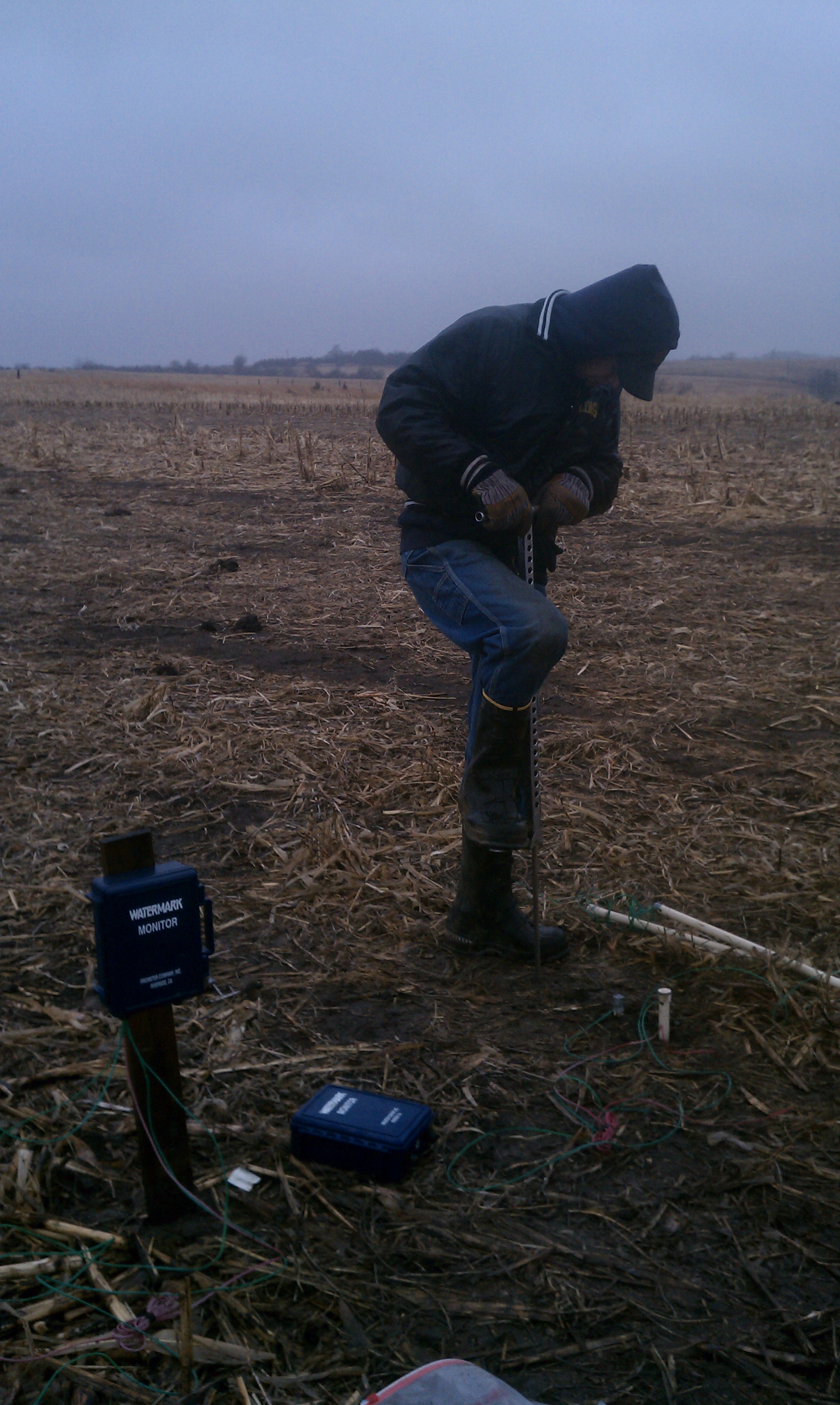 something. So I had been analyzing my crop water use data from my dryland corn, sorghum, soybean crop water use comparison study. It’s the one where we had coon problems this year and ended up trapping a skunk! I noticed how much the soil moisture profile had been depleted and knowing we’ve received minimal precip during fall and winter, I wondered what our soil moisture profile would be for dryland fields by planting. During a meeting yesterday I thought it would be good to install some watermark sensors to determine soil moisture profile recharge with the pending storm. Problem was I was at a meeting over 100 miles from my equipment and the pending storm was starting today. But I was still determined to get them in the ground as early as possible in order to measure the soil moisture status. So I woke up at 4:00 a.m. to heavy rain. Great! It was such a gorgeous day yesterday, and the past week…past month… The first thing my colleagues had asked me when I told them my idea was “Why didn’t you think of this sooner?” Answer: “Guess I needed a precipitation event!”
So I drive to the field in the rain, get the gear together and start installing the sensors. First foot went in easy with the rain that had soaked in. Then it seemed like I tried for 20 minutes (although probably not near that long) putting all my weight on the soil probe to get the 2nd foot in. Wind-driven rain soaked my jeans since I didn’t have rainpants on…fingers were numb from the cold. I  kept telling myself this will still hopefully be worth it! On the research data from this field, the second foot was driest of all the crops (was depleted well above plant available water). I got the third foot in and John, the man who farmed the field appeared.
While he thought it was crazy he graciously volunteered to help as he always does. He put in the rest of the sensors while I
hooked everything up.
The last several years we have been blessed to have a fully charged profile going into planting. Even with this rain/snow event, I’m not sure we will have that in dryland fields in this area of Nebraska. So I thought it would be interesting to know 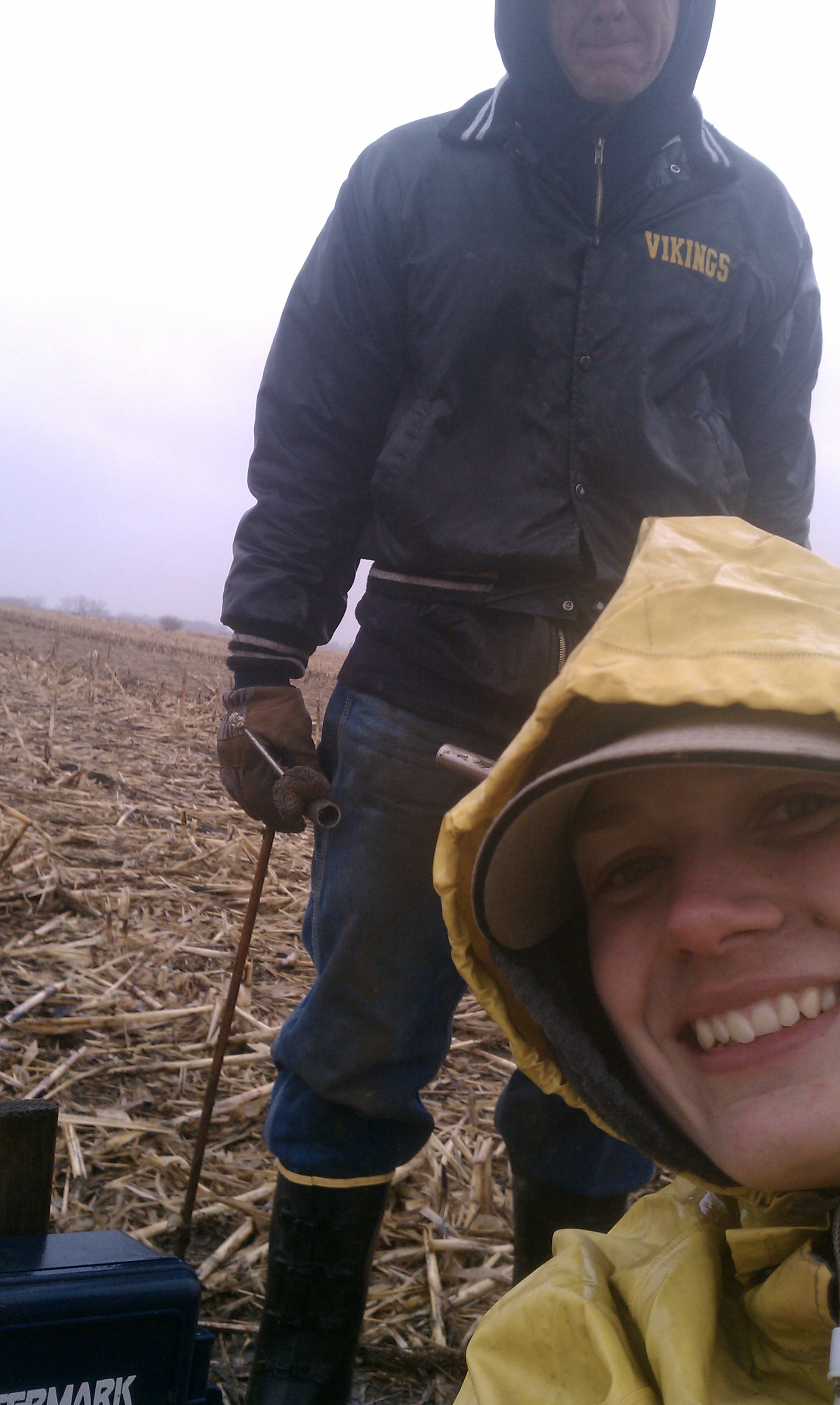 where we stood before planting and figured the farmers may want to know that as well. Perhaps a little crazy regarding installing the sensors on such a bad weather day but hoping the data in the end will benefit our farmers and be worth it!
Cash Rent Questions
Cash rent questions continue to be the primary question I receive and it’s been hard for me to keep sharing numbers based on the UNL or USDA surveys as I question how useful the surveys alone really are. I caught up with Al Vyhnalek, Extension Educator in Platte Co. during the crop production clinics. Al’s specialty is risk management. He shared the following with me which may be helpful to you as well. This isn’t research-based or based on surveys; it’s based on land productivity and yield potential. But it’s another potential tool to reach a starting point for cash rent considerations. The numbers discussed below assume the landlord owns the irrigation equipment.
“Farmers and landowners alike want to know what they should offer or charge for farmland next year. The question is simple, while the answer is more complicated. There is no formula or equation available that will definitively provide an objective value for farm or pasture land. The caller wants to know what the UNL or USDA survey of cash rental rates says to help them determine the correct starting point for discussing cash rent for the following year. While I am glad to provide that information and do provide that information, I am more uncomfortable than ever in providing that information. Why am I not feeling good about that? Because the price of cash rent for a piece of farm ground should be based on the productivity of the ground. It is important to think about the value being tied to yield potential.
One quick way to do the calculation of productivity is to take the last 5 year average corn and/ or soybean yields for the farm you are renting times the local elevator price for 2012. This calculation equals the estimated gross income per acre. Take that number multiplied by 25-30% for corn or 30-33% for soybeans with the lower percentages for dry land crops and the higher ones for irrigated acres. It gets you to a starting point for that cash rent negotiation. Many want to set rent based on the 2011 high price of about $7.00 per bushel, but that price has never been available for the 2012 crop. Using the 2012 fall elevator price is more realistic of what might happen next year. Using this information as a starting point and combining it with the information from the surveys will help with fair negotiations of the cash lease. The example percentages were determined by working through UNL budgets when determining cost/acre.
As an example – 200 bushel irrigated corn times $5 per bushel (2012 harvest price) is $1,000 gross per acre. 30% of 1000 is $300 per acre (corn acres). Soybeans: 60 bushel beans times $11 per bushel is $660 times 33% is $220 per acre – landlord’s share. If we have 1/2 acres beans and 1/2 acres corn then average the two rent numbers – or $260 per acre average for the farm. That is how I think we should arrive at a discussion point for cash rents in the upcoming year based on productivity.” For more information, please contact Allan Vyhnalek, 402-563-4901 or e-mail AVYHNALEK2@unl.edu.
Farm Research
Every winter, producers in our Greater Quad County on-farm research group meet to discuss the past year’s results and to 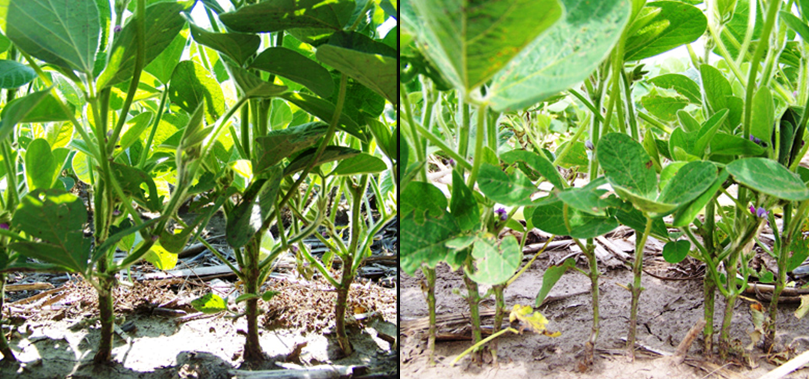 brainstorm which projects they wish to test the following year. Very popular studies from the past few years include soybean planting rates and planting dates and corn planting rate studies. These studies are randomized and replicated and conducted on full-length farmers’ fields.
Every year we share on-farm research results with our clientele. These results are often the highlight of many programs as the research is being conducted on your peers’ farms. Whether during pesticide trainings, crop production clinics, Extension news columns, Market Journal, or the Nebraska Farmer, these results have been presented and you as our clientele have preliminarily showed that you were interested in changing your farming practices as a result of what you learned.
Now, we’d like to see how many of you did change your practices as a result of this information. Please go to: http://www.surveymonkey.com/s/TPCJCGF and fill out a very short survey to let us know what you have changed in your farming operation. Your comments will help us in estimating the value of these on-farm research efforts to you and to our farmers who are faithfully conducting these studies. You can also find the direct link off the http://clay.unl.edu home page if you’d rather just click on it there. Please do take a few minutes to fill out this survey for us-it’s much appreciated!
Also, anyone interested in conducting on-farm research is welcome to attend our Greater Quad Co. results meeting on December 20 at 1:00 p.m. at the 4-H Building in York. We will also have some UNL researchers share results with the group. Please let me know if you plan to attend!
2011 Corn Yield Predictions
Harvest is nearly complete! In early August, I shared a post regarding in-season yield predictions from the Hybrid Maize model. At that time, I showed how 2011 predicted yields had been tracking with the 30 year long term average yields up until early August. At that point, the 2011 predicted yields took a steep drop due to high night time temperatures. High night time temperatures don’t allow for the corn plant to shut down at night. The plant engages in respiration, essentially burning sugars that should be converted into yield.
Some interesting things happened with the weather this year to make yields more favorable than what once was predicted. While silking to beginning dent occurred in 20 days or less in several Nebraska fields this year, the weather cooled off during the filling process. Some fields stayed at ¼ starch for nearly three weeks. Looking at fields, kernels continued to get deeper, heavier, and expand to help cover some of the pollination problems observed earlier in the year. During this time, yield predictions from the Hybrid Maize model showed that yields had the potential of returning close to the long-term median yields and it was interesting watching the trendlines move back up toward normal. This seemed to be truer for 113 day hybrids vs. 110 day hybrids.
For example, a 110 day hybrid planted April 15 at 32,000 seeds/acre showed a predicted yield of 227 bu/acre compared to 240 bu/acre long-term median. But a 113 day hybrid planted the same day showed a predicted yield of 244 bu/acre compared to a 248 bu/acre long term median yield.
So what happened in your fields? While yields have been decent, on average, I’m not seeing the trend towards the long-term median yields in our area in general. Dryland yields I think have been better than expected but irrigated yields potentially not as good as anticipated by many.  Hybrid Maize predicts yields based on perfect conditions-nothing limiting and no pest/disease issues. In many fields, corn was planted then sat in cool, wet soils. We had stand losses due to Pythium in some fields or due to loose residue that was piled in areas of fields after heavy rains. We also had varying degrees of pollination problems and the high night temperature stresses which reduced yields. Regardless, yields are still very good in spite of another interesting growing season! Please share what you’ve been seeing for yields in your fields!
Table 1: Hybrid Maize 2011 Predictions from Simulations (through Oct. 30, 2011)
Date RM Population Long-Term Median Yield 2011 Predicted Yield
Apr. 15 110dy 32,000 240 bu/acre 227 bu/acre
Apr. 15 113 dy 32,000 248 bu/acre 244 bu/acre
May 1 110dy 32,000 241 bu/acre 234 bu/acre
May 1 113dy 32,000 260 bu/acre 245 bu/acre
May 10 110dy 32,000 244 bu/acre 235 bu/acre
May 10 113dy 32,000 258 bu/acre 258 bu/acre
Last Irrigation Scheduling
With corn in various stages of dent and starch fill, you may be wondering how to schedule for last irrigation. For those of you in our Nebraska Ag Water Management Network using watermark sensors, the goal is to use them to determine when the soil profile reaches 60% depletion (for silty-clay soils in our area aim for an average of 160 kpa of all your sensors). You may be thinking, “An average of 90kpa was hard enough!” but as Daryl Andersen from the Little Blue Natural Resources District points out, you’re only taking an additional 0.30 inches out of each foot. So if you’re averaging 90kpa on your three sensors, you have depleted 2.34 inches in the top three feet so you still have 0.96 inches left (see the Soil Moisture Depletion Chart). If you add the fourth foot (using a similar number from the third foot), it would bring the water available to the plant up to 1.28”.
At beginning dent corn you need 24 days or 5 inches of water to finish the crop to maturity. If you subtract 1.28 from 5 you will need 3.72” to finish out the crop. Corn at ½ milk line needs 13 days or 2.25” to finish the crop to maturity-so subtracting it from 1.28 would be only 0.97”. Taking into account the good potential for rainfall and what moisture is in the profile, you should be done irrigating corn. Soybeans at the beginning of seed enlargement (R5) need 6.5”. Most soybean fields that I’ve looked at are in R6 or full seed which needs 3.5 inches yet for maturity. Subtracting off the 1.28” in the four foot profile would lead to 2.22”. If we don’t get a few more rains then beans may need one more round. The UNL NebGuide Predicting the Last Irrigation of the Season provides good information on how determine your last irrigation in addition to showing charts on how much water the crop still needs at various growth stages.
Daryl Andersen explains how to use this information in a simplified way. One way to look at this is by the numbers of days left. At 1/4 starch, there are about 19 days before maturity so you can let your sensors average 130kpa on the first week and 150kpa on the next week. If these targets are met during the week, you would put on about 1 inch of water. By going to these numbers, it might give you a higher probability for rain in the next couple of weeks. ET rates this summer have been running less than 0.25” per day for the most part, so with the humidity we’ve had, the crops have not been using much water, which has really helped our dryland corn again in areas where we aren’t receiving rain events.
Soybean Management Field Days
Every year I look forward to attending the Soybean Management Field Days! I enjoy hearing the latest research-based information and seeing so many of our clientele who attend. We have an excellent opportunity for the Soybean Management Field Days to be held at South Central Ag Lab near Clay Center on August 16th! I would encourage you to register and to go! If you’ve been to the field days before, changes have been made so that all the demo plots are now research plots-so all the trials will be harvested, data collected, and shared in future meetings and field days. The theme this year is “Growing Nebraska’s Future” and the event will focus on staying competitive in a global marketplace, increasing profits and meeting the world’s growing food and energy needs starting in Nebraska.
Topics include: nutrient management and high yield alternatives; pest management and yield enhancement products; weed management; and marketing and risk management. In addition, UNL Extension’s BIT Mobile will be on hand for participants to visit and learn how to optimize irrigation efficiency and energy use with the SoyWater program. If you have unknown crop problems, please bring along your samples for agronomists and plant disease and insect specialists to look at for no charge.
The field days are sponsored by the Nebraska Soybean Board in partnership with UNL Extension in the University’s Institute of Agriculture and Natural Resources and are funded through checkoff dollars. The efforts of the checkoff are directed by the United Soybean Board promoting effective, efficient, farmer-driven programs. The field days begin with 9 a.m. registration and conclude at 2:30 p.m. Free registration is available the day of the event; it would be helpful to RSVP for meal count to 800-529-8030 or you can let me know by replying to this blog or emailing me at jrees2@unl.edu. More information can be found at http://ardc.unl.edu/soydays. I hope to post the pod cast of this event shortly, but am still working on how to do this!
CropUpdate 7-18-11
While it may be strange, I love the smell of corn pollinating and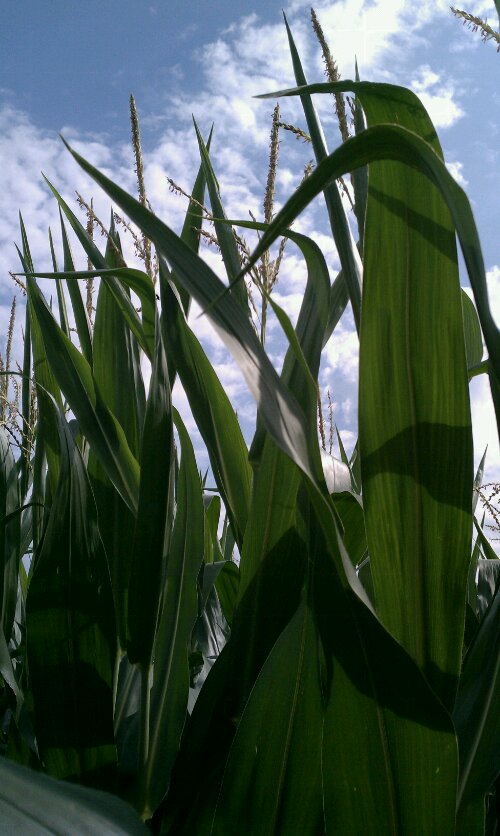 don’t mind walking fields this time of year! Summer is flying by but it seems like it’s taken a long time to get to tasseling in our fields this year. Now that corn is tasseling, we can take into account the third foot root zone for irrigation scheduling. There still is moisture to consider in the third foot so continue to check your readings on your irrigation scheduling tools and now take averages for all three feet. You may be surprised as some of you won’t need to water till end of July/beginning of August! If you have any questions about your irrigation scheduling tools, please continue to call any of us Extension educators or the NRD personnel as we want to help you and work with you now to answer them.
Disease just isn’t an issue so far in fields, so for those of you who purchased fungicide, wait till disease is present when you may need it. UNL research by Dr. Tamra Jackson has proven yields are just as good with delayed fungicide applications as they are at tassel. The longer you wait to use it for gray leaf spot, the more chances you will have residual for southern rust when it comes in. While corn prices are high, you want to keep as much of that money as you can! I don’t recommend fungicides on soybeans as we don’t have the disease to warrant it. If you did pre-pay fungicide for soybeans as well, the timing of that application should be R3 (beginning pod).
Soybeans are approaching beginning pod for many of you. For soybeans, this is a critical time for moisture in addition to seed fill at R5. Many irrigation systems were running on beans last week and I just cringed because the time we don’t want to water soybeans is full flower or (R2). The reason for that is because it can create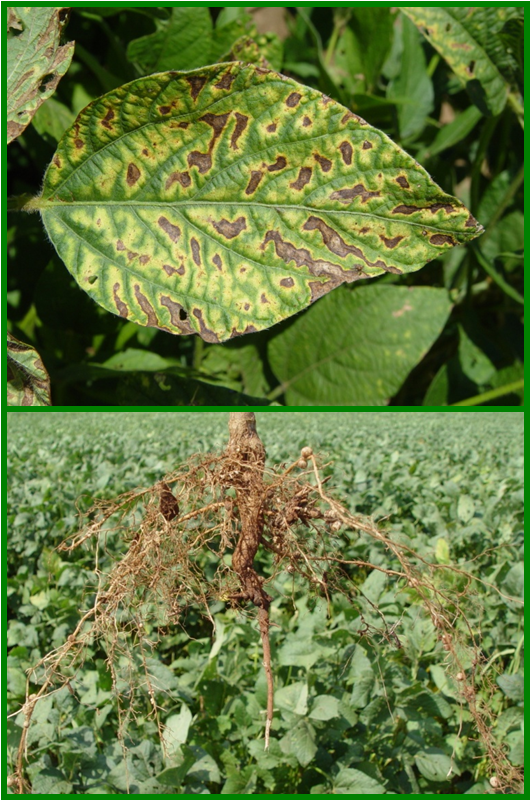 disease issues. We’ve seen a large increase of sudden death syndrome (SDS) the past few years in our county. Part of that is due to early planting in cold soils, but irrigation during flowering can also play a role. The major disease that occurs when irrigating during flowering is sclerotinia stem rot (also known as white mold). While we have very few cases of this in the area, this disease is one that you don’t want to get started in your fields. Like the fungal pathogen causing SDS, the fungal pathogen causing white mold is soil borne. Thus, once you have it, you can never get rid of it. White mold gets started during R2 when flower petals begin to die and the fungus develops on those dead petals. Wet, humid conditions during flowering are key to fungal development, so in the future, avoid irrigating beans during the flowering stages to avoid problems with these two diseases.
Wheat Ergot Update
Numerous calls have come in on the wheat ergot situation. It must have been the perfect environmental conditions for this to happen this year in such a wide area and I need to take some time to figure out why this year during conditions that also favored scab and not a few years ago with similar environmental conditions.
Two main questions have been raised: “Can I save back seed” and “can I bale and graze straw?”. I don’t recommend that you save back seed, yet many seed fields in the area most likely were affected as well. Seed can be sifted on a gravity table to help clean it so that is an option-but most farmers don’t have means for doing this so ultimately I wouldn’t recommend our farmers to save back seed.
In regards to baling straw and grazing, while walking harvested fields, I was noticing some ergot in heads that were too short to go through the combine heads. Ultimately, the few kernels in a large amount of straw would be so dilute, I wouldn’t expect there to be problems with grazing the straw. If you’re concerned about using wheat straw for feeding or bedding, you can always dilute it with alfalfa or another feed to reduce chances of ergotism in livestock even further. I should point out that I’m talking about wheat straw in which the wheat grain has been harvested. I would not recommend feeding wheat straw that was just cut with the ergot contaminated and wheat grain in tact. If you plan to feed straw in that situation, I’d recommend sending samples to a Vet Diagnostic Center for alkaloid testing.
A third question I’ll throw in here is should you plant 2nd year wheat if that is your rotation. While it is not assumed that ergot will happen every year and while the chances of ergot happening a second year are not great, it’s best management practices to go ahead and rotate to be on the safe side as any sclerotia (black fungal ergot fruiting bodies) would be lying on the soil surface and can produce spores that could affect the next wheat crop. Again, this isn’t guaranteed to be a problem again next year (unlike things such as tan spot or septoria that are likely to show up in wheat on wheat fields), but to be on the safe side, I would recommend rotating. Dr. Stephen Wegulo also wrote an article on ergot in wheat at the following site.

CropUpdate: 7-5-11
Last week was a blur of phone calls but it’s great to receive them and know so many of you are doing your best to wait for your soil to be depleted before scheduling your first irrigation! There are some of you in the Little Blue NRD who haven’t received the rains the past few weeks and have hit the 90-100 trigger on your watermark sensors to schedule your first irrigation. Most of you reading this won’t have to irrigate till after tassel (and then you can take into account the 3rd foot in your average)! The 90-100 trigger relates to 35-40% soil moisture depletion and is proven by research via Dr. Suat Irmak at South Central Ag Lab for our silty clay soils. Waiting for the trigger, regardless if you’re on load control or not, will still allow you at least a week to 10 days before you have to worry about getting behind. Please continue to call with questions. There’s also a discussion topic on my blog for your comments/questions.
Corn and beans are looking good overall, are closing canopies, and corn is rapidly growing. Wheat is being combined in the southern tier of counties and there has been quite a range of yields due to the dry weather producing small heads and disease issues such as scab, smut, and ergot. Scab (Fusarium Head Blight) is a concern when we receive rain and high humidity during and around flowering. We were recommending fungicides at that time. Some people escaped it, some put the fungicide on, and others didn’t-so there’s a range of yields out there from that. Common bunt (stinking smut) is the smut that creates clouds of black spores when you’re combining and the grain smells like fish. Loose smut is loose in the head and doesn’t form a kernel shape like common bunt does. Both can be prevented by not saving contaminated seed and using fungicide seed treatments at planting.
Ergot is one I hadn’t seen in wheat since I’ve been here but have in roadside grasses. Ergot is caused by a fungus that infects the wheat head during cool, wet conditions during flowering. Like the fungus that causes scab, it simply replaces the normal pollination process and instead, a black/purple hard fruiting body (sclerotia) is eventually formed. Before this is formed, a sugary drop called honeydew is formed which then turns into the sclerotia. It’s a problem for our producers because I don’t know that you can set your fans to blow it out like you can for light, scabby kernels since ergot sclerotia are denser. The problem with ergot is that it contains toxic alkaloids (one is like LSD)…in fact, it’s blamed that ergot-contaminated grain is what caused the Salem Witch Trials. These alkaloids are also toxic to livestock so contaminated grain should not be fed or even blended off for livestock. Federal grain standards classify wheat as ergot infested when it contains more than 0.3% sclerotia. If you are finding ergot-contaminated grain in your fields, do not save seed back next year; start over with disease free certified seed. The sclerotia will live on top of the soil for a year (they will produce spores next growing season so don’t plant contaminated wheat fields back into wheat, barley, oats, or triticale). Mowing roadside ditches and keeping wheat fields free of other grasses can help prevent ergot infested grasses from spreading the ergot fungus to wheat via blowing spores and rain splash. More information can be found by checking out the UNL Extension publications Head, Grain, and Seed quality on the http://cropwatch.unl.edu/web/wheat/disease Web site.
White Heads in Wheat
The last week I have received questions about white heads in wheat. An excellent resource from UNL to determine various wheat head disorders can be found here. If the heads are completely bright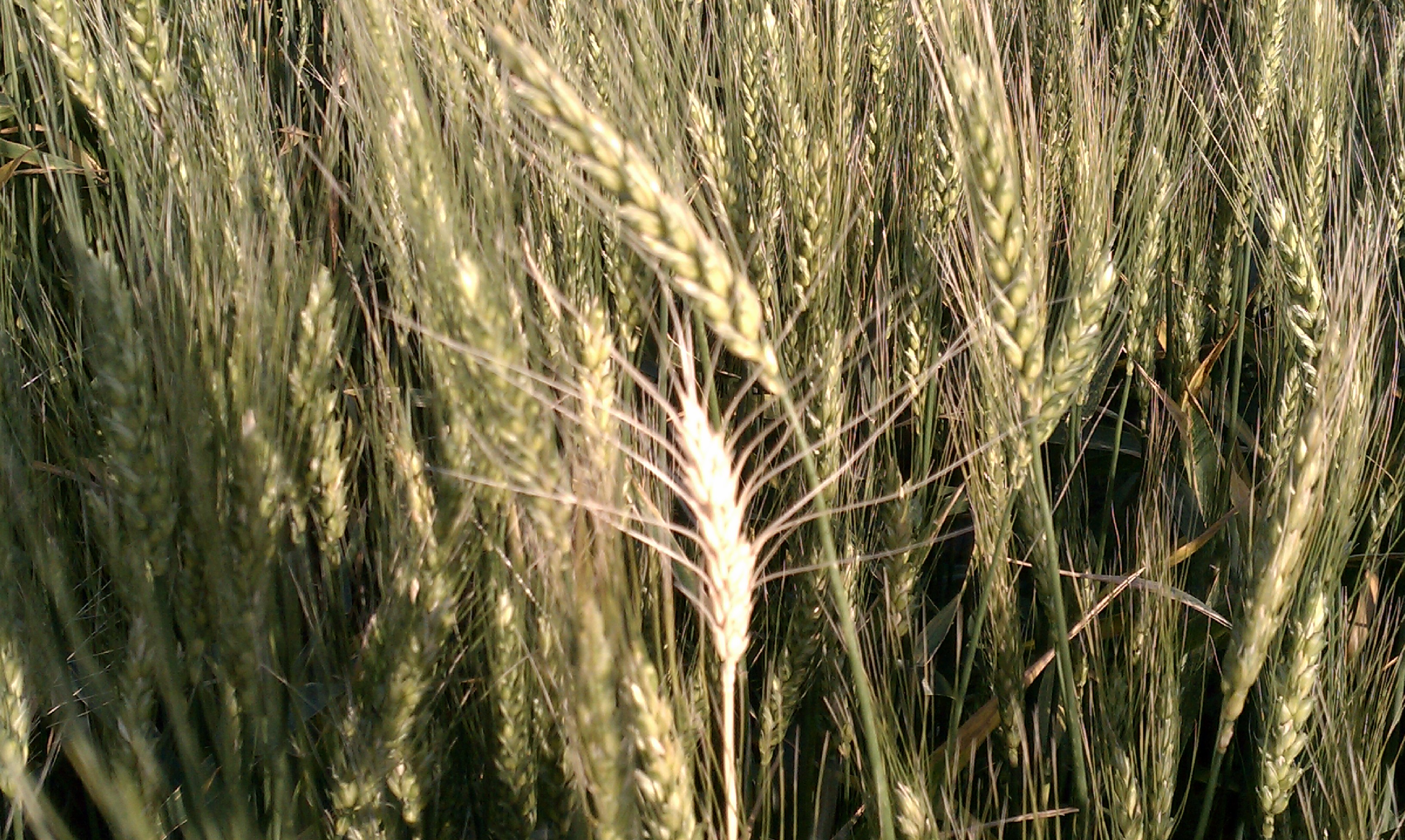 white and you can easily pull those heads out of the stem, the culprit is the wheat stem maggot. This insect will sever the stem above the top node so that the stem upward to the head are white while the rest of the plant remains green. I usually only see a few of these types of heads scattered around in fields and there’s no recommendations for managing it
 because damage isn’t considered economical.
If your heads have white or pink colored kernels in them in addition to regular looking kernels, chances are the discolored kernels have Fusarium Head Blight also known as head scab. The kernels eventually may have a brown discoloration to them and the stem just below the head may also turn a brown-purple color. The Fusarium fungus that causes head scab is the same that causes stalk rot in corn. Wheat on corn rotations in no-till systems have a greater potential of scab in wheat, but these situations don’t mean that scab will always occur. Ultimately, rainy, humid conditions for a 2 week period around flowering is the primary factor for allowing scab to occur.
If you are finding scab in your fields, there’s nothing to spray or do now. Set your combine to blow out the lighter, shrunken, scabby kernels to help avoid dockage at the elevator. I would also recommend to avoid saving back scab-infested seed. Plan to purchase certified seed instead for next year and be sure to have a fungicide seed treatment applied to it to avoid problems with smut.


 JenResources