
Blog Archives
March 2026 Events
Ag Recognition Banquet: Kiwanis Club of Seward invites you to Celebrate Agriculture by attending the 58th Annual Ag Recognition Banquet! It will be held on Monday, March 23 at the Seward County Fairgrounds Ag Pavilion. 5:30 p.m. is the social with prime rib meal at 6:30 p.m. and program/awards at 7 p.m. Being recognized this year for Outstanding Farm Family is Havlat Farms and recognized for the Agribusiness Award is Baack Ag Services. Past award winners who wish to attend should contact Nick Bauer at 402-429-6119 or nick.bauer@fcsamerica.com. Tickets can be purchased and table sponsors can request tables at the following website: https://sewardkiwanis.org/events/ag-recognition-banquet.
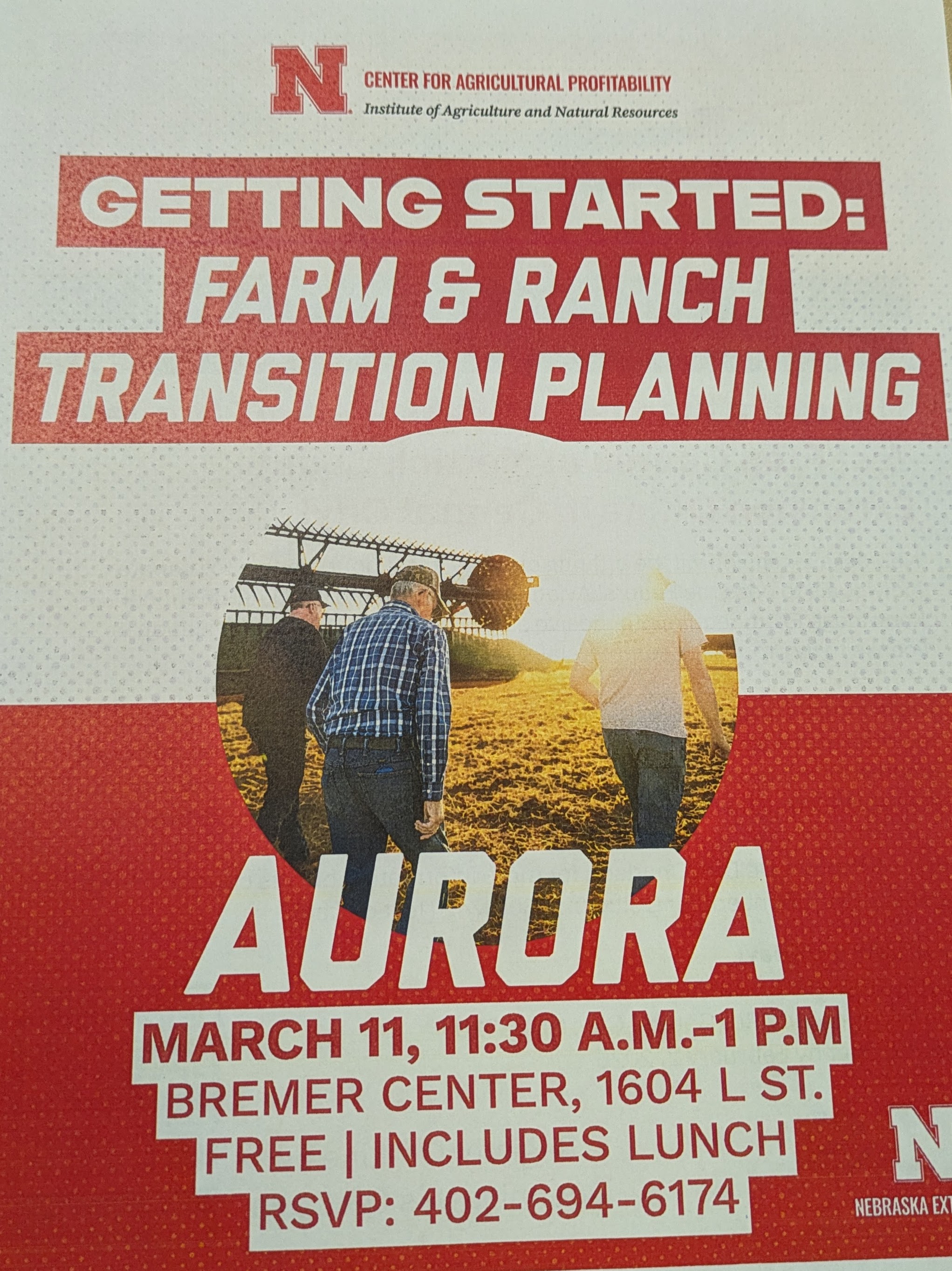
Getting Started Farm & Ranch Transition Planning will be held on March 11th from 11:30 a.m.-1 p.m. at the Bremer Center in Aurora. There is no charge and includes a free lunch. RSVP is request to 402-694-6174. Transition and estate planning is one of the most important topics we face in agriculture!
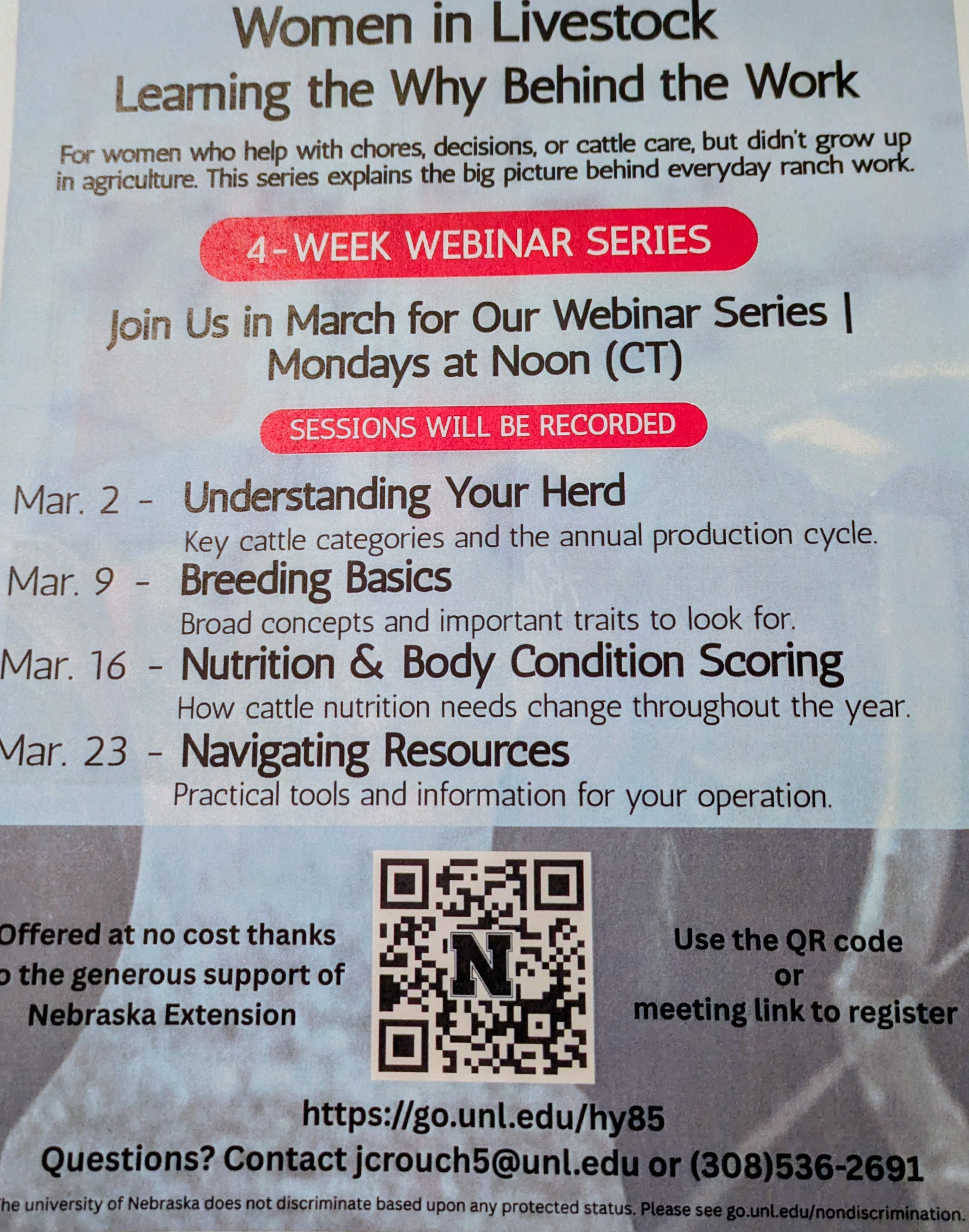
“Learning the Why Behind the Work” are webinars held each Monday in March at noon CST. The webinars are geared for women who help with chores, decisions, or cattle care but didn’t grow up in agriculture. All are welcome though. Each webinar has been recorded in case you missed one. For remaining webinars: March 9 is on breeding basics; Mar. 16 is on nutrition and body condition scoring; and Mar. 23 is on navigating resources. There is no cost but please go to https://go.unl.edu/hy85 to register and receive the zoom links.
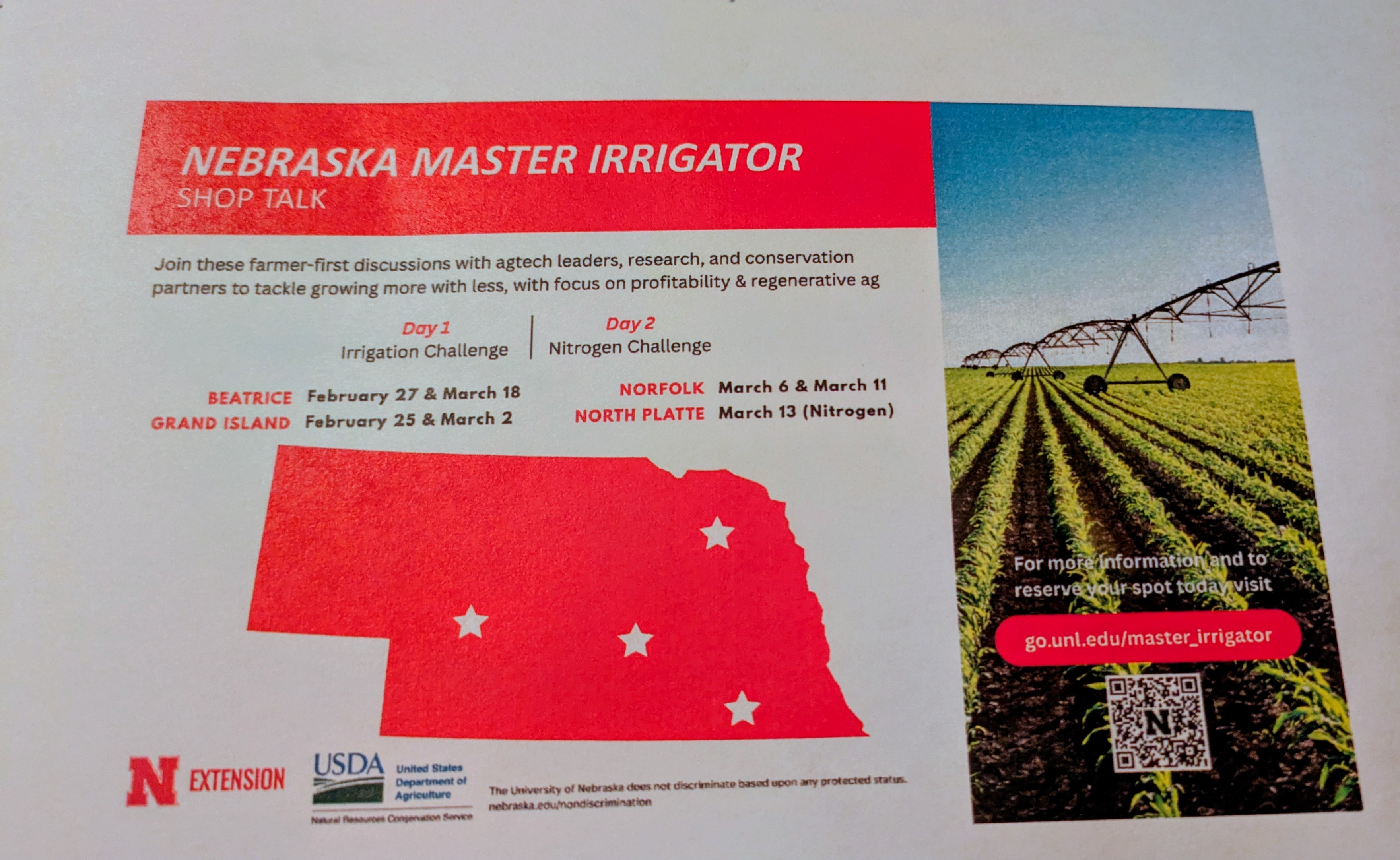
Master Irrigator Nitrogen discussions will be held at a variety of locations this month including March 11th in Norfolk, March 13th in North Platte, and March 18th in Beatrice. More info. at: https://go.unl.edu/master_irrigator.
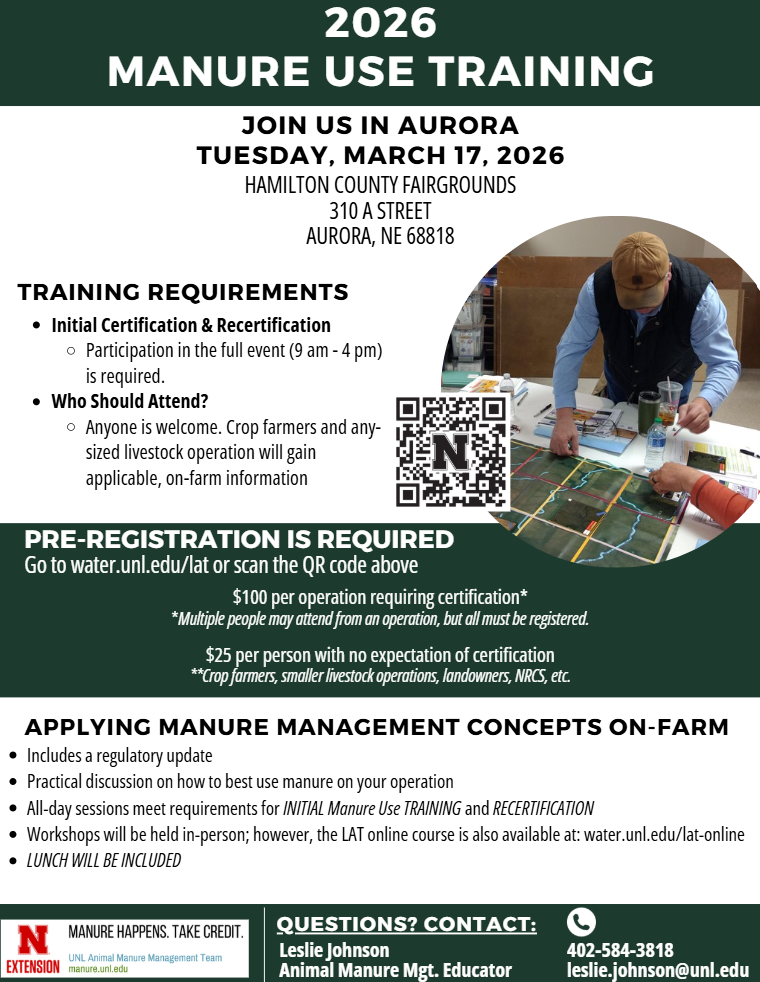
Manure Management on Crop Ground in Aurora March 17th: Turning manure nutrients into improved crop yields while protecting water and soil quality will be the focus. The day-long sessions, held from 9 a.m. to 4 p.m. local time, provide DWEE Land Application Training certification. Participants must attend the full program, which includes lunch, to earn certification. Sessions will cover regulatory updates and strategies for using manure effectively on cropland. While certification is available, anyone may attend, including crop farmers and smaller livestock operators seeking practical guidance for their operations.
Hands-on activities will help participants evaluate which fields are best suited for manure application. Each session will present a scenario in which attendees assess potential fields and determine whether manure use would be beneficial or if certain limitations make the site less desirable. Participants will then rank fields by priority based on factors such as nutrient value, transportation cost, soil health, water quality, neighbor proximity, and odor concerns. Regulations and record-keeping requirements for manure storage and application will also be covered. Registration is available at https://water.unl.edu/lat. The cost is $100 per operation requiring certification—typically larger livestock facilities—or $25 per person for attendees not seeking certification, including smaller livestock producers, crop farmers, NRCS staff, and landlords.
JenREES 11-18-18 Farm Transition

Wishing everyone a blessed Thanksgiving with family and friends! We have much for which to be thankful!
Last week we held a farm transition meeting in York. I was thinking back to a family gathering we had shortly after one of my dad’s farm accidents. We were grateful he was going to be ok. In talking about what needed to be done on the farm, I asked something like, “Does anyone here know what your wishes or plan is for the farm if this had been more serious?” It wasn’t the best time and I didn’t do this correctly. It did allow for discussion as we never talked about what would happen to the farm before that. I’m grateful my parents responded over time asking each of us kids our intentions/values regarding the farm. They then put their estate plan together and at Christmas one year, went through everything with everyone including any spouses that were present. What I appreciate the most is that they were intentional and there is no secret.
The fact that estate plans can be secret was a common frustration among attendees at the workshop…and as I talk with various farmers. Dave Goeller, emeritus Farm Transition Specialist, shared a sad story about a man in his late 60’s whose 90+ year old dad still hadn’t transitioned management of the ranch to him. When he asked his dad about the opportunity to manage the ranch in the future, the dad didn’t wish to talk and said not to worry. I won’t go into the details but when the parents passed away, the ranch was sold. What’s sad is that, most likely, the outcome is not what the parents intended, and certainly not what the son hoped. We need to get away from estate plans being a secret.
Consider these questions:
- Have you been able to talk to your parents about what is happening with their estate plans? If not, why?
- What is your biggest concern/anxiety/fear(s)? What are you afraid you might find out?
- What is the biggest obstacle in your family dynamics?
- What do you love about your family business?
- What is the worst situation you can think of which might happen in the future?
- What could you learn that can help you?
- What is your mission statement for your farm/ranch? What is your vision for the farm/ranch?
- What are your goals for your farm/ranch? What will you do to make your vision happen?
Dave shared that while a person may feel like a ‘vulture’ when asking about the estate plan (as asking can come across as greed), it can really be a question over shared values. As I think about my immediate family, our shared values are faith, family, hard work, sacrifice, maintaining our family farm. I should’ve broached the subject using shared values instead:
“Dad, I’m so grateful God protected you and you’re going to be ok! You and mom have worked so hard and sacrificed so much for us kids and for this farm. We as your children wish to see your legacy live on in keeping the farm in our family. May we please discuss what your and mom’s goals and dreams are for the farm in the future?”
For those who have asked me how to have this conversation, perhaps some of these questions found in the Workbook at http://go.unl.edu/FarmRanchTransition may help? I also have copies of this workbook in the Extension Office. The questions cover a range of topics from understanding common values, asking if there are written documents, what is long term health care plan to protect the farm/ranch, contribution of all heirs, etc. Please also consider the Nebraska Farm Hotline at 800-464-0258 as a valuable and free resource for you! This hotline is a confidential resource for talking about stress, anxiety, financial concerns, and also for scheduling a time to meet with Dave Goeller and Joe Hawbaker (Attorney) for free to discuss estate plans and farm transitions. All you need to do is call 800-464-0258. For those interested in meeting regarding estate plans/farm transition, Dave and Joe have promised to come back to York to meet individually with families once they receive at least 5 calls. So, if this is of interest to you, please mention this when you call the hotline.
Final thought, this past year in particular, several farmers have shared with me their children would like to see them retire. I sense a variety of feelings about that from them as I listened. I also asked several questions including, “What does retirement look like to them? What does it look like to you?” Perhaps those and other questions could be asked in an honest conversation together?
Much of our identity, right or wrong, is found in what we do for a living. After all, we tend to ask this question when we meet new people. Through life’s circumstances, I’ve had to learn to seek my identity in who I am. Dave mentioned to think of retirement not as no longer working on the farm or being an important player, but retiring the management to the next generation. So, perhaps work out a transition plan that fits your situation where the first perhaps 3-10 years, the older generation is the primary manager in a mentor role explaining why he/she made the decisions a certain way to the next generation. The next 3-10 years, decision making is shared between the older and next generation. After that, decision making is transitioned to the next generation. And, during this entire process, the older generation needs to consider what he/she will be “retiring to”…what purpose or meaning can be found to occupy the time that was once spent in managing the farm?
Ultimately, estate planning and farm transition…relationships…are too important to not talk about these topics. Let’s no longer keep them a big secret!


 JenResources