Blog Archives
Farm Bill 2025
Farm Bill: Have received a number of calls the past few weeks on the farm bill election decisions. Normally I write this column in February, but the deadline this year is April 15, 2025 to make a determination on farm bill programs.
The greatest change for this year is the increase in the effective reference price again for all crops, which may impact on how decisions play out.
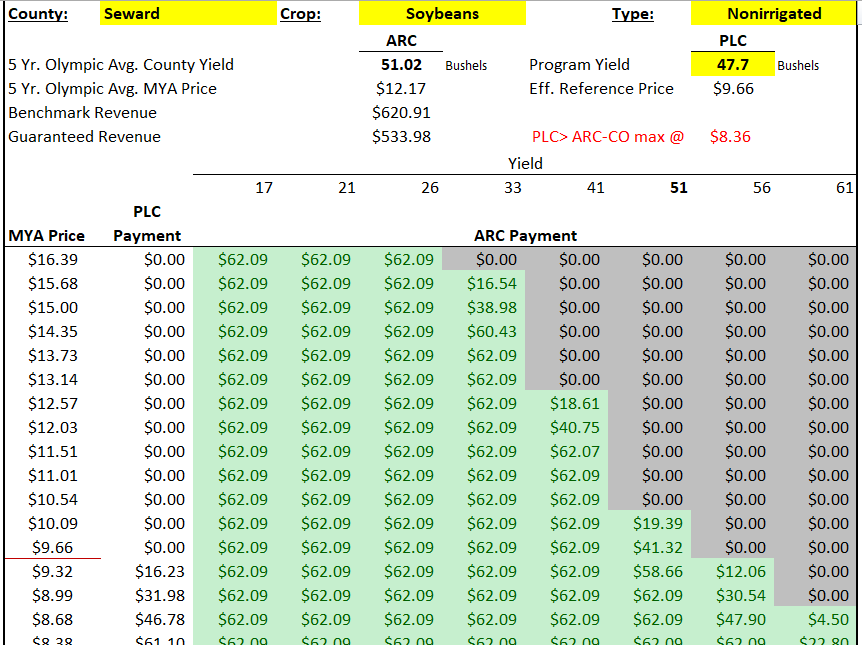
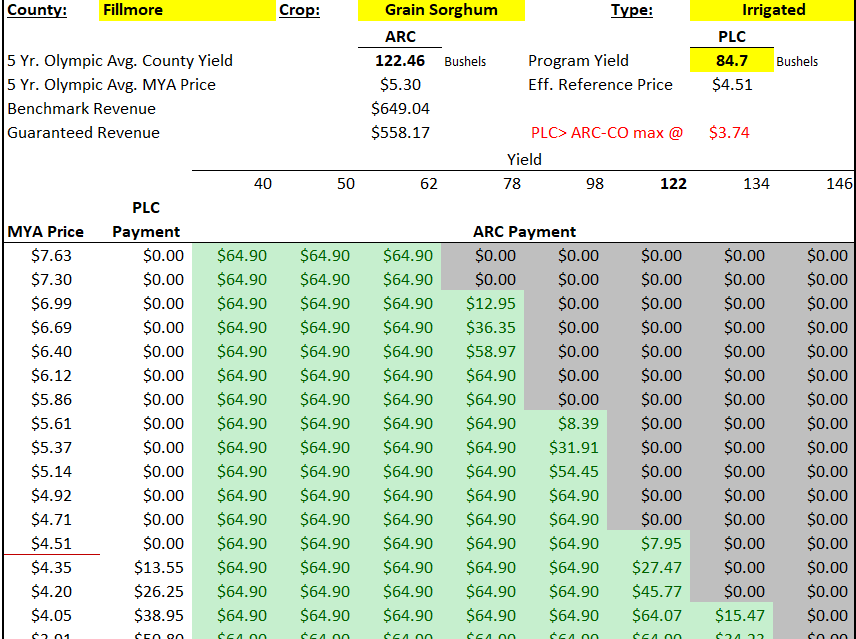
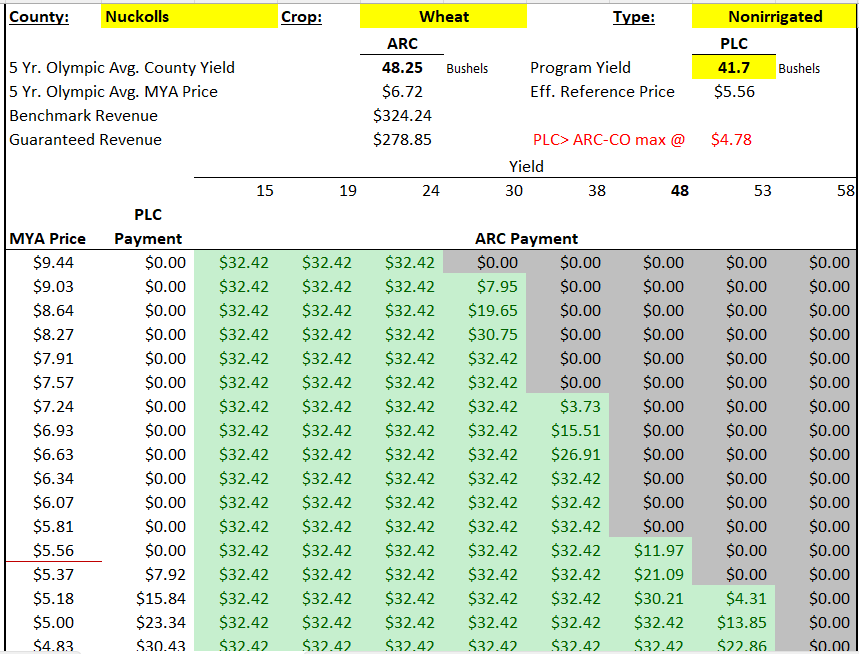
The following are PLC reference prices for commonly grown commodity crops in the area: Corn $4.26; Grain Sorghum: $4.51; Soybeans $9.66; Wheat $5.56.
The following are ARC-Co Effective Prices at Benchmark Yields for grown commodity crops in the area: Corn $4.32; Grain Sorghum $4.56; Soybeans $10.46; What $5.78.

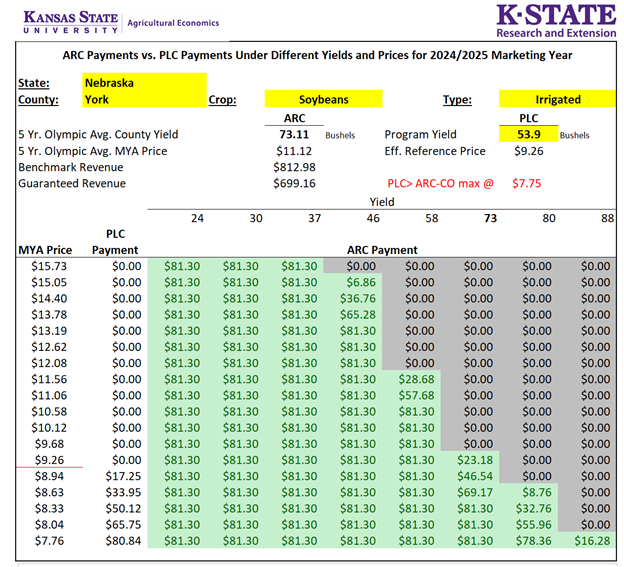
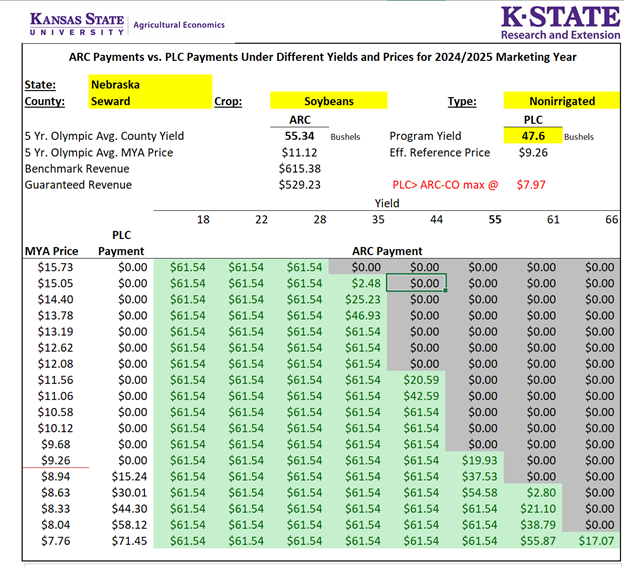
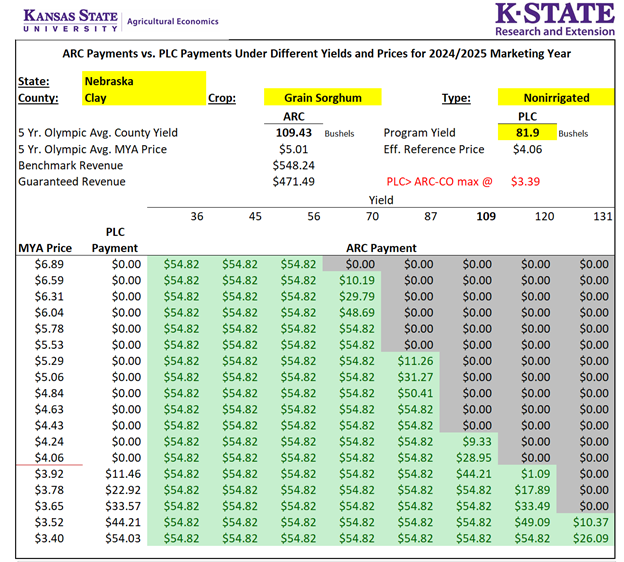
For those who are more visual like me, the easiest way for me to look at these decisions is via the K-State Ag Manager Spreadsheet tool found at: https://www.agmanager.info/ag-policy/2018-farm-bill/tradeoff-between-20252026-arc-and-plc. I added some photos of these decisions at jenreesources.com.
Please look at this for yourself for your specific state and county. When I look at it, because of the higher ARC-Co effective prices compared to PLC for all crops, ARC-Co is triggering before PLC, regardless of irrigation or not, for the counties in this area of the State. And, the payments increase rapidly hitting the cap with any potential for lower prices and/or county average yields. ARC-Co also triggers sooner if prices don’t tank but in the event of lower county-average yields due to drought, hail, etc.
So, this year, beyond considering crop insurance, the decision appears somewhat clearer in spite of not knowing for sure what will happen with market year average prices. Again, I would still recommend you try running the spreadsheet for yourself.
If you are concerned about spreading risk with your farm bill decision and you’re concerned about prices tanking, you could put your highest proven PLC yielding fields for different crops into PLC and the rest into ARC-Co. This is also a consideration if you’re concerned about hitting payment caps with ARC-Co.
As you make crop insurance decisions, the following webinar may be of help if you’re considering Supplemental Coverage Option (SCO) or Enhanced Coverage Option (ECO). SCO can only be used with PLC elections. https://www.agmanager.info/ag-policy/2018-farm-bill/making-farm-program-and-crop-insurance-decisions-2025-webinar-slides-and.

2024 Farm Bill Decisions
Perhaps this year’s farm bill election decision takes more thought than in the past. Part of this is because the reference price for PLC (Price Loss Coverage) and ARC-CO (Agriculture Risk Coverage) finally increased (due to a couple of higher marketing year average prices with only the highest year being thrown out for the Olympic average). Thus, the trigger potential increases. Most of the decisions could really go either way depending on what happens and how you wish to manage risk. ARC-CO will often trigger faster with a higher price and lower yields, but the maximum payment caps out faster. PLC, when triggered, provides greater payments faster. There’s also the potential of using Supplemental Coverage Option (SCO) via crop insurance with PLC, which was very attractive for some producers in non-irrigated situations hit by drought last year. It could be worth your time to read this article from K-State on SCO and ECO (Enhanced Coverage Option): https://agmanager.info/crop-insurance/crop-insurance-papers-and-information/supplemental-coverage-option-sco-and-enhanced if you’re not familiar with these options. Sign up deadline with FSA for farm bill decisions and with Crop insurance for those decisions are both March 15.
PLC effective reference prices for 2024 are:
Corn: $4.01; Beans: $9.26; Wheat: $5.50 (stayed the same); Grain Sorghum: $4.06
ARC-CO effective references prices for 2024 are:
Corn: $4.17; Beans: $9.56; Wheat: $5.34; Grain Sorghum: $4.31
Projected Prices for 2024 based on projections from FAPRI as of August 2023:
Corn: $4.47; Beans: $10.94; Wheat: $6.38; Grain Sorghum: $4.31
So, at first glance, comparing the prices for each commodity, ARC-CO triggers first for all crops except for wheat when county average yields are maintained. In fact, for those with milo base acres, ARC-CO would already trigger with current projected price and the ARC-CO effective reference price of $4.31.
If you want to protect yield variation, ARC provides protection sooner than PLC. If you want protection for lower prices, PLC provides larger payments once it triggers.
It also depends on crop insurance. For example, if you choose 75% revenue protection and want to add SCO on top up to 86%, then you need to take PLC as SCO is not available with ARC.
Another thought that I’ve often brought up, although it’s not feasible for everyone, is to consider splitting your risk. Corn, to me, is the harder decision here that could go either way. If you have a field or two with higher PLC proven yields, then perhaps consider a few farms in PLC and a few others in ARC-CO to split your risk and provide some protection to you whether either program triggers. It also helps split risk regarding payment caps should they be hit. Some helpful resources are included below:
K-State Ag Manager Excel Spreadsheet Tool (download and run for your specific county/crop info.): https://agmanager.info/ag-policy/2018-farm-bill/tradeoff-between-20242025-arc-and-plc
Understanding PLC, ARC, SCO, ECO for 2024 (videos and ppt presentations): https://agmanager.info/news/recent-videos/managing-risk-arc-plc-and-sco-webinar-slides-and-recording
2023 ARC-Co Payments Nationally (shows 2023 payments): https://agmanager.info/ag-policy/2023-county-yields-trigger-arc-co-payments/2023-county-yields-trigger-arc-co-payments-0
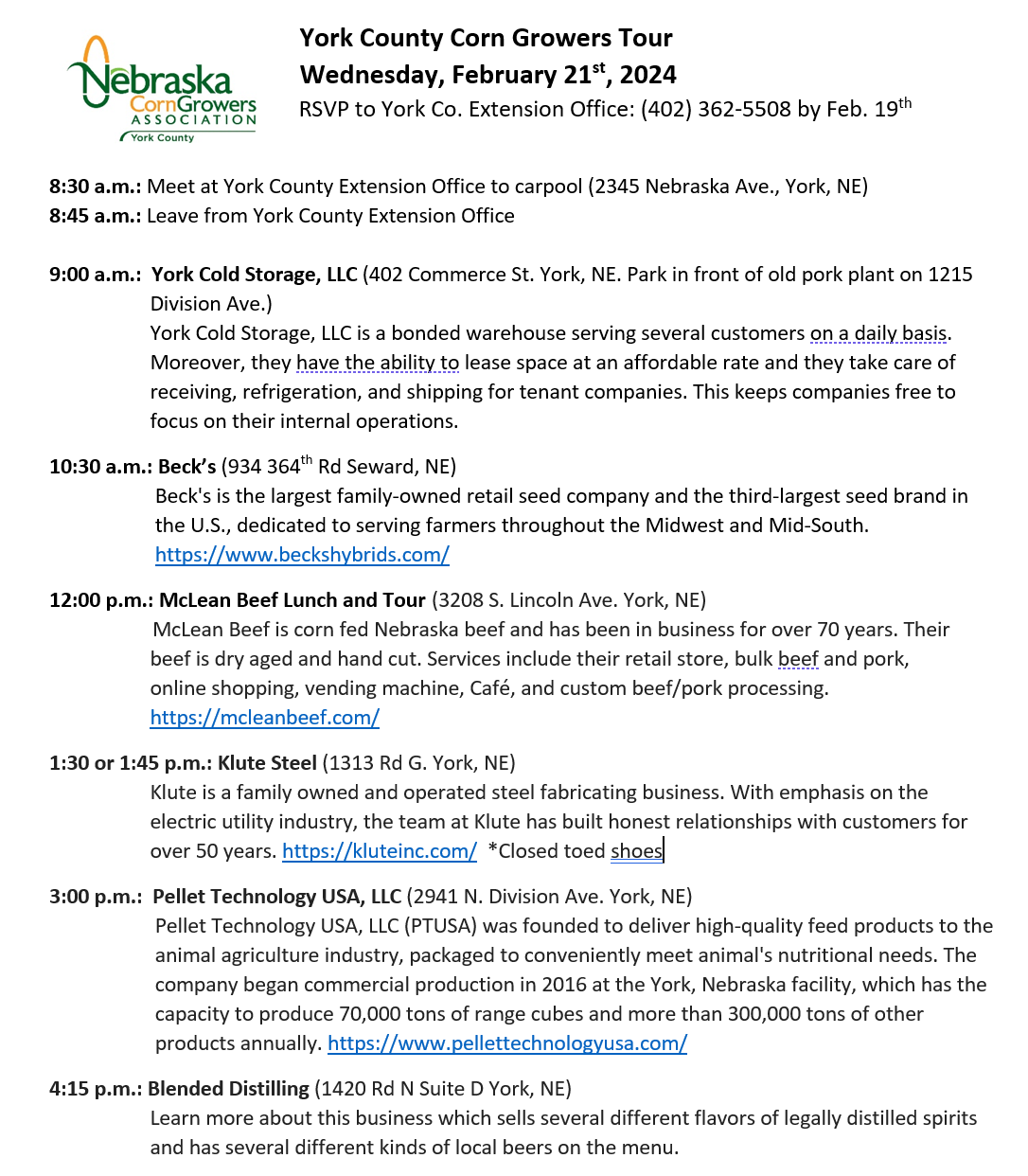
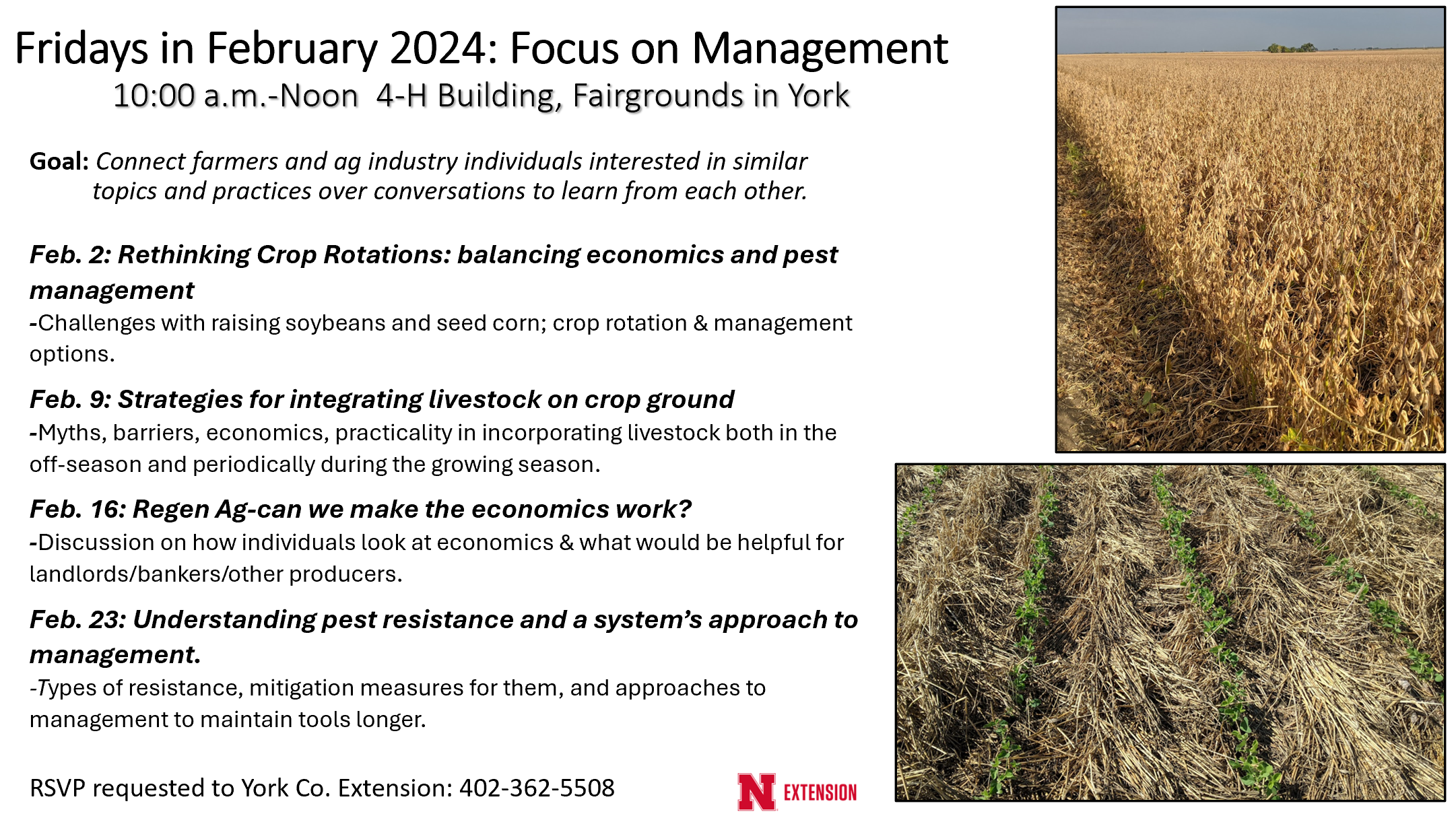
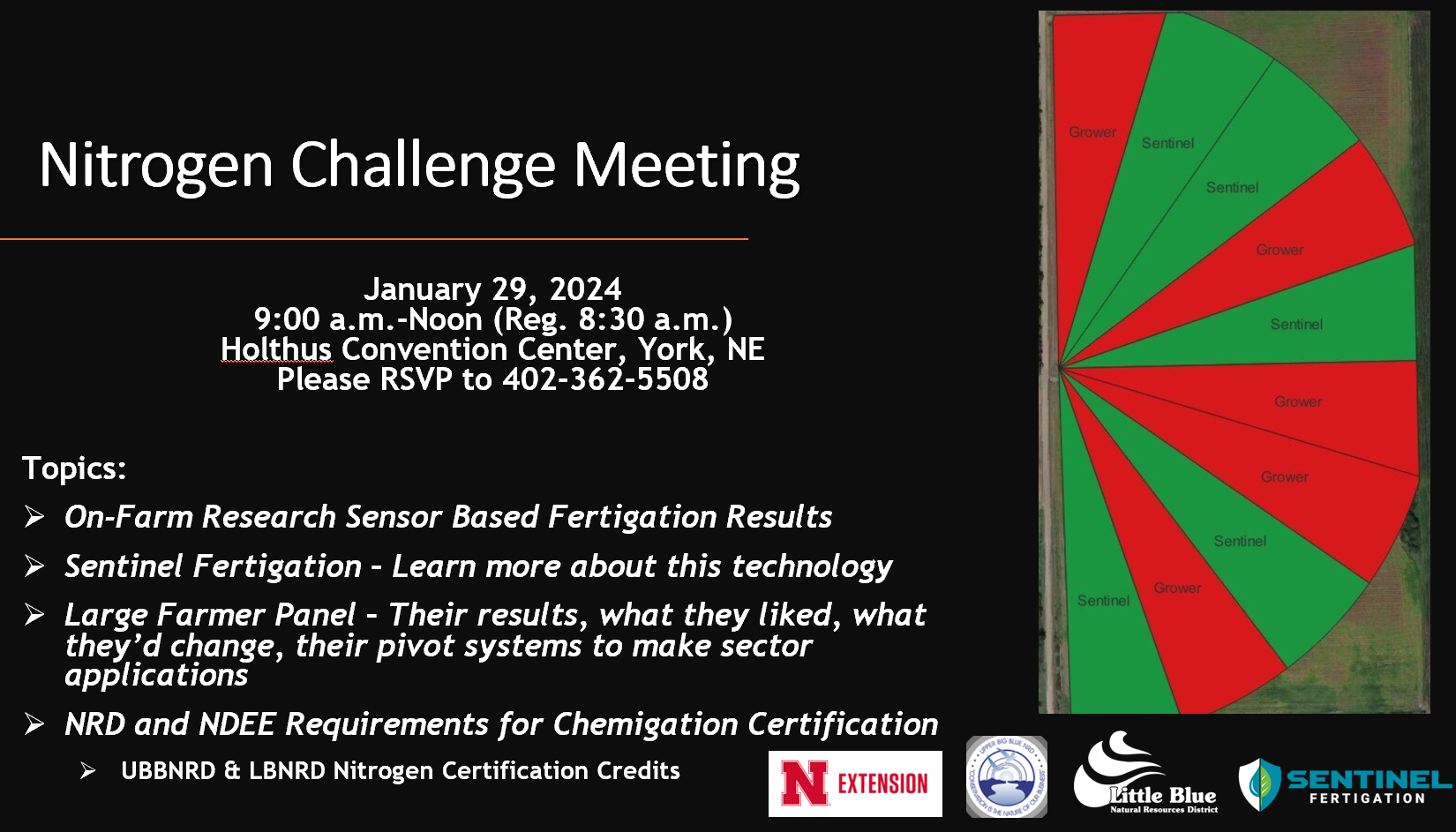
Upcoming Events: Friday (16th) conversation on economics of RegenAg from 10-noon at 4-H Bldg in York. RegenAg Conf. Feb. 28th at Concordia College in Seward (RSVP to 402-362-6601). On-Farm Research Update in York at Holthus Convention Center Feb. 27th (RSVP: https://go.unl.edu/bhdw). Also, York County Corn Growers is having our tour on Feb. 21st (RSVP to 402-362-5508 if interested).







JenREES 1/28/24
It’s incredible how quickly January flew by! The following are programs occurring next week. Reminder of the Friday February Conversations (10-Noon 4-H Bldg. York). The February 2nd conversation is around crop rotations, specifically diving into pest management issues with soybeans and seed corn and discussing ideas to help. It’s going to take farmers and ag industry working together on these discussions, so please invite/encourage those who have input/ideas to attend!
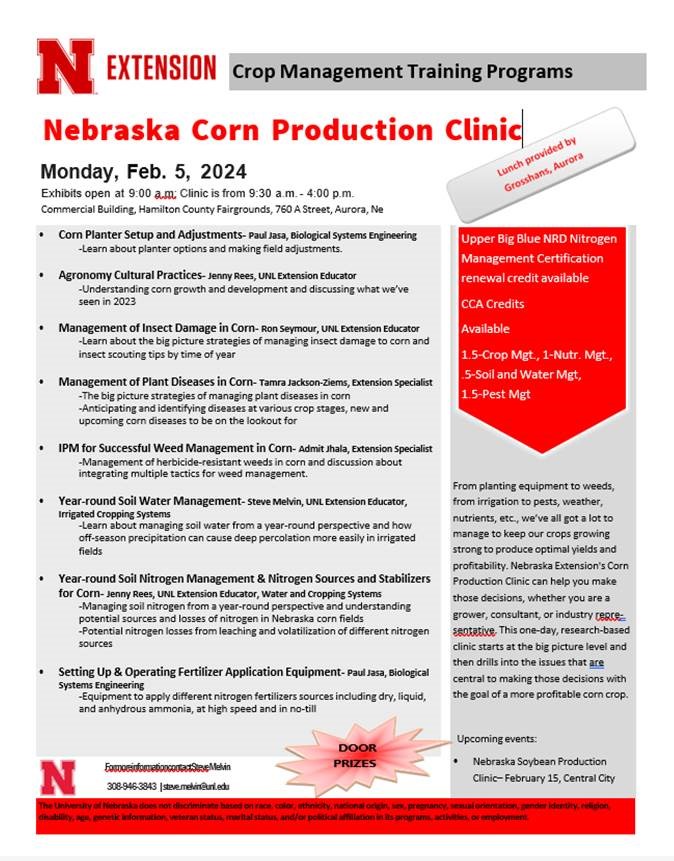
Nebraska Corn Production Clinic Feb. 5 at the Commercial Building, Fairgrounds in Aurora, starting at 9 a.m. with breakfast and time to visit with the vendors at the display booths. Presentations will start at 9:30 a.m. with Corn Growers and USDA updates, and conclude about 3:45 p.m. with door prizes. The event has a great lineup of excellent speakers focusing on all things corn, plus several ag display booths.
Topics include: Corn Planter Setup and Adjustments; Advanced Agronomy Cultural Practices; Management of Insect Damage in Corn; Management of Plant Diseases in Corn Including Tar Spot; IPM for Successful Weed Management in Corn; Year-round Soil Water Management; Year-round Soil Nitrogen Management and Nitrogen Sources and Stabilizers for Corn; and Setting Up and Operating Fertilizer Application Equipment. CCA credits are available.
The ag day event is consistently ranked by the farmers who attend as one of the best educational ag events. The day is free of charge to the participants thanks to sponsors and exhibitors. The noon meal sponsor is Grosshans in Aurora. More information is available https://merrick.unl.edu or by calling Steve Melvin at (308) 946-3843.
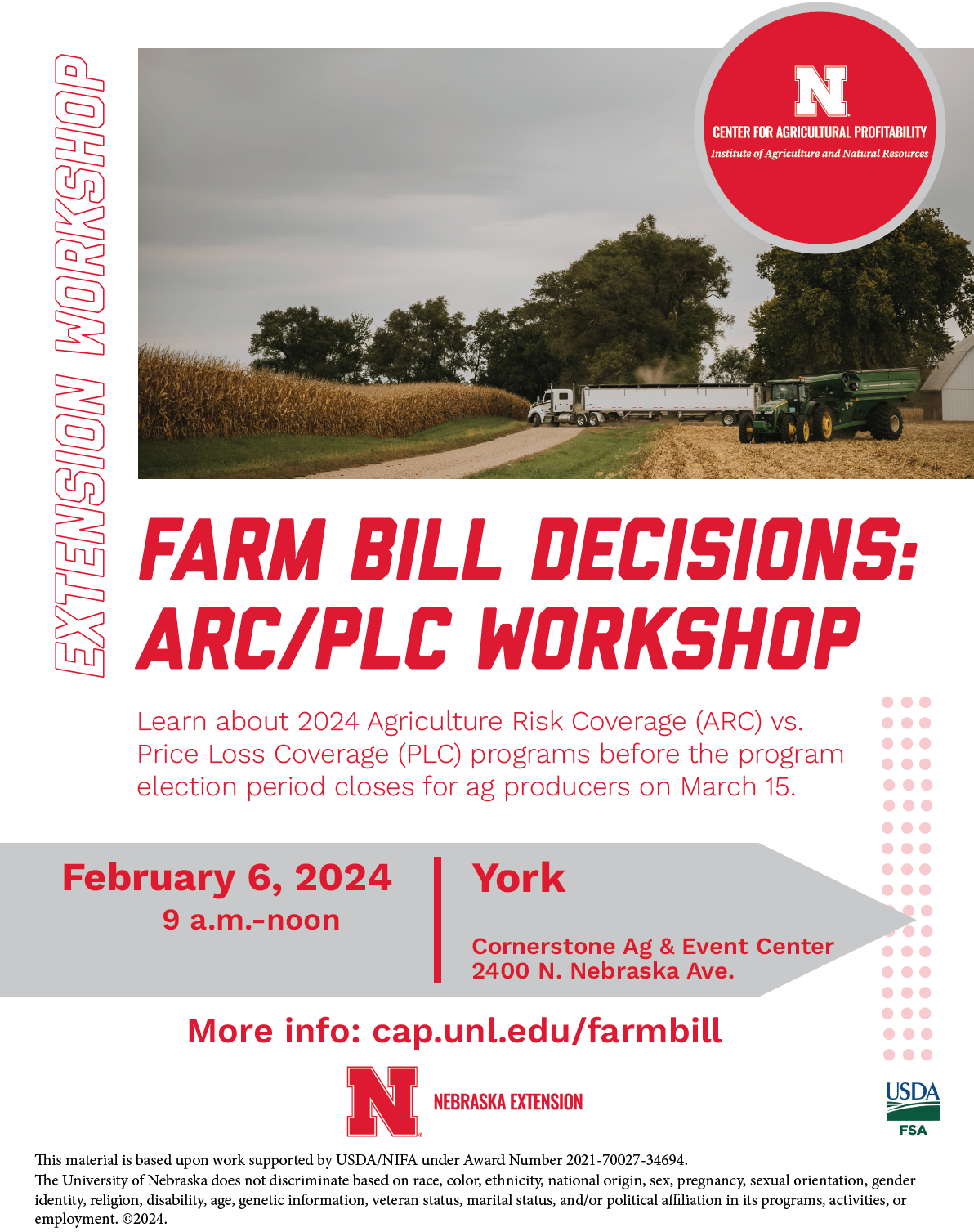
Farm Bill (ARC/PLC) program workshop for ag producers will be in York on Feb. 6 from 9 a.m.-Noon at the Cornerstone Ag & Event Center at the Fairgrounds in York. Nebraska USDA Farm Service Agency (FSA) is reminding producers now is the time to make elections and enroll in the Agriculture Risk Coverage (ARC) and Price Loss Coverage (PLC) programs for the 2024 crop year. The signup period is open through March 15, 2024, and producers are encouraged to begin working with their USDA county Farm Service Agency (FSA) office to complete the process. Although election changes for 2024 are optional, enrollment (signed contract) is required for each year of the program. If a producer has a multi-year contract on the farm, it will be necessary to sign a new contract for the farm by the March 15th deadline if a 2024 election change is desired. If an election is not submitted by the deadline of March 15, 2024, the election defaults to the current election for crops on the farm from the prior crop year.
Producers can learn about the ARC and PLC options for 2024 during a series of workshops hosted by the University of Nebraska-Lincoln’s Center for Agricultural Profitability (CAP) and Nebraska FSA that will be held across the state in February. Area workshops include:
- Feb. 6, 9 a.m.-Noon, Fairgrounds in York
- Feb. 7, 1-4 p.m., Community Building in Columbus
- Feb. 9, 9 a.m.-Noon, ENREEC near Mead
- Feb. 9, 1-4 p.m., Extension Office in Beatrice
- Feb. 14, 1-4 p.m., Extension Office in Hastings
The meetings have no charge and are open to the public. More information and a full schedule are available on the Center for Agricultural Profitability’s website, https://cap.unl.edu/farmbill.
Feb. 6-7 Nebraska Soils School: There’s also an incredible opportunity for learning and CCA credits through this soils school in partnership with the Nebraska AgriBusiness Association. More details here: https://cropwatch.unl.edu/2023-CW-News/2024-Soils-School-Agenda.pdf.
Feb. 7 Part 107 course training to help you pass the test for flying drones will be held at ENREEC near Mead. More info: 402-460-0742.
Farm Bill 2023 Elections
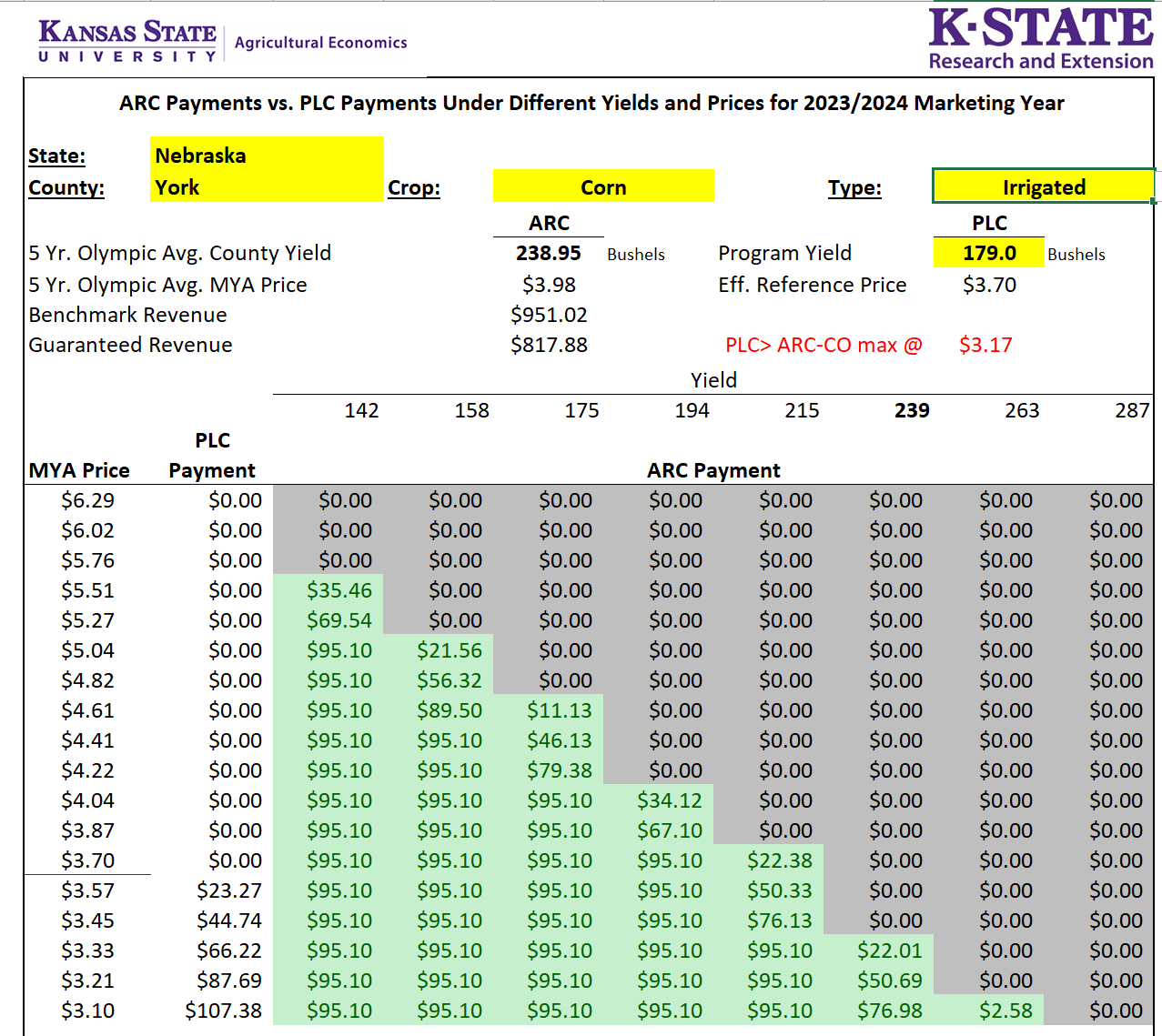
During our on-farm research meeting last Wednesday, several farmers received text message reminders to make their ARC/PLC enrollment/election by March 15, 2023, and were asking about this after the meeting. Regardless of whether you choose to make a new election or not, a new enrollment (contract) is required, so please contact the FSA office to take care of that. You can view the UNL/FSA farm bill webinar at: https://go.unl.edu/mbhy. No need to run simulations. You can download the spreadsheet from K-State that shows price/yield options for PLC/ARC-Co triggers: https://www.agmanager.info/ag-policy/2018-farm-bill/tradeoff-between-20222023-arc-and-plc.
Bottom Line: For 2023, neither ARC-Co nor PLC would be anticipated to trigger for corn, soybean, wheat, sorghum with current USDA projected prices. If you’re concerned about price decline and want to protect that downside, PLC can be selected. If you think high prices will remain, ARC-Co provides a better likelihood of payment in the event of disasters such as drought and hail impacting county average yields. These are risk management tools, and ultimately, crop insurance will be important again in 2023. Different election decisions (ARC-Co or PLC) can be made for crops in different FSA farm numbers if you’d like to spread risk. Fields with higher PLC yields could be more favorable for your PLC decisions.
But how do you choose between PLC and ARC? ARC-CO would only be anticipated to pay with a catastrophic yield loss, such as county-wide hail and/or drought.
PLC Reference Prices are: $3.70 for corn, $3.95 for milo, $8.40 for soybean, and $5.50 for wheat. Because market year average prices are much higher than these reference prices at this time, barring any major disaster causing price reduction, PLC payments wouldn’t be anticipated for any of these crops in 2023. Reasons to consider PLC: if you feel prices have the potential to decline or if you choose to use Supplemental Coverage Option (SCO) through crop insurance. Both the UNL and K-State webinar links on my blog go into more detail about SCO.
The following patterns hold true for every county I ran for both irrigated and non-irrigated. If you feel prices will stay high, then ARC-Co will only trigger if county average yields decline. If you feel prices will decline, PLC will mostly only trigger before ARC-Co. at county average yields. I think most of us would prefer good crops and decent prices to having either of these programs trigger. I’ve shared additional photos with explanations and reference links at my blog: jenreesources.com if seeing this explanation is helpful.
Corn: at county average yields, price would have to fall to $3.33 to trigger an ARC-Co. payment while it will trigger PLC payment at $3.70. When county average yields decline, ARC-Co triggers before PLC.
Soybean: at county average yields, price of $8.11 would trigger ARC-Co compared to $8.40 for PLC. When county average yields decline, ARC-Co. triggers before PLC.
Wheat: at county average yields, price of $4.60 would trigger ARC-Co compared to $5.50 for PLC. It takes more reduction in county average yields for ARC-Co to trigger before PLC. Please run these for yourself if you’re looking at wheat.
Milo (Sorghum): at county average yields, a $3.68 price would trigger ARC-Co compared to $3.95 for PLC. When county average yields decline, ARC-Co triggers before PLC.
For ARC-IC (individual), if any of us knew we’d get the hail damage we did last year, it may have been a great decision for last year’s election for those hardest hit with all/majority of fields. Because we can’t make this decision looking backward, ARC-IC tends to be more favorable for those with diversified crops or situations where yields wouldn’t reflect county average yields.
References:
- K-State spreadsheet tool: https://www.agmanager.info/ag-policy/2018-farm-bill/tradeoff-between-20222023-arc-and-plc
- UNL Webinar: https://go.unl.edu/mbhy
- K-State Webinars: https://www.agmanager.info/news/recent-videos/managing-risk-arc-plc-and-sco-2023-webinar-recording-and-slides
- USDA Prices/Yields: https://www.fsa.usda.gov/programs-and-services/arcplc_program/arcplc-program-data/index
- K-State Prices/Yields: https://www.agmanager.info/crop-insurance/risk-management-strategies/projections-and-sources-myaprices-arc-and-plc-commodity


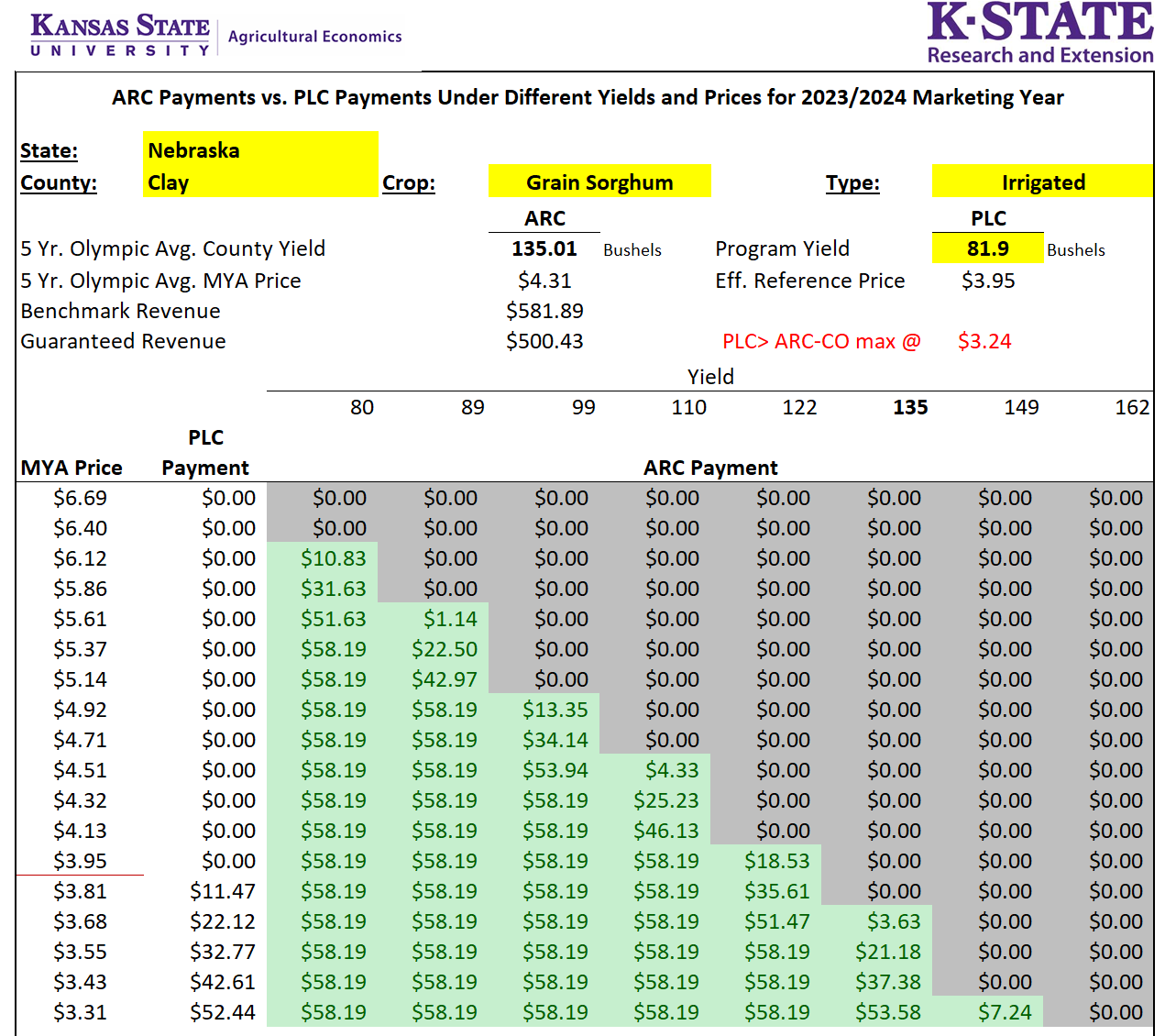
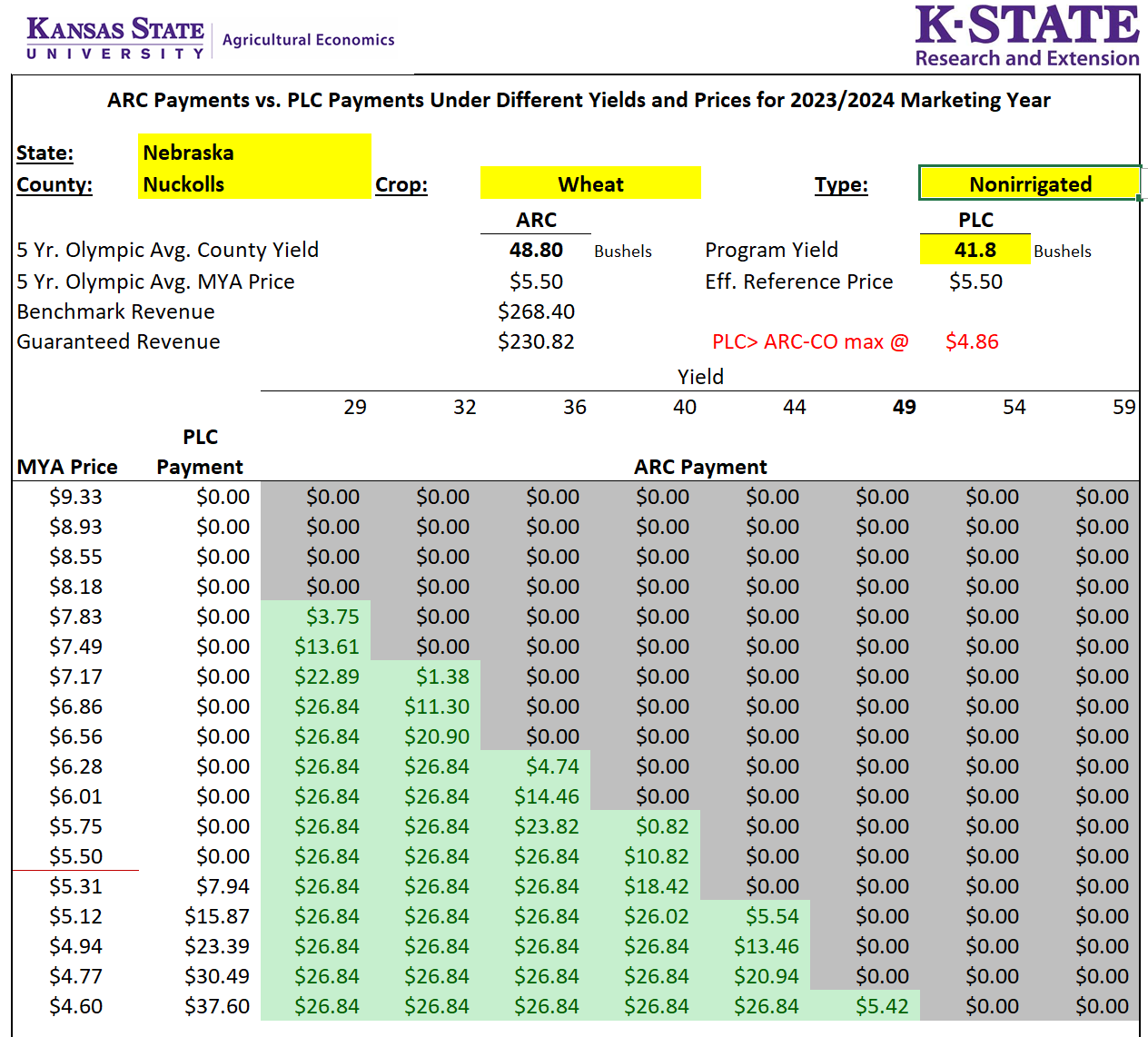



Farm Bill Decisions
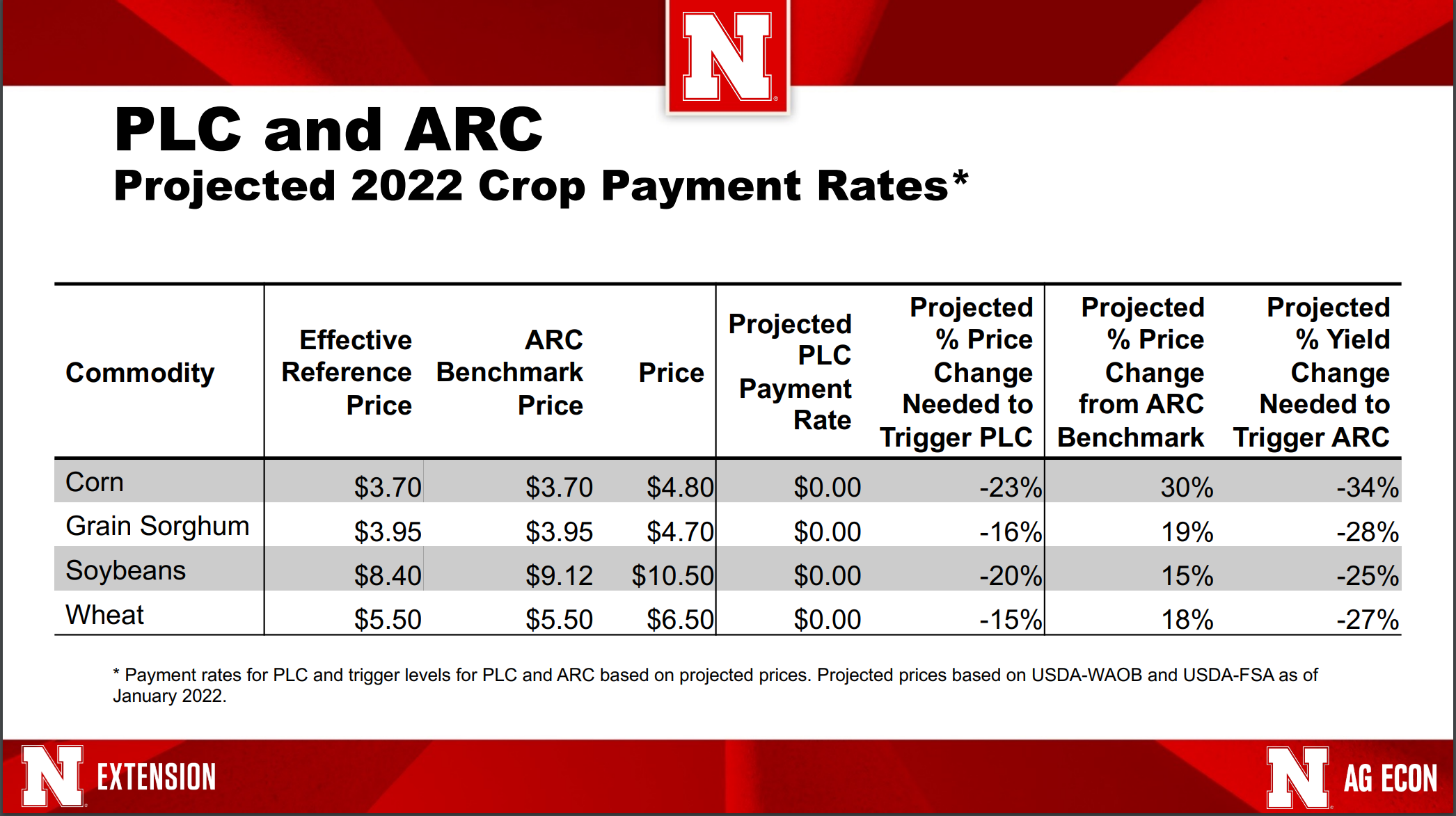
Farm Bill: Been receiving questions on farm bill since before Christmas and just hadn’t taken time to dig into it till this week. Viewing charts is helpful to me, so I’ve added some to jenreesources.com, including one from Robin Reid from K-State which is helpful in understanding how program payments are triggered. If you missed the UNL/FSA farm bill webinar, you can view it at: https://go.unl.edu/x0i9. I am not running simulations this year and don’t recommend that you do it either. The Texas A&M tool is a very good tool, but it will show you a range of probabilities beyond what is realistic for this 2022 decision, barring some type of trainwreck. If you’d like to very easily see for yourself what yields and prices would be necessary to trigger program payments, download the spreadsheet from K-State (and I have an example on my blog): https://www.agmanager.info/ag-policy/2018-farm-bill/tradeoff-between-20222023-arc-and-plc.
Looking at any potential payments for the 2021 crop, projected prices are substantially above the PLC price payments for crops like corn, soybean, wheat, and sorghum grown in Nebraska and would take a 23-33% price reduction to trigger a PLC payment. They’re also substantially above (30-47%) the price and would take a 30-40% county yield loss to trigger ARC-Co. I’m unsure counties with more substantial wind damage from July 9, 2021 wind storm had enough county average yield loss to trigger and ARC-Co payment…and many may have chosen PLC corn last year with the prices at the time anyway.
Decisions for 2022 need to be made by March 15, 2022. For 2022, neither ARC-Co nor PLC would be anticipated to trigger for corn, soybean, wheat, sorghum with current USDA projected prices (which are just numbers at this time). K-State does a nice job of compiling the different sources of 2022/2023 MYA prices and updating them every month here: https://www.agmanager.info/crop-insurance/risk-management-strategies/projections-and-sources-myaprices-arc-and-plc-commodity. Different election decisions (ARC-Co or PLC) can be made for crops in different FSA farm numbers if you’d like to spread risk. Fields with higher yields would be more favorable for your PLC decisions.
A consideration for ARC-Co for corn, soybean, wheat, or milo would be if a county has a lot of non-irrigated acres and one anticipates a drought event in 2022. That may look additionally favorable if the county has the opportunity to split crops into irrigated and non-irrigated decisions.
For soybean, ARC-Co is potentially a little more favorable than PLC, but still most likely won’t trigger a payment. The Soybean MYA price would need to fall below $8.40 to trigger a PLC payment and below $7.84 to trigger an ARC-Co payment with an average yield.
For corn, the MYA price would need to fall below $3.70 to trigger a PLC payment and below $3.18 to trigger an ARC-Co payment with an average yield. Robin Reid with K-State shares, “Strong export demand currently would lead us to believe that PLC payments are unlikely, but again, much uncertainty exists. A farmer could select PLC for the downside price protection or, if they are optimistic that current high prices are here to stay, selecting ARC-County would give them a higher likelihood of payment if county yields are low. In the case of irrigated corn, the likelihood of a yield loss large enough to trigger an ARC-County payment is less, so irrigated base may lend itself more to PLC.” I would note, this is true unless the county has a history of major storm events which traditionally have impacted county average yields, thus making ARC-Co irrigated also an option.
For wheat, PLC has been favorable in the past, but current prices are well above the $5.50 reference price. And for sorghum, PLC has also been favorable in the past with a $3.95 reference price, but again, current prices are well above this.
Bottom line, it’s not anticipated that either PLC nor ARC-Co will trigger program payments for 2022 at this time. I think many farmers would prefer good crops and decent prices. ARC-Co and PLC are tools for risk management and perhaps crop insurance tools will play an even bigger factor in managing risk for this coming year.



JenREES 2-21-21

On-Farm Research Updates: This week brings my favorite winter meetings, the on-farm research updates on Feb. 25 and 26! I’m passionate about on-farm research as it’s such a practical, inexpensive way to address the research questions growers have! These meetings are more meaningful to me because we get to hear from the farmers themselves who conducted the studies and have more discussion around the topics. They do look different this year with a huge number of people registered virtually vs. in-person. They’re also only a half day and we won’t cover the entire book of studies that were conducted. However, whether you participate virtually or in-person, you will hopefully hear from farmers who conducted on-farm research studies. And, this ‘in-person’ meeting does have people at most local sites also presenting in person. I realize that’s been a point of confusion/frustration as we’ve hosted many zoom meetings as ‘in-person’ watch events where no one presented live at the location. Register for virtual or in-person at: https://go.unl.edu/h83j.
I enjoy hearing from the farmers themselves regarding why they conduct on-farm research. The following YouTube video produced in 2020 highlights area farmers David and Doug Cast of Beaver Crossing and Ken Herz of Lawrence: https://youtu.be/tEy-I43CT0E.
Succession/Estate Planning opportunities are upcoming with a two-part webinar event held Feb. 25 and Mar. 4 at Noon. You can register for those at: https://farm.unl.edu/webinars . There’s also an in-person event at Central City at the Fairgrounds on March 2 at 9:30 a.m. and please RSVP to 308-946-3843 if you’d like to attend.
Tree and Houseplant Webinars: A webinar focused on trees will be Feb. 26 from 9 a.m.-Noon with registration here: Go.unl.edu/ProHort. A houseplant webinar series will occur on Feb. 27 and Mar. 6 from 10-noon with registration here: https://go.unl.edu/houseplants101.
Nitrogen Studies: With spring nitrogen applications around the corner, perhaps you are interested in testing different rates, timing, or inhibitors on your farm? On-farm research is a great option to consider! For some specific precision nitrogen studies (including inhibitors), there are stipends of $1300 available to producers interested in those studies. More info: https://cropwatch.unl.edu/precision-nitrogen-management-farm-research-project. There’s also a partnership with the Upper Big Blue NRD where those interested in conducting nutrient management or cover crop studies may receive $300 in reimbursement costs. If you’re interested in a study like this, please let me know. Next week I’ll share on nitrogen rate and timing results.
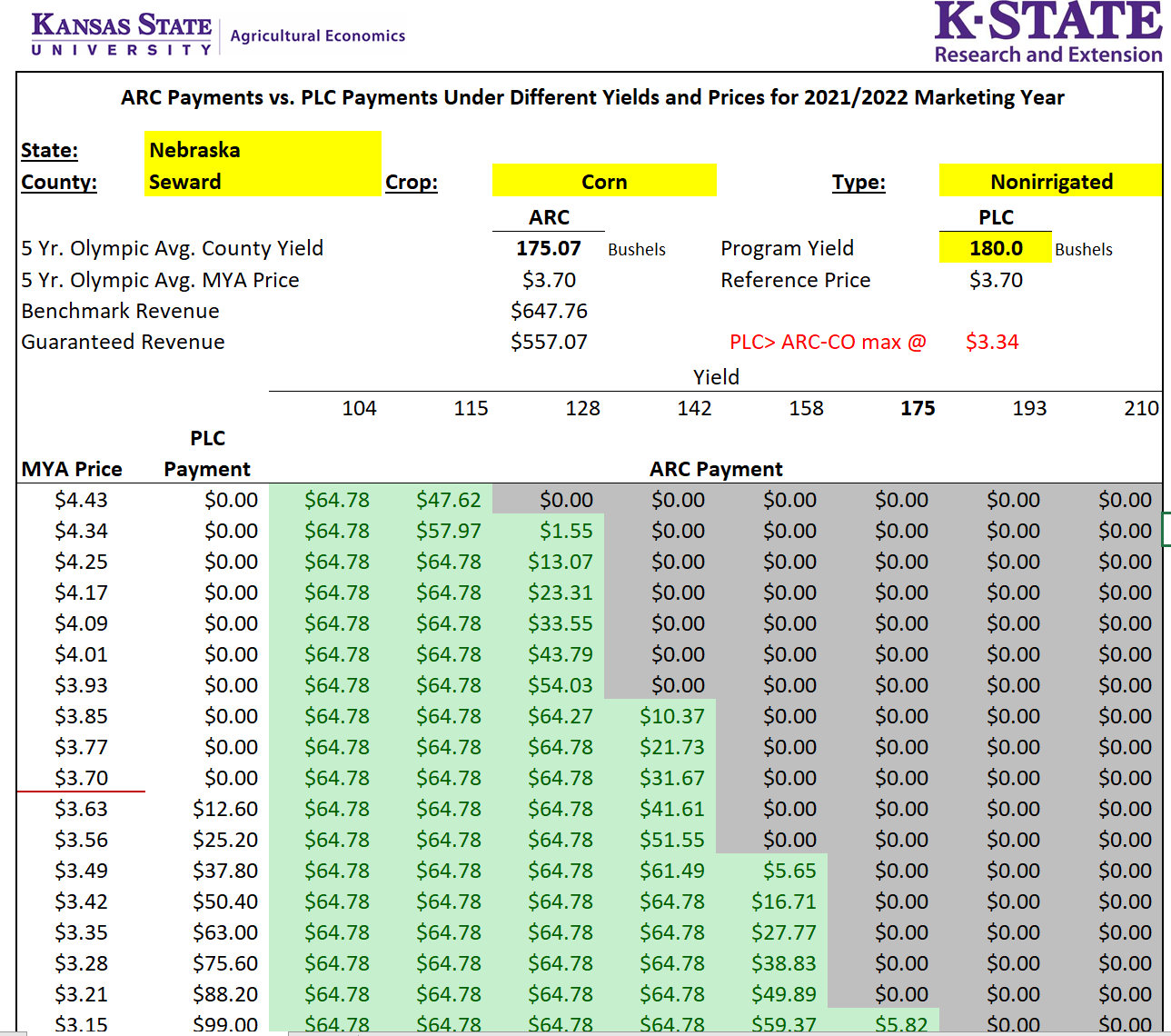
Farm Bill: Another tool that may be more visual in helping you make these decisions is the K-State tool at: https://www.agmanager.info/ag-policy/2018-farm-bill/tradeoff-between-20212022-arc-and-plc and I added it to my Farm Bill Decision Tools blog post. It shows you in one chart what happens with potential ARC-CO or PLC triggers by crop depending on what market year average price does or what county yield does. It doesn’t allow you to put in a historical irrigated percentage (HIP), so you need to consider that when selecting ‘irrigated’ or ‘nonirrigated’ in the tool. With it being in one chart, visually, perhaps that would help some of you more? It honestly doesn’t change what I’ve shared with you before, but it seems people are really struggling with this decision, so if you need another way to visualize what to do, it may help. Ultimately, no matter what tool is used, PLC is favored most often in corn, milo, and wheat. Soybeans often could go either way, and likely there may be no payment for soy or corn unless something substantial happens with MYA price or county yields. If you’re really on the fence, it may be helpful/wise to just split decisions between the two programs for different farms? For counties where there’s split irrigated/non-irrigated payments, particularly in areas that are drought-prone, look at what county average yield will trigger ARC-CO for your specific county using the tool. Crop insurance and marketing are ultimately a huge chunk of risk management too. Ultimately, the decision is up to you and no one can predict prices/yields. This information is just shared as a way to hopefully help with your decision making.
I still haven’t heard/seen that 2020 county average yields have been released for me to help anyone with looking at ARC-IC. From the past, we needed around 20% farm level yield loss compared to county average yield for ARC-IC to trigger. So, for those with significant yield loss from wind events, depending on how your farms are grouped, it still may be something to look at. Hopefully county average yields will be available soon.


2021 ARC-CO Calculation
Background: Ultimately, PLC offers price protection. If your MYA price is less than the reference price ($3.70 for corn; $8.40 for soy; $3.95 for sorghum; $5.50 for wheat), a PLC payment is triggered. ARC-CO is a revenue safety net with price and yield protection, and it takes into account a 5-year Olympic average of prices and yields (for this 2021 decision it looks at 2015-2019).
We’ve had good market prices recently. However, remember ARC-CO is based on a 5-year Olympic average where the high and low are thrown out. This average is based on 2015-2019 (2020 doesn’t come into the picture until the 2022 decision. And, if it’s the high, it gets thrown out then…so it may take a couple years of high prices). And, the reality is that PLC corn price of $3.70 may also not trigger depending on the MYA price. Another consideration for the 2021 election is county yields for ARC-CO payments (looking at years 2015-2019 where the high and low are thrown out).
So as things set today, it’s possible there will be no ARC-CO nor PLC payment for corn or soybean for 2021. Corn tends to favor a PLC decision. Wheat favors PLC. Sorghum traditionally has favored PLC. Soybean could be selected either way, particularly depending on if the county has irrigated/non-irrigated split or not. What can impact this is if we see major yield or price losses from current expectations. Because different weather events hit portions of counties, and because some counties have separate payments for irrigated and non-irrigated acres, it’s important to look at your individual county data to make decisions.
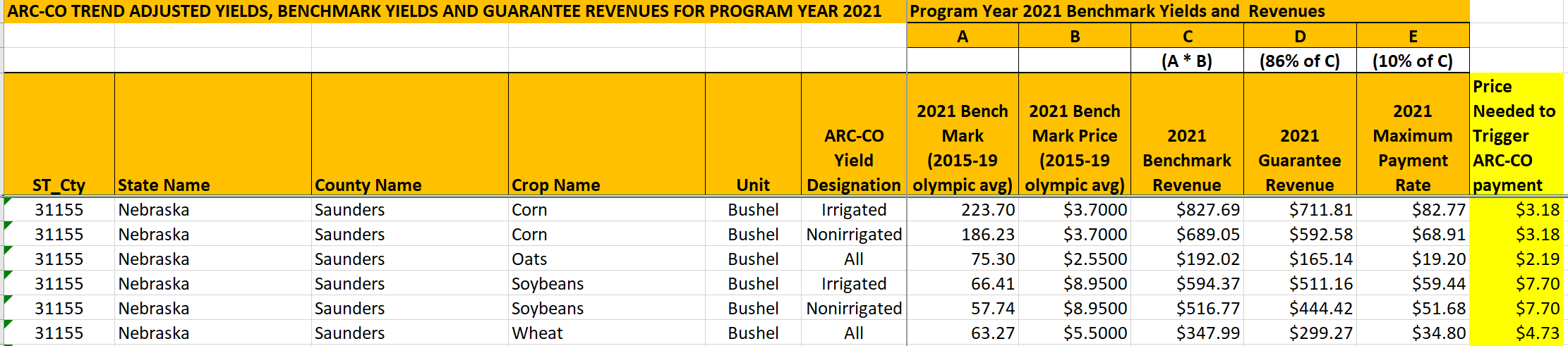
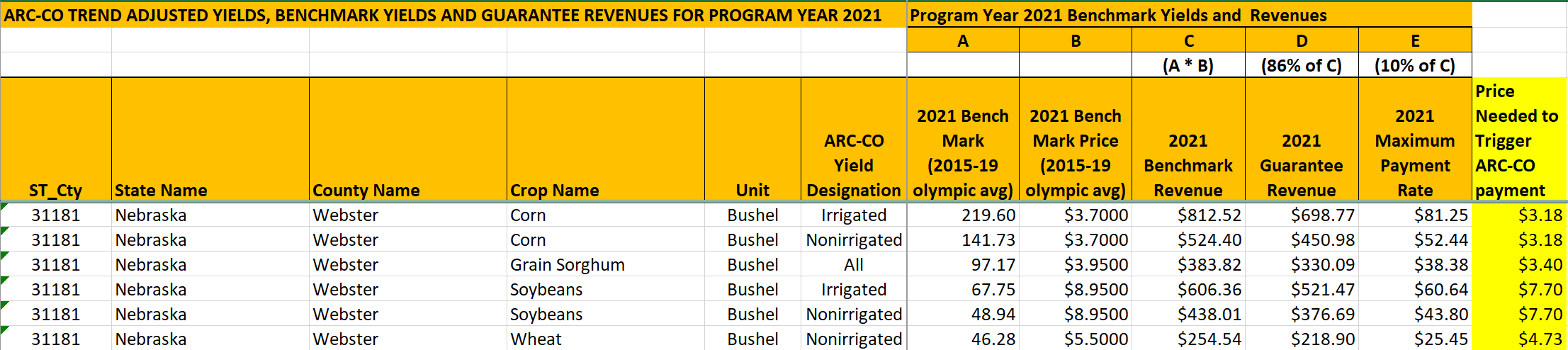
Calculation: One way to look at ARC-CO vs. PLC decision for your county based on crop is to do a simple calculation. Take your 2021 County Guaranteed Revenue for a specific crop and divide that by 2021 County Benchmark Yield for that crop. I’ve provided screenshots from several counties where I’ve helped individuals with farm bill decisions in the past. If your county isn’t listed, you can find your county information here: link to download a USDA excel spreadsheet.
How to Use the Calculation: Essentially, the calculation shows similar triggers for all crops. The ARC-CO trigger for corn is essentially 86% of the Reference Price (except this isn’t the case for soybean when considering individual years where MYA was higher than the Reference Price). Thus, what these numbers currently say is that prices have to drop much lower than the reference prices in order to trigger ARC-CO payments. This makes PLC elections more favorable for all the crops. What can change the ARC-CO trigger would be if there’s a change in the 2021 benchmark yield for that specific county.
| Crop | ARC-CO Trigger (prior to final yields) | PLC Reference Price |
| Corn | $3.18 | $3.70 |
| Soybean | $7.70 | $8.40 |
| Sorghum | $3.40 | $3.95 |
| Wheat | $4.73 | $5.50 |
For the screenshots below, I’ve added a column to the right (yellow) where I’ve done the calculation. As you will see, the ARC-CO price trigger is similar for counties for each crop. However, that assumes no fluctuation in yield from the 2021 Benchmark Yield, which should approximate a county trend yield projection. If the actual yield is higher or lower than the benchmark, then the effective trigger price goes down or up. If the trendline yield ends up changing, it will impact the ARC-CO price trigger. Thus, you can adjust by increasing and decreasing the guaranteed yield in the calculation to determine how that could impact your ARC-CO trigger.
Example that can be applied to the other County screenshots (please click on images to enlarge):


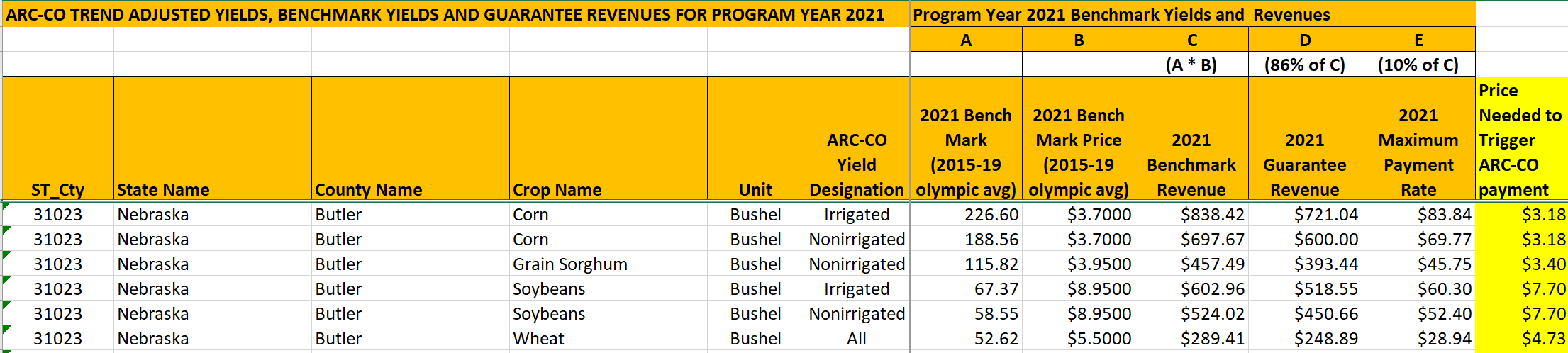

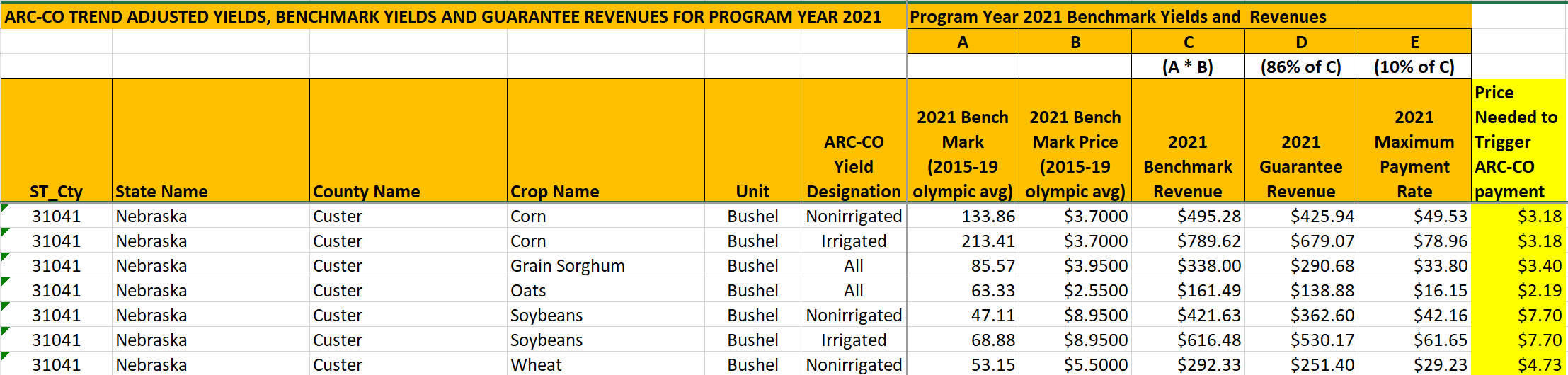


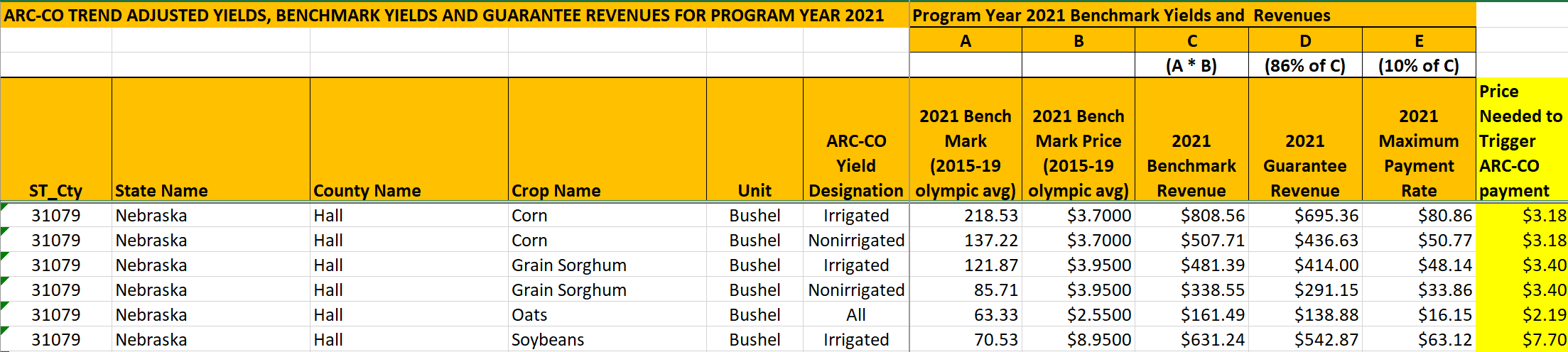
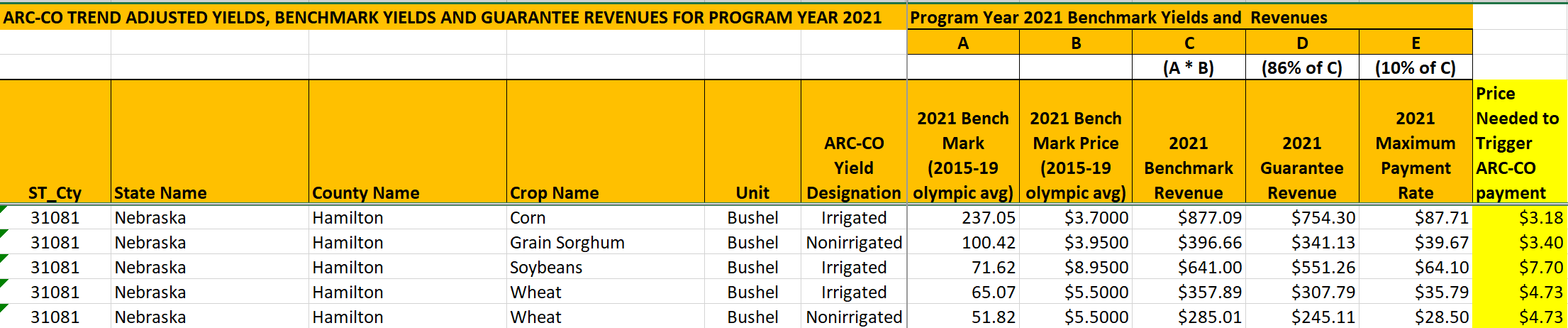

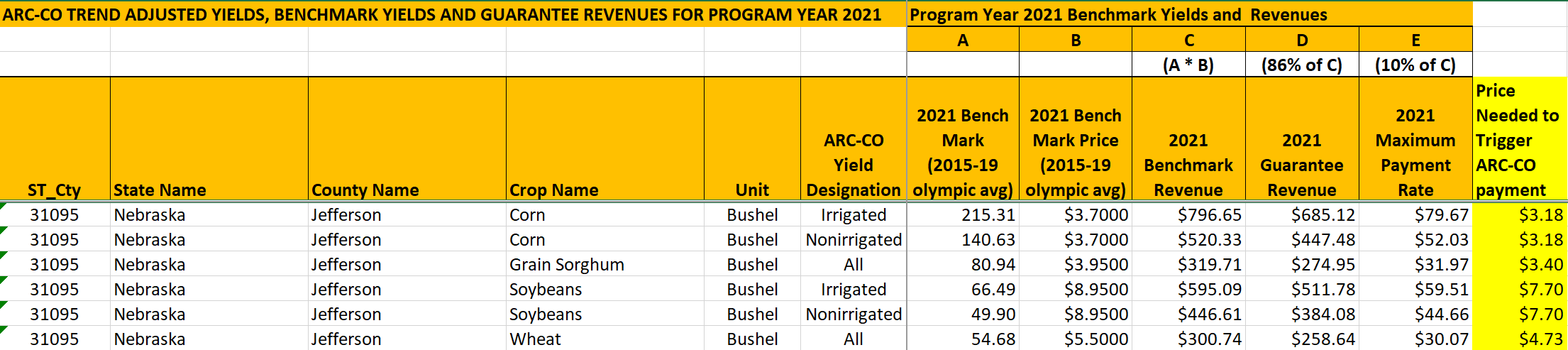



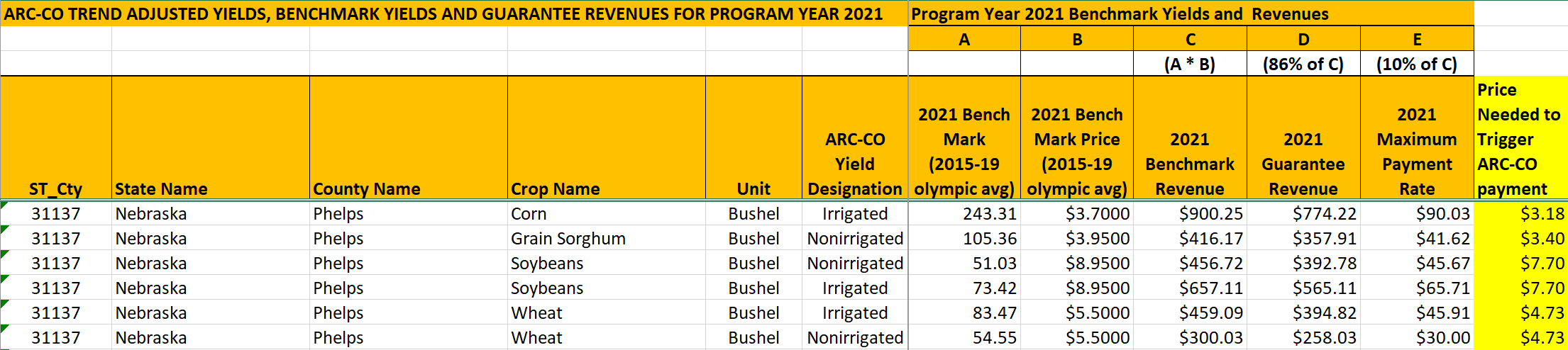
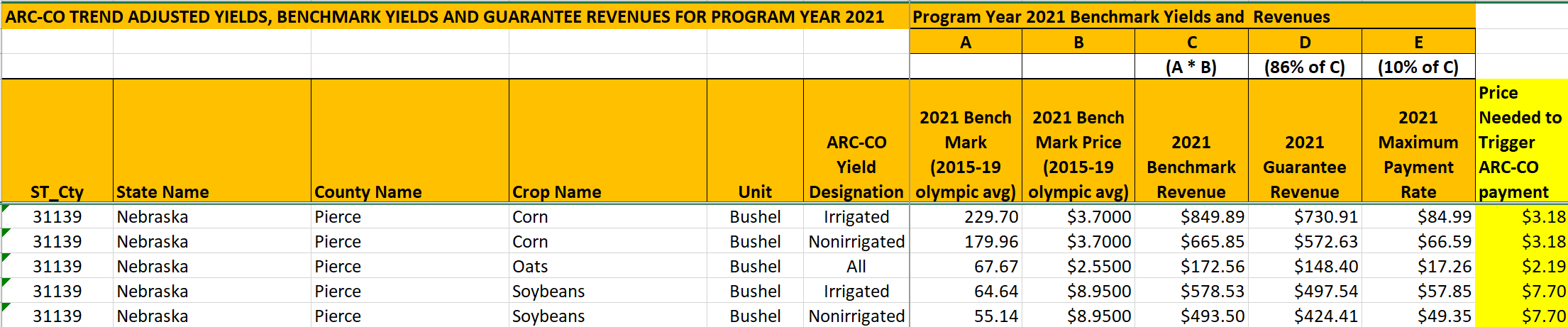
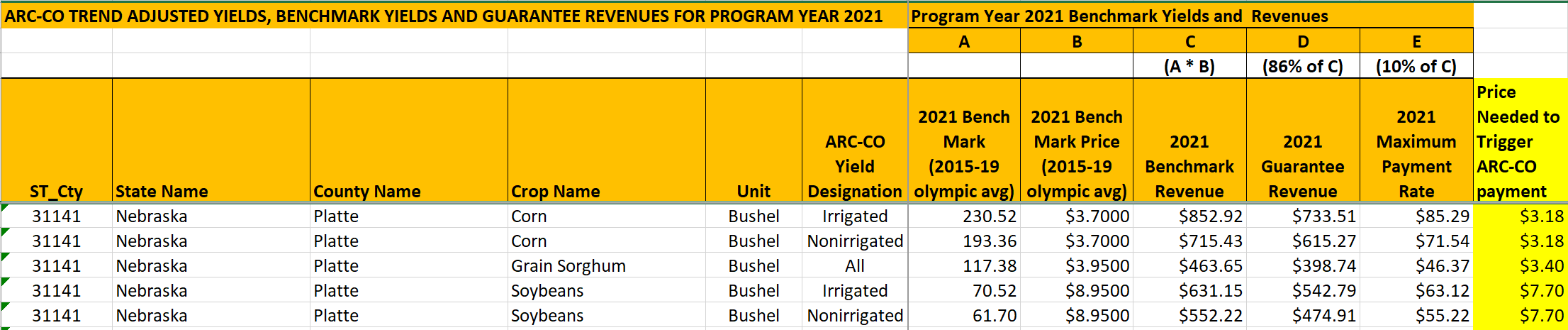





Additional Resources:
- 2021 ARC/PLC recorded webinar
- JenREES ARC-CO Calculation Blog Post
- JenREES 2021 Farm Bill Decision Tools
- 2021 Crop Production Clinic Farm Bill Presentation
- USDA FSA Farm Bill Info.
- USDA County Yield and Revenue Excel Spreadsheet for ARC-CO decision (Download. NE data shown. Unhide cells to see other states.)


JenREES 1-24-21
Farm Bill: In my desire to share what I’ve learned with you all, I realized I threw too much information into the decision tool blog post, and what I was seeking to share didn’t come across clearly. So, I revised it and you will need to refresh your web browser to view the most updated version.
Ultimately, PLC offers price protection. If your MYA price is less than the reference price ($3.70 for corn; $8.40 for soy; $3.95 for sorghum; $5.50 for wheat), a PLC payment is triggered. ARC-CO is a revenue safety net with price and yield protection, and it takes into account a 5-year Olympic average of prices and yields (for this 2021 decision it looks at 2015-2019).
So as things set today, it’s possible there won’t be either an ARC-CO nor PLC payment for corn or soybean for 2021. Corn tends to favor a PLC election. Wheat favors PLC. Sorghum traditionally has favored PLC. Soybean could be selected either way, particularly depending on if the county has irrigated/non-irrigated split or not. What can impact this is if we see major yield or price losses from current expectations.
What I don’t know yet is if ARC-IC is an option as a result of the significant windstorm in several counties. Once we get the 2020 county yields (most likely in February), I will start looking at that.
Sometimes looking at the probabilities in the decision tools can be confusing, but they can also provide direction if you’re unsure. Thus, why I provide the blog post on how to use the decision tools.
The calculation I shared with you last week may be the easiest thing you can do. So, I put that into a separate blog post and placed screen shots of county by crop in Nebraska so you can see which way things are favored by county. The best way to find all this info. is go to the “Farm Bill” category on my blog: https://jenreesources.com/category/farm-bill-2/ (but only look at the 2021 info.).

Fungus Gnats: Kelly Feehan shares, “If you have small gnats flying around your home or windows, these may be fungusgnats. These nuisance pests are small fly-like insects mainly noticed around houseplants. They cause no harm to people, pets and rarely to plants. Fungus gnats develop in overwatered houseplant soil or poorly drained potting mixes. The larvae, which is a tiny maggot, lives and matures in the potting medium, mainly feeding on fungal or algal growth in overwatered soil. If the potting mix is harboring fungus gnats, cut back on watering frequency so the mix dries out briefly between watering. If needed, repot plants using a well-drained potting mix and containers with drainage holes. Pour excess water out of catch basins after watering. Reduced moisture limits fungal growth, hence fungus gnat larvae food. The upper two inches of the potting mix can also be treated with a labeled houseplant insecticide or insecticidal soap.”
York-Hamilton Cattlemen January Meeting is scheduled for Tuesday, January 26, 2021 at Chances ‘R’ in York. The meeting will open the doors at 6:30 p.m. with meal at 7:00 p.m. Gerald Peterson, Secretary, said this meeting is scheduled in place of the Cattlemen’s Banquet that is usually held this time of year but has been canceled for 2021 on recommendations of area health departments. Kim Siebert, Cattlemen’s President said the evening will feature a presentation from Max McLean of McLean Beef who are in the process of opening a new animal processing and retail meat business in south York. McLean Beef is a longtime cattle feeder farmer in the Benedict area of northern York County. Bill Rhea, President of the Nebraska Cattlemen has been invited to attend the meeting along with Nebraska Cattlemen staff to update the Cattlemen on bills in the Nebraska Legislature. Please RSVP to Gerald Peterson by email at gpeterson808@gmail.com or by phone at 308-991-0817 if you plan to attend.
JenREES 1/17/20
Winter in-person meetings are ‘a go’ for this week for this part of the State. Also, the online pesticide training is available for those who would rather not attend in person. It’s found at: https://web.cvent.com/event/4efa4d41-c770-4a78-99d7-4c4ea75d45ae/summary
Dicamba Training will be conducted by the companies, not UNL. Most have an online training option. Some also have live webinars and in-person meetings. Please see each company’s info:
Bayer (Xtendimax): https://www.cvent.com/c/calendar/7829eb5d-ddef-4c2f-ac2c-a67626018ece
BASF (Engenia): https://www.engeniaherbicide.com/training.html
Syngenta (Tavium): https://www.syngenta-us.com/herbicides/tavium-application-stewardship
Farm Bill: Because the tools are the same as in the past, I’ve updated a blog post (go to the “Farm Bill” category) at jenreesources.com. It shows step by step instructions on how to enter data into the Texas A&M and Illinois decision making tools. Your election this year is for one year only (2021). Some of my data was saved in the Texas A&M tool, so hopefully that’s the case for you individually as well.
After looking at data, here’s some things that may be helpful for consideration. Yes, we’ve had good market prices recently. However, remember ARC-CO is based on a 5-year Olympic average where the high and low are thrown out. This average is based on 2015-2019 (2020 doesn’t come into the picture until the 2022 decision. And, if it’s the high, it gets thrown out then…so it may take a couple years of high prices). And, the reality is that PLC corn price of $3.70 may also not trigger depending on the MYA price.
Another consideration for the 2021 election is county yields for ARC-CO payments (looking at years 2015-2019 where the high and low are thrown out). Because different weather events hit portions of counties, and because some counties have separate payments for irrigated and non-irrigated acres, it’s important to look at your individual county data to make decisions.
If you don’t want to use the decision tools from Texas A&M and Illinois, another option is a simple calculation. On my blog, you can click on a link to download a USDA excel spreadsheet which shows data for figuring ARC-CO triggers and payments. I’ve hidden the cells for the rest of the U.S. and only have Nebraska shown; once downloaded, you can unhide cells if you want to look at other states. For the calculation:
Take your 2021 County Guaranteed Revenue for a specific crop and divide that by 2021 County Benchmark Yield for that crop. For example, York County irrigated corn (irrigated and non-irrigated are combined) shows a 2021 Guaranteed Revenue of $745.35. The 2021 Benchmark Yield (which is an Olympic average yield from 2015-2019) is 234.24. Taking 745.35/234.24=$3.18. Based on these numbers, an ARC-CO payment would not be triggered for corn in York County unless the price went down to $3.18. This is in comparison to PLC in which the trigger is $3.70 for the corn price. This helps with decision making as it leans towards enrolling in PLC for corn. (Again, no guarantee of a payment even with PLC depending on the MYA price). You can also try other figures (ex. trying 240 and 220 bu/ac) if you think the trendline yields may be higher or lower than the current estimate to see other potential ARC Co price triggers. You can use this same calculation for other crops such as soybean, wheat, sorghum, etc. and compare the prices obtained vs. the PLC price for that crop.
The windstorm, fairly widespread in this part of the state, impacted many individual corn yields. I don’t know how that compares to average county yields for 2020. In the past, we had those at some point in February, so it will be interesting to look at this later.
ARC-IC and Illinois Tool
I hadn’t been considering ARC-IC for many situations as it seemed like one had to have 100% prevent plant in 2019 in order for it to trigger. However, I received enough calls from those with hail damage in 2019 to take another look at this.
Purdue University put together a great video that explains ARC-IC and situations where ARC-IC may trigger (two examples listed below). Check it out here: https://youtu.be/AwCMySwjWT4.
If you had the following two situations, it may be beneficial to check out ARC-IC.
- 100% prevent plant for 2019
- Planted entire farm but 2019 yields were below average (20% or more production loss)
NOTE: You will need to have worked through your 2013-2017 yields and also 2019 yields in order to look at ARC-IC. Yields for each crop need to be combined for irrigated and non-irrigated (blended yield) by year. If you have several tracts within a farm number, all the yields for same crop regardless of irrigation practice need to be combined by year. Doing this also allows you to look at any potential to update PLC yields.
The Texas A&M tool doesn’t allow one to look at ARC-IC. I realize I haven’t recommend the Illinois tool. However, they created a second tool (2018 Farm Bill What if Tool) and I apologize as I hadn’t been back to their site since December to see this. The first tool looks at the life of the farm bill and I felt it wasn’t as accurate because this is a 2 year decision instead of 5 year. However, the second tool looks at 2019-2020 and it also is very helpful when considering ARC-IC for single or multiple farms. This blog post will hopefully help you work through the Illinois “What If” tool for considering ARC-IC found at https://farmdoc.illinois.edu/2018-farm-bill.

I recommend using the ‘2018 Farm Bill What if Tool’. Download the tool and it will appear as an excel spreadsheet. Enable editing.
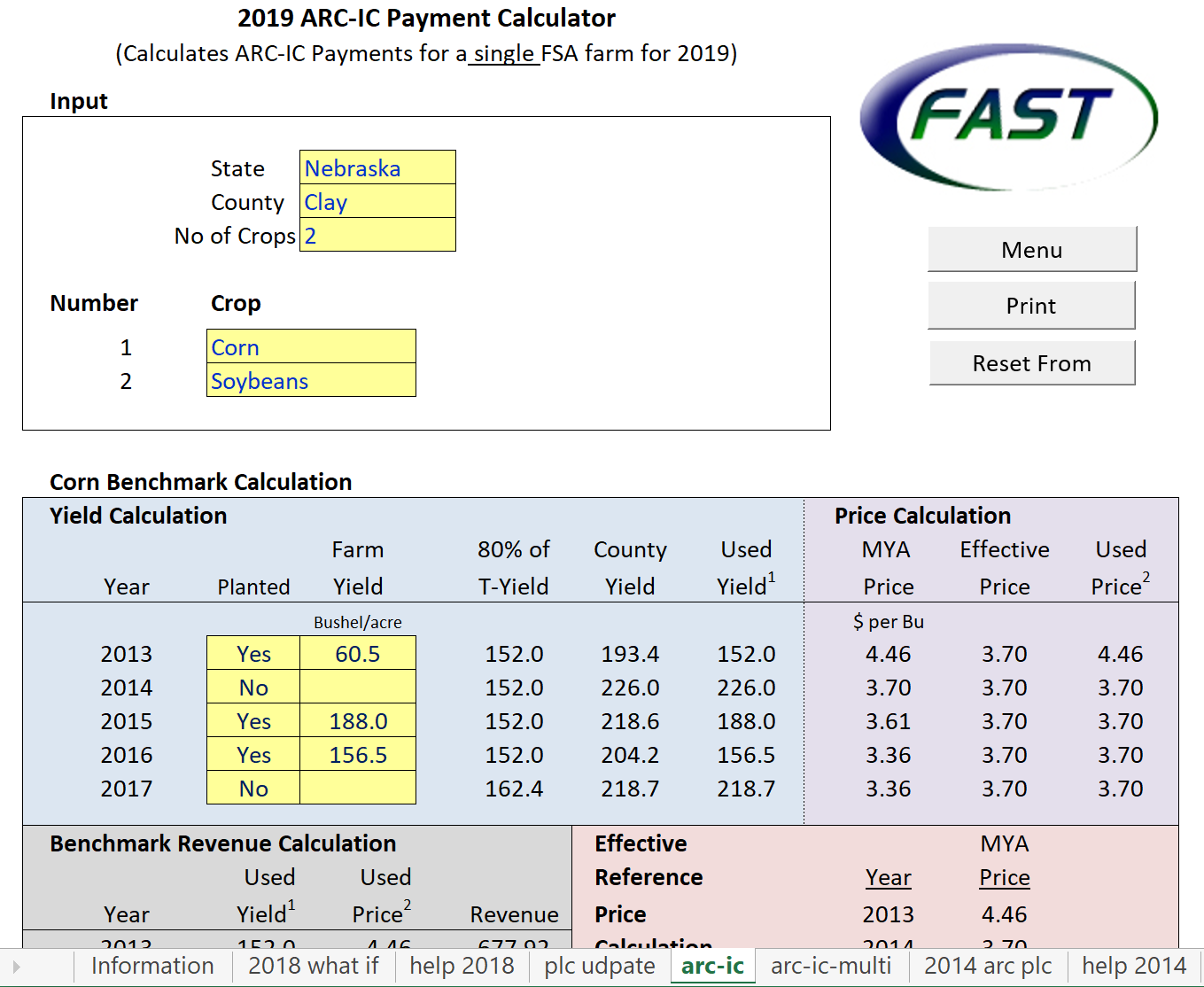
At the bottom of the spreadsheet, you will see multiple tabs. Click on “arc-ic” if you’re interested in looking at only 1 farm number. The yellow boxes within the sheet contain either dropdown menus or can have data entered into them. Use the dropdown menus to select State, County, Number of crops, Crop (be patient and wait as it will think before changing the cell). Select “yes or no” from dropdown regarding which years the crop was planted and enter in the yield for that year for that crop. Remember the yield is the blended yield of irrigated/non-irrigated and for every tract within a farm number. Do this for each crop. *Note, in this example, the 2013 hail storm in this same area of the State also impacted yields.

This shows the calculations. When the crop wasn’t planted, the county yield is used. When the yearly yield is less than the County Yield, 80% of the T-Yield is automatically used. The yields are then multiplied by the higher of the market year average price or effective reference price to determine benchmark revenues. An Olympic Average (throw out high and low then average the other three revenues) is then determined for each individual crop.

For ARC-IC, the total base acres get combined together. So if there were 92.8 total base acres for the farm, and the other crop wasn’t planted, I put the total base acres into the crop that was planted. If both crops were planted, I split the base acres and entered the 2019 yields for each crop. If the farm was 100% prevent plant or had some portion of farm in prevent plant, make sure to designate those acres as such. I have been seeing this trigger for hail or other impacts to yield for 2019 if the loss was at least 20% of the 2013-2017 yields. In this case, the grower could receive a pretty substantial payment of around $47/base acre for 2019. Even if there’s no payment for 2020, this type of payment for 2019 far exceeds what is expected for potential payments from either ARC-CO or PLC at this time.
So what if you had more than one farm in a significant hail damaged area? You can also use this tool to look at multiple farms.
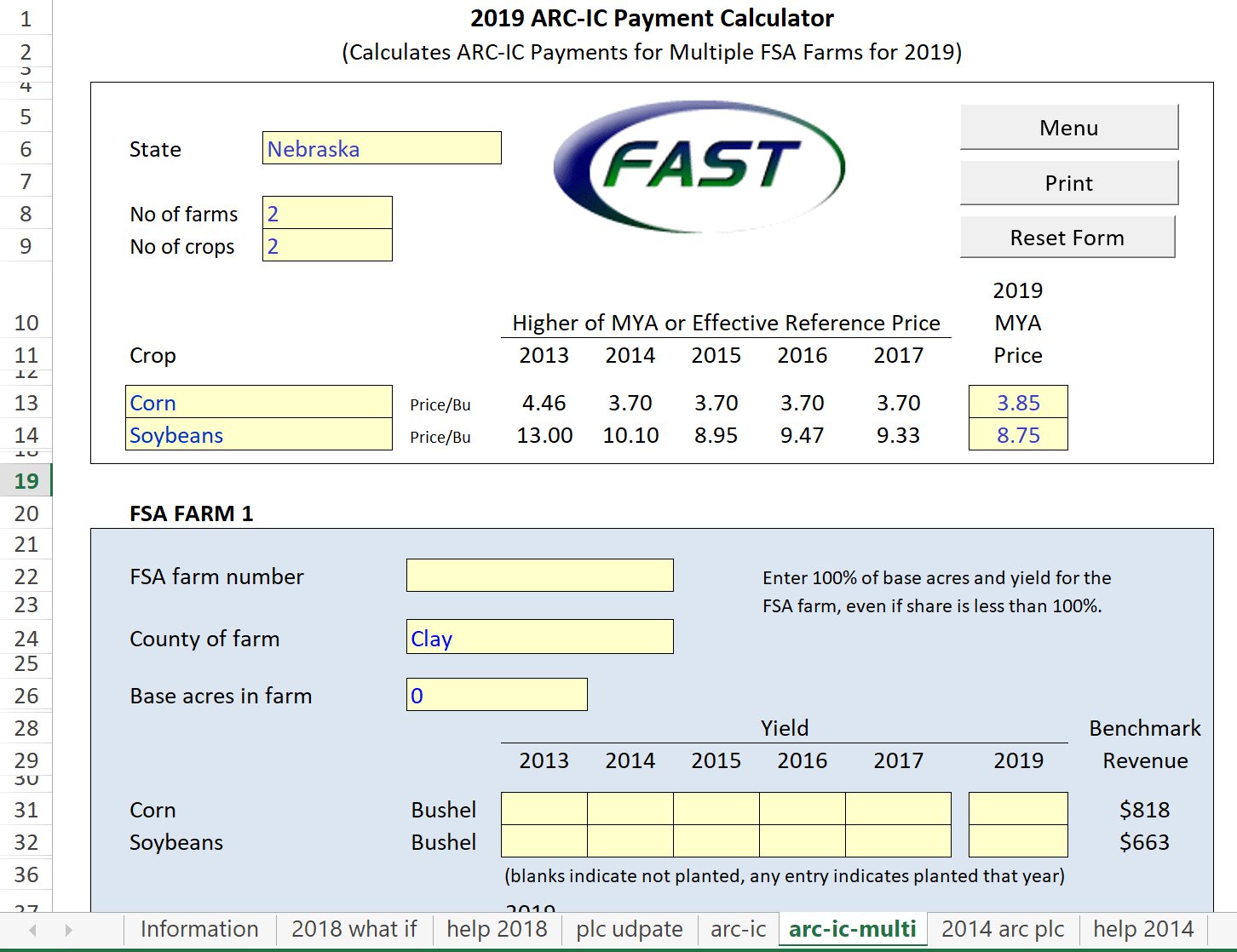
In the spreadsheet tab select “arc-ic-multi”. Select your state from drop-down menu. Then select how many farms you’re interested in looking at arc-ic and the crops. Be patient as it takes time for the tool to change cells. Then enter in your data for each farm. You will need to enter the total number of FSA base acres for that farm number (it’s not split by crop).
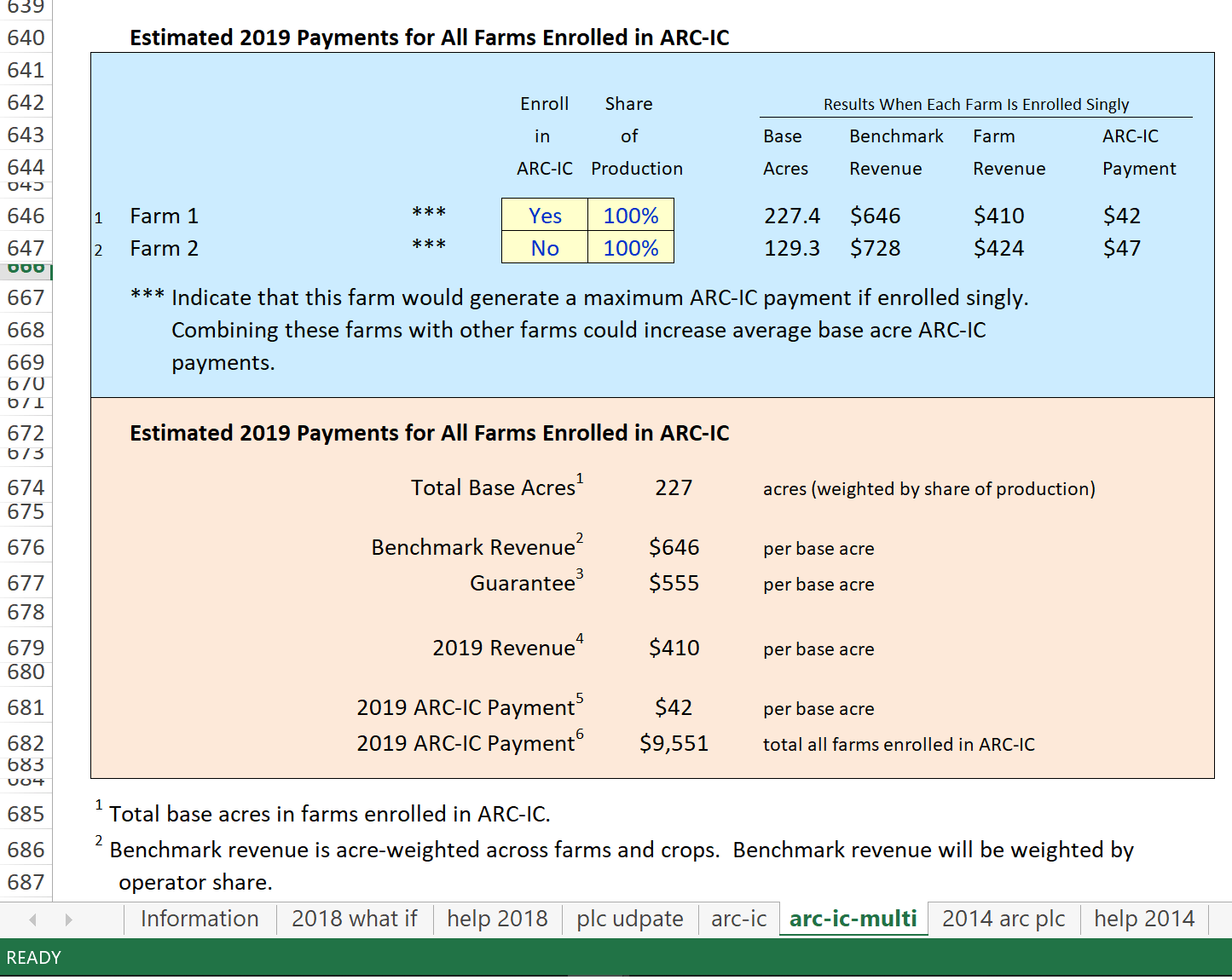
Once all the farm yields are entered, you can look at potential payments for individual farms by simply selecting “yes or no” in the expected payments portion at the end of the spreadsheet. You can also see what happens to potential payments when you select “yes” on multiple farms. Note: for all farms enrolled in ARC-IC, all the base acres will be combined regardless of crop and regardless of farm number to determine payment per base acre and payment will be applied to 65% of total base acres.
This is very farm and situation dependent. If several farms are within one farm number and one farm had significant loss but the other(s) didn’t, it may not trigger ARC-IC. Same thing for prevent plant acres (if a portion of farm is planted and part is prevent plant, the yield of planted acres may result in too much revenue to trigger ARC-IC).
Situations where ARC-IC tends to trigger best are:
- When there’s one farm within one farm number and that farm either went 100% prevent plant or had a yield loss of 20% or greater for 2019.
- When there’s several farms within one farm number but all had 100% prevent plant and/or significant yield losses in 2019.
Hopefully this is helpful if you’re considering ARC-IC!
Additional Farm Bill Info:


 JenResources