Blog Archives
Ag Reflections from 2014
Happy New Year! Wishing all of you and your families a wonderful 2015! As I look back at 2014, there are several ag-related observations that I noted throughout the year.
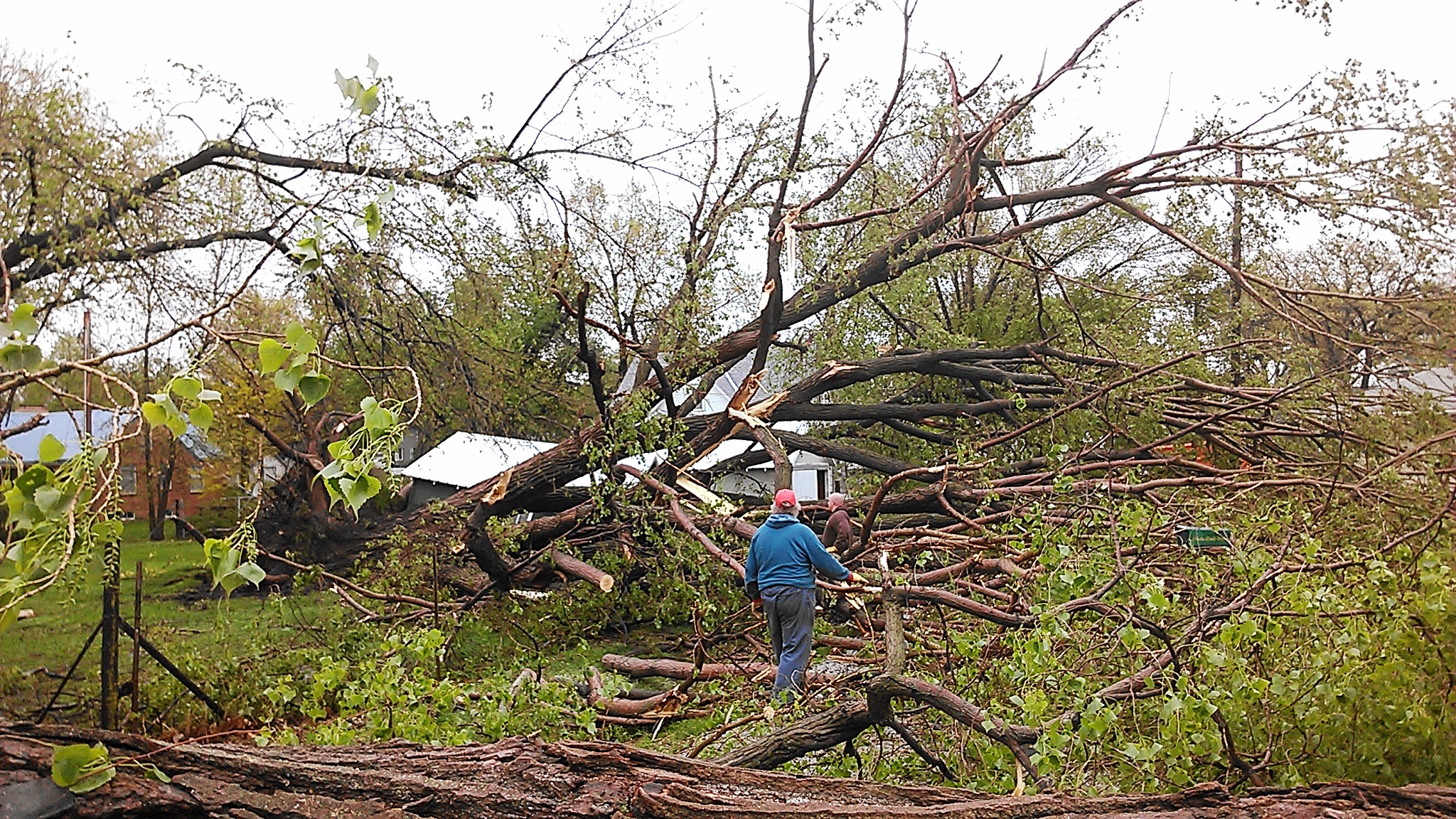
Cleanup after the tornado in Sutton on Mother’s Day 2014.
The first observation continues to be the way communities and people in this County/area pull together in difficult times. Whether after tornadoes/wind storms or helping other farm families who had an injured family member or had lost a family member, it’s just a blessing to see the way people pull together to help each other in time of need. It was also a blessing for many who were unable to harvest in 2013 due to the August 1st storm, to harvest fields in 2014, and for many in the area to experience really good irrigated and dryland yields this year.
The dry winter of 2013/14 allowed for very mellow ground during planting time. Often seeding depth ended up ½-1” deeper than intended. The dry winter also didn’t allow for good residue decomposition leading to problems during planting and ensuing stand emergence. Cutting off residue and high rains in May led to unintended consequences of replant situations when residue was moved off of farmers’ fields onto neighboring fields, suffocating emerged plants in portions of fields. I’m not sure what the solution is for the future other than it really needs to be something worked out with neighboring farmers, but perhaps mentioning it here opens an opportunity for future conversations.
Cover crops have been incorporated into more operations in recent years, yet the ultimate goal for using them remains important in determining what species/crops are used in the fields. We also realized the importance of determining amount grazed prior to turning cattle into fields (whether for grazing cover crops or crop residue), as high winds in winter 2013/14 in overgrazed fields led to soil blowing throughout the winter.
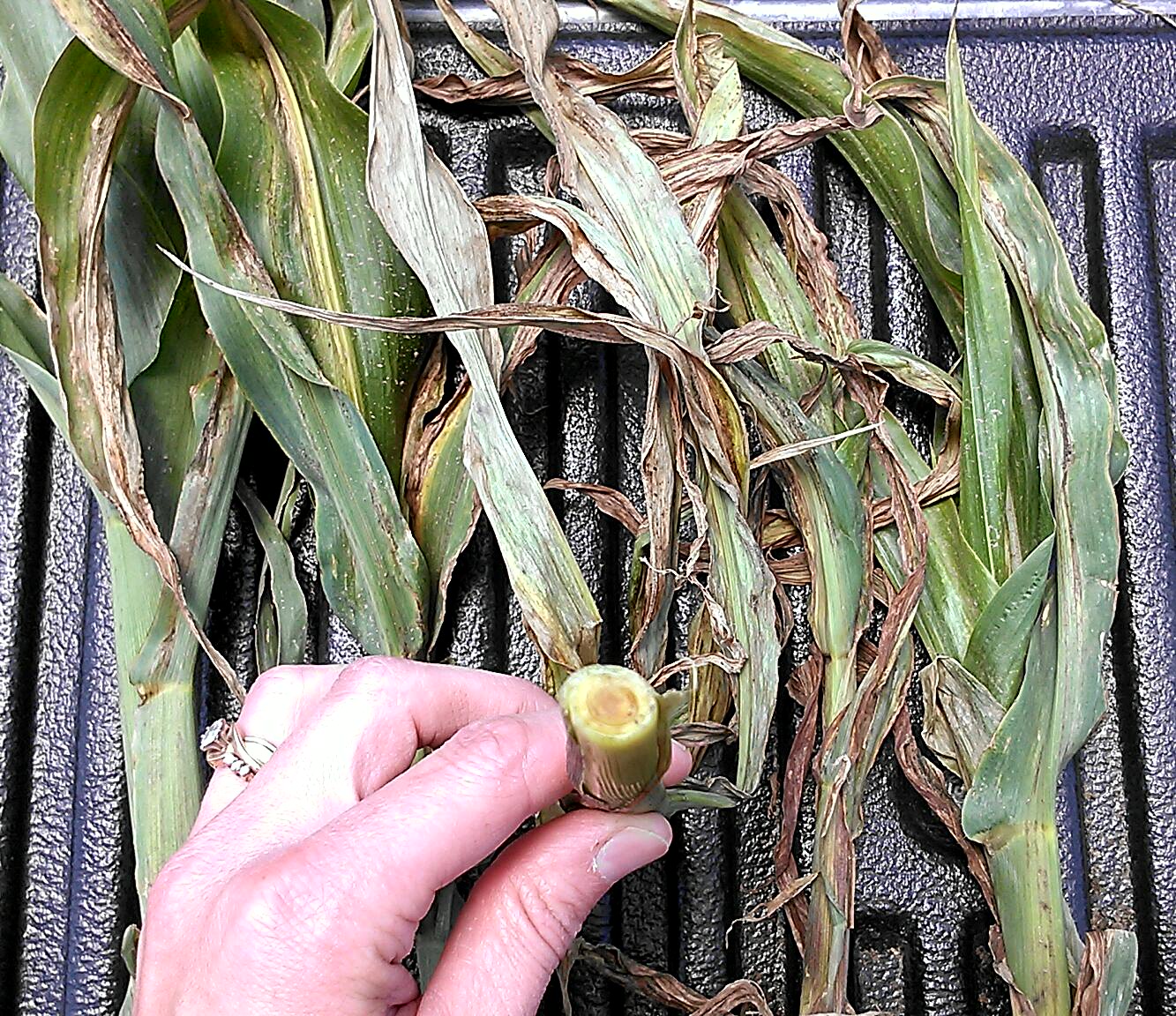
Systemic Goss’ wilt showed up in some fields that were hail and/or frost damaged by V6.
The May frost showed us emerged soybeans at the cotyledon stage held up well to the frost compared to the corn. We also again watched Goss’ wilt show up systemically by 6 leaf corn that was injured early by frost or hail in fields where Goss’ wilt had been a problem in the past. We need more research/understanding of this disease. Wheat continues to show us its resiliency as it winterkilled in portions of fields, withstood drought-stress, and then made up yield in the last 4-6 weeks.
Perfect pollination conditions coupled with high solar radiation, low night-time temperatures, and timely rain events were keys to the bountiful corn crop we experienced this year. Soybeans were more of a mixed bag. In walking fields and in conversations with farmers, I think the disappointment in some irrigated yields could be attributed to early/over-irrigation, disease problems, and planting date. UNL on-farm research showed on average a 3 bu/ac yield increase when soybeans were planted in late April to first week of May (regardless if growing season was warm/dry or cold/wet like it was this year) and those I’ve talked to who achieved 80+ bu/ac in the area this year planted in that time-frame. I’m curious if there’s something to planting a 2.4-2.5 maturity early vs. a 3.0+ maturity early as some area producers are seeing strong yields from a shorter season hybrid planted early the past few years. So if you’ve also seen this and/or are interested, that will be an on-farm research project to try next year. Please let me know if you’re interested!
Here’s wishing you a healthy and prosperous 2015!
Field Assessments to Improve Efficiency
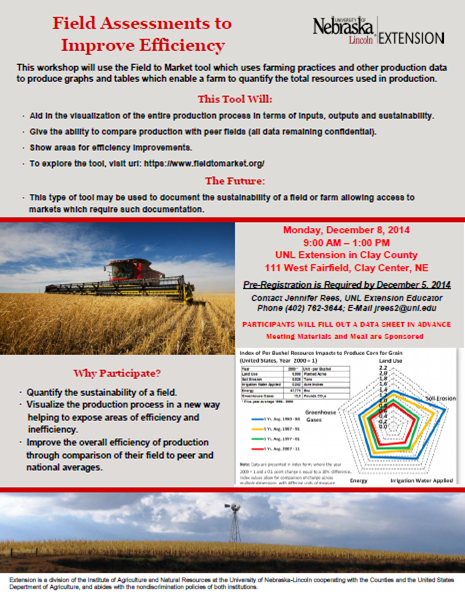
Field to Market Training: On December 8th from 9:00 a.m. to 1:00 p.m., I will be hosting a workshop at the Extension Office in Clay Center (Courthouse) for interested producers/crop consultants to learn more about a web-based tool called Field to Market (https://www.fieldtomarket.org/). Please RSVP to me at jrees2@unl.edu or (402) 762-3644 by Dec. 5th if interested. Field To Market® brings together a diverse group of grower organizations; agribusinesses; food, fiber, restaurant and retail companies; conservation groups; universities and agency partners to focus on promoting, defining and measuring the sustainability of food, fiber and fuel production. Sustainability in this effort is defined as meeting the needs of the present while improving the ability of future generations to meet their own needs by: increasing productivity to meet future food, fuel and fiber demands; improving the environment; improving human health; and improving the social and economic well-being of agricultural communities. The meetings will be hands on and producers will leave the room with their carbon & energy footprint and efficiency factor information on a field for 2014. If there is time, participants can enter records on a previous year. Using the tool, farmers evaluate how their decisions influence their sustainability outcomes; the food industry can access and share more accurate details about sustainable food and fiber production; and conservation groups understand what’s happening on the farm, while helping farmers understand questions and concerns about sustainability.

10 Life Tips from Future Ag Leaders
This was a great conference to attend and present at! Great open, honest, thought-provoking discussions about agricultural issues while learning about different issues other States are facing. A summary of the final thoughts from the conference are presented by Dr. Lindsay Chichester, UNL Extension in the following blog post.

I spent three days this week with at the AgriFutures Conference, held in Kearney, Nebraska. Myself, along with persons from the Wyoming Department of Ag and the Nebraska College of Technical Agriculture (NCTA) had been planning this event for several months. In attendance were college students, producers, and industry representatives from Nebraska, Wyoming, Colorado, Utah, New Mexico, Kansas, and Canada! We had some great speakers and networking opportunities.
Before we adjourned on the last day we went around the room and shared “take away messages” from our time together. I think that many of the take away messages from the conference apply not only to agriculture, but to life in general.
The list I am sharing with you today is one generated by these agriculture enthusiasts and leaders – the people who grow and raise the food we all eat. And boy let me tell you, they are excited…
View original post 65 more words
Soybean Stem Borer

Are you noticing holes in your soybean stems? Holes where the petiole meets the main stem are the entry point where soybean stem borer (also known as Dectes stem borer) larvae tunnel into the main soybean stem. Originally eggs are laid in soybean leaf petioles in the upper canopy. The eggs hatch into larvae which burrow down the petiole then into the main soybean stem. Notice the soybean stem borer infected stem in the middle while the soybean stem to the right has a a non-infested area where the petiole dropped (it is naturally sealed over by the plant). Count how many plants out of 20 have this symptom to get an idea of percent infestation and repeat in several areas of the field. Fields with 50% or more infestation need to be harvested first and perhaps earlier to avoid lodging and yield loss associated with lodging.

Lodged soybeans can be another key for checking for stem borer around harvest time. Notice the stem in the middle of the photo that is lodged (fallen over instead of standing in the row).

Following the stem to the base, the stem easily breaks away from the plant. The stem itself will appear solid. The base of the plant where it breaks is also often sealed off. The stem borer will seal itself inside the base of the stem. In this case, there’s a small portion that hasn’t been sealed off yet.

Gently pulling apart the base of the stem reveals the soybean stem borer larva. The larva will spend the winter and eventually pupate here. Adult beetles will emerge in late June and there’s only one generation per year. For more information specific to life cycle and management, please see the following NebGuide.
Crop Update 8/1/14

Southern rust of corn confirmed in Clay County July 31. Very small, tan-brown lesions on upper surface of the leaf, usually in clusters. Spores inside the pustules are typically orange. This was found on one leaf in a field near Trumbull. Just because southern rust has been found in the area, we don’t recommend automatically spraying. Scout your fields and consider disease pressure, growth stage, and economics. Long season corn and late-planted fields have the potential for most damage. Secondary common rust sporulation has also been confused as southern rust as the secondary pustules tend to look like this. It’s important to obtain microscopic confirmation to know for sure if you have southern rust in your fields.
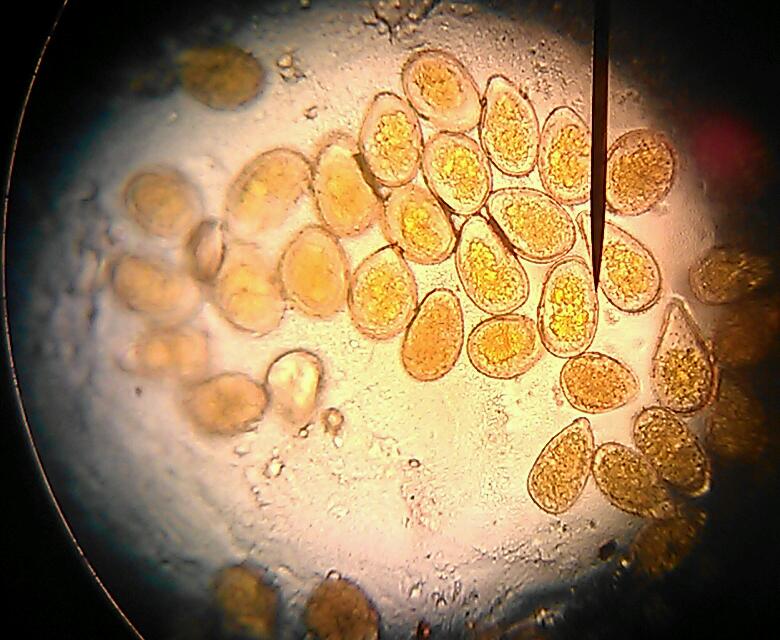
Microscopic Observation: Spores of southern rust appear elongated vs. common rust appear as near perfect circles.

Another common problem is old common rust lesions being confused as gray leaf spot. The color of this lesion is a tan-gray, typical of gray leaf spot. Using backlighting or a handlens, you can see the pustules within this lesion confirming it is common rust and not gray leaf spot. I’ve had many calls that gray leaf spot was up the entire plant in their fields and after looking at fields, have found it to be common rust in most situations. It’s important to know what disease you truly have to make the best decision on fungicide application.
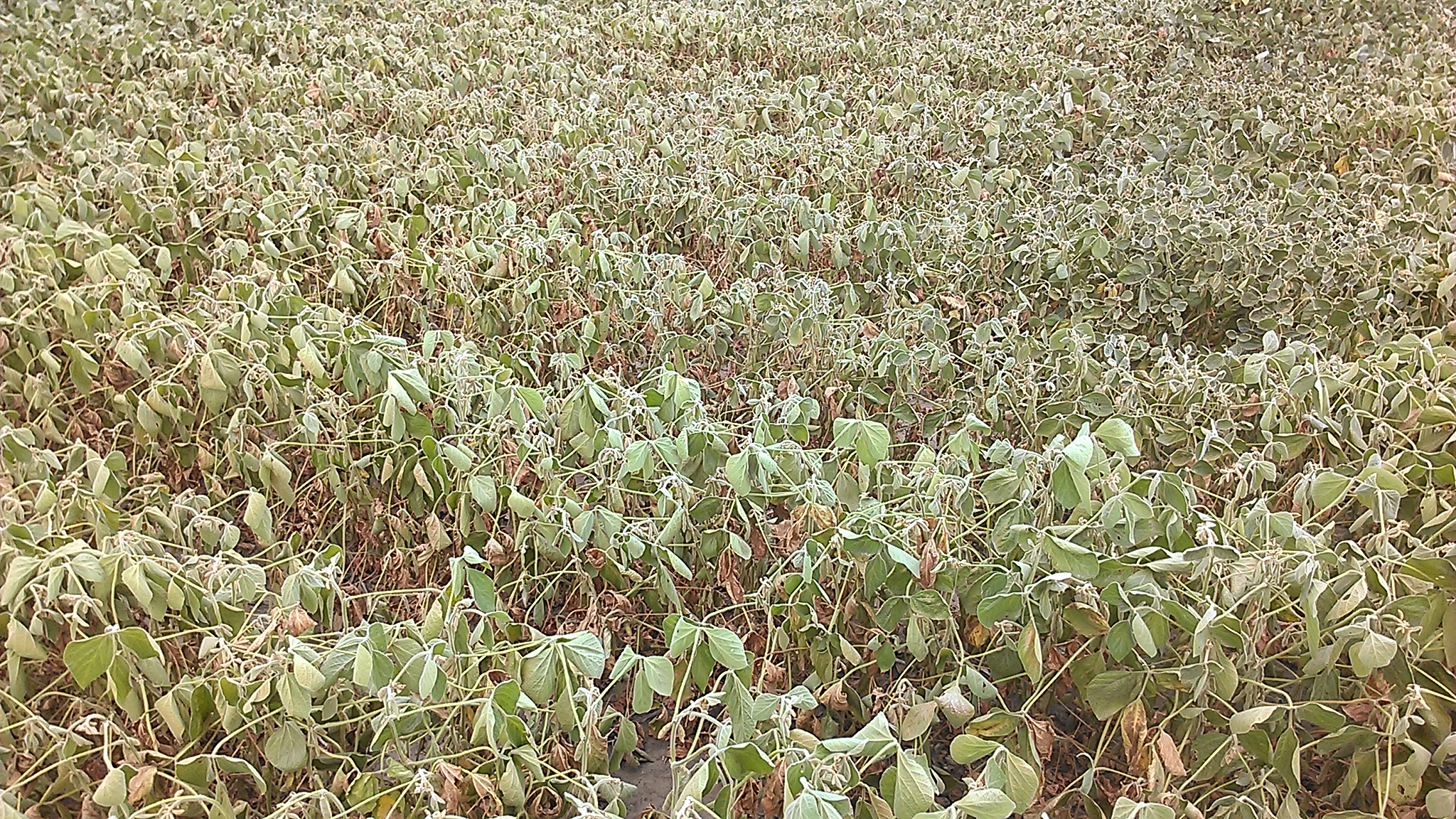
Have also received questions on soybeans, particularly in dryland. This photo is showing drought stressed soybeans-often occurring in pockets within dryland fields right now. Closer observation shows plants aborting pods and losing lowest leaves. Spidermites can also be viewed on leaves in some of these patches.

Dryland corn showing stress as well. June rains were making for dryland crops with potential, but also led to shallow rooting. Crops could use a drink right now….but would prefer no more hail and tornadoes. The storm that hit Clay County so hard occurred one year ago today.
Alabama Agriculture-What I learned

At our first stop, this farming operation had fields where peanuts were strip cropped between rows of pecan trees (shown in background). The farming operation went from around 1500 to 900 pecan trees after the hurricanes in the 1980s. The pecan trees were around 80 years old.
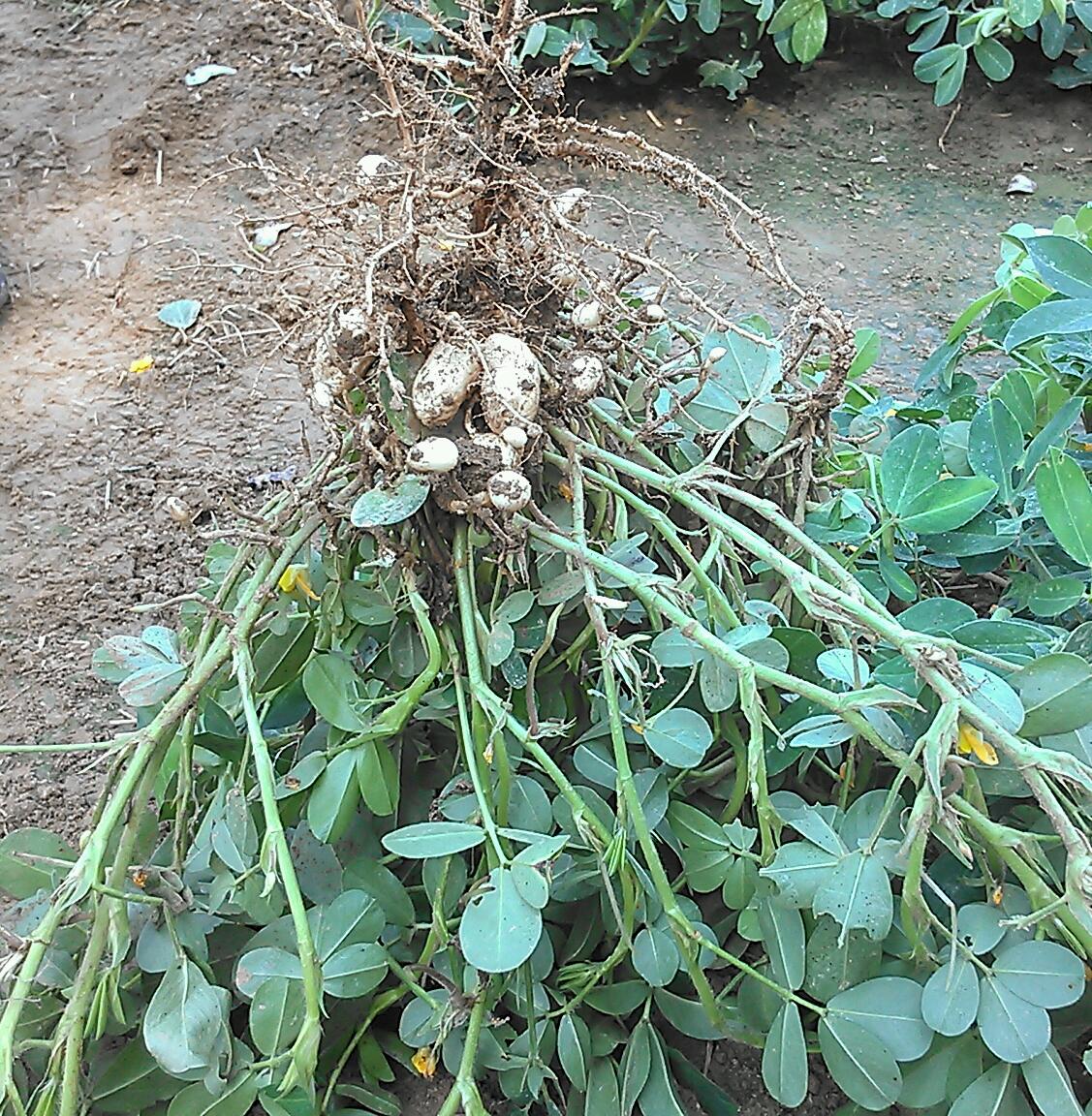
Peanut plant up close. The soils in this part of Alabama are highly acidic and peanuts like a pH between 5.8-6.8 and well-drained soil, so the producers add quite a bit of lime. Different maturities of peanuts are grown so they’re harvested anywhere from September to October.
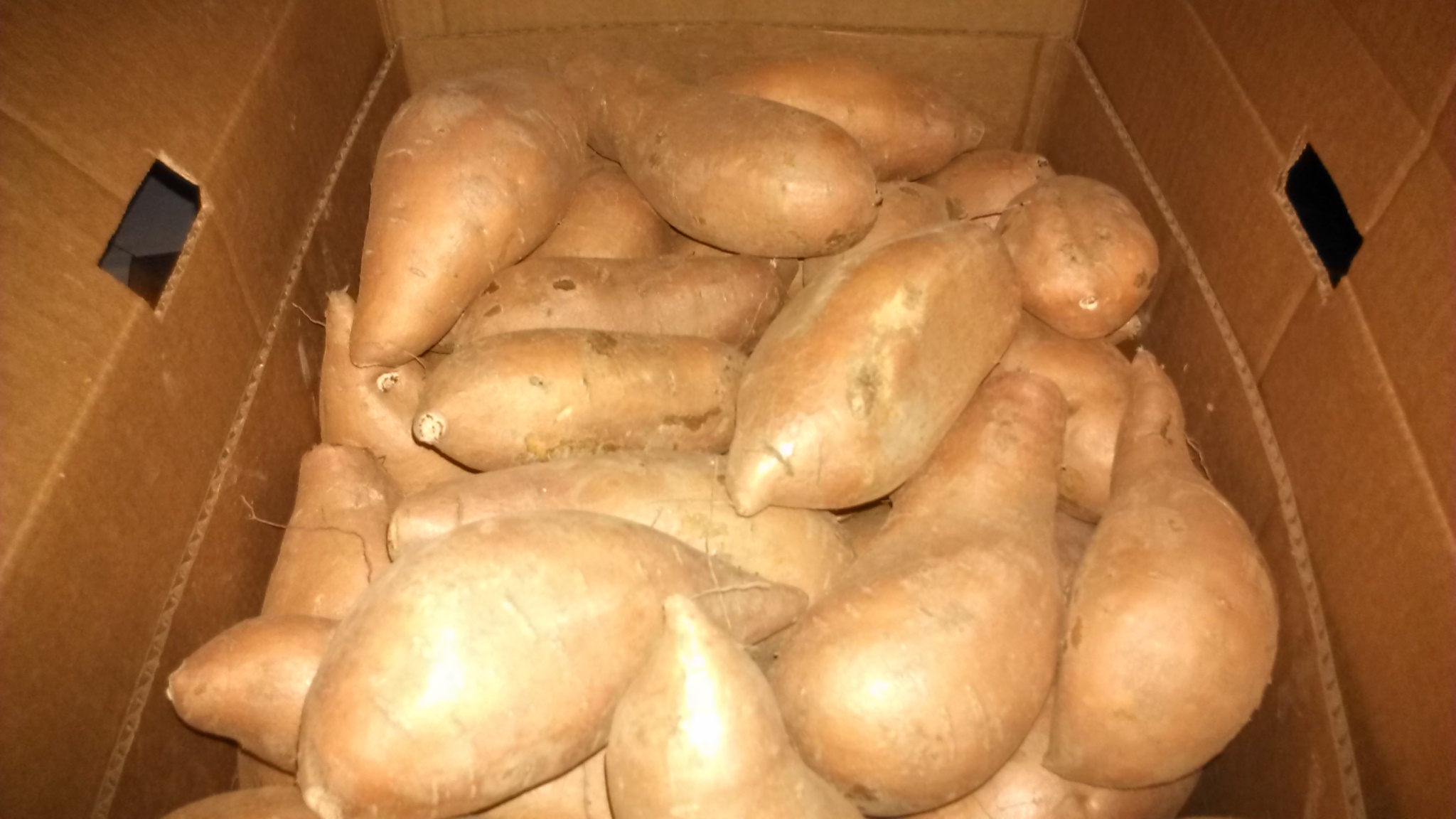
Sweet potatoes! I absolutely love to eat them 🙂 This farm had tried a variety of crops in the past and continues to grow cotton and peanuts as well for a rotation with the sweet potatoes. With low commodity prices for the other crops, sweet potatoes provided another source of income. They are planted mid-April and will be harvested early August this year. The smaller sweet potatoes will go to a canning facility. Potatoes have to be at least 2″ in diameter to be processed for sweet potato fries.

The nephew of the sweet potato farmer was interested in value-added herbs and greens. He put up this greenhouse 11 months ago and has been growing hydroponic greens and herbs for high end restaurants and supermarkets.

A cotton plant. Cotton is actually in the hibiscus family and can get 5-7 feet tall. Growth regulators are used to keep the cotton short so more energy goes into producing cotton instead of vegetative material like leaves and branches. While not easily seen on this picture, the “squares” are where each cotton blossom and seed will be produced.

Auburn Extension Specialist explaining how a cotton plant puts on a new node (where flowers and seed are produced) about every 3 days. He was also showing the shortened internode length due to adding growth regulators to the cotton. Cotton was often no-tilled into wheat. They have similar findings as we do here regarding the improved yields of crops following wheat in dryland. Although, interestingly, they receive on average 66″ of rain a year and Mobile, AL has surpassed Seattle as the rainiest city in the U.S.
Corn Progression After August 2013 Storm
On August 1, 2013, a severe wind and hail storm damaged 170,000 acres of corn and 86,000 acres of soybeans in Clay County, Nebraska. Corn at the time of the storm was from brown silk-blister. While the storms in the Gibbon/Blue Hill areas occurred a little earlier in the growing season, the following photos show the progression of damage in the event it can be of help to those affected by 2014 storms.

Field on August 2nd that was totaled out and planted to cover crops. Where crop insurance allowed, producers considered various forage options.

Some producers chose to spray fungicides on fields with more foliar leaf tissue such as this one.

Hail damage to stalks shown 4 days after the storm.

Splitting the stalks open 4 days after the storm resulted in seeing stalk rot already beginning to set in.
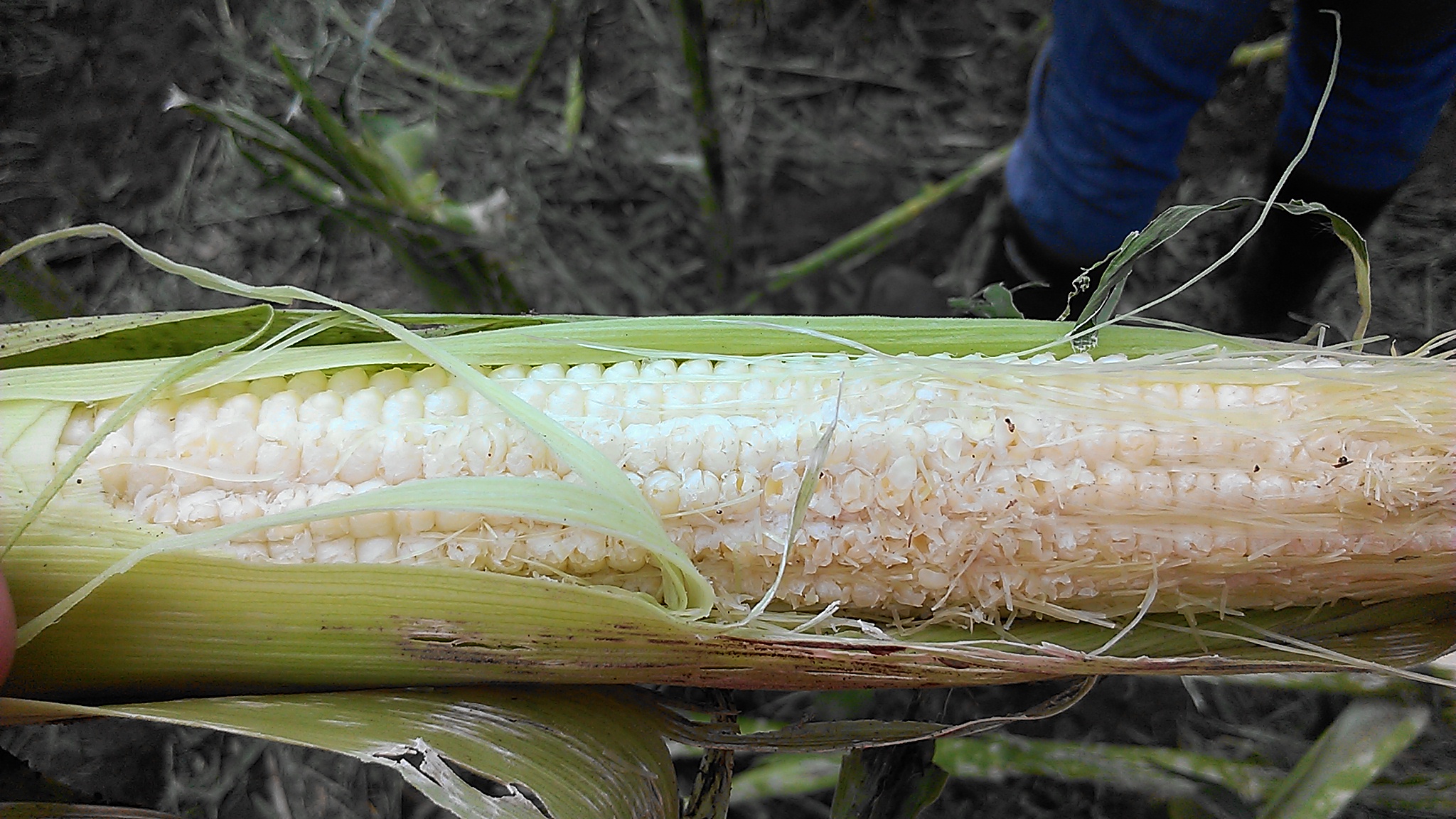
Corn on August 2nd in blister stage in which hail stones made kernels all mushy on one side of the ears.

Corn ear on August 6th. Notice moldy kernels appearing on side where hail damaged ear.
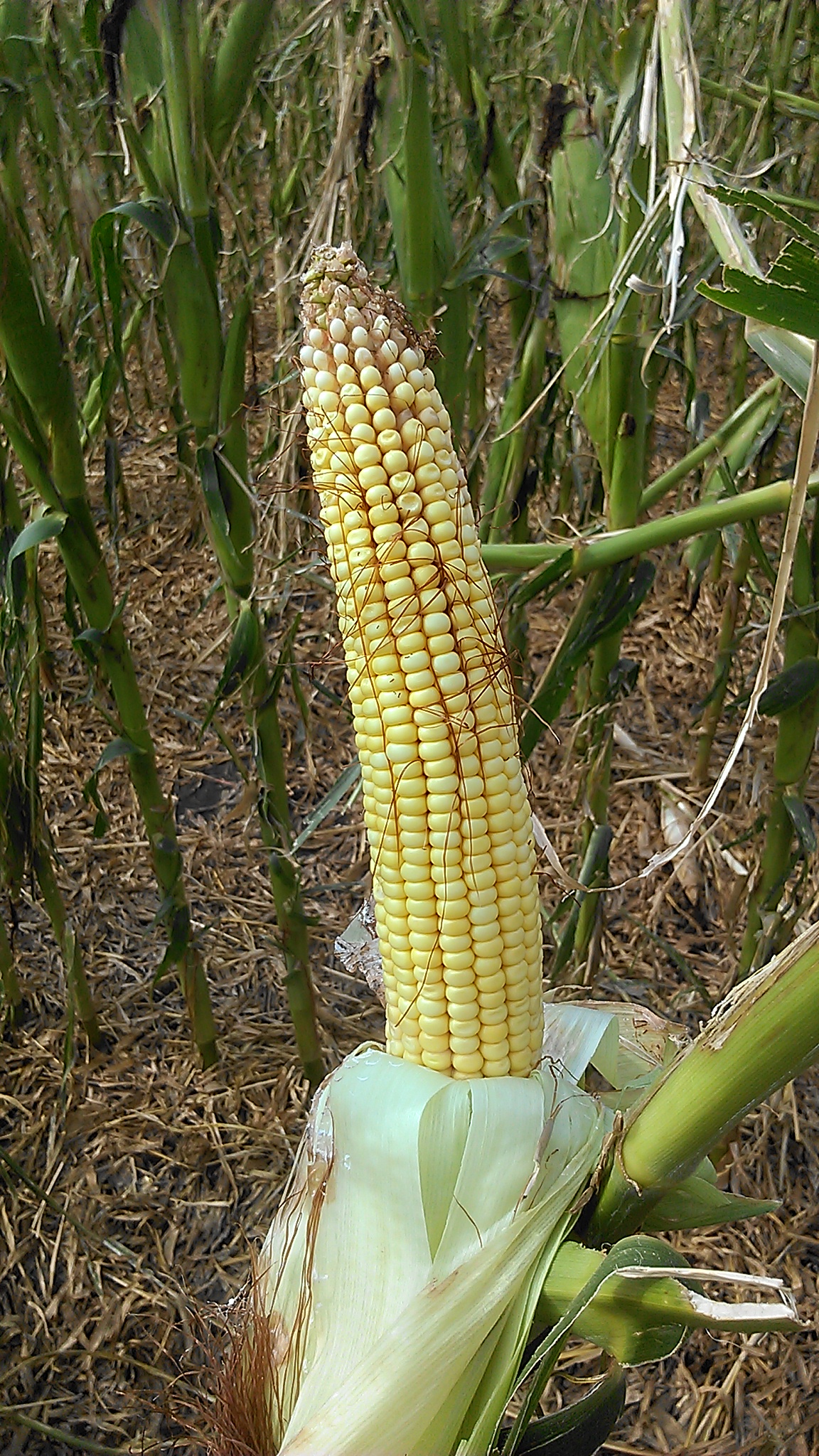
Six days after the storm, the good side of the ear that didn’t receive hail damage.

Six days after the storm, the side of the ear that received hail damage.
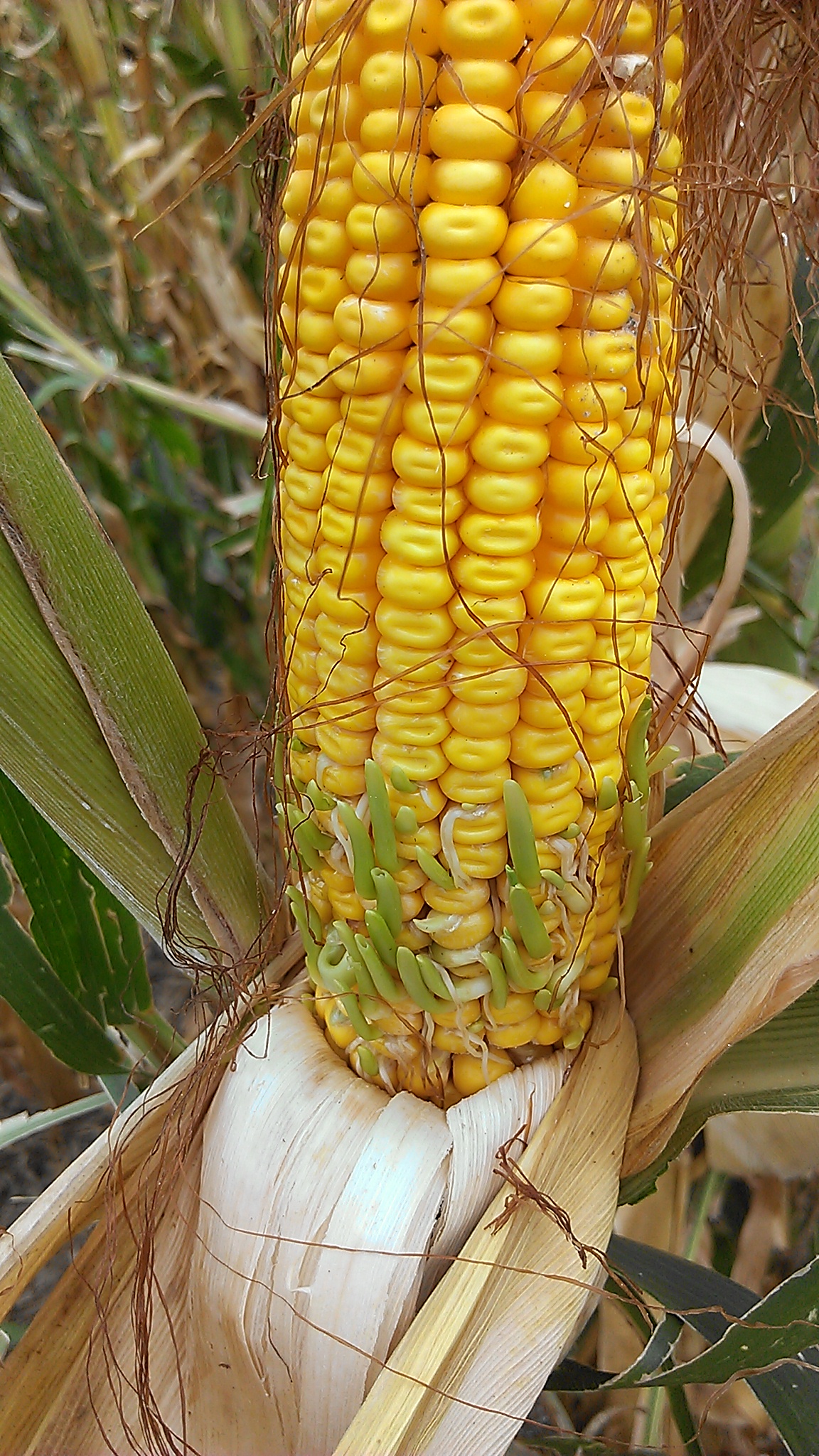
33 days after the storm, kernels on the “good” side of ears were beginning to sprout.
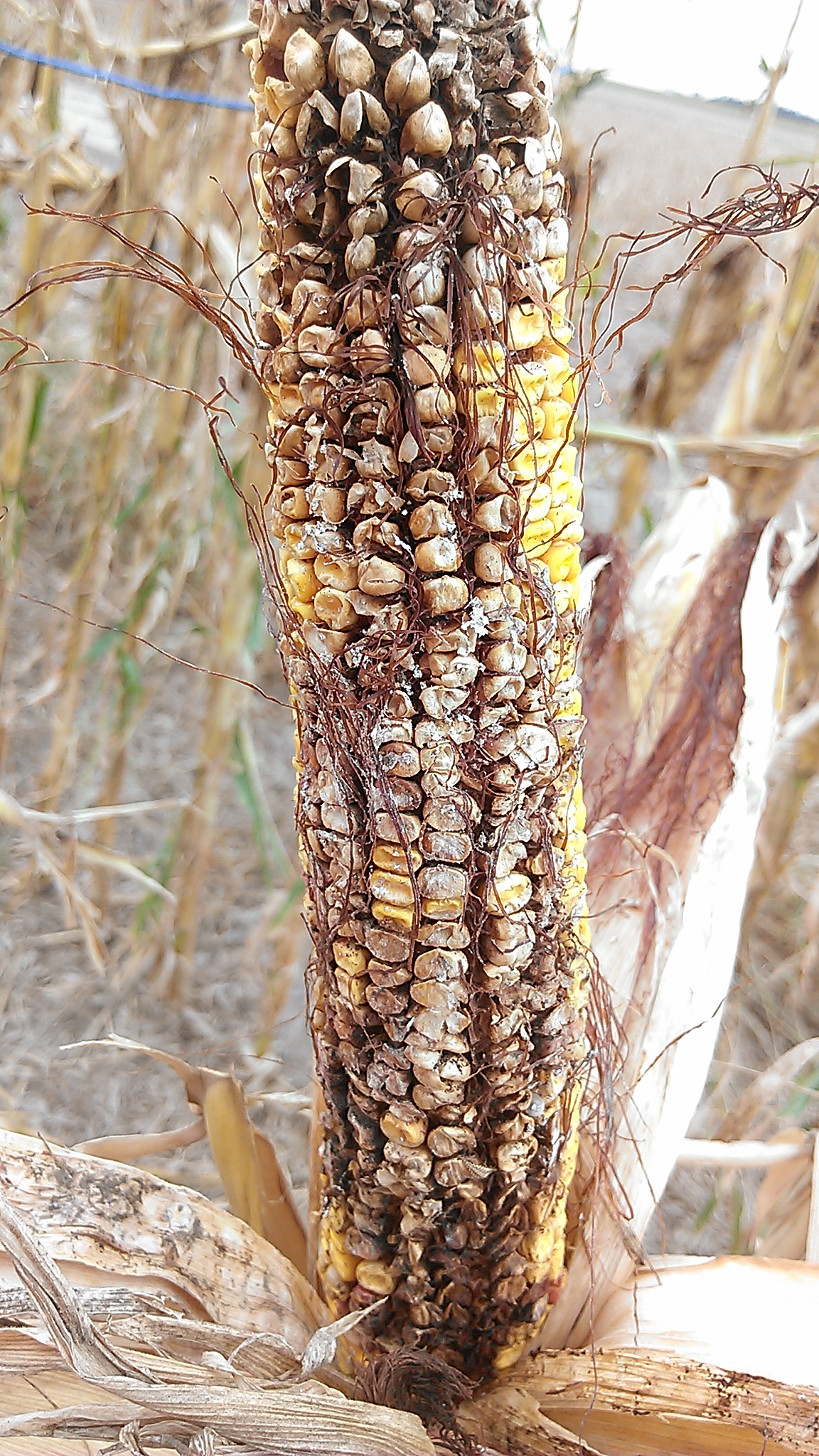
33 days after the storm: Diplodia set in creating light-weight ears and brittle kernels. Sprouting occurring on damaged kernels on sides of ears. The presence of mold does not automatically mean a mycotoxin is present. Producers also wondered about the safety of feeding moldy grain to livestock.
Corn Disease Look-Alikes
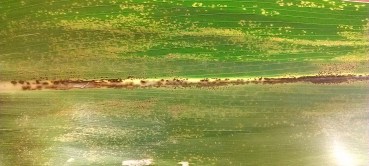
Physoderma brown spot on corn. While the small, speckled lesions may look like southern rust, under hand lens or microscopic observation, there are no raised pustules as would be the case with southern rust. Also notice the brown/purple discoloration on the midrib which is also noticed on the stalk as well where the leaf color meets the stalk.
Fair week tends to be time for tasseling in corn and considerations for watering and fungicide application are being made. Regarding diseases in corn, there has been confusion about a few diseases, particularly about a disease called physoderma brown spot which some have confused for southern rust. The fungus causing physoderma brown spot feeds on pollen and debris on leaves and does not cause harm to the corn plants themselves. Because the spores of this fungus move via water (it’s closely related to oomycetes), numerous lesions can appear on leaves in bands or areas where water collects. While the lesions may look like early southern rust, there will be no pustules present and often purple colored lesions will also be observed in the midrib, leaf sheath, stalk, and outer husks.
Differentiating Rusts:
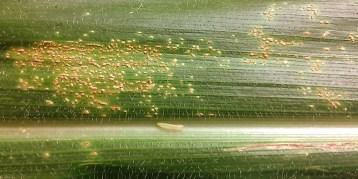
Southern rust in corn. We currently have not seen southern rust in Nebraska in 2014. Notice how you can see raised pustules in this picture compared to the photo of physoderma brown spot above.
When differentiating between southern rust vs. common rust, there are several criteria to consider and this NebGuide is a great resource. Typically common rust will have brick-red pustules randomly scattered on the upper and lower leaf surfaces that are larger in size. It is common rust that we are currently seeing in our fields.
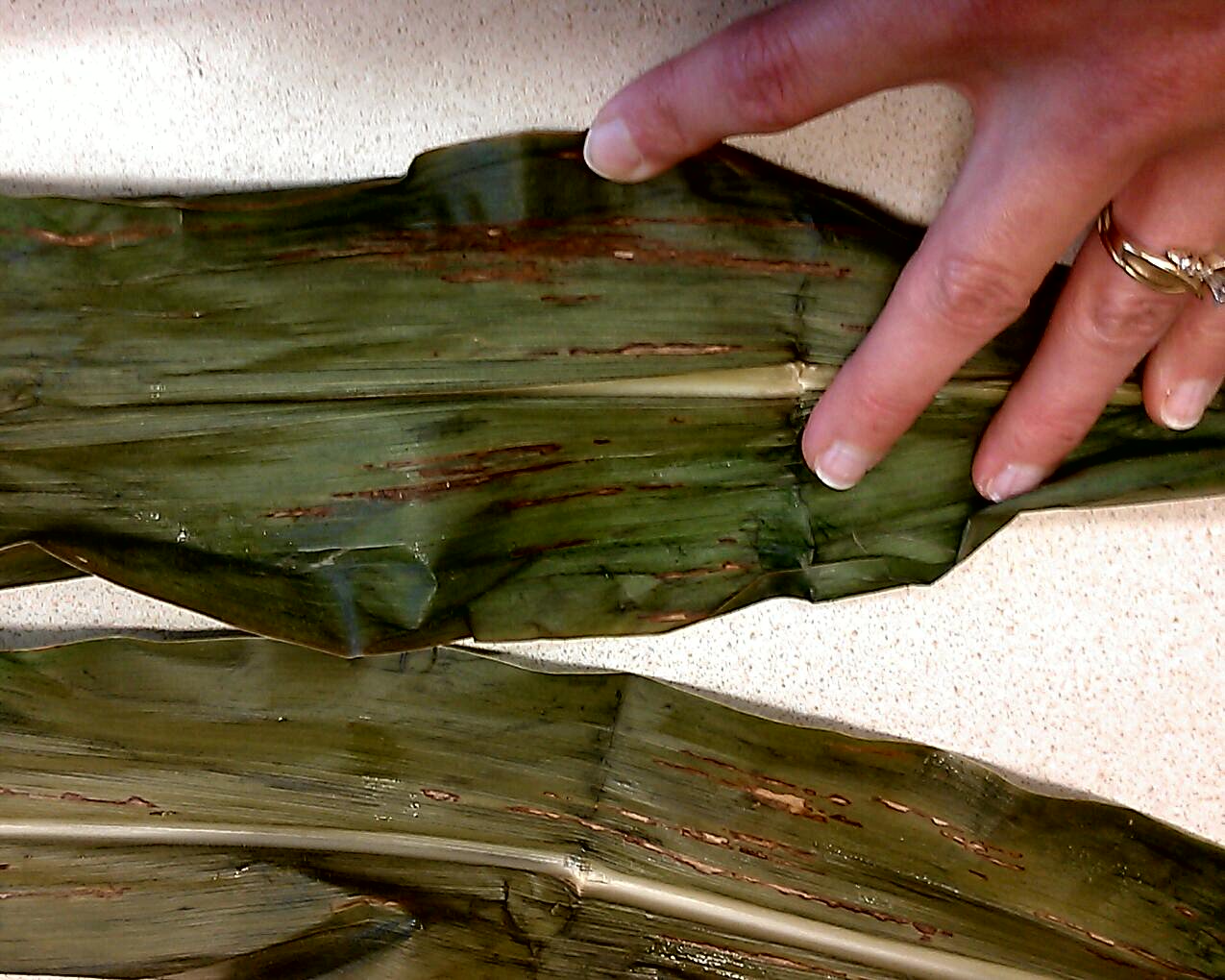
Bacterial leaf blight showing up heavily in some hybrids. The lesions are red-brown in color, long and skinny and mostly vein-limited. Older lesions spread outside the veins and are buff in color-sometimes they are being confused as gray leaf spot. The UNL Plant and Pest Diagnostic Lab is determining species and we will share more information in the future. There is no control for this disease at this time of the season.
Southern rust in our area tends to have very small, raised, tan-orange pustules on the upper leaf surface of leaves in localized areas on mid-upper leaves. These pustules are tightly clustered on the leaves. However, color and size are relative as sometimes the two diseases can look alike. Microscopic observation is the best way to differentiate the two diseases. Fungal spores from Puccinia sorghi causing common rust will be near perfect round circles whereas fungal spores fromPuccinia polysora will be oblong in shape.
We do have some gray leaf spot in the lower canopies and I haven’t seen much northern corn leaf blight in the fields. But we do
have a bacterial leaf blight that is affecting quite a bit of leaf tissue on some hybrids. These lesions are long and skinny appearing at first to be limited to the veins. There’s been concern about these lesions being severe gray leaf spot but it’s not and there’s nothing you can do about the bacterial disease. Please don’t mistake this bacterial disease as a fungal one and trigger a fungicide application too early.
Fungicide Application Timing
We tend to see southern rust in our part of the State each year; it’s a matter of time. Triggering a fungicide application too early may result in no residual for when you need it if/when southern rust occurs. Every year some producers make more than one fungicide application due to blanket applications at tassel or shortly after followed by another fungicide application when southern rust occurs later in the year. Consider good fungal resistance management and apply fungicides when disease pressure warrants them in your fields and also consider economics for your situation for proper fungicide application timing.
Hail Damage Meetings
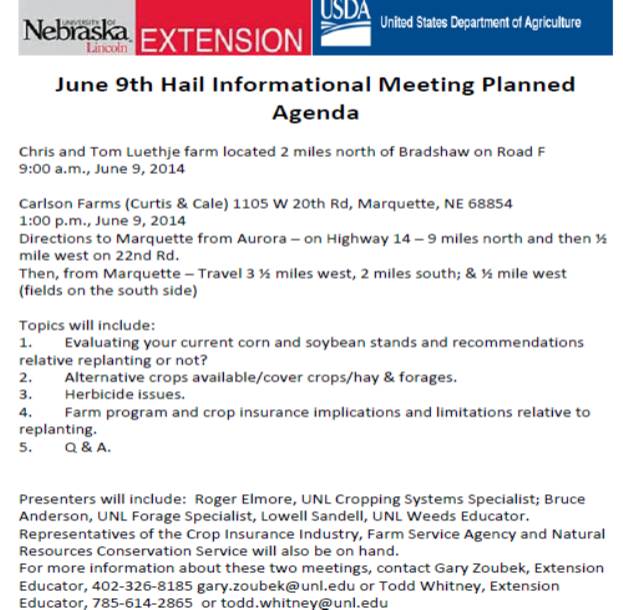
Hail Damage Meetings in York and Hamilton Counties. Please click on image to enlarge.
Storm Damage Resources

Field flooding occurred in newly planted and newly emerged fields throughout the area after recent rains.
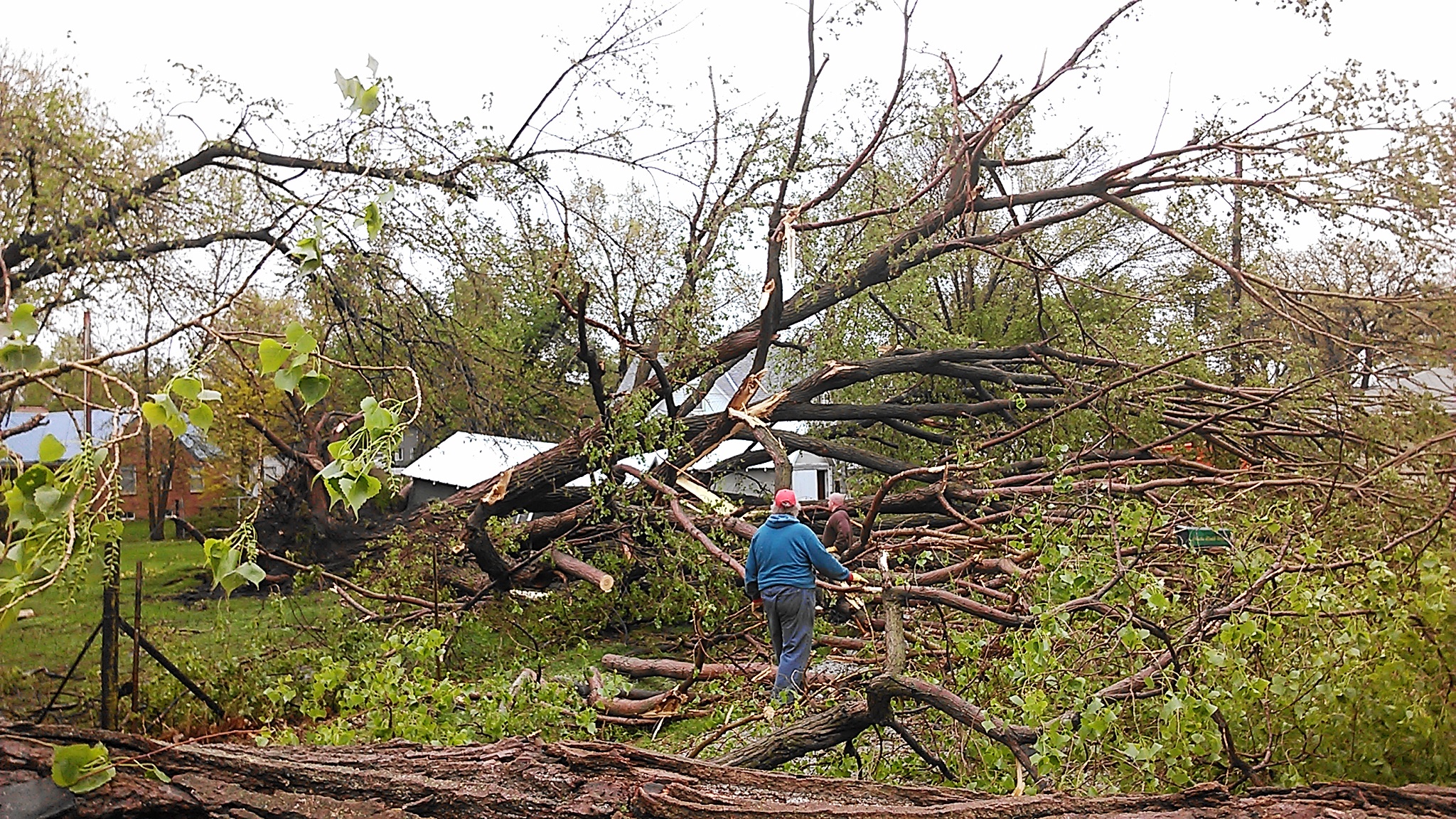
Large trees were uprooted falling on buildings, homes, and cars in Sutton after the May 11, 2014 tornadoes.
The Mother’s Day 2014 storms caused significant damage in Clay County and other areas of the State. It never ceases to amaze me how people throughout the area respond to storm damage! Clay County has had its share, and yet the attitude of those affected has been one of thankfulness-thankfulness that no one was injured and that so many still have their homes in spite of damage. It’s also wonderful to see people from all over the County and area pull together with each storm-helping each other out bringing themselves and equipment to pick up debris or help however possible. It’s a blessing to work with and serve the people of this County!
Resources
As clean-up continues, the following are a list of resources that may be helpful to those affected by the storms. Thoughts and prayers go out to all who were affected!
- Numerous Tornado Damage, Recovery, Cleaning, Decision Making resources (scroll to Recovery portion in middle of page)
- Tips for Early Tornado Damage Recovery
- When to Save and Throw out Frozen Food after Power Outages
- When to Save and Throw out Refrigerated Foods after Power Outages
- Flooding and Corn Survival
- Flooding and Soybean Survival
- Evaluating the Need to Replant


 JenResources