Blog Archives
JenREES 9/22/24
Harvest is here and it’s been wonderful to see some good yields thus far! I was not expecting what we’re seeing for non-irrigated corn yields with how dry it’s been. And, it’s wonderful to finally see good soybean yields again! So far, non-irrigated, depending on area, is going 50-70 bu/ac and irrigated is going 70-high 80’s. The beans are also beautiful in size and quality so far this year!
Harvest Safety: For all of us as we’re on the roads, please be alert and slow down. It’s also important to talk about safety with teens who drive. Key things for us all: don’t pass in any designated “no passing zones”. Also don’t pass within 100 feet of an intersection, bridge, or railroad crossing. Don’t assume a tractor is going to turn right (another reason not to pass within 100 feet of an intersection). I always appreciated how dad pulled off into the right-hand side of the intersection when on highways or paved roads if he wanted to make a left-hand turn in a tractor because one never knows what vehicles behind you will do.
It’s so dry and hard to see on gravel roads when there’s traffic. Please be safe, slow down/stop at intersections and railroad crossings, headlights on, and be watchful/slow down as you come up on slow moving vehicles. For our farm families, we know things happen so quickly so please think safety with machinery, watch for people and objects around you, watch for power lines, and take your time on machinery and bin steps. Brandy VanDeWalle, Extension Educator, shares additional info. on her blog: http://vandewalleviews.com/2024/09/13/harvest-safety-12/. Here’s wishing everyone safety and good yields this harvest season!
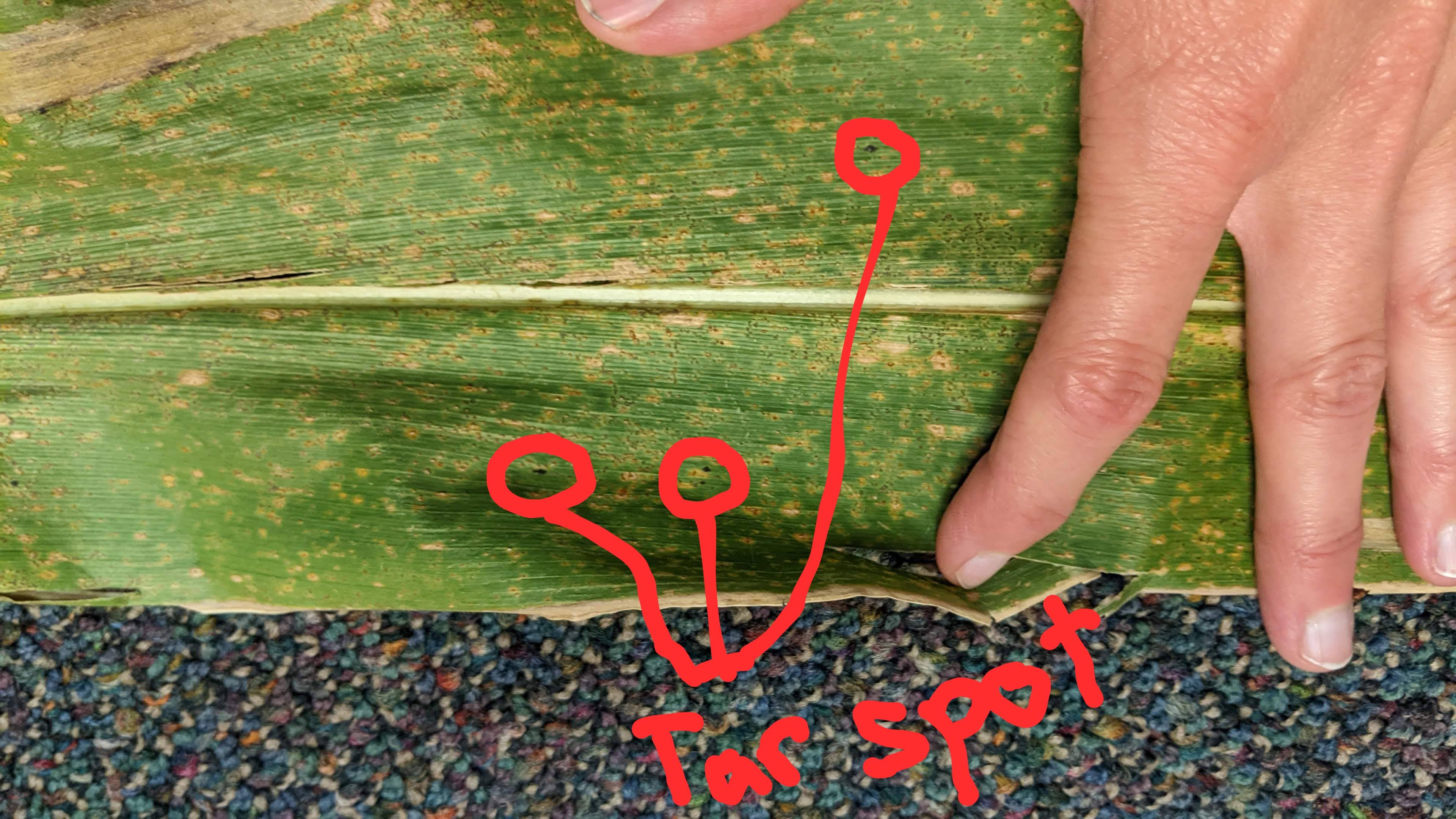
Tar Spot vs. Southern Rust: With corn leaves drying down, people are wondering about the black spots they’re seeing on leaves. Right now, the majority of what is seen is either southern rust teliospores or saprophytic fungi feeding on dead/decaying material. Both of those can make for a dusty harvest. I have photos on my blog showing differences again between southern rust teliospores and tar spot. Tar spot just has a totally different look and color of black compared to what southern rust looks like. Hopefully the photos help ease people’s minds as most of what is out there is southern rust.
UNL Beef Extension online learning opportunities: Nebraska Beef Extension has planned several online learning opportunities that cover a variety of topics (listed below). For more information and registration please visit https://beef.unl.edu.
- Increasing Feed Value of Grazed Corn Residue: Sept. 24, 10 a.m. – 3 p.m. (CDT)
- 2025 Beef Heifer Replacement Price Forecast: Sept. 26, Noon (CDT)
- UNL Heifer Development Center First Year Wrap-up: Oct. 2, 10 a.m. – 3 p.m.
- Cornstalk Grazing Fundamentals, Leases and Agronomic Impacts Webinar Series 7 p.m.:
- Oct. 8, Corn Residue Grazing Fundamentals
- Oct. 10: Grazing Leases, Prices and Finding and Renting Residue
- Oct. 15, Agronomic Impacts for Grazing Corn Residue
- Oct. 17: Producer Panel-Challenges and Opportunities
- Knowing, Growing and Grazing Grass: Oct. 14, 17, 21, 24, 28 & 31, 7:30 – 8:45 p.m. (CDT)
- Pasture, Rangeland, Forage Insurance for Livestock Producers: Oct. 24, Noon (CDT)
- Leveraging Genetics to Improve Profitability: Nov. 4 & Nov. 6, 6:30 – 7:45 p.m. (CDT)
- Cattle Cost of Production, part of the Ag Smart Money Week series: Nov. 4
- Fundamentals of Feeding the Cow: Nov. 11, 14, 18 & 21, 7:30 pm – 8:45 pm

JenREES 9/17/23
It was great getting to see and catch up with several people at Husker Harvest Days last week! The main update I have is that tar spot is being found more in this area of the State. Grateful it has only ever occurred at the end of the season for us. Next week I’ll share on an invasive grass that cattle won’t eat being found in some area warm-season pastures.
Harvest Safety: With harvest, it’s up to all of us to be safe and watchful on the roads. It’s so dry and hard to see on gravel roads when there’s traffic. Please be safe, slow down at intersections and railroad crossings, lights on, and be watchful/slow down as you come up on slow moving vehicles. For our farm families, we know things happen so quickly so please think safety with machinery, watch for people and objects around you, watch for power lines, and take your time on machinery and bin steps. Brandy VanDeWalle, Extension Educator, shares additional info. on her blog: https://vandewalleviews.com/2023/09/15/harvest-safety-11/. Here’s wishing everyone safety this harvest season!
Pricing corn silage: This was written by Shannon Sand, UNL ag economist, “According to UNL research, corn silage priced standing in the field before harvest would be valued at 7.65 times the price per bushel of corn, where a ton of corn silage is harvested at 60-65% moisture. For example, corn near $5.00/ bushel at harvest puts corn at $38.25 per ton. This accounts for not having to combine or haul grain to market but should also be harvest corn prices as we add storage costs to silage. According to the 2022 Nebraska farm custom rates publication, the average for harvest, hauling and packing of corn silage was $13.50 per ton. At $38.25 per ton plus $13.50 per ton for custom work, this gives us $51.75 per ton in the pile. When $3.00 per ton is added for storage, the price is now $54.75.” Additional information can be found in the following NebGuide: https://go.unl.edu/mik9.
Planting Trees: Fall is tree planting time and sometimes tree problems I diagnose are the result of incorrect planting. Kelly Feehan, Extension horticulture educator shares, “It is very important not to plant trees too deep. If a tree is planted the same depth it is in the container; or, the soil beneath the root ball is loosened when digging; then the tree is likely planted too deep. When I diagnose tree problems, I look at the trunk near the soil line. If it looks like a telephone pole going into the ground and there is no trunk taper at the base, I know the tree was planted too deep and that may be the cause of decline. Planting trees too deep leads to slower growth, decline and girdled roots that can cause tree failure. To plant a tree at the correct depth, never dig the hole until you find the first lateral root growing off of the trunk. Soil may need to be scraped away to locate this root. Once found, dig a hole that is a depth where the first root will remain just below or at the soil line. Do not disturb the soil under the root ball; but dig the hole one to two feet wider than the root ball.”
Lawn Weed Control: Those without irrigation systems struggled with thin lawns and both annual and perennial weeds this year. Perennials weeds have included dandelions, ground ivy, and bindweed. Annual weeds have included crabgrass, prostrate spurge, and purslane. So what can you do for the future? Late September through mid-October is the best time to control perennial broadleaf weeds with herbicides labeled for their control in grass. During the fall, the weeds will take the chemical into the root system increasing the opportunity for their death. Annual weeds will die with a hard frost. You can hand-pull or power-rake if you’re still working on reseeding lawns, but seed most likely has been produced. In May next year, you can apply a pre-emergence herbicide to prevent the weed seeds from emerging. Because we often get another flush of weed seeds germinating, if you had a lot of weed pressure this year and have a thin lawn, you can consider making a second pre-emergence application 8-10 weeks later. Thicker lawns help reduce weed seed germination if you can get a thicker lawn established as well.


I realized for all those who subscribe to my blog but don’t receive my email that I haven’t been posting the irrigation needs each week like I have on my email. So, adding that again as a reference for everyone finishing up.
JenREES 9-6-20
Harvest: Harvest has begun for some with soybeans, seed corn, and silage. For all of us as we’re on the roads, please be alert and slow down. It’s also important to talk about safety with teens who drive. With it being so dry, gravel roads are extra dusty, reducing visibility. It can be helpful to turn on headlights and be sure to slow down at intersections. On highways, slow down when coming upon slow-moving equipment. And, be aware of equipment turning. Here’s wishing everyone a safe harvest!
Nebraska Public Power District, Rural Radio, Center for Ag Safety and Health, and Nebraska Extension are teaming up to share on harvest safety with the Harvest Safety Tour. Power line, ATV, and grain bin safety demos will be on display and a free lunch will be served September 9th from 11 a.m.-1 p.m. at the big parking lot at the York County Fairgrounds. For more information call 877-ASK-NPPD.
Early and mid-group two soybeans rapidly turned last week and may be drier than one realizes in spite of having green stems. Every year it’s a challenge to harvest close to 13% moisture. There’s a dock for delivering wet beans. While not a dock, delivering soybeans below 13% moisture reduces profits because there’s fewer bushels to sell (load weight divided by 60 lbs/bu assuming 13% moisture). Selling soybeans at 8% moisture, you’re losing about 5.43% yield; at 9% moisture, it’s 4.4%; at 10% moisture, 3.3%; at 11% moisture, 2.25%; and at 12% moisture, it’s 1.14% yield loss. That doesn’t take into account additional risk for shatter losses during harvest. The following are two profit examples:
Example 1: Based on the elevator dockage numbers obtained, if the grower was to sell beans at 13.8% moisture, he/she would be docked 3% of the selling price of $8.75/bu, reducing the actual price to $8.49 per bushel. Total income per acre would be: 75 bu/ac yield x $8.49/bu = $636.75 per acre gross
Example 2. If the soybeans were harvested at 9% moisture, there would be 3.3 fewer bushels per acre to sell (4.4% of 75 bu/ac yield due to water loss): 75 bu/ac – 3.3 bu/ac =71.7 bu/ac yield x $8.75 = $627.38 per acre gross
In this example it’s better to take a dockage for selling beans at 13.8% moisture than sell them at 9%. The difference is a positive gain of $9.37 per acre or almost $1265 on a 135 acre field.
Harvesting at 13% moisture is perhaps a combination of art and luck depending on environmental conditions. Some tips to achieve this can include begin harvesting at 14% moisture, making combine adjustments and operating at slower speeds (consider these equipment adjustment tips for your combine), plan variety selection to spread out maturity and harvest (we’re finding around 1 day delay for every 0.1 difference in maturity group), and avoid harvest losses from shatter as only 4-5 beans on the ground can add up to a bushel per acre loss.
Pasture & Forage Minute: With Dr. Bruce Anderson’s retirement (former Extension Forage Specialist), a team of Extension specialists and educators are sharing pasture and forage minutes. These quick updates are also shared via email. If you’re interested in receiving them, you can sign up for the email list by going to this site: https://listserv.unl.edu/signup-anon , enter PASTURE-AND-FORAGE under ‘list name’, and your email.
Emerald Ash Borer (EAB) was found in Seward in a trap at the Blue Valley Campground in early August. We don’t recommend treatments right now in the fall. Because of the cost, treatments are only recommended for high value and/or already healthy trees. Once EAB has been confirmed within the 15 mile radius of your location, then you can begin the proper treatment applications on healthy trees. A yearly soil drench application is one option for homeowners for trees under a 20” trunk diameter. Tree care professionals are able to use additional products like trunk injections on larger trees. Contact a certified arborist for these treatments. Some products are best applied in the spring, while others can be done throughout the summer. Treatment zone considerations can be found here: https://nfs.unl.edu/documents/EABmap_2020-08-03.png. Please don’t move firewood to help prevent the spread!
JenREES 9-22-19
Harvest: Grateful to see harvest going last week! There’s a good article in CropWatch from Roger Elmore, Tom Hoegemeyer, and Todd Whitney regarding how cool weather and reduced solar radiation (sunlight) in August impacted yields. Part of our problem with stalk quality is also due to this. Yield potential can be reduced by cool, cloudy weather yet it can also increase grain fill period allowing for heavier ears as we’ve also seen. You can read the article with full details at https://cropwatch.unl.edu. We would also ask for your input regarding the most important weed problems/issues in your part of the State by completing this survey at: https://www.surveymonkey.com/r/QZV8Z2T.
A reminder for all of us to please be safe during harvest! It was sobering scrolling

From Ag Twitter Sept. 18, 2019
through Ag Twitter last week seeing the number of people posting pictures of farm accidents. Most common were truck drivers taking corners too quickly, overturning vehicles. It was extra sobering that some of the accidents led to death of family or friends. Others posted remembrances of this time of year when they lost someone due to a farm accident.
For all of us as we’re on the roads,

From Ag Twitter Sept. 19, 2019
please be alert and slow down. It’s also important to talk about safety with teens who drive. Gravel roads are especially dangerous with dust blowing as vehicles travel, limiting visibility. Slow down at intersections. On highways, slow down when coming upon slow-moving equipment. And, be aware of equipment turning. Collisions involving 1,432 Ohio farm vehicles and other motor vehicles were analyzed for a four-year period (1989-1992). Seventy-eight percent of two-vehicle collisions occurred during daylight hours, with a peak occurrence during the time interval from 3:00 to 6:00 P.M. Forty-two percent of the nighttime crashes were rear-end collisions, compared to 8% of the daylight crashes. Fifty-two percent of daylight crashes occurred when the tractor operator was making a left-hand turn. It’s hard to know if the drivers behind a tractor will try to pass when you want to make a left-hand turn. To avoid this some will pull off to the right and square up to go straight when they want to make a left-hand turn. I also read an interesting publication from Purdue University called “Learning from Truck and Equipment Collisions”-interesting actual accounts and photos. Bottom line: even if the tractor or truck driver wasn’t at fault, there’s a checklist of items that will be asked as the other party will look for any potential way to place fault. I think it’s a helpful read, especially if you have employees within your farm or ag operation: https://ppp.purdue.edu/wp-content/uploads/2019/07/PPP-127.pdf.
Reading an article on harvest safety by Iowa State University, I was surprised the greatest number of harvest accidents actually involve slipping or falling off equipment. But it makes sense as people are mounting and dismounting tractors and combines several times a day. Painted metal on ladders and platforms can become slippery especially when wet or with factors such as mud, crop residue, snow, or ice. Reminder to use grab bars when mounting or dismounting machinery; wear well-fitting shoes with non-slip soles; and recognize that fatigue, stress, drugs/alcohol, and age can affect stability.
Double check where all people are. Keep children away from machinery and grain bins. Double check to make sure all machinery is working properly and that safety shields are in place. When moving equipment, especially grain augers, watch for power lines, keeping equipment at least ten feet from them. Don’t get into grain wagons or bins while the grain is moving. There’s a new film that every farm family should consider seeing called “Silo” where it talks about the dangers of entering grain bins. This week’s Market Journal highlighted the movie and you can learn more here: https://www.silothefilm.com/. Shut down moving equipment when it gets plugged. It only takes a few extra seconds and is well worth it to save a limb. In the rush of harvest season, our ultimate goal is everyone gets home safely each day/night! Here’s wishing you a safe harvest season!


 JenResources