Blog Archives
CropUpdate 7-18-11
While it may be strange, I love the smell of corn pollinating and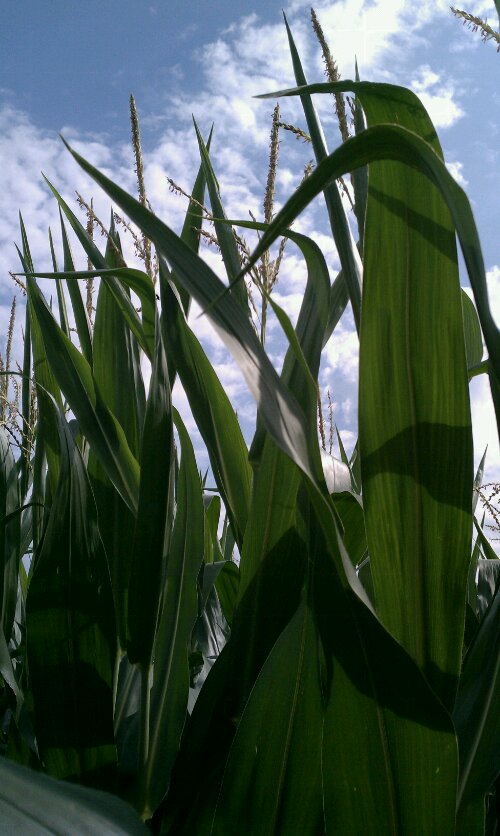 don’t mind walking fields this time of year! Summer is flying by but it seems like it’s taken a long time to get to tasseling in our fields this year. Now that corn is tasseling, we can take into account the third foot root zone for irrigation scheduling. There still is moisture to consider in the third foot so continue to check your readings on your irrigation scheduling tools and now take averages for all three feet. You may be surprised as some of you won’t need to water till end of July/beginning of August! If you have any questions about your irrigation scheduling tools, please continue to call any of us Extension educators or the NRD personnel as we want to help you and work with you now to answer them.
Disease just isn’t an issue so far in fields, so for those of you who purchased fungicide, wait till disease is present when you may need it. UNL research by Dr. Tamra Jackson has proven yields are just as good with delayed fungicide applications as they are at tassel. The longer you wait to use it for gray leaf spot, the more chances you will have residual for southern rust when it comes in. While corn prices are high, you want to keep as much of that money as you can! I don’t recommend fungicides on soybeans as we don’t have the disease to warrant it. If you did pre-pay fungicide for soybeans as well, the timing of that application should be R3 (beginning pod).
Soybeans are approaching beginning pod for many of you. For soybeans, this is a critical time for moisture in addition to seed fill at R5. Many irrigation systems were running on beans last week and I just cringed because the time we don’t want to water soybeans is full flower or (R2). The reason for that is because it can create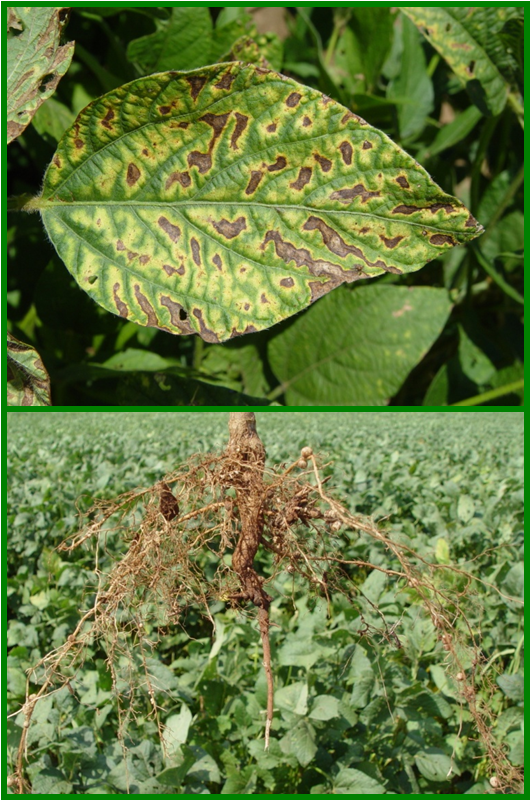 disease issues. We’ve seen a large increase of sudden death syndrome (SDS) the past few years in our county. Part of that is due to early planting in cold soils, but irrigation during flowering can also play a role. The major disease that occurs when irrigating during flowering is sclerotinia stem rot (also known as white mold). While we have very few cases of this in the area, this disease is one that you don’t want to get started in your fields. Like the fungal pathogen causing SDS, the fungal pathogen causing white mold is soil borne. Thus, once you have it, you can never get rid of it. White mold gets started during R2 when flower petals begin to die and the fungus develops on those dead petals. Wet, humid conditions during flowering are key to fungal development, so in the future, avoid irrigating beans during the flowering stages to avoid problems with these two diseases.

CropUpdate: 7-5-11
Last week was a blur of phone calls but it’s great to receive them and know so many of you are doing your best to wait for your soil to be depleted before scheduling your first irrigation! There are some of you in the Little Blue NRD who haven’t received the rains the past few weeks and have hit the 90-100 trigger on your watermark sensors to schedule your first irrigation. Most of you reading this won’t have to irrigate till after tassel (and then you can take into account the 3rd foot in your average)! The 90-100 trigger relates to 35-40% soil moisture depletion and is proven by research via Dr. Suat Irmak at South Central Ag Lab for our silty clay soils. Waiting for the trigger, regardless if you’re on load control or not, will still allow you at least a week to 10 days before you have to worry about getting behind. Please continue to call with questions. There’s also a discussion topic on my blog for your comments/questions.
Corn and beans are looking good overall, are closing canopies, and corn is rapidly growing. Wheat is being combined in the southern tier of counties and there has been quite a range of yields due to the dry weather producing small heads and disease issues such as scab, smut, and ergot. Scab (Fusarium Head Blight) is a concern when we receive rain and high humidity during and around flowering. We were recommending fungicides at that time. Some people escaped it, some put the fungicide on, and others didn’t-so there’s a range of yields out there from that. Common bunt (stinking smut) is the smut that creates clouds of black spores when you’re combining and the grain smells like fish. Loose smut is loose in the head and doesn’t form a kernel shape like common bunt does. Both can be prevented by not saving contaminated seed and using fungicide seed treatments at planting.
Ergot is one I hadn’t seen in wheat since I’ve been here but have in roadside grasses. Ergot is caused by a fungus that infects the wheat head during cool, wet conditions during flowering. Like the fungus that causes scab, it simply replaces the normal pollination process and instead, a black/purple hard fruiting body (sclerotia) is eventually formed. Before this is formed, a sugary drop called honeydew is formed which then turns into the sclerotia. It’s a problem for our producers because I don’t know that you can set your fans to blow it out like you can for light, scabby kernels since ergot sclerotia are denser. The problem with ergot is that it contains toxic alkaloids (one is like LSD)…in fact, it’s blamed that ergot-contaminated grain is what caused the Salem Witch Trials. These alkaloids are also toxic to livestock so contaminated grain should not be fed or even blended off for livestock. Federal grain standards classify wheat as ergot infested when it contains more than 0.3% sclerotia. If you are finding ergot-contaminated grain in your fields, do not save seed back next year; start over with disease free certified seed. The sclerotia will live on top of the soil for a year (they will produce spores next growing season so don’t plant contaminated wheat fields back into wheat, barley, oats, or triticale). Mowing roadside ditches and keeping wheat fields free of other grasses can help prevent ergot infested grasses from spreading the ergot fungus to wheat via blowing spores and rain splash. More information can be found by checking out the UNL Extension publications Head, Grain, and Seed quality on the http://cropwatch.unl.edu/web/wheat/disease Web site.
Discussion: Irrigation Scheduling
I’m adding this post as a discussion topic as we get into the growing season for producers to post their irrigation scheduling questions or to share what their sensors and ET gages are reading. With the Nebraska Ag Management Network, we’ve learned that producers often need other producers to check their readings with-kind of like a support group for producers involved with this effort. That’s because it’s hard to not irrigate when neighbors are irrigating and your irrigation scheduling tools are telling you that you don’t need to irrigate! We’ve had some good discussions in the past so I look forward to the discussions this coming year!
Irrigation Scheduling Equipment
It’s nearing mid-May and crops should hopefully be emerging soon! For those of you utilizing watermark sensors for irrigation scheduling, it’s important to install those shortly after emergence so you can monitor soil moisture fluctuations long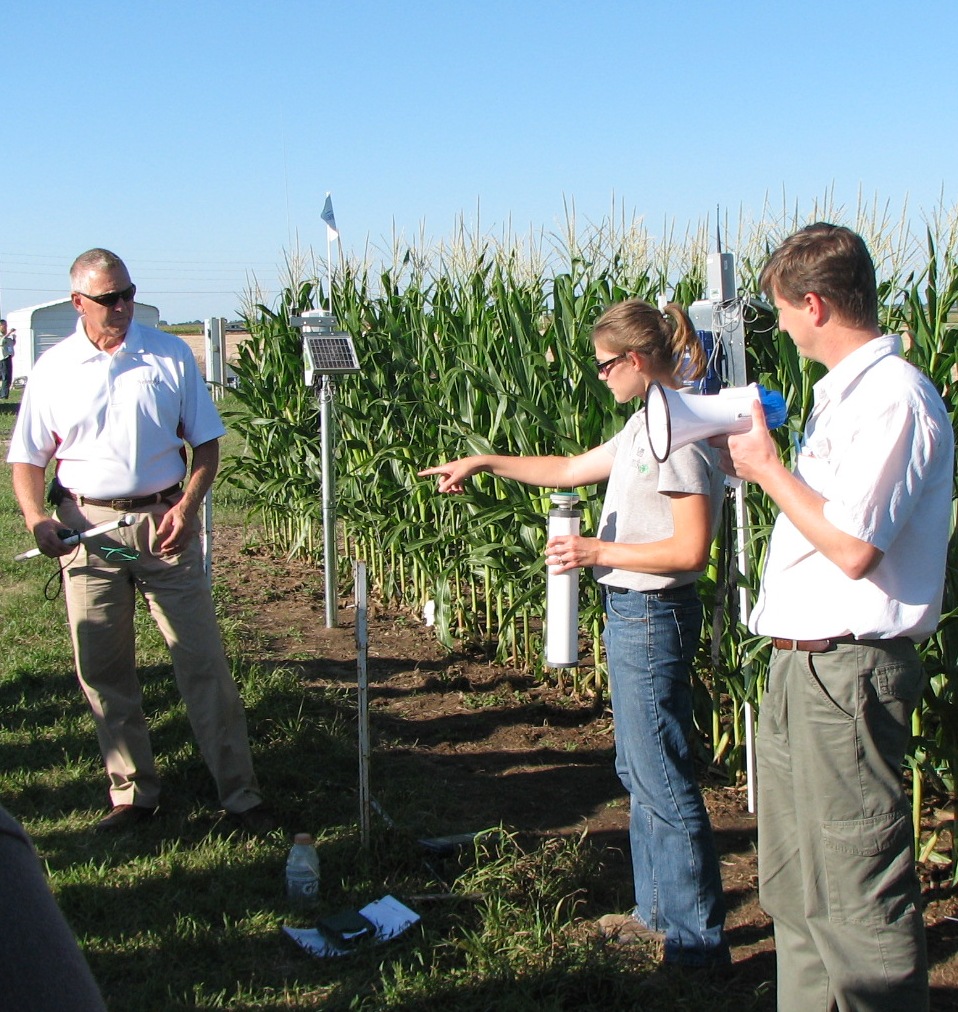 before you ever need to think about irrigating. I’ve found that our cooperators who install these early after emergence are far more confident in the readings than those who install them closer to irrigation time. That’s why we no longer install these for anyone past June 15.
In case you’re wondering what is a watermark sensor, it’s a 3″ sensor filled with fine sand with a fiber glass mesh around it that measures how much energy it takes for the plant roots to extract moisture from the soil. The sensor measures this in a unit of energy called kilopascals or centabars…units that don’t mean much to you or I. That’s why we’ve created charts that convert these units to inches of depletion/foot-terms with which we are more familiar! We recommend farmers install one set at 1′, 2′, and 3′ depths in their fields to monitor when their soil reaches at least 35% depletion. The basic rule of thumb based on research by Dr. Suat Irmak at UNL is to take the average of the top two sensors prior to the reproductive stages of the crop and the average of all three sensors once the crop has reached the reproductive stages (tasseling or flowering). When the average of these sensors reaches 35%, we suggest you consider scheduling an irrigation.
The other tool we use are Evapotranspiration (ET) Gages. The green canvas cover mimics the leaf surface and essentially as the cover is exposed to different environmental conditions such as wind and low humidity, water is moved out of the tube through the canvas cover and the depletion is noted on a site gage on the front. This tool has helped farmers visually better understand why their crop did or didn’t use water for any given week as they can look at the ET gage and consider the weather conditions and the influence they had on what the crop used.
On average, our farmers have saved 2.0-2.5″ of water in corn and soybeans since participating in this program. This program called the Nebraska Ag Water Management Network began in 2005 and now has over 500 cooperators State-wide in Nebraska. More information about the Network, the tools and charts I described above, and videos demonstrating the equipment can be found at: http://water.unl.edu/nawmdn.


 JenResources