Blog Archives
Cornhusker Economics Conference
The Cornhusker Economics Conference will focus on the ag outlook and management decisions for farmers and ranchers at  Clay Center on February 29th at the Clay County Activities Building at the Clay County Fairgrounds. The program will run from 10:00 a.m.-2:30 p.m. with registration beginning at 9:30 a.m. The conference will cover key topics affecting farm management and production decisions for 2012. It is offered by UNL Extension and the UNL Department of Agricultural Economics and is sponsored in part by funding from the Nebraska Soybean Board.
Dan O’Brien of Kansas State University will share his insight on grain and oilseed outlook and risk management decisions in today’s uncertain markets. While market volatility shows the need for sound hedging strategies, concerns about futures market performance and the recent MF Global bankruptcy affecting hedge margin accounts raise questions about the best path ahead for managing market risk. O’Brien will bring his experience and analysis of futures market performance to bear on the issues and discuss implications for producer decisions.
Shane Ellis, livestock marketing specialist at Iowa State University, will discuss the outlook for livestock markets and producer profitability. With outlook for meat demand and continued reductions in cattle supplies, the market fundamentals look strong, but must weigh against grain supplies and feed prices. Ellis will bring his expertise to the situation and provide guidance for producer marketing and production decisions in 2012.
The land market has also been moving in the past year and UNL Extension Educator Allan Vyhnalek will use his local knowledge and analysis to discuss land markets and leasing arrangements with implications for producer decisions. The closing session will feature a focus on agricultural policy and the direction for new farm programs. Brad Lubben, policy specialist, will discuss the policy outlook in Washington and the major policy developments that could affect agriculture in 2011. Then, Lubben will team with UNL Extension educators to discuss specific directions for the new farm bill and implications for farm programs, conservation programs, and risk management decisions.
There is a $25 registration fee to cover programming expenses for speakers, materials, and the noon meal. Please RSVP to Jenny Rees at the Clay County Extension Office at (402) 762-3644 or jrees2@unl.edu by Feb. 27 so we can obtain a meal count. Hope to see you at the excellent conference!
Cash Rent Questions
Cash rent questions continue to be the primary question I receive and it’s been hard for me to keep sharing numbers based on the UNL or USDA surveys as I question how useful the surveys alone really are. I caught up with Al Vyhnalek, Extension Educator in Platte Co. during the crop production clinics. Al’s specialty is risk management. He shared the following with me which may be helpful to you as well. This isn’t research-based or based on surveys; it’s based on land productivity and yield potential. But it’s another potential tool to reach a starting point for cash rent considerations. The numbers discussed below assume the landlord owns the irrigation equipment.
“Farmers and landowners alike want to know what they should offer or charge for farmland next year. The question is simple, while the answer is more complicated. There is no formula or equation available that will definitively provide an objective value for farm or pasture land. The caller wants to know what the UNL or USDA survey of cash rental rates says to help them determine the correct starting point for discussing cash rent for the following year. While I am glad to provide that information and do provide that information, I am more uncomfortable than ever in providing that information. Why am I not feeling good about that? Because the price of cash rent for a piece of farm ground should be based on the productivity of the ground. It is important to think about the value being tied to yield potential.
One quick way to do the calculation of productivity is to take the last 5 year average corn and/ or soybean yields for the farm you are renting times the local elevator price for 2012. This calculation equals the estimated gross income per acre. Take that number multiplied by 25-30% for corn or 30-33% for soybeans with the lower percentages for dry land crops and the higher ones for irrigated acres. It gets you to a starting point for that cash rent negotiation. Many want to set rent based on the 2011 high price of about $7.00 per bushel, but that price has never been available for the 2012 crop. Using the 2012 fall elevator price is more realistic of what might happen next year. Using this information as a starting point and combining it with the information from the surveys will help with fair negotiations of the cash lease. The example percentages were determined by working through UNL budgets when determining cost/acre.
As an example – 200 bushel irrigated corn times $5 per bushel (2012 harvest price) is $1,000 gross per acre. 30% of 1000 is $300 per acre (corn acres). Soybeans: 60 bushel beans times $11 per bushel is $660 times 33% is $220 per acre – landlord’s share. If we have 1/2 acres beans and 1/2 acres corn then average the two rent numbers – or $260 per acre average for the farm. That is how I think we should arrive at a discussion point for cash rents in the upcoming year based on productivity.” For more information, please contact Allan Vyhnalek, 402-563-4901 or e-mail AVYHNALEK2@unl.edu.
Fall herbicides & Grazing Corn Stalks
With the increasing problem of controlling weeds such as marestail (horseweed), UNL has recommended using fall applied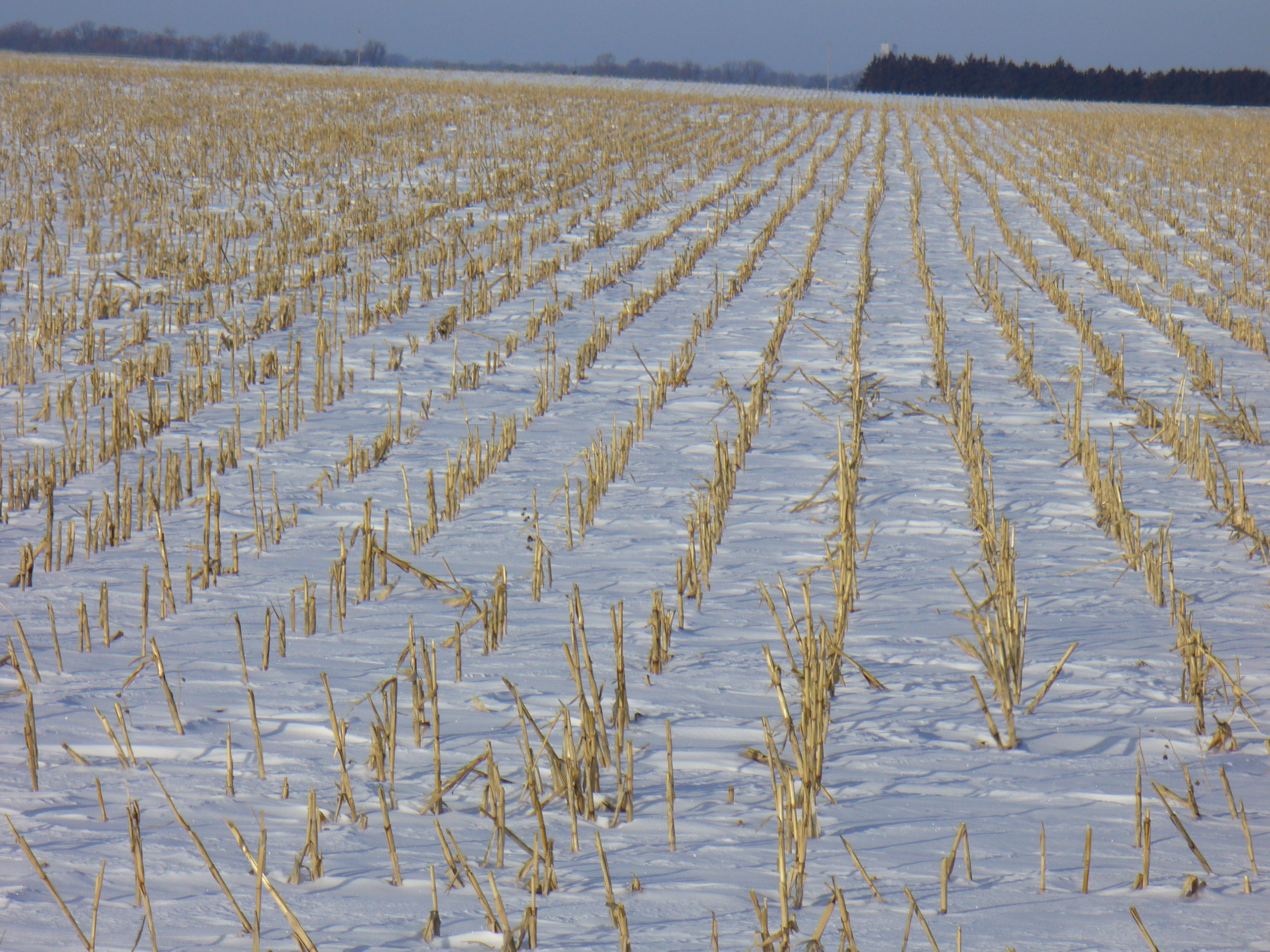 herbicides to help control this in addition to winter annual weeds. This practice usually does help with weed control, but I hadn’t thought about the considerations when grazing corn stalks until I received a recent question on it. The farmer wanted to see if it was safe for his cattle to graze corn stalks after a fall herbicide had been applied. The label wasn’t clear so he gave me a call.
I won’t provide information for the various herbicides that can be applied in the fall, but I will recommend that if you are planning on having your cattle graze stalks, that you check to see if a fall herbicide was applied and check the pesticide label to determine if there are any grazing restrictions with that pesticide.
If the label doesn’t specify any restrictions, then it should be ok. If you want to be on the safe side, a rule of thumb many chemical reps use is to use the pre-harvest interval for the amount of time to wait before grazing stalks. Some labels will say that residue should not be grazed or baled and fed to livestock. Sometimes studies were actually conducted to know there is a safety concern. In other cases, the chemical company may not choose to conduct all the studies the EPA required for labeling due to high costs. If that’s the case, the EPA requires the strongest restrictive language be placed on the label. Regardless, if it says there’s a grazing restriction on the label, the label needs to be followed. Your cattle may not be affected by grazing stalks where a chemical with a grazing restriction is on the label, but there may be other concerns such as problems with the chemical affecting the calf or being retained in the cow’s milk.
I’m still recommending utilizing our corn stalks by grazing and utilizing fall-applied herbicides for weed control. I just also recommend you check the pesticide labels on fields where a fall herbicide has been applied to determine any grazing restrictions or safety concerns.
Farm Research
Every winter, producers in our Greater Quad County on-farm research group meet to discuss the past year’s results and to 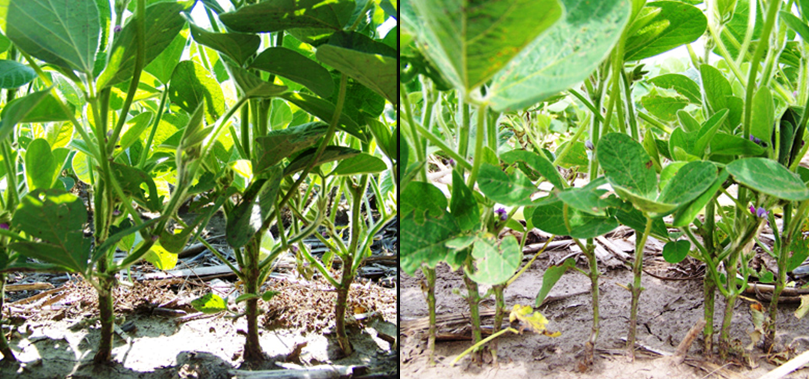 brainstorm which projects they wish to test the following year. Very popular studies from the past few years include soybean planting rates and planting dates and corn planting rate studies. These studies are randomized and replicated and conducted on full-length farmers’ fields.
Every year we share on-farm research results with our clientele. These results are often the highlight of many programs as the research is being conducted on your peers’ farms. Whether during pesticide trainings, crop production clinics, Extension news columns, Market Journal, or the Nebraska Farmer, these results have been presented and you as our clientele have preliminarily showed that you were interested in changing your farming practices as a result of what you learned.
Now, we’d like to see how many of you did change your practices as a result of this information. Please go to: http://www.surveymonkey.com/s/TPCJCGF and fill out a very short survey to let us know what you have changed in your farming operation. Your comments will help us in estimating the value of these on-farm research efforts to you and to our farmers who are faithfully conducting these studies. You can also find the direct link off the http://clay.unl.edu home page if you’d rather just click on it there. Please do take a few minutes to fill out this survey for us-it’s much appreciated!
Also, anyone interested in conducting on-farm research is welcome to attend our Greater Quad Co. results meeting on December 20 at 1:00 p.m. at the 4-H Building in York. We will also have some UNL researchers share results with the group. Please let me know if you plan to attend!
Upcoming Farming Workshops
Let the season of Workshops begin! Hope you are able to attend!
***Nov 30-Farmers and Ranchers College with Dr. David Kohl: “Global Economic Impacts on the Farm and Ranch” will be the topic of Dr. Kohl’s presentation on November 30th from 1:00-4:00 p.m. at the Bruning Opera House in Bruning, NE. There is no fee.
***Nov. 30-Specialty Crops Grants Available: The U.S. Department of Agriculture (USDA) provided a grant to the Nebraska Department of Agriculture (NDA) to administer a project that is designed to provide small, competitive grants, in amounts of up to $4,600, to a limited number of Nebraska specialty crop growers for the sole purpose of extending the growing season for specialty crops. Growers who want to be considered as a potential project applicant for the 2012 year can find more info. and complete the application by Nov. 30th at: http://www.agr.ne.gov/promotion/2011_specialty_crop_block_grant_program.pdf
Farmers wishing to apply and needing assistance with the application process and writing their proposal are welcome to contact NSAS through healthyfarms@gmail.com or the Nebraska Cooperative Development Center with Elaine Cranford at, ecranford2@unlnotes.unl.edu
***Dec. 2-Symposium to Feature Fruit and Vegetable Production, Marketing Strategies: Fruit and vegetable growers are invited to attend the Tri-State Fruit and Vegetable Growers Symposium Dec. 2 from noon to 5:15 p.m. at Stoney Creek Inn, 300 Third Street, in Sioux City, Iowa. Featured speakers include South Dakota State University Professor of Forestry John Ball with an overview of specialty crops and Tim Vala of Vala’s Pumpkin Patch near Omaha providing marketing tips. Growers can choose from a variety of fruit/vegetable production and marketing sessions led by university extension horticulture specialists and experienced local growers. Topics include fruit trees, aronia berries, grapes, ethnic vegetable varieties, organic insect and pest control, and community supported agriculture strategies. The symposium is planned in partnership with University of Nebraska-Lincoln Extension, Iowa State University Extension and Outreach and South Dakota State University Extension. Cost is $25 for the first person and $15 for the second person participating from the same farm or business until Nov. 23. Cost at the door is $30. For more information or to register call ISU Extension in Woodbury County at 712-276-2157 or visit http://www.flavorsofnorthwestiowa.org.
***Dec. 3-Explore Farming Class Planned: Do you have dreams of self-sufficiency and living off the land? Are you a budding entrepreneur? If so, you may wish to attend the free Explore Farming Class at UNL Extension in Lancaster County on December 3, 2011 from 10 – noon. This two-hour seminar will help you think through the resources, skills, and time you will need to launch a successful farm business. Local farmers and participants in the Community CROPS Growing Farmers Training Program will be on hand to answer questions. Information about various training opportunities in the 2012 season will also be available. The class is free, but you must register to attend. To register, simply send your name and phone number to warren@communitycrops.org. For more information, check out this website: http://www.communitycrops.org/
***Dec. 5-Summit on the Proposed Revised 2011 P-Index: A Dec. 5 University of Nebraska-Lincoln Extension Animal Manure Management team workshop will help those who work closely with livestock operations and their nutrient management plans. The “P-Index Summit” will be at the Nielsen Community Center, 200 Anna Stalp Ave. in West Point, Neb. The program will be from 9 a.m.-3 p.m. Central Time. Topics include: the science and history of the P-Index, discussion on proposed revisions, case studies illustrating the differences between the 2007 and 2011 versions and discussion of livestock environmental issues of interest. CCA continuing education units will be available.
For more information and to register, contact Leslie Johnson at 402-584-3818, email ljohnson13@unl.edu. Registration is $20 per participant if sent with your registration or $25 at the door. The use of a computer with Microsoft Excel is necessary; please bring your laptop as there will only be a few extra computers. To save time the day of the event, old and new versions can be downloaded at http://go.unl.edu/847 These workshops are sponsored by the UNL Extension AMM team which is dedicated to helping livestock and crop producers better use the state’s manure resources for agronomic and environmental benefits. For additional information and other resources for managing manure nutrients, visit http://manure.unl.edu.
***Dec. 6-Landlord/Tenant lease workshop: I can’t stress enough for you to consider attending this workshop and it is recommended that the landlord and tenant attend together! Cash Rental rates for farmland has nearly doubled in the past 6 years. Volatility in the grain markets is wilder than ever. These and other land lease issues will be discussed Tuesday, Dec. 6th at the Adams Co. Fairgrounds in Hastings. The program begins with registration at 5:00 p.m. and concludes at 9:00 p.m. The main purpose of these workshops is to help with establishing and maintaining positive farm leasing relationships. A meal and handouts will be provided. The workshop is free to participants because it is sponsored by the Nebraska Soybean Board. Participation is limited, thus you will need to pre-register to reserve your spot. To pre-register, please contact the UNL Extension Office in Adams County at 402-461-7209.
***Dec. 9-10-Returning to the farm: If you are considering a family member returning to the farm in the future, please consider attending this returning to the farm program! It will be held Dec. 9-10 and Jan. 6-7 the Holiday Inn Downtown in Lincoln and it is required that you attend both weekends and that all members of the farm management team attend. Bringing a young person into a farm/ranch operation presents challenges. However, the business operation can accomplish numerous goals by helping the young person get a solid start in the operation, keeping the farm/ranch in the family, and ensuring a comfortable retirement for all involved. Blending a variety of talents and personalities into one farming or ranching operation takes planning, communication, and management. The Returning to the Farm program is designed to assist families and operations in developing a financial plan and successful working arrangements that will meet the needs of multiple families. For more information call 800-472-1742 or check out: http://agecon.unl.edu/rtf.
2011 Corn Yield Predictions
Harvest is nearly complete! In early August, I shared a post regarding in-season yield predictions from the Hybrid Maize model. At that time, I showed how 2011 predicted yields had been tracking with the 30 year long term average yields up until early August. At that point, the 2011 predicted yields took a steep drop due to high night time temperatures. High night time temperatures don’t allow for the corn plant to shut down at night. The plant engages in respiration, essentially burning sugars that should be converted into yield.
Some interesting things happened with the weather this year to make yields more favorable than what once was predicted. While silking to beginning dent occurred in 20 days or less in several Nebraska fields this year, the weather cooled off during the filling process. Some fields stayed at ¼ starch for nearly three weeks. Looking at fields, kernels continued to get deeper, heavier, and expand to help cover some of the pollination problems observed earlier in the year. During this time, yield predictions from the Hybrid Maize model showed that yields had the potential of returning close to the long-term median yields and it was interesting watching the trendlines move back up toward normal. This seemed to be truer for 113 day hybrids vs. 110 day hybrids.
For example, a 110 day hybrid planted April 15 at 32,000 seeds/acre showed a predicted yield of 227 bu/acre compared to 240 bu/acre long-term median. But a 113 day hybrid planted the same day showed a predicted yield of 244 bu/acre compared to a 248 bu/acre long term median yield.
So what happened in your fields? While yields have been decent, on average, I’m not seeing the trend towards the long-term median yields in our area in general. Dryland yields I think have been better than expected but irrigated yields potentially not as good as anticipated by many.  Hybrid Maize predicts yields based on perfect conditions-nothing limiting and no pest/disease issues. In many fields, corn was planted then sat in cool, wet soils. We had stand losses due to Pythium in some fields or due to loose residue that was piled in areas of fields after heavy rains. We also had varying degrees of pollination problems and the high night temperature stresses which reduced yields. Regardless, yields are still very good in spite of another interesting growing season! Please share what you’ve been seeing for yields in your fields!
Table 1: Hybrid Maize 2011 Predictions from Simulations (through Oct. 30, 2011)
Date RM Population Long-Term Median Yield 2011 Predicted Yield
Apr. 15 110dy 32,000 240 bu/acre 227 bu/acre
Apr. 15 113 dy 32,000 248 bu/acre 244 bu/acre
May 1 110dy 32,000 241 bu/acre 234 bu/acre
May 1 113dy 32,000 260 bu/acre 245 bu/acre
May 10 110dy 32,000 244 bu/acre 235 bu/acre
May 10 113dy 32,000 258 bu/acre 258 bu/acre
National 4-H Week and Reflections
Happy National 4-H Week! Thank you to all the volunteers and supporters that make 4-H in our area counties and the State a success; we wouldn’t have the 4-H program without numerous volunteers such as many of you reading this!
A few weeks ago, I was attempting to explain not only Extension but 4-H to a group of people who didn’t understand either. A survey found that nearly 96% of people recognize the name 4-H but only 35% recognize Extension. That’s why at our County fair, I put up the large red flags to help people make the connection between Extension and 4-H. I think many in our county are familiar that 4-H has to do something with the fair, but it’s so much more than that! Essentially 4-H is a youth development program coordinated by land grant universities such as UNL through the Cooperative Extension System. The National 4-H site at http://4h.org states that “4-H fosters an innovative, “learn by doing” approach with proven results.” A study conducted by Tufts University found that youth involved with 4-H are nearly two times more likely to get better grades in school, are nearly two times more likely to go to college, 41% less likely to engage in risky behaviors, and 25% more likely to positively contribute to their families and communities.
The 4-H pledge explains what the 4 H’s stand for including pledging our:
*Heads to clearer thinking
*Hearts to greater loyalty
*Hands to larger service
*Health to better living….for our clubs, communities, country, and world.
I remember reciting this pledge at every monthly meeting at a 4-Her. I’m so thankful for the numerous volunteers-particularly the amount of time our club leader invested into the youth in our club-teaching us to sew and the importance of straight seems, cook the 4-H way, model sewn garments, importance of volunteering and community service, and teaching us parliamentary procedure by empowering us as youth to run and conduct meetings. I’m thankful for volunteers who spent each week during the summer teaching me about weeds, trees, and horticulture ID….skills I use nearly every day of my Extension career and as a homeowner. While we often worked on them last minute and weren’t thrilled about doing them, I’m thankful my mom required us to do 4-H presentations each year to develop public speaking skills. I’m thankful my grandma taught me how to make homemade bread and rolls and that so many volunteers worked with me on my 4-H Jr. Leader projects to help me develop leadership skills. I’m also thankful for the Extension staff at the office while I was growing up-they were always so friendly and helpful and modeled the way for me in my career today.
Thinking about my 4-H experiences reminds me that you are encouraged by the Nebraska 4-H Foundation to share your 4-H story! Some have asked me what this means. Essentially, any of us who have went through the 4-H program or volunteered with the 4-H program has a story to tell about how 4-H has benefited us or how we’ve seen the program benefit others. It may be a funny story or a serious one. The best part is that it’s YOUR story and the 4-H Foundation wants to hear them to help with promoting 4-H! The deadline is November 30th and you can find more information at: http://www.ne4hfoundation.org. Thanks again to everyone involved with helping or supporting the 4-H program and to the 1 in every 3 Nebraska youth currently involved with the 4-H program!
Water Jamboree & Removing Irrigation Scheduling Equipment
Last week was fun and somewhat exhausting teaching with my colleagues in Extension and several area Agencies at the Water Jamboree at Liberty Cove in Lawrence. Water Jamboree started over 15 years ago to teach 5th and 6th graders about the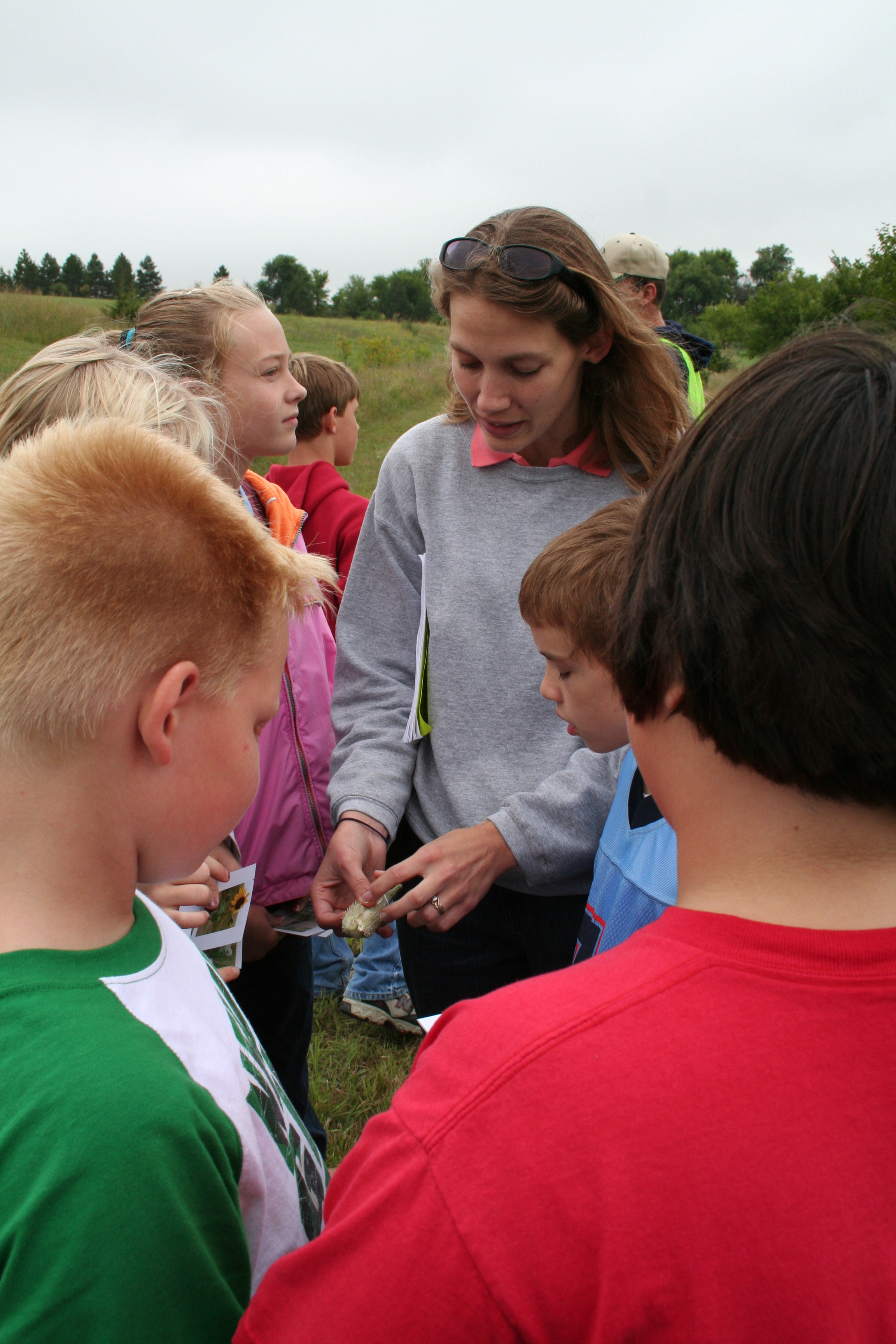 importance of water and water-related subjects. Nearly 800 youth learned about where water goes when it goes down the storm drain, about irrigation and siphon tubes, the aquifer, life inside and outside of the lake, mosquitoes, water movement, and much more. Holli Weber and I utilized the nature trails through the tallgrass prairie to teach a session on life outside the lake focusing on the importance of plants as buffers to filter chemicals and allowing youth to run through the trails doing a photo ID scavenger hunt of the area plants (also to burn off energy!). While I’ve done this session the past 5 years, this year I took time to show the youth specific characteristics to ID grasses. God created each plant unique and I was showing them how Indiangrass has rabbit ears when you pull the leaves back from the stem…or the M/W on the smooth brome leaves. It was fun watching the youths’ faces light up and then try to find these and other characteristics for themselves while on the trails. It was a great day, although I really don’t know how teachers do it day in and out! I wish I could’ve attended something like this when I was young! A special thanks goes to Marlene Faimon at the Little Blue NRD for coordinating this each year.
After Water Jamboree, I headed to my research plot at Lawrence. It’s been a trying year of coon damage and most recently a skunk inside our traps instead of the coons (and it still smelled like skunk out there!). Anyway, I was pulling watermark sensors and the 1st and 2nd foot ones were really rough but the 3rd and 4th feet came out easily. So just a reminder, when pulling watermark sensors, clamp a vice grip below the cap, twist and pull up. I’ve taken out hundreds of these and have only pulled apart four. If your sensor won’t pull up, simply take a spade and dig around the sensor and also bring a jug of water with you. This is the first time I’ve had to dig sensors out but the water really helped as I got it to run down the tube, it eventually loosened at the base to pull out easily without removing the sensor from the pvc pipe. Sensors can be gently washed with a hose or in a bucket of water using your fingers to gently clean them-don’t use a brush. Allow to dry and store in your shed, garage, basement, etc. Also a reminder (although I should’ve done this during the cold of Husker Harvest Days), to get your ET gages inside. Pour out the water and empty the ceramic top by pulling out the tube and then store that inside where it won’t freeze during the winter.
Inspiring Young Nebraskans-HHD 2011
Last week was busy with Husker Harvest Days-the coldest one I can remember! It’s always fun for me to see many familiar faces-like a big reunion! The theme at the IANR booth this year was “Inspiring Young Nebraskans”. This theme was important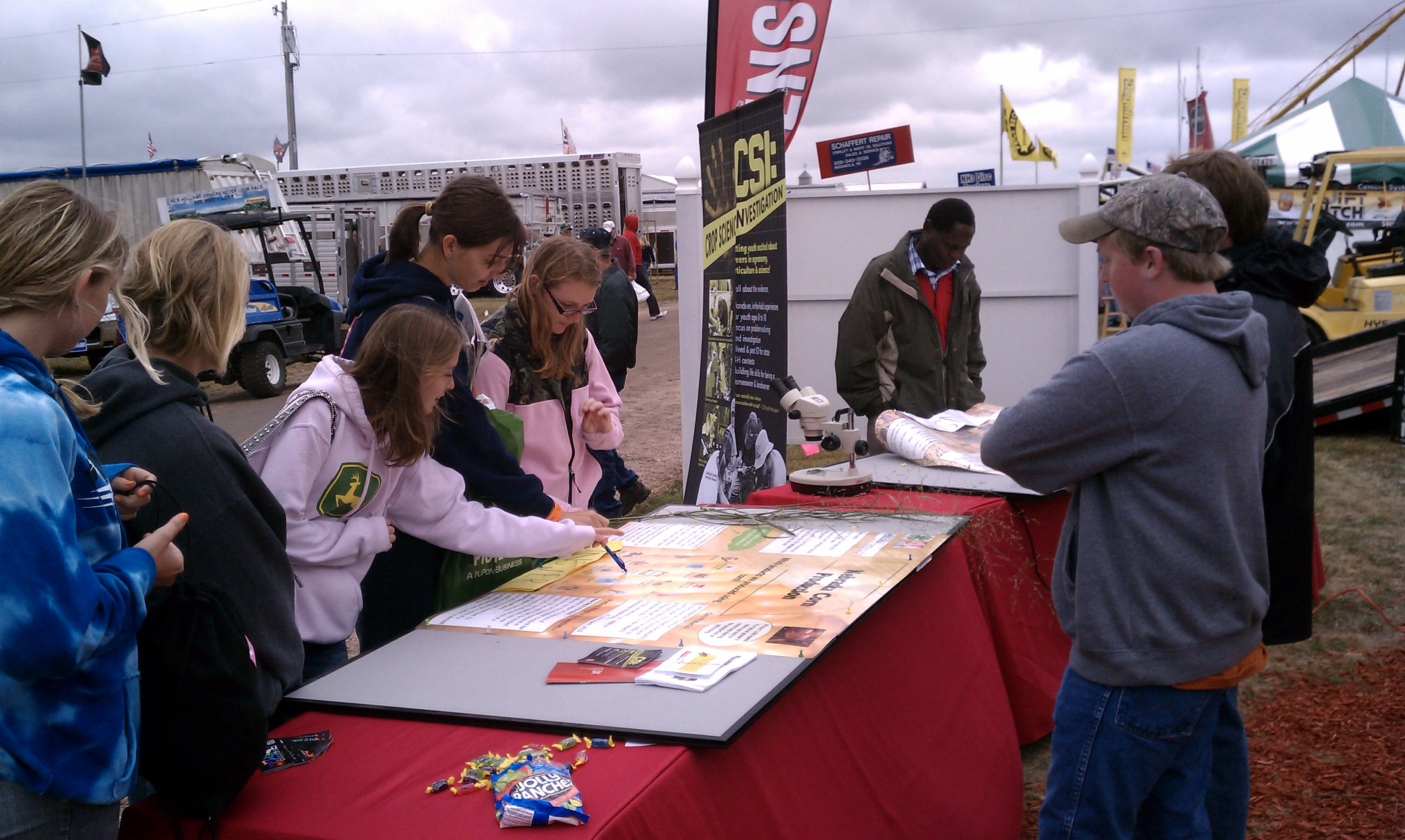 to showcase how IANR is influencing our youth from early childhood development to entrepreneurship activities and future careers. A statistic that may surprise you is that over 144,000 Nebraska youth (nearly every 1 in 3 youth in the State) is involved with 4-H. That’s something we would like to continue to grow as I think any of you who have been involved with youth programs whether 4-H, FFA, or scouts can attest they build life skills! The goal of this year’s exhibit was to show how IANR is impacting youth to hopefully keep more local youth here in Nebraska.
The first exhibit dealt with UNL Extension’s focus on Early Childhood Development which focuses on youth ages 5 and under by helping childcare providers, babysitters, and parents understand brain development and UNL’s research in this area. An alarming statistic is that up to 25% of children are not ready to begin school. The second exhibit was Teaching Science through Soybeans in which an iPad app was created for youth to drag and drop items into grocery carts to learn from where their food comes. There are many additional activities involved in the partnership between the College of Ag Sciences and Natural Resources, UNL teacher education, and local schools.
The third exhibit showcased the Unique Role of Teachers in Rural Communities and a research grant obtained by UNL to study the best strategies for supporting rural teachers in reading (K-3) and science education (6-12). Robotics is a curricula exploding with interest amongst youth in the State and was the fourth exhibit. “Bots are Hot” but they’re not only toys, they’re teaching technology to our youth with Nebraska being the leader in this National Science Foundation initiative. The fifth display showcased Youth-Adult Partnerships in which youth are encouraged to define and address community issues in addition to helping provide youth a voice and responsibility in their communities by working with adults. Connecting the Dots for Nebraska Youth was the sixth display in which an iPad app was developed for youth to link actions and personal choice to his/her future success in a college or career. So often we showcase projects in 4-H, but we’re striving consciously link them with future careers-to show youth how their 4-H projects truly are their first class at the University of Nebraska!
The seventh exhibit showcased Public/Private partnerships in which UNL Extension is working with Nebraska businesses to create opportunities for young Nebraskans across the State. Entrepreneurship was the focus of the eighth display with the goal of building a strong root system for homegrown Nebraska businesses. Reid Ely was front and center on that display banner with his asparagus and Ashley Nunnenkamp helped in the booth as part of the Paul Engler Agribusiness Entrepreneurship Program at UNL. Market Journal taped their latest show there and the Mobile Diagnostic Lab had interactive displays this year on Soybean Cyst Nematode kits for FFA youth, Pine Wilt Nematode, Biological Invaders, and Crop Science Investigation (CSI) for youth. I was thankful for the Clay and Fillmore County youth who helped us in our CSI display as youth can better inspire their peers to be involved!
Like in the past, a Web site was developed and rolled out at Husker Harvest Days. To find out more about what UNL Extension is doing in the child and youth area, please check out our latest Web site at http://child-youth.unl.edu.
Nebraska State Fair Reflections
Every year I look forward to the Nebraska State Fair. As a youth, that was often our family vacation. We would participate in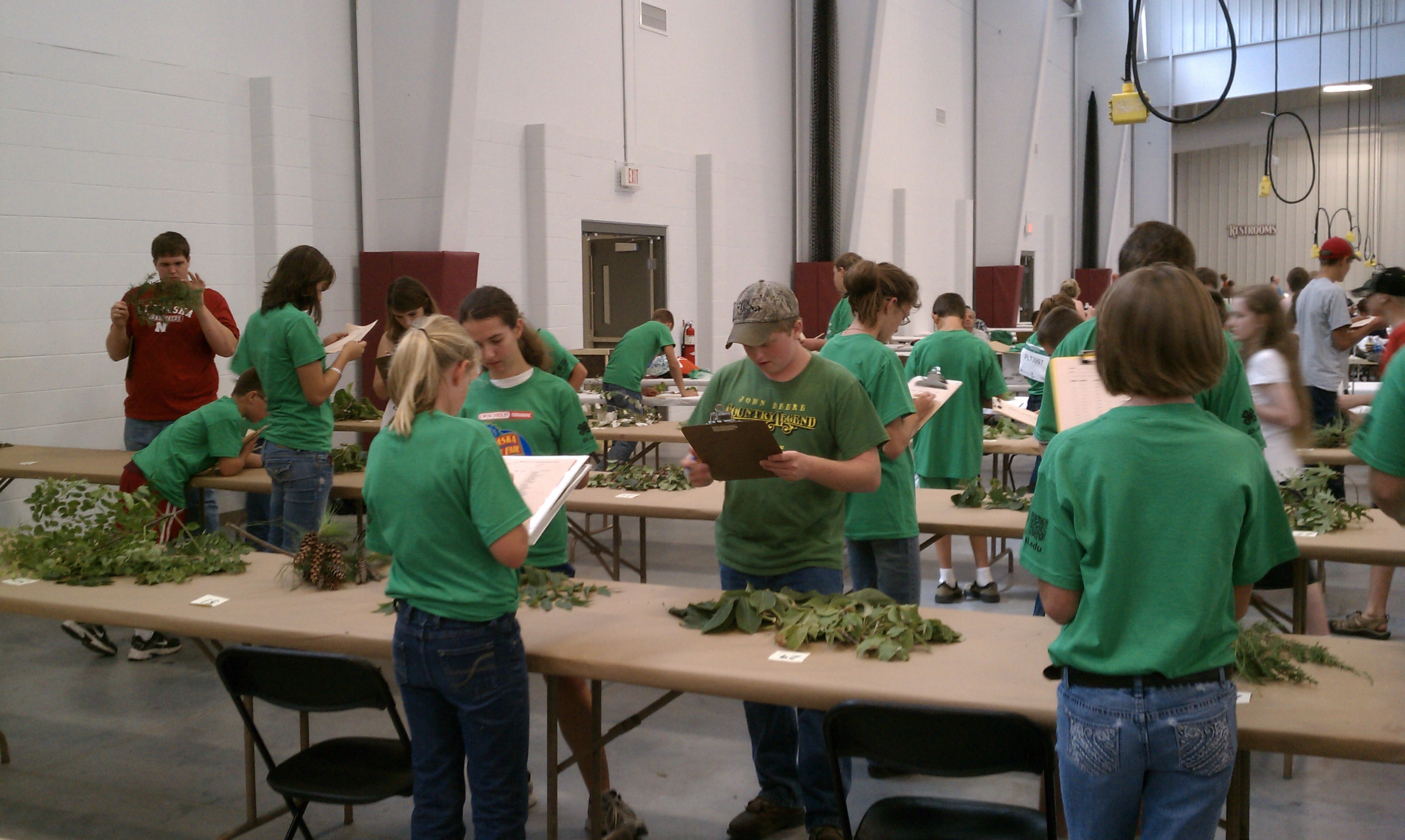 the State 4-H Weed, Tree, and Horticulture ID contests; present 4-H presentations; model our sewn garments; and view all the exhibits that made it to the fair in addition to getting ideas for the following year. State Fair was always a memorable family experience for me!
This year, I was so excited for the State Fair to begin! It was exciting seeing so many entries moving into the 4-H/FFA building to be judged and then seeing them displayed! Walking across the Fairgrounds in Grand Island, one can’t help but feel a sense of agriculture and pride in Nebraska’s agricultural roots. The facilities are absolutely amazing and our livestock numbers continue to climb.
The first weekend I enjoyed watching 4-H youth compete in the same plant ID contests when I was in 4-H…contests which provided me a love for plants and ability to identify them which helps me in my Extension career. These plant ID contests build life skills that these youth can use for numerous jobs but also as future home-owners. I was so proud of our area youth who placed so high in these contests-all the practicing paid off and they did very well. But in spite of ribbon placing, the most important fact is that they’re building life skills and learning!
The second weekend started off by catching the end of the Quilts of Valor presentation. The Quilts of Valor project is one in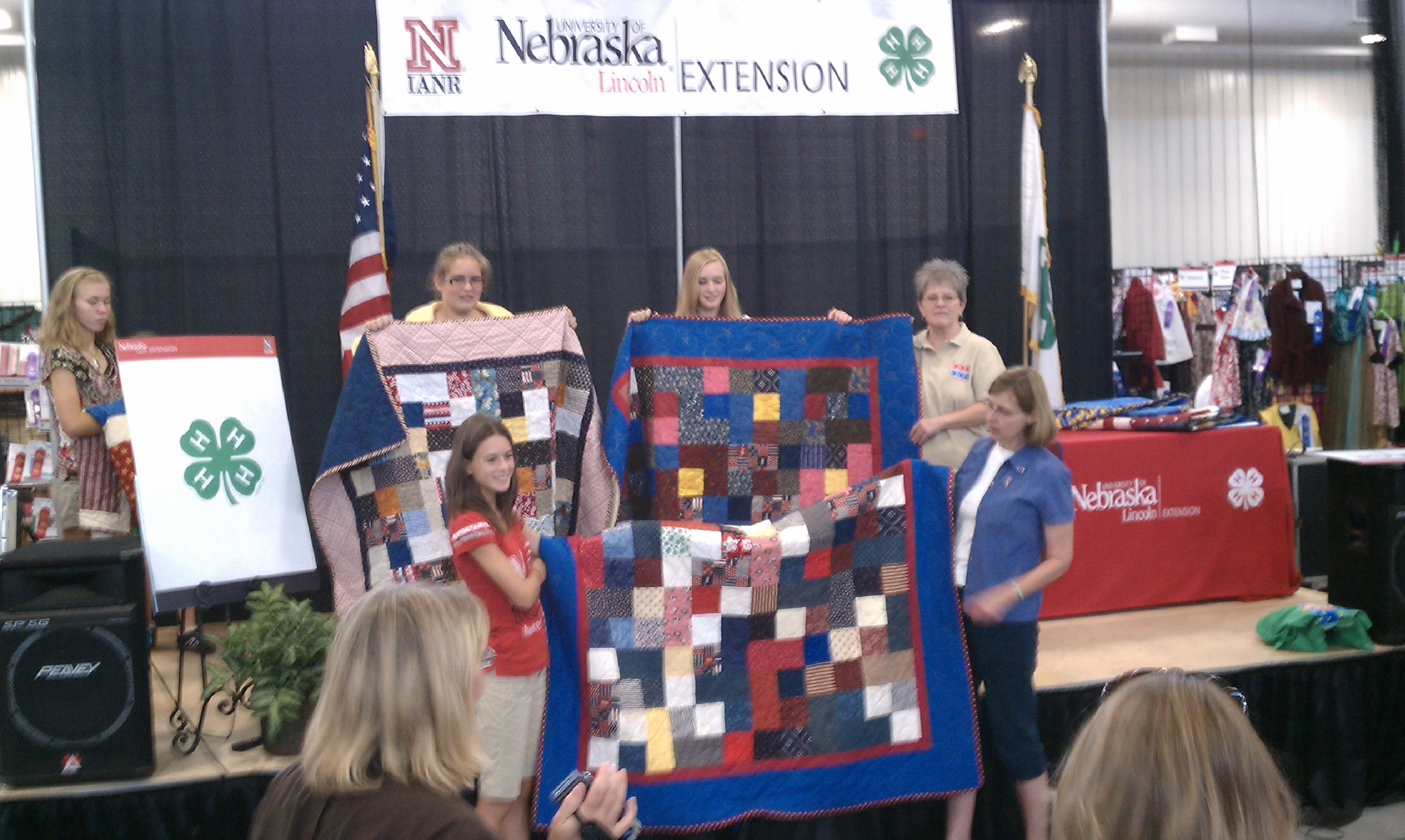 which Nebraska 4-Hers made and donated quilts to wounded soldiers. Over 40 quilts were made by Nebraska 4-Hers and it was touching seeing them displayed. It is neat seeing our youth develop life skills in quilting and giving back in such a special way!
I also enjoyed working with the swine show again and was also superintendent of the livestock premier exhibitor contest. We were anticipating 60 4-H and FFA youth competing in the 4 large animal species but around half of them actually competed due to so many shows at the same time. Premier Exhibitor allows youth to showcase their skills and knowledge in areas besides showing their animal. For instance, the majority of their score comes from an interview in which they share their knowledge of their livestock project and are asked questions about the livestock industry. They also take a written exam and participate in a skillathon in which they ID livestock breeds, feeds, equipment, and conduct other related activities. I was so proud of these youth for working so hard and participating in these events. Again, these are life skills that they are building-the essence of what 4-H and FFA programs are about.
While many long days and late nights were involved and much walking which was great exercise, the 2011 Nebraska State Fair was a great experience and huge hit with attendance numbers projected to be up 8%! Our 4-H and FFA youth overall did an excellent job representing 4-H, FFA, their families, their knowledge and skills learned, and Nebraska in general. Regardless of ribbon placing, they made us proud and while I’m glad this year’s Fair is over, I will be ready for next year’s Fair when it rolls around!


 JenResources