Blog Archives
Goss’ Wilt in Corn
Goss’ wilt was found this week in corn damaged from Memorial Day storms in Clay County. I’ve also received pictures that appeared to be Goss’ from crop consultants in other areas of the State. Goss’ wilt lesions have a wavy edge, have a varnished look to them when wet, and have characteristic black “freckles” within and particularly along the lesion edges. We are seeing some plant death due to the systemic version of Goss’ wilt. This can be seen by taking a cross-section of the stem and looking for orange discoloration in the vascular bundles. Because this is a bacterial disease, fungicides are not effective in controlling Goss’ wilt. If you are interested in trying a product that is labeled for treating bacterial diseases in corn, we would recommend you test its effectiveness via on-farm research. Spraying in a paired comparison treatment design will give you a true answer if the product made a difference for you or not.
To do this simply: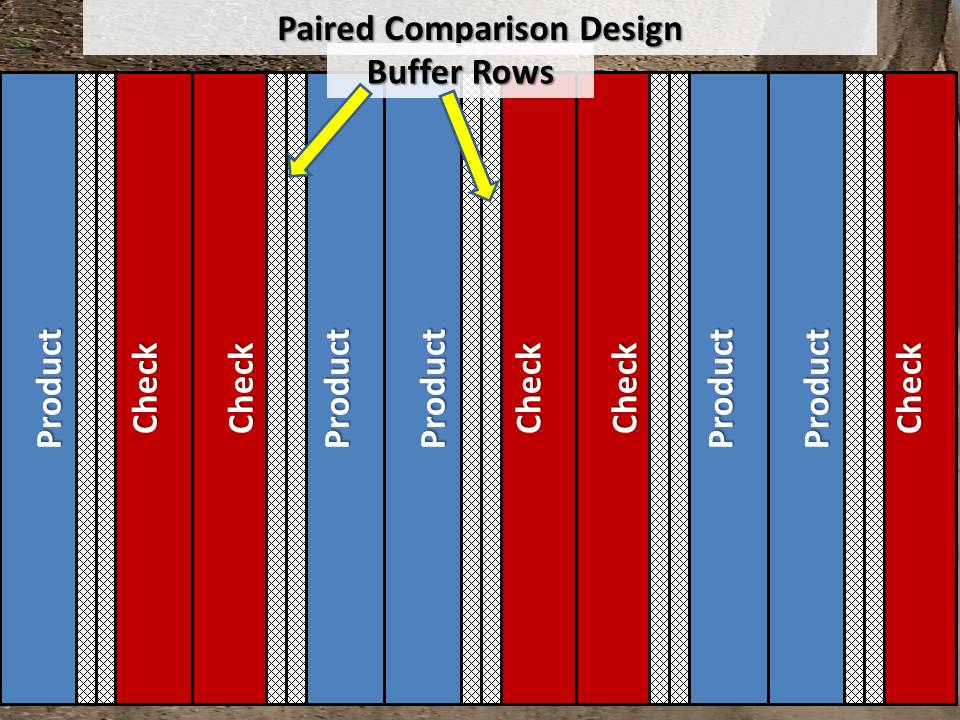
1-Spray a pass or round with the product (depending on sprayer size) to ensure you can harvest two passes from the center of the treated area.
2-Skip the same amount of distance as you previously sprayed.
Repeat steps 1-2 at least three more times
Mark a few plants in each plot and take photos throughout the growing season to determine if disease progresses or not. You may also wish to keep track of percent of plants affected in each untreated and treated area throughout the season, and check for percent stalk rot and harvest population in each area before harvest as well.
Make sure to harvest two passes from the center of each treated and untreated  area. Then compare the weights as shown in the harvest figure. Please let Jenny Rees jrees2@unl.edu (402) 762-3644 know if you decide to conduct this study and if you have any questions!
More information:
Goss’s Wilt from UNL
Sample Submission to UNL Plant and Pest Diagnostic Clinic
Nebraska On-Farm Research Network
Crop Update 6-20-13
The sun has been welcomed and crops are rapidly growing in South Central Nebraska! Corn right now is between V6-V8 (6-8 leaf) for the most part. Quite a few farmers were side-dressing and  hilling corn the past two weeks. It never fails that corn looks a little stressed after this as moisture is released from the soil and roots aren’t quite down to deeper moisture.
Installing watermark sensors for irrigation scheduling, we’re finding good moisture to 3 feet in all fields in the area. The driest fields are those which were converted from pasture last year and we want to be watching the third foot especially in those fields. Pivots are running in some fields because corn looks stressed, but there’s plenty of moisture in the soil based on the watermark sensor readings I’m receiving for the entire area. So we would recommend to allow your crops to continue to root down to uptake deeper moisture and nitrogen.
The last few weeks we observed many patterns from fertilizer applications in fields but as corn and root systems are developing, they are growing out of it. We’ve also observed some rapid growth syndrome in plants. This can result from the quick transition we had from cooler temperatures to warmer temperatures, which leads to rapid leaf growth faster than they can emerge from the whorl. Plants may have some twisted whorls and/or lighter discoloration of these leaves, but they will green up upon unfurling and receiving sunlight. This shouldn’t affect yield.
Damping off has been a problem in areas where we had water ponded or saturated conditions for periods of time. We’ve also observed some uneven emergence in various fields from potentially a combination of factors including some cold shock to germinating seedlings.
We began applying sugar to our on-farm research sugar vs. check studies in corn. We will continue to monitor disease and insect pressure in these plots and determine percent stalk rot and yield at the end of the season.
Leaf and stripe rust can be observed in wheat fields in the area and wheat is beginning to turn. We had some problems with wheat streak mosaic virus in the area again affecting producers’ neighboring fields when volunteer wheat wasn’t killed last fall. Alfalfa is beginning to regrow after first cutting and we’re encouraging producers to look for alfalfa weevils. All our crops could really use a nice slow rain right now!
Preparing Irrigation Scheduling Equipment
It’s wonderful receiving the rain we did, seeing how quickly planting progress came along, and how quickly corn is popping out of the 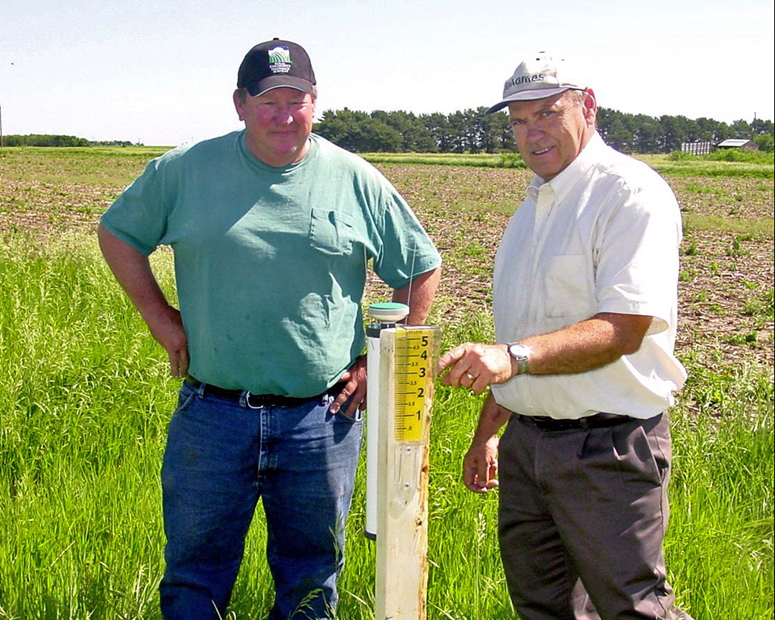 ground! Being mid-May, it’s time to get our Evapotranspiration (ET) gages out. A reminder to only use distilled water in the gages, make sure to fill up the ceramic top portion of the gage before inserting the stopper, and gently dust off the ceramic top and replace the white membrane and green canvas cover. We recommend replacing those membranes and covers each year so if you need a new one, please let the Natural Resources Districts (NRDs) or me know and we’ll get you a new one! For those of you recording ET information online, please be sure to do so consistently each week to help your neighbors and crop consultants.
Early after crop emergence is the best time to install watermark sensors. For those of you with watermark sensors, read them to ensure they read 199 kpa (dry). Then “prime” them first by soaking them for 24 hours in water to ensure all the air bubbles have been released. The sensors should have a reading of 10 kpa or below to be considered good. If they read higher than that, either continue soaking them another 24 hours and read them again, or plan that they no longer are reading correctly and replace them with others from the NRDs. Remember after soaking sensors that water moves up into the PVC pipe via capillary action, so be sure to dump the water out of the pipe  as well.
When installing the sensors, be sure to install them wet, drain excess water, and look for areas that are not compacted, avoid tractor wheel tracks, and look for even spacing of plants. Carefully install without breaking off any plants (thus easier when plants are small!). It’s also important not to install sensors into extremely wet fields. What we have found is that a thin soil layer can cover the sensor when pushing it into the soil of very wet fields. When that soil layer dries, it can provide a reading of 199 saying the sensor is dry when it truly isn’t. If this happens to you, simply remove the sensor, rewet for one minute and re-install. It should be acclimated to field conditions within 48 hours. If you have any questions regarding the installation process, please let the NRDs or your local Extension Educator know. You can also view videos of the installation process and receive additional information to answer your questions.
Understanding Research Statistics
Dr. Charlie Wortmann, UNL Extension Soil Fertility Specialist, explains the power of statistics for understanding yield and other differences and non-differences for on-farm research.
Sugar Applications to Crops
For the past ten years I’ve come across farmers who really believed in applications of sugar to reduce their pest populations. Being no research to my knowledge to prove it, I tucked the observation in the back of my head for future reference. With farmers looking to increase yields and looking to other farmers such as Kip Cullers for information, some of our on-farm research producers were curious about sugar applications in their operations with the hopes of increasing yield.
Nebraska On-Farm Research Corn Results
Using the application rates that Kip Cullers uses, one Clay County producer applied 3 lbs of sugar (purchased pallet of cane or beet sugar from the local grocery store) per 10 gallons of water at V7-V8 on corn in 2010-2011. Cullers also tanked mixed the sugar solution with a post-herbicide application like glyphosate but this producer didn’t do that. To simulate any affect of the water or driving through the field, he also drove through the untreated check spraying water only. Two years of research results showed no significant increase in yield. However, there was a noticeable difference in standability at harvest. This producer did not apply a foliar fungicide either year. When it came to harvest, this producer needed the reel in 2010 for the untreated check. Stalk rot ratings were taken using the pinch test two weeks prior to harvest. To him, the $1.25/acre of sugar was worth it to improve standability even if yield was not significantly improved. You can view the full research report here.

Several York County producers have also tried this with one producer finding a non-statistical 2 bu/ac yield difference with the check yielding better while the other producers found a statisically significant 2 bu/ac increase to the sugar treatment. Another producer in Hamilton County is testing this using the corn product he grows-using 1 qt of corn sugar (high fructose corn syrup) per 10 gal of water applied still at V7-v8.
In 2012, a small plot study was conducted at UNL’s South Central Ag Lab near Clay Center to determine any differences between sugar application, fungicide application, and untreated check in corn. All treatments were applied at R2. Because of the drought in 2012, there was minimal disease pressure, thus there were no significant differences between the three treatments regarding area under the disease progress curve. The untreated check did show the most stalk rot (via the push lodging test). The sugar application reduced the lodging rating by half and the fungicide application showed the lowest lodging rating. For yield, there were no significant yield differences with the untreated check yielding the highest followed by the fungicide and sugar applications. The entire study report can be found here.
In Soybeans we have had producers apply 3 lbs sugar in 10 gallons of water at R3 (beginning pod). In all years, there have been no significant differences in yield. Lodging ratings were not taken as that is more variety and water dependent.
Additional research…
has shown that application of sugar to crops increases the numbers of beneficial insects in those fields. South Dakota research entomologists showed that lady beetles benefited from a combination of prey and non-prey foods. In a follow-up study, these entomologists applied sugar sprays to soybeans and quantified the frequency of sugar feeding by analyzing the gut contents of common lady beetles in three states. They found all the tested lady beetles regularly consumed sugar-like nectar in soybean fields, even when it wasn’t applied as a supplement. They also found more lady beetles in the sugar treated plots compared to the untreated plots.
At this time we can’t explain the standability effect we’re seeing from our sugar applications to corn. Our hypothesis is that early application of sugar to corn is increasing beneficial microbes that may be keeping the exposed brace roots and stalks healthier. We hope to conduct more research in the future to answer this question.
In conclusion,
the application of sugar to corn and soybeans has not always shown increased yield. However, in nearly all of the corn studies, sugar treated plots have shown increased stalk strength at harvest. Research has also shown an increase in the number of beneficial insects in fields where sugar was applied. Further research is needed to understand the interactions aiding stalk strength in corn.
If you are interested in conducting on-farm research studies in your field, please contact any of our UNL Extension Educators or Specialists! You can also follow the conversations this year via our Facebook page and Twitter feed!
What do you think of sugar applications to crops? Have you tried this in the past and if so, what were your results?
Corn Planting Rate Research & Recs
Even with recent rain and snow events, the subsoil is still dry. You may be wondering,
“What should I do regarding corn planting rates in 2013?”
A few weeks ago, UNL Extension held our on-farm research meetings to share our 2012 Corn Planting Rate results for irrigated and dryland conditions. I always enjoy hearing our farmers share why they were interested in a certain trial and what they found out as a result.
Our farmers followed protocols of 28K, 32K, 36K, 40K (40,000 seeds/acre) or 30K, 34K, 38K, 42K/acre for irrigated production and 18K, 22K, 26K, and 30K for dryland production. 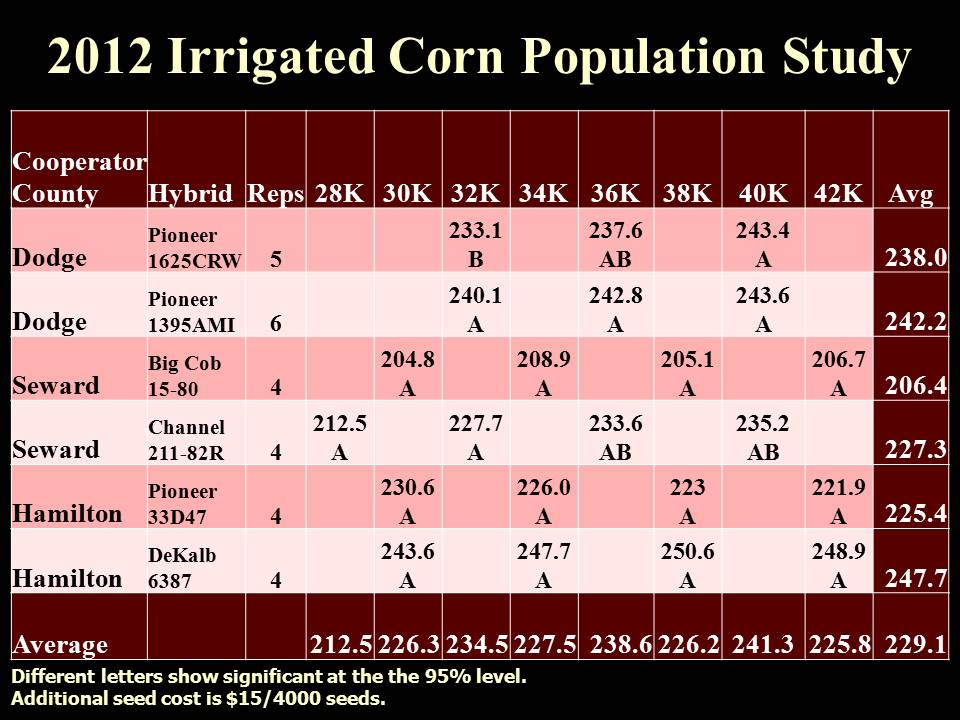
The results since 2010 continue to show us that each individual hybrid varies in its response to increasing populations; however, there is a general trend with newer hybrids that increasing population results in increased yields. Dr. Tom Hoegemeyer, UNL Agronomy Professor of Practice spoke about how our hybrids have genetically come so far in combating various stresses while maintaining yields. We know that many seed companies have conducted research to determine the population calibration curve for each hybrid to determine best recommendations for you. Thus, we’d recommend that you check with your seed dealer to determine which hybrid may fit best at which population for your operation.
Even with this data, you may question if that’s truly the best population for your field; that’s where on-farm research comes in! We recommend testing the recommended population against a higher and lower population with at least 4000 seeds/acre difference in planted population-whether irrigated or dryland. With today’s technologies, it’s not very difficult to test seeding rates for different hybrids for yourself!
So what rate should you plant this year? In the majority of our irrigated studies, economically, many hybrids maximized yields and economic returns between 32,000-36,0o0 seeds/acre. Again, this is very hybrid dependent so ask your seed dealer what he/she would recommend and test for yourself!
Regarding limited irrigation, UNL research has actually shown a negative effect of lost yield by backing off population too far in a dry year. 
Tom’s recommendation was for dryland in Eastern Nebraska, most hybrids even with the low soil moisture profile should be ok with planting 24,000-28,000 seeds/acre. I realize we have essentially no moisture in our profile. But taking probabilities of rainfall events, March-May is usually pretty good and we don’t want to short-change ourselves in yield by planting too low of populations. For Central into Western, NE, I feel 20,000-22,000 seeds/acre will work for many hybrids. Our genetics have come so far since we finished the last drought in 2007 and were planting 18,000 seeds/acre in dryland. We will just keep praying for rain and hope for the best next year! Ultimately, test this and your other on-farm questions for yourself to know what will work for your farm!
If you’re interested in conducting some seeding rate trials, please let anyone on our UNL On-Farm Research Team know! All our studies are posted on the CropWatch on-farm research page.
What planting rates are you considering for 2013?
Research Fertilizer Options for Your Farm
November 1 is just around the corner-the beginning of when fall fertilizing occurs in this area of the State. Hopefully many of you have taken soil samples as excess nitrate is to be expected after this drought year. This is an excellent time to consider evaluating your nitrogen program by starting an on-farm research trial!
On-farm research is using your own equipment, in your own fields, over single or multiple growing seasons allowing you to determine the most economical, efficient, and sustainable practice for the production of irrigated and/or dryland crops on your own farm.
What are the soil fertility questions you have for your farm?
Right now, with fertilizing on producers’ minds, we’re hoping you will consider a soil fertility study. We have several example nutrient protocols including the UNL N fertility rate compared to +/- 30 lbs, and considerations for nitrogen timing studies such as pre-plant, sidedress, or fertigation. You can view all these plot designs by clicking on 2012 protocols. If you are planning on applying anhydrous this fall, be sure that the anhydrous strips are the correct width, as the corn must be harvested and weight determined in a correct manner next fall.
When designing a nitrogen comparison you need to remember nitrogen is a mobile nutrient and corn roots will spread laterally. Therefore, the width of the treatments must take this into account and compensate for it. If you have a 16 row nitrogen applicator and an 8 row corn head, you will need 32 rows of each nitrogen rate. Each 32 row strip must be repeated 4 times. At harvest, in each 32 row block, you must record and weigh the center 16 rows with two separate weights i.e. 8+8 . This is done for statistical analysis purposes. Without statistics, you cannot determine if differences between treatments is the result of the nitrogen rate or because of soil variability.
What’s in It for You?
On-farm research in your own fields allows you to find answers to the questions you may have. We all read articles or hear presentations about various practices and products. The question is “Will it work on my farm?“. That’s what on-farm research allows you to find out!
UNL Extension Educators and Specialists are here to help you design your on-farm research trials, help you with data collection, and will statistically analyze the data for you at the end of the season. Correct plot setup is critical to reduce any error in favoring one treatment over another (because we know fields are variable and some portions of the field will yield better than others). The statistical analysis is another tool which helps us determine how much any yield differences between treatments are due to the treatments themselves or to chance.
So if you have an idea you’d like to try, please contact any of the UNL Extension Educators or Specialists working with on-farm research! The Nebraska On-farm Research Effort is a partnership between the Nebraska Corn Board, Nebraska Corn Growers Association, and UNL Extension.
On-farm research may sound daunting, but today’s equipment makes it easier than ever. It does take a little extra time, but our farmers conducting on-farm research feel the value of knowing the results of a study on their own piece of ground make the effort worthwhile.
What are some on-farm research studies you would like to conduct this year or that you would like our group to consider?
On Farm Research
 As harvest rolls to a close you most likely noticed some field variability or have some questions about how various products or production practices may work on your farm. Every year during the winter, UNL Extension educators share research conducted by your peers-other farmers-in their own fields and often those presentations are very interesting to our clientele.
With the advance of farming technologies, it’s easier than ever for more farmers to conduct research on their own farms. Depending on the study, there may be additional time involved, but overall, the farmers I’ve worked with who have conducted on-farm research say they obtained answers to their questions and the power was knowing it was research based on their own farm.
Last winter the two on-farm research groups in Nebraska combined to form the Nebraska On-Farm Research Network. With help from the Nebraska Corn Growers and Nebraska Corn Board, three State-wide studies were rolled out in addition to other studies that producers wanted to conduct on their own farms. That data is still being collected and analyzed right now and results will be presented this winter.
So as you think about the 2012 season, what are the questions you have? Consider working with your local Extension Educator to design a valid research-based experiment to answer the questions on your farm. To learn more, please check out the CropWatch on-farm research page.
What studies would you like to see our group research on-farm in 2013?
Plant #Soybeans Early for Increased Yields
While I got this posted in our CropWatch Web site, I didn’t get it on my blog till now! Hopefully this inspires many of you to get soybeans planted yet this week! 
Planters are rolling throughout the state and given the size of today’s equipment corn planting is rapidly progressing. Based on UNL research, we would encourage you to consider planting your soybeans as soon as possible—preferably before the end of April for the southern two-thirds of Nebraska and or the first week of May for the northern third of Nebraska. While evening temperatures have been low, consider the percent risk of frost for emerged plants not planted seeds. The above recommendation considers a 10% risk of frost 7-10 days after planting, the time when soybeans would most likely emerge.
Why plant early? Five years of UNL small plot and on-farm research has proven that early planted soybeans yield more than late planted beans—regardless of whether the spring has been cold and wet or warm and dry. Soybeans are a photoperiod-sensitive crop so the goal is to allow the plant to use the sun’s energy to accumulate as many nodes as possible as day length decreases after June 21. Nodes are important because that’s where pods, seeds, and ultimately yield are produced. The goal is to have the soybean canopy “green to the eye by the fourth of July!”. Thus the plants are absorbing all the sunlight possible not allowing any to be wasted by hitting the soil.
Table 1 shows how three years of on-farm research have resulted in an average of 3 bu/ac yield increase (with a range of 1-10 bu/ac depending on the year and the planting date range of early versus later planting). With today’s soybean prices, a 3 bu/ac yield increase adds up (see Table 2). We do recommend a fungicide/insecticide seed treatment to reduce the risk of damping off diseases and bean leaf beetles which tend to feed on early-planted soybeans.
Several previous CropWatch articles explain soybean planting date in more detail. Please see these for more information:
- For Increased Yields Plant Soybeans in Next Two Weeks
- Three Reasons Why Soybean Planting Date Matters
- Farm Research Shows Benefits of Planting Soybeans Early
- Risks and Caveats of Early Planting Soybeans
Table 1: Nebraska On-farm Research Early and Late Planted Soybean Yield Results (2008-2010)
|
Year |
Producer |
Date |
Reps |
Rainfed/ Irrigated |
Variety |
Row Spacing |
Yield (bu/acre) |
|
2008 |
SCAL Early |
Apr. 29 |
3 |
Irrigated |
Producers 286 |
30” |
67.2 |
|
2008 |
SCAL Late |
May 15 |
3 |
Irrigated |
Producers 286 |
30” |
65.8 |
|
2008 |
Seward Co. Early |
Apr. 30 |
3 |
Irrigated |
NC+ 2895 |
30” |
68.4 |
|
2008 |
Seward Co. Late |
May 19 |
3 |
Irrigated |
NC+ 2895 |
30” |
66.2 |
|
2008 |
York Co. Early |
Apr. 23 |
8 |
Irrigated |
Producers 286 |
30” |
66.9 |
|
2008 |
York co. Late |
May 14 |
8 |
Irrigated |
Producers 286 |
30” |
63.5 |
|
2008 |
Fillmore Co. Early |
Apr. 30 |
7 |
Irrigated |
Pioneer 93M11 |
30” |
81.0 |
|
2008 |
Fillmore Co. Late |
May 19 |
7 |
Irrigated |
Pioneer 93M11 |
30” |
77.5 |
|
2009 |
SCAL Early |
Apr. 27 |
4 |
Rainfed |
Pioneer 93M11 |
30” |
37.6+ |
|
2009 |
SCAL Late |
May 18 |
4 |
Rainfed |
Pioneer 93M11 |
30” |
37.2 |
|
2009 |
Saunders Co. Early |
May 3 |
6 |
Rainfed |
NC+ A63RR |
15” |
66.6 |
|
2009 |
Saunders Co. Late |
May 21 |
6 |
Rainfed |
NC+ A63RR |
15” |
65.1 |
|
2009 |
SCAL Early |
Apr. 27 |
4 |
Irrigated |
Pioneer 93M11 |
30” |
70.2 |
|
2009 |
SCAL Late |
May 18 |
4 |
Irrigated |
Pioneer 93M11 |
30” |
68.1 |
|
2009 |
Fillmore Co. Early |
Apr. 24 |
4 |
Irrigated |
Pioneer 93M11 |
30” |
69.5 |
|
2009 |
Fillmore Co. Late |
May 15 |
4 |
Irrigated |
Pioneer 93M11 |
30” |
68.4 |
|
2009 |
Seward Co. Early |
Apr. 24 |
4 |
Irrigated |
NC+ 2A63 |
30” |
73.2 |
|
2009 |
Seward Co. Late |
May 20 |
4 |
Irrigated |
NC+ 2A63 |
30” |
71.3 |
|
2009 |
York Co. Early |
Apr. 30 |
3 |
Irrigated |
NK 28B4 |
30” |
59.1 |
|
2009 |
York Co. Late |
May 15 |
3 |
Irrigated |
NK 28B4 |
30” |
58.6 |
|
2010 |
Saunders Co. Early |
Apr. 18 |
6 |
Rainfed |
Channel 2751 |
15” |
75.7 |
|
2010 |
Saunders Co. Late |
May 18 |
6 |
Rainfed |
Channel 2751 |
15” |
71.2 |
|
2010 |
Seward Co. Early |
Apr. 19 |
6 |
Irrigated |
Channel 3051RR |
30” |
72.0 |
|
2010 |
Seward Co. Late |
May 24 |
6 |
Irrigated |
Channel 3051RR |
30” |
62.3 |
|
|
Average Early |
|
|
|
|
|
70.0* |
|
|
Average Late |
|
|
|
|
|
67.1 |
*Statistically significant at 95% level.
+SCAL Rainfed was not included in the combined statistical analysis but Saunders Co. Rainfed was compared with irrigated yields from other locations.
Table 3: Economic Advantage to a 3 bu/ac Yield Increase Due to Early Soybean Planting Date
| Price of Soybeans | $ 7.00 | $ 8.00 | $ 9.00 | $ 10.00 | $ 11.00 | $ 12.00 | $ 13.00 | $ 14.00 |
| Economic Advantage | $ 21.00 | $ 24.00 | $ 27.00 | $ 30.00 | $ 33.00 | $ 36.00 | $ 39.00 | $ 42.00 |


 JenResources