Blog Archives
June 2024 Events
Happy June! This week sharing on June upcoming events.
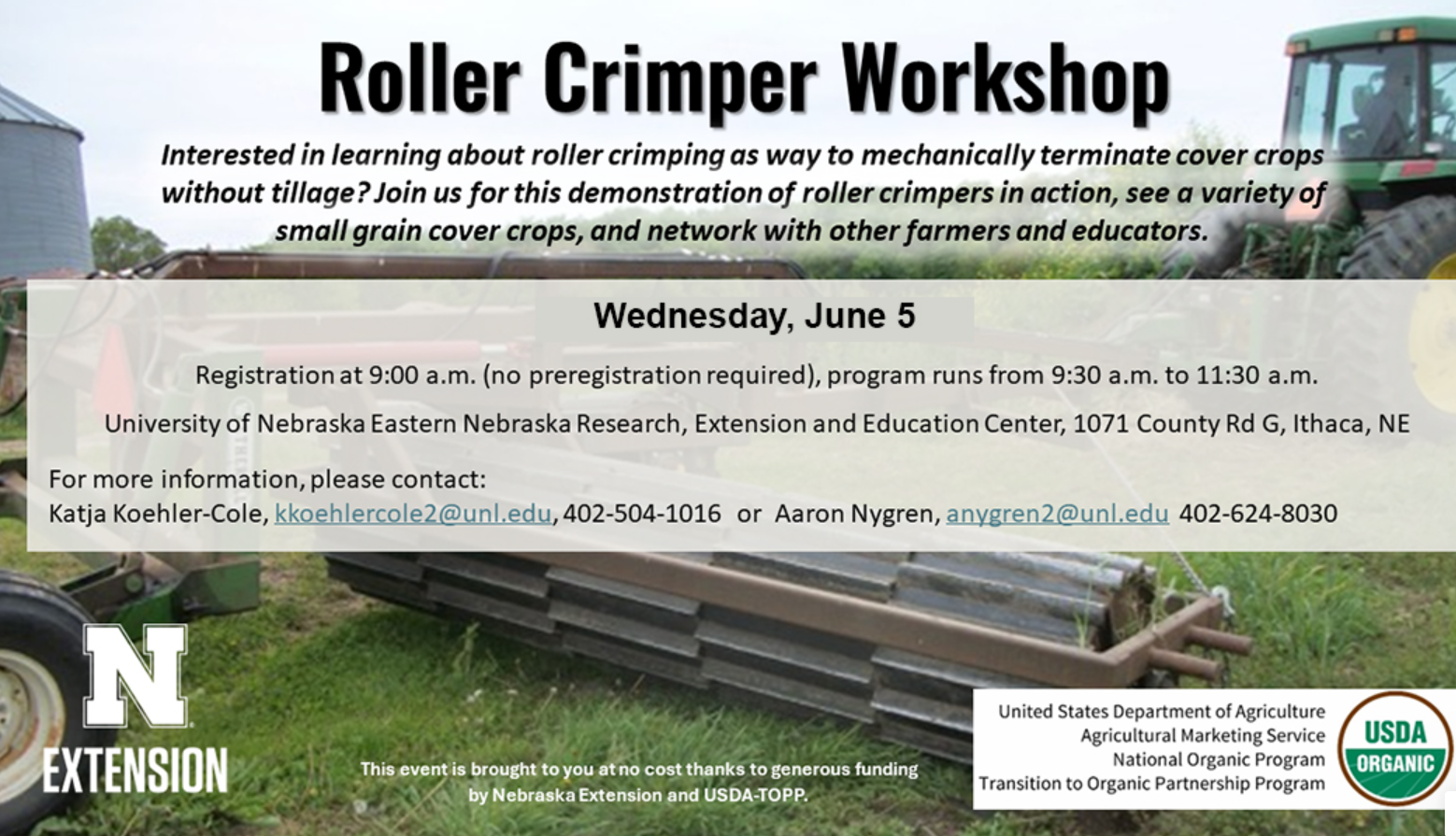
Roller crimping workshop will be held June 5th from 9:30-11:30 a.m. (Registration at 9 a.m.) at the Eastern Nebraska Research, Extension and Education Center, 1071 County Rd G, Ithaca. No pre-registration necessary and anyone interested in learning and/or sharing their experiences is welcome. During this short program, we will show a roller crimper in action, invite farmers to share their experiences with crimping, and discuss what conditions must be met to be successful with this termination method. Demo plots include barley, oats, rye, triticale, and wheat.
Progressive Ag Safety Day: Youth ages 5-14 are invited to attend the Progressive Ag Safety Day at the Fairgrounds in York on June 11 from 8:30 a.m.-1 p.m. Safety topics include: Electrical, grain, sun, drug, equipment, and water safety. Registration fee is $5 which includes lunch, snacks, t-shirt, and goody bag. RSVP by calling 402-362-5508. This event sponsored by York Co. Farm Bureau and York Co. Extension.
SCAL Weed Management Field Day: Growers, crop consultants and educators are encouraged to attend Nebraska Extension’s Weed Management Field Day from 9 a.m. to 1 p.m. (Registration at 8:30 a.m.) June 26 at the South Central Agricultural Laboratory near Clay Center. It’s located five miles west of the intersection of Highways 14 and 6, or 13 miles east of Hastings on Highway 6. GPS coordinates for the field day site: 40.57539, -98.13776.
The field day includes on-site demonstrations of new technology and new herbicides for corn, soybean and sorghum. Projects include using cover crops such as cereal rye or interseeding small grains (wheat, oat, barley) for weed suppression, See and Spray Precision Sprayer, iGrowth and INZEN sorghum. Attending this field day will provide an opportunity to stakeholders to learn about management of herbicide-resistant weeds. There is no cost to attend, but participants are asked to pre-register online at https://agronomy.unl.edu/fieldday. CCA credits are available.
Paraquat Trainings: Syngenta is offering Paraquat Training Webinars for June 2024 for those who plan to apply this herbicide this year. The trainings are held from 1-2 p.m. CST on: June 5, 18, 20, 25, 26. Registration is required at: https://syngenta.zoom.us/webinar/register/WN_Gh1T5t4tTS-S3QbFJUJe-w#/registration. Registration will require: first and last name, email address, state, and pesticide certification license number. There is a mandatory quiz at the end of the webinar that will be conducted thru zoom, so you need to stay on until the end of the webinar.
Yellow Nutsedge Control: Kelly Feehan shared the following, “It is time for yellow nutsedge control if using herbicide for control. While we may not be able to see much sedge yet, it is starting growth and control from first week of June up to June 21st is important. Yellow nutsedge is the yellow grass-like plant with waxy blades that grows taller than Kentucky bluegrass. Larger plants are most noticeable after June. This perennial sedge begins to emerge from underground tubers in late May. To help reduce nutsedge, mow tall at 3.5 inches, and avoid overwatering. Hand-pulling can be effective where there are very few plants. If herbicides are used, products containing sulfentrazone, known as Dismiss, halosulfuron or Sedge-Hammer, and mesotrione such as Tenacity are labeled for postemergence control in cool-season turfgrasses. As always, follow all label directions.”


JenREES 5/13/24
Wheat Fungicide Considerations: Part of the area receiving this news column grows wheat for grain as it’s a great crop in rotation. The wheat has looked tremendous this year! Varieties that are susceptible to stripe rust are showing low to medium disease pressure. Wheat ranges from the flag leaf through late boot/early heading stages. Last week, the question was if growers should spray a fungicide to protect the flag leaf from stripe rust. I’m unsure how many still have that question this week but am writing about the tradeoffs I talked about with growers.
We did have a few growers choose to apply fungicide to protect the flag leaf as their wheat had good yield potential and the variety was very susceptible. That was most likely the best decision for these specific field situations with how quickly stripe rust was setting in in their wheat with the cooler conditions and the high humidity within the canopy. It’s important to know one’s economics to make that individual situation as there’s potential we may need a fungicide application for wheat scab (fusarium head blight) prevention as well. A map of where stripe rust has been observed can be found at: https://go.unl.edu/98zy Please note the map doesn’t reflect the fact that it’s also observed in Nuckolls and Webster counties.
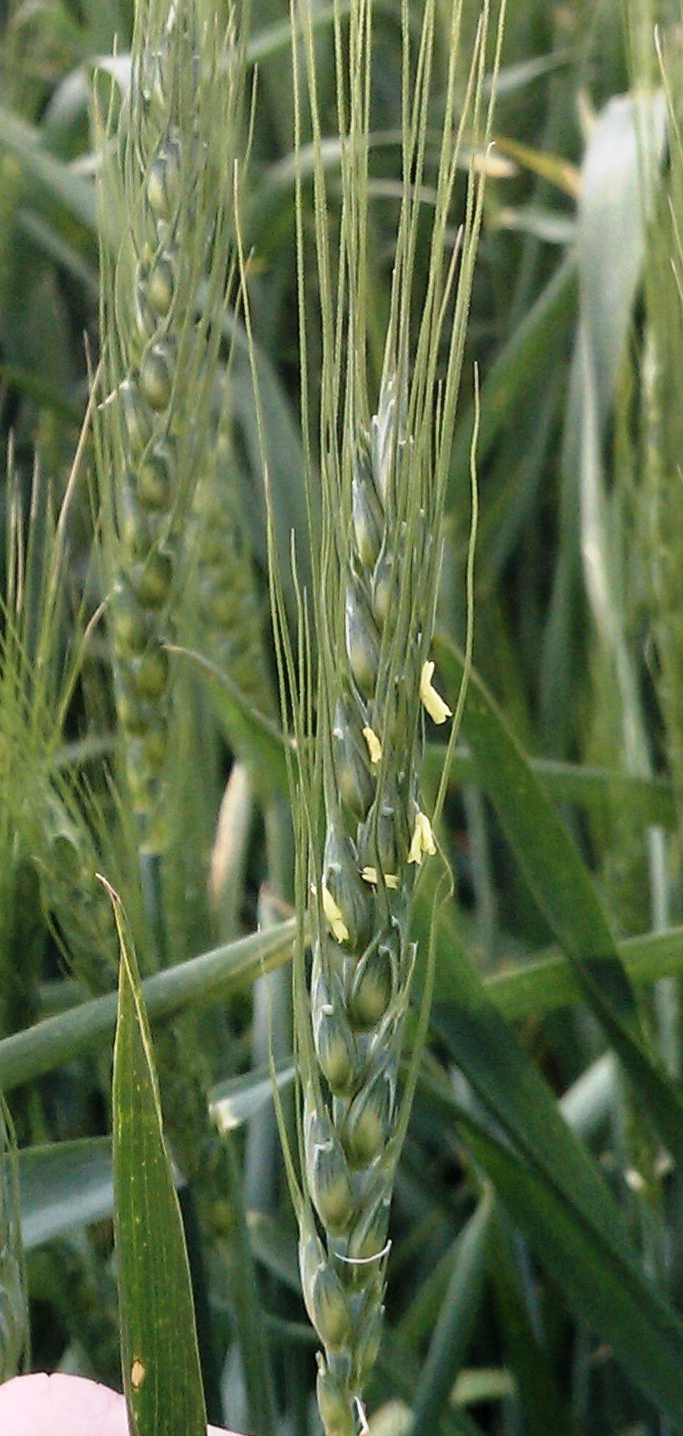
With non-irrigated wheat and the economics of it, many try seeing if we could get by with one fungicide application at flowering. A fungicide app at flowering to prevent wheat scab will also kill any fungi present on the leaf surfaces. Fungicide options include: Prosaro, Prosaro Pro, Caramba, Proline, Miravis Ace, and Sphaerex. Applying when 30% of the wheat is at beginning flowering (seeing yellow anthers in the center of the head) provides the best timing and efficacy. Applying too early before flowering or after the majority of the wheat is past 50% flowering doesn’t provide as good of efficacy. I realize the timing is tough. We normally have a 3-5 day window to get fungicides applied timely and efficacy isn’t guaranteed to be greater than 70%. Efficacy also improves when we can increase the gallonage of aerial apps to 4-5 gallons/acre. You can monitor the potential for wheat scab risk at: https://www.wheatscab.psu.edu/.
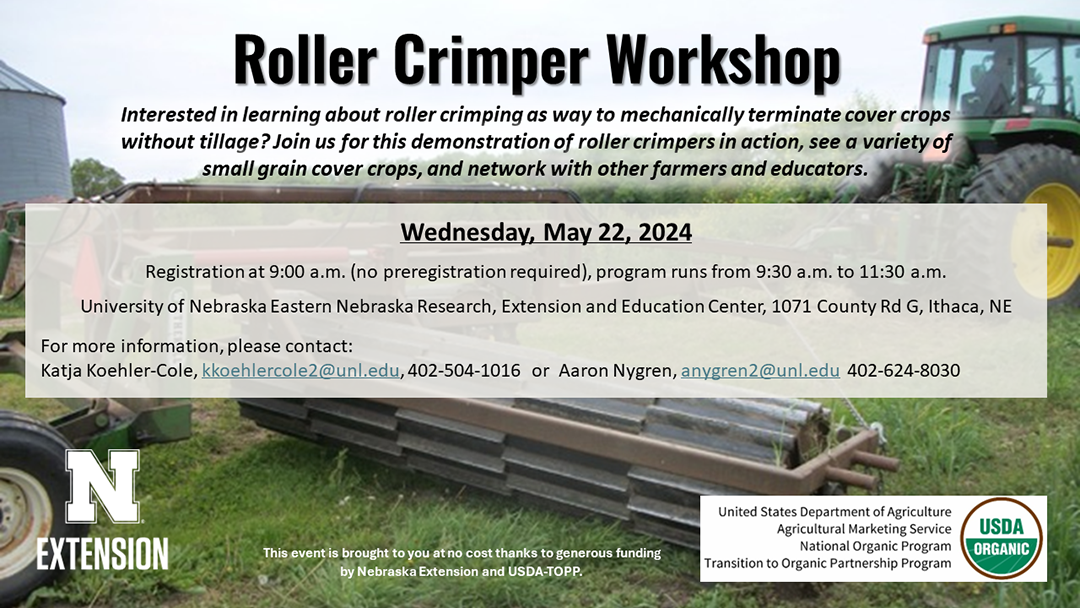
Roller Crimping Workshop May 22: For growers and ag industry professionals interested in learning more about roller crimping, Nebraska Extension is hosting a roller crimper workshop from 9:30-11.30 am. Wednesday, May 22 at the University of Nebraska Eastern Nebraska Research, Extension and Education Center, 1071 County Rd G, Ithaca. We’re also seeking growers to speak about their experiences with roller crimping at this workshop, so please let us know if you’re interested in that.
Roller crimpers are used to mechanically terminate cover crops without soil disturbance and ideally create a thick mulch that will act as a weed barrier. Crimpers are used by organic farmers, regenerative farmers and others who, for various reasons, want to reduce herbicide inputs and/or improve weed management with their cover crops.
During this short program, we will show a roller crimper in action, invite farmers to share their experiences with crimping, and discuss what conditions must be met to be successful with this termination method. Demonstration plots with small grains of barley, oats, rye, triticale, and wheat will be showcased to compare the differences amongst them side by side. On-site registration begins at 9 a.m. For more information, please contact Katja Koehler-Cole at kkoehlercole2@unl.edu. This event is sponsored by Nebraska Extension and the USDA Transition to Organic Partnership Program.
Intro Crop Scouting: Also, for those interested in learning about introductory crop scouting, we’ll be having a clinic on May 21st at ENREEC near Mead. More info: https://go.unl.edu/29qk.


 JenResources