Blog Archives
Beginning a Soil Health Journey
This was the topic of last week’s Friday February conversation. $700 million has been designated by USDA for regenerative ag and soil health. USDA’s defintion: “Regenerative Agriculture is a conservation management approach that emphasizes natural resources through improved soil health, water management, and natural vitality for the productivity and prosperity of American agriculture and communities.” From the website at: https://www.nrcs.usda.gov/programs-initiatives/regenerative-pilot-program, participants work with their local NRCS office to determine a whole farm plan addressing soil, water, and nutrient concerns. A soil sample is required in the first year and last year of the program. I’m grateful there’s finally a program that helps farmers who are either beginning or more advanced. For those beginning, practices such as reduced tillage, cover crops, etc. can be implemented. Those more advanced have additional options such as soil amendments. The original application was due Jan. 15 to qualify for 2026; however, several NRCS staff have told me to contact your local NRCS to fill out an application if you’re interested.
Why does this matter? The soil is a big deal! The majority of food and feed is raised in the soil. Healthier soil can lead to healthier people and animals. There’s an increasing number of labs that are documenting the nutrition density of foods grown in conventional vs. regen/organic systems. As I continue to learn results from these labs, it’s sad to hear how much we’ve lost in food nutrition. It’s also important for us to steward the resources we’ve been given well.
The following are a few thoughts shared by the farmers from the conversation. The greatest obstacle to overcome is one’s mindset…all the reasons we tell ourselves that we can’t change in addition to the social implications (family and friends) of doing something differently. We are only given so much time and so many seasons to farm. If you’re thinking about any change, try it now!
Advice to begin: Focus on one or two fields and continue the practices (reduced tillage or cover crops) on them for several years. It takes at least three years to see changes based on their experiences and our on-farm research studies. Planting cover crops on this or that field without consistency each year leads to frustration as one may not see improvements over time.
- Cereal rye before soybeans is the easiest way to start. Before corn, we’d recommend planting winter wheat or winter barley in the fall or spring oats.
- Either plant your crop into dead brown covers or green growing ones; don’t plant into the in-between stage. If terminating pre-plant, use clethodim to allow more structure to the covers and follow label restrictions before planting corn.
- Money savings can occur through reduced herbicide, fungicide, and seed treatment costs. Also through reduced irrigation if reducing tillage, which improves soil structure.
- Challenges are markets for alternative crops or to be paid for raising crops with less inputs.
- Challenges are also economics. Choosing to continue using the same amount of inputs with reduced tillage and covers makes the economics challenging. Personally, I see how growers on this journey could reduce inputs more; however fear is a factor in addition to advisors uncomfortable with recommending less.
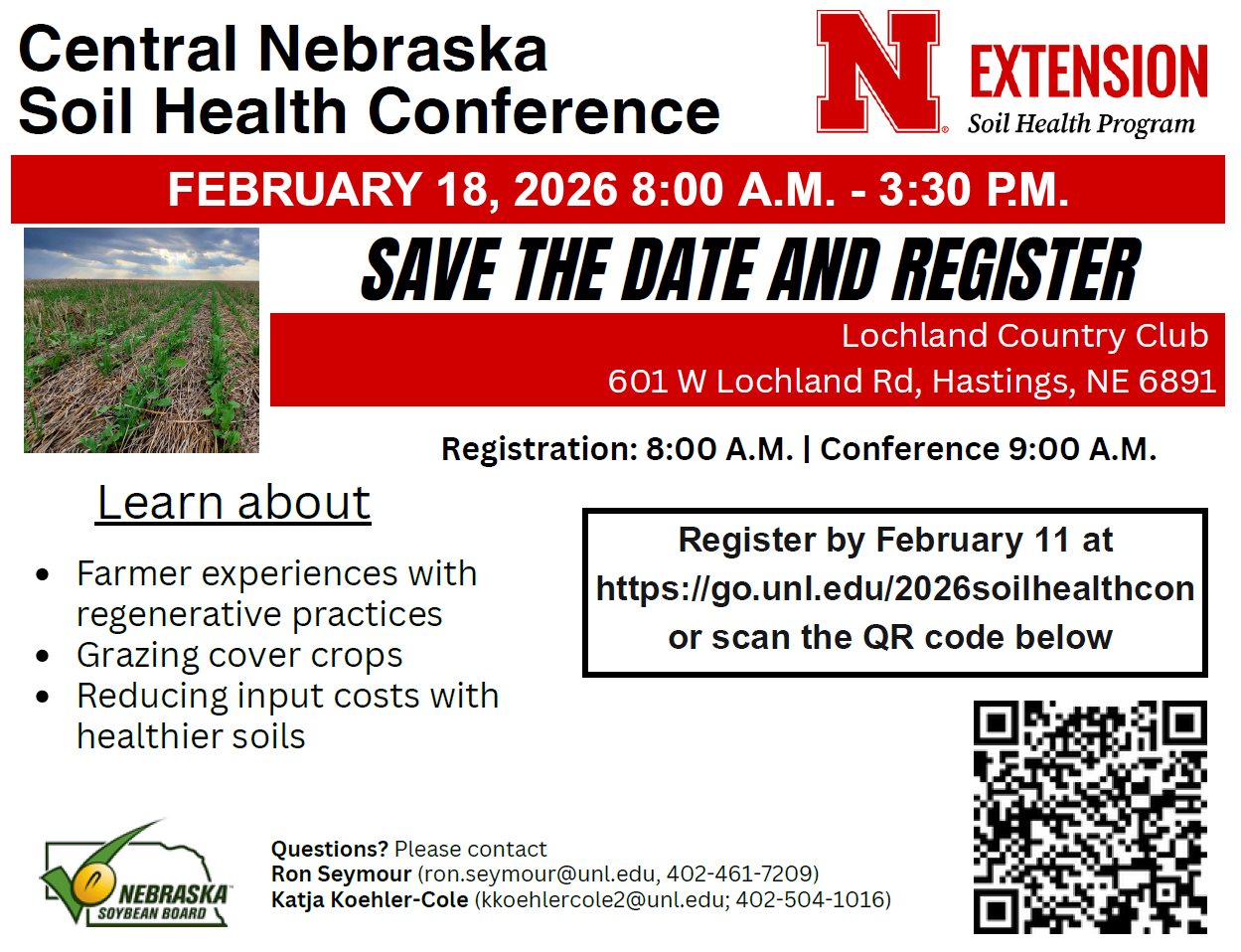
- Peer support is key. You don’t have to do this alone! If you’re interested in being connected to others, please reach out to me (jrees2@unl.edu). Another resource working to establish producer groups is the Nebraska Soil Health Coalition: https://www.nesoilhealth.org/. This Friday’s conversation (Feb. 13) is on nutrient balance from 10-Noon at the 4-H Bldg in York. The Central Nebraska Soil Health Conference is Feb. 18th at the Lochland Country Club in Hastings beginning at 9 a.m. (Reg. at 8 a.m.), RSVP: https://go.unl.edu/2026soilhealthcon.



 JenResources