Blog Archives
Sugar Applications to Crops
For the past ten years I’ve come across farmers who really believed in applications of sugar to reduce their pest populations. Being no research to my knowledge to prove it, I tucked the observation in the back of my head for future reference. With farmers looking to increase yields and looking to other farmers such as Kip Cullers for information, some of our on-farm research producers were curious about sugar applications in their operations with the hopes of increasing yield.
Nebraska On-Farm Research Corn Results
Using the application rates that Kip Cullers uses, one Clay County producer applied 3 lbs of sugar (purchased pallet of cane or beet sugar from the local grocery store) per 10 gallons of water at V7-V8 on corn in 2010-2011. Cullers also tanked mixed the sugar solution with a post-herbicide application like glyphosate but this producer didn’t do that. To simulate any affect of the water or driving through the field, he also drove through the untreated check spraying water only. Two years of research results showed no significant increase in yield. However, there was a noticeable difference in standability at harvest. This producer did not apply a foliar fungicide either year. When it came to harvest, this producer needed the reel in 2010 for the untreated check. Stalk rot ratings were taken using the pinch test two weeks prior to harvest. To him, the $1.25/acre of sugar was worth it to improve standability even if yield was not significantly improved. You can view the full research report here.

Several York County producers have also tried this with one producer finding a non-statistical 2 bu/ac yield difference with the check yielding better while the other producers found a statisically significant 2 bu/ac increase to the sugar treatment. Another producer in Hamilton County is testing this using the corn product he grows-using 1 qt of corn sugar (high fructose corn syrup) per 10 gal of water applied still at V7-v8.
In 2012, a small plot study was conducted at UNL’s South Central Ag Lab near Clay Center to determine any differences between sugar application, fungicide application, and untreated check in corn. All treatments were applied at R2. Because of the drought in 2012, there was minimal disease pressure, thus there were no significant differences between the three treatments regarding area under the disease progress curve. The untreated check did show the most stalk rot (via the push lodging test). The sugar application reduced the lodging rating by half and the fungicide application showed the lowest lodging rating. For yield, there were no significant yield differences with the untreated check yielding the highest followed by the fungicide and sugar applications. The entire study report can be found here.
In Soybeans we have had producers apply 3 lbs sugar in 10 gallons of water at R3 (beginning pod). In all years, there have been no significant differences in yield. Lodging ratings were not taken as that is more variety and water dependent.
Additional research…
has shown that application of sugar to crops increases the numbers of beneficial insects in those fields. South Dakota research entomologists showed that lady beetles benefited from a combination of prey and non-prey foods. In a follow-up study, these entomologists applied sugar sprays to soybeans and quantified the frequency of sugar feeding by analyzing the gut contents of common lady beetles in three states. They found all the tested lady beetles regularly consumed sugar-like nectar in soybean fields, even when it wasn’t applied as a supplement. They also found more lady beetles in the sugar treated plots compared to the untreated plots.
At this time we can’t explain the standability effect we’re seeing from our sugar applications to corn. Our hypothesis is that early application of sugar to corn is increasing beneficial microbes that may be keeping the exposed brace roots and stalks healthier. We hope to conduct more research in the future to answer this question.
In conclusion,
the application of sugar to corn and soybeans has not always shown increased yield. However, in nearly all of the corn studies, sugar treated plots have shown increased stalk strength at harvest. Research has also shown an increase in the number of beneficial insects in fields where sugar was applied. Further research is needed to understand the interactions aiding stalk strength in corn.
If you are interested in conducting on-farm research studies in your field, please contact any of our UNL Extension Educators or Specialists! You can also follow the conversations this year via our Facebook page and Twitter feed!
What do you think of sugar applications to crops? Have you tried this in the past and if so, what were your results?
Youth Discover Crop Science
An excellent opportunity for youth to become detectives and have fun while learning about crops and science! Consider having a youth you know attend this Big Red Camp and learn more about agriculture careers! There are also scholarships available to attend!

Are you interested in science, agriculture, plants, crops, insects, or diseases? If so, join our team of detectives to solve crop-related problems in the Crop Science Investigation (CSI) Big Red Camp! Become a detective while participating in hands-on sessions to learn about and increase your knowledge of crops, science, and agricultural careers. Youth detectives will interact with agronomic professionals across Nebraska to solve experiments in: nutrient management; managing disease, insect and weed problems; water management; crop production, and much more! Do you have what it takes to become a CSI detective?

There are a variety of careers related to plant sciences such as:Agricultural Communicator; Agronomist; Crop Consultant; Crop Insurance Adjuster; Educator; Co-op Manager; Farmer or Rancher; Farm Credit Banker; Field or Lab Researcher; Plant Breeder; Soil or Water Conservationist; Seed, Fertilizer, or Chemical Sales; or Technical Representative.
Scholarships are available in the amount of $300 to participants who…
View original post 243 more words
On-farm Research
Wow, I’m sorry I haven’t published much the past two months! Much has happened though as we’re in the middle of winter Extension ag programming season! I love this time of year seeing farmers and ag industry reps-and just chatting about what happened last year and speculating about the upcoming season.
Many of you are also attending numerous meetings. You’re gathering information regarding products and production practices. You may be wondering “Will this work on my farm?” Why not go a step further and see for yourself? On-farm research is a great way to test these questions for yourself using your own equipment in your own fields!
UNL Extension has partnered with the Nebraska Corn Board and Nebraska Corn Growers to form the Nebraska On-farm Research Network. There are three main studies we are conducting state-wide: corn population, corn nutrient, and corn irrigation studies…but we are open to helping you design a valid research experiment for your field to test what you would like-and it can be for a crop other than corn.
We have some upcoming opportunities for you to learn more. On February 11 and February 12 from 9:00 a.m.-3:00 p.m. at UNL’s Ag Research and Development Center near Mead and the York Co. Fairgrounds in York respectively, growers who conducted on-farm research in 2012 will be sharing their results; you can also learn more about conducting on-farm research in your own field. There is no charge for the meetings courtesy of the Farm Credit Services of America but we do need an RSVP for meal count and handouts. Please RSVP by calling (402)624-8030 for ARDC or (402)362-5508 for the program in York. I hope to see you at these meetings as well!

Research Fertilizer Options for Your Farm
November 1 is just around the corner-the beginning of when fall fertilizing occurs in this area of the State. Hopefully many of you have taken soil samples as excess nitrate is to be expected after this drought year. This is an excellent time to consider evaluating your nitrogen program by starting an on-farm research trial!
On-farm research is using your own equipment, in your own fields, over single or multiple growing seasons allowing you to determine the most economical, efficient, and sustainable practice for the production of irrigated and/or dryland crops on your own farm.
What are the soil fertility questions you have for your farm?
Right now, with fertilizing on producers’ minds, we’re hoping you will consider a soil fertility study. We have several example nutrient protocols including the UNL N fertility rate compared to +/- 30 lbs, and considerations for nitrogen timing studies such as pre-plant, sidedress, or fertigation. You can view all these plot designs by clicking on 2012 protocols. If you are planning on applying anhydrous this fall, be sure that the anhydrous strips are the correct width, as the corn must be harvested and weight determined in a correct manner next fall.
When designing a nitrogen comparison you need to remember nitrogen is a mobile nutrient and corn roots will spread laterally. Therefore, the width of the treatments must take this into account and compensate for it. If you have a 16 row nitrogen applicator and an 8 row corn head, you will need 32 rows of each nitrogen rate. Each 32 row strip must be repeated 4 times. At harvest, in each 32 row block, you must record and weigh the center 16 rows with two separate weights i.e. 8+8 . This is done for statistical analysis purposes. Without statistics, you cannot determine if differences between treatments is the result of the nitrogen rate or because of soil variability.
What’s in It for You?
On-farm research in your own fields allows you to find answers to the questions you may have. We all read articles or hear presentations about various practices and products. The question is “Will it work on my farm?“. That’s what on-farm research allows you to find out!
UNL Extension Educators and Specialists are here to help you design your on-farm research trials, help you with data collection, and will statistically analyze the data for you at the end of the season. Correct plot setup is critical to reduce any error in favoring one treatment over another (because we know fields are variable and some portions of the field will yield better than others). The statistical analysis is another tool which helps us determine how much any yield differences between treatments are due to the treatments themselves or to chance.
So if you have an idea you’d like to try, please contact any of the UNL Extension Educators or Specialists working with on-farm research! The Nebraska On-farm Research Effort is a partnership between the Nebraska Corn Board, Nebraska Corn Growers Association, and UNL Extension.
On-farm research may sound daunting, but today’s equipment makes it easier than ever. It does take a little extra time, but our farmers conducting on-farm research feel the value of knowing the results of a study on their own piece of ground make the effort worthwhile.
What are some on-farm research studies you would like to conduct this year or that you would like our group to consider?
On Farm Research
 As harvest rolls to a close you most likely noticed some field variability or have some questions about how various products or production practices may work on your farm. Every year during the winter, UNL Extension educators share research conducted by your peers-other farmers-in their own fields and often those presentations are very interesting to our clientele.
With the advance of farming technologies, it’s easier than ever for more farmers to conduct research on their own farms. Depending on the study, there may be additional time involved, but overall, the farmers I’ve worked with who have conducted on-farm research say they obtained answers to their questions and the power was knowing it was research based on their own farm.
Last winter the two on-farm research groups in Nebraska combined to form the Nebraska On-Farm Research Network. With help from the Nebraska Corn Growers and Nebraska Corn Board, three State-wide studies were rolled out in addition to other studies that producers wanted to conduct on their own farms. That data is still being collected and analyzed right now and results will be presented this winter.
So as you think about the 2012 season, what are the questions you have? Consider working with your local Extension Educator to design a valid research-based experiment to answer the questions on your farm. To learn more, please check out the CropWatch on-farm research page.
What studies would you like to see our group research on-farm in 2013?
Harvest #Soybeans at 13%
In spite of green stems and even leaves on some plants, soybeans are surprisingly drier than what you may think. I’ve been hearing reports of 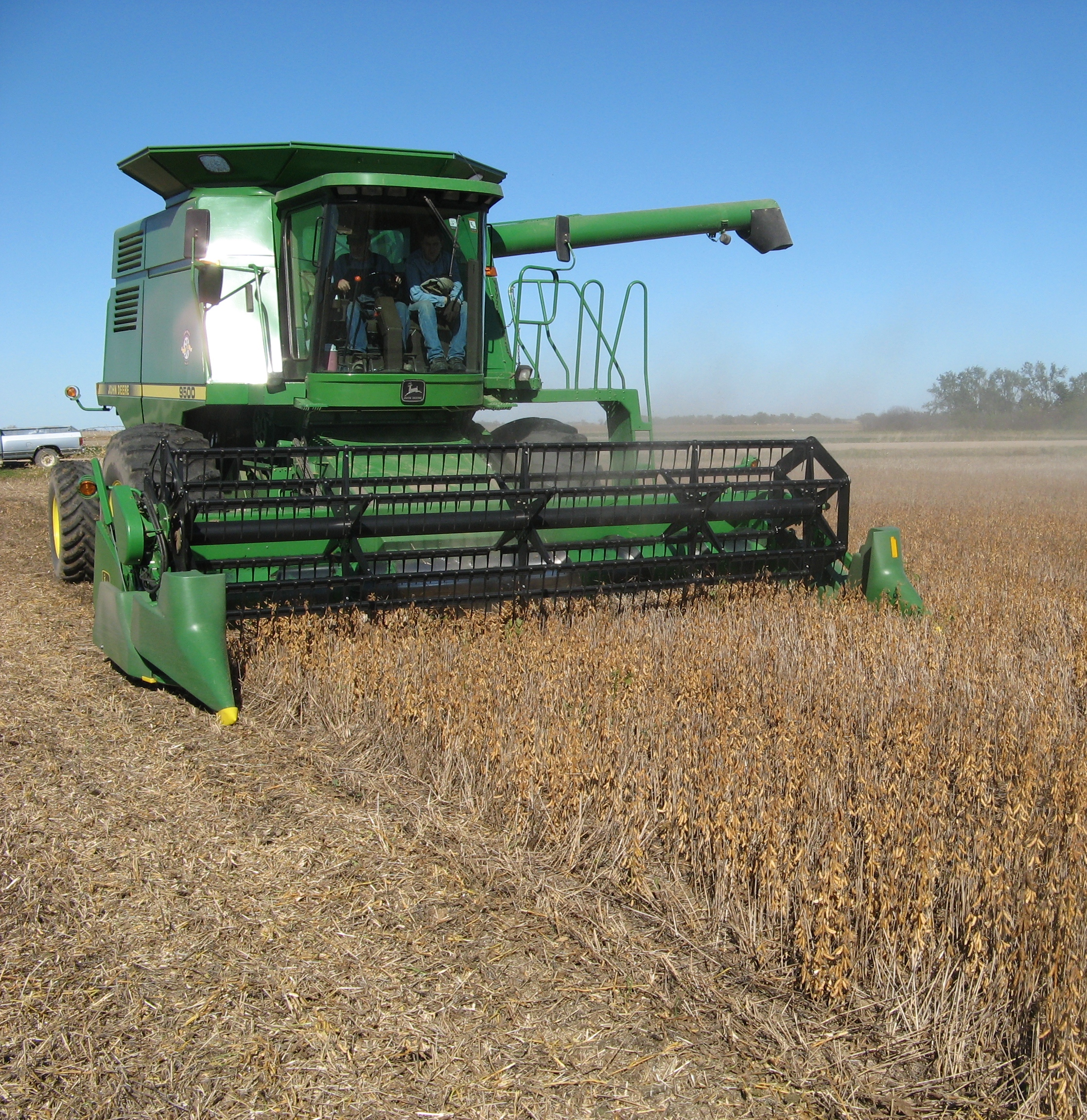 soybeans in the 7-10% moisture range already in spite of there also being some “lima beans” along with the low moisture beans at harvest.
Harvesting soybeans at 13% moisture is a combination of skill and maybe some luck. Why is 13% so critical? A standard bushel of soybeans weighs 60 lbs. and is 13% moisture. Often beans are delivered to the buyer at lower moisture than 13%. The difference between actual and desired moisture content will result in lost revenue to the grain producer. Here’s how the loss works based on UNL Extension’s “10 Easy Ways to boost profits up to $20/acre”:
- Since 13 percent of the weight is water, only 87 percent is dry matter. The dry matter in a standard bushel is 52.2 pounds and the remaining 7.8 pounds is water.
- If this bushel of soybeans is kept in an open basket and some moisture is allowed to evaporate, the net weight of beans would decrease. If the dry matter weight remains unchanged at the standard 52.2 pounds, the wet basis weight for any moisture content can be calculated.
- For example, a standard bushel at 13 percent moisture weighs 60 pounds. If the moisture content were reduced to 11 percent (89 percent dry matter), the wet basis weight per bushel of the soybeans would be 52.2 pounds of dry matter divided by .89=58.65 pounds. (1.35 pounds less than the standard 60 lb. weight of beans initially placed in the basket). For each 52.2 pounds of dry matter delivered at 11 percent moisture, you miss an opportunity to sell 1.35 pounds of water.
- It is standard practice for buyers to assume 60 pounds of soybeans constitutes a bushel when soybeans are at or below 13 percent moisture. When the beans are below 13 percent, the difference in water content is made up for by an equal number of pounds (wet basis) of soybeans.
- Assuming a 60 bushel per acre yield and selling price of $8.50 per bushel, the potential extra profit the producer could realize if the beans are harvested at 13 percent moisture instead of 11 percent is $11.48 per acre.
Rapid dry-down and difficulty harvesting green stems and pods are the most common reasons for harvesting at lower than standard moisture. The following practices can help producers maintain quality and expected moisture content.
- Adjust harvest practices. When harvesting tough or green stems, make combine adjustments and operate at slower speeds.
- Begin harvesting at 14 percent moisture. Try harvesting when some of the leaves are still dry on the plant; the beans may be drier than you think. Soybeans are fully mature and have stopped accumulating dry matter when 95 percent of the pods are at their mature tan color.
- Plan planting dates and variety selection to spread out plant maturity and harvest.
- Avoid harvest losses from shattering. Four to five beans on the ground per square foot can add up to one bushel per acre loss. Harvest at a slow pace and make adjustments to the combine to match conditions several times a day as conditions change.
More on Last #Irrigation
It’s been a long irrigation season thus far, but we are so thankful for irrigation in this part of the Country during this drought of 2012! Questions continue to roll in regarding last irrigation for corn and soybeans. Corn at 1/2 starch only needs 2.25″ to finish up so it’s important to know what your soil moisture status is. For most irrigated producers, at 1/2 starch, you should be finished irrigating.
For soybeans at R5 or beginning seed fill, you still need about 6.5″ to finish out the crop. At R6 when the seeds are filling, that drops to 3.5″. At R7 when you begin to see leaves yellowing, that is beginning maturity and you are finished irrigating. They key is we don’t want to fill the profile going into the fall as we’d like to replenish the profile with fall and spring rains and winter snow. However, with soybeans, it’s also critical not to stop irrigating too soon during seed fill.
Gary Zoubek, Extension Educator in York County sheds more light in the following video produced by UNL’s Market Journal.
#UNL South Central #Ag Lab Field Day
We have a great field day coming up on August 22 at South Central Ag Lab near Clay Center. Check out the flyer below for more details and hope to see you there!

Field Days
Well, August has begun and so has the season for field days. Here are a few I hope you mark on your calendars and plan on 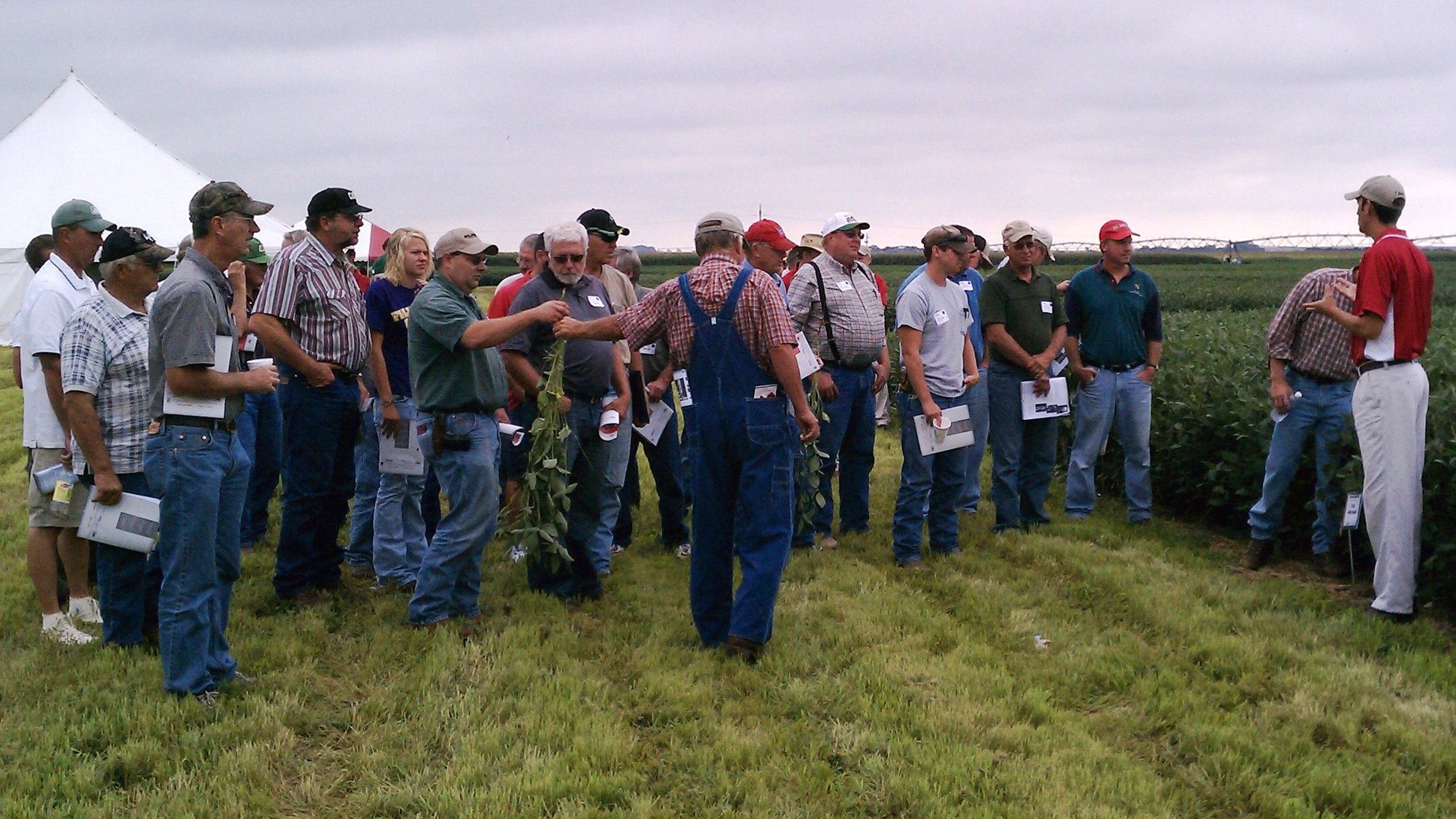 attending. Also a reminder, for all drought information from UNL Extension including crop, livestock, water, lawn, and garden, please check out http://droughtresources.unl.edu.
With the drought and a shortage of forages, if you are considering harvesting or grazing crops for forage, it is important to consider the herbicide restrictions applied to these fields. Check the labels of these herbicides to confirm that grazing restrictions or forage harvesting restrictions have been met before you turn livestock into the fields or cut the crop for hay or silage. Check out this link for more information.
Soybean Management Field Days Planned: Please mark the dates of the upcoming Soybean Management Field Days on your calendar. They are planned for August 14-17 with sessions planned for Lexington, O’Neill, Platte Center and David City. Registration for each of the Field Days starts at 9:00 a.m. with four one hour programs from 9:30 a.m. to 2:30 p.m. Topics include: Soybean Seed Treatments and Foliar Fungicides Growth Enhancement Interaction with Herbicides, Managing Land Leases and Soybean Marketing, Herbicide Carrier Rate Study and Quest for the Holy Grail in Soybean Production! Check out the sessions by going to http://ardc.unl.edu/soydays. The David City date and location is August 17th and it’s located from the Jct of 92 & Hwy 15, 1 mile east on 92 and ¾ mile north on county road.
South Central Ag Lab Field Day: Some of you have been asking about the next field day at South Central Ag Lab near Clay Center. Please mark your calendars for August 22 from 9:00 a.m.-2:00 p.m. with registration beginning at 8:30 a.m. Topics include: Weed control, timing, resistant weeds; Emerging diseases of corn and corn rootworm management options; Impacts of corn stover harvest on soil quality and greenhouse gas emissions; Variable rate nitrogen and irrigation management according to landscape variation; and Use of Soy-Water for managing soybean irrigation. There is no charge but please RSVP for a meal count by Friday, August 17 to (402) 762-4403. Hope to see you there!
York County Corn Grower Plot Tour: The York County Corn Growers Annual Plot tour will be held Thursday, August 23, 2012 from 5:30 – 7:30 p.m. This year’s cooperators are Ray and Ron Makovicka and the plot is located west of York on the Dwight Johnson farm. The plot is located ¾ miles north of Hwy 34 on Road I. Those attending will be able to check out the various corn varieties and visit with the seed company representatives. Supper will be served after the tour. Then there will be a report on 2012 practices, products used and irrigation update.
Also this year they have several different types of irrigation equipment in the field to monitor soil moisture and estimate crop ET. Systems in the field include: AquaCheck USA provided an AquaCheck soil moisture sensor system; Servitech provided the Profiler Watermark soil moisture sensor system; McCrometer provided an EnviroPro soil moisture sensor system; and AquaSpy provided AquaSpy soil moisture sensor system. Several of you have asked about wireless irrigation scheduling systems-here’s your chance to compare them all in one place!


 JenResources