Blog Archives
Wheat Updates-May 2016

May 27: Wheat is in the milk to soft dough stages of filling with later heads still pollinating in Clay/Nuckolls county fields. Stripe rust greatly increased in severity, particularly on susceptible varieties. This photo is showing progression on Overland. I haven’t seen stripe rust yet in fields planted to Wolf. Barley yellow dwarf is appearing in small amounts in more fields, but is limited to field corners/borders thus far.

May 23: (Photo: barley yellow dwarf in wheat-characterized by yellow-purple flag leaves. It is vectored by aphids). Wheat is in the late flowering to beginning milk stage in many Clay/Nuckolls county fields. Stripe rust increased in severity this past week in more susceptible varieties and barley yellow dwarf is also appearing more often in patchy areas of fields.
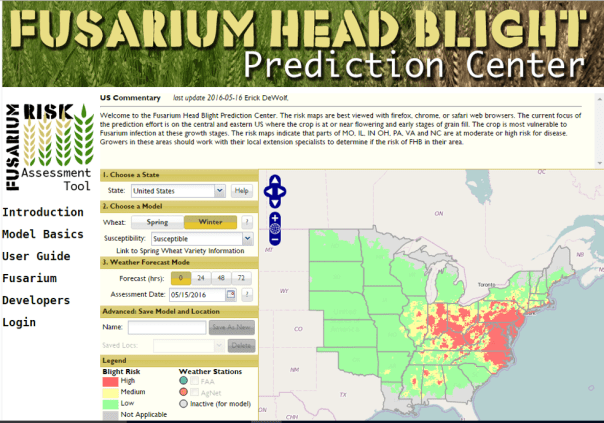
May 15: Rain is falling this morning in parts of our area and wheat is in a variety of heading and flowering stages. While the risk management tool at: http://www.wheatscab.psu.edu/ still says “low risk” I’ve been concerned it had the potential to be higher with our growth stage and weather conditions. Last week I received numerous wheat fungicide questions. Caramba and Prosaro are the two products you can apply legally once your wheat is flowering. Twinline is off-label once flowering begins. Yes, it has metconazole in it (also active ingredient in Caramba) in addition to a strobilurin, but it only legally can be applied to Feekes 10.5 which is full heading and is off-label once flowering occurs. Caramba and Prosaro will help prevent scab in addition to kill the rust already occurring in your plants. Unfortunately, I was also starting to see barley yellow dwarf appearing in Nuckolls County fields. This virus is vectored by a number of aphid species. We’d been seeing aphids and stripe rust for a month at this point but both remained below threshold levels/low incidence. Barley yellow dwarf can be identified by the flag leaf turning a bright yellow-purple color. With 80% of wheat yield coming from the flag leaf and there being nothing you can do about barley yellow dwarf, this also needs to be part of your decision making process if you were planning on applying a fungicide for preventing scab/controlling stripe rust.
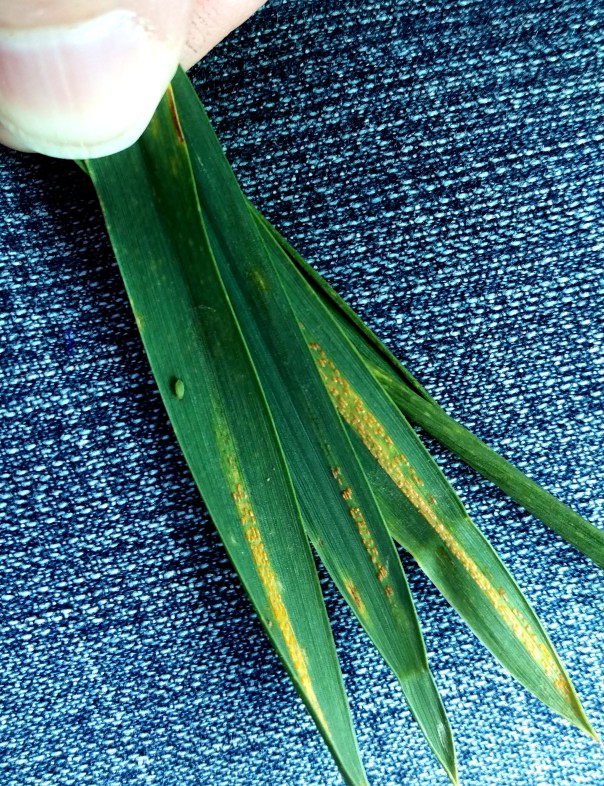
May 9: We’ve been seeing stripe rust in wheat for over a month now, but the amount of rust has remained low. Some have chosen to spray wheat at this point; however I’m also concerned about the potential for Fusarium Head Blight (scab) in wheat. Fusarium head blight is caused primarily by Fusarium graminearum, the same fungus causing Fusarium stalk, root, and ear rot in corn. The fungus survives the winter in corn and other small grain residue and then releases spores in the spring. However, wheat planted into soybean ground can still be affected by scab because the fungal spores can be wind-blown in addition to being water-splashed to wheat that is in the flowering stage.
According to research, wheat is susceptible from flowering through soft dough development stage. “Typical” fungicides used for control of fungal leaf diseases are off-label thus illegal to apply once the wheat has flowered and they do not have activity on the Fusarium fungus causing scab of wheat. Management for scab includes the use of the preventive fungicides Caramba or Prosaro. Both are labeled for headed and flowering wheat. There’s a 30 day pre-harvest restriction for both. Rainfast varies from ¼ hour to 2 hours or when dry depending on environmental conditions. Both fungicides can help prevent scab and control rust on the plant.
Research from the US Wheat and Barley Scab Initiative (which is a combined effort of several Universities in the U.S. and Canada) has found that the best prevention using these products occurs when wheat is headed and 30% of the plants are in the beginning flower stage. Application within five days of these criteria still showed positive results. This research also showed that application before or after this time period greatly reduced effectiveness of preventing scab. Understandably, the economics of fungicide application are difficult in wheat, yet, if you are aiming to make one application, this could be your best option for both scab prevention and controlling rust in your plants. The risk map for scab can be found at: http://www.wheatscab.psu.edu/. With wheat at heading to beginning flower and rain/humidity this risk in reality could be higher for us.
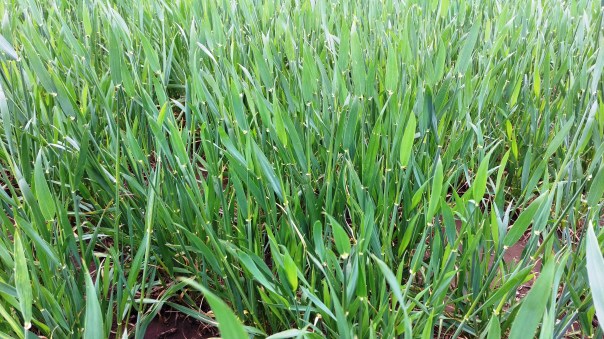
May 1: Wheat progressed quickly in one week! Wheat in Clay and Nuckolls counties have flag leaves emerged even though wheat is really short. The color is getting better thanks to moisture, root establishment, and nitrogen uptake. I also didn’t see an increase in rust incidence this past week and aphid numbers were holding steady. For those asking about fungicides, I’m still hoping we can hold off a little longer with current wheat economics, especially since in those counties rust wasn’t increasing due to the colder temps. With warmer temperatures this coming week, please be checking your wheat. If possible, one option that could be more economical in non-irrigated situations would be to consider treating your wheat once during flowering with either Caramba or Prosaro (as these products both prevent scab at the proper application timing and also kill fungal diseases including rust already present on the leaves). We’ll have to see what happens with rust development and with how long it takes for heads to emerge. There’s also been consistency with some varieties rated high for rust resistance where I have yet to find rust in them-so that’s a good thing!
Crop Update June 5
This year I was counting my blessings as we made it through May with no tornadoes in Clay County and no Memorial Day storms! Yet history seems to repeat itself on days. Last year, hail went through the counties north of us on June 3. This year, hail hit us on June 3rd….an estimated 30% of Clay County. Please also see the resources listed at the end of this post for more specific information regarding decision-making.
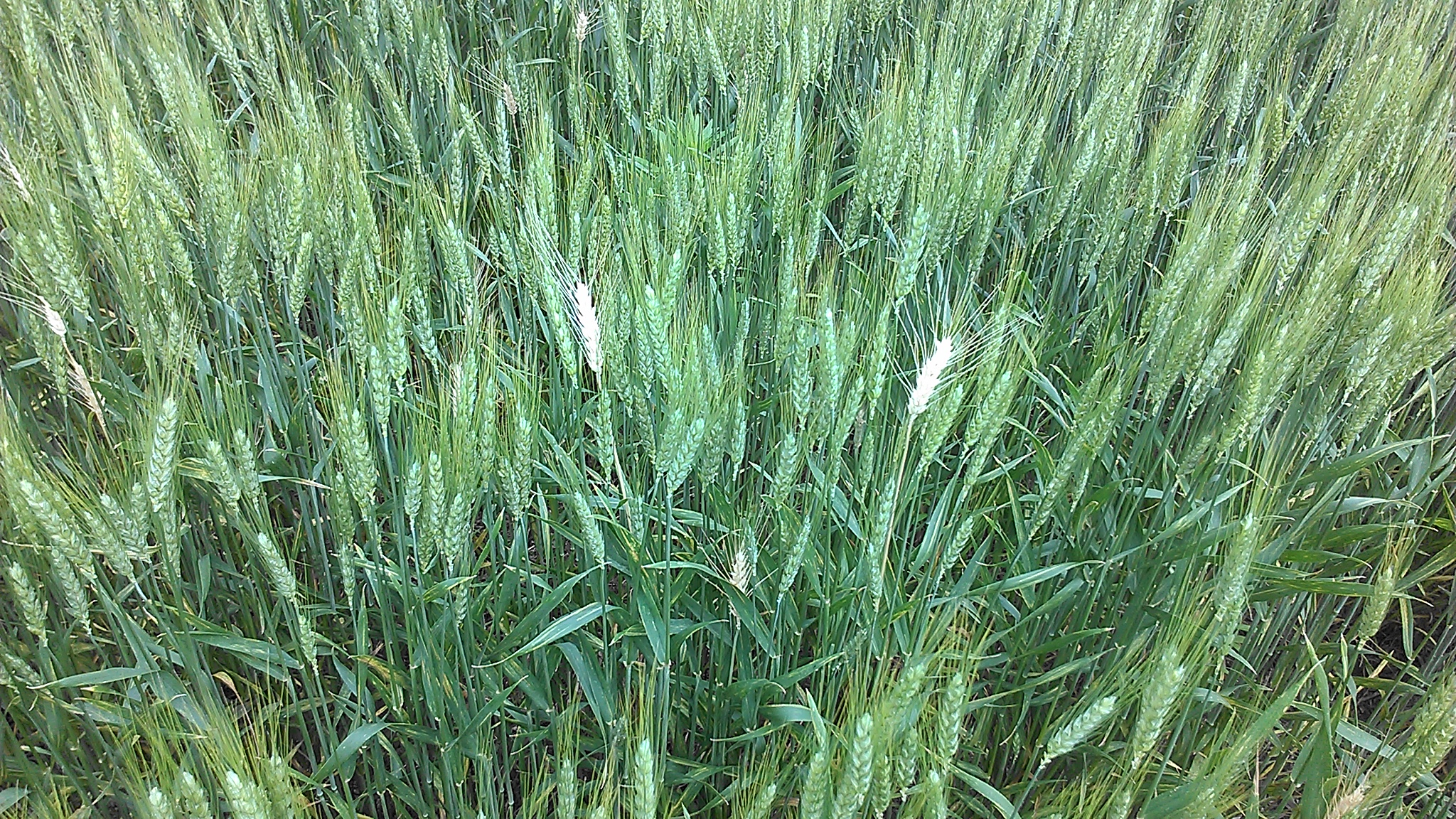
Earlier that day, I had looked at wheat in a number of counties where white heads were appearing in wheat. Most often they easily pulled from the head and weren’t more than 2% of fields. Those were attributed to wheat stem maggot. The white heads that were hard to pull from the stem were most likely due to some late frosts that we had in the area.

The evening of June 3rd resulted in various rainfall totals throughout the county and hail damage to an estimated 30% of the County. This photo is of the west fork of the Upper Big Blue River that was flooding many fields along Hwy 6 between Hwy 14 and Sutton.

This was June 4: Water along both sides of Hwy 6 from Hwy 14 to Sutton and over the road in a few areas. The road was closed on June 5th after another 3-4 inches fell in the area Thursday night. Portions of fields were flooded throughout the County and we’ll have to see how long it takes for water to recede and what temperatures do to determine any replant situations.
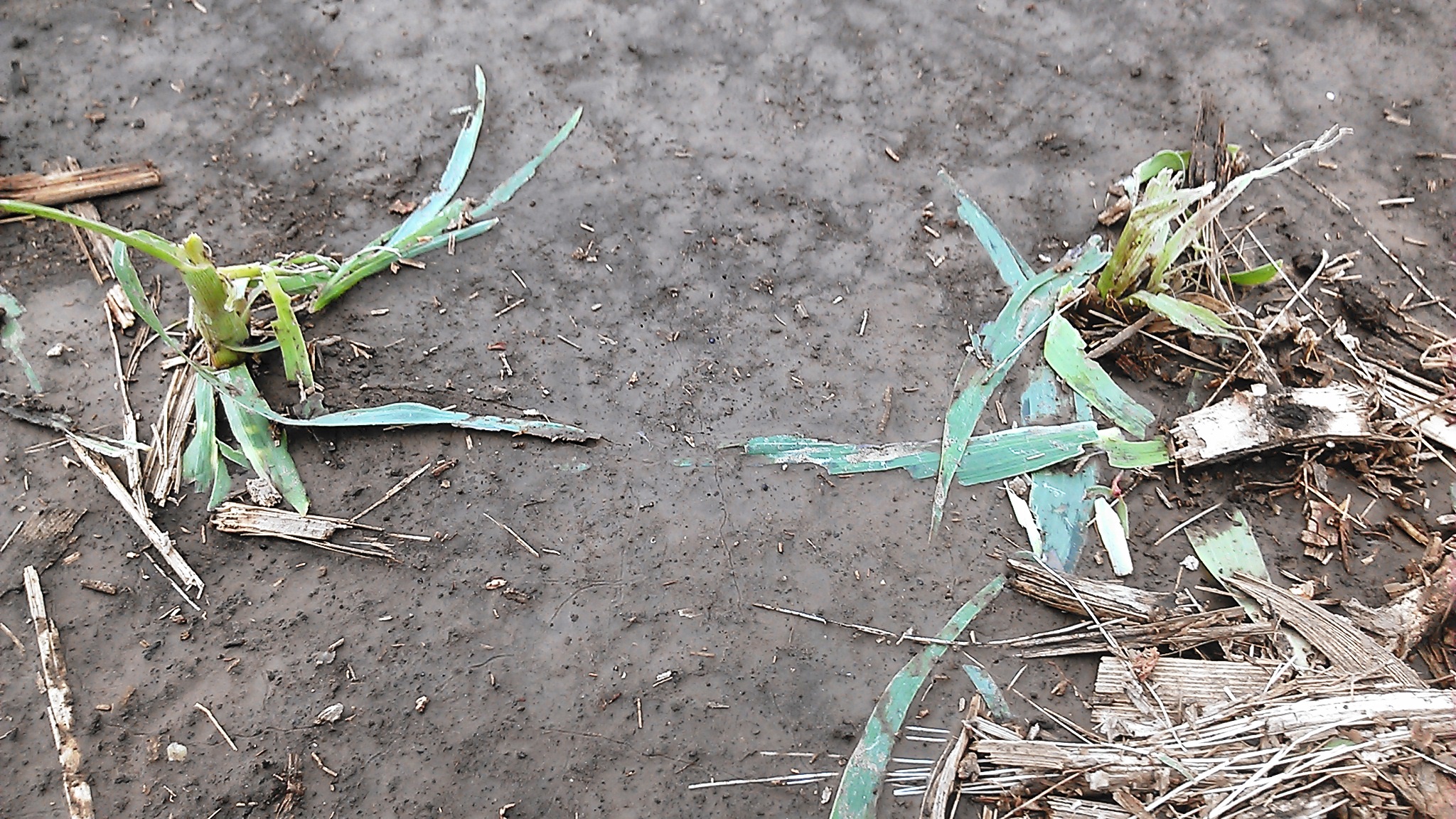
Corn in the V5-V6 stage ranges in hail damage. The worst damage of plants were reduced to sticks. Time will tell how well the plants recover. I’m concerned about bacterial diseases in corn-particularly Goss’ wilt showing up later…but also a bacterial rot that we were seeing in Nuckolls and Thayer Co. after the heavy rains they received last month.
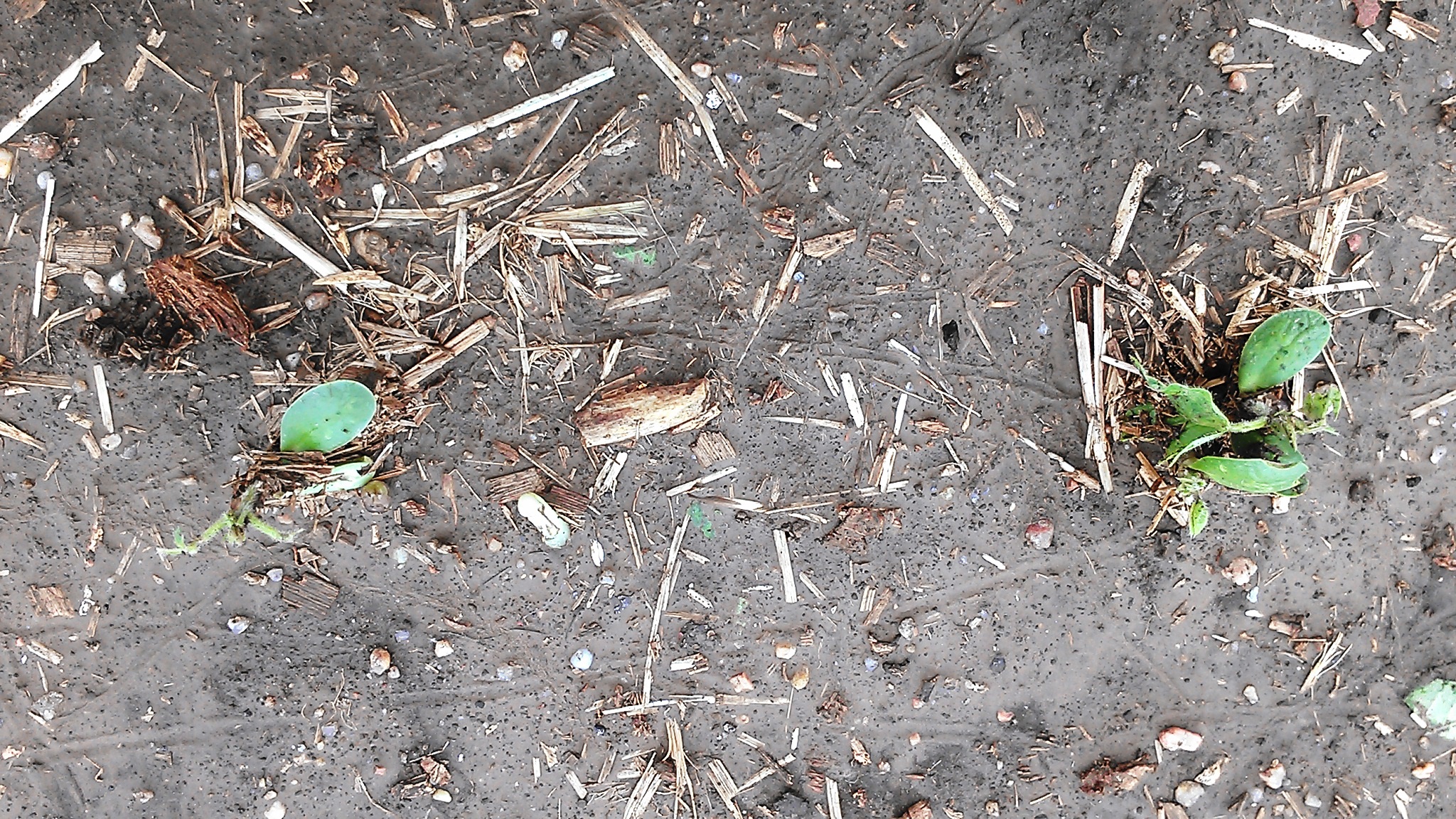
Soybeans ranged from planted to V3 in the County. Many of the hail-damaged beans still had a cotyledon attached. In the past, I’ve seen new plumules shoot from the top of the stem when the growing point wasn’t too damaged. We again will need to wait and see what happens.

First cutting alfalfa is down in much of the County waiting to be baled.

Severely hailed wheat field. You can also see the amount of stripe rust present in this field. We estimated 75-80% of wheat heads in this field were broken over and wouldn’t fill the heads.
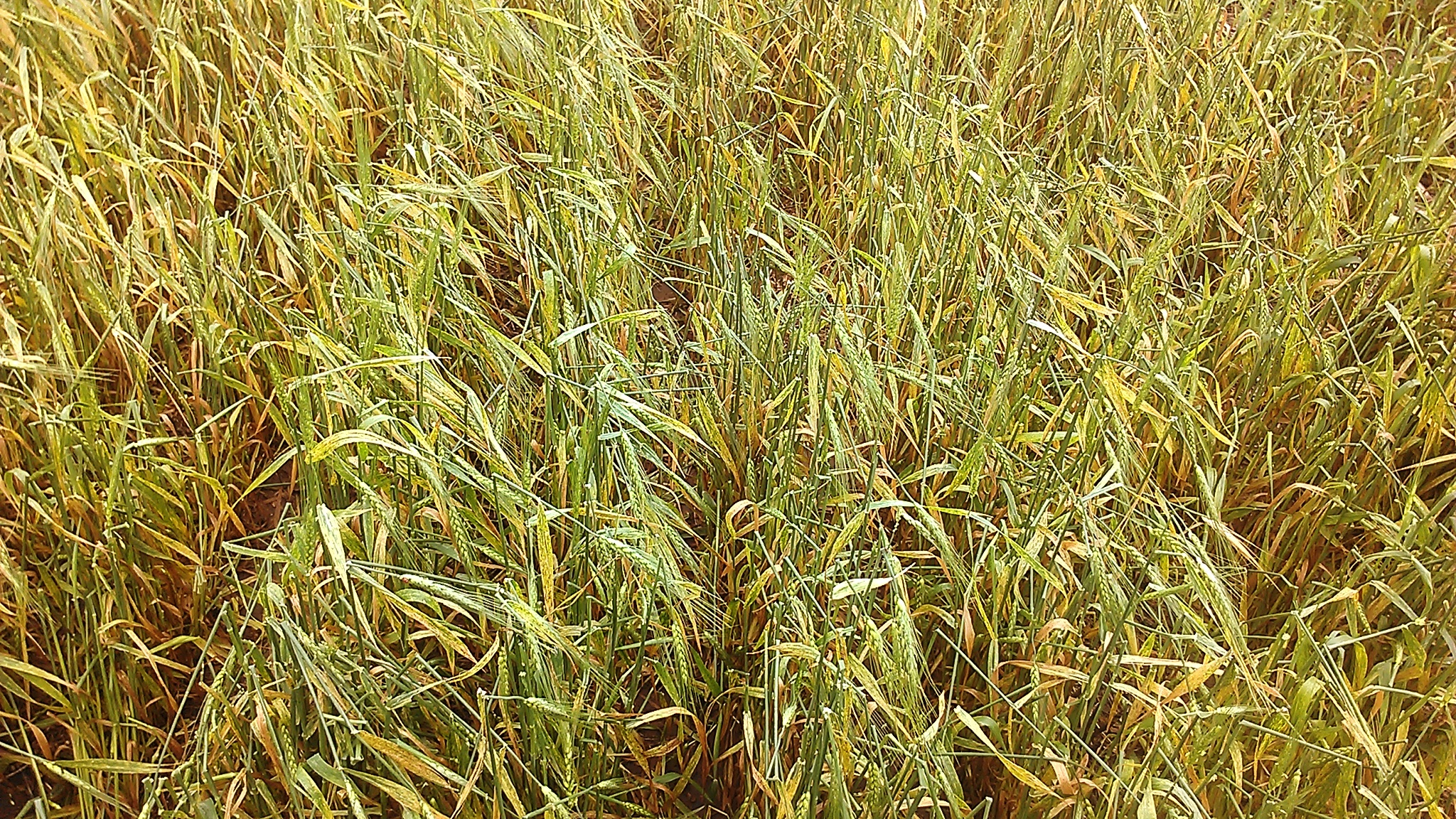
Another hail-damaged wheat photo. We have a great deal of stripe rust of wheat in the County and some farmers with livestock have chosen to hay wheat that is severely affected by stripe rust. Some did spray fungicide which has held the rust back. Others are going to just see what happens yield-wise.
For more information on hail and replant decisions, please see:
Options for Stripe Rust in Wheat
Stripe rust has exploded in wheat in the past 3-7 days in South-Central Nebraska due to the rain and cooler weather. Nebraska Extension is receiving numerous questions regarding options to consider. Rain has also increased our risk for Fusarium Head Blight (head scab).
Wheat is at such a variety of stages in the area; many fields are just heading and/or flowering right now while others are in soft-dough.
Stripe rust on the flag leaf, as shown in this photo, will continue to progress with cool, wet conditions, reducing yield. If your fields are currently yellow with stripe rust, here are a few options:
1-Do nothing and see what happens regarding what yield is obtained. If your wheat is past flowering, fungicide application is not an option as all fungicides would be off-label.

Susceptible wheat varieties to stripe rust that have not been treated with a fungicide to date have a yellow cast to them in South-Central Nebraska.
2-If your wheat is headed and beginning to flower, you could still consider a fungicide application of Caramba or Prosaro. Both are labeled for headed and flowering wheat. There’s a 30 day pre-harvest restriction for both. Rainfast varies from ¼ hour to 2 hours or when dry depending on environmental conditions. Both fungicides can help prevent scab and control rust on the plant. However, research has shown that best scab prevention occurs when wheat is headed and 30% of the plants are in the beginning flower stage. Application within 5 days of these criteria still showed positive results. Research showed that application before or after this time period greatly reduced effectiveness of preventing scab. Understandably, the economics of a fungicide application are tight with current wheat prices. The following article includes economic considerations.
3-Consider haying it. Dr. Bruce Anderson, Nebraska Extension Forage Specialist shared the following:
“Baling hay or chopping silage are two potential options. Rust pustules are not toxic to cattle although sometimes the spores can irritate respiration. It can be difficult to make good silage, though. Rusty leaves dry out rapidly so it can be hard to get the best moisture content for silage packing and fermentation.
Usually it is best to harvest rusty wheat hay just before heading to retain reasonable forage quality. As plants mature further, quality can decline rapidly. Digestibility of rust affected cells is much lower than that of normal cells. Fortunately, protein doesn’t seem to be affected greatly. Properly made hay should not deteriorate in the bale due to the rust any more than normal.
Be sure to have the forage tested before feeding. It is likely that nutrient concentration will differ from typical wheat hay so testing will help in developing rations. Also consider the impact of removing the wheat residue. Adequate residue helps retain soil moisture, boosting yield of your next crop.
There never are good choices when problems like this develop. All you can do is weigh your options and choose what is best for you.”
Also, please continue to check out UNL CropWatch for wheat disease and all our crop updates.
Wheat Scab Risk Increasing
Fusarium Head Blight Risk Assessment Tool: http://www.wheatscab.psu.edu/.
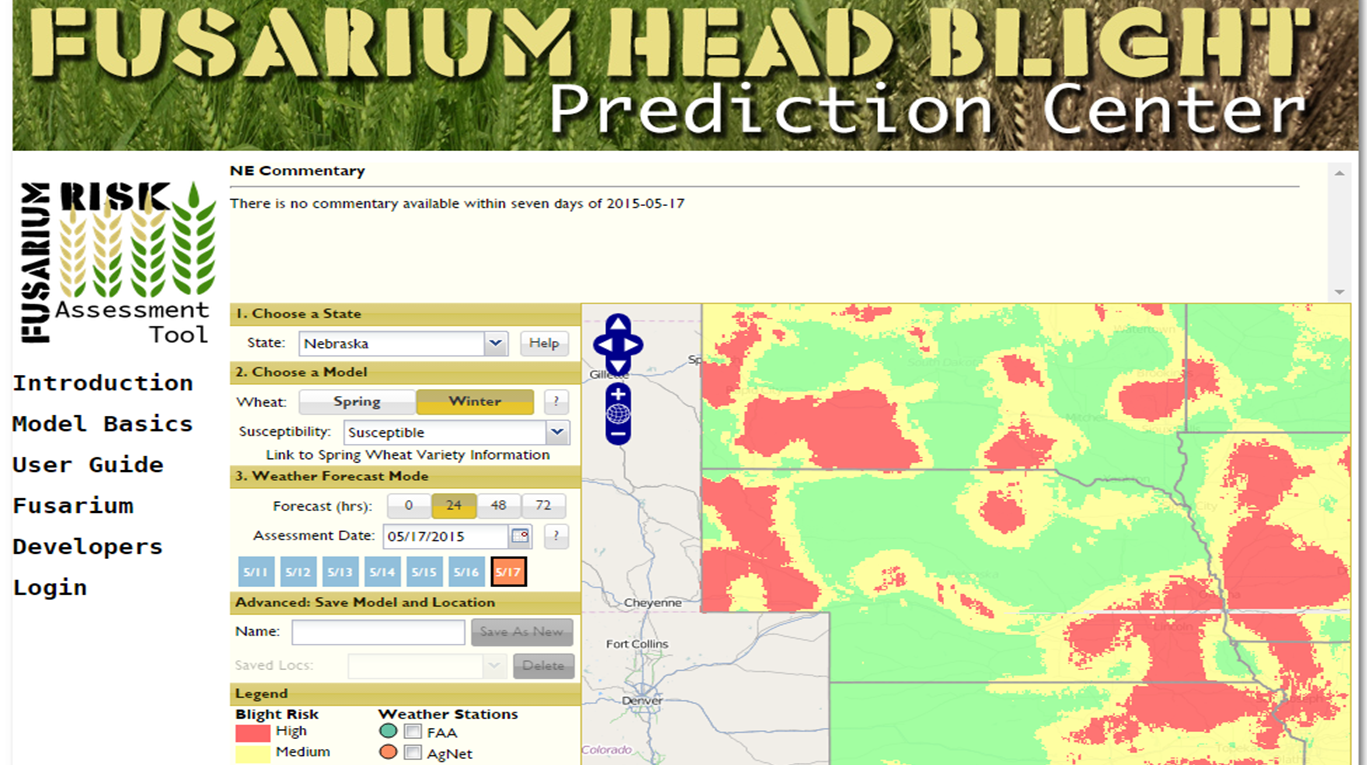
With wheat heading/flowering in South Central Nebraska and recent rains, risk for Fusarium Head Blight (scab) in wheat in our area of the state has increased to moderate/high. I’m also finding stripe rust up to a leaf below flag with some just beginning to appear on the flag leaves. This year creates a harder decision for applying fungicides in non-irrigated fields with cost of production, wheat price, poor stands, and severe stripe rust. If you are considering a fungicide, your options during flowering are: Prosaro, Caramba, and Proline. Typical foliar fungicides are off-label once flowering occurs. The above-mentioned fungicides can help prevent scab and control stripe rust and some other foliar fungal diseases if the fungicide is timed correctly. For preventing scab, research has shown that fungicides applied when approximately 30% of wheat heads reach beginning flower stage do a good job of protecting wheat plants as did the application of fungicide within 5 days of early flowering. Application of the fungicide 7-10 days after flowering offered minimal control based on University research trials sponsored by the U.S. Wheat and Barley Scab Initiative.
Ag Reflections from 2014
Happy New Year! Wishing all of you and your families a wonderful 2015! As I look back at 2014, there are several ag-related observations that I noted throughout the year.
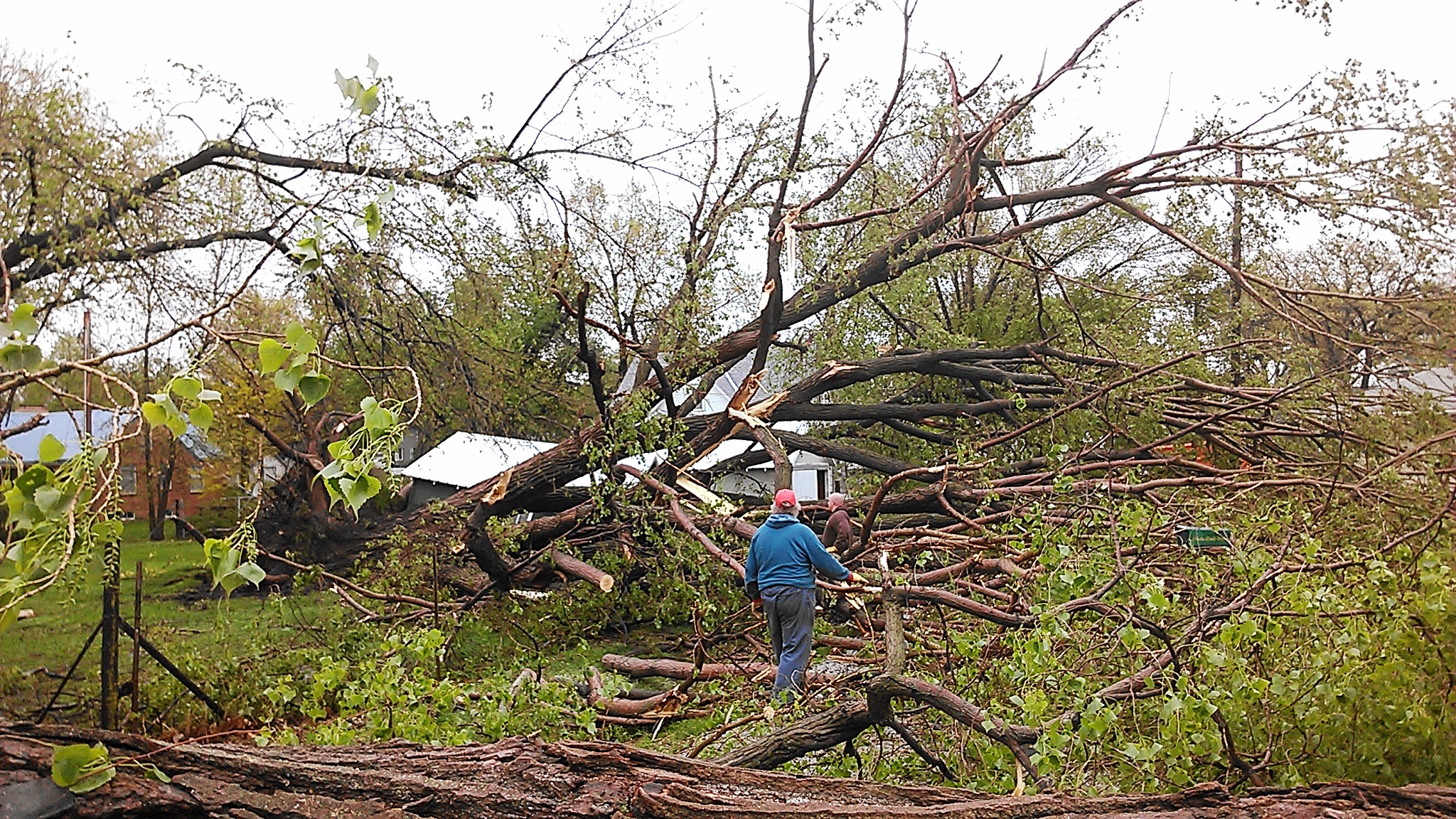
Cleanup after the tornado in Sutton on Mother’s Day 2014.
The first observation continues to be the way communities and people in this County/area pull together in difficult times. Whether after tornadoes/wind storms or helping other farm families who had an injured family member or had lost a family member, it’s just a blessing to see the way people pull together to help each other in time of need. It was also a blessing for many who were unable to harvest in 2013 due to the August 1st storm, to harvest fields in 2014, and for many in the area to experience really good irrigated and dryland yields this year.
The dry winter of 2013/14 allowed for very mellow ground during planting time. Often seeding depth ended up ½-1” deeper than intended. The dry winter also didn’t allow for good residue decomposition leading to problems during planting and ensuing stand emergence. Cutting off residue and high rains in May led to unintended consequences of replant situations when residue was moved off of farmers’ fields onto neighboring fields, suffocating emerged plants in portions of fields. I’m not sure what the solution is for the future other than it really needs to be something worked out with neighboring farmers, but perhaps mentioning it here opens an opportunity for future conversations.
Cover crops have been incorporated into more operations in recent years, yet the ultimate goal for using them remains important in determining what species/crops are used in the fields. We also realized the importance of determining amount grazed prior to turning cattle into fields (whether for grazing cover crops or crop residue), as high winds in winter 2013/14 in overgrazed fields led to soil blowing throughout the winter.
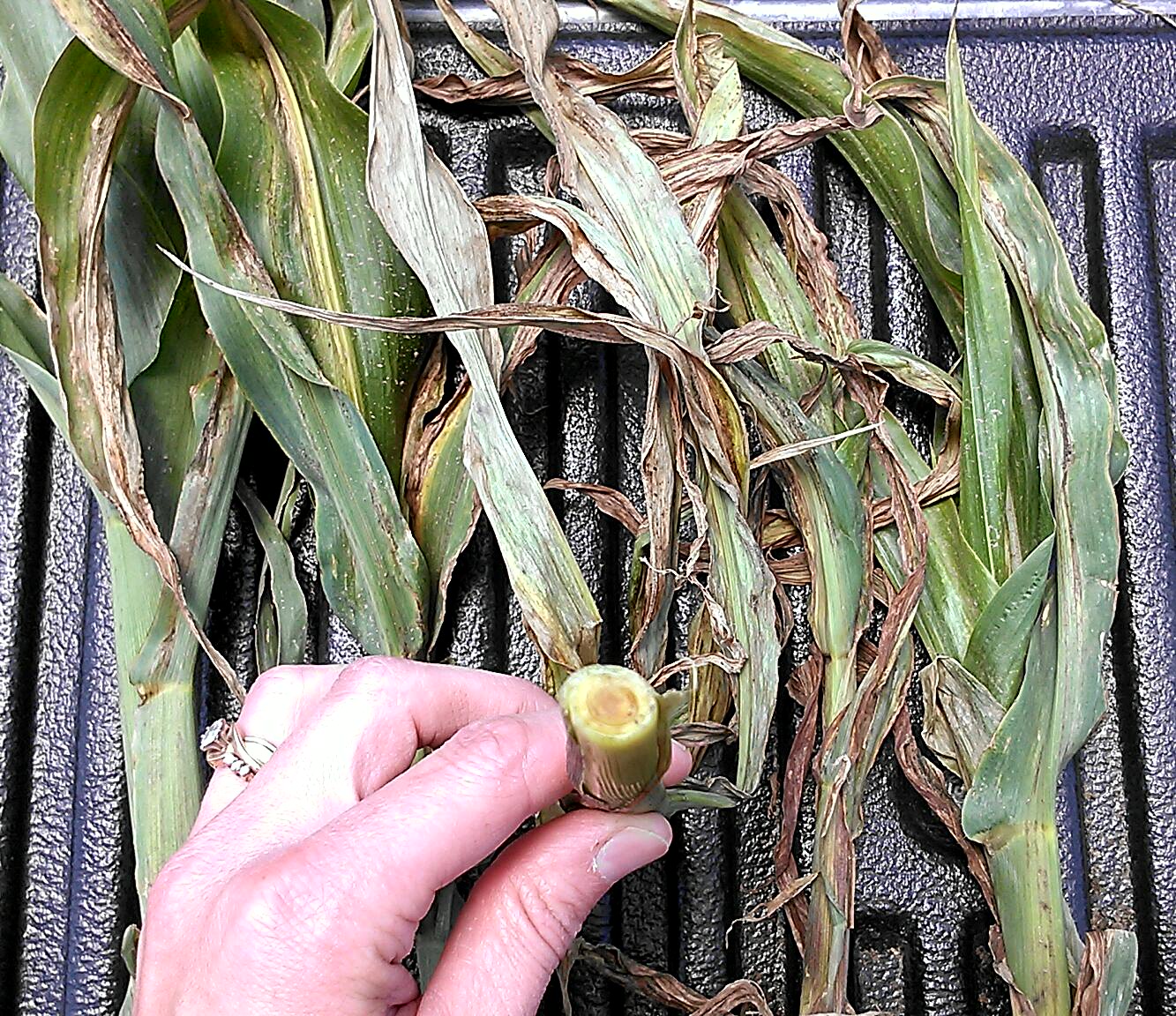
Systemic Goss’ wilt showed up in some fields that were hail and/or frost damaged by V6.
The May frost showed us emerged soybeans at the cotyledon stage held up well to the frost compared to the corn. We also again watched Goss’ wilt show up systemically by 6 leaf corn that was injured early by frost or hail in fields where Goss’ wilt had been a problem in the past. We need more research/understanding of this disease. Wheat continues to show us its resiliency as it winterkilled in portions of fields, withstood drought-stress, and then made up yield in the last 4-6 weeks.
Perfect pollination conditions coupled with high solar radiation, low night-time temperatures, and timely rain events were keys to the bountiful corn crop we experienced this year. Soybeans were more of a mixed bag. In walking fields and in conversations with farmers, I think the disappointment in some irrigated yields could be attributed to early/over-irrigation, disease problems, and planting date. UNL on-farm research showed on average a 3 bu/ac yield increase when soybeans were planted in late April to first week of May (regardless if growing season was warm/dry or cold/wet like it was this year) and those I’ve talked to who achieved 80+ bu/ac in the area this year planted in that time-frame. I’m curious if there’s something to planting a 2.4-2.5 maturity early vs. a 3.0+ maturity early as some area producers are seeing strong yields from a shorter season hybrid planted early the past few years. So if you’ve also seen this and/or are interested, that will be an on-farm research project to try next year. Please let me know if you’re interested!
Here’s wishing you a healthy and prosperous 2015!
Crop Update 6-20-13
The sun has been welcomed and crops are rapidly growing in South Central Nebraska! Corn right now is between V6-V8 (6-8 leaf) for the most part. Quite a few farmers were side-dressing and  hilling corn the past two weeks. It never fails that corn looks a little stressed after this as moisture is released from the soil and roots aren’t quite down to deeper moisture.
Installing watermark sensors for irrigation scheduling, we’re finding good moisture to 3 feet in all fields in the area. The driest fields are those which were converted from pasture last year and we want to be watching the third foot especially in those fields. Pivots are running in some fields because corn looks stressed, but there’s plenty of moisture in the soil based on the watermark sensor readings I’m receiving for the entire area. So we would recommend to allow your crops to continue to root down to uptake deeper moisture and nitrogen.
The last few weeks we observed many patterns from fertilizer applications in fields but as corn and root systems are developing, they are growing out of it. We’ve also observed some rapid growth syndrome in plants. This can result from the quick transition we had from cooler temperatures to warmer temperatures, which leads to rapid leaf growth faster than they can emerge from the whorl. Plants may have some twisted whorls and/or lighter discoloration of these leaves, but they will green up upon unfurling and receiving sunlight. This shouldn’t affect yield.
Damping off has been a problem in areas where we had water ponded or saturated conditions for periods of time. We’ve also observed some uneven emergence in various fields from potentially a combination of factors including some cold shock to germinating seedlings.
We began applying sugar to our on-farm research sugar vs. check studies in corn. We will continue to monitor disease and insect pressure in these plots and determine percent stalk rot and yield at the end of the season.
Leaf and stripe rust can be observed in wheat fields in the area and wheat is beginning to turn. We had some problems with wheat streak mosaic virus in the area again affecting producers’ neighboring fields when volunteer wheat wasn’t killed last fall. Alfalfa is beginning to regrow after first cutting and we’re encouraging producers to look for alfalfa weevils. All our crops could really use a nice slow rain right now!
Wheat Scab Potential Risk
With the recent rains in Nebraska, the potential for wheat scab has increased. This video shares more information including a fungicide table of products to consider with product efficacy ratings for scab. For more information, please check out http://cropwatch.unl.edu. Thanks to Rachel Stevens, UNL Extension Intern, for producing this video!
Understanding Research Statistics
Dr. Charlie Wortmann, UNL Extension Soil Fertility Specialist, explains the power of statistics for understanding yield and other differences and non-differences for on-farm research.
Youth Discover Crop Science
An excellent opportunity for youth to become detectives and have fun while learning about crops and science! Consider having a youth you know attend this Big Red Camp and learn more about agriculture careers! There are also scholarships available to attend!

Are you interested in science, agriculture, plants, crops, insects, or diseases? If so, join our team of detectives to solve crop-related problems in the Crop Science Investigation (CSI) Big Red Camp! Become a detective while participating in hands-on sessions to learn about and increase your knowledge of crops, science, and agricultural careers. Youth detectives will interact with agronomic professionals across Nebraska to solve experiments in: nutrient management; managing disease, insect and weed problems; water management; crop production, and much more! Do you have what it takes to become a CSI detective?

There are a variety of careers related to plant sciences such as:Agricultural Communicator; Agronomist; Crop Consultant; Crop Insurance Adjuster; Educator; Co-op Manager; Farmer or Rancher; Farm Credit Banker; Field or Lab Researcher; Plant Breeder; Soil or Water Conservationist; Seed, Fertilizer, or Chemical Sales; or Technical Representative.
Scholarships are available in the amount of $300 to participants who…
View original post 243 more words


 JenResources