Yearly Archives: 2019
JenREES 9-1-19
*I’m grateful to Dr. Richard Ferguson, former Extension Soil Fertility Specialist, for reviewing this article; Dr. Charlie Wortmann, Extension Soil Fertility Specialist, for sharing research-based studies with me; and Glen Slater, SCAL Research Technician, for sharing details of the SCAL study mentioned below.
Nitrification Inhibitors: Two weeks ago, my column included a general overview regarding nitrogen losses in addition to general summary statements based on research. Nitrification inhibitors are best thought of as an insurance policy against loss of applied ammonium-based fertilizer due to excess rain in the first month or so after fertilization. Dr. Richard Ferguson, former Extension Soil Fertility Specialist, and his team have conducted much research regarding the use of nitrification inhibitors over time. Much effort has occurred in sandier soils within the Central Platte NRD. However, an ongoing study at UNL’s South Central Ag Lab (SCAL) near Clay Center is conducted on silt loam soils which are more common in the UBBNRD. Twenty-eight years of this study are summarized here. The majority of the study at SCAL compared Spring pre-plant anhydrous vs. side-dress application with and without the use of nitrification inhibitor N-Serve (nitrapyrin). This product was the product available back in the 90’s. The study actually began by comparing 2 different in-season side-dress applications before switching to pre-plant vs. side-dress in the early 2000’s. Soil samples for nitrate and ammonium content were taken when funding was available. In talking with Dr. Charlie Wortmann, UNL Extension Soil Fertility Specialist, he mentioned that they found yield to be correlated to amount of nitrogen in the soil. A yield increase due to nitrapyrin applied pre-plant was observed in 6 of 28 years with a mean yield change of 2 bu/ac/year. Only 1 of 28 years was a yield increase observed when nitrapyrin was applied in season during side-dress application with a mean yield change of 0 bu/ac/year. In this study, they found that delayed side-dress N with nitrapyrin could reduce plant N uptake. A detailed analysis of nitrapyrin effects on N uptake and soil accumulation from early years of this study can be found in Ferguson et. al (1991). The duration of inhibitor efficacy was measured in other studies where it was found a nitrification inhibitor such as nitrapyrin to last around two weeks with Spring applications. They’ve seen it last as little as 1 week to as long as 6 weeks depending on soil temperatures and moisture. The use of inhibitors is not advised in season as research showed they can release N too slowly for the crop demand resulting in yield loss and/or resulting in increased leaching of nitrogen when it was released too late in the growing season for crop uptake. In general, the research is more supportive for nitrification inhibitor use in sandy soils vs. heavier textured soils; yield benefit to a nitrification inhibitor may be none to a few bushels/acre for silt loam or silty clay loam soils.
In-Season Applications of Nitrogen: In-season application means the nitrogen is applied when the crop is actively growing and utilizing it, greatly reducing potential for loss. Recent on-farm research studies compared side-dress applications using either the UNL equation/Maize N model or industry models such as Climate Field View. In all these studies, the recommended rate was compared to rates that were at least 30 pounds over and under the recommended rate. Some of the studies went as high as +/- 50 lbs/acre compared to recommended rate. I’ve compiled these results in a table at https://jenreesources.com/2019/04/14/jenrees-4-14-19/. Take homes: In none of the studies did the addition of 30-50 lbs N/ac above the recommended rate increase the yield statistically. A few of these studies also compared side-dress applications vs. pre-plant alone. One situation resulted in a statistically lower yield with pre-plant alone while the other two resulted in no yield differences. Many of you have most likely heard of Project Sense in which a grower’s nitrogen application was compared to 75 lbs pre-plant + variable rate in-season application using sensing technology. This project was an on-farm research partnership with Nebraska Extension, Nebraska Corn Board and Corn Growers, and numerous NRDs including UBBNRD. From 2015-2017, 48 site-comparisons were conducted. The results showed 28.7 lbs less nitrogen was applied using the Project Sense method with a loss of 1.4 bu/ac in yield, and greater profitability of $7.24/ac. All of these results were statistically significant at the 95% level.
To reduce the risk of leaching or denitrification, consider applying the majority of nitrogen close to when crop demand is high with more nitrogen applied during the growing season vs. pre-plant. Also for consideration is the fact that farm operations differ in equipment and labor and growing seasons like 2019 present additional challenges, including for nutrient management.
JenREES 8-25-19
Crop Updates: An increase in disease pressure has been the theme the past few weeks. 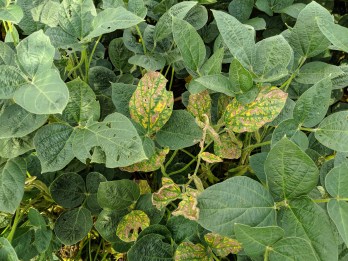 Sudden death syndrome is increasing in soybeans, but there’s also brown stem rot (BSR) and frogeye leaf spot in some fields. The foliar discoloration is the same for SDS and BSR with the yellow/brown discoloration between leaf veins. You can tell the difference by pulling a plant out of the ground. SDS is usually easy to pull as the taproot is rotted. Splitting the stem open, the root will show rot at the soil line but the stem pith will be white and healthy. With brown stem rot, the pith will have brown discoloration. The addition of stem borer can make it more difficult to tell the difference sometimes. Unfortunately there’s nothing one can do for SDS or brown stem rot now as both are caused by soil borne fungi. I would recommend taking soil samples for soybean cyst nematode (SCN) in areas currently impacted by SDS as the combination of diseases is synergistic in impacting yield loss. You only need 0-8” samples and they can be taken during soil fertility samples if you don’t want to take them now. The samples are free via your checkoff dollars and they can be sent to the Plant and Pest Diagnostic Lab at UNL in Lincoln.
In corn, foliar disease is increasing in mid-canopies. Most concerning are the number of stalk rot samples/situations I was called to the past week. They all appear to be bacterial stalk rot thus far. Symptoms include watersoaked nodes and below the nodes with plants breaking off/falling over. Damaged nodes are from the soil line to upper canopy. The bacteria disintegrates these stalks creating a stringy appearance within them where the nodes break and when slitting open stalks. It also has a distinct foul smell. This is more of a problem in wet years such as this and hybrid susceptibility varies. The bacteria doesn’t typically transfer from plant to plant. I have photos of what I’m seeing on my blog at https://jenreesources.com.
There have been multiple late-season hail events in the area. For those fields hit by the 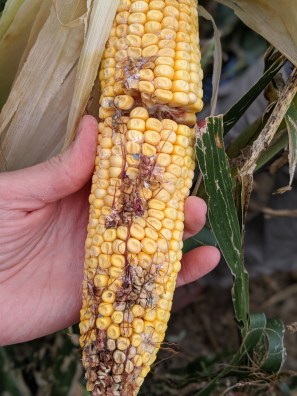 August 6th storm, the rainy, cool conditions have allowed for increase in mold on the hail damaged side since many of those damaged ears were at milk stage. However, I’m also seeing mold damage on some back-side of ears in hybrids with tighter husks. The white/pink fluffy growth on the hail damaged side is caused by Fusarium/Gibberella fungi. The presence of these fungi does not automatically mean mycotoxins are present; they do have the potential to produce mycotoxins. The green fungal growth in ears are caused by secondary and minor fungal pathogens that don’t produce mycotoxins. The white fungus overtaking ears on some tight-husked hybrids is diplodia which can cause for light test weight but does not produce a mycotoxin. It will be important to continue to watch grain quality over time prior to harvest.
Wild and Burcucumber on Trees has also been a huge question. Do Not apply 2,4-D to trees for
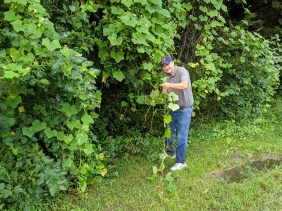
Thanks to Randy Pryor for demonstrating how easy these are to pull while we were on a field call together!
control as that has been the most common question! The simplest way to kill wild and burcucumber is pull or hoe the plant at its base below the tree. There’s not much to the plant root and the vines will then die on the tree!
It’s been a hard year for our growers and livestock producers with continued challenges. Seeking to end this column on a positive note, this year is the 10th year of the Nebraska State Fair in Grand Island and the 150th Fairabration. I’m grateful for the focus on agriculture, families and youth! And, it’s encouraging to me to see youth learning life skills whether competing in public speaking, 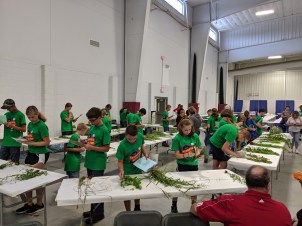 working with and showing livestock, or studying and competing in contests such as weed and grass ID at the State Fair. 4-H is where I got my start and it’s exciting for me to wonder at the futures these 4-H and FFA youth have ahead of them as they continue to work hard and put into practice the life skills they are learning! Hope you can make it out to the State Fair at some point!
*End of News Column. Bacterial stalk rot photos below.

Plants still standing showing various symptoms of dying and death
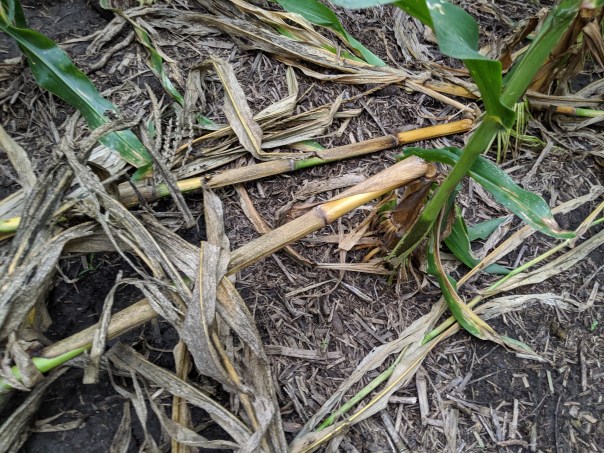
Some plants exhibiting bacterial stalk rot are already lodged or broke off at or around plant nodes.
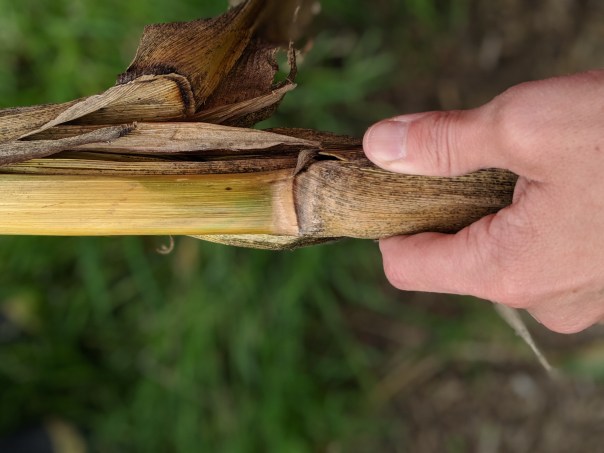
Plant nodes show discoloration with watersoaking around the nodes (notice the soaked appearance on internode where I removed the outside sheath).
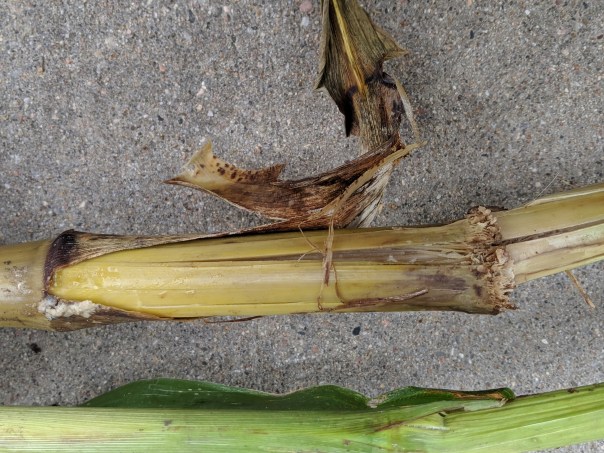
Majorly impacted nodes and internodes by bacterial stalk rot. There’s a distinct foul odor. Notice how wet and watersoaked nodes and internodes are and there’s even bacterial ooze in this case on the stalk.
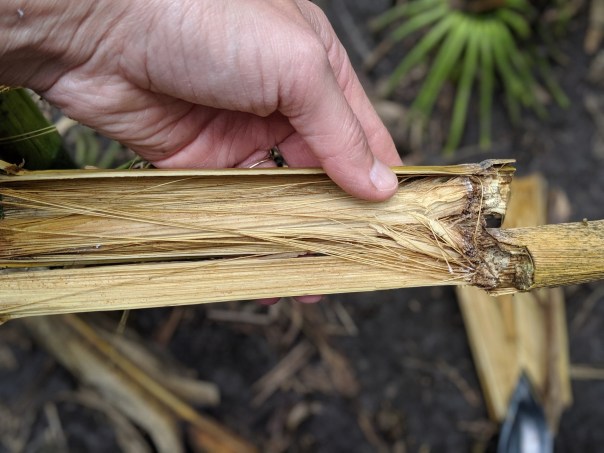
Plants break at nodes. Also notice the stringy appearance of stalk pith.

Commonly seeing this with impacted nodes from the soil line through upper canopy…stringy appearance of pith tissue.
JenREES 8-18-19
Reducing Nitrogen Losses: Most growers I’ve interacted with desire to be good stewards of the land and leave it better for future generations. Economically, they also need to be increasingly efficient in how they farm. One of these stewardships and efficiencies comes in preventing nitrogen losses and individual farm situations may differ in how the risk of those losses is reduced.
Nitrogen losses occur three primary ways: Leaching, Denitrification, and Ammonia Loss.
1-Leaching: All nitrogen fertilizer eventually converts to the nitrate-Nitrogen (nitrate-N) form. This form has a negative charge and is not held by negatively charged soil particles. Thus excessive rains can allow for leaching of nitrogen below the plant root zone, particularly in sandier soils. Fertilizers that are already in the nitrate form such as urea ammonium nitrate (UAN) and ammonium nitrate are susceptible to leaching upon application. Soil microbes can convert urea to nitrate-N within two weeks in late spring, making it susceptible to leaching loss. Anhydrous ammonia takes longer to convert to nitrate-N because it initially kills soil microbes that would convert it. Less conversion occurs once soil temperatures consistently reach 50°F and lower without excess soil moisture.
2-Denitrification occurs in saturated soil conditions where certain soil bacteria can survive and thrive. The bacteria convert nitrate-N to oxygen and nitrogen gases resulting in nitrogen lost to the atmosphere. Heavy, poorly drained, compacted soils are most susceptible to loss via denitrification.
3-Volatilization occurs primarily in urea based products such as dry urea or liquid urea-ammonium nitrate (UAN) when applied on the surface and not incorporated via rain or tillage. The urea in these situations is converted to ammonia gas via urease enzymes in the soil and plant residues. Up to 15-20% of urea can volatilize within a week after application if the conversion occurs at the soil surface during warm, sunny days, particularly in high residue situation, pH levels greater than 7.0 and on light textured soils. If the urea is injected or incorporated after application, or if half-inch of rain/irrigation is received within 24 hours after application, volatilization risk is essentially eliminated.
In general, to reduce the risk of leaching or denitrification, our Extension Soil Fertility Specialists recommend considering applying the majority of nitrogen close to when crop demand is high with more nitrogen applied during the growing season vs. pre-plant. Research has included in-season and split applications including side-dress with and without use of crop sensors, and/or fertigation. The use of inhibitors is not advised in season as research showed they can release N too slowly for the crop demand resulting in yield loss and/or resulting in increased leaching of nitrogen when it was released too late in the growing season for crop uptake. Inhibitors may help reduce risk of leaching or denitrification pre-plant, but they are not a silver bullet and need to be well targeted in order to aid in reduced nitrogen losses. In general, the research is more supportive for inhibitor use in sandy soils vs. heavier textured soils; yield benefit to a nitrification inhibitor may be none to a few bushels/acre for silt loam or silty clay loam soils. The duration of inhibitor effects depends on soil temperature and may be as little as 1-2 weeks or as much as 6 weeks with spring pre-plant applications. Split application was likely more effective than use of most inhibitors to reduce leaching loss.
Places where inhibitors could be well-targeted to high risk nitrogen loss situations include: urease inhibitor reducing ammonia volatilization with delayed rainfall after urea or UAN broadcast to no-till fields, wheat and pastures, and/or soil pH >7.2; nitrate leaching in a wet spring, especially with sandy soil; denitrification and nitrous oxide emission for poorly drained soil subject to flooding. Other research-based recommendations include considering the addition of alfalfa in rotation 5 of 10 years and including a cover crop in situations where excess nitrate-N may occur, such as seed corn. Two tools developed by UNL for helping quantify the risk of nitrogen loss include the Nitrogen-Loss Assessment Tool (N-LAT) and Maize N which can be accessed at: https://cropwatch.unl.edu/soils.
JenREES 8-11-19
Crop Update and Hail Damage: While I don’t remember numbers as well, calendar dates are something I tend to remember. And, in agriculture, there’s numerous dates that accumulate over one’s life from hail, tornado, blizzard, flood, and wind events. I was reflecting on the Aug. 6th hail storm that occurred in Merrick, York, and Seward counties in 2018. This past week on August 7th, some woke up to hail/wind damage in Adams, Clay, and Nuckolls counties. The tree damage was incredible. Michael Sindelar, Clay Co. Educator, and I surveyed damage a day later. My estimation of the worst hit crops: corn around 80% defoliation with varying percentages of greensnap above/below ear and soybeans around 50% defoliated/broken off/with at least 50% pods on the ground. Where hail stones hit the ears, the kernels are mushy and mold is already setting in on corn at milk stage. There’s also mold setting in on soybean pods hit with hail stones. It’s hard to receive crop damage any time. The good news is that nothing appears to be a total loss; the majority of what we looked at was less than 40% defoliated and in general, the hail did not seem to penetrate the stalks, thus early stalk rot doesn’t appear to be setting in. Pictures at https://jenreesources.com.
Tree Problems: The majority of my questions the past 10 days were regarding tree  leaves turning yellow and dropping from trees. They look stark against green grass. In general, what’s happening is the fact that we’ve had high humidity for a period of time now and we’ve had rain throughout spring and summer. Fungal pathogens thrive in these conditions. So, ornamental/flowering pears have pear rust; crabapples and apples have scab and also cedar-apple rust (depending on varieties); maples, ash, sycamores are showing anthracnose; and a number of other fungal leaf spots are observable on shade trees in general. Evergreen trees show various fungal needle spots. Ultimately, we don’t recommend doing anything for these diseases this time of year. We typically don’t recommend to spray shade trees in general, but fruit and evergreen trees should be sprayed in the spring if fungal diseases have occurred in the past. So, fungal diseased leaves may drop early and you may or may not observe a new flush of leaves yet this year. These fungal diseases won’t kill deciduous trees. They can kill evergreen trees over a period of years.
Oak leaves turning brown in clusters was also observed this past week. Sometimes


browning of leaves can be due to a fungal disease called anthracnose. Most of what I’m seeing, I believe, is environmental. It could be due to changes in hot/cool and periods of heavy moisture followed by lack of moisture on trees that had a huge flush of leaves due to moisture this spring. I really don’t know the cause for sure, but it doesn’t appear to be disease related from what I can tell. We wouldn’t recommend doing anything for the trees at this time.
UBBNRD Public Hearing: The Upper Big Blue NRD will hold a public hearing and informational open house on Aug. 19 at 7:00 p.m. at the Holthus Convention Center. The purpose is to receive comments on proposed changes to District Rule 5 – Ground Water Management Area Rules and Regulations. A complete copy of Rule 5 and the proposed changes are available at the district office and at www.upperbigblue.org/publichearing. The public will have the opportunity to learn more about these proposed changes and their effects, and address NRD board members about their concerns or support.
The proposed changes would stipulate that an approved nitrification inhibitor must be applied at the manufacturer’s recommended rate with pre-plant nitrogen fertilizer in the following situations: The application of anhydrous ammonia prior to March 1; The application of all nitrogen fertilizers other than anhydrous ammonia after February 29. In addition to these requirements, in Phase II and Phase III areas pre-plant application of nitrogen fertilizer shall not exceed 120 lbs. per acre. The remaining nitrogen fertilizer may be applied post plant. Prior to applying nitrogen fertilizer, but no later than April 1 of each year, each operator in the management area will be required to report information regarding the use of best management practices. For more information, visit www.upperbigblue.org or call (402)362-6601.
York County Corn Grower Plot Tour will be held Aug. 20th from 5-7 p.m. at 1611 Rd. 14 east of York. Pizza and refreshments will be provided and check out the latest hybrids. Guess the winning yield without going over and win a $50 gas card. All are welcome!
*End of News Column. Hail damage photos below.

Pitting from hail stones can be observed on corn stalks and husks. The damage doesn’t seen to be penetrating stalks beyond the surface, thus stalk rot is not setting in at this time. This field also had wind damage where plants were broke off both above and below the ears.

Kernels are mushy and damaged where hail stones hit and mold is already setting in.

Soybean in worst areas were bent over/broken off with hail damage evident on stems.

Soybean defoliation and soybean bent over from wind and hail damage. They will most likely try to upright themselves somewhat. Stems will become brittle over time and many pods were visible on the ground when lifted up.
JenREES 8-4-19
Thank you to everyone who “pulled together” to make the 2019 York County Fair a success! Reminder of the Seward County Fair in Seward August 8-11 and you can find details at: http://sewardcountyfair.com/.
Cash-Rent Workshops: Nebraska Extension land specialists will address common agricultural landlord and tenant questions such as: What does an equitable rental rate look like for my land? How do I manage a farmland lease? How could the lease be adjusted for recent flood damage? What should I expect for communications between the landlord and tenant? What are key pasture leasing considerations including stocking rates? Who is responsible for cedar tree removal from grazing land? What does it cost to raise crops on my ground? The closest locations to our area are listed below. Registration is 15 minutes prior to start time. The cost is $15 per person or $25 per couple. Registration will include refreshments and handouts.
- Aug. 8, 10 a.m. – 2 p.m.: Eastern Nebraska Research and Extension Center near Mead (includes lunch). RSVP: 402-624-8030 or kglewen1@unl.edu
- Aug. 19, 10 a.m. – 2 p.m.: St. Paul Community Library, 1301 Howard Ave., St. Paul (includes lunch). RSVP: 308-754-5422 or troy.ingram@unl.edu
- Aug. 20, 9 a.m. to noon: Saline County Extension Office, 306 W 3rdSt. Wilber. RSVP: 402-821-2101 or randy.pryor@unl.edu
- Aug. 21, 1 – 4 p.m.: Lancaster County Extension Office, 444 Cherrycreek Rd., Lincoln. RSVP: 402-441-7180 or tyler.williams@unl.edu
Nebraska Soybean Management Field Days will be held August 13-16 and will offer farmers research-based information to improve their soybean profitability. Locations are Sargent on Aug. 13; Pilger on Aug. 14th; Plymouth on Aug. 15; or Waverly on Aug. 16. The field days begin with registration at 9:00 a.m. and conclude at 2:30 p.m. More details at: https://go.unl.edu/2019smfd. Topics include: Making Sense of Production Costs and Policy Changes; Soybean Insects & Cover Crops; Hail Damage Impact on Growth & Development of Soybeans; Management of Cover Crops & Soybean Insects and Pathogens; Soybean Weed Control & Cover Crops; Cover Crop – Pros & Cons Associated with Soybean Production; Soybean Production & Agronomic Topics Associated with Cover Crops – Planting Rates, Row Spacing, Planting Dates, Maturity Groups, Irrigation Management. CEUs available for Certified Crop Advisors.
Soil Health Workshop will be held on August 22 at the Eastern Nebraska Research & Extension Center near Mead. This hands-on workshop is geared for anyone interested in learning more about soil health including home and acreage owners, farm operators, and industry consultants. Topics include: management considerations to improve soil health; measuring bulk density, porosity and infiltration and the impact on soil health; physical soil properties – the foundation for soil health; cover crops for improving soil health; what is soil biology – active carbon test; soil characteristics, productivity and landscape position; and chemical soil properties. CCA credits have been applied for (6.5 Soil & Water Mgt.). Details at: https://enrec.unl.edu/2019MidwestSoilsClinic.pdf or call (800) 529-8030.
West Central Crops and Water Field Day will be held on Aug. 22 at the West Central Research & Extension Center in North Platte. Registration begins at 8 a.m. with program from 8:45 a.m.-5 p.m. This Field Day offers a unique opportunity for anyone interested in water to learn and see irrigation practices and cropping systems on a farm scale that maintain or increase crop production while conserving water. Approximately 25 commercial vendors will be on hand to provide live demonstrations of how their products can help farmers manage their fields. UNL-TAPS updates and field tours will be included. Details at: https://extension.unl.edu/statewide/westcentral/water-crops-field-day/.
JenREES 7-28-19
Southern Rust in Nebraska was confirmed in Nuckolls, Thayer, and Fillmore counties last week. The lesions were typically on one leaf in an isolated portion of fields at low incidence and severity. I was recommending to watch the fields instead of spraying right away. Greatly appreciate everyone who has gotten samples to me this month and to neighboring Extension offices serving as drop off points for samples. I’ve been looking at samples since early July and honestly, common rust at times has exhibited signs similar to southern rust. At my blog site (https://jenreesources.com), I’ve posted photos showing the differences of common vs. southern rust that we’re seeing this year. Southern rust typically is orange to tan colored with tiny, clustered pustules on the upper leaf surface. Common rust has had an orange appearance to it at times with smaller lesions than the ‘typical’ brick red larger ones. However, in every southern rust sample I’ve confirmed, the pustules have not gone through the back of the leaf…there’s been indentations but nothing has produced pustules on the backside. That doesn’t mean that the fungus can’t; it just rarely does. Also, these leaves have all occurred in the mid-canopy. I realize lowest leaves of plants often have a great deal of rust on them, but it’s been common rust in leaf samples I’ve pulled and received to date. I’ve also posted photos of another disease called Physoderma brown spot on my blog. Physoderma is the disease that has purple/brown on the midribs, around leaf axils and sheaths and it also can have tiny yellow-brown spots without pustules that look a lot like southern rust on leaves of plants. It’s one that we tend to see around pollination as the fungus-like pathogen swims in water on the leaf surface and feeds off of decaying pollen.
Confirming southern rust in a few Nebraska counties thus far doesn’t mean that every field has it and we don’t know how it will progress. So our recommendation is to continue scouting and if you have a suspect sample, you can get it to me (if you’re in the area) or to our Plant and Pest Diagnostic Lab in Lincoln. You can keep updated with counties that are confirmed by checking out the Southern Rust tracking site at: https://corn.ipmpipe.org/southerncornrust/. The wide range of planting dates across Nebraska this year has resulted in a wide range of corn growth and reproductive stages in fields, some of which are still in the vegetative growth stages. Keep in mind that late planted fields are at particular risk for southern rust if it increases in development. Right now corn disease pressure in general is low. I’m anticipating that to soon change for gray leaf spot susceptible hybrids. Some growers added a fungicide in with an insecticide treatment for western bean cutworm, which made sense to save an application cost. However, in general, automatic fungicide applications when one treats before disease develops may lead to loss of full product efficacy before critical disease levels. This can also result in the need for reapplication later if the disease worsens after the previous fungicide application and residual has worn off. And, always in my mind is eventual potential for pathogen resistance…so utilizing fungicides when we need them vs. automatically applying is wise for maintaining these fungicide chemistries.
York County Fair: This week is the York County Fair! All events and details can be found at: http://www.yorkcountyfair.com/. One special addition this year is “Brownies for Bergen” on Saturday, August 3 from 5:30-7:00 p.m. The late Gene Bergen was a 4-H icon and was planning on celebrating 50 years as a York County Ag Society Member at this year’s fair before retiring. While he won’t be with us in person, the York County Ag Society, 4-H Council, and Extension Office would like to honor him and his original plans to celebrate. So please join us for brownies and ice cream and share your favorite memories and stories of Gene!

Lower corn leaf that is dying early and has a great deal of rust on it. So far, this has all been common rust as pictured here in spite of smaller, clustered pustules or even orange colored pustules.
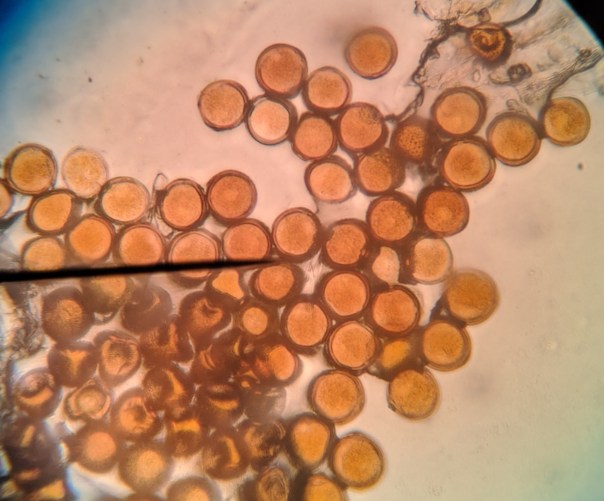
Common rust spores are circular in shape.

Southern rust was confirmed on this leaf in 2019. Small, clustered, tan-orange colored pustules can be seen on this leaf.

Southern rust spores are brown and oval in shape. Sharing this photo as the clear structures are spores (condia) and spore-holding structures (conidiophores) of Cercospora zeae-maydis which causes gray leaf spot (gls) in corn. Was seeing these spores/structures with only ‘specks’ of gls lesions on this leaf. With humid weather and longer leaf wetness from dews, we may see an increase in appearance of gls lesions in the next 7-10 days.
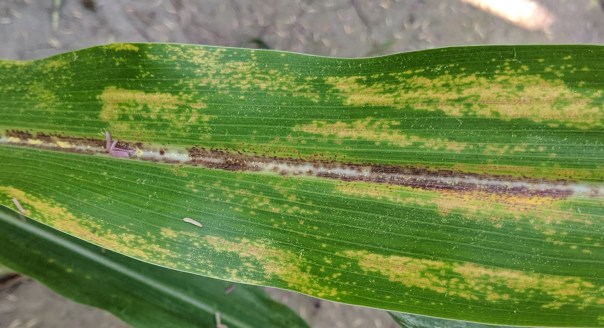
Physoderma brown spot. Symptoms include both the purple/brown midrib in addition to the yellow-brown lesions on the leaf. These lesions are flat in comparison to southern rust which would have raised pustules.
FSA County Committee Nomination Deadline
Many Farm Service Agency county committees are seeking nominations. Brandy explains more about this opportunity to serve at a local level.

It is important for one to stand for what they believe in and takes an active role in one’s community. Effective leadership is crucial to any community or organization. An effective leader understands the issues at-hand, is knowledgeable in his/her area, knows the proper ways to motivate others, embraces change, can work in a variety of settings and with a variety of personalities, and involves the group or followers in important decision-making. That being said, remember that a leader is not only a political figure or someone that is well known, but a leader can be a farmer, local businessmen/women, or anyone in a community or organization. For those individuals desiring to take on leadership roles, consider serving on the FSA County Committee. Details for how to step into this role follow.
 Photo by Pixabay on Pexels.com
The U.S. Department of Agriculture (USDA) Farm Service Agency (FSA) encourages all farmers…
View original post 208 more words
JenREES 7-21-19
Heat and Pollination: With last week’s heat and anticipated heat later this week, we were receiving questions regarding the impacts of heat and humidity on pollination. You can view the entire article in this week’s CropWatch at https://cropwatch.unl.edu. Key points include: Heat over 95°F depresses pollen production and prolonged periods of heat can reduce pollen production and viability. When soil moisture is sufficient, one day of 95-98°F has little or no impact on yields. After four consecutive days, there can be a 1% loss in yield for each day above that temperature. Greater yield loss potential occurs after the fifth or sixth day. High humidity, without a drop in humidity during the day, can delay pollination or prevent pollen from leaving anther sacs. We’ve been blessed we only had days of extended high heat around pollination, received a break in the heat in addition to weekend moisture.
Insect Pests: From light trap reports, peak western bean cutworm (WBC) flight appears

I’m pulling for the soldier bug predator 🙂
to have occurred last week, so scout for egg masses and live larvae with a 5-8% treatment threshold. Thistle caterpillars grew rapidly last week. Others are with me in considering spraying closer to 15% (instead of 20% threshold) with stressed fields from flash drought and/or off-target dicamba injury that don’t have canopy cover yet. In CropWatch, check out the articles regarding scouting for grasshoppers in field borders and what to expect for insects depending on crop growth stages yet this year.
Cattle Losses from High Heat: If the recent heat/humidity conditions are determined to be an extreme weather disaster event, then livestock losses would be covered by the Livestock Indemnity Program (LIP). Livestock producers who lost livestock should document losses in the expectation that they may be covered by LIP and contact your local Farm Service Agency (FSA) to report those losses.
South Central Ag Lab Field Day Aug. 1: View current field trials on improving crop production and profitability at UNL’s South Central Ag Lab (SCAL) on August 1 near Harvard. Guests can customize their day to select the tours they’re most interested in. Presentation topics include: Cover crops, pollinators and weed management; European corn borer, corn rootworm, and cover crop insect control; Herbicide-resistant weed management; Assessing injury and management decisions in corn and soybeans; Corn and soybean disease updates; Sensor-based nitrogen management in irrigated corn; Corn stover harvest management and impacts; mobile beef lab and hail machine demonstrations. Registration is at 8:30 a.m. followed by tours through 4 p.m. Lunch and refreshments are included. CCA credits have been applied for. For more info. see the program brochure and register at: https://go.unl.edu/2019scalfieldday.
Silage Webinar Aug. 2: With this year’s challenging weather and the need for forage, there may be more opportunities for harvesting corn for silage. Aimed at feedlot, cow-calf, and dairy producers, a silage webinar on August 2 at Noon CST will focus on moisture at chopping, chop length, inoculants, proper packing, silage covers and more. Pre-registration for the webinar is necessary and can be done at: https://go.unl.edu/vau7.
Trees Losing Leaves: The wet spring and humidity allowed for fungal diseases on leaves of shade trees with flowering pears and crabapples in particular dropping leaves early. I’ve also had a number of questions regarding red maple leaves (Autumn Blaze and Sunset) suddenly turning brown on trees. These symptoms may also be experienced on ash, tuliptree, and other maples. We think it’s environmental stress from having so much cool and wet early to almost a ‘flash drought’ situation in eastern Nebraska prior to this weekend’s rains. Sarah Browning has been recommending watering and mulch as the best ways to reduce stress and to prevent additional root death and tree decline. I’ve been seeing new growth starting to occur on trees so my hope is if your tree is experiencing this, that 10-14 days from now you will also see new growth occurring on your trees.
JenREES 7-14-19
Interesting, memorable don’t seem to capture this year. While portions of Nebraska are flooding again, many growers in this part of the state and east would like some rain. Dr. Suat Irmak shares on understanding matric potential and water content thresholds on sensors for irrigation scheduling in this CropWatch article: https://go.unl.edu/miym.


Soybean: The large number of painted lady butterflies we experienced in late May/June was due to a wet season in Mexico that allowed for greater vegetative growth and survival for northern migration, according to Bob Wright, Extension Entomologist. The cooler conditions may have caused more to stay here instead of move north. Saw newly hatched to early instars of thistle caterpillar (the larvae of painted lady butterflies) this week. Yet, a tremendous number of butterflies are still laying eggs. A painted lady female can lay up to 500 pale green eggs on plants individually instead of in egg masses. The larvae hatch in around a week and can feed from 2-6 weeks depending on weather conditions. Other defoliators including various worms, grasshoppers, Japanese beetles are also present. Thresholds for damage for all soybean defoliators is 20% defoliation of plants during the reproductive stages. If you’re unsure what 20% defoliation in soybean looks like, check out the graphic in CropWatch at: https://go.unl.edu/v0ts. If your primary defoliator is thistle caterpillars, it’s important to use insecticides that can be effective on them once their ‘tents’ are built. The 2019 Guide for Weed, Disease, Insect Management gives information regarding products that may work better on pages 308-314.
Gall Midge in Seward County: My colleague Aaron Nygren found soybean gall midge in

Gall midge (orange colored worm)
Seward County north of Bee this past week. I was a few miles away so met him at the field. Being a new insect pest, little is known about it. Infected plants show signs of wilting from larvae feeding within the base of the stem. These plants will eventually die. To scout for soybean gall midge, focus on plants that are close to the field edge and adjacent to fields that were planted to soybean in 2018. If you’re seeing wilted/dying plants, particularly in early planted beans this year, please contact your local Extension educator. More information at: https://cropwatch.unl.edu/gallmidge.
Bob Wright is asking for help to understand distribution of the green June beetle, Japanese beetle, and brown marmorated stink bug. If you see these insects, please take a picture and upload it to: inaturalist.org, including information on where the photo was taken. You need to make an account with inaturalist.org before you can upload photos. And, if you’re unsure what these insects look like, you can view them at: https://go.unl.edu/uzd0.
Corn: Looked at numerous corn leaves but so far, only common rust in Nebraska. Southern rust was confirmed in southern Kansas and Missouri this past week. You can view U.S. counties where southern rust has been confirmed at: https://corn.ipmpipe.org/southerncornrust/.
As we approach tasseling: 1-Areas of fields that had water ponded this

Tassels appear leafy in crazy top of corn. Took this pic from flooded waterway area in 2017.
growing season may show crazy top of corn. Crazy top symptoms include when the tassel appears strange and leafy. Plants can be barren, have barren kernels on ears, or have multiple ears at shank. 2-Automatic fungicide applications at tassel: I prefer waiting till disease warrants application & Nebraska research shows fungicide applications later in the season are effective. Be careful if you automatically spray at tassel! Canopy closure covered problems in fields, including uneven growth stages. Plants in the field may have tassels with others several growth stages behind. Arrested ear development primarily occurs on plants from 12-14 leaves when surfactants (particularly non-ionic) are applied with fungicides. So, it’s important to know your growth stages and consider what you’re applying. 3-Japanese beetles in corn threshold: Three or more Japanese beetles per ear with silks clipped to less than ½ inch and pollination is less than 50% complete. 4-It’s OK to fertigate pollinating corn. Avoid running pivot from 6 a.m.-Noon during pollination. Can apply 30 lbs N in 0.25″ water or up to 60 lbs N in 0.50″.
Linden trees and Japanese beetles: Last week I didn’t stress the importance of insecticides and impact to bees when spraying linden trees. ‘Sevin’ is effective but highly toxic to bees. It’s better to use heavy streams of water in late afternoon to knock Japanese beetles down (then drown in soapy water), pyrethroids, or permethrin like ‘Eight’ as those products are not taken back to the hives.
JenREES 7-7-19
Crop Updates: I really appreciate all those in ag industry who share what you’re seeing in the fields; it’s a blessing to have a great network of people looking at fields in different areas of the state and sharing what we’re all seeing!
Western bean cutworm (WBC) moths were seen in corn whorls the past week. They’re

Western Bean Cutworm Moth courtesy UNL CropWatch
also showing up in UNL light traps in addition to industry ones. To view the UNL light trap reports near Clay Center, please go to: https://scal.unl.edu/ltr2019.pdf. The light trap near Mead is currently having black light issues, but the report can be viewed at: https://go.unl.edu/2usz and the light trap report from North Platte is at: https://go.unl.edu/a56b. WBC moths prefer laying eggs on upper leaf surfaces in corn that is in the late whorl to early tassel stage. UNL entomologists recommend scouting at 25% of moth flight. It’s unknown how larval survival will be impacted by corn growth stage at this time. Larvae survival is highest when they have fresh tassel tissue and pollen to feed on before moving down to developing ears and silks. Larval survival is lowest when only vegetative tissue is available to feed on. So, the delayed planting and growth in some fields may allow for less western bean cutworm damage in 2019. However, our entomologists say that air and soil temperature can also impact insect development leading to slower development of the insects. UNL Entomologists Tom Hunt and Bob Wright, along with University of Minnesota researchers, developed a degree-day model to predict when WBC moths will emerge to begin mating and laying eggs. In a recent CropWatch article, they were predicting 25% moth flight to occur for the following dates/locations: July 7th in Lincoln; July 11 in Hastings and Ithaca; July 12 in Grand Island and York; July 13 in Clay Center; July 15 in Holdrege, and July 23 in North Platte. Corn expressing VIP3A proteins are highly effective for WBC control. Corn expressing Cry1F (Herculex) proteins may provide some WBC feeding suppression but shouldn’t be relied upon for control. The current UNL economic threshold for treatment is 5-8% of corn plants with eggs or larvae.
Common Rust in Corn: The rainfall, humidity, and wet canopies have allowed for


increased common rust to be seen in corn this past week. I was seeing larger numbers of pustules on lower leaves of plants, but this week could also see pustules occurring in upper canopies. Pustules of common rust are typically brick red in color, larger, more separate, and can appear on both the upper and lower leaf surfaces. Southern rust typically has smaller, orange to tan colored pustules occurring in tight clusters on upper surfaces of leaves. However, the past few years, we’ve seen common rust looking more orange in color, including this year. The best way to confirm for sure if it’s common or southern rust is to check the spores under the microscope, and I’m happy to do that. The spores of common rust will be circular in shape whereas southern rust spores are more oval to football shaped. Samples can also be submitted to the UNL Plant and Pest Diagnostic lab. So far, every sample I’ve looked at has been common rust. Southern rust hasn’t been found further than Georgia and Louisiana to my knowledge right now. We don’t typically recommend fungicides for common rust. It will be important to continue scouting for diseases with the humidity and leaf wetness we’re experiencing this year.
Lawn and Garden Questions: The wet weather has allowed slime mold (gray-black fungal growth on leaves) in patches in lawns in addition to mushrooms in lawns and landscapes. They are harmless and fungicides aren’t effective. They will go away upon drying out and with warmer weather.
Bagworms are out and it’s time to control them if you have them. The following gives more detailed info on their life cycle: https://go.unl.edu/rgju and this YouTube video shows what you’re looking for this time of year on your trees: https://jenreesources.com/2015/06/27/bagworms-in-evergreens/.
Japanese Beetles may be causing holes in Linden trees or rose leaves. They are
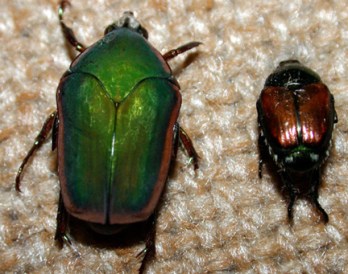
Green June Beetle (left) and Japanese beetle (right). Photo via Purdue Entomology.
green/brown beetles with white hairs that look like rows of white spots near each wing. Kelly Feehan in Platte County shares that “applying insecticides to lawns to control grubs will not prevent beetles from feeding on landscape plants. The product ‘Milky Spore’ sold to kill them, does not work. On landscape plants, hand picking or knocking beetles into a bucket of soapy water around 7 PM is the best time of day to do this as it prevents plants producing a distress pheromone that attracts more beetles. Japanese beetle traps work very well – IF you want to attract them to your yard – so traps are best NOT used. If a Linden tree has Japanese beetles, know these trees CANNOT be treated with Imidacloprid or other Neonicotinoid insecticides.” Carbaryl (Sevin) is effective to use for Lindens and landscape plants where it’s not feasible to remove beetles by hand.


 JenResources