Monthly Archives: December 2023
January 2024 Events
Whether your holiday was filled with family and/or friends, plans changed due to weather, or whether holidays are difficult for various reasons, I hope you were able to find something for which to rejoice over during Christmas! Normally I write a column reflecting on the past year at the year’s end, but I feel like we’ve talked about 2023 enough! Each year we will face new challenges, many outside our control. As we look towards 2024, may we be intentional to rest, rejuvenate (reminder to think about goals for this year, our ‘why’, and what would making faming more fun), reflect, and anticipate 2024 with renewed hope! Here’s wishing you blessings in 2024 and the wisdom and resilience for whatever the year may hold!
January Winter Meetings: Tis the season of winter meetings! Winter program brochures have been mailed. If you didn’t receive one, you can contact your local Extension Office or view it at: https://jenreesources.com/upcoming-events/. Please contact the Extension Office hosting the event you’re attending so we know how to plan.
Successful Farmer Series: January 4th from 9-11:30 a.m. is the last program in this series. They’ve been excellent topics and sessions so far and the previous meeting recordings in addition to the Jan. 4th RSVP can be found at: https://lancaster.unl.edu/ag/successfulfarmerseries. The Jan. 4th session is about Nitrogen Management Tools, Water Quality, and Nitrate Management. Topics/speakers: Nitrogen & Nitrate Issues (Tim Mundorf, Central Valley Ag); Best Nitrogen Management Practices to Improve Nitrogen Use Efficiency and Water Quality (Javed Iqbal, UNL); Optimizing Nitrogen Use Efficiency Using Image Based Fertigation Scheduling (Shane Forney, Sentinel Fertigation). The event is held in person at the Extension Office in Lincoln and also via webinar. Please RSVP at the link above.
Crop Production Clinics offer recertification for pesticide applicators in addition to updated crop and pest management information for anyone interested. The closest to this area include Jan. 10 near Mead, Jan. 11 in Beatrice, Hastings on Jan. 17, and York on Jan. 19. It’s back to the original format and I mention that so you’re not expecting the new format at York this year. Info: https://agronomy.unl.edu/cpc.
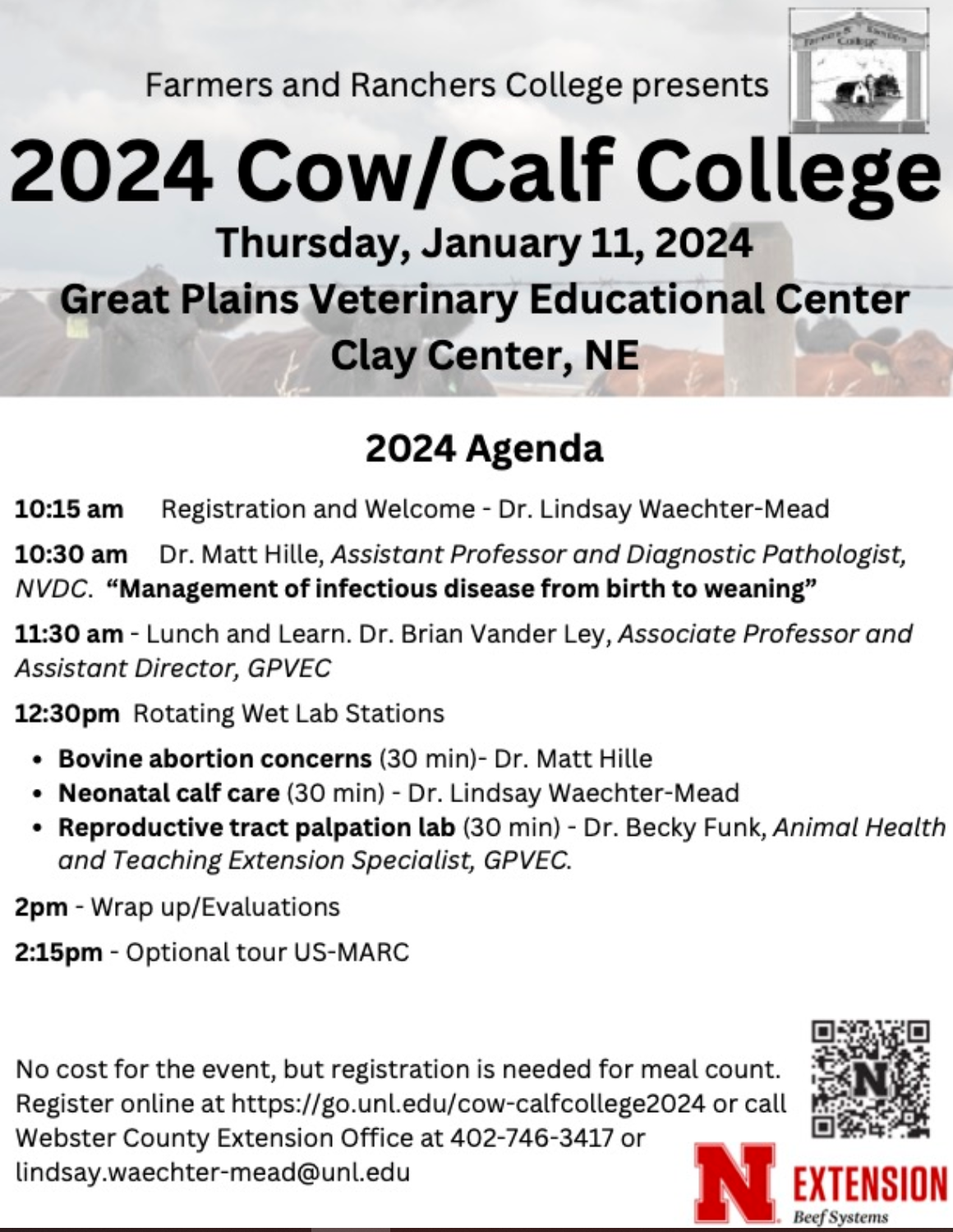
Farmers and Ranchers Cow-Calf College is Jan. 11 at the Great Plains Veterinary Educational Center, near Clay Center, NE. Registration at 10:15 a.m. with program from 10:30 a.m. – 2:00 p.m. This year’s focus is on strategies to enhance cow/calf health from birth to weaning. The hands-on format will allow participants to engage with specialists and peers throughout the day. Dr. Matt Hille, Assistant Professor and Diagnostic Pathologist at Nebraska Veterinary Diagnostic Center will provide an in-depth look at common infectious diseases affecting calves. Topics include scour prevention and treatment techniques, and when it may be worthwhile to pursue diagnostics. Discussion will also include pinkeye disease background, treatment, and prevention strategies.
The afternoon will be comprised of three mini-workshops. Dr. Becky Funk, GPVEC Extension Specialist will host a hands-on palpation wet lab utilizing bovine reproductive tracts and Dr. Hille will continue the cow health discussion with potential causes of abortion and when diagnostics are needed. Dr. Brian Vander Ley, Associate Professor and Assistant Director of GPVEC will provide an overview of activities at the Center while participants enjoy a catered lunch. The program will conclude with an optional tour of US-Meat Animal Research Center (weather permitting). There is no cost; however, registration is required due to limited space. Pre-registration can be made by calling the Webster County Extension office at 402-746-3417 or online at https://go.unl.edu/cow-calfcollege2024.
Nitrogen Challenge Meeting will be held Jan. 29th from 9-Noon at the Holthus Convention Center in York. I’ll share more on this next week, but for now, please hold this on your calendars.
Reporting Survey: It’s also reporting season for Extension. If you’d kindly like to share how my Extension work impacted you in 2023, please go to slido.com and use the code 4EXT. Thanks!


Rest, Rejuvenate, Rejoice
Christmas blessings to all! Wishing safety with the weather, quality time spent with family and friends, and special memories. With all the preparations, may we find ways to slow down and enjoy the time with others so we don’t miss it. Life is so short, not guaranteed, and time is precious!
Was reflecting on how blessed I’ve been with all the relationships in my life. One colleague shared a Christmas greeting wishing me “time to rest, rejuvenate, and rejoice in the season”. I really liked those three “R’s” so for this column, digging into them more with the help of a dictionary and some reflection.
Rest – “Cease work or movement in order to relax, refresh oneself, or recover strength”. I think of this past year with the work put in by many. The difficulty and challenges, the joy when some rain came – how many of us actually stood out in it a little while 😊, the incredible amount of learning, the character built in the midst of adversity. Even since harvest, I’ve heard from many how it’s been such a strange few months of going hard with the weather so nice. Many in various occupations have mentioned it doesn’t seem like the Christmas season with how nice the weather has been. There’s also much that people do to prepare for the end of the year and the Christmas season.
We all need rest; it may look different for each of us, but we all need times to relax and recover physically, mentally, emotionally, spiritually. So my hope is that we all may be intentional about finding rest in some way this Christmas through New Year season, and throughout the coming year!
Rejuvenate – “Given new energy or vigor, revitalized”. How many of us don’t want this?! And perhaps this comes as a result of resting? I think sometimes challenges and the stress at hand can provide new energy to tackle the challenge, which is helpful. But I’m mostly thinking of finding passion and interest to tackle a new goal or project. As we think about the new year, what is something you would like to try or do differently?
As I think of the farming community I serve, too many told me this past year that “farming is no longer fun”. I mentioned this in a talk this December – almost the entire room of people raised their hands in agreement. That’s just sad to me. The stress I see and feel from those I serve has been exponential in the past 5-7 years. If you resonate with that statement, may I ask us all to think about our “Why” before next growing season? Why do we do this?-and perhaps write it and place it somewhere to remind you during challenges next year. Why is farming no longer fun and what would make it fun for you again? Some examples from conversations with me included the need to try something different on a few acres, giving up some ground, spending more time with family, diversifying an enterprise, focusing on increasing the quality on one piece of ground, changing a crop enterprise, learning a new skill. Would encourage us all to set a goal around something that would rejuvenate us.
Rejoice – “Feel or show great joy or delight”. What we rejoice in or about can differ for us all. As I looked around my house, I realize many of my Christmas decorations have a “Joy” theme. As we think of Christmas, with my faith, I’m rejoicing in God’s rescue plan of humbling himself to be born as a baby who would live a perfect life, die, and rise again conquering sin and death so that in believing and receiving, we could have hope of eternal life with him! You may believe in something else that gives you joy and may have a different belief surrounding this time of year. Another way to rejoice is to think about gratitude. As we reflect this Christmas season of all we’ve been given and blessed with, of the people in our lives, of the people who have passed on who impacted our lives, may we all find reasons to rejoice!
So as my friend wished this for me, here’s wishing us all, “time to rest, rejuvenate, and rejoice in the season”!
It’s also Extension reporting season. If you would be so kind to share any comments on how the Extension work I did impacted you this past year, I’d appreciate it. Thanks!
Participants can vote at Slido.com with #4EXT
Certifications & Trainings
I’ve received several questions about various certifications, so sharing on that. In the next few weeks, those of you in this part of the State will also receive our Extension winter program mailing with info.
Private Pesticide Applicator Training is for those who purchase and/or use restricted use pesticides on land you own/rent. Those desiring initial certification or recertification have the same options:
1-Attend a face to face training.
2-Take the online training at https://pested.unl.edu/certification-and-training (available after Jan. 1)
3-Attend a Crop Production Clinic (need to stay the entire day) https://agronomy.unl.edu/cpc
Commercial/Noncommercial Applicator Training is for those who apply pesticides on other people’s ground and receive a payment for those applications. Trainings and testing dates available after Jan. 1.
Initial certification involves purchasing the books in the categories you wish to be certified in. All need to be certified in the general standards (00) category in addition to the specific application category. You then have choices of walk-in testing, attending a training session, or taking the test at a computer center. Info. on the commercial/non-commercial tab at: https://pested.unl.edu/certification-and-training.
Recertification training for those with the Ag Pest Control-Plant category (01) is to attend our Crop Production Clinics. The closest to this area include Jan. 10 near Mead, Jan. 11 in Beatrice, Hastings on Jan. 17, and York on Jan. 19. Last year I enjoyed how we revamped the Mead and York locations to make them more hands-on. Unfortunately, they didn’t choose to keep that format and I mention that so you’re not expecting the new format at York this year. Info at: https://agronomy.unl.edu/cpc. Recertification for other categories can be found at: https://pested.unl.edu/certification-and-training.
Spray Drone Certification is a question I’ve received several times. I asked Elizabeth Smith with NDA to specify requirements, “For drone applications the pilot will need to have the same level of certification as our fix winged aerial applicators (FAA Part 107): If they are applying an RUP (restricted use product) they need the applicator licensed with 00, 12, and any additional category for the line of work they would be in outside of Ag Plant which is included in the category 12 exam (ex: Ornamental and Turf, Right of Way, Aquatic). They would also then need the aerial business license unless they are only applying on land they own/lease. Drone operators need to fly under a commercial or noncommercial license as we cannot issue the aerial category to a private applicator license. As always they would also need to ensure there are no label restrictions on the product they intend to apply such as “Do not apply aerially”. For general use products (GUP) they do not need an applicator license but may still need the business license if they intend to apply on property other than their own.”
Chemigation is for anyone who applies fertilizer and/or chemicals through water systems like pivots and subsurface drip irrigation. Options for initial and recertification include face-to-face meetings and online testing at: https://water.unl.edu/article/agricultural-irrigation/chemigation.
Dicamba and Paraquat training are offered by the manufacturing companies. Info. on dicamba training here: https://nda.nebraska.gov/pesticide/dicamba.html. Info. on paraquat training here (English & Spanish): https://campus.extension.org/login/index.php
Worker Protection Standard training materials can be found at https://www.pesticideresources.org/wps/full-library/#categories:training-materials. At this site, use the drop-down menu and select the “role” of those being trained. There are different training requirements for ‘workers’ vs. ‘handlers’.


Pivot Performance
Pivot Performance: As we think about and look at data from 2023 and at costs for 2024, something that has come up in a few conversations is pivot performance. Water covers a multitude of problems. The lack of moisture much of the past 2-3 years, the number of hail and windstorms, and the number of pivots and/or nozzles that were replaced are all factors to consider as you view yield maps and imagery. For example, in the rush of getting new pivots up and going, the wrong nozzles were placed on the wrong spans in some situations. It’s easy to do and can make a big difference in water output and distribution. It’s also easy to check to make sure nozzles are correct on the pivot by driving alongside of it and checking it with what the sprinkler package design says. Would encourage anyone who replaced pivots/sprinkler packages to add this to your checklist before irrigation season next year.
Another field I was checking fairly often in 2023 showed too much variability of plants in the field; imagery showed a problem too. I thought there was something wrong with the water output but was told that couldn’t be a problem. Turns out the wrong sprinkler package was put on that pivot after checking into it further; it can easily happen when several pivots are being replaced for the same farmers who get hit by these storms. Everyone is doing their best during these times of disaster events to keep ag going, yet mistakes can happen. I also think about how often a nozzle that was damaged gets replaced with whatever is handy vs. the correct nozzle, so that’s another thing to think about before irrigation next season.
My colleague, Bruno Lena in Platte County, received a Nebraska Soybean Board grant to work locally with growers on understanding their uniformity of water application. He worked with three growers and provided an excellent summary of what they did and their case study findings in the following CropWatch article: https://go.unl.edu/yfb8. The economics are also provided; it’s well worth a read.
Essentially he worked with growers on ‘catch a can’ tests where cups are mounted on stakes like electric fence posts and distributed evenly along a pivot. He and a team of colleagues worked together to collect the information. “Initially, pivots 1, 2 and 3 exhibited uniformity of water application (UWA) values of 78%, 59% and 23% with the old nozzles, as these pivots had received minimal maintenance attention since their initial installation. Growers noted that these pivots were 21, 34 and 38 years old, still equipped with the original nozzle package. Following the replacement of nozzles, all pivots demonstrated improvements. UWA increased to 92%, 90%, and 74% for pivots 1, 2, and 3, respectively. While pivots 1 and 2 met the manufacturer’s recommendation of at least 90% UWA, pivot 3 still fell short of the recommended values. Upon discussing this with the grower of pivot 3, it was revealed that the primary reason for the suboptimal UWA was the pumping capacity.”
Once the new sprinkler packages were installed, another thing Bruno and his team found were inconsistencies between the selected irrigation rate at the panel and the actual irrigation rate measured by the cups. The measured irrigation depth deviated from the depth selected at the pivot panel. One pivot was underapplying water by 0.19” and another was overapplying by nearly 0.38” each circle.
A father/son operation in York County had built their own catch a can system after working with Dr. Jim Specht and me on a project in 2022. They used it to test nozzle output on different pivots in 2023. On one pivot, they were aiming for 0.75” per circle yet the output in the cups was only 0.40” on average. That was a big realization to be underapplying by 0.35″/circle, especially in a year like 2023. They slowed the pivot down to get the application where it needed to be, and the father mentioned how grateful he was for doing that test. In a recent conversation, he mentioned it was a 30 year old pivot with an upgraded drive system (new center drives and gear boxes two years ago) that led to the gear ratios being different than the original. That was something they didn’t account for when using percentages on the computer printout, so another consideration. With many area pivots being completely new or upgraded in various ways the past few years, I mention all these examples for awareness and consideration as all these details can make a difference in pivot performance as you look at 2023 data and head into the 2024 season.
Christmas Plant Tips
This week, sharing some information on Christmas plants from my Extension horticultural colleague, Kelly Feehan. Before I do that though, I’ve been asked by a couple of Extension specialists to consider a soybean project that has different experimental treatments for soybean gall midge, stem borer, frogeye leaf spot, and white mold. The project would be conducted in small plots on the edge of an interested farmer’s field taking no more than 1-2 acres total. Can be irrigated or non-irrigated and can have history of one or more of the above-mentioned pests in the field. I’m on the fence regarding participating and want to gauge farmer interest. So, if this is something you’re interested in learning more about, please contact me this week and I’ll provide details for consideration.
Live Christmas Trees: Kelly shares, “Just a reminder to daily check live Christmas trees for their watering needs to avoid a fire hazard. For safety, start with a fresh Christmas tree and don’t let the basin run out of water. Use at least a one-gallon capacity tree stand and check the stand daily for adding water. A fresh tree whose trunk has not sealed will take up water quickly. The rule-of-thumb is a tree will use one quart of water per day for every inch of trunk diameter near the base. If you have a tree with a 3-inch base, it can use 3 quarts of water per day. The trunk should have been freshly cut at a slant just prior to putting it in the stand.
Once a Christmas tree stand runs out of water, how long does it take for the trunk to seal so it will no longer take up water? If the water drops below the base of the cut trunk, a seal of dried sap can form over the stump in four to six hours. This seal will prevent the tree from absorbing water, even if the tree stand is refilled; leading to tree drying and increased fire risk.
If a tree stand dries out and a seal forms on the tree base, the tree can be taken out of the stand and a fresh cut made; or one-half inch deep holes drilled into the trunk one-half inch apart; which might allow the tree to begin absorbing water again. This is not very feasible; so be diligent and don’t let Christmas tree stands dry out for a safe holiday season. Also, when watering, nothing needs to be added to water in the tree stand to promote freshness.”
Christmas Cactus: Kelly shares, “To keep Christmas cactus blooming as long as possible, place it in bright but indirect light. Too much sun can cause leaves to turn yellow. Keep soil or potting mix constantly moist but not waterlogged. Even though they are cactus, they are jungle natives and prefer just moist conditions with indirect light. Avoid fertilizing Christmas cactus during the winter; but do fertilize every other week from spring through fall. Plants seem to flower best if they are a little pot bound; but if roots become over-crowded in the container, blooming will decrease. If you haven’t repotted in several years, or you notice a decrease in flowering from the previous year, repot the plant into a slightly larger pot, but wait until spring. If possible, move the plants outside for summer. Keep in a shady area as Christmas cactus will not tolerate full sun.”
Poinsettias: Kelly also shares, “It’s Poinsettia time. Hard to believe these bright, colorful plants originated from a weed. And amazing what plant breeding and good marketing can do. To enjoy your Poinsettia as long as possible, place them in an area with bright sun for at least half the day. If possible, provide a night temperatures in the 50’s or 60’s. This is often the most challenging condition to meet in the home, but keep plants as cool as possible at night. If plants are near a window, don’t let the leaves touch cold window panes; and keep Poinsettias away from warm or cold drafts. Poinsettias need to be well-watered. Because they are in a light weight soil-less mix, they will dry out quickly. Allow the soil to dry slightly between watering; then water thoroughly until water runs out of drainage holes. Be sure to punch holes in decorative foil wraps to prevent soggy soil conditions or at least pour excess water out of the foil after each watering.”



 JenResources