Author Archives: JenBrhel
JenREES 5/30/22
Thankful today for all those who paid the ultimate sacrifice for our freedom, that our flag is still flying and for the freedoms we still have. May we never forget freedom isn’t free.
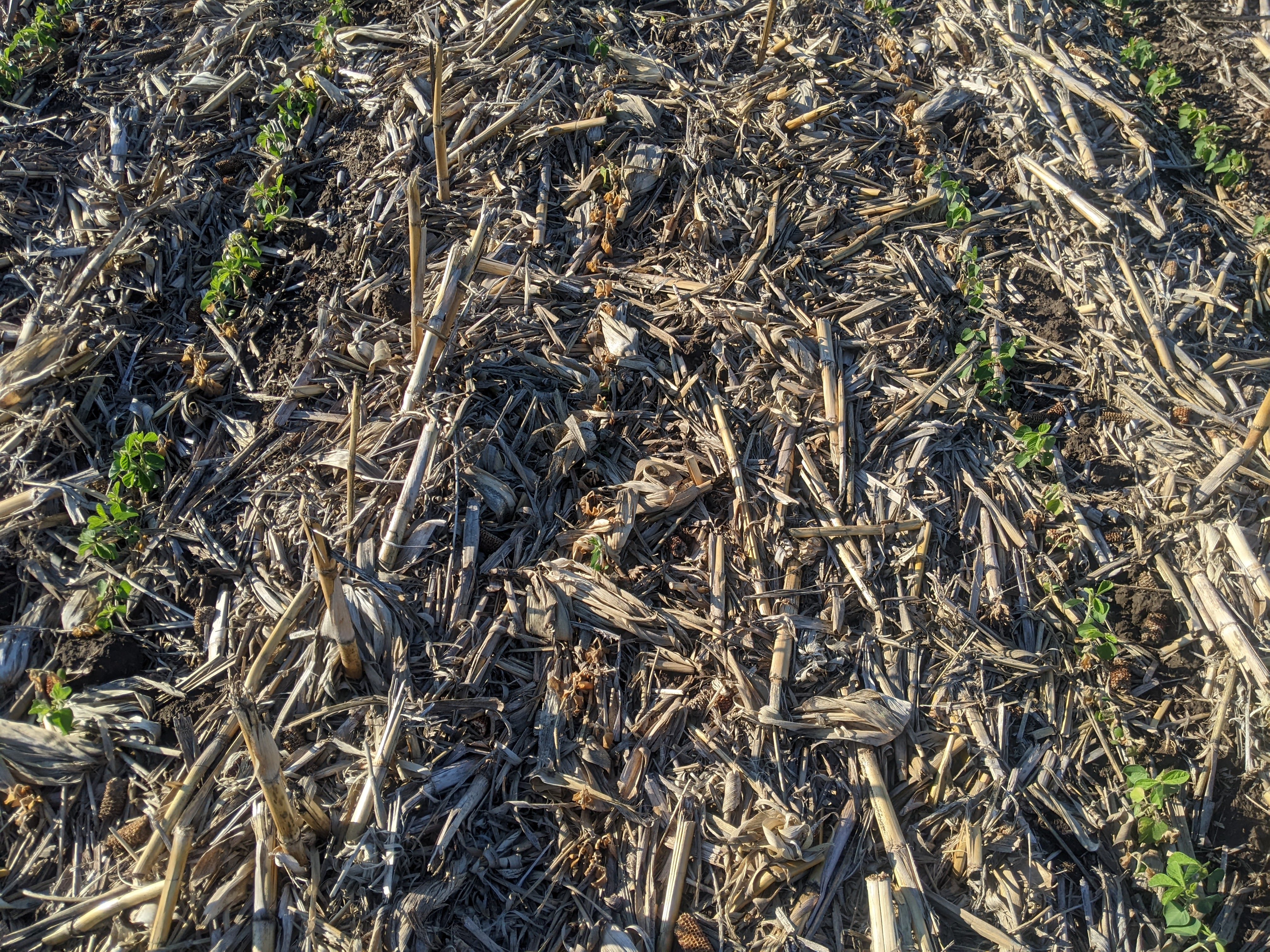
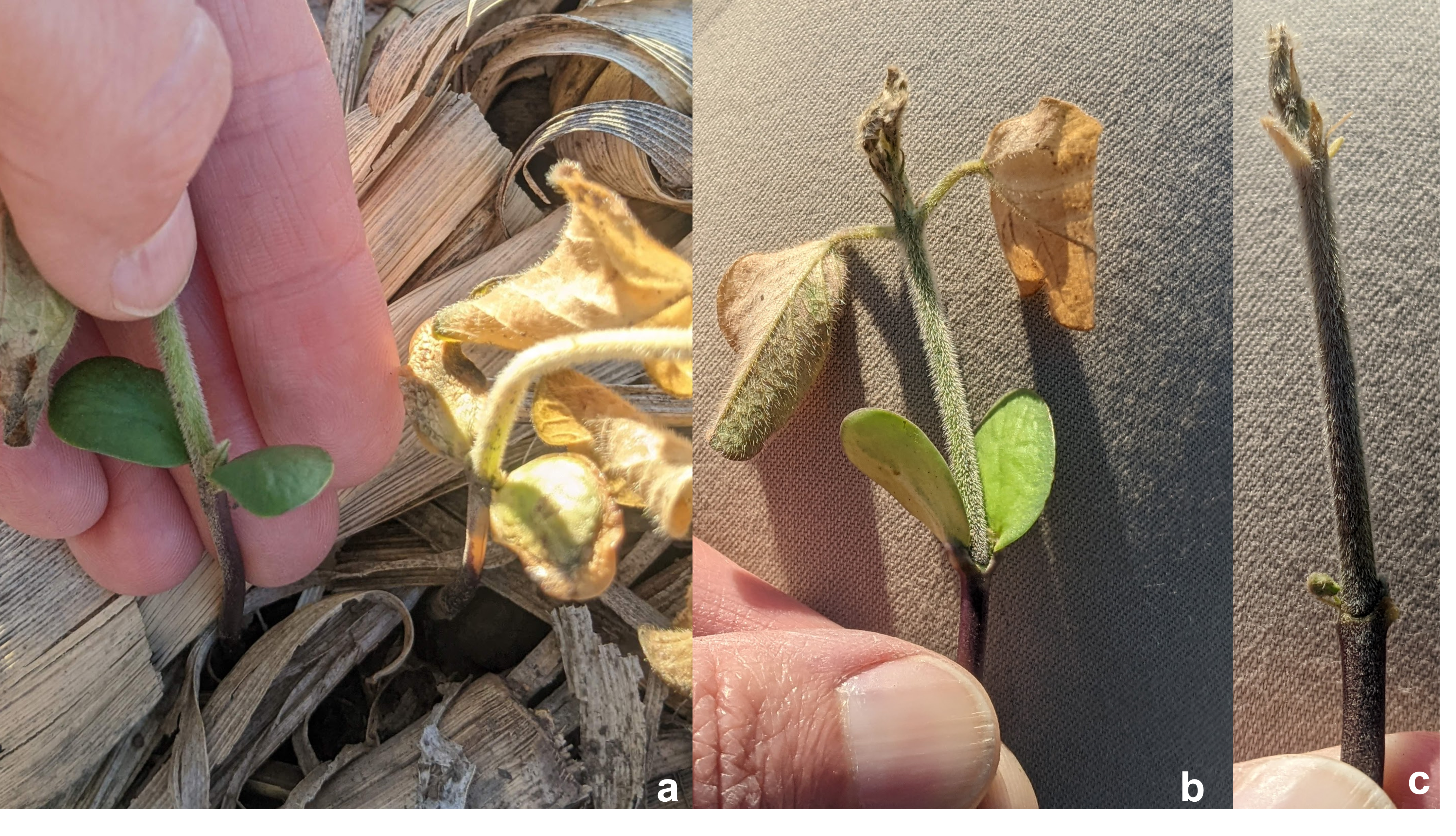
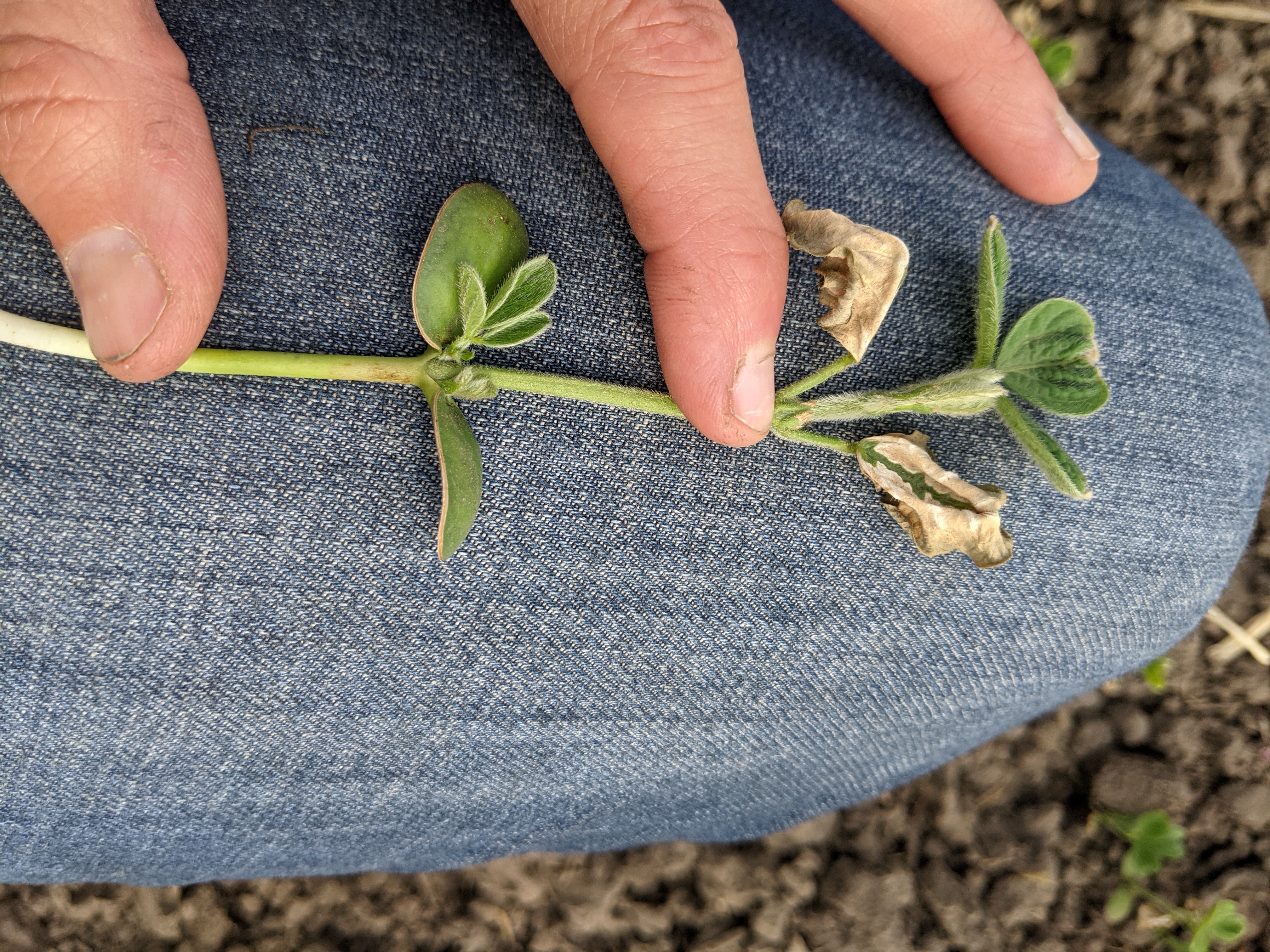
Frost Damage: Looked at a lot of fields this past week for frost damage, particularly bean fields. A key for evaluation is making sure the hypocotyl (the portion below the stem) is still firm and not pinched in any way or soft. Then exam the cotyledon area as there is an axillary bud next to each cotyledon which can shoot new branches. The rest of the upper-most plant may die, but as long as the cotyledon area is healthy, the plant should live. I have pictures to show this at jenreesources.com and we go into more detail in a CropWatch article at: https://go.unl.edu/e3si.
There’s a lot of situations with one or two rows damaged, but the damage alternates between the two. There’s many situations where there’s several rows of beans missing in patchy areas of drilled or planted fields (however, it’s not the entire row in any field I’ve looked at). Some of the patchy areas of fields are between 30-65K while other portions of fields are 100K or over. Beans are incredible at compensating and they will branch to compensate for no plants in an adjacent row. I just keep wondering about damaging the yield potential already there from these early planted beans to slot more in. I realize I would leave things at a lot less population than many are comfortable with and our recommendation is to leave fields with at least 50K. One needs to consider history of weed control in these fields as well. Each decision to leave a stand or replant is an individual and field-by-field one. I still am encouraging anyone who wishes to slot some in to consider planting a strip, leaving a strip, and alternating that at least 3 times. (Or if you’re drilling beans, you may need to make a round instead of a pass). The goal is to get two combine-widths from each planted/drilled area. This at least would be a way to see for yourself if slotting the beans in made any difference for you and please let me know if you are interested in doing this! If you do slot beans in, we’d recommend going with as similar of maturity as what the original maturity was until June 15. Ultimately, I just wish you the best in the decisions you’re making.
York County Progressive Ag Safety Day will be Tuesday, June 14th, 2022 8:30 am – 1:00 pm York County Fair Grounds York, Nebraska. This is a fun-filled day of learning for school-aged children. Topics for demonstrations and discussions include: Electrical Safety, Pipeline-Gas Safety, Grain Safety, ATV/UTV Safety, Look-a-Likes, Power Tool Safety, Equipment Safety, and Internet Safety. The registration fee is $5.00. This safety day includes lunch, snacks, a T-shirt, and a take-home “goody” bag. Registration is due by June 7th to ensure a t-shirt and take-home bag. Please register with the York County Extension office at (402) 362-5508. Sponsors include York County Farm Bureau, York Co. Extension, Wilbur-Ellis, and Black Hills Energy.
Weed Management Field Day will be held June 29 at South Central Ag Lab near Clay Center. Growers, crop consultants and educators are encouraged to attend. The field day will include on-site demonstrations of new technology and new herbicides for corn, soybean, and sorghum. An early morning tour will focus on weed management in soybean and sorghum followed by a tour of weed management in field corn. Field experiments will provide information for weed control options with various herbicide programs.
Three Certified Crop Advisor (CCA) Continuing Education Units are available in the integrated pest management category. There is no cost to attend the field day, but participants are asked to preregister at http://agronomy.unl.edu/fieldday. A brochure with more info. is located at the website. The South Central Agricultural Laboratory is five miles west of the intersection of Highways 14 and 6, or 13 miles east of Hastings on Highway 6. GPS coordinates for the field day site are 40.57539, -98.13776.


JenREES 5/23/22
This past week was a tough one on some crops. We’ve seen crusting, hail, wind, and frost cause damage to crops throughout the State. The following are considerations for plant recovery and replant.
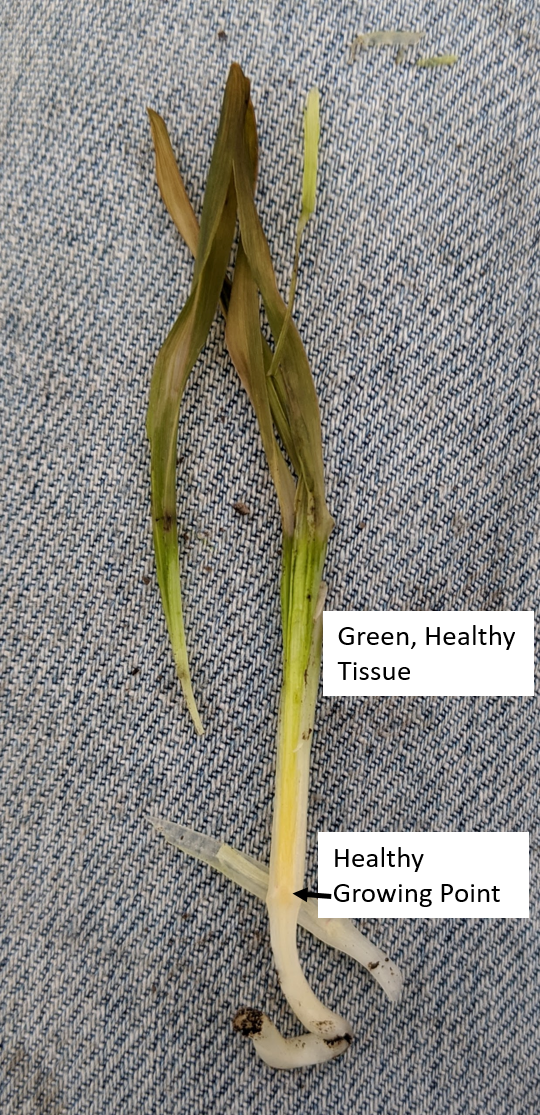
Recovery: For any situation, while it’s hard to wait, waiting 3-5 days does help when assessing any regrowth potential. We may need closer to 5 days with the rain and cool nights forecasted. Some may have experienced plants in your field that have burnt leaves and appear to be very dry. When you dig up the plants, check the roots and see if they appear white and healthy. If they appear stunted or burnt back, that may still be ammonia burn occurring. Most of what I’ve seen this week was due to wind damage from the amount of soil moving, ridges of dirt, and plants ultimately being ‘sand-blasted’ minus the sand. In cutting open plants, look to see if the growing point is white/cream in color and firm. That would indicate it is healthy and should survive. Often one can see the newer green leaves under the dying brown ones that were exposed to wind. The brown, drying leaves may do some wrapping. Often the wrapped leaves are removed by wind as regrowth pushes through, depending on severity of wrapping.
Similarly, if the corn experienced hail and/or freeze damage, digging plants and splitting stems to check for healthy growing points are part of the assessment.
For soybean, the growing point is above ground. The most critical point for new soybeans is when they’re emerging with hypocotyl hook exposed. Anytime the hypocotyl gets pinched (whether from crusting, frost at soil surface, some PPO inhibitor damage), the soybean won’t survive. Soybeans can survive the cotyledons being stripped and/or burnt off. Soybeans at the true VC stage (unifoliolates unfurled) can have 4 growing points below the main growing point (due to the axillary buds) which can shoot new petioles. What was cool for me was watching this in an organic field where the farmers flame for weed control. The soybeans after flaming can look similar to frost damage, yet a few days later, new shoots formed from the axillary buds. I haven’t experienced frost damage past the true cotyledon (VC) stage so I can’t say for sure how they will recover in fields that were hit hard. I’m hoping they could react similar to the flaming situation, depending on how badly the hypocotyl was damaged. The hypocotyl is the stem portion below the cotyledons.



Replant Considerations: For corn, the following chart from Iowa State University by Roger Elmore and Lori Abendroth, is the standard for consideration regarding populations.
For soybean, I have left stands as low as 50,000 plants/acre, particularly the closer to mid-June we get. I realize that’s hard, especially when one considers weed control. University of Wisconsin found only a 2 bu/ac yield increase when replanting early soybeans between 50,000 and their optimum stand of 100,000-135,000 plants/acre. A York County irrigated field in 2018 comparing 90K, 120K, and 150K became final plant stands of 60,875, 88,125, and 121,750 plants/acre with yields of 93, 94, and 97 bu/ac respectively.
As you assess plant stands, keep in mind that a gap in one plant row will be compensated by plants in the adjacent flanking rows. They will form extra branches to take advantage of the sunlight. Thus single-row gaps may not be as yield-reducing as you might think, especially in narrower row spacings.
If one replants at this time of year, it’s best to use a similar maturity as what one started with. We can still use full season maturities to mid-June. For stands less than 50,000 plants per acre, plant a similar maturity into the existing stand; don’t tear out or kill an existing stand as early planted soybeans have a higher yield potential. And, you can also test this for yourself via an on-farm research study! Simply leave a planter pass of your existing stand, plant into your existing stand for a planter pass, and alternate this across your field. Please see this protocol for more information.
JenREES 5/15/22
I heard many say they’d never before seen that kind of wall of dirt that came through with the storm last week; I hadn’t either. Also can’t remember a spring where we’ve had this much wind and significant storms to have so many pivots needing replaced. In spite of the property damage, grateful to hear most share they were ok in spite of the scary situations they were in when the storm hit!

Tree Wind Damage: Heard a number of people had tree damage in addition to all the visible damage in York and other areas. For those with large branches down, it will be helpful for the life of the tree to get branches trimmed back to the next larger branch or the trunk. Corrective pruning can help with trees that lost less than 50% of their branches (and don’t have additional issues such as significant decay). The pruning should be done to balance the limbs on all sides of the tree canopy (crown). Cut at the collar area instead of flush to the trunk to aid the tree in healing. Cut large limbs in stages. With one cut, a branch often breaks before it’s completely cut, causing damage to the tree bark. Instead, as explained by K-State, “take a cut around 15” from the trunk. Start from the bottom and cut one-third of the way up through the limb. Make the second cut from the top down but start 2 inches further away from the trunk than the first. The branch will break away as you make the second cut. The third cut, made at the collar area, removes the stub that is left.”
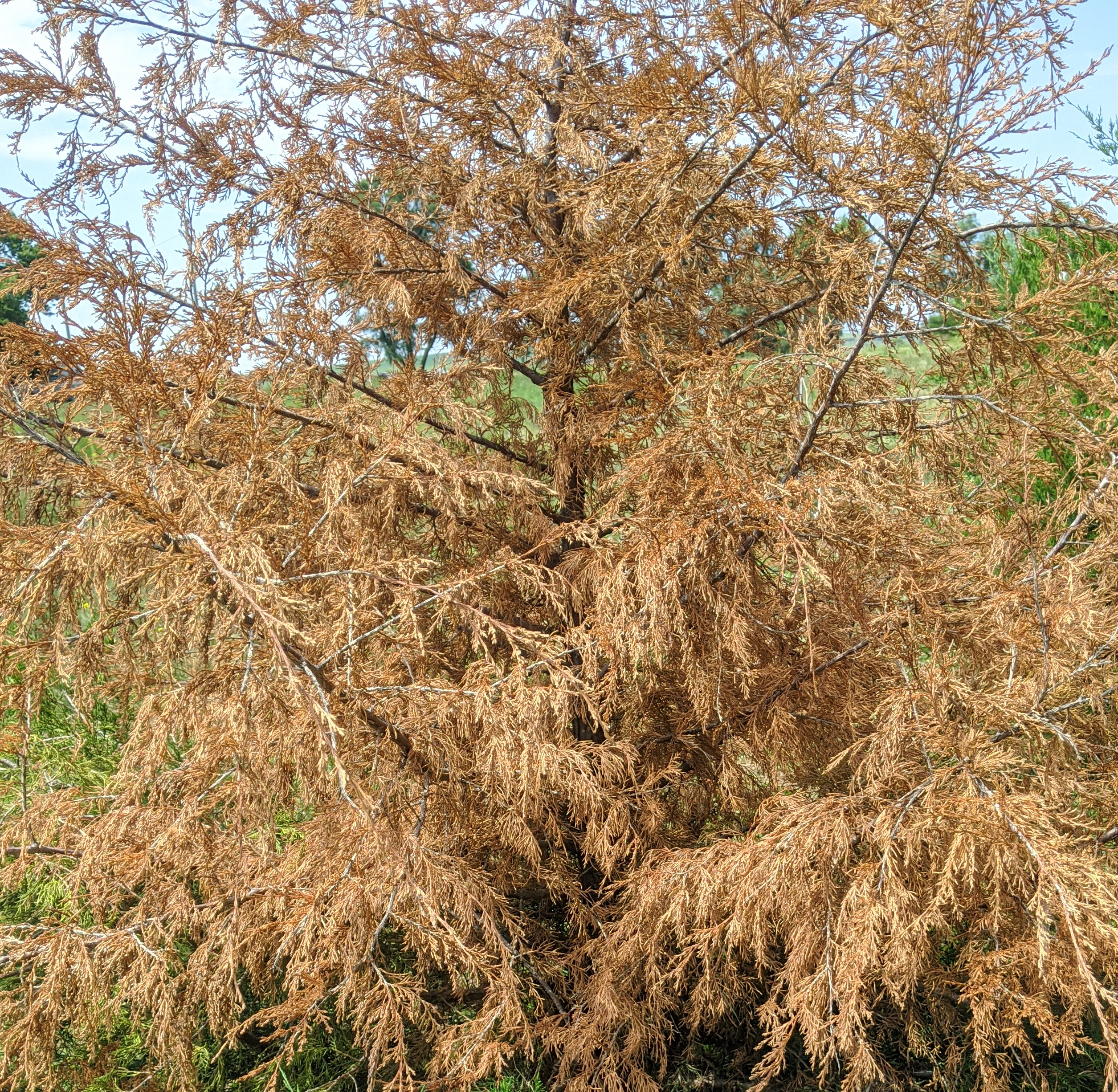
Sudden Tree Death in Windbreaks: Received a number of calls about evergreen trees that were suddenly dying, particularly in windbreaks. Anytime this happens, it’s due to some environmental and/or cultural problem. We most likely are going to see lots of tree and shrub issues this year due to the dry fall, winter, spring and the fact that we didn’t have snow cover. Trees rapidly dying right now are most likely due to the dry conditions and/or a combination of those conditions with my next comments.
A cultural example that I see aiding in the cause of tree death is landscape fabric/weed barrier. For example, (from my experience) the #1 cause of death I see of cedar tree windbreaks that are usually in the 10-20 year range, is when landscape fabric was used as weed barrier between the tree plantings.
So why does the fabric cause an issue? Often the original hole size doesn’t necessarily expand with the tree trunk as it expands. Getting under the tree (which is a pain with the pokey fallen needles!), one can often see how the tree is choked right where the fabric is and then the trunk flares right above that point, indicating the choking point. For trees that haven’t died, taking some type of long-handled tool that has a hook or something to pull the fabric away from the trees in several places around each tree can help. And honestly, if anyone reading this has a windbreak with landscape fabric, it would be wise to do this regardless if any trees are dying to potentially avoid future distress. I realize weed barrier is typically used with windbreak plantings. Research has shown that just planting grass between the trees (or leaving grass between the trees), while resulting in a natural weed barrier, causes trees to grow more slowly. It is an option though for weed control. Another option is using some type of mulch around the trees (but not against the trunk). I realize in the country, it can blow away more easily, but is another option that provides weed control.
Sickly looking evergreen trees could be due to a combination of things such as the dry conditions plus a disease/insect issue from previous years. I’ve seen several of these as well where they look sick, but aren’t rapidly dying. In those cases, it’s important to reduce the stress to the tree and be aware of the specific insect/disease problem for treatment.
Cutworms: As corn emerges, be scouting for cutworms. More info: https://go.unl.edu/a6fy.
BQA Training: Face to face BQA and BQA Transportation training for livestock producers is on May 18, 4:00 p.m.-6:00 p.m., Casey’s Building, Albion, NE. RSVP to Brad Schick at: 308-632-1230.
JenREES 5/8/22

Alfalfa Weevil should be scouted in alfalfa now. I have sweep nets that can be borrowed from the Extension office if you’d like. Otherwise, just go to different spots in the field and look for small holes on the newest leaflets near the stem tips. The larvae are small, green, and have black heads with a white stripe down the back. During the heat of the day, they’re often found near the crowns of plants and they curl into a C-shape when touched. To determine economic threshold, cut 10 alfalfa stems at ground level and shake the larvae off the stems by beating them off the sides into a bucket. The economic threshold right now is right around 1.5-2 larvae per stem. More info. here: https://go.unl.edu/tpkz.
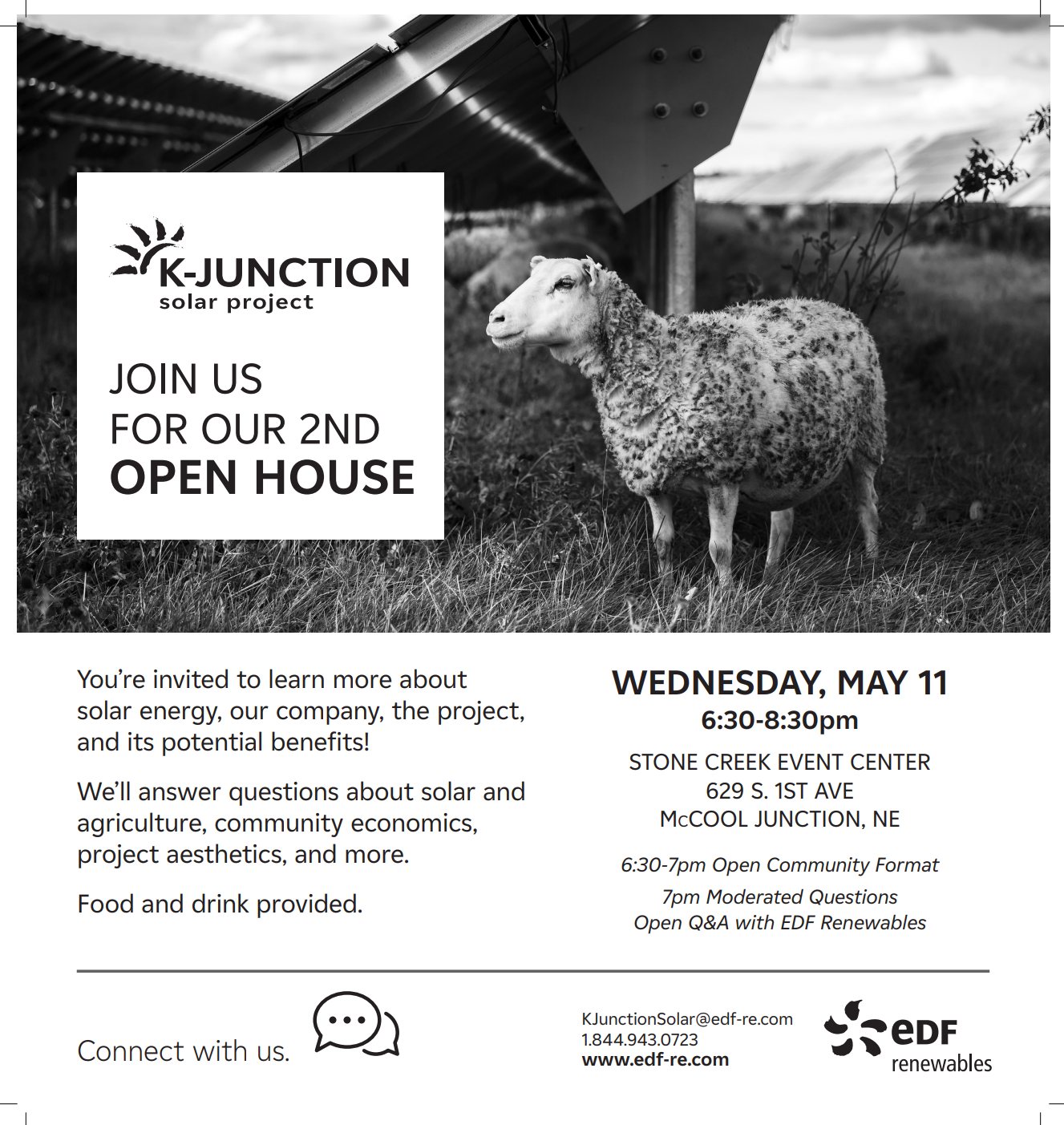
K-Junction Public Forum: I’m grateful for the opportunity that EDF Renewables is allowing for a public forum in addition to their second open house regarding the proposed solar farm this Wednesday, May 11 from 6:30-8:30 p.m. at Stone Creek in McCool Junction. Because we’re to be impartial as Extension faculty, I was asked to serve as the moderator for the evening. I just wanted to share a little about this, and also felt it was important to share how I’m choosing to moderate the event so it’s not a surprise that evening.
As I’ve listened to various conversations and perspectives, it just seems like people need the opportunity to share their viewpoints publicly and ask their questions so all can hear the same answers provided. Because of this, a few of us expressed concern to EDF to allow for a public forum. EDF chose to change the open house format to a blended one of both display boards and the forum and I’m grateful for that. While public forums are difficult, I feel there can be some healing that occurs in just being heard, despite differences of opinion, and that’s my hope and prayer.
As I’ve tried to put myself in the shoes of landowners, while my family doesn’t own land in the area of the proposed solar farm, if we were in this situation, our decision would be based on our specific goals and plans for our farm. But our goals may not be the same as our neighbors. Thus, each landowner has to make decisions based on the goals and values that fits his/her family’s specific situation. The difficulty can be for those caught in the middle who don’t get to make that choice, such as neighbors, community members, and those whose jobs also support agriculture in some way.
As I’ve listened, the theme I continue to hear and sense, is the lack of information for a few years that occurred. I think that’s the greater underlying frustration. I’ll admit, that was a frustration to me as I felt I let landowners down by not knowing, thus didn’t have resources available for them to make informed decisions and to help with negotiating contracts. But I had to move past that to what I could do now. While hard, we can’t change the past. We can choose how we face the present and future doing our best to listen to each other and get answers to the questions we have. This public forum will hopefully allow an opportunity to do this. I think it also helps to remember we’re all just people. Regardless of which side a person is on, the person is not the enemy.
Rural Nebraskans are known for being respectful. I watched that during the first open house when differences of perspective were expressed in conversations. I only saw respectful conversation and discourse in addition to the passion for one’s position/perspectives. That’s what I would ask for this Wednesday evening as well.
In the public forum, there will be opportunity for sharing via a microphone and, for those who prefer not to speak, also via written questions. Each person will be given 3 minutes to speak followed by 3 minutes for EDF representatives to respond. I will make every attempt to get to everyone’s questions in the time we have. While it may be hard not to ask follow-up questions, I’m going to ask that everyone who desires has the opportunity to speak before anyone speaks twice. There will be additional opportunities to speak with EDF representatives following the public forum.
JenREES 5/1/22
What a blessing to receive rain!!! That almost seems like an understatement with the joy several shared with me as rain hit different locations of the State. The benefits were huge for pastures and lawns, activating herbicides, helping with ammonia burn, helping germinate seeds. There’s also just something about the way the air smells and to hear it after it being since last fall since much of the State has experienced a substantial rain.
And, I realize the winds also caused damage to some buildings and hundreds of pivots on top of all the pivots damaged from wildfires in the southwest part of the State. So sorry to hear about all the damages and here’s hoping they can be fixed/replaced soon.
Free Well Testing: From May 1-31, any Nebraska resident can sign up for free well water testing for nitrate, nitrate, and phosphate in well water and surface water. For more information and to sign up please go to: https://go.unl.edu/wqcs.
Food Preservation: Freezing Garden Produce webinar will be held May 3 from 7-8 p.m. To register, please go to: https://go.unl.edu/freezingclass. Freezing produce has been my go-to when I’m short on time!
K-Junction Solar Project Open House will be held on May 11th from 6:30-8:30 p.m. at Stone Creek Event Center in McCool Junction. From 6:30-7 p.m. will be an open community format. At 7 p.m. there will be moderated open Q/A with EDF renewable representatives. Food and drink will be provided.
Tractor Safety Training Courses will be held in late May and early June throughout the State. The first day of instruction can be taken either in person or online. The second day is a hands-on event including the required driving test. Teens 14 or 15 years of age who work on farms, or others who are interested in learning about safe farming practices are encouraged to register. Federal law prohibits children under 16 years of age from using certain equipment on a farm unless their parents or legal guardians own the farm. However, certification received through the course grants an exemption to the law allowing 14- and 15-year-olds to drive a tractor and to do field work with certain mechanized equipment. The closest hands-on training date is May 26th at Raising Nebraska, 501 East Fonner Park Rd, Grand Island (Contact: Sarah Polak, 308.385.3967, spolak2@unl.edu). The closest driving date is located June 9 at Adams County Extension, 2975 South Baltimore Ave, Hastings (Contact: Ron Seymour ron.seymour@unl.edu and Twila Bankson 402-461-7209, twila.bankson@unl.edu). For more information or to register, please go to: https://cvent.me/44ExVl.
Pasture/Range Management in Drought: A recent webinar shared how to trigger pasture and forage management decisions before a drought including animal turnout and stocking rates. You can view it here if interested: https://go.unl.edu/hygd.
Ornamental pears, also known as Callery pears, have been blooming. Kelly Feehan in Platte Co. shares, “If thinking of planting one of these white blooming trees, it might be best to reconsider. Ornamental pears have been a popular tree for white spring blooms, but this tree is overplanted and has issues with bark blasting and fire blight disease. More important, ornamental pear is on the Nebraska invasive species list; planting them is discouraged. The seeds of Callery pear are relished by song birds and small mammals who rapidly distribute them over a large area. If you want a white spring blooming tree, avoid planting ornamental pear and select a serviceberry, white flowering crabapple or Japanese tree lilac instead.”


JenREES 4/25/22
Signs of spring are all around with tulips and flowering shrubs budding or beginning to break forth in blossom! Have heard of a range of planting conditions and received a variety of questions last week. The following are some considerations as you begin planting or continue to plant this year. Also, John Mick, Pioneer Hi-Bred field agronomist, had excellent planter setting and planting season tips in his agronomy newsletter this week and a team of us share more detail in this CropWatch article.
Honestly, for many of us as agronomists, this spring is a new territory. We’ve dealt with dry conditions and wet ones before, but this situation of not receiving rains, the high winds, and availability of products presents a new challenge for many of us. There’s the saying ‘plant in the dust and your bins will bust’, but there’s also difficulty surrounding herbicide activation and potential ammonia burn from fall/spring applied anhydrous in the seed row.
Soil temps, depth, pops, conditions: We have one chance with planting to start the season off right, so soil conditions fit for planting, seeding depth for corn and soybeans close to 2”, and soil temps in the mid-40’s on a warming trend with no chance of a cold snap within 8-24 hours for soybean and 48 hours for corn are important components to achieving this. I prefer removing one more stress off corn by putting it in the ground when temps will stay over 50F for 5-7 days. It’s been interesting to see the shift in the number of soybean acres planted before corn in the several county area this year. I’m hearing the need for very high down force and difficulty getting planters in the ground, particularly down in the Nuckolls, Webster, Clay, Adams-county areas. Some have shared that no-till ground is working amazing and others have shared the wind removing residue has made the ground extra hard.
Finding moisture has been of concern to both non-irrigated and irrigated farmers as the winds continue. Bob Nielsen at Purdue shared that corn can be planted 3-4” deep based on their research. I wouldn’t put soybean past 2.5”. Regarding seeding rates, I haven’t recommended changing them unless the soybean germination percentage is less than 85%. We do have growers conducting soybean seeding rate studies again this year, and if you’re interested in trying that as well, please let me know.
Some have wondered about planting non-irrigated crops or waiting for a rain. This ultimately will be a grower by grower and field by field decision. We’re only setting at April 25th as I write this and as we think of planting windows vs. planting dates, we are still setting good. Many have asked about watering prior to planting. In general, we’re not recommending it at this time; if we don’t get rains as this planting season continues, we may need to adjust that thinking. Ultimately, we’d say to water before planting if the ground isn’t fit due to extra cloddy or hard soils. For those who applied anhydrous via strip till whether fall or spring, watering prior to planting may help with ammonia burn damage to the seed and to the plant when the roots reach the application zone.
I’ve also been asked about pre-plant herbicides. With the colder soil temps, several have mentioned not seeing weeds thus far. I’m concerned about a few things regarding PREs. One, activation. Most need at least 0.5-0.75” of moisture 5-7 days after application. Some can last on the ground up to 14 days with partial activation. With the wind, my concern is soil particles containing herbicide not staying on the soil surface (depending on tillage practice). Another concern is the moisture levels in soybean fields, planting depth, and PPO-inhibiting herbicides. This is a great chemistry. The challenge can be damage to seeds and seedlings can occur if they come in contact with the herbicide by the seed vee not closing, seed trench cracking, or rain/water-splash onto hypocotyls and cotyledons. Planting soybeans deeper, at least 1.5” (UNL research found best yield at 1.75”), will help allow the soybean to imbibe water from soils that have moisture at that depth. By planting shallow into dry soil, applying herbicide and then having rain or irrigation activate the herbicide, the herbicide can potentially enter the seed when completing the water-uptake process, damaging it. For those concerned about these different situations with pre-plant herbicides, an alternative could be to use a Group 15 product once the corn or soybean emerges. Just know those products won’t kill any weeds that have emerged but will provide residual for ones that come later.
Reminder of York Co. Tire Collection April 30 and May 1 at the York Co. Landfill from 8 a.m.-5 p.m. No tires on rims and participants must show proof of residency. More info: 402-363-2690.
JenREES 4/17/22
Hope you had a blessed Easter weekend! Reminder that soil temperatures can be viewed at: https://cropwatch.unl.edu/soiltemperature.
Hay and Forage Resources: Resources for buying/selling hay, corn residue, and other forages can be found at the following:
- Nebraska Hay & Forage Hotline: https://nda.nebraska.gov/promotion/hay/index.html
- Nebraska Hay Exchange: http://www.hayexchange.com/ne.php
- Crop Residue Exchange: https://cropresidueexchange.unl.edu/
Fire Damage to Crop Residue: With the dry conditions and various fires that have occurred, have received questions regarding the nutrient value in the residue and/or soil impacts. When residue is burned, most nitrogen and sulfur in the residue are lost; however, the phosphorus and potassium are retained in the ash (as long as they don’t blow away).
In spite of this, short-term nutrient loss from the residue is none to minimal. Research from the University of Wisconsin looked at the need to replace nitrogen to the succeeding corn crop when soybean residue was either removed or not removed. They found no difference in nitrogen impacts to the corn crop regardless if the residue was removed; this suggests there is no need to replace the nitrogen in burnt soybean residue. Research from USDA-ARS in Nebraska, when looking at corn residue removal prior to corn planting, also suggested no need to replace the nitrogen lost from the residue. They found increased mineralization due to the change in C:N ratio when residue was removed. Previous research compiled in this resource from South Dakota State shared the same sentiments: https://openprairie.sdstate.edu/cgi/viewcontent.cgi?article=1365&context=extension_extra. The SDSU resource is also helpful when walking through a dollar value of other loss considerations.
Regarding longer-term nutrient loss, a UNL NebGuide shares for every 40 bu/ac of corn or sorghum, approximately one ton of residue is produced. Each ton of corn and sorghum residue contains approximately 17 lb N, 4 lb P2O5, 37 lb K, and 3 lb S. For every 30 bu/ac of soybean residue, approximately one ton of residue is produced with 17 lb N, 3 lb P2O5, 13 lb K, and 2 lb S for each ton of residue produced.
Perhaps the greatest losses to consider are organic matter, soil loss, and soil moisture. Regarding organic matter, the soil holds the greatest portion of this. One year of residue is minimal, attributed with the potential of increasing organic matter 0.03-0.06%, depending on tillage type, crop, etc. Soil erosion due to wind/water can result in organic matter loss and loss of more productive soil. This is hard to quantify. Perhaps the more important factor is the soil moisture losses in no-till, non-irrigated fields, particularly in a dry year such as this. Paul Hay, Extension Educator emeritus, years ago shared with me several documented situations where yield losses due to moisture loss were estimated. Corn planted into burned no-till, non-irrigated soybean stubble ranged from 15-28 bu/ac yield loss in two situations. There was 0-3 bu/ac yield loss associated with soybean planted into burned, no-till, non-irrigated corn residue in two situations. Use of soil moisture probes can give an indication of soil moisture differences between burned and non-burned areas of fields or between fields. Direct yield comparisons between fields are difficult to make due to planting dates, hybrids/varieties, agronomic practices, etc., but important to still collect and assess.
Crabgrass Preventer timing: Crabgrass germinates when soil temperatures are maintained at 55F for 5-7 consecutive days. You can watch the CropWatch soil temperature maps at the link listed above. Or, use a meat thermometer (that you dedicate to only taking soil temperature!) for your own lawn situation at a 2-4” depth. Typically, towards the end of April/beginning of May is a good time for the first application, but it will vary by year. So far, this timing is holding true for 2022. When crabgrass preventer is applied too early, it can move out of the zone where the crabgrass seed is germinating. Would also recommend that you consider splitting your crabgrass herbicide application. Apply half of the highest labeled rate when soil temps warm and the other half 6-8 weeks later. Often there’s a flush of crabgrass later in the season and splitting the application can help with that It’s helpful for the products to be watered in within 24 hours for best results.
Cover Crop Termination including Planting Green
Cover Crop Termination: I always enjoy seeing new life and the seasons, so enjoying seeing wheat/rye greening up! Grateful for the excellent discussion around termination timing at the February practical cover crop management meeting! Pictures with more details each farmer shared is at jenreesources.com.
In a column last year, I shared detailed considerations for termination timing (prior to planting vs. planting green). That info. can be found at: https://jenreesources.com/2021/03/28/jenrees-3-28-21/. For this column, sharing key tips from the discussions that may be helpful for this year.
Key points I gleaned:
- While rye may die slowly depending on the temperature and year, it will die.
- Two farmers consistently killed rye with only 20-22 oz/ac of Roundup Powermax (even when headed). For those who planted vetch with rye, the vetch will survive the Roundup application allowing it to grow longer, produce more nitrogen, and be killed by a post-application containing a Group 27 herbicide (like Callisto) later (if want it to die).
- Clethodim vs. glyphosate: Two farmers and a Pioneer rep shared sentiments of clethodim providing a slower kill and allowing the rye to stay greener longer for weed/erosion control. This is of benefit especially for farmers who need to terminate prior to corn or seed corn planting.
- Regarding clethodim rates, several are aiming for the mid-range this year by using 12 oz/ac. Another farmer used 10 oz clethodim + warrant. Many use 8-10 oz/ac to kill volunteer corn in soybean, so a few are also trying the lower rate. When going into corn, clethodim needs to be applied to rye to kill it at least 7 days prior to planting corn. For soybeans, it can be applied anytime after planting/emergence if desired.
- When rye is greater than 12”, consider increasing gallonage to 15-20 gal/ac for better coverage.
- When considering planting corn green into rye on subsurface drip irrigation (SDI), need the ability for higher capacity well to get moisture up to the seedbed. Potential yield loss otherwise.
- When planting soybeans green, the goal is often to off-set the PRE herbicide cost with the cover crop seed and application cost. A residual is necessary at some point either at time of termination or up to a week after termination when planting soybean green. Plan on irrigation or rainfall to get the residual to the ground, especially on rye taller than 12”.
My key points for planting green include: plan on some form of nitrogen at planting if planting corn green into rye, have the pivot ready to go if need moisture for the seedbed, don’t use a PRE in soybean if can’t get seed vee closed, plan to water residual application as soon as label allows to get residual to ground, and if non-irrigated, consider seedbed moisture for termination timing.
Lawns: Lawns are slowly greening up and for those with fall armyworm damage last year, overseeding and/or replanting may be necessary. Consider overseeding now as Kentucky bluegrass overseeding is recommended from April 1-30th and tall fescue from Apr. 15-June 15. The full seeding rate for 1000 sq ft is 3-4 lbs for Kentucky bluegrass and 8-10 lbs for tall fescue; for overseeding, use ½ these rates. Small amounts of sawdust or sand can be mixed with the seed to aid spreading. The area should be prepared prior to seeding by raking to loosen the soil and excess dead growth. Areas can also be aerated or power raked (power raking should only be used if ½” thatch or greater is present). Scotts TurfBuilder Starter for New Lawns can be spread either immediately after seeding or one can wait till the seedlings emerge. Either way, it is safe for the seed/seedlings. Spring rains in April will greatly help with emergence, but otherwise, irrigation by mid-April will be necessary to keep the soil moist until germination occurs. Then apply water deeply and infrequently to encourage rooting. Also check out this excellent brochure for Lawn care in Eastern NE: https://go.unl.edu/mhkd.
Thank You to the following for their contributions to this information: Gabe Bathen, David Cast, Chad Dane, Jay Goertzen, Marvin Linhorst, Ron Makovicka, Kevin Medow, Brad Morner, Scott Richert, Todd Schmeiding, Stuart Spader, and Mike Spray. The photos are mostly mine from field visits other than the ones taken by the farmers from their tractor cabs.


Pivot irrigated, no till other than strip freshener for seedbed. Seed 40 lb/ac rye with sunflower drill by following combine with drill. 2 rows rye then gap. Kill at 8-10″ at planting with 40 oz Roundup + PRE watered in. Rye pins down residue keeping it from blowing. Planting green easier than planting into dying rye. 
Pivot Irrigated. Drill 40 lb/ac rye with 30′ Great Plains drill. Drill at moisture 0.5-2″ deep. Seeded 5″ off corn stalk (2 rows 20″). Currently putting 1/3 N up front with strip till (32% UAN); now considering 1/2 up front. 
Pivot irrigated. Corn planted green into rye (left). 1-2″ off corn row. Dribble 8-10 gal 32% UAN at planting. Waited 2 weeks after emergence to terminate (at times lost a lot of moisture). Terminate with 20 oz/ac Roundup PowerMax (even with headed rye). Have added 15-20 lb vetch to rye which doesn’t kill with RoundUp so allows more growth and N production. It does kill with POST containing Callisto. April 21 soybean into rye (right), originally intended to relay crop but had inconsistent rye stand. Used Great Plains drill on ridge till. Clean row every 3rd row. Terminated at heading on May 22 with 20 oz/ac Roundup PowerMax + Zidua (waters in since rye >12″). 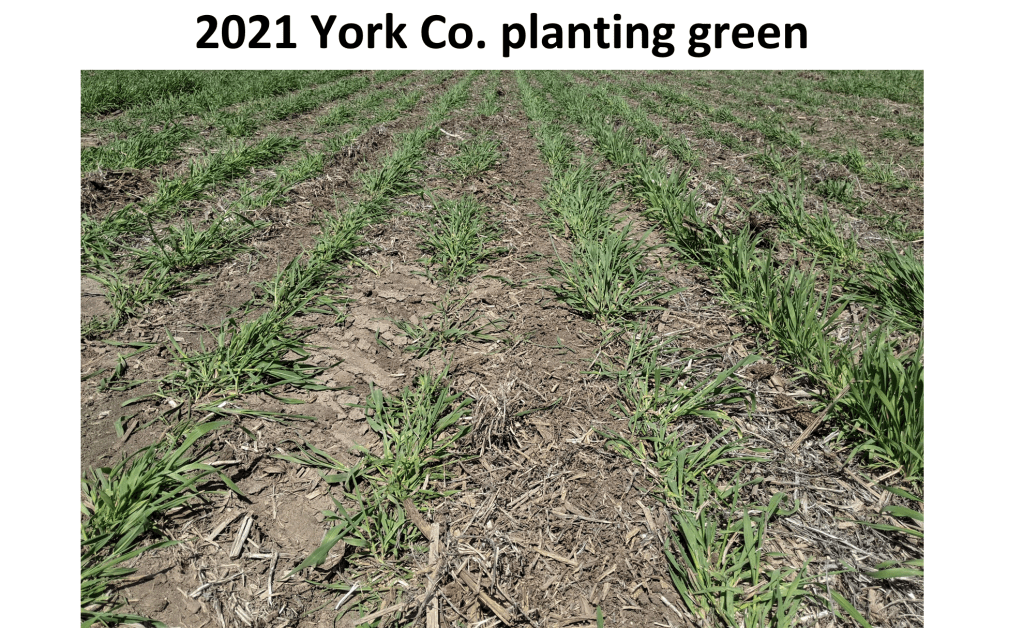
Pivot Irrigated. Drilled 21 lb/ac rye in fall in 15″ rows. Case planter struggled with closing wheels but good depth and stand. Planted green into the rye. 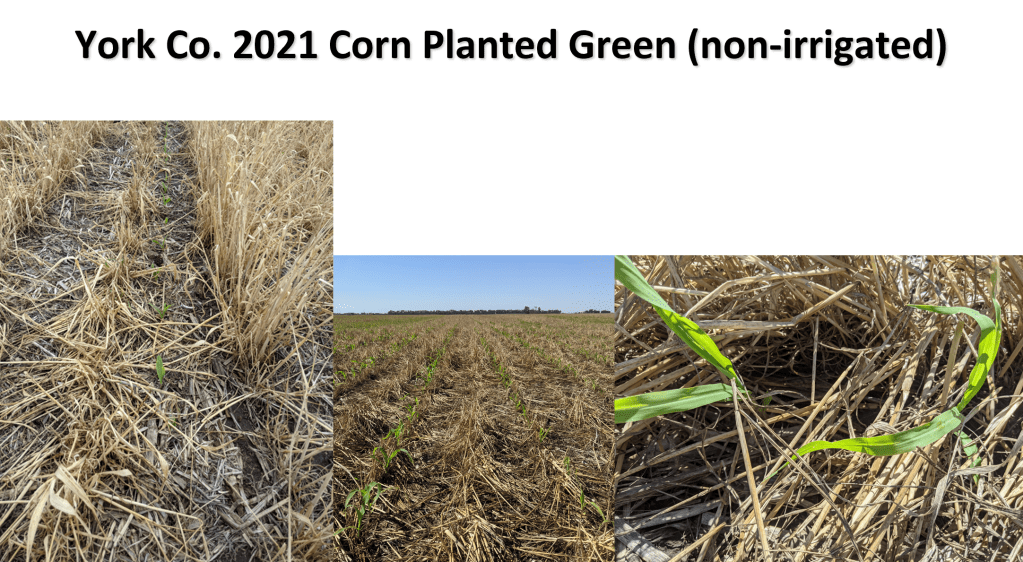
Non-Irrigated on 6 acres. Had difficulty getting seed vee closed. Applied 3.5 gal. 6-24-6 at planting with population of 27,000 seeds/ac. Applied additional 130 lb/ac of 32% UAN. No difference in yield compared to other non-irrigated corn. Corn spindly at first as it stretches for sunlight. 
Pivot irrigated. Seed 40 lb/ac wheat (cheaper and doesn’t get as tall prior to corn) or sometimes seeds rye or triticale. Has to terminate 2 weeks prior to planting seed corn for companies. Kill small grain with 22 oz/ac glyphosate. For soybeans follow with residual + POST (Liberty or Engenia) on emerged beans. Also using clethodim+NIS allows greener stems and slower kill for the wheat or rye to stay around longer when have to terminate prior planting corn or seed corn. 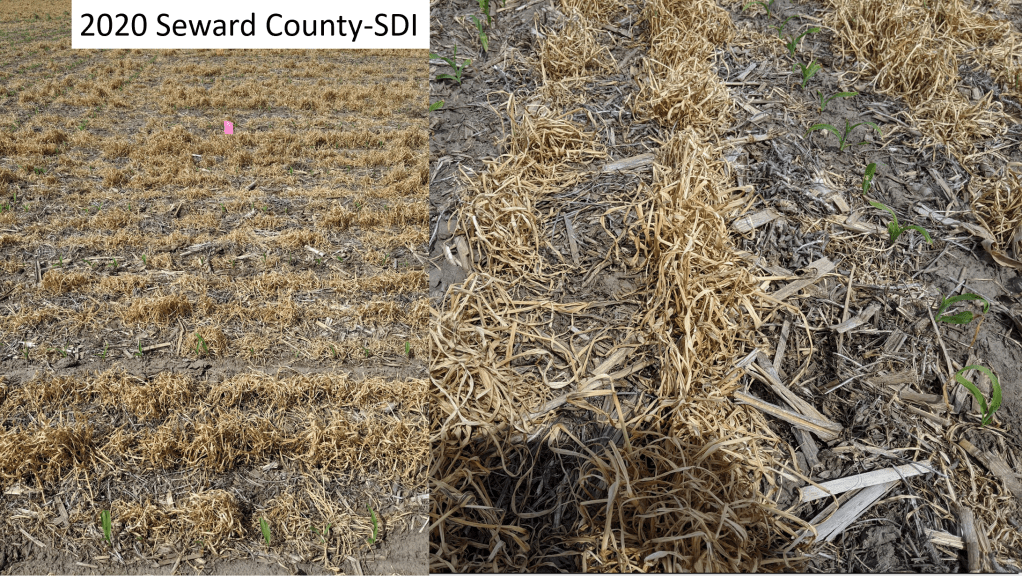
Subsurface drip irrigation. Solid seed rye at 40 lb/ac on 10″ spacing following the combine. Terminate when rye is 12″ tall. Another grower (pictures not shown) shared his rye was 10″ at termination and his well capacity wasn’t great enough to get water up to seedbed in his SDI system which caused yield loss when he planted green. His SDI drip line was on 40″ spacings. 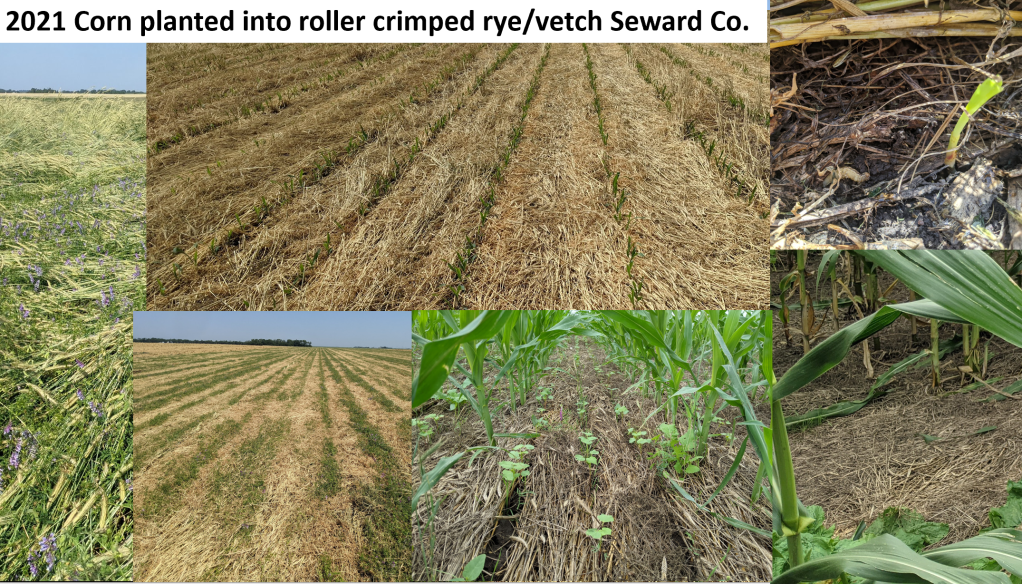
Pivot irrigated. Goal was transitioning to no-till organic. Planted 30 lb vetch and 30 lb rye in fall. Rolled rye and vetch and planted corn over 3 planting dates. late May-June 2021. Army cutworms took out corn on one planting date and he ran insecticide through pivot. The rye/vetch mat provided excellent weed control season-long. Also drill interseeded a cover crop into the mat. 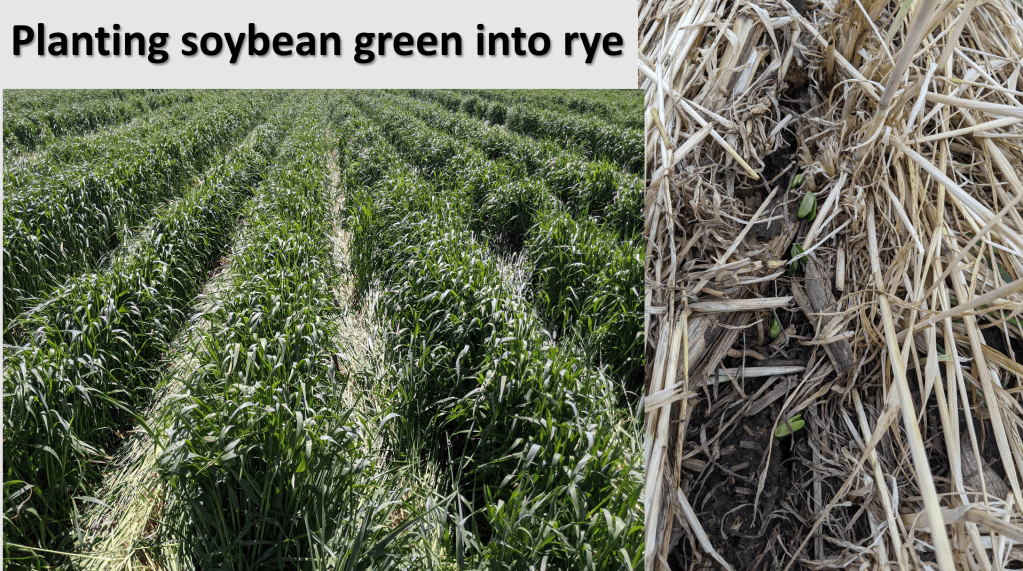
Pivot Irrigated. Fall 2019 seeded 40 lb/ac cereal rye on seed corn acres. Soy planted Apr. 25. Sprayed 44 oz Roundup + 16 oz Brawl Apr. 26. Post with 32 oz Liberty. Excellent weed control. 
Pivot irrigated. 9/5/20 seeded 30 lb/ac cereal rye on seed corn field. Soybeans planted 4/23/21. Sprayed 44 oz Roundup 4/24/21. Sprayed 24 oz Enlist, 12 oz Outlook, 32 oz Roundup 6/3/21. Sprayed 32 oz Liberty + 24 oz Enlist 6/28/21. Heavier waterhemp and palmer pressure and decided need residual in burndown or shortly after to avoid the additional herbicides. Rye noticeably reduced anthracnose and diaporthe complex on soybean compared to soybean in their adjacent pivot w/o rye. 
JenREES 3/27/22
Grateful for a little moisture last week! Lots to share based on questions. For those with poultry, the highly pathogenic avian influenza (HPAI) has impacted a fourth Nebraska farm. Farms impacted thus far have been in Merrick, Butler, and Holt counties. All were under quarantine with birds being humanely depopulated and disposed of in an approved manner. HPAI is a highly contagious virus that spreads easily among birds through nasal and eye secretions, as well as manure. The virus can be spread in various ways from flock to flock, including by wild birds, through contact with infected poultry, by equipment, and on the clothing and shoes of caretakers. Wild birds can carry the virus without becoming sick, while domesticated birds can become very sick. Symptoms of HPAI in poultry include: a decrease in water consumption; lack of energy and appetite; decreased egg production or soft-shelled, misshapen eggs; nasal discharge, coughing, sneezing; incoordination; and diarrhea. HPAI can also cause sudden death in birds even if they aren’t showing any other symptoms. Poultry owners should restrict access to your property and poultry and report unusual poultry bird deaths or sick birds to NDA at 402-471-2351, or through USDA at 866-536-7593. More info: https://nda.nebraska.gov/animal/avian/index.html
Preliminary farm real estate numbers were released this week at: https://cap.unl.edu/realestate.
Weed Guides: We didn’t receive 2022 weed guides. I do have some flash drives with PDF copies for those interested. Otherwise, print copies can be purchased at: https://marketplace.unl.edu/default/ec130.html.
CropWatch at cropwatch.unl.edu covers a variety of topics including drought outlook and BT trait table.
On-Farm Research Results Book: PDF version can be viewed at: https://go.unl.edu/vfi4.
Nutrient Management: If you’re applying fertilizer this spring or in-season, it may be an opportunity to cut back on fertilizer rates in some strips. Protocols for consideration that can be adjusted at: https://jenreesources.com/2022/02/06/jenrees-2-6-22/.
Also received questions regarding starter fertilizer. Javed Iqbal and Laura Thompson shared the following in this week’s CropWatch, “From 1995 to 2019, farmers working with the Nebraska On-Farm Research Network conducted 35 studies looking at starter fertilizer on corn. The results of these studies can be found in the Results Finder database at http://resultsfinder.unl.edu/. Some were in the same field for a number of years, others moved around. Various starter materials were evaluated, and not all studies reported soil test Phosphorus (P) levels.” UNL’s critical soil test levels for P are when Bray-P is less than 20 ppm for corn after corn (C/C) or 15 ppm for corn after soybean (C/S). The information below is focused on studies comparing 10-34-0 to no starter.
“Eighteen of the studies compared a 10-34-0 starter fertilizer in the range of 4-6 gal/ac to a no starter check. Soil P levels were between 4 and 35 ppm. The crop yield response across range of soil P levels:
- For soils with P soil tests at or below 10 ppm, there was an average yield increase of 14.3 bu/ac due to the starter (four sites).
- For soils with P soil tests of 10-20 ppm, there was an average increase of 2.6 bu/ac (five sites).
- For soils with P soil tests of 20-35 ppm, there was an average increase of 0.3 bu/ac (nine sites).
- When all the data were combined, regardless of soil test values, there was an average increase of 4 bu/ac.
In spite of this analysis, of the 18 studies, only five had statistically significant differences. Of these five, the average yield increase was 12 bu/acre and the average soil test P level was 9 ppm.
To summarize, when fertilizer is used as a starter (as defined above with soil test levels above the critical value), the data shows that it is largely not effective in terms of yield or economical response (even though plants with starter applied will be greener early on); however, if the fertilizer is added to a soil that tests low for soil test P (less than the critical value), a yield response to that fertilizer is expected.
A similar analysis of the soybean on-farm research found six starter studies between 1992 and 2015, with only three sites reporting soil test P, all of which were greater than 17 ppm. Average yields for the no-starter studies were 61.2 bu/ac and for soybeans with starter, 61.3 bu/ac.” If you’re interested in trying this for yourself in corn or soy, consider this simple protocol.
Ag Week 2022
National Ag Week: As a kid growing up on the farm, I don’t remember thinking about how many jobs outside of farming are agricultural-related. Yet, one in four Nebraska jobs are connected to ag. These jobs provide food, feed, fiber, and fuel and include farming/ranching/livestock and poultry production, processing, manufacturing, transportation, advising/education, storage, inspecting, veterinary/medical, technology, sales, research and development, conservation, government, etc.
What happens in ag impacts all Nebraskans. A strong ag economy (Nebraska ranks #1 in farm cash receipts of all commodities/capita) helps Nebraska’s overall economy. This week is National Ag Week with National Ag Day celebrated on March 22. So, this week I dug into ag facts from Nebraska Dept. of Ag’s ‘Nebraska Ag Facts Brochure’ at: https://nda.nebraska.gov/publications/ne_ag_facts_brochure.pdf and 2022 Ag Facts card: https://nda.nebraska.gov/facts.pdf. Thank you to all who are involved with ag-related careers! And, for youth, there’s numerous opportunities to pursue ag-related careers in the future!
#1: Nebraska’s largest ag sector is beef production with Nebraska leading the nation in commercial cattle slaughter, #2 in cattle on feed, all cattle and calves, beef exports, and commercial red meat production. Nebraska’s beef industry generates approximately $10.6 billion in annual cash receipts. With 6.8 million head of cattle, cattle outnumber people in Nebraska more than three to one. Every part of a cow is used for a wide variety of products, including leather, fishing line, biodegradable outboard motor oil, pet chew toys and gummy candies.
#1: Nebraska ranks 1st in U.S. popcorn production with approximately 34% of the popcorn consumed in the U.S. produced in Nebraska. Popcorn is a nutritious and low-calorie snack! Nebraska also ranks 1st in Great Northern bean production, 2nd for pinto bean production and 4th in the nation for all dry edible bean production.
#2: Nebraska is #2 in ethanol production. With approximately 25 operating ethanol plants utilizing corn as the main feedstock, Nebraska produces more than 2 billion gallons of renewable fuel annually. Distillers grains, a co-product of ethanol production, is an important livestock feed. Nebraska also ranks 2nd in alfalfa hay production and 3rd in total grass and alfalfa hay production with hay grown in every county in Nebraska, which is vital to the state’s livestock producers. A surprising fact I learned is that Nebraska is also #2 in bison production.
#3: Nebraska is #3 in corn production. There are 21,500 corn farmers across the state, producing seven times more corn than in the 1920s. Today’s corn farmers grow 87 percent more corn per ounce of fertilizer than they did 30 years ago and have cut erosion by 44 percent through new tillage practices.
#4: Nebraska ranks 4th in soybean production. Soybeans are used in animal feed, human food products, renewable fuel, ink, coatings, solvents, plastics, lubricants and adhesives. 1 bushel of soybeans can make 1.5 gallons of biodiesel. Nebraska also ranks 4th in grain sorghum with it used for livestock and poultry feed, ethanol, and for human food. Nebraska is also ranked #4 in dry edible pea production.
#5-6: Nebraska ranks 5th in the nation for production of sugar beets with half of U.S. sugar production coming from sugar beets. Nebraska is 6th for all hogs and pigs on farms and in commercial hog slaughter.
Nebraska is the 11th largest wheat producing state; one bushel of wheat weighs 60 lbs on average and can make 64 loaves of bread. For potato chip lovers, Nebraska ranks 11th in potato production with 1/3 of Nebraska’s potatoes processed as potato chips.
In egg production, Nebraska ranks 14th nationally with 9.1 million birds populating Nebraska’s commercial laying facilities producing more than 2.6 billion eggs/year. Nebraska ranks 25th in total milk production from dairy cattle. There are around 78,000 sheep and lambs raised in Nebraska and Nebraska is home to more than 24,000 meat goats and around 3,500 dairy goats.


 JenResources