Author Archives: JenBrhel
JenREES 4-28-19
 Perhaps it was the hard winter, but I’m finding the flowering trees to be exceptionally pretty this year! Corn and even some soybean went into the ground this past week too. In last week’s column I shared regarding planting considerations yet would still encourage growers to keep considering your local field conditions before planting. You’re hearing some of these same things from both Extension and Industry partners and we realize field situations differ. We keep repeating these things to provide reassurance when you’re questioning decisions. We’ve already seen problems with anhydrous application in too wet of conditions in some fields. We’ve already seen some situations that were too wet when corn was planted leading to problems with compaction, depth issues, and not closing seed vee’s. With the cold snap, it’s important to consider soil temperatures (preferably around 50F or warmer for next 48 hours), soil moisture conditions, air temperatures for the next 48 hours, potential for cold rain, and cold tolerance of seed. Soil temperatures are listed at http://go.unl.edu/soiltemp and I would also encourage you to check your own particular field conditions. Last week, I was finding soil temperatures in local field conditions to be cooler than what was being reported from high plains regional climate center. If you don’t have a soil temperature thermometer, you can do this with a meat thermometer (and just dedicate it for field use).
I can appreciate the added concern and stress with this week’s forecast. There’s several planting-related articles in this week’s CropWatch at http://cropwatch.unl.edu. Two really helpful articles from Roger Elmore share on corn planting windows where he used USDA NASS data to show Nebraska data and also shared how other states throughout the Corn Belt have found similar results regarding planting windows. The key point is there’s a planting window between mid-April to mid-May within which optimum yields are usually obtained. After this period, yields decrease rapidly. So there’s still time and the planting conditions play a role in determining final yield by getting that seed off to a good start. You also keep hearing me talk about planting soybean early. Even as early as you can in May is better than mid to late May for higher yields if that works for your situation.
Browning Evergreen Trees and Shrubs: This past winter was hard on many things. When it comes to evergreen trees, the deep frost line and extreme cold led to the inability for transpiring trees to uptake moisture. This resulted in needles appearing brown and looking dead, particularly on the north and sometimes west sides of trees. I’m seeing this particularly on junipers, cedars, arborvitae, white pines, and some spruce. We’d recommend waiting till June before pruning any dead portions out or removing any trees/shrubs to see what happens with new growth.
Rhizosphaera Needle Cast in Spruce has been really bad the past few years. If you’re seeing spruce needles on lower parts of the tree turning yellow/reddish-purple/brown, then this disease may be the problem. The fungus continues moving upward on the tree. Affected needles are prematurely cast from the tree. Above average moisture during the growing season in parts of the State led to an increasing number of spruces affected by the Rhizosphaera fungus. What’s interesting is that the fungus infects the needles in spring but the symptoms often don’t appear till the following spring. One way to double check is to look for tiny black specks on the needles and on the twigs. The good news is that fungicide applications of chlorothalonil (Fungonil, Daconil, Bravo) or Bordeaux mixture in May can help when shoots are ½ to 2” in length! If we get frequent rains this growing season, applications can be repeated every 3-4 weeks.
Vegetable Planting Guide: Gary Zoubek had put together an excellent vegetable planting guide for the area which can be obtained at the Extension Office or at: https://go.unl.edu/d7qk.
Spring Lawn Seedings: With the difficulty of this past year, many didn’t get dormant seedings on because of all the snow and typically lawn renovation in the spring is difficult because of the inability for applying crabgrass preventer to newly seeded areas. However, a new product has changed this! Scott’s Turf Builder Starter Food for New Grass contains mesotrione which provides PRE and POST control of weeds without affecting the new bluegrass or fescue seeding. We’d still recommending seeding as soon as possible or else wait till August. Tenacity is also a product containing mesotrione that works as a POST for emerged crabgrass, foxtail, and for those dealing with nimblewill (best to apply on troublesome grassy weeds up to 1” tall).
Rhubarb and Frost: For those impacted by frost/freeze this past weekend, if rhubarb leaves are not damaged too much and the stalks remain firm, it is still safe to eat. If the leaves are severely damaged or the stalks become soft or mushy, do not eat these stalks. Remove and discard them. New stalks can be harvested and eaten. Rhubarb often develops seedheads following cold temperatures, but this also does not affect eating quality of the stalks. Remove rhubarb seedheads and discard.
JenREES 4-19-19
Planting Considerations: Everything we do at planting sets the stage for the rest of the year. We’re blessed to have equipment that can allow for many acres to be planted in a short amount of time. And, we have the ability to mess up a lot of acres in a short amount of time.
For soil conditions, it’s important that we’re not mudding in fertilizer and seed to avoid compaction and uneven emergence issues. Soil temperature information can be found at: https://go.unl.edu/soiltemp. It’s best to plant when soil temps are as close to 50°F as possible, check weather conditions for next 48 hours to hopefully maintain temps 50°F or higher, and avoid saturated soil conditions. If planting a few degrees less than 50°F, make sure to check with seed dealers on more cold-tolerant seed and only do so if the forecast is calling for warm temperatures the next few days that would also help increase soil temperatures. Once planted, corn seeds need a 48-hour window and soybeans need a 24-hour window when the soil temperature at planting depth does not drop much below 50°F. Otherwise chilling injury is possible.
With the variability of weather each spring, we perhaps need to shift our focus from “calendar dates” to “planting windows”. The optimum planting date for corn may not be in April every year. Research from Iowa State found optimum planting date windows to obtain at least 98% yield potential range from April 15-May 9 for northwest and central Iowa; from April 17 to May 8 for southwest Iowa; and from April 12-30 for north central and northeast Iowa. To achieve at least 95% yield potential, those ranges extend from April 15 to May 18 for northwest and central Iowa; from April 12 to May 13 for southwest and southeast Iowa; and from April 12 to May 5 for north central and northeast Iowa. It’s not Nebraska data, but could be considerations for us for similar areas of Nebraska. And, while we don’t have a lot of data in Nebraska, one can use USDA ag statistic yields and I’ve also used the Hybrid Maize Model to show how yearly weather can impact optimum planting windows for best potential yield.
Planting soybean early is critical to maximizing yield. Beyond genetics, this is the primary way to increase soybean yield through numerous University studies in addition to grower-reported data. Because of this, an increasing number of growers are planting soybean earlier than corn or at least at the same time as planting corn. ‘Early’ is within reason, though. While we’ve had on-farm research fields and many growers’ fields planted from April 22 and after (in good field conditions), be aware that crop insurance date is April 25. We also recommend adding an insecticide + fungicide seed treatment when planting in April as we have no data without seed treatment in our planting date studies.
Planting depth is also key. Aim to get corn and soybean in the ground 1.5-2” deep. This is critical for correct root establishment in corn to avoid rootless corn syndrome. While not as critical regarding root establishment for soybean, our UNL research showed lowest yields when soybean was planted 1.25” or less or 2.25” or greater with the highest yield at 1.75” deep. This is most likely because moisture and temperature were buffered, particularly when soybean was planted early. It’s important to get out and check seeding depth for all planter units within every field. Even with monitors showing down force and seeding depth, it’s still important to check. I’ve seen how adjusting down force can lift up planter ends resulting in shallow planting in the outside rows, particularly with center-fill planters. Results of improper/uneven planting depth can be seen all season long and may affect yields. While this takes time, you’ll be glad you caught any issues before too many acres are planted incorrectly!
For corn seeding rates, it’s best to check with your local seed dealer as all our research shows that optimal corn population varies by hybrid. However for soybean, our recommendation after 12 years of combined on-farm research studies continues to be: plant 120,000 seeds/acre, aim for a final plant stand of 100,000 plants/acre and you’ll save a little over $10/acre without reducing yields. If that’s too scary, try reducing your populations to 140,000 seeds/acre or try testing it for yourself via on-farm research! Please contact me if you’re interested in that. We have an article on our soybean seeding rate data in this week’s CropWatch at http://cropwatch.unl.edu.
Lawn Crabgrass Preventer and Fertilizer Application: Crabgrass is a warm season grass and needs soil temperatures to reach 55 degrees F for a few consecutive days to germinate. It doesn’t all germinate at once, thus the potential for a second flush in the summer. The targeted window to apply pre-emergence herbicides for crabgrass in eastern Nebraska is April 20 to May 5. Keep in mind that the product needs to move into the soil within 3 days or it will start breaking down due to sunlight exposure. You may also consider applying your crabgrass preventer with first lawn fertilizer application around the beginning of May.
JenREES 4-14-19
*Note: you may have to turn your cell phone horizontal to more easily read this post.*
Some commented we’ve felt all four seasons last week! This additional weather event didn’t help with stress levels. Disaster stress stages can include heroic, honeymoon, disillusionment, and reconstruction. Heroic was at the beginning of the blizzard/flood disaster. This quickly progressed into the honeymoon phase where we’ve seen an outpouring of support to help with donations, clean-up, etc. It’s very heart-warming and provides some hope in the midst of disaster. While there’s overlap of phases, we’re seeing more of the next stage called ‘disillusionment’ now. This phase can last a year with events like this past week’s weather triggering new anger, grief, loss. It’s during this phase that people more affected by disaster can feel forgotten as others not affected move on with life. And, those not as affected as neighbors/others may experience guilt. For any type of stress, it’s important to talk to a trusted friend, family member, counselor, pastor and not isolate. Unhealthy coping can include turning to substance abuse or other unhealthy options. I’ve been asked what can be done to help. Perhaps the biggest help is to keep praying. Also, keep checking on and reaching out to friends, family, neighbors. These things are more helpful than I can express here! Reminder: the Wellness for Farm and Ranch Families webinar will be held on April 23rd from Noon-1 p.m. at: http://go.unl.edu/farmstresswebinar.
In-Season Nitrogen: I know several were glad to get some nitrogen on last week! For those in NRDs which require nitrogen rates based on UNL recs, it’s important to note that the UNL nitrogen equation uses a weighted average soil nitrate test for the ppm Nitrate. A minimum of 2’ is required. Thus, if you only have a 0-8” soil sample, you have to account for a weighted average or the equation will overestimate the amount of soil nitrate and result in a lower requirement than what may be needed. The Extension circular “Fertilizer Recommendations for Corn” (http://extensionpublications.unl.edu/assets/pdf/ec117.pdf) explains this in detail with an example. There is also an excel spreadsheet that does this for you when you input the depth of soil samples taken. If you’d prefer to use the excel spreadsheet, you can find it at the following website by scrolling to “Corn Nitrogen Recommendations Calculator” https://cropwatch.unl.edu/soils.
With a full soil moisture profile, some have wondered at the impact of using a nitrification inhibitor with their anhydrous this spring. We have a couple farmers testing this and if you’re interested, here’s an on-farm research protocol: https://go.unl.edu/j9dg.
We’ve had some on-farm research studies recently look at sidedress applications using either the UNL equation/Maize N model or industry models such as Climate Field View. In all these studies, the recommended rate was compared to rates that were at least 30 pounds over and under the recommended rate. Some of the studies went as high as +/- 50 lbs/acre compared to recommended rate. I’ve compiled these results in a table at http://jenreesources.com. Take homes: In none of the studies did the addition of 30-50 lbs N/ac above the recommended rate increase the yield statistically. A few of these studies also compared side-dress applications vs. pre-plant alone. One situation resulted in a statistically lower yield with pre-plant alone while the other two resulted in no yield differences. In-season nitrogen studies is our featured on-farm research study this year. You can find protocols at: https://cropwatch.unl.edu/farmresearch/extensionprotocols.
For chemigating fertilizer, often we tend to apply 30 pounds of nitrogen with each quarter inch of water. However, Randy Pryor shared: “did you know that a high capacity injector pump on a pivot can supply 50-60 pounds of nitrogen with a quarter inch of water safely on corn with one application? A soil at field capacity will still intake a quarter inch of irrigation water. Split applications of nitrogen reduces risks with corn injury when the time window is shortened between pre-plant anhydrous applications and corn planting.”
Soil Temperatures: Soil temperatures are available at https://cropwatch.unl.edu/cropwatchsoiltemperature. Your local field and lawn conditions may vary, so you can check with a meat thermometer at 4″ depth. It’s too early for crabgrass preventer. More on that and planting considerations next week.
#NebraskaStrong also means being strong enough to ask for help. Nebraska Family Helpline: 888-866-8660. Nebraska Farm Hotline: 800-464-0258.
*Note: End of column for newspapers.*
Nebraska On-Farm Research Corn Yield Results (2015-2018) where Growers Tested a Base Pre-Plant + Varying In-Season Nitrogen Rates
| Year | County / Irrigation | Pre-Plant | In-Season Rate/
Yield |
In-Season Rate/
Yield |
In-Season Rate/
Yield |
In-Season Rate/
Yield |
Other |
| 2015 | Dodge
(Maize N Model) |
12 lbs N/ac MAP (fall)
80 lbs N/ac 32% UAN at planting |
70 lbs N/ac
222 bu/ac |
100 lbs N/ac
220 bu/ac |
|||
| 2015 | Dodge
(Maize N Model) |
12 lbs N/ac MAP (fall)
80 lbs N/ac 32% UAN at planting |
70 lbs N/ac
221 bu/ac |
100 lbs N/ac
221 bu/ac |
|||
| 2016 | Dodge
Rainfed (Climate Field View Model) |
78 lbs N as 32% UAN in April | 30 lbs N/ac as 32% + 10% ATS (SD)
224 bu/ac |
60 lbs N/ac as 32% + 10% ATS (SD)
226 bu/ac |
90 lbs N/ac as 32% + 10% ATS (SD)
239 bu/ac |
||
| 2016 | Dodge
Non-Irrigated (Climate Field View) |
78 lbs N as 32% UAN in April | 35 lbs N/ac as 32% +10% ATS (SD) 196 bu/ac |
65 lbs N/ac as 32% + 10% ATS (SD)
201 bu/ac |
95 lbs N/ac as 32% + 10% ATS (SD)
201 bu/ac |
||
| 2016 | Dodge
Pivot Irrigated
|
70 lbs N/ac as NH3 | 110 lbs N/ac
247 bu/ac |
140 lbs N/ac
250 bu/ac |
170 lbs N/ac
249 bu/ac |
||
| 2017 | Dodge/
Pivot Irrigated 4” |
70 lbs N/ac as 32% UAN Spring
|
110 lbs N/ac 32% (SD)
239 bu/ac |
140 lbs N/ac 32% (SD)
243 bu/ac |
170 lbs N/ac 32% (SD)
251 bu/ac |
210 lbs N/ac 32% Spring Pre-Plant
216 bu/ac* |
|
| 2017 | Saunders
Non-Irrigated |
100 lbs N/ac as 32% UAN Spring | 40 lbs N/ac 32% (SD)
195 bu/ac |
40 lbs N/ac 32% + Humic Acid (SD)
199 bu/ac |
75 lbs N/ac 32% (SD)
|
140 lbs N/ac 32% Spring Pre-Plant
193 bu/ac |
|
| 2017 | Saunders
Non-Irrigated |
100 lbs N as 32% UAN Spring
|
40 lbs N/ac 32% (SD)
183 bu/ac |
40 lbs N/ac 32% + Humic Acid (SD)
183 bu/ac |
75 lbs N/ac 32% (SD)
185 bu/ac |
140 lbs N/ac 32% Spring Pre-Plant/
185 bu/ac |
|
| 2018 | Gage
Non-Irrigated |
150 lbs N as 32% UAN in April. Rye cover crop. | 0 lbs N/ac as AMS (SD)
137 bu/ac* |
50 lbs N/ac as AMS (SD)
161 bu/ac |
100 lbs N/ac as AMS (SD) 151 bu/ac |
||
| 2018 | Franklin
Pivot Irrigated 4”
|
None. Cover crop mix. | 0 lbs N/ac as Urea broadcast
210 bu/ac * |
100 lbs N/ac as Urea broadcast
254 bu/ac |
175 lbs N/ac as Urea broadcast
272 bu/ac |
250 lbs N/ac as Urea broadcast
275 bu/ac |
*Denotes that treatment was statistically different from others for a given year and location at the 90% confidence level. All other treatments without this denotation are not statistically different although they may be numerically different due to variability.
(SD) = Sidedress application
JenREES 4-7-19
Reflecting on conversations the past week, I think of the challenges those dealing with disaster and cleanup continue to face, the perhaps blessing in the fact more fall tillage didn’t occur for additional soil loss due to the rainfall and flooding, and the anxiety surrounding this planting season for many.
Waiting is hard for many of us in any aspect of life, yet has its benefits. As we think of this planting season, we can mess up the entire growing season with wrong decisions now through planting. Mudding in fertilizer and seed or tilling when too wet will have lasting effects. This also goes for planting in cold soil temps and/or planting shallow. Economically we also can’t afford these practices either. While I mentioned I’d share research on in-season fertilizer applications this week, I need more time to compile the results. So I’ll share on that and other planting considerations next week.
April 29 Application Deadline for Livestock Losses: On the livestock side, we know livestock losses had occurred due to the severe winter in January/February/March prior to and including the Blizzard/Flood event. Nebraska Extension worked with Farm Service Agency (FSA) to provide additional criteria for consideration of these losses qualifying for the Livestock Indemnity Program (LIP). There is now an extension granted for livestock producers to report livestock losses for LIP till April 29th for any losses that occurred the past three months due to adverse weather event or loss condition. An FSA press release last week shared, “Extended cold combined with above-normal precipitation during the months of January, February and early March created an adverse weather event that has had a significant impact on some livestock producers. We encourage them to reach out to our (FSA) office by the April 29 notice of loss deadline. LIP compensates livestock owners and contract growers for livestock death losses in excess of normal mortality due to an adverse weather event. The payment rate is based on 75 percent of the average fair market value of the livestock.” Documentation of loss can include beginning inventory and losses, pictures or video records documenting loss, records of the number and kind of livestock that died, vet records, or other production records.
The following is an excerpt from some information Extension provided: “As we think about February weather data, what created challenges in particular for cow-calf producers was the extended period of wet combined with cold. Most recently, additional challenges have included blizzard conditions and flooding. The draws and sheltered areas that protected calves from the cold and wind are sometimes the same places that were swept away during the most recent flooding events. Even for cattle out in pasture or grazing cornstalks, for many locations, there hasn’t been an opportunity for cattle to truly dry out, prolonging stress. Even for producers that bedded cattle, the bedding would get wet quickly because of saturated soil conditions. Cattle with a wet hair coat are much more susceptible to cold and windchill. A wet hair coat raises the lower critical temperature at which cattle experience cold stress (from a temperature of 19° Fahrenheit to 59° Fahrenheit). This higher critical temperature means that cattle have to use more energy to maintain their body temperature and creates a situation where often the cattle just can’t eat enough to meet their energy requirements. When this occurs, they begin to use body fat reserves. If this happens for an extended period of time, those reserves can become depleted and the animal will not be able to maintain body temperature and will die.”
Wellness in Tough Times Webinar: Farmers and ranchers have many stressors in their lives. A free webinar will be offered April 23 from Noon-1 p.m. CST for farm and ranch families and will provide strategies for dealing with the stress of farming or ranching in today’s difficult economic environment. Perhaps anyone involved with agriculture could benefit from this additional information? The webinar can be accessed at http://go.unl.edu/farmstresswebinar and will be presented by Nebraska Extension Educators Glennis McClure and Brandy VanDeWalle. Participants will learn: How to recognize the signs and symptoms of stress; understand the role stress plays in our lives; and strategies and resources to manage stress. For more information, contact Brandy VanDeWalle at brandy.vandewalle@unl.edu or (402)759-3712. Dates and locations for a separate workshop available to agribusiness professionals and service providers working with farmers and ranchers will be released soon: Communicating with Farmers Under Stress. For more information on this workshop contact Susan Harris-Broomfield susan.harris@unl.edu
Gardening Expo in York: Join the Upper Big Blue NRD’s Project GROW, Nebraska Extension-York County and Common Ground for a Gardener’s Expo! It will be held on Saturday, April 27 from 10 a.m.-Noon at the Killgore Memorial Library in York. Vendors from the Prairie Plains Research Institute, Nebraska Extension, Nebraska Bee Keepers Association, Miller Seed & Supply, Harmony Nursery, and Project GROW will answer questions about gardening, soil health, pollinators and trees. Door prizes include a rain barrel and composting bin. There are also free trees for the first 25 attendees.
#NebraskaStrong also means being strong enough to ask for help. Nebraska Family Helpline: 888-866-8660. Nebraska Farm Hotline: 800-464-0258.
JenREES 3-31-19
Our climate and weather experts speak of the past 60 days as “Nebraska’s most challenging days of weather”. In their article recapping events that have occurred since January 15th, Tyler Williams and Al Dutcher share, “The recent string of weather events is definitely one for Nebraska’s history books. The key word to that sentence is “string” because it took a combination of patterns and extremes to get us to this point. Beginning in mid-January, the weather pattern shifted from warm and relatively wet to a very cold and highly active pattern that brought snow, rain, and ice. This pattern lasted well into March. This almost 60-day period from mid-January to the March 13-14 storms and resulting flood will leave a lasting mark on Nebraska. Following is a description of how this scenario developed…” I would encourage us to read the full article at: https://go.unl.edu/0gbr.
In spite of more crazy weather last week, March did go out like a lamb! It’s hard to believe this week is April. Grateful for signs of greening up and new life after a long, hard winter such as greening wheat, rye, lawns, and new life with buds swelling on trees and various bulbs poking through the ground! For whatever reason, the first signs of green after winter seem so bright and stark to me, perhaps even more so this year!
And, I also realize with April upon us is the added stress that there’s so much to do yet for this growing season. Perhaps a bright spot is that the moisture has allowed for stalk deterioration which helps with the residue management side. Nutrient management is also on growers’ minds. Charlie Wortmann and Bijesh Mahajan, Extension Soil Fertility Specialists, addressed considerations for nutrient management going into 2019 in a CropWatch article as well this week: https://go.unl.edu/7u7u. I’ll share a few thoughts from it here and would encourage you to check out the full article in the link above. For those with wheat, the following addresses top-dressing winter wheat: https://go.unl.edu/pk6f.
Of concern is broadcast applications of phosphorus that occurred on frozen ground in January and February. It’s not a practice we recommend and unfortunately, this year may have resulted in quite a bit of loss as runoff from fields. The only way to really know where you’re at for phosphorus is to do soil samples and they’re recommending 0-8” depth.
For any nitrogen applied last fall, it’s not anticipated to have been lost yet due to the low soil temperatures. However, because of the full soil profile and gravitational water, there’s concern of nitrogen leaching as soil temperatures warm. In May there will be much potential for leaching of nitrate-N when the soil becomes warm enough to allow ammonium-N conversion to nitrate-N. The soil specialists share “residual soil nitrate-N from 2018 is already subject to leaching and that, on average, approximately 60 lb N/ac of residual soil nitrate-N is available annually in the upper 4-feet of soil.” They also share the potential for denitrification in June if we continue to see water-logged soils. So, I realize this isn’t good news on top of the stress you’re already under. The opportunity I see in all of this is the potential to move more nitrogen in-season. They’re recommending to move at least 50% of nitrogen application in-season. I realize this is a mind-shift and challenging equipment and perhaps cost-wise for some. I also think, perhaps hope, that it allows a future culture shift to more in-season nitrogen applications for future years.
A study from Purdue University found that between flowering and maturity, today’s hybrids can take up from 30% to 40% of their total N, over 50% of their total P and over 40% of their total sulfur. On the nitrogen side alone, hybrids today remove 27% more nitrogen from the soil after flowering than hybrids developed from 1950-1990. Thus, anything we can do to spread out nitrogen applications and aim for more in-season applications, can aid in nutrient uptake, yields, and reduce nutrient loss. Next week I’ll share more of our on-farm research and other research results regarding moving nitrogen in-season.
Also wanted to share that we have several updated articles on our http://flood.unl.edu regarding spreading flooded adulterated grain on ag land, considerations for gardens in areas that were flooded, reclaiming pastures and fields with silt/sand deposits, lease considerations on flooded ground, and fencing considerations. Prior to the flooding/blizzard, livestock producers were struggling with the weather and losing livestock. A team of us put together information for FSA regarding the severe winter as a disaster consideration. While that information was submitted several weeks ago, you can find our article at: https://go.unl.edu/6agf.
#NebraskaStrong also means being strong enough to ask for help. Nebraska Family Helpline: 888-866-8660. Nebraska Farm Hotline: 800-464-0258.
JenREES 3-24-19
This past week was tough at times yet also incredible to see people pull together, rally around each other, and donate so much. All of this is so hard to put into words…praying for those impacted and grateful for the many heart-warming stories amidst all the loss! I realize not everyone reading this is directly affected by the flooding. However, we all most likely know others affected and there’s several resources and information Nebraska Extension wishes to share. Please help us in sharing this information!
Flood Website: http://flood.unl.edu Information for Rural/Urban, Families, Business, Crop and Livestock Producers, Home Damage, and English/Spanish resources all in this one spot. Grateful for all my colleagues working really hard to redo/update this site! Also, all flood-related questions can be directed to: floodresponse@unl.edu
Volunteers: https://flood.unl.edu/how-can-i-help Individuals and organizations should never self-deploy. Support relief organizations that are already established in the area by contacting local organizations to see what support they need. You can also check with your county Emergency Manager. It’s also recommended to get a tetanus shot if you’re cleaning up in flood affected areas.
Homeowners: https://flood.unl.edu/cleaning-after-flood
- Get a tetanus shot before removing flood damaged items.
- Test private wells that may have come in contact with flood water before drinking or cooking. Kits can often be obtained from your local Health Department or Extension office. More info: https://flood.unl.edu/well-water
- First Steps for flood recovery: https://www.extension.purdue.edu/extmedia/ACS/ACS-101-W.pdf
- Cleaning up after a flood (includes videos and also questions to ask to ensure contractors are trustworthy). Remove drywall and carpeting as quickly as possible (24-48 hours) to prevent mold growth. Don’t rebuild until studs are 13% moisture: https://www.cdc.gov/disasters/cleanup/facts.html
- Free legal assistance for low-income flood survivors: https://flood.unl.edu/legal-aid
- Financial recovery and documentation: https://flood.unl.edu/family-financial
- Handling food following a flood: https://flood.unl.edu/foodsafety
Livestock: https://flood.unl.edu/livestock Our livestock producers care so greatly for their animals and work so hard to keep them safe and healthy. Prayers for all affected.
- Options for Disposal of Animal Carcasses including rendering and landfill locations, burial and composting considerations. EQIP assistance for disposal costs may be available; apply for waiver through local NRCS office before disposal: https://beef.unl.edu/beefwatch/options-disposal-animal-carcasses
- Contact local Farm Service Agency regarding losses. Phone call starts the process and only have 30 days to report for Livestock Indemnity Program. Can report losses from severe winter prior to flooding in addition to flood and blizzard events: https://beef.unl.edu/beefwatch/extreme-weather-events-and-livestock-indemnity-program
- Article I’ve promised for a few weeks regarding the extreme winter before the flood/blizzard event: https://beef.unl.edu/beefwatch/considerations-attributing-livestock-losses
- Flood damaged grain and hay is considered adulterated and cannot be used as a food or feed source; it must be properly disposed: http://deq.ne.gov/publica.nsf/pages/11-023
- Post bomb-cyclone recovery
- Wet hay has the potential to combust so remove hay from building structures if impacted by flooding. Best practice for flooded hay and silage is to dispose of by spreading on fields as a fertilizer. Most practical way may be just unrolling bales for now. Hay bales that are at 30 to 40 percent moisture content pose the greatest risk of fire. Check hay storage often for pungent odors, hot damp areas on the stack, emission of water vapors and other signs of heating. To check a stack’s temperature for fire risk, drive a sharp pointed pipe into the hay, lower a thermometer inside the pipe and leave it there for about 20 minutes. At 150 degrees F, the hay is approaching the danger zone. At 170 degrees F, hot spots or fire pockets are possible. Have the fire department on standby.
Flooded Grain Bins: Flooded grain is considered adulterated and needs to be disposed. Grain above that can be salvaged by removing it from the top or side of bin with a tool like a grain vacuum. This article shares info. on considerations and grain vac service/suppliers: https://cropwatch.unl.edu/2019/grain-vacuum-services-rentals-suppliers
Flooded Pesticides: https://www.ag.ndsu.edu/flood/farm-ranch/flooded-pesticides
I don’t have room to mention all the resources! Please check out: https://flood.unl.edu/
Please keep talking to each other, share your stories, and don’t isolate! Eat a good meal, drink plenty of water, get some rest and be mindful of your personal well-being. Recovery is a marathon, not a sprint. We’re all being impacted by this. #NebraskaStrong is so true. It also takes strength to ask for help when we need it; help is always available!
- Nebraska Farm Hotline/Rural Response Hotline: 800-464-0258.
- The Nebraska Counseling, Outreach and Mental Health Therapy (COMHT) Program: 800-464-0258.
- Nebraska Family Helpline: 888-866-8660
JenREES 3-17-19
Perspective. I spoke a little of this last week. This week, in the midst of much occurring, it was all about perspective for me. It’s hard to find words for the devastation occurring in Nebraska. Perhaps like me, you found yourself feeling a tad overwhelmed or helpless by the images of damage…cattle being dug out of snow or stranded on islands and whole communities engulfed by water… I think what made this extra hard for me is that so many of our people are hurting and affected. Tornadoes and hail damage are somewhat more isolated for allowing people to more easily respond. This has been harder to help with road and bridge infrastructure damaged in so much of the State. And, unfortunately, we will feel these effects for a long time.
Perspective for me was counting my blessings. Because I rely a great deal on my faith, considering worse things I’ve personally gone through and remembering God’s faithfulness to me helps me with perspective. My family is all safe and we have each other, and my dad’s livestock are also safe. Those statements aren’t true for some I know who lost family and livestock this week and many more that I don’t know. In talking to a farmer friend, he was also sharing how he kept thinking about his blessings and that was the message he was sharing with others. So perhaps thinking of our blessings can help all of us with so much loss all around us? That actually is one of the research-based tips mentioned in this article: https://cropwatch.unl.edu/2019/coping-stress-during-crisis.
Nebraskans are so resilient! In the midst of tragedy, the stories of people pulling together to help however they can is heart-warming. Though we may experience more devastation for a time, we will get through this! #NebraskaStrong.
Considerations and resources for now:
- Please heed the warnings of emergency management and Nebraska State Patrol regarding road closures, bridges, etc. People not doing so has put them at additional risk for rescue operations.
- There may be additional places in the future, but this is what was shared with me thus far. Anyone in need of feed for livestock or wishing to donate to help farmers/ranchers affected can consider doing so at Nebraska Farm Bureau’s website: https://www.nefb.org/get-involved/disaster-assistance
- For anyone who has lost livestock, feed, fences in the past month due to weather or flooding, please call your local Farm Service Agency office to report those losses. Losses have to be reported within 30 days and a phone call will start that process. We have additional information regarding considerations for livestock losses that occurred due to extreme weather conditions before this most recent blizzard and flooding. I just don’t have room to cover all that here now.
- We also realize that loss of livestock, farms, etc. is more than a source of income; it’s a livelihood. There’s an emotional component to loss that financial compensation can’t replace. Nebraska Extension cares about you and recognizes the additional stress that can occur to producers and your families during times of crisis and loss. A number of resources are available. The following has helpful tips on how to cope during crisis: https://cropwatch.unl.edu/2019/coping-stress-during-crisis
- I’d also ask us all to consider two things. One: continue checking in on each other and seeking to encourage as I wrote about in an earlier news column. Two: consider adding two phone numbers into your address book as we never know when we may need them.
- The Nebraska Counseling, Outreach and Mental Health Therapy (COMHT) Program, 800-464-0258, offers no-cost vouchers for confidential mental health services for persons affected by the rural crisis.
- Nebraska Farm Hotline/Rural Response Hotline – 1-800-464-0258.
- All our flood information can be found at: http://flood.unl.edu.
- We’ve seen entire farmsteads and elevators engulfed by water. Flood-damaged grain is considered adulterated due to the potential for chemicals and other contaminants in the water. It’s also at higher risk for mold damage. More info here: https://cropwatch.unl.edu/flooding-and-stored-grain-cropwatch-june-27-2011.
- If you’re concerned your private well may have been contaminated by flood water, here are some considerations for protecting your well, testing your water, and how to treat it if necessary: https://flood.unl.edu/well-water.
- All disaster recovery resources can be found at: https://extension.unl.edu/disaster-recovery-resources. In particular, those dealing with food safety after power outages: https://extension.unl.edu/disaster-recovery-resources/#tab4
Coping with Stress During a Crisis
Good resources for managing stress during a crisis.

With the flooding and blizzard conditions affecting a large portion of the state, this week I looked up some Extension resources and decided to write some of the research ideas for dealing with stress and how to help the whole family cope. First of all, our Nebraska Extension publication, Effective Management of Stress & Crisis points out numerous tips that come from worldwide research on strong families. It involves research from more than 24,000 family members in 35 countries. While the publication identifies 18 ideas, I selected the top ten that interest me. For the remainder of the ideas, go online to the publication which can be accessed through our extension.unl.edu website and search for “Effective Management of Stress & Crisis.”
 Photo by Pedro Figueras on Pexels.com
Ideas for coping with stress and crisis include:
- Look for something positive to focus and focus on that positive element in…
View original post 388 more words
JenREES 3-10-19
Been hearing reports from our cattle producers about calf loss prior to birth and also after birth. Wet hair coats, low air temps with the windchills we’ve experienced have been brutal. We would recommend reporting your losses. We realize that the Livestock Indemnity Program has criteria for wind chills that may not have been met for each part of the State. However, the unusual weather events this year compounded upon each other led to a very extreme winter and we feel additional factors should be considered. Some Farm Service Agency (FSA) offices have contacted us for additional considerations as well. There’s a team of us working together on this and we hope to release information for consideration by local Farm Service Agency offices and others.
Tyler Williams, Extension Educator in Lancaster County who specializes in weather, shared the following stats with the team of us working on the additional considerations for FSA. Since February 1st:
- Above normal snowfall: 5” (West) to 20” (East) above normal
- Total Snowfall at least 10” for most of Nebraska – Eastern Nebraska 20-30”
- Average temperature was 10°F North/East and 20°F South/West
- Min temps were 10-15°F below normal, Max Temps 10-20°F below normal
- 20 (Southwest) to 30 (Northeast) days the max temp was below freezing
- 6-10 (South) to 20-24 (North) Days the temp dropped below zero
- 10-15 days with measurable precipitation
In the last two weeks:
- Minimum temps dropped to 20 below Central and West, 6-12 below East
- 4-6 (North) to 7-11 (South) days with min temp above zero i.e. 8-10 (North) to 3-7 (South) days the temp dropped below 0
- 4-7 days with measurable precipitation – Almost every other day
- 0 days temps were above 32°F, except for NE/KS border and Southwest Panhandle
- Snowfall 2 (Southwest) to 10 (Central/East Central) inches above normal
- Snowfall ranged from 2-4” in Southwest and Northeast to 7-12+ in Northwest, Central and East Nebraska
- Wind chills dropped to 20-30°F below zero
- Cattle comfort index in “extreme” category
I know a lot of crop farmers have been concerned about field work and how far behind they feel due to the fall. Right now our livestock producers could really use some encouragement too with the brutal calving season, ice/snow covered stalks, high hay prices and blowing through feed with the added energy requirements due to the cold. Another thing that put this winter into perspective for me was seeing the tornado damage in parts of the U.S. There’s just been a lot of crazy weather! Al Dutcher’s forecast doesn’t sound great for the next few weeks either and I realize our next challenges may include potential flooding and muddy lots. However, for now, just seeing the sun shine does wonders in lifting my spirits and have heard several others remark on this too!
Kiwanis and SCCDP Ag Banquet: The 51st Annual Agriculture Recognition Banquet will be held on Monday, March 18 at the Seward County Fairgrounds in Seward. The banquet begins with wine and cheese at 5:30 p.m. and a prime rib meal at 6:30 p.m. Rancher, humorist and cowboy poet R.P. Smith will be the evening’s entertainment. The Brett Borchers family of Utica will be honored as the 2019 Kiwanis Farm Family. Bill Hartmann, owner of Hartmann Construction, will receive the 2019 Seward County Chamber and Development Partnership Ag Business award. Fifteen Seward County students will also be recognized by the Briggs family and the Seward County Ag Society for their agricultural achievements. Tickets for the prime rib dinner are limited to 500. Contact Pam Moravec, banquet chair, (402) 643-7748, or Shelly Hansen, (402) 643-3636, for tickets or information about becoming a banquet sponsor. Tickets are $30 each. The Kiwanis Club of Seward will use the proceeds from the event to support the youth of Seward County through a variety of programs and events, including the Agronomy Academy.
JenREES 3-3-19
I’m assuming we can say March came in like a lion, so hopefully, it goes out like a lamb! My thoughts have also been with our livestock producers, especially everyone calving with this extra difficult winter. It’s also been an interesting winter programming season for me-probably the worst travel wise ever with some scary trips. Grateful winter programming is concluding and extra grateful for safety on all the bad roads. My out of state travels often were to speak on palmer amaranth management. I don’t claim to be an expert on this, just seek to read, observe, and learn for helping our farmers. Well, palmer had another ‘win’ with the announcement this week of a population in Kansas being confirmed to be 2,4-D and dicamba resistant. Populations in Kansas had already been confirmed to be resistant to ALS, atrazine, glyphosate, and HPPD chemistries. The 2,4-D and dicamba resistant population was found at K-State Agronomy’s long-term (45 year) conservation tillage study in southern Riley County. This study compares long-term monocrops to various crop rotations. The seeds from plants that survived in the field were collected, grown, and exposed to dose rate studies at the K-State Agronomy Department greenhouse. Twenty-one days after treatment, the resistant progeny survived up to a 16X rate of 2,4-D (8 lb acid equivalent/acre (ae/a)) while susceptible progeny were killed with 1 lb ae/acre or less. The seed from plants that survived in the field were also treated with 0.5 lb ae/acre rate of dicamba with 81% of the plants surviving. Studies are ongoing to determine the level of resistance and additional cross-resistance to other growth regulator (Group 4) herbicides.
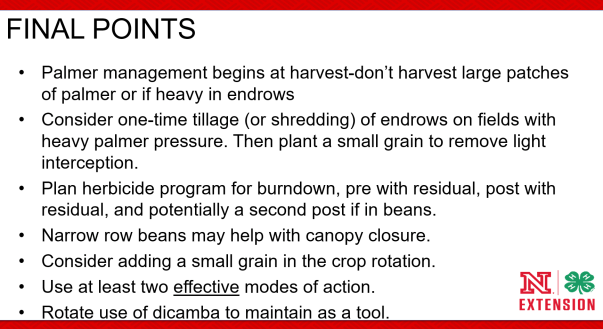
That’s why when I talk about palmer, waterhemp or frankly any of our weeds, to me, it’s  about a system’s approach. We can’t rely on herbicides alone. I think of weed control beginning at harvest by not combining patches of weeds or extra weedy endrows. There’s research documenting 99% of palmer seed survives the combine. There’s also research proving seed dispersal from the combine throughout the field the following growing season by counting plants that resulted from the first several combine passes. Instead, I recommend to consider disking once or shredding those areas at harvest. Then get a small grain seeded to reduce light interception onto the soil surface. Why? Natural and red light has been proven by the research to stimulate germination of palmer seed more than soil temperature. Light interception onto bare soil can allow for a flush of palmer to germinate. So in managing palmer, I’m thinking of anything we can do that can delay or reduce germination. Palmer seed in general is short lived…7-10 years. But plants are prolific seed producers. A plant inside the field can produce up to ½ million seeds. The large plant at the field edge can produce up to 1.8 million seeds. Adding a small grain such as wheat or rye for grain back into the rotation can delay palmer germination for a few months as the crop canopy delays germination until after harvest. Research and observation has proven this as well. The exception to this has been when tram lines were in the field as the bare soil in the tramlines has allowed for palmer germination. After using a burndown to kill the germinating palmer flush after small grain harvest, a cover crop can keep the ground covered for the rest of the season and allow for managed livestock grazing if desired. Even if the small grain crop isn’t taken for grain, the cover alone helps reduce light interception onto the soil surface and palmer germination.
Going back to the tillage, the southern U.S. has gone back to the plow. We can’t afford that. There’s also many no-till guys where disking is a hard option to consider. Several research studies showed that a 1 time tillage to bury the seed at least 3-4” and keep it buried for at least 3 years reduced palmer seed viability by 80-100%. That’s why I’ve mentioned the tillage. I did ask Dr. Jason Norsworthy from the University of Arkansas about the possibility of just shredding weed patches at harvest instead. He doesn’t have research on that and I don’t have observation but it could be another option to consider instead of running the combine through weed patches at harvest. Regarding herbicides, I’m so proud of an increasing number of farmers last year using pre’s with residual followed by posts with residual. Herbicides are part of the strategy, but we’ve got to look at the whole system. And, we’ve got to rotate our use of dicamba! We rely on dicamba a lot for our corn apps. But if we use it in corn and soybeans, we have the potential in 3-4 years to have resistance develop here. Take Home Considerations: palmer/waterhemp/weed management begins at harvest by not combining major weed patches; Consider one-time tillage (or shredding) of endrows on fields with heavy palmer pressure. Then plant a small grain to remove light interception; Plan herbicide program for burndown, pre with residual, post with residual, and potentially a second post if in beans; Narrow row beans may help with canopy closure; Consider adding a small grain in the crop rotation; Use at least two effective modes of action; Rotate use of dicamba to maintain as a tool. What is perhaps positive is we have an opportunity to learn from the southern U.S. and manage palmer better here! If you missed the palmer amaranth webinar by Dr. Jason Norsworthy, you can view it here: https://unl.box.com/s/al5zrhxjwml7s31liv1bryne320bf6r6.