Category Archives: Grazing
Crop-Livestock Integration Case Study
Happy March! We had a great Friday February conversation again. I think the power in that conversation was watching how ideas from previous years of conversations came to fruition with actual data including stocking rates and economics from several growers. The following is a case study where a grower who enjoys cattle wanted to find a way to raise his herd in the Utica, NE area where corn/soy/seed corn is plenty and pasture is limited. He thought outside the box, challenged the status quo and split a pivot into four quarters in 2024.
On one quarter he planted corn, the next quarter was a year of annual forages for strip grazing, the next was cereal rye for seed followed by winter stockpiled annual forages, and the final was soybeans. The pivot corners consist of pasture and one farmstead. The crops on each quarter are rotated clockwise each year. For example, the quarter that was strip-grazed annual forages in 2024 was planted to corn in 2025. Volunteer rye and vetch were grazed before corn was planted in that area and the cows were moved onto oats/peas he planted into the annual forage quarter. As they were dying out, he followed the cows with planting an annual forage summer mix that contained multi-species but was heavier on millets so he didn’t have to worry about removing cows during light frosts (he was avoiding the potential of prussic acid poisoning by using the millets instead of sorghum species). Now the cows are on the winter stockpiled forage that was also a muti-species mix but heavier on the sorghum species side. For a stocking rate, he figures 1 pair per acre (around 33 pairs if he stayed on this quarter system). This would also be a great system for stockers.
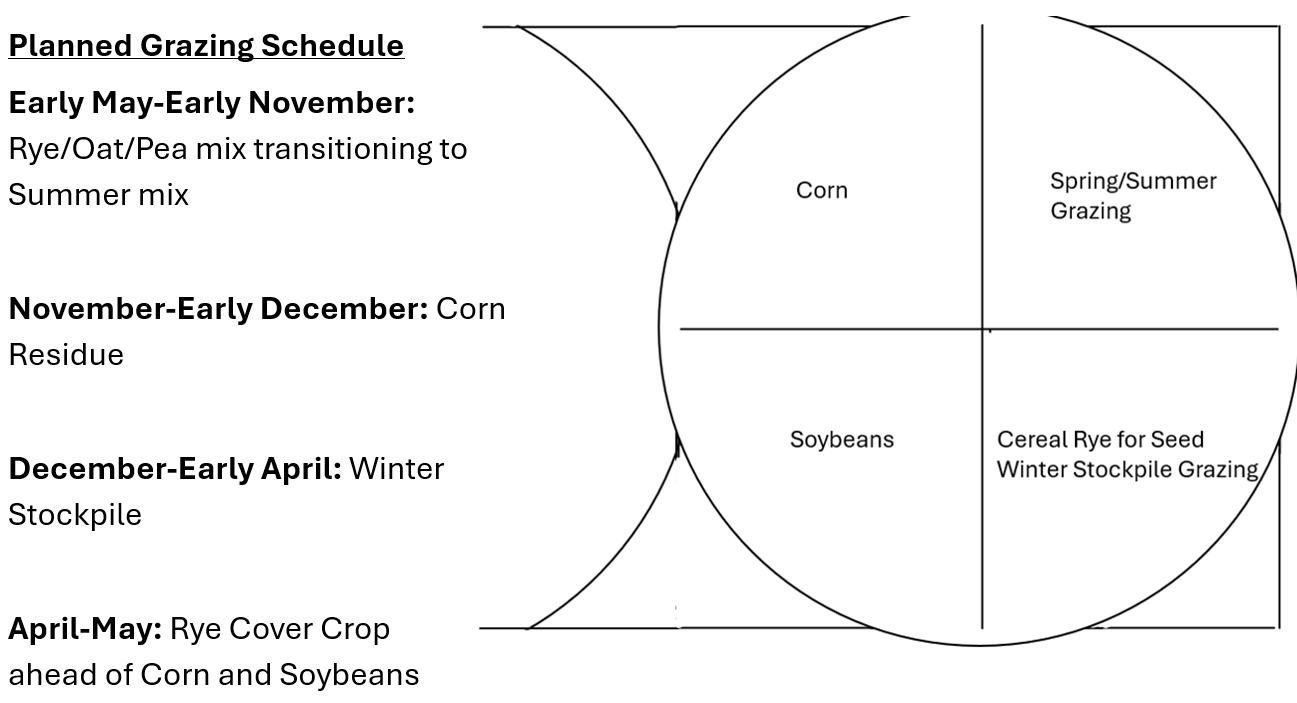
Splitting a pivot into quarters wouldn’t perhaps be the easiest set-up for most. His goals were to keep his cows on this one pivot for the entire year and to see what his stocking rate could be as he grew his herd. He also wanted to determine the economics and soil health of this system by the end of four years to see if he could scale it to other pivots on his farm. The beauty of this is that the system could be adapted to each producers’ goals and needs. Pivots could be split in half or converted entirely to suit the individual’s goals.
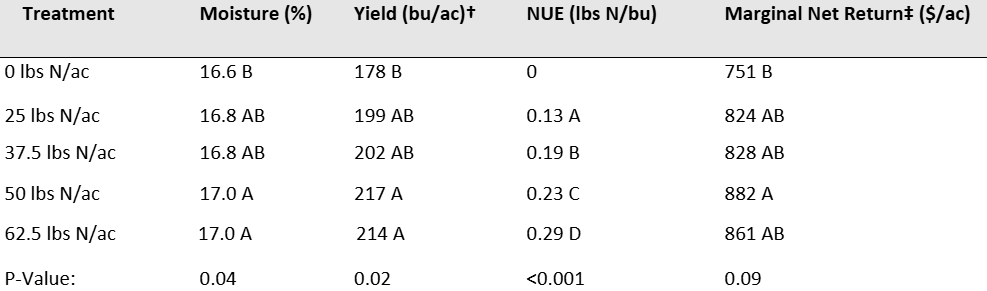
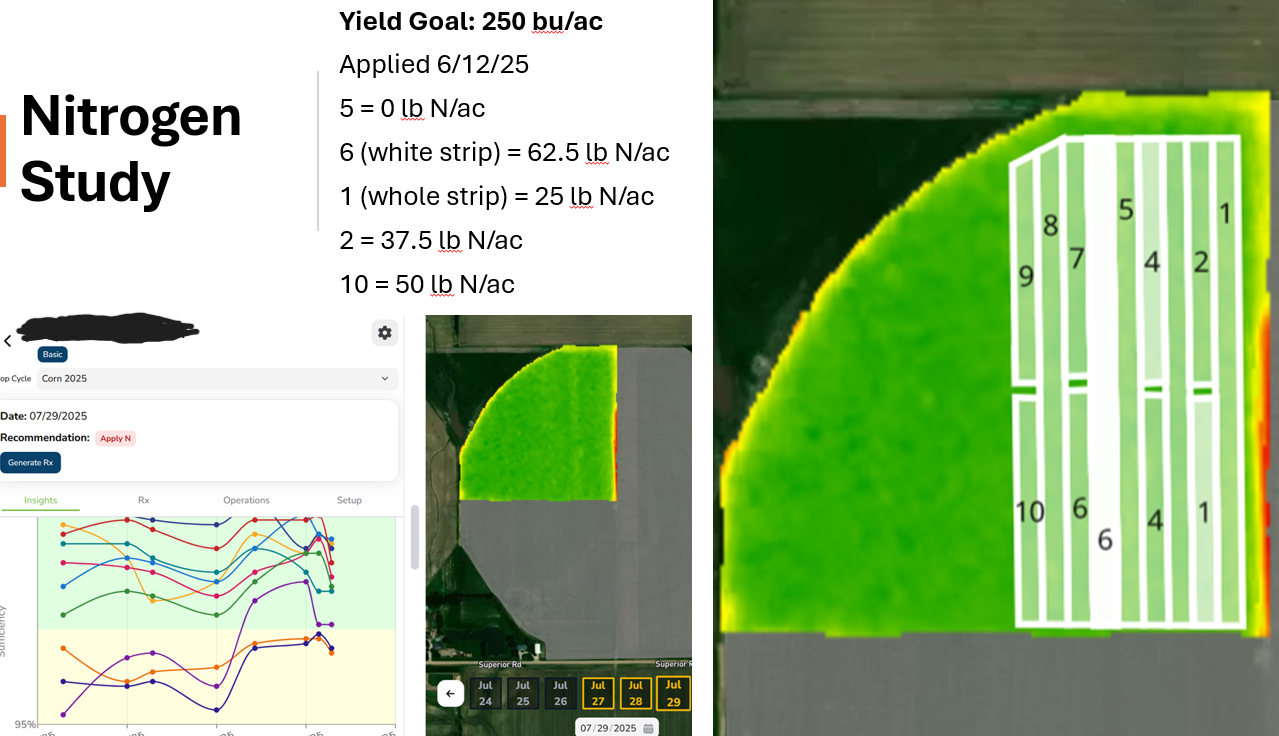
This grower also wanted to see how much nitrogen…and other nutrients over time…the annual forage grazing contributed to the succeeding corn crop. We’ve heard a potential of 100 lb/ac of nitrogen could be credited, so that was considered in addition to the residual soil nitrate and nitrate in irrigation water. He set up a side-dress on-farm research study where he applied starter fertilizer but no other nitrogen until V2-V3 corn. He had 4 reps including rates of 0, 25, 37.5, 50, and 62.5 lb N/ac applied. The goal was to apply these same rates to the same strips the next time he side-dressed. He then used Sentinel Ag to sense the timing of when he would need additional nitrogen. However at side-dress time, the Sentinel Ag imagery said he only needed nitrogen on the 0 lb and two of the 25 lb/ac strips. So, the grower decided to let it go and see what happened. His yields? While they were down like many in the area, he raised 217 bu/ac on 50 lb N/ac and 178 bu/ac on 0 lb N/ac! For the annual grazing with cow-calf pairs, his economics came to a profit of $683/ac (that was using $300/ac rent cost). Think about his corn and grazing economics for your own system. It’s exciting to me to see a case study like this where crops and livestock are integrated so well to show the benefits of diversity not only for the land and reduced inputs but economically!
And, it’s another example of how Sentinel Ag’s satellite imagery can be used to help with nitrogen management. With March pre-plant nitrogen applications, consider the nitrogen challenge: only apply 50-100 lb N/ac pre-plant and use Sentinel Ag to determine the remaining needs this growing season. Please contact me if you’re interested in more information.


Crop Ground to Annual Forage Grazing
Converting Crop Ground to Annual Forage Grazing: A handful of producers have been doing this in the area with more considering it for 2026. Why? With the high input costs and low commodity prices, producers are searching for alternatives. The economics of grazing covers is good compared to planting corn and soybeans. Pencil it out for your operation. Input costs for grazing annual forages include cover crop seed and seeding, land costs, potentially one herbicide application between rye and planting a summer cover crop, water and fence infrastructure, and irrigation for establishing covers on irrigated ground. Here’s a potential rotation to make this work: rye planted in the fall or oats planted in March. Strip graze the rye or oats in April-May. Plant a summer annual cover crop mix in June/early July. Strip-graze the summer mix in late July-October. Some people will move livestock off the crop ground between light frosts until a hard freeze if sorghum species are in the summer mix (to avoid any prussic acid poisoning). Then livestock can continue grazing any remaining forage after frost with minimal loss in quality. If cool season cereals like rye/wheat/oats were added to the summer mix, they will come on in the fall and add additional quality to the forage into the winter. Or, a cool season cereal can be planted in the fall after the summer annual forages are grazed off. There’s multiple options for doing this!
Those cash renting ground were often able to pay for the cash rent of irrigated or non-irrigated crop ground in 1 to 2 grazings. How to figure costs? UNL farm real estate reports share an average cost of $68/cow-calf pair/month to graze on pasture in Eastern and Central NE. Annual forages would have a higher quality, so that should be taken into consideration for the value received. If you would graze cattle for someone else, such as grazing custom cattle, you can expect to receive anywhere between $1.50-$2.50/1000 lbs of cow (standard animal unit)/day depending on one’s location. This is also the value you’re creating if you’re using your own cattle to graze the covers. If you own cattle and want to retain your calves and add weight after weaning, consider putting the calves on the forages for the highest value return and gains. Pencil it out for your operation. We converted half our crop acres this year to forages for custom grazing cows. And, the benefits are beyond a single year of economics. I’ve seen how strip-grazing plants with animals can improve ground through improving pH, improving water infiltration through better soil aggregation, increased soil microbial communities, and nutrient release. A risk for consideration is lack of rainfall on non-irrigated ground to establish covers and maintain growth. Producers will also share specific examples with their economics on this Friday’s Feb. 27th conversation from 10-noon at the 4-H Building in York.
Farmers Bridge Assistance (FBA) Program: This program provides $11 billion in one-time bridge payments to row crop producers in response to temporary trade market disruptions and increased production costs. The FBA enrollment period opens Feb. 23 and closes April 17, 2026. There will not be mailed prefilled applications anymore. Producers are encouraged to use/create a login.gov on farmers.gov to apply or they can still apply in person in the office. More info: https://www.fsa.usda.gov/news-events/news/02-20-2026/usda-announces-enrollment-period-farmer-bridge-payments?utm_campaign=022026fbaenrollment&utm_medium=email&utm_source=govdelivery.
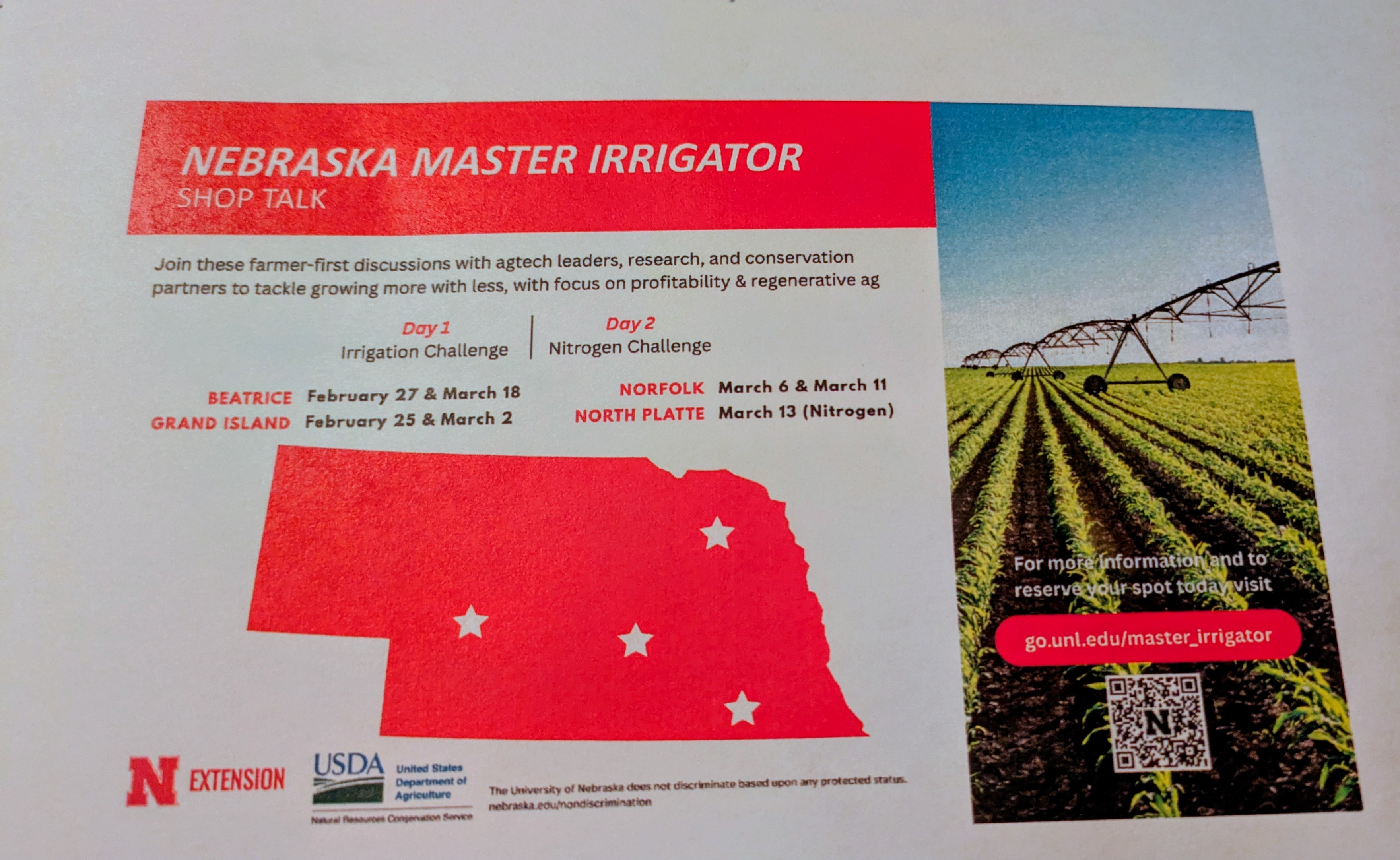
Master Irrigator Program: Nebraska Extension invites farmers, agricultural professionals and conservation partners to participate in a local 2026 Nebraska Master Irrigator “Shop Talk” discussion. These will be two‑day, discussion‑based programs focused on tackling today’s most pressing irrigation and nitrogen management challenges. The first day of each location will focus on irrigation and the second day will focus on nitrogen. Registration and info at: https://go.unl.edu/master_irrigator. Walk-ins are welcome. Closest sessions include: Grand Island Extension Office on Feb. 25 & Mar. 2; Extension Office in Beatrice on Feb. 27 & Mar. 18.

Yield & Soil Impacts from Grazing Corn Residue
With pastures short on grass due to drought, it’s a blessing for producers to get cattle out on cornstalks. Sharing an update on long-term research showing no negative impacts to the subsequent yield or soil from cattle grazing corn residue.
Mary Drewnoski, et. al share on yield impacts, “Two studies were conducted to evaluate the effects of corn residue harvest on subsequent crop yields. In a long-term study (16 years), cattle grazing corn residue in the spring (February to the middle of April) or the fall (November through January) slightly improved subsequent soybean yields and had no effect on corn yields in an irrigated field maintained in an annual corn-soybean rotation at Mead, Neb. In a five-year study, fall grazing (December through January) or baling of corn residue had no effect on subsequent corn grain yields in a field maintained in continuous corn production at Brule, Neb. These data suggest that the grazing of corn residue in the fall or spring at or below UNL recommended stocking rates will have slightly positive or no impacts on subsequent soybean or corn yields.
The stocking rates utilized were consistent with UNL grazing recommendations, which result in removal of half the husks and leaves produced (8 lb of leaf and husk per bushel of corn grain produced). The corn yields ranged from a low of 186 bu/ac in 2004 to a high of 253 bu/ac in 2009, with a median over the 16 years of 203 bu/ac. Recommended stocking rates would have ranged from 2.1 to 2.9 AUM/ac with a median of 2.3 AUM/ ac.”
Dr. Mary Drewnoski wrote an updated Beefwatch article about soil compaction and grazing. “One of the most common concerns about grazing corn residue is that cattle will cause soil compaction. A long term grazing data (16 years) conducted at the UNL has shown no compaction when grazing in the fall or the early spring. In this long-term study, grazing did not impact soil nutrient content. This fits well with expected impacts given that cows in mid-pregnancy retain very little nitrogen, phosphorus or potassium. Thus, they excrete in manure and urine most of what they consume resulting in very little nutrients being removed from the land. With long term grazing there was an improvement in subsequent soybean and corn yields. This could have been due to the nutrient cycling being sped up as there is an increase in microbial biomass in the soil in the grazed areas.
More recently, a study was designed to test an extreme scenario for spring grazing. The thought was that if grazing was to cause compaction, it was most likely to happen when the soil is wet and thawed and when a high stocking density was used. The field was grazed at the recommended rate by starting in mid-February with 3 hd/ac for 45 days (normal stocking) or starting in early March with 9 hd/ac for 15 days (high stocking). Turn out of the higher stocking density groups was delayed until it rained to have the worst-case scenario. All groups were removed mid-March. There were some minor increases in bulk density (measure of compaction). The penetration resistance was also higher, and thus more down pressure had to be applied to get the soybeans planted. Down pressure applied at planting was 265 lbs in the non-grazed and 290 lbs in the grazed treatments. Much of the increase in penetration resistance is due to the soil having less cover and thus less surface soil moisture. The planting speed was also reduced due to the surface roughness. However, the subsequent soybean yields were still improved by grazing. While it is not recommended to graze late into the spring as this does have some downsides when it comes to planting, if cattle happen to be left out when a warm-wet spell occurs, there is no long-term damage to the land.
Overall, when managed correctly, grazing corn residue can be a win-win for both the crop and cattle producer. Want to see the data for yourself? Check out these Nebraska Beef Reports:”
Effect of Corn Residue Removal on Subsequent Crop Yields
Effect of long-Term Corn Residue Grazing on Soil Properties
Effect of Corn residue grazing or Baling on Subsequent Crop Yield and Nutrient Removal
Impact of Spring Corn Residue Grazing on Soil Physical Properties and Crop Yield

JenREES 8/20/23
Two weeks’ worth of articles to share here. Lots happened with weather for fields, vegetables, trees.
Water use till maturity for Corn: Dough 7.5”; Beginning Dent 5”, ¼ milk 3.75”; ½ milk 2.25”; ¾ milk 1”.
Water use till maturity for Beans: Beg. Seed 6.5”; Full Seed 3.5”; Leaves beg yellow 1.9”.

Silage: With higher nitrates in drought-stressed corn, for those cutting the corn for silage, please be aware of silage gas (nitrogen dioxide) which is toxic. National Ag Safety Database shares, “Shortly after ensiling green plant material, oxygen is used in fermentation and the nitrates in the plant are released as nitric oxide (NO). This gas quickly escapes from the silage and combines with oxygen in the air to form toxic nitrogen dioxide. The lethal gas is yellowish-brown and smells like some laundry bleaches. After more oxidation, it forms N2O5, which then forms highly corrosive nitric acid when combined with water. Since oxidation may occur in the lungs, nitrogen dioxide can produce permanent lung damage.” Nitrogen dioxide is denser than air so it hangs out in low-lying areas around the bunker or pile (stay out of these low lying areas to reduce exposure). It’s worse the first 12-60 hours after ensiling. More info: https://nasdonline.org/901/d000741/watch-out-for-silage-gas.html.


Grazing: Grazing drought-stressed corn or harvesting the corn and grazing the residue can still be safely done in spite of higher nitrates. The key is to remember the nitrates are highest in the stalk, particularly the lower foot of the stalk. Thus, for those choosing to graze drought-stressed corn instead of harvesting, the cattle will pre-select for ears first followed by husk and leaf tissue which are low in nitrate concentrations. The same goes when grazing harvested fields high in nitrates. As long as the cattle aren’t forced to eat much more than any grain, leaf, husk, one can better manage for nitrates.
In both cases, since grain will be present at this point, there’s increased risk of acidosis due to potentially higher grain in the cow’s diet. Strip grazing can help limit the amount of grain cattle are allowed to consume at one time. Also, adapt cattle to grain by feeding two to three pounds per day and slowly move up to 10-15 pounds per day over approximately 10-14 days. Turn cattle out that are full and make sure plenty of fresh water is readily available. Also consider feeding high quality hay as a supplement and then moving to the corn field for a period of time during the day. Cross fencing and strip grazing areas will help limit intake and reduce trampling while turned out on drought-stressed corn. I realize many probably won’t strip graze or allocate acres. Stalk trampling can provide ground cover. The problem is when cattle are forced to eat the trampled stalks and end up with portions of stalks higher in nitrates. Those are the concerns to watch for.

Some asked about grazing drought-stressed soybeans where pods quit filling/didn’t develop. From what I understand (please check with your insurance), crop insurance rules don’t allow the soybeans to be released till they’re brown. However, ask them if you can leave strips and you should be able to utilize the rest for forage. Soybeans were originally developed as a forage crop and they have value when they’re green with low bloat risk. Once they turn brown, the quality becomes like sawdust in feed value. Don’t let young calves graze beans with seeds due to problems with high oil content. We wrote more about this topic in this article: https://cropwatch.unl.edu/2023/soybeans-forage. One final important thing is not to provide access to blocks, tubs or supplements that contain urea when allowing access to raw soybeans. Raw soybeans contain urease that can rapidly turn urea into ammonia and cause ammonia toxicity.
Final consideration: I realize this sounds crazy in the midst of drought, but I’m also thinking about soil erosion if we get wind again. Perhaps consider a cover that will winter kill like brassicas/spring cereals to get some roots in the ground where silage is being chopped or in the wildfire damaged areas. I know winter cereals like rye took a lot of moisture in a drought year and got a bad rap-they did hold the soil in place. Some are hoping to plant wheat after silage. Just a consideration; it will rain again one day.
Soybean Problems: White mold, sudden death syndrome, and gall midge have also been hot topics for several weeks. For white mold and SDS, aim to irrigate deeper and less frequently. Gall midge is popping up more in Seward Co. and there’s still too much unknown about it. Will share more next week.
Corn Grower Banquets: Aug. 28: Hamilton Co. Corn Growers 5 p.m. plot tour-field ¼ north of 6 road and J near Giltner; 6 p.m. meal and program Giltner Community Center with featured speaker KAAPA Ethanol. Aug. 29: York Co. Corn Growers 6 p.m. seed dealers share, 6:30 p.m. social, 7 p.m. meal and program with featured speaker Sentinel Fertigation (all at Stone Creek in McCool Junction). Cost $15 for beef and chicken meal and appetizers. RSVP to 402-362-5508 or any corn grower director.
Vegetables: Many questions on vegetables. Basically, the humidity allowed for a number of fungal diseases to get started. Most vegetables with blemishes can still be eaten or used (just wash and remove the blemishes). One can’t use green beans with rust and it’s not recommended to can tomatoes with certain diseases (tomato ringspot virus, lateblight fungus) as they can change the pH.

Brown leaf clusters: Every August, oak trees (but sometimes others such as hackberry, honeylocust, elm, linden) get a cluster of brown leaves towards the ends of branches. This damage is caused by twig girdlers or twig pruners, different types of beetles. Adult beetles chew a circle in the bark between where the old and new wood occurs on a twig. This girdles the twig, cutting off the water and nutrient supply causing its death. Eggs are then deposited and larvae hatch, tunnel, and survive in the dead twigs. Twigs girdled by any of these insects may stay attached to the main branch for several weeks or be broken out of the tree by wind. Tunneling in the twigs may not be evident in the fall if twigs fall out of the trees before the insect eggs have hatched. Mature trees with heavy infestations can look bad, but the damage isn’t a serious health problem to the tree and no chemical control is recommended. Burn or discard infected twigs in the fall and spring that contain developing larvae to minimize the impacts for the future.



JenREES 11/14/21
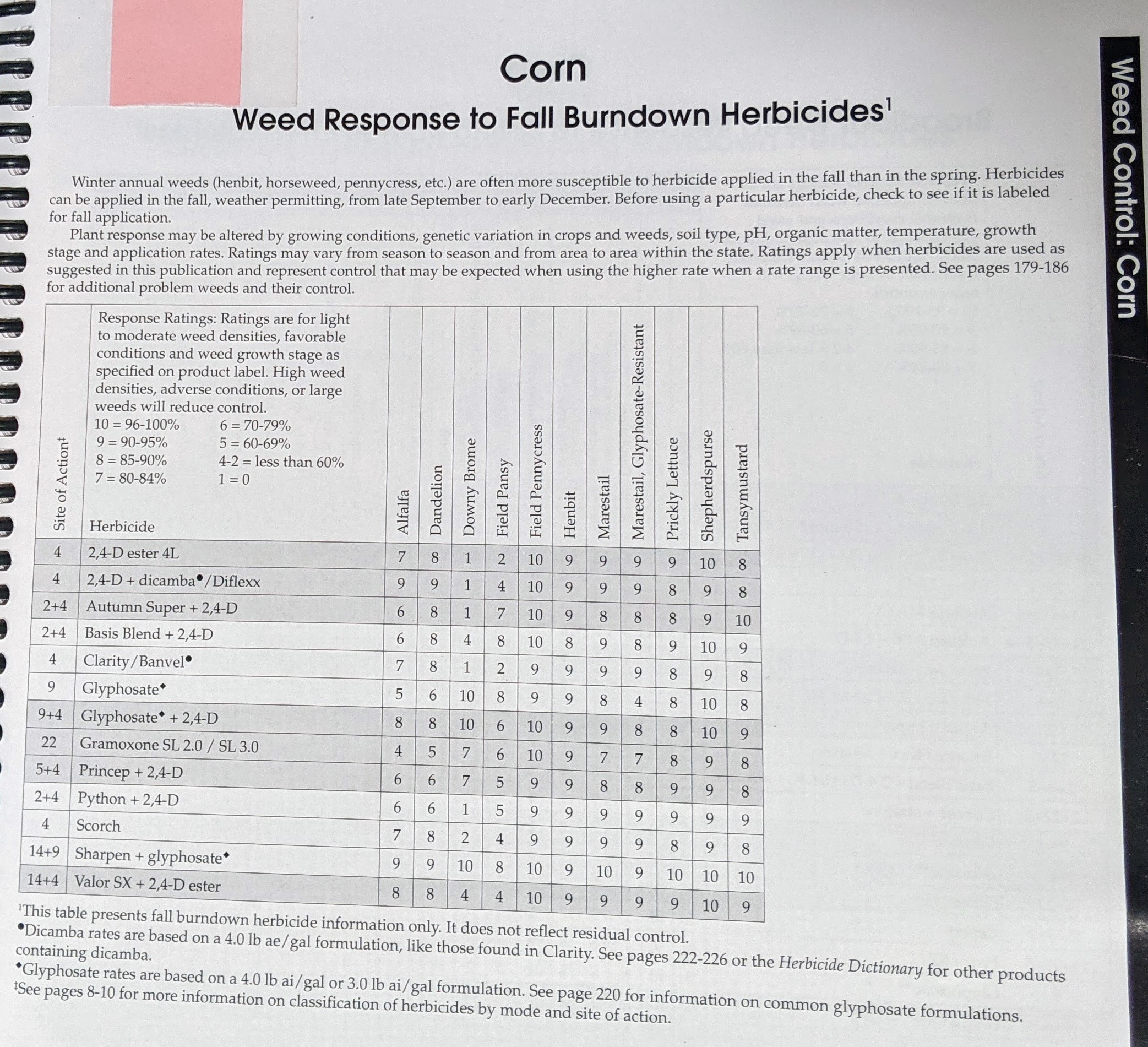
Grateful harvest has finished for most or will be hopefully wrapping up this week for the rest. Last week was seeing more fall herbicide applications being applied. If you have a 2021 Guide for Weed, Disease and Insect Management, page 93 provides fall burndown corn herbicide options and page 139 provides soybean ones (I also show these at https://jenreesources.com/). Most products contain 2,4-D and/or dicamba. Tank-mixing a residual herbicide with a burndown product will improve marestail control because the residual activity will control marestail emerging after herbicide application.
Regarding temperatures, Dr. Amit Jhala shared in a CropWatch article that the ideal temperature for applying most post-emergence herbicides is between 65°F and 85°F. Herbicides can be applied at 40°F to 60°F, but weeds may be killed slowly. When the temperature is below 40°F for an extended time after burndown, weed control will most likely be reduced, specifically for a systemic burndown herbicide such as glyphosate. Additionally, weed control may be reduced under cloudy conditions following an initial temperature drop below 40°F. With late-fall herbicide applications be sure to add labeled adjuvants to improve herbicide efficacy.
Actively growing weeds are key to achieving good control, regardless of herbicide used. Frosts of less than 25°F usually cause leaf damage to annual plants, making them poor targets for herbicide applications; however, winter annual weeds may tolerate a frost up to 20°F and continue growing when conditions improve, with little tissue damage. After weeds experience frost, active growth may not begin again for a few days. Growers should wait until new leaf tissue is produced, scout the field, and then consider applying herbicide. Generally, this would be when nighttime temperatures are 35°F or greater and daytime temperatures are at least 50°F for two consecutive days. Additionally, sunshine is needed for plants to recover.
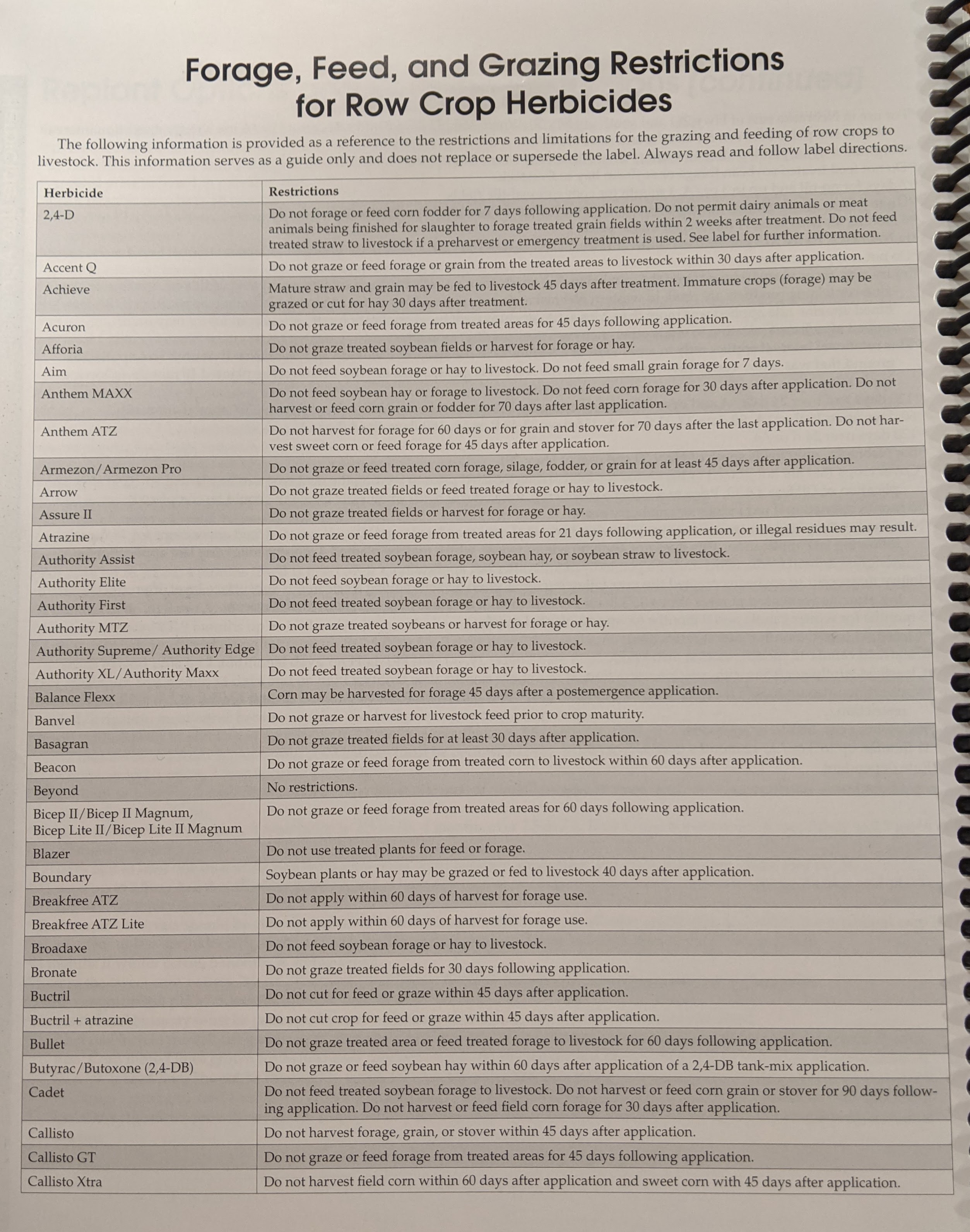
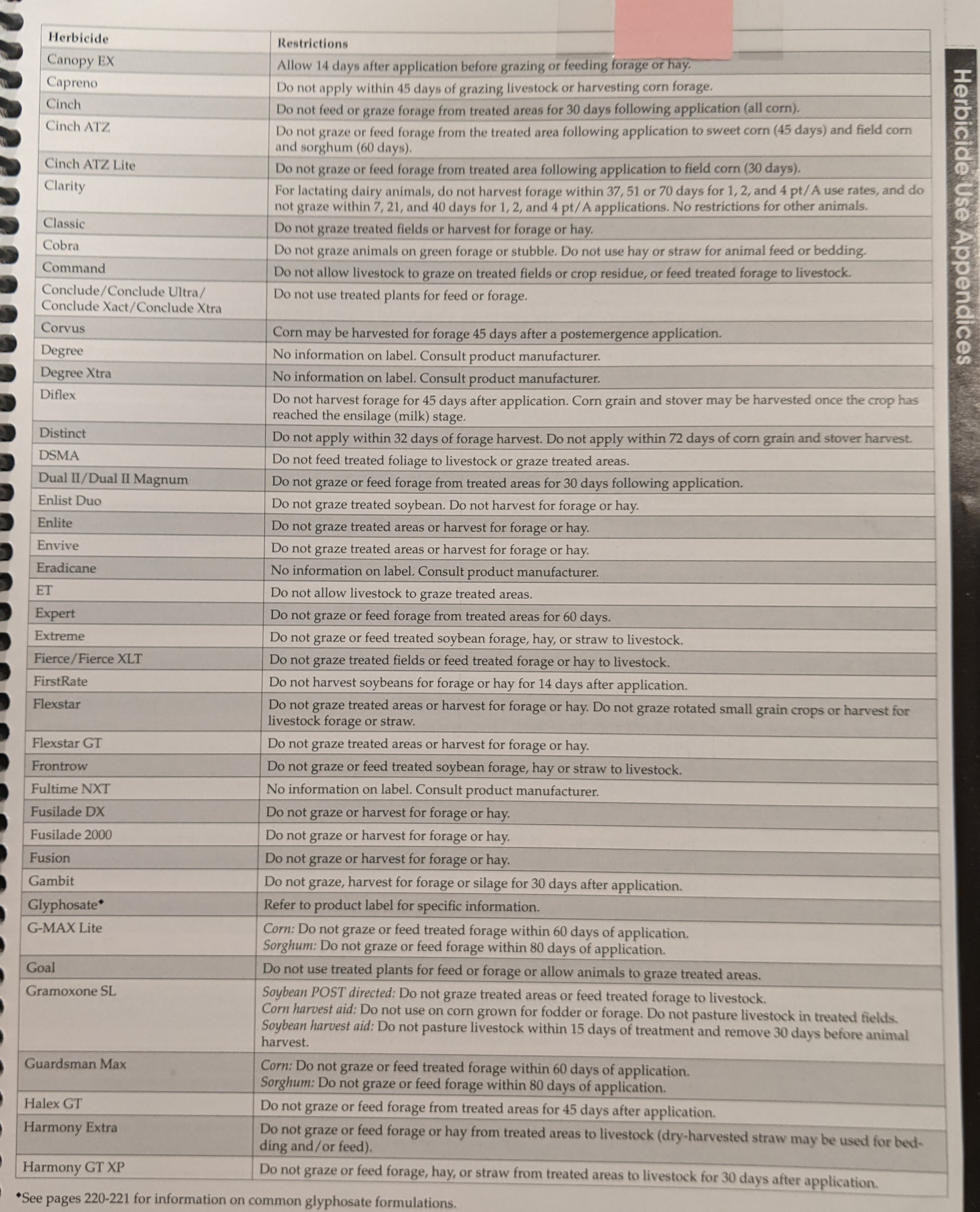
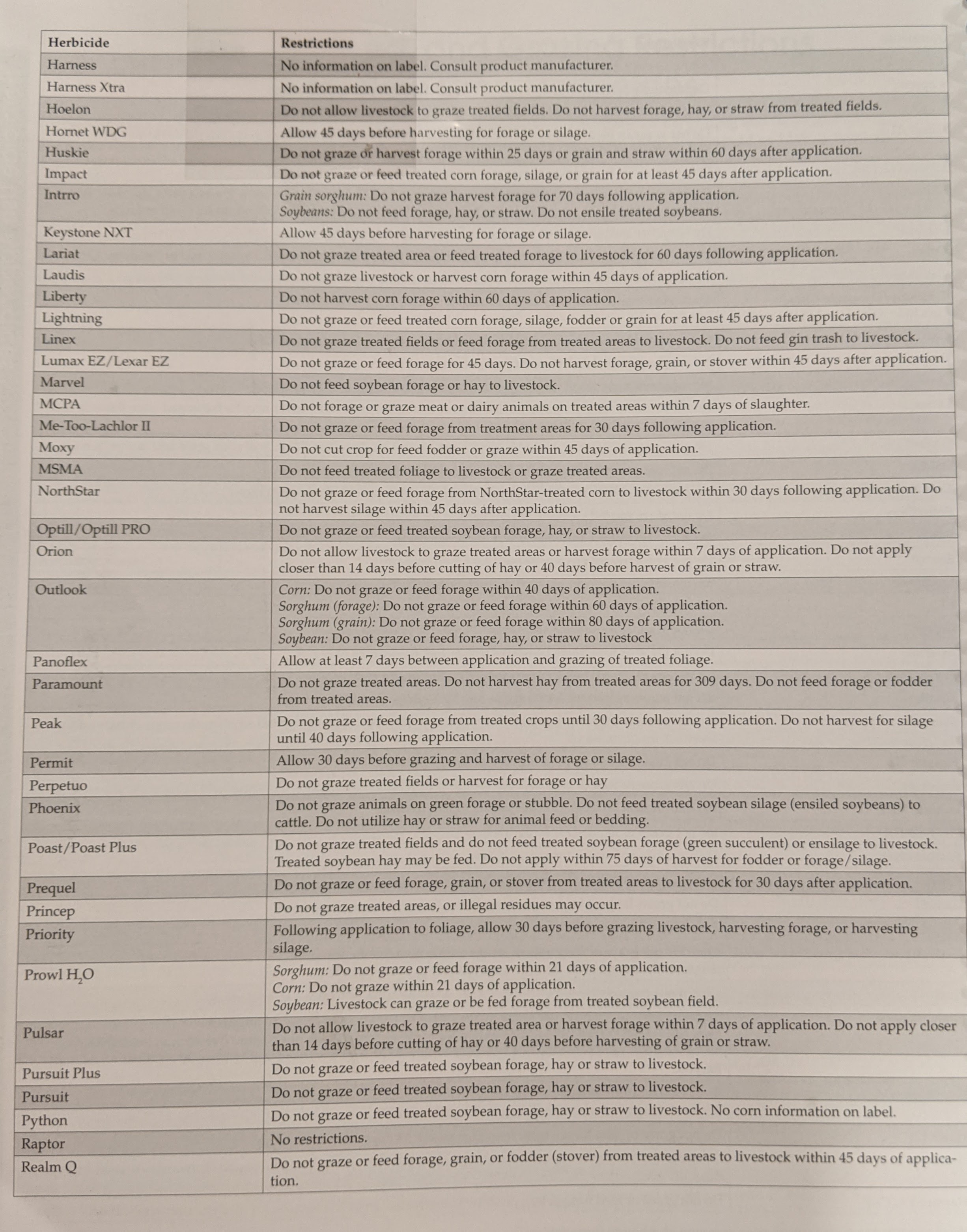
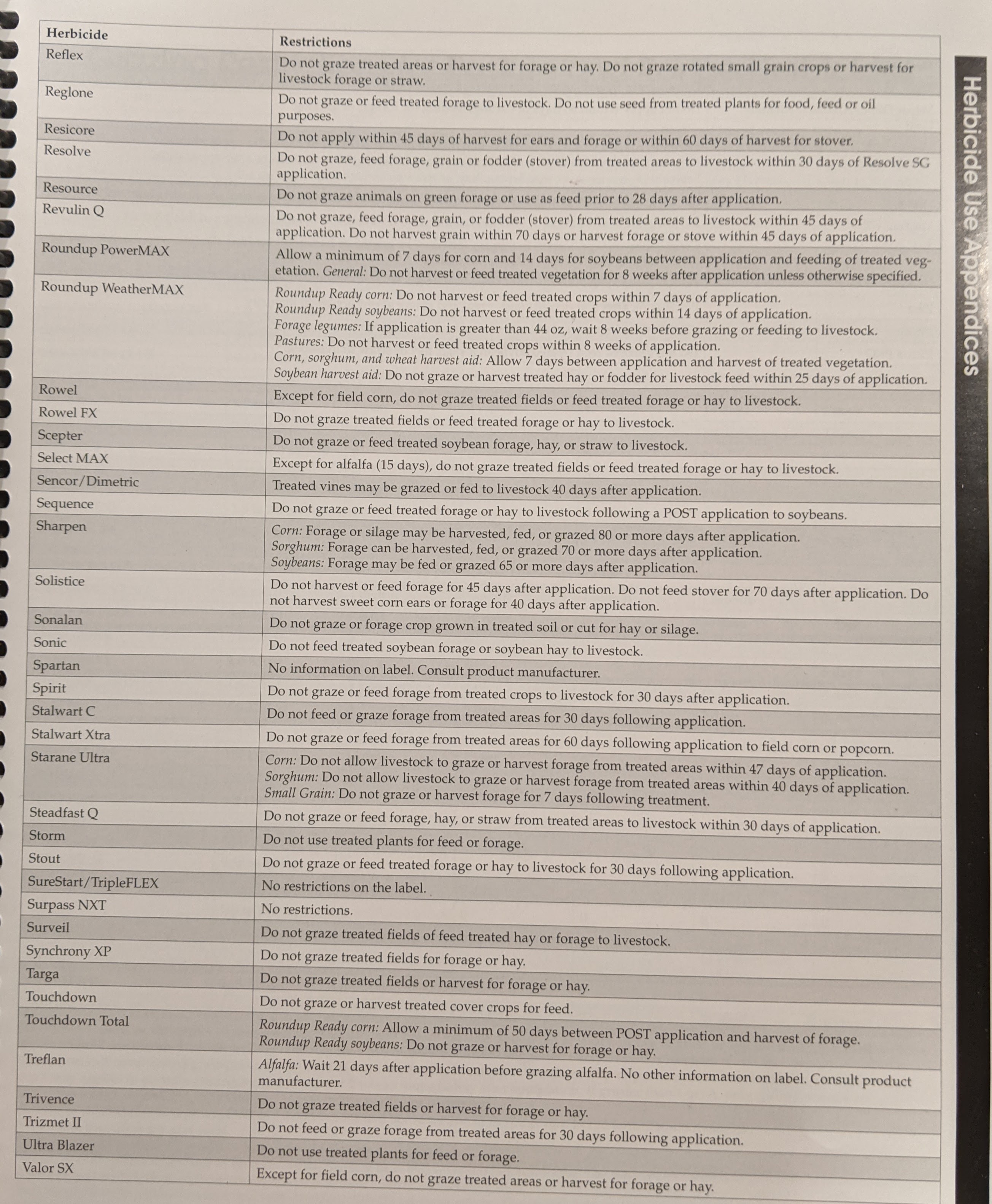
Grazing fields with fall herbicide applications: Be sure to check labels for any grazing restrictions if livestock will graze cornstalks after in-season and fall herbicide applications. You can find these in the Forage, Feed, Grazing Restrictions area on pages 212-216 of the 2021 Guide. Some labels will say that residue should not be grazed or baled and fed to livestock. Sometimes there’s no guidance on the label. If you want to be on the safe side, a rule of thumb some chemical reps use is to use the pre-harvest interval for the amount of time to wait before grazing stalks. Regardless, if it says there’s a grazing restriction on the label, the label needs to be followed as it is a legal document and the law.
As you plan for next year’s herbicide program, if you’re thinking about fall cover crops, the following NebGuide may be of benefit to you as it goes through the grazing restrictions of various herbicides.
Lawns and Leaves: The tree colors have been gorgeous the past few weeks and with colder temperatures, leaves are now dropping. If you have large, established trees like I do, they can pile up on a lawn rather quickly. Leaves should be removed by raking or mulching into the lawn by mowing in order to prevent damage to lawns over the winter from snow mold. If you choose to mulch leaves via the mower, raising the mower height two to three times will help break down the leaves and incorporate them. According to our turfgrass specialists, mulching grass clippings and leaves does not contribute to thatch development in the lawn.
Fallen leaves release phosphorus and nitrogen when they decompose, which can help with lawns and also with gardens if they’re added to garden sites as a soil amendment. When leaves are intentionally blown into streets, they can be a pollutant to surface water as they are washed away via storm drains.


JenREES 10-25-20

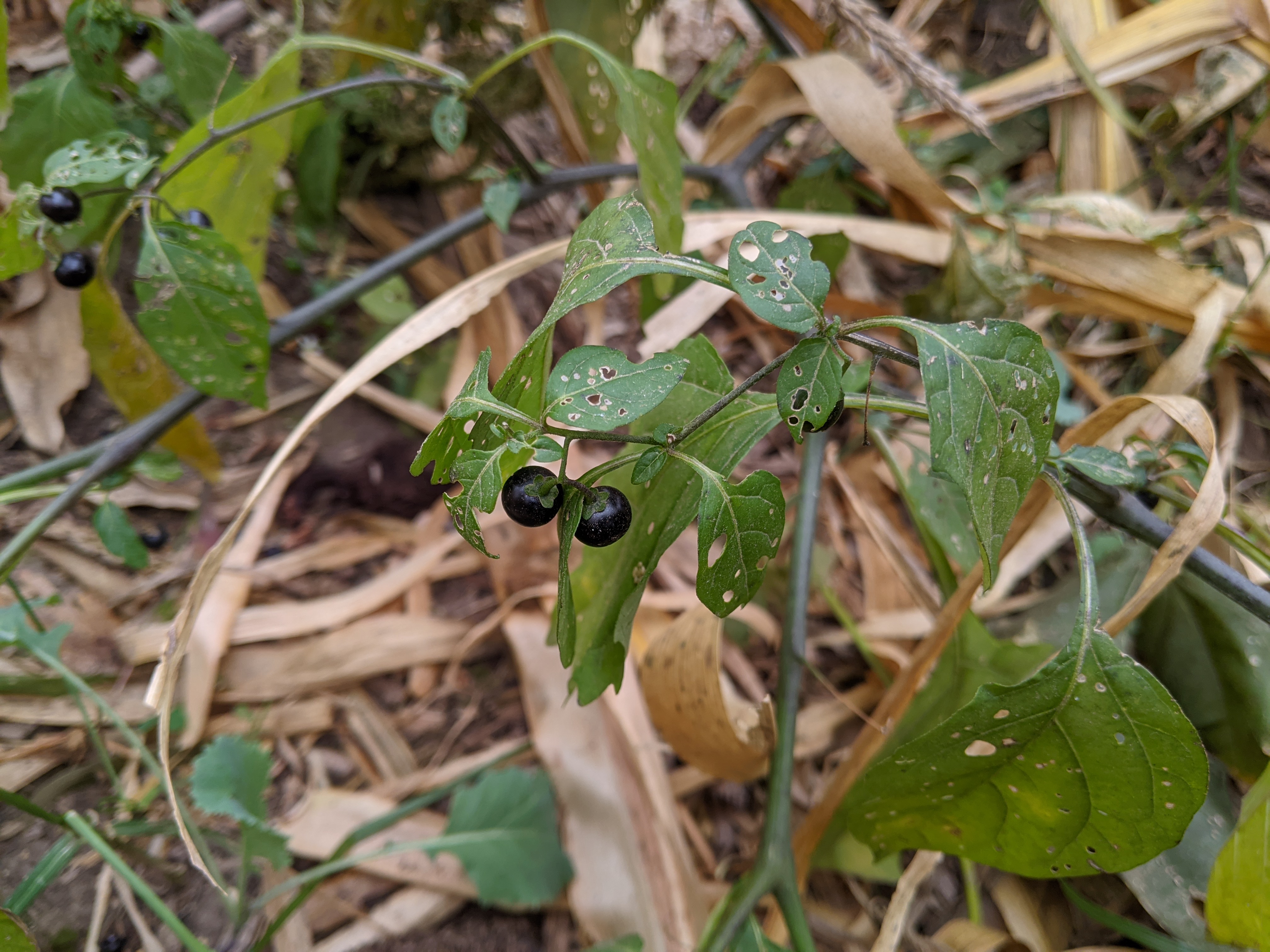
Grazing Corn Residue: Have received some questions on corn residue management. Cattle grazing can be a beneficial way of residue management if one has access to cattle. Note: I’ve been seeing quite a bit of black nightshade and some horsenettle, particularly in corn fields that had wind damage. Both species have poisonous leaves (increase concentration as plants age) and berries (decrease concentration as berries ripen). Frost doesn’t change toxin levels. UNL forage specialists say when cattle graze corn fields containing nightshade species, there’s enough dilution with the grain, leaf, and husk that poisoning shouldn’t be an issue. We’d recommend watching the cattle as some may prefer grazing the nightshade. I’ve also seen cattle prefer weeds after herbicide applications, so also watch that if fall herbicides are applied. Ultimately, would just recommend don’t turn cattle empty into stalks with significant amounts of nightshade, watch cattle, and don’t graze past the point of 50% of leaf/husk removal. Dr. Jerry Volesky shares more here: https://twitter.com/jenreesources/status/1320513145941692418?s=20.
So, how does one calculate 50% leaf/husk removal and the grazing days for cattle on corn residue? The following is information from my beef Extension colleague, Brad Schick.
- “There are 8 lbs of grazable dry matter per bushel of corn.
- Leaf and husk make up 39.6% of the dry matter in corn residue.
- Intake on corn residue fields will be close to 2% of bodyweight.

Having corn stalks to graze is a great resource for livestock producers. For dry cows, it is a relatively inexpensive feed that can typically meet or come very close to meeting nutritional needs. Grazing can also help get rid of corn remaining in the field and potentially reduce volunteer corn the following year. But are cattle really grazing stalks?
Yes and no. In everyday conversation, grazing corn stalks is said, but the stalk is the last thing cattle eat. Cattle do eat stalks, particularly if they are left on a field too long, but they are primarily consuming leaf, husk, and leftover corn. The stem or stalk makes up about 48.5% of the residue, while the leaf blade and husk make up 39.6%. Cattle will consume leaf and husk if available. That diet will consist of 52 to 55% TDN (total digestible nutrients) and 5 to 5.5% crude protein.
When thinking about how long to graze corn residue, the calculation to follow is that for every bushel of corn produced, there is 16 lbs of dry leaf and husk. The recommended grazing plan should be to remove 50% of the leaf and husk. This assumes that portions of the forage will also be lost to trampling, defecation, and other considerations such as wind. That leaves 8 lbs (16 lbs X 50%) of good forage on a dry matter basis that is available for consumption for every bushel of corn.
For example, say the field produced 200 bu/ac corn. By the calculations, there is 1600 lbs of dry matter per acre available (8 lbs X 200 bu = 1600 lbs). A 1000 lb animal will consume about 26 lbs of dried forage per day which means a 1300 lb animal will consume about 34 lbs per day. However, with lower quality forage such as corn residue, intake will be closer to 2% of bodyweight. In this example, that means closer to 26 lbs for the 1300 lb animal. So, how many days of grazing is that? By the calculations, there are 61 days of grazing for one cow grazing one acre (1600 lbs DM ÷ 26 lbs = 61 days). A general rule is about 30 cow days per 100 bushels/acre of corn produced.
Calves and replacement heifers can be also be a great option but will need a protein source in order to meet their growing requirements. Not only is grazing corn residue good for the cattle producer, but it is also good for the crop producer. Studies from the University of Nebraska-Lincoln have shown that grazing corn residue increases or at least maintains crop yields. (Grazing Corn Residue: A Win-Win for Crop and Cattle Producers).” More info. can be found at: https://go.unl.edu/fsa9.
JenREES 12-2-18
Part 2 of my residue management series focuses on grazing corn residue. We’re blessed  in Nebraska to have corn, cattle, and ethanol with the distiller’s co-product…the golden triangle as it’s been dubbed. What’s interesting is that a huge feed resource in corn residue is under-utilized each year, with an estimated 52% of our state-wide corn residue being grazed or mechanically harvested.
Because a small amount of residue is removed, many fields in Nebraska have potential for grazing, except for the case of extreme slope and/or very low yields. Regarding stocking rates, Dr. Mary Drewnoski, Extension Beef Nutritionist shares, “Corn residue is about 10% husk and 34% leaf with the remaining residue being stalk and cob. Recommended stocking rates are based on the ability of a pregnant cow to maintain body weight without supplementation of protein or energy. The rates suggest that you can graze a 1200 lb cow for 30 days for every 100 bu. of corn grain produced. This would result in the cow consuming only about 12% to 15% of the corn residue in the field and nearly all would be husk with some leaf. Cob and stalk have less energy available.”
Compaction is the main concern I hear for not grazing. An increase in a soil’s bulk density and penetration resistance can be indicators of compaction. A summary of Nebraska research studies when corn residue was grazed at proper stocking rates has shown fall and winter grazing:
- do not significantly impact soil properties that would lead to compaction;
- don’t result in changes to soil organic matter, N, P, or K (just uneven distribution of the nutrients excreted back onto the land);
- results in maintained or increased yields; and
- increases soil microbial activity.
Grazing corn residue resulted in no detrimental effects on soil properties (sixteen years in silty clay loam soils) including bulk density and penetration resistance. Increase of surface roughness was observed where cattle congregated for water and during wet conditions when soil was thawed. An Iowa study indicated the surface roughness could impact seed placement for the following no-till crop but only found that in one location in one field studied. In another study of five Eastern Nebraska locations, penetration resistance was slightly increased in two of the locations but was below the threshold for impeding root growth and did not carry over into the next year. There were no yield differences between grazed and ungrazed treatments whether continuous corn (239 bu/ac for grazed and 223 bu/ac for ungrazed) or soybean (grazed 59 bu/ac and ungrazed 62 bu/ac) in the three years at those five locations. Sixteen years of fall grazed corn residue (November to February) resulted in a statistical soybean yield increase of 3.4 bu/ac in Eastern Nebraska. There was also an increase in the soil microbial community in the grazed treatments vs. ungrazed for those sixteen years. Under continuous corn in western Nebraska, five years of fall grazing corn residue did not statistically impact yields (154 bu/ac grazed vs. 148 bu/ac ungrazed).
Some have mentioned that the weather is not allowing them to till this fall. Perhaps cattle grazing is an option? Regarding the questions I’m receiving about this: The tenant in cash rent situation owns the stalks unless the landlord has specified otherwise in the written lease. Specify in the grazing lease who takes care of fence, water, and monitoring cattle. To help connect cattle and crop producers for utilizing residue and forage cover crops for grazing, there’s a free resource called The Crop Residue Exchange at https://cropresidueexchange.unl.edu/. After establishing a log-in account, growers can list cropland available for grazing by drawing out the plot of land available using an interactive map. They can then enter basic information about the type of residue, fencing situation, water availability, and dates available and provide their preferred contact information. Livestock producers can log in and search the database for cropland available for grazing within radius of a given location of interest. There’s also an ‘Other’ category where growers can list forage cover crops for grazing. Grazing rates are listed as either a ‘per acre’ basis or ‘rate/head/day’. An excel spreadsheet called the ‘Cornstalk Grazing Cow-Q-Later’ may be of help to determine rates at this site: https://go.unl.edu/2fb6. There’s more I’d like to share but for additional resources, please see my blog site at: http://jenreesources.com or contact your local Extension Office.
Of importance is to double check in-season and fall-applied herbicide labels for any grazing restrictions. These restrictions can also be found in the ‘Forage Feed Grazing Restrictions’ in the UNL Guide for Weed Management. The forage, feed, and grazing restriction only applies to the crop for which the herbicide was applied. When it comes to grazing cover crops planted into these residues, one must use the replant/rotation restriction guidelines found on the herbicide label and in the UNL Weed Guide: ‘Replant Options Rotation Restrictions’. If the label doesn’t specify any restrictions, then it should be ok. If you want to be on the safe side, a rule of thumb is to use the pre-harvest interval for the amount of time to wait before grazing stalks.
Resources:
- Crop Residue Exchange: https://cropresiduexchange.unl.edu
- Crop Residue Exchange Resources: https://cropresidueexchange.unl.edu/resources
- Grazing Crop Residues with Beef Cattle (excellent at explaining portion of crop residue, determining stocking rates, leasing rates, etc.)
- Cornstalk Grazing Cow-Q-Lator (excel spreadsheet guide for lease rates)
- Nutrient Removal by Cows Grazing Corn Residue, November 2018 CropWatch article
- Grazing Cornstalks Rental Agreement Considerations, 2016 Beef Article
- Renting Crop Residue: A Checklist for first-time renters, 2016 Beef Article
- Fillable leases: http://aglease101.org
- Grazing spring-calving cow-calf pairs on cornstalks-a producer’s perspective, November 2018 Beef Podcast
- Drewnoski et al. 2015. Effect of Corn Residue Removal on Subsequent Crop Yields. University of Nebraska-Lincoln Beef Report p 53-55.
- Rakkar et al. 2017. Effect of Long-term Corn Residue Grazing on Soil Properties. University of Nebraska-Lincoln Beef Report. p 50-52.
- Ulmer et al. 2017. Effect of Corn residue Grazing or Baling on Subsequent Crop Yield and Nutrient Removal. University of Nebraska-Lincoln Beef report p 46-49.
- Schmer et al. 2017. Corn Residue Use by Livestock in the United States. Agricultural & Environmental Letters.
Herbicide Grazing Restrictions
Forage Feed Grazing Restrictions
Replant Options Rotation Restrictions-long
Grateful for a nice week for harvesting and for the good yields being reported! It’s also good to see cattle being turned into cornstalks. A reminder to read herbicide labels to understand if there’s any grazing restrictions from corn and soybean herbicides applied in-season.
It’s also important to look for any grazing restrictions on fall-applied herbicides to control marestail and other germinating weeds. These restrictions can also be found in the Forage Feed Grazing Restrictions in the UNL Guide for Weed Management. The forage, feed, and grazing restriction only applies to the crop for which the herbicide was applied. When it comes to grazing cover crops planted into these residues, one must use the replant/rotation restriction guidelines found on the herbicide label and in the UNL Weed Guide: Replant Options Rotation Restrictions-long. I apologize as these scanned blurry; hopefully you can zoom in ok to read what you need.
If the label doesn’t specify any restrictions, then it should be ok. If you want to be on the safe side, a rule of thumb is to use the pre-harvest interval for the amount of time to wait before grazing stalks. Some labels will say that residue should not be grazed or baled and fed to livestock. Sometimes studies were actually conducted to know there is a safety concern. In other cases, the chemical company may not choose to conduct all the studies the Environmental Protection Agency (EPA) required for labeling due to high costs. If that’s the case, the EPA requires the strongest restrictive language be placed on the label. Regardless, if it says there’s a grazing restriction on the label, the label needs to be followed as it is a legal document and the law.
As you plan for next year’s herbicide program, if you’re thinking about fall cover crops, the following NebGuide may be of benefit to you as it goes through the grazing restrictions of various herbicides.
UNL Grazing Corn Residue Research
Many stalks in Nebraska are left ungrazed for various reasons. One reason I’ve heard is the potential impact of increased compaction and reduced yield of the next crop. Nebraska Extension has long-term research addressing this concern…in fact, 16 years of research conducted at the Ag Research and Development Center near Mead. There’s various components to this study and you can view the full report at: http://go.unl.edu/8mp6.
In this study, cattle were allowed to graze corn residue in the spring (February to mid-April) or the fall (November through January) and these treatments were compared to an area not grazed. Corn and soybeans were planted the spring after grazing the residue for 16 years to determine the effect of grazing on the subsequent crop yield.
In the fall grazing treatments, the corn and soybeans were planted no-till. For corn or soybeans planted into the spring grazing treatments, three tillage treatments were also implemented for nine years: no-till, ridge-till, and spring conventional till, after which all treatments were converted to no-till. This result of the tillage by spring grazing treatments for either corn or soybean yield over nine years showed no interaction and suggested the same effect on yield regardless of tillage treatment used after spring grazing.
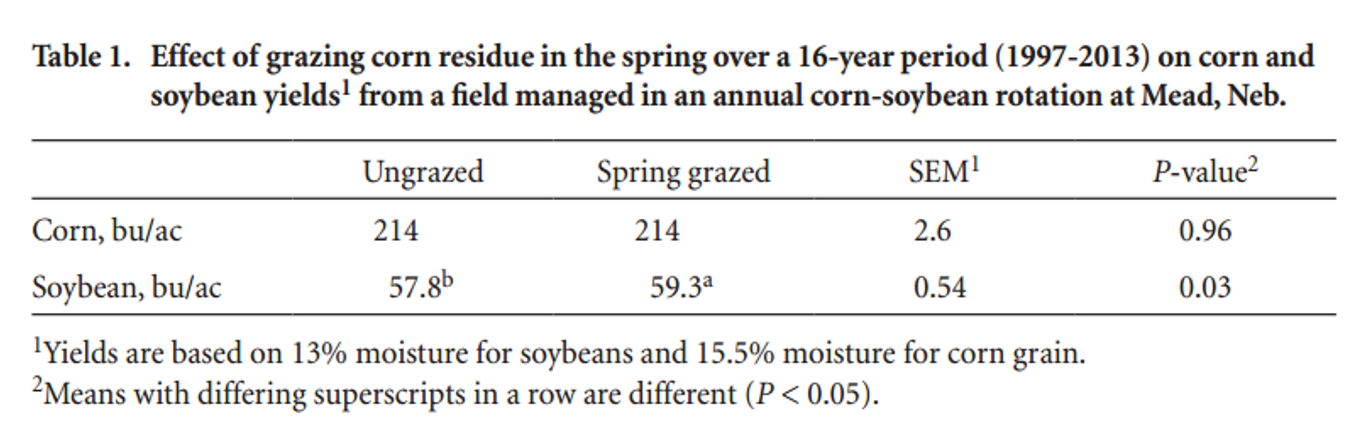
“Effect of Corn Residue Removal on Subsequent Crop Yields“, 2015 Nebraska Beef Cattle Report. Mary E. Drewnoski, L. Aaron Stalker, Jim C. MacDonald, Galen E. Erickson, Kathy J. Hanford, Terry J. Klopfenstein
Spring grazing across all tillage treatments did increase soybean yields statistically (58.5 bu/ac for spring grazed vs. 57.0 bu/ac for ungrazed) and had no effect on corn yields. The results were similar looking at 16 years of grazing vs. not grazing under no-till for both corn and soybeans in the spring; there was no yield effect found for corn and the soybeans showed a slight yield increase with grazing.

“Effect of Corn Residue Removal on Subsequent Crop Yields“, 2015 Nebraska Beef Cattle Report. Mary E. Drewnoski, L. Aaron Stalker, Jim C. MacDonald, Galen E. Erickson, Kathy J. Hanford, Terry J. Klopfenstein
Looking at a 10 year period of no-till management for both spring and fall grazed corn residue and subsequent corn and soybean crops, fall grazing statistically improved soybean yields over both spring grazing and no grazing (65.5 bu/ac vs. 63.5 bu/ac and 62.1 bu/ac respectively). No grazing effects were observed on corn yields in either season. All statistics were at the 95% confidence level meaning the researchers were 95% confident any yield differences were due to the treatments themselves vs. random chance.
Regarding compaction, in the fall, the field was typically frozen and the researchers felt any mud and compaction associated with grazing cattle was minimized; highest subsequent soybean yields were achieved with fall grazing. The spring treatment was designed to look more at potential compaction and muddy conditions after spring thaw till right before planting-thus the implementation of different tillage treatments as well. They used a stocking rate consistent with UNL grazing recommendations resulting in removal of half the husks and leaves produced (8 lbs of leaf and husk per bushel of corn grain produced). Results of this study indicate that even with muddy conditions in the spring, grazing increased subsequent soybean yields compared to not grazing regardless of tillage system used and that corn yields were not different between grazing vs. not grazing and regardless of tillage system used in the spring. This study was conducted in Eastern Nebraska in a rainfed environment with yields ranging from 186-253 bu/ac with a 16 year median yield of 203 bu/ac.
Additional Grazing Study
A five year fall grazing study (December through January) was conducted in an irrigated continuous no-till corn field at Brule, NE to determine the effect of corn residue removal via baling corn residue or fall grazing on subsequent corn yields. That environment receives limited rainfall and residue is deemed important for reducing evaporation of soil moisture in addition for catching/keeping snow on fields. Farmers were questioning the effects of any residue removal on subsequent corn yields and the study was implemented.
Treatments were 1) fall grazing at 1 animal unit month/acre (AUM), 2) fall grazing 2 AUM/ac, 3) baled, or 4) ungrazed. The researchers found that residue removal did not affect corn grain yields from 2009-2013 in the continuous corn rotation. There were no statistical yield differences with 5 year average yields of: 152 bu/ac, 155 bu/ac, 147 bu/ac and 148 bu/ac respectively for the above-mentioned treatments.

“Effect of Corn Residue Removal on Subsequent Crop Yields“, 2015 Nebraska Beef Cattle Report. Mary E. Drewnoski, L. Aaron Stalker, Jim C. MacDonald, Galen E. Erickson, Kathy J. Hanford, Terry J. Klopfenstein
Sudden Death Syndrome and Corn Residue

Symptoms of Sudden Death Syndrome (SDS) on leaves show green veins with discoloration between the veins (left photo). Signs of the blue/gray/white Fusarium fungus causing SDS on a rotted soybean root (right photo).
Grazing corn residue provides many benefits to both livestock and grain farmers, yet many corn stalks in our area are not grazed for various reasons. With as much hail as we’ve had this fall, grazing is also an option to remove ears and kernels that were lost, preventing volunteer corn next season. Normally there is less than a bushel of ear drop per acre, but we most likely have more than that in some of our fields this year. Two kernels per square foot or one ¾ pound ear in 1/100 of an acre is the equivalent of 1 bu/ac yield loss. In 30” rows, 1/100 of an acre is 174’ long if you count in one row or 87’ if you count in two rows.

Soil samples (0-8″) for soybean cyst nematode (SCN) can be taken at any time but always good to sample areas that were affected with SDS to determine if SCN is also present.
What may also be of interest to you is a recent finding between corn grain loss pre-and during harvest and sudden death syndrome (SDS) of soybean. Many asked me this this year, “Why did I see SDS this year when we’ve never had it in this field before?” It’s a great question and I often responded by saying we need to sample the areas affected with SDS for soybean cyst nematode (SCN) as the two diseases are synergistic. Sampling for SCN still remains free through your Nebraska Soybean Board Checkoff dollars and you can stop by the Extension Office for free sampling bags. Crop consultants should contact the UNL Plant and Pest Diagnostic lab directly at (402) 472-2559 if you are requesting 10 or more sampling bags.
Anything that moves soil can transport the fungal soil-borne pathogens causing these diseases. But recent research from Iowa State University also suggests that the fungal pathogen causing SDS (Fusarium virguliforme) survives on grain lost during the harvest process in fields and that SDS management in soybean actually needs to begin at corn harvest.
Studies were conducted for two years in greenhouse and in field plots with nine treatments to determine the survivability of Fusarium virguliforme (Fv) on corn and soybean residue. The treatments were: 1-Corn kernels + Fv; 2-Corn roots + Fv; 3-Corn stem/leaves/husk + Fv; 4-No residue + Fv; 5-Soybean seeds + Fv; 6-Soybean stem/leaves/pods + Fv; 7-Soybean roots +Fv; 8-Corn stalk on soil surface + Fv; 9-Corn kernels and stalk on soil surface + Fv. The researchers consistently found in both the greenhouse and field experiments that Treatment 1 of corn kernels at average harvest loss resulted in the most SDS. Treatment 2 consistently resulted in the second most SDS.

From Iowa State University, September 2010, “Good Harvest in Corn Should Help Manage SDS“.
This helps to explain why some farmers are finding SDS in fields that have been continuous corn for a period of years, are finding SDS in corn and soybean rotation when little or no SDS was previously observed, and why SDS has increased in seed corn fields that may have higher harvest losses. They did not experiment with tillage systems and their recommendation is to reduce harvest losses to reduce the risk of SDS.
Grazing residues can reduce your risk from these harvest losses and for those losses which were incurred with the hail/wind storms we’ve experienced since Labor Day. When grazing corn residue, cattle are selective. They will eat the grain first followed by the husk and leaf followed by the cob and stalk.
It’s also important to be aware of grazing restrictions from herbicides applied to row crops; you can read more about that in this post.


 JenResources