Category Archives: Grazing
Sudden Death Syndrome and Corn Residue

Symptoms of Sudden Death Syndrome (SDS) on leaves show green veins with discoloration between the veins (left photo). Signs of the blue/gray/white Fusarium fungus causing SDS on a rotted soybean root (right photo).
Grazing corn residue provides many benefits to both livestock and grain farmers, yet many corn stalks in our area are not grazed for various reasons. With as much hail as we’ve had this fall, grazing is also an option to remove ears and kernels that were lost, preventing volunteer corn next season. Normally there is less than a bushel of ear drop per acre, but we most likely have more than that in some of our fields this year. Two kernels per square foot or one ¾ pound ear in 1/100 of an acre is the equivalent of 1 bu/ac yield loss. In 30” rows, 1/100 of an acre is 174’ long if you count in one row or 87’ if you count in two rows.

Soil samples (0-8″) for soybean cyst nematode (SCN) can be taken at any time but always good to sample areas that were affected with SDS to determine if SCN is also present.
What may also be of interest to you is a recent finding between corn grain loss pre-and during harvest and sudden death syndrome (SDS) of soybean. Many asked me this this year, “Why did I see SDS this year when we’ve never had it in this field before?” It’s a great question and I often responded by saying we need to sample the areas affected with SDS for soybean cyst nematode (SCN) as the two diseases are synergistic. Sampling for SCN still remains free through your Nebraska Soybean Board Checkoff dollars and you can stop by the Extension Office for free sampling bags. Crop consultants should contact the UNL Plant and Pest Diagnostic lab directly at (402) 472-2559 if you are requesting 10 or more sampling bags.
Anything that moves soil can transport the fungal soil-borne pathogens causing these diseases. But recent research from Iowa State University also suggests that the fungal pathogen causing SDS (Fusarium virguliforme) survives on grain lost during the harvest process in fields and that SDS management in soybean actually needs to begin at corn harvest.
Studies were conducted for two years in greenhouse and in field plots with nine treatments to determine the survivability of Fusarium virguliforme (Fv) on corn and soybean residue. The treatments were: 1-Corn kernels + Fv; 2-Corn roots + Fv; 3-Corn stem/leaves/husk + Fv; 4-No residue + Fv; 5-Soybean seeds + Fv; 6-Soybean stem/leaves/pods + Fv; 7-Soybean roots +Fv; 8-Corn stalk on soil surface + Fv; 9-Corn kernels and stalk on soil surface + Fv. The researchers consistently found in both the greenhouse and field experiments that Treatment 1 of corn kernels at average harvest loss resulted in the most SDS. Treatment 2 consistently resulted in the second most SDS.

From Iowa State University, September 2010, “Good Harvest in Corn Should Help Manage SDS“.
This helps to explain why some farmers are finding SDS in fields that have been continuous corn for a period of years, are finding SDS in corn and soybean rotation when little or no SDS was previously observed, and why SDS has increased in seed corn fields that may have higher harvest losses. They did not experiment with tillage systems and their recommendation is to reduce harvest losses to reduce the risk of SDS.
Grazing residues can reduce your risk from these harvest losses and for those losses which were incurred with the hail/wind storms we’ve experienced since Labor Day. When grazing corn residue, cattle are selective. They will eat the grain first followed by the husk and leaf followed by the cob and stalk.
It’s also important to be aware of grazing restrictions from herbicides applied to row crops; you can read more about that in this post.
Forage, Feed, and Grazing Restrictions for Row Crop Herbicides
It’s nice seeing cattle being turned out into corn stalks!  One point that I haven’t mentioned recently is that we all need to be checking the herbicide label for any grazing restrictions of crop residues.
So check the labels from in-season applied herbicides to row crops and fall-applied herbicides to crop residue for any potential grazing restrictions…and any restrictions on grazing cover crops planted into crop residues following application of those chemicals to a row crop. If the label doesn’t specify any restrictions, then it should be ok. If you want to be on the safe side, a rule of thumb many chemical reps use is to use the pre-harvest interval for the amount of time to wait before grazing stalks.
Some labels will say that residue should not be grazed or baled and fed to livestock. Sometimes studies were actually conducted to know there is a safety concern. In other cases, the chemical company may not choose to conduct all the studies the Environmental Protection Agency (EPA) required for labeling due to high costs. If that’s the case, the EPA requires the strongest restrictive language be placed on the label.
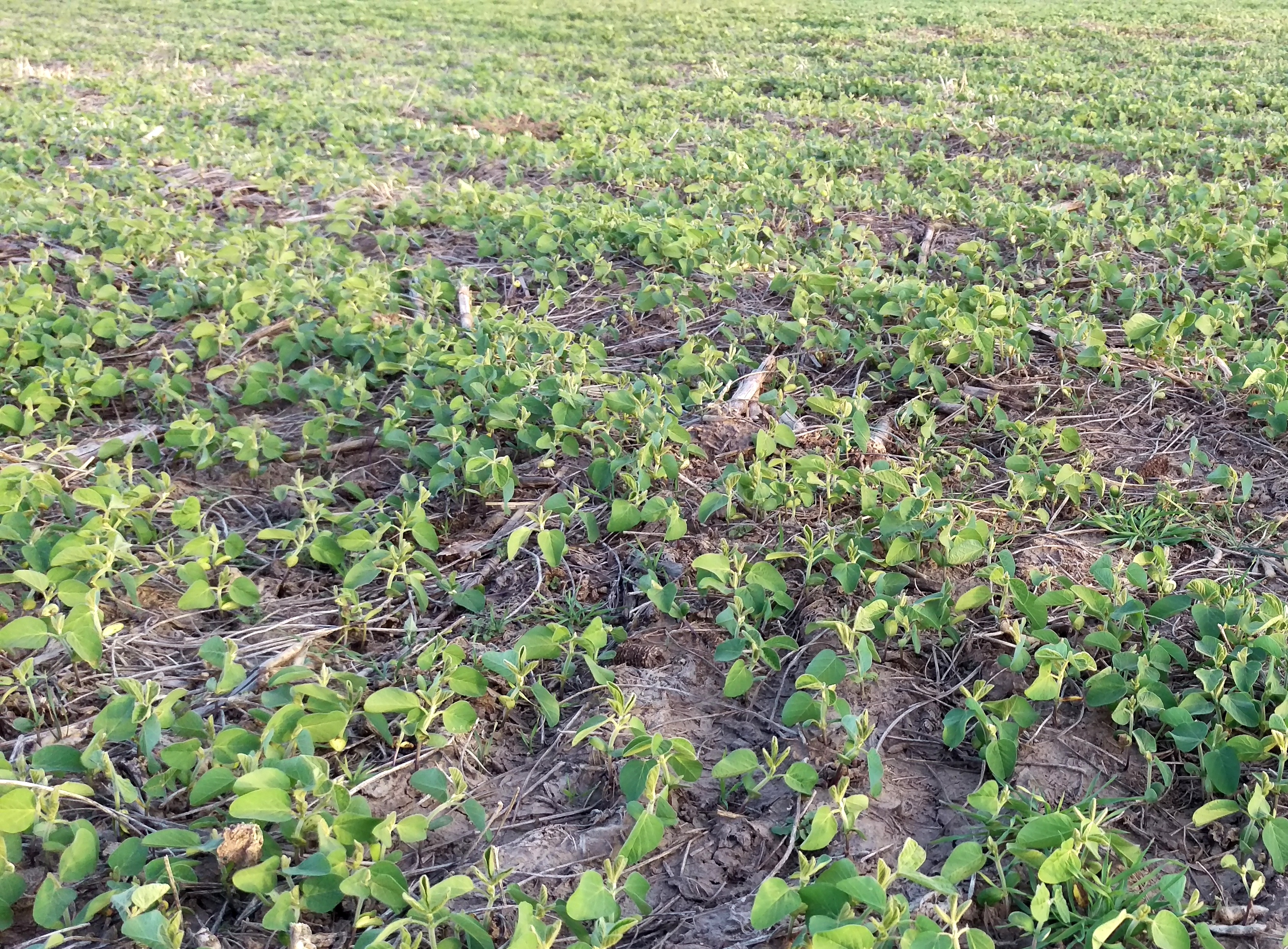
Hail/rain/wind caused for soybean shatter and harvest loss. Volunteer beans have created green fields in the area. For those considering grazing, one needs to look at any herbicide grazing restrictions from herbicides applied in-season to soybeans as well. Dr. Bruce Anderson says, “Soybeans can cause bloat, but the incidence is low. The young green ones may be more risky. Founder would be possible problem with a sudden diet change. Too many unsprouted beans in the diet could cause excess fat; I think maximum is about 3 lbs beans per cow. I’d try to limit amount of grazing for a few days, maybe feeding a very palatable supplement like a ground forage/distillers mix and reduce the amount of this supplement each day for a week or so. And keep a dry, palatable hay always available free choice.” Additional information from the University of Missouri.
Regardless, if it says there’s a grazing restriction on the label, the label needs to be followed as it is a legal document and the law. Your cattle may/may not be affected by grazing stalks or cover crops where a chemical with a grazing restriction is on the label, but there may be other concerns such as problems with the chemical affecting the calf or being retained in the cow’s milk.
For quick references, the 2015 UNL Guide for Weed Management shows Forage, Feed, Grazing Restrictions for Row Crop Herbicides on pages 174-177. A new weed guide will be released January 2016. These pages just provide a reference; it’s truly best to read and follow the label.


