Category Archives: JenREES Columns
JenREES 8/29/21
Congratulations to all the 4-H youth who competed at the Nebraska State Fair this past weekend! The talent of our youth never ceases to amaze me. It’s also so encouraging to see life skills being developed such as public speaking, plant and insect identification, and the responsibility and care for animals.
Also so grateful to receive rain last night! And, that should finish up irrigation, or get it pretty close, for many that didn’t have late-planted crops. It’s really important to know your crop growth stage and to finish well. There’s some fields that are obviously over-irrigated with water standing after this last rain. On the flip side, it’s important to monitor soil moisture and crop growth stages to not stop too soon in spite of the long irrigation season and how tired farmers are. Several questions last week on ‘how’ to finish with irrigations and when physiological maturity occurs in soybeans.
Last irrigation: if you’ve been triggering irrigation during the growing season based on the recommended 35% depletion (average of 90 kpa on watermark sensors), you would have around 1.28” of moisture available in the top 4 feet for the plant in silt loam soils. A consideration for a step-wise approach I’ve used is this: Corn at ½ milk line needs around 13 days or 2.25” to finish the crop to maturity-so subtracting that from 1.28 would be 0.97”. As we consider allowing the soil moisture profile to deplete to 50-60% for recharge over the winter, a person could delay to 40-45% depletion (around 130 kpa average on watermarks) before triggering irrigation the first 7 days and then allow for 50% depletion (around 150 kpa average on watermarks) that last 7 days to finish irrigation for corn.
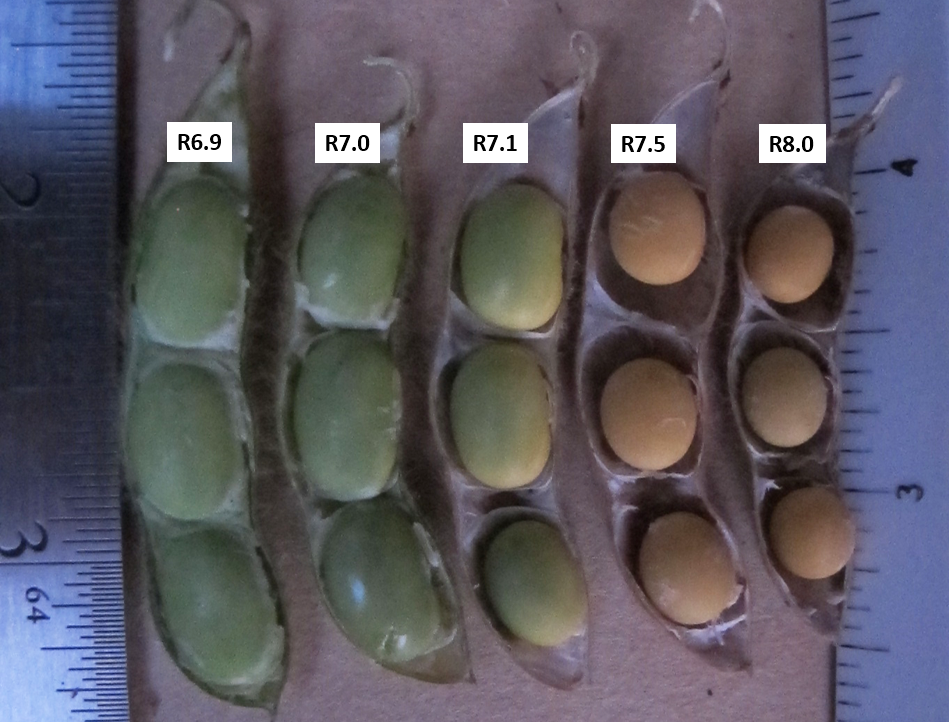
Soybeans range from full seed (R6 end of seed enlargement) which needs 18 days or 3.5” of water; R6.5 (leaves yellowing/pod membranes still clinging to seed) which needs 10 days or 1.9” yet; or physiological maturity in which the pod membrane has separated from the seed and no more water is needed. The NebGuide, “Predicting the Last Irrigation of the Season”, speaks to yellowing leaves as the beginning of physiological maturity. But the question I kept getting last week was “how yellow is considered yellowing leaves?”. Perhaps a better indicator for today’s varieties would be to also look at the pods. Until the pods reach R7, physiological maturity, the plant is still utilizing water. At R7, at least 50% of the field plants will have one mature pod anywhere on the main stem. A mature pod is considered when the pod membrane no longer clings tightly to seeds in that pod (this is like black layer on corn where the nutrient/water supply is cut off from the kernel forming the black layer). So essentially, if you pull off a pod on the main stem, carefully open it up and look at the membrane surrounding the seed. If it’s still clinging tightly to it, it’s not quite mature. If you see separation of the membrane and seed, it’s considered mature and will no longer use water. There can be a range of pod stages on a plant, but between yellowing leaves and pod color changes, one can get a pretty good idea when R7 has occurred and no additional water is needed for the plants. The timing of the ending R stages in soybean is determined by planting date and varietal maturity group, though the date of R7 can be hastened if water stress and high temperatures prevail in August — something we are seeing this year.
Soybean stems typically turn brown shortly after R7 begins, though the stem can remain green longer due to a number of reasons, including fungicide use. The final soybean stage is R8, which occurs when 95% of pods have attained maturity and have a variety-dependent color of brown or tan. Seed moisture in a soybean pod dries down from 70% at R7 to about 13% at R8. This has shown to be around 12 days based on research, but can be faster or slower depending on solar radiation, humidity, temperature, wind speed and soil surface moisture.
So, for scheduling last irrigation in beans: if we use the same example of having 1.28” of available water at 35% depletion in silt loam soils in top four feet, soybeans would need 2.22” with 18 days to finish at R6 or 0.62” with 10 days to finish at R6.5. Using the stepwise approach, one could again allow the soil moisture to dry down to 40-45% the first week and 50-60% the second week. This also allows room to catch rain like we finally experienced last night.
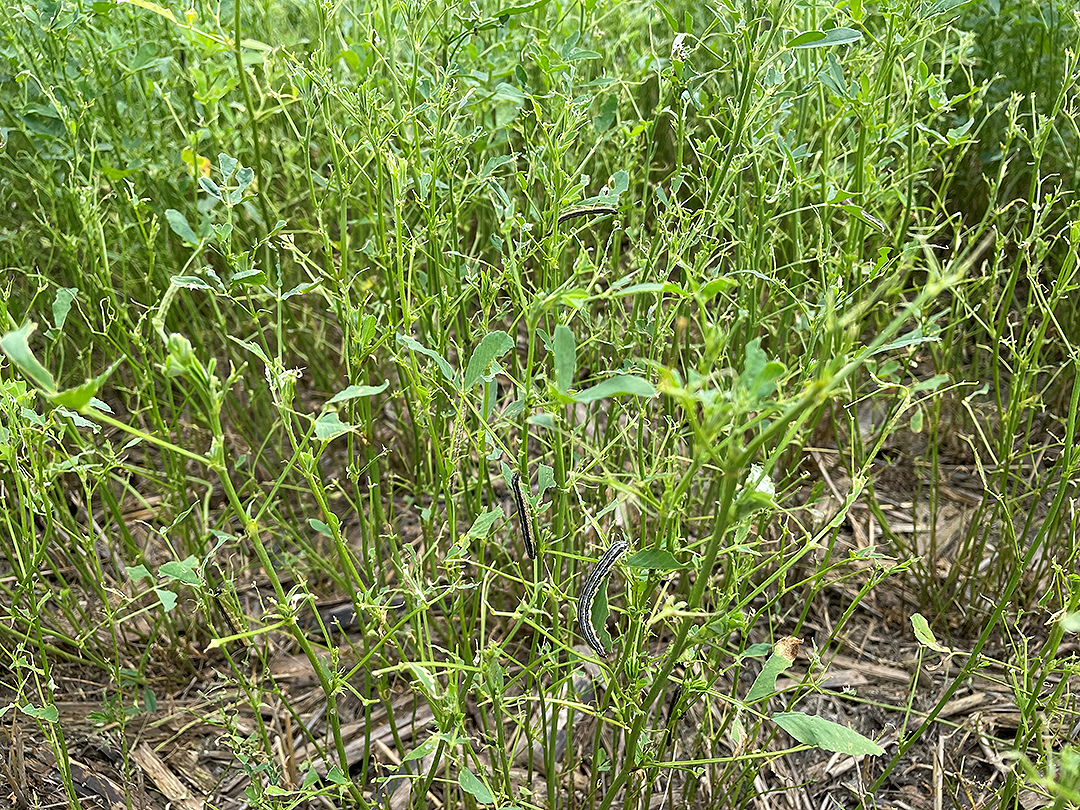
Fall armyworms have been on the increase in alfalfa and pastures recently, so please be scouting as they can decimate a field quickly in the late larval stages. The threshold is 3 or more per square foot and they’re easier to control if the larvae are ¾ inch long or less. When they’re larger than this, they’re more difficult to control and choosing to harvest the alfalfa may be a better control method. Insecticide options include products with active ingredients including the pyrethroids, Alpha-cypermethrin (Fastac CS), Beta-cyfluthrin (Baythroid XL), cyfluthrin (Tombstone), Gamma-cyhalothrin (Proaxis, Declare), Lambda-cyhalothrin (numerous products), permethrin and Zeta-cypermethrin (Mustang Max), organophosphates, chloropyrifos (numerous products), and carbamates, carbaryl (Sevin) and methomyl (Lannate).
JenREES 8/22/21
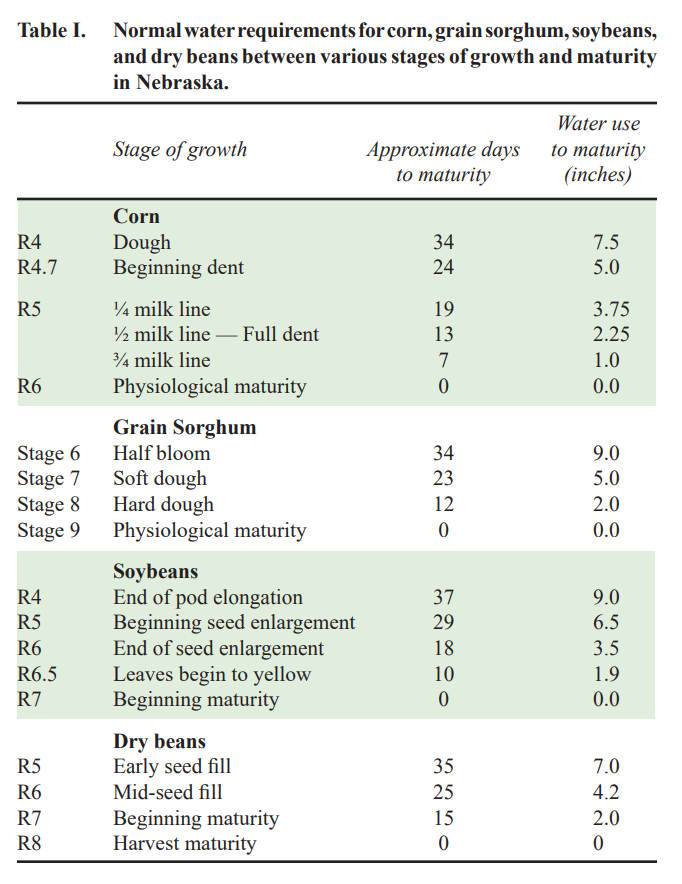
Crop Update: The heat has really pushed crops along. Grateful for the reports of some rain! It’s really important to know your soil moisture levels and work for the balance of not stopping too soon vs. leaving the field too wet going into the fall/winter. The following information comes from the NebGuide: Predicting the Last Irrigation of the Season found at: https://go.unl.edu/k74n:
- Corn at Dough needs 7.5” (approximately 34 days to maturity)
- Corn at Beginning Dent needs 5” of water (approximately 24 days to maturity)
- Corn at ¼ milk needs 3.75” (approximately 19 days to maturity)
- Corn at ½ milk (Full Dent) needs 2.25” (approximately 13 days to maturity)
- Soybean at beginning seed (R5) needs around 6.5” (approx. 29 days to maturity)
- Soybean at full seed (R6) needs 3.5” (approx. 18 days to maturity)
- Soybean with leaves beginning to yellow (R6.5) needs 1.9” (approx. 10 days to maturity)
Alfalfa and Wheat Expo: Southeast Nebraska farmers can sharpen their management strategies at the inaugural 2021 Southeast Nebraska Alfalfa and Wheat Expo. The inaugural Alfalfa and Wheat Expo is scheduled for Thursday, September 2, 2021, in Crete at the Tuxedo Park Exhibition Building. The Expo will begin at 8:00 a.m. with refreshments and exhibitor booths. The educational program starts at 9:00 a.m. and ends at 3:30 p.m. Hosts and local Water & Integrating Cropping Systems Extension Educators, Nathan Mueller, Gary Lesoing, and Melissa Bartels said more diverse crop rotations are both underutilized and undervalued. Integrating alfalfa and winter wheat into the crop rotation can provide a critical tool to mitigate extreme weather, improve soil health, increase corn and soybean yields, combat troublesome pests, increase flexibility in manure management plans, and more. This new expo will help farmers prepare to grow these crops for the first time or fine-tune the skills of experienced alfalfa and winter wheat growers. Speakers and panelists will address important issues for southeast Nebraska farmers and allow for great one-on-one discussion with local private industry exhibitors and sponsors. The Expo is free to attend including lunch, but pre-registration is requested by August 31. For more info. and to pre-register, please visit https://croptechcafe.org/alfalfawheatexpo or call the Saline County Extension office at 402-821-2151.
Renovating Lawns in the Fall: August 15-September 15 are the best times to seed cool season grasses. This resource, Improving Turf in the Fall at https://go.unl.edu/rz9z is a great one to walk you through renovation depending on your situation. Some lawns can be easily improved by adding fertilizer this fall.
Sarah Browning, Extension Horticultural Educator shares, “Late summer or fall fertilization of Kentucky bluegrass and tall fescue lawns is the most important time to fertilize these cool season grasses. Fertilizer applied now promotes recovery from summer stress, increases density of thinned turf, encourages root and rhizome growth, and allows the plant to store food for next spring’s growth flush. On older lawns, those that are 10 to 15 or more years old, that typically need only two fertilizer applications a year, make the fall application in late August or early September using fertilizer with all or some slow-release nitrogen. On younger lawns, two fertilizer applications during fall are recommended. Make the first one in late August or early September, and the second in mid to late October. For the first one, select a fertilizer with all or some slow-release nitrogen. For the later application, use a fast release nitrogen source so plants will take it up before going dormant.”
Other lawns can be improved via overseeding or total renovation. If overseeding is needed to fill in thinned areas but more than 50% of good turf remains, mow the existing grass 2.5” tall to make the soil preparation easier. For lawns needing total renovation, start with a glyphosate (Roundup application) followed by waiting at least 7-10 days to kill the lawn. Mow dead vegetation as short as mower goes to then prepare the soil for planting.
To prepare the soil for seeding, it’s helpful to aerate the lawn making three passes. Watering a day or two beforehand can make the aerification easier. The full seeding rate for turf-type tall fescue is 6-8 lbs./1,000 sq.ft., and 2-3 lbs. for Kentucky bluegrass. When overseeding into an existing lawn, the seeding rate can be cut in half. Drilling the seed is perhaps easiest for a total lawn renovation. Otherwise, use a drop seeder to apply the seed (not rotary ones as the seed is too light to spread evenly). Make sure to seed half the seed north/south and the other half east/west to ensure even distribution. Then lightly rake in the seed to ensure seed to soil contact. Starter fertilizer is helpful for new seedings where the total phosphorus is 1 to 1.5 lbs/1000 sq. feet. It’s also important to keep the top ½ to 1” of soil moist as seedlings germinate. Thus, it may requiring watering several times a day the first two weeks, depending on temperature and moisture. As seedlings develop, reduce the watering schedule to allow root development. When the grass is tall enough to mow, reduce watering to only 2-3 times/week with deeper watering. Mowing as soon as the grass allows encourages tiller development and thicker new stands.
JenREES 8/15/21
Crop Update: It was great to see people at soybean management field days last week and to hear their experiences around cover crops and weed management! White mold in soybean was the primary question received last week. It was already heavy in some Butler and Polk county fields and has since increased in York county with calls over the weekend. I don’t get too concerned about managing different insects/pathogens/weeds as we have various management strategies for them. White mold, though, is a very difficult one to manage.
It’s a soil-borne disease in which the fungus survives in a black structure (sclerotia) that resembles mouse droppings. Rain events and irrigation during flowering can favor it along with extended dew periods and fog like we’ve experienced this year. If you see random plants in an area that are turning brown but remaining upright, look into the canopy and see if there’s white cottony fungal growth on the stem. You may also see the black sclerotia on either the outside or inside of the stems. It can continue to spread from plant to plant. Management right now includes managing soil moisture and irrigation. It’s important to keep the top portion of the soil as dry as possible (which I realize is practically impossible with heavy dews). When it comes to irrigation management, infrequent, heavy watering is better than light, frequent watering in heavy-textured soils. It’s a good idea to keep notes on areas of the field you’re seeing it this year so you’re aware of it the next time soybeans are planted.
Some cultural and crop rotation things going forward that may or may not fit for your operation, yet good to be aware of: No-till allows the sclerotia to die more quickly on the soil surface (within 2-3 years), whereas tillage allows sclerotia that are buried to survive longer. Also, as we think of cover crops and crop rotations, fields with a history of white mold should avoid rotations for 2-3 years with edible beans, field peas or other pulses, canola, turnips, radishes, sunflowers, or potatoes. Grass crops (corn and sorghum) and using small grains like wheat, rye, oats, etc. in rotation can help reduce the amount of sclerotia that survive. For more detailed information, check out: https://soybeanresearchinfo.com/soybean-disease/white-mold/.
Watch insects in soybeans regarding clipping pods; not seeing too much of that yet. Am seeing bean leaf beetles and grasshoppers in several counties. Saw woolly bear and green cloverworms in Nuckolls co. last week. I have no idea why Japanese beetles are still around for all who keep asking!
Have been seeing sudden death syndrome (SDS) for several weeks now. For those seeing it in fields where beans were treated with ILeVO or Saltro, the symptoms can still appear on beans treated with those products. In spite of this, from our on-farm research fields that had a history of SDS, the symptoms were less in the treated beans than the check treatment.
Mid-August brings a sigh of relief to many agronomists in getting closer to the end. I’m sure our farmers will be grateful to get to the end of irrigation season this year too. Many soybeans are at R5-R5.5 (can see seed development in pods on upper 4 nodes). At this point, flowering stops. Soybeans at R5 still need around 6.5” of moisture to finish. At R6 (full seed), that amount drops to 3.5”. We don’t talk about last irrigation yet for corn at milk stage. For fields at dough (R4), corn needs around 7.5” of moisture yet to finish and 5” at beginning dent.
Seward County Ag Banquet to be Held August 23: The Kiwanis Club of Seward partnered with SCCDP and Seward Co. Ag. Society will honor Seward County Ag Leaders on Monday, August 23, 2021 with our 53rd Annual Agriculture Recognition Banquet. The banquet begins with wine, cheese, and sausage at 5:30 p.m. and a prime rib meal at 6:30 p.m. Ag Promoter, Educator, and YouTube Sensation, Greg Peterson will be the evening’s entertainment. This event provides an excellent opportunity to recognize the importance of agriculture in Seward County. The evening will honor the Seward County farmers, producers, ag businesses and ag students for their continued economic contributions to our strong local agricultural economy. Due to COVID not allowing us to have a banquet in 2020, we will be honoring individuals and families selected in 2020 and 2021. Please contact Pam Moravec, Banquet Chair, 402-643-7748, or Shelly Hansen, 402- 643-3636 information about becoming a banquet sponsor. The cost to attend the banquet is $30.00 per person. You can contact Pam or Shelly to reserve you seat. The Kiwanis Club of Seward will use the proceeds from the event to support the youth of Seward County through a variety of programs and events, including the Agronomy Academy.
JenREES 8/9/21

Thank You to all the volunteers; ag society and 4-H council members; Extension staff; and all the youth and families who made the 2021 York and Seward County Fairs successful! It was a joy for me to see ‘normal’ fairs, youth and adults excited to find their projects and show their ribbons, the number of people out attending activities, walking through buildings, and just talking with each other!
Crop Update: Thanks also to the crop consultants and ag industry agronomists who dropped off samples during fair and kept me in the loop with what you were seeing in the fields! Southern rust was also confirmed in Hamilton and York counties this week. Frogeye leaf spot is also showing up on some soybeans with the high humidity and dew on soybean leaves.
Many have asked why the crops aren’t using much water. ET is evaporation from soil and leaf surface + transpiration (process of water lost through leaf stomata) from the crop. The high humidity has kept plants wet, especially soybeans, longer during the day (which is why I think the soil moisture use has been showing up less on soybeans than corn). I know many, including myself, have been trained that crops automatically remove 0.30”+ a day upon tassel and flowering, but that’s just not true. That thinking doesn’t account for the environmental factors at play which change every day of every year. Higher ET occurs on sunshiny days with high heat, higher wind, low humidity. Cloud cover, humidity, and low wind all reduce ET (and we’ve had a lot of these lately). As I’ve worked with farmers through the years, I’ve heard many say how helpful their ET gage was, because it’s such a visual representation of what’s going on with the environment and crop water use. If you don’t have an ET gage, the UBBNRD is sharing daily crop water use from the High Plains Regional Climate Center via email, so you can contact Marie there if you would like this info. each day. Thankfully, the humidity has allowed non-irrigated crops to hang on longer, due to lower crop water demand, in spite of the humidity being harder on us and animals.
Pollination: I realize there’s pockets of really good looking corn out there. And, I also realize that a lot of corn may look good from the road, but there’s concerns and questions about pollination and tip back in fields. As I think about when pollination occurred, the smell of pollen was thick in the air some mornings, and even early evenings when pollen shed was delayed from high humidity. Many fields I walked into had ample pollen shed. There’s a range of pollination dates in the area, so heat/humidity could have played a role for your specific fields. Dr. Tom Hoegemeyer shared the following about high heat and humidity during corn pollination in a CropWatch article, “Just a day or two difference in flowering, or planting, or other factors can make a substantial difference in (kernel) set. Stress during pollination and silking could result in shorter ears, increased tip back and fewer kernels per ear. All of these contribute to less yield potential.”
- When soil moisture is sufficient, one day of heat over 95-98F during pollination has little to no yield impact. After four consecutive days, there can be a 1% loss in yield for each day above that temperature. Greater yield loss potential occurs after the fifth or sixth day.
- Heat over 95°F depresses pollen production. Prolonged periods of heat can reduce pollen production and viability (ability of pollen to fertilize silks).
- High humidity helps reduce crop water demand. High humidity, without a drop in humidity during the day, can delay pollination or prevent pollen from leaving anther sacs. “The process of releasing the pollen from the anthers is called “dehiscence.” Dehiscence is triggered by the drop in humidity, as the temperature rises. However, when it is extremely humid and the humidity falls very little, dehiscence may not occur at all, or it may be delayed until late in the day. If one has breezes, while the humidity is still very high, the anthers may fall to the ground before pollen is released.”
I also think about what I’ve seen the past few weeks with all the silk balling, pollination misses, tip back, and what’s being shared with me by others in the field. The July 9 wind event that hit a portion of this area seems to have impacted plants more greatly that were within 1 week of tasseling. With the resources it took to right plants in developing additional brace roots, thickened nodes, etc., I wonder how much of the resources that would’ve been put into “normal” pollination were used for these other purposes instead and how that may have impacted pollination timing, silks pushed out of husks, etc.? A number of agronomists are reporting abnormal ear development they’re seeing in addition to pollination misses and tip back of various levels. This is what’s known from the research regarding wind impacts to yield on lodged plants (however the specific causes of the yield losses are not mentioned):
- Research found lodged plants after a wind event had yield reductions of 2-6% (V10-12 stage), 5-15% (V13-15 stage), and 12-31% (V17 and after stages).
- We’ve also personally observed yield losses greater than this due to abnormal ear development on lodged plants in the area after wind events.
Regarding tip back, it’s important to count kernels long as there may be more kernels than one realizes in spite of tip back occurring. Tip back on corn occurs most often from some sort of stress. One can tell the approximate timing of stress events by the appearance of the kernels. If kernel formation isn’t evident, the stress occurred before or during pollination. If kernels are very small or appeared to have died, the stress was after pollination as the kernels were filling. Japanese and rootworm beetle silk clipping can impact tip pollination. We’ve also had high heat with humidity since pollination in addition to cloudy/hazy days and I haven’t dug into the weather data yet. Hopefully this helps a little for the questions received thus far.
JenREES 8/1/21
Reminder of the Seward and York County Fairs this week! August also brings the season of field days! Soybean Management Field Days will be held next week at various locations in the State from Aug. 10 to Aug. 13. The closest to this part of the State is Aug. 12th near Rising City at the Bart & Geoff Ruth Farm. More info. at: enrec.unl.edu/soydays.
Corn Update: I realize this week’s column shares lots of problems seen in the field last week. My goal is always to increase awareness, but sometimes it feels ‘heavy’ hearing about the problems. Grateful we’ve had few problems overall this season till now! The high humidity has allowed non-irrigated crops to hang on and crops in general to not use as much water as anticipated for crops at this stage. In general, fungal disease is still low in fields. I’m starting to see baby lesions that will most likely become gray leaf spot around mid-canopy, so that will be something to watch in coming weeks. Spidermites have also been flaring above the ear in some fields, particularly non-irrigated.
For our area of the State, southern rust has been confirmed in Adams, Nuckolls, Thayer, Gage, Saline, Clay, and Fillmore counties. There are probable samples at time of writing this for Seward and Jefferson counties (https://corn.ipmpipe.org/southerncornrust/). In all the samples, incidence and severity were very low. Many are being found around waist-high in the canopy. Three samples I confirmed last week were from fields that had already been sprayed and the pustules were found mid-canopy. This happens every year, regardless of the residual applied in the first application. I know a couple farmers who have paid a little extra to have the aerial applicator increase gallonage from 2 gal/ac to 3 gal/ac. They felt that aided in coverage a little further into the canopy. For those with chemigation certification, I also know several growers who chemigate their insecticide and/or fungicide effectively, which allows for better plant coverage into the canopy (as long as pivot doesn’t have drop nozzles below canopy).
I really enjoy observing what occurs with plants, yet I honestly don’t know anyone who wishes to see abnormal corn ears, especially after wind events such as July 9. I feel it’s important to observe and document what occurs on these plants that bent and didn’t break. The goal is awareness to know what type of ear development exists so there’s not such a surprise at harvest if yields are off, and to be aware when working with your crop insurance agent. There’s unfortunately some ugly looking ears out there. Some similar stress events occurred this year comparable to 2016, minus the drop in temperature prior to the wind event. I’m not seeing anything yet to the level like what we saw in 2016, which is encouraging. What I’m seeing ranges from row abortion above where the ear stress occurred to torpedo and banana shaped ears to pinched areas on ears including various forms of ‘barbells’. Finding greater damage in fields where the plants were within a week of tasseling when the wind event occurred. It also appears like those fields that were 2 weeks or more from tasseling at the time of the wind event aren’t as impacted. For growers that had plants that blew down or leaned and then righted themselves but didn’t break, it’s wise that you and/or your agronomist are checking ear development on them. Each field can be unique depending on stage of development the particular hybrid was in at the time of the wind event. Pictures of what is being observed are at jenreesources.com.
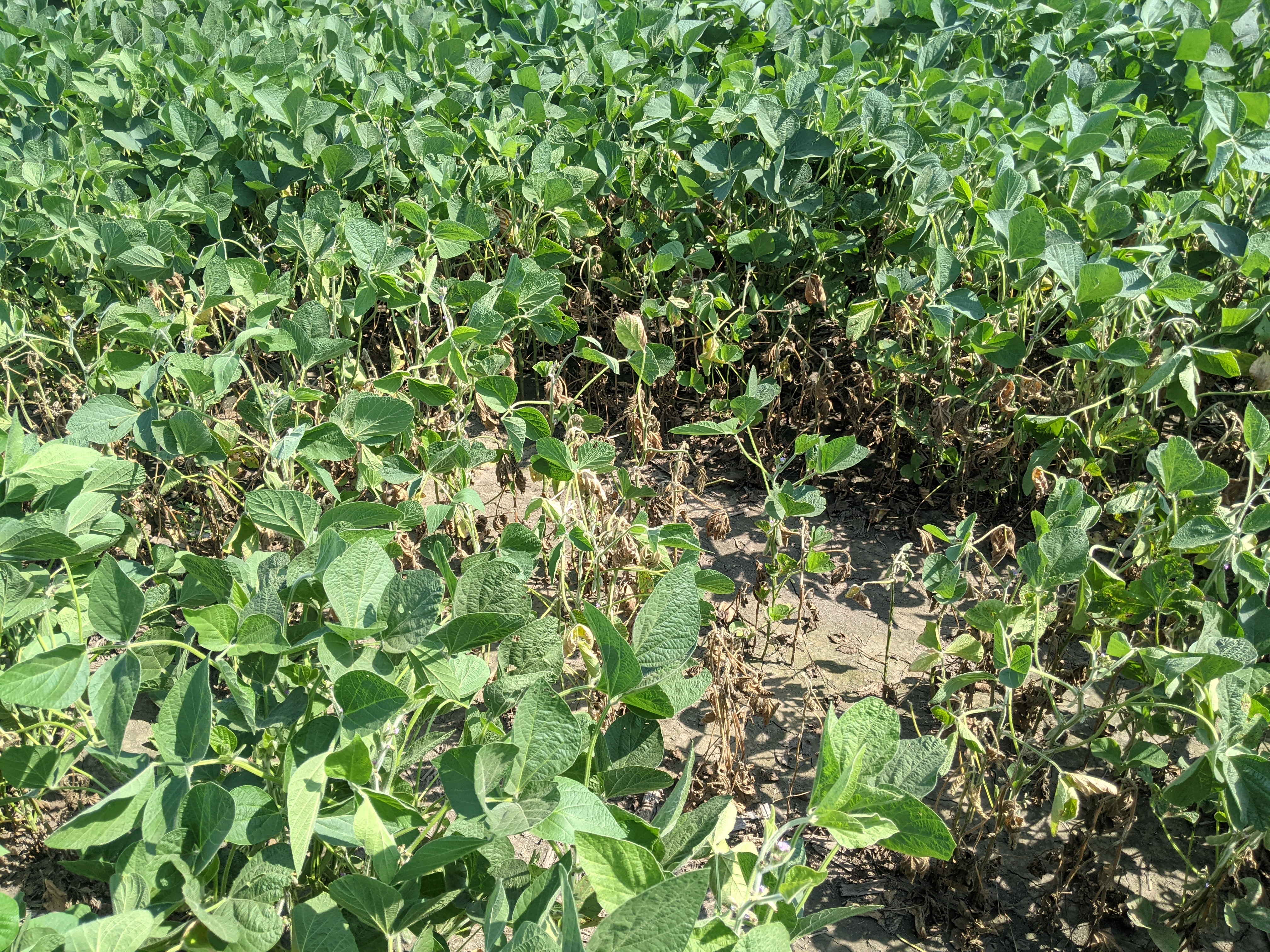
Soybean Update: Received a number of calls regarding poor-looking patches in soybean fields this week. Drought stress is showing up in non-irrigated fields. Be checking those areas for spidermites as well. If they’re present, I tend to find them towards the edge of the patch between the impacted area and what appears to be healthier beans. White mold in soybeans is something that’s becoming more common in counties such as Butler. It can have patterns such as several plants in a row impacted and/or a patchy area in the field. The plants will have a white cottony fungal growth on them and eventually the stem (upon splitting) has black fungal structures that look like mouse droppings in them.
Sudden death syndrome (SDS) and/or brown stem rot are also showing up in small patches of fields where the leaves have a chlorotic/necrotic look between the veins. The humidity has allowed the blue/gray fungal growth characteristic of SDS on the rotted taproots to be observed even mid-day. If you split the stem and the pith is brown, the culprit is most likely brown stem rot; if it’s not but the taproot is rotted and you can easily pull it from the soil, it’s probably SDS. Plants can sometimes have both diseases. All of these are soil-borne fungal diseases and there’s no control measures for this time of year. It would be wise to pull 0-8” soil samples to check for soybean cyst nematode in areas of fields you’re finding SDS and brown stem rot in. Dectes (soybean) stem borer tunneling can be confusing when determining dectes vs. brown stem rot. At this time of year, I don’t typically see dectes moving far (more than 1-2″ either direction) from the initial point of hatching near the petiole. This is in comparison to brown stem rot which would have browning of pith from soil line. Dectes also will not kill plants (just create conditions for lodging and breaking off near harvest). This is because the vascular bundles of soybeans are found on the outside edge and not in the center of the stem. Thus, death of plants this time of year are due to another cause.
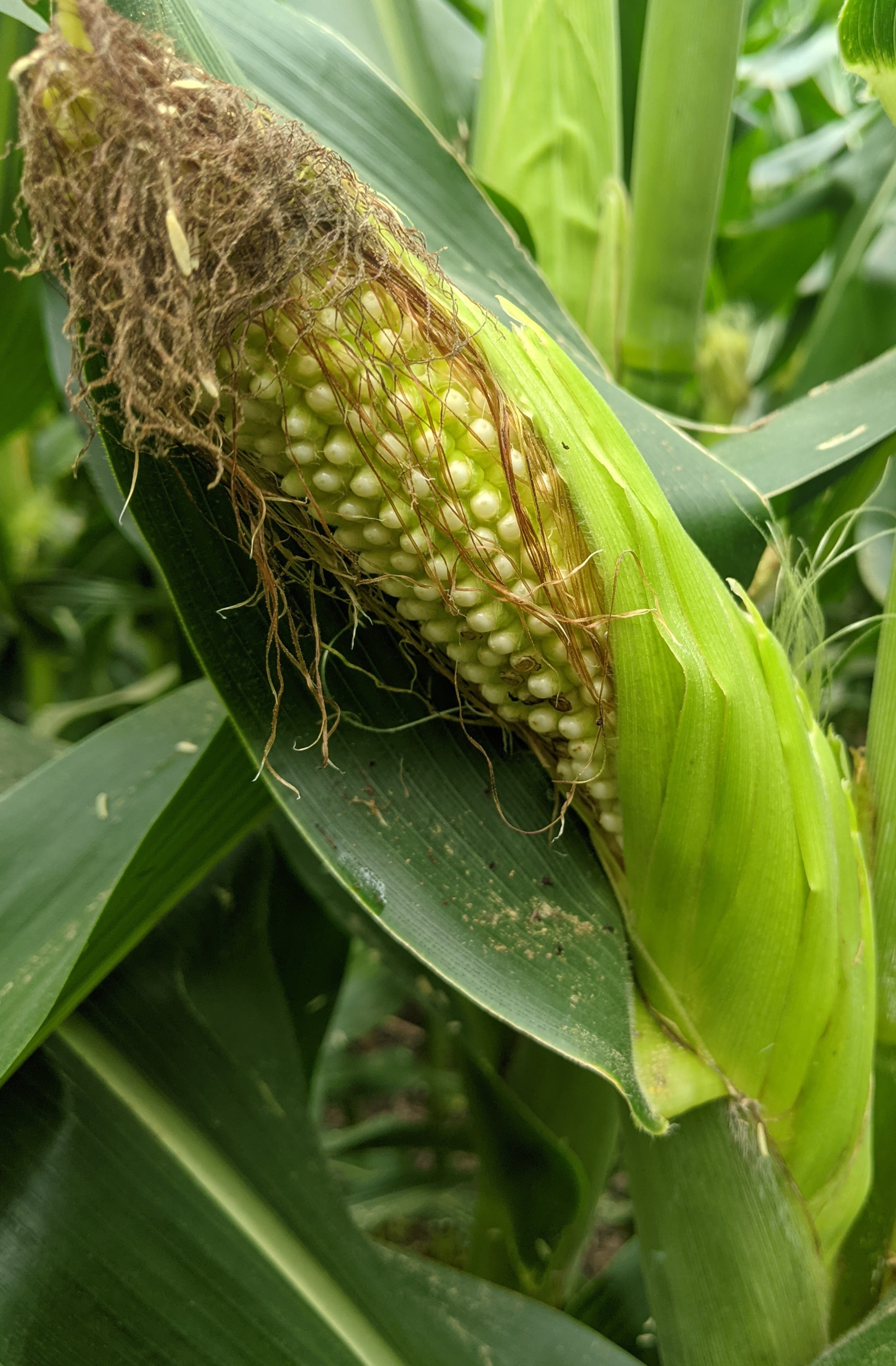

Two examples of shortened husks on developing ears. Husking back these ears often shows a pinch point that occurred during the windstorm resulting in jumbled kernels.


JenREES 7/25/21
Last week I heard several mention close calls on gravel roads. Please, slow down/stop before crossing unmarked intersections, fully stop at marked ones, and please remind young people of this too.
Crop Update: Keep watching silk clipping on corn that’s pollinating; rootworm and Japanese beetles clipping silks to ½” long triggers treatment thresholds. Southern rust was found in Nemaha and Greeley Counties last week from two samples at low incidence and severity. You can view updates at: https://corn.ipmpipe.org/southerncornrust/. Consultants and farmers with suspect samples are welcome to get them to me as in the past, or send to the Plant and Pest Diagnostic clinic in Lincoln. I’ve only seen gray leaf spot on the lowest leaves of fields last week so far, so disease is currently very low.
South Central Ag Lab Field Day: Reminder of this field day near Clay Center this week on July 28th which will cover nutrient, insect, disease, and weed management topics in addition to irrigation, cover crops, and biomass ones. There was a press release from UNL that had the wrong date, so just want to make sure those in the area interested in attending are clear that this will be held on July 28th from 8:45 a.m.-4 p.m. (Registration at 8:30). More details and registration at: https://enrec.unl.edu/2021scalfieldday. Walk-ins are also welcome; we just ask for pre-registration to aid in meal planning purposes.
Workshops on ag land management, leasing, carbon credits: Nebraska Extension and the University of Nebraska-Lincoln’s Center for Agricultural Profitability will host a land management workshop. It will offer updated leasing information relevant to landlords and tenants, including the latest financial trends in Nebraska agriculture, updated land values and cash rental rates for the state, strategies for equitable leasing and farm succession considerations. The latest information on carbon credit contracts for ag producers and landlords will also be discussed. The presentations will be led by Jim Jansen, an extension educator and agricultural economist, and Allan Vyhnalek, an extension educator specializing in farm and ranch transition and succession. The meeting is free to attend with meal sponsored by People’s Company, but registration is required. Locations include:
- July 28, 10:30-1:30 p.m., Extension Office, Columbus, Reg. 402-563-4901.
- Aug. 2, 10:30-1:30 p.m., Fairgrounds, Auburn. Reg. 402-274-4755.
- Aug. 3, 10:30-1:30 p.m., College Park, Grand Island. Reg. 308-385-5088.
- Aug. 17, 10:30-1:30 p.m., Extension Office, Lincoln. Reg. 402-441-7180
- Aug. 18, 9-Noon, Extension Office, Wilbur, Reg. 402-821-2151
Leaf Drop in Trees: Still receiving questions on this. For leaves such as Linden and Birch trees that have a lacy appearance of feeding on them, this is due to Japanese beetles. We hopefully are on our last week of them. For crabapple, flowering pear, ash, maples whose leaves are turning yellow/brown and dropping, this is due to fungal diseases and we wouldn’t recommend you do anything for this either. Next week I’ll talk about iron chlorosis and treatments for trees.
Brown Leaves on Oak Trees: Browning on leaf margins of individual leaves is anthracnose, which is a common fungus of shade trees. We don’t recommend that you do anything for this.
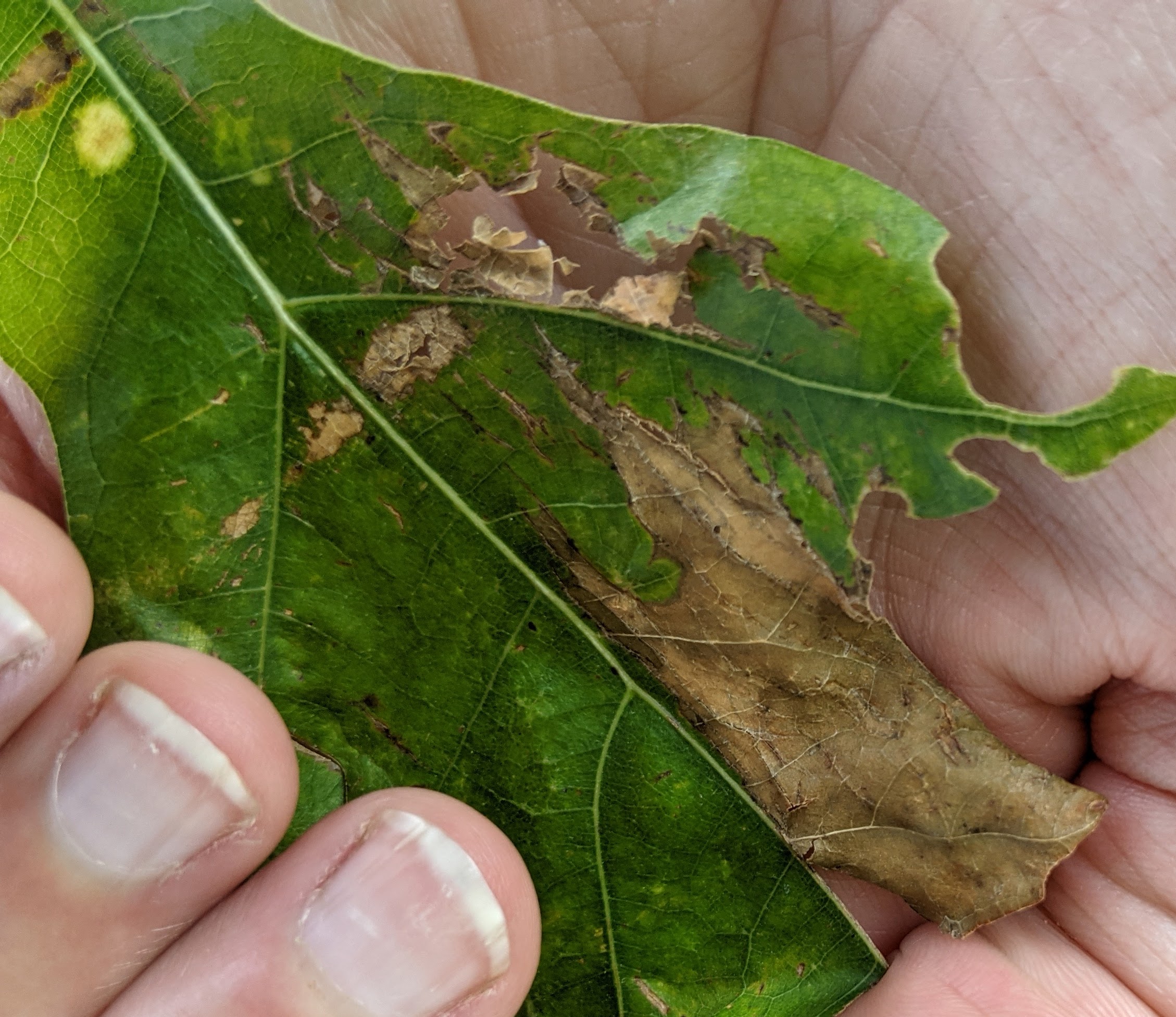
The past few years around fair time, we’ve seen oak trees (but sometimes others such as hackberry, honeylocust, elm, linden) that get a cluster of brown leaves towards the ends of branches. This damage is caused by twig girdlers or twig pruners, different types of beetles. Basically, the adult beetles chew a circle in the bark between where the old and new wood occurs on a twig. This girdles the twig, cutting off the water and nutrient supply causing its death. Eggs are then deposited and larvae hatch, tunnel, and survive in the dead twigs. Twigs girdled by any of these insects may stay attached to the main branch for several weeks or be broken out of the tree by wind. Tunneling in the twigs may not be evident in the fall if twigs fall out of the trees before the insect eggs have hatched. Mature trees with heavy infestations can look bad, but the damage isn’t a serious health problem to the tree and no chemical control is recommended. You can burn or discard infected twigs in the fall and spring that contain developing larvae to minimize the impacts for the future.


JenREES 7/18/21
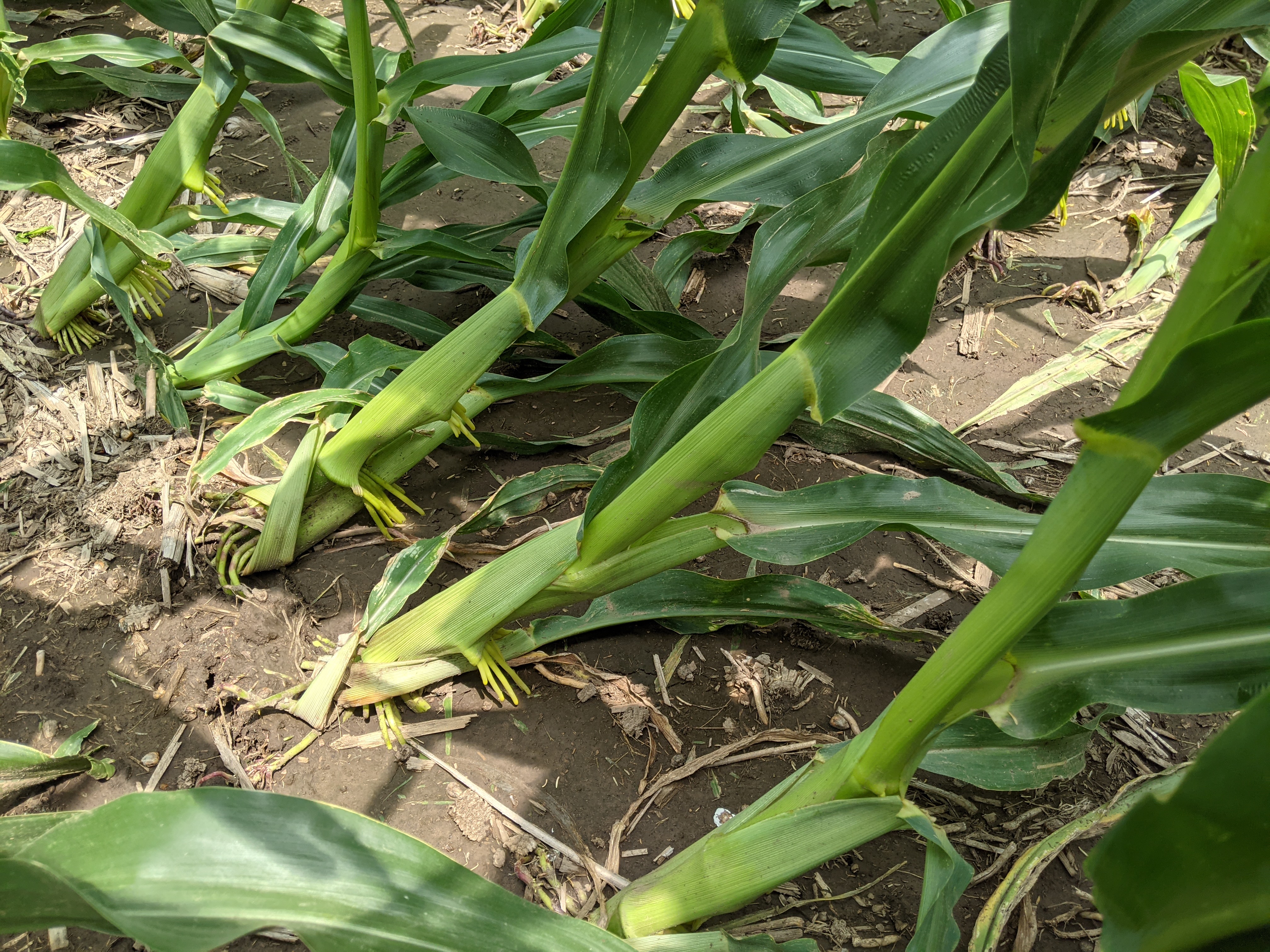
Crop Update: Grateful that in general (beyond seed corn), greensnap levels were lower for the widespread area compared to what we saw in 2020. It appears many fields with leaned plants have been working to right themselves with brace roots growing like crazy to help stabilize plants. Ear development on bent plants will be something to watch going forward. With plants bending in the wind instead of breaking, sometimes extra stress occurs where the ear is developing. Sometimes we see ear abnormalities and sometimes the ears are fine. With fields with severe bending, once the plant reaches tassel, it will no longer try to right itself and will switch to putting resources into the ear. For those with storm damaged fields who were originally planning on more nitrogen through the pivot, last year we took tissue samples to assess that need.
For fields with uneven development with plants ranging from vegetative stages to tassel, particularly storm damaged and uneven emerging fields, one needs to be aware that various adjuvants added to an insecticide and/or fungicide application pre-tassel can cause ear abnormalities.
So, the conversation with those at western bean cutworm thresholds with only portions of fields tasseling was to consider not adding the adjuvant (the same applies for those applying fungicide). I wasn’t sure how efficacy would be for different products without them (that would be a conversation for the chemical reps), but we know that adjuvants such as non-ionic surfactants can cause ear abnormalities when applied pre-tassel.
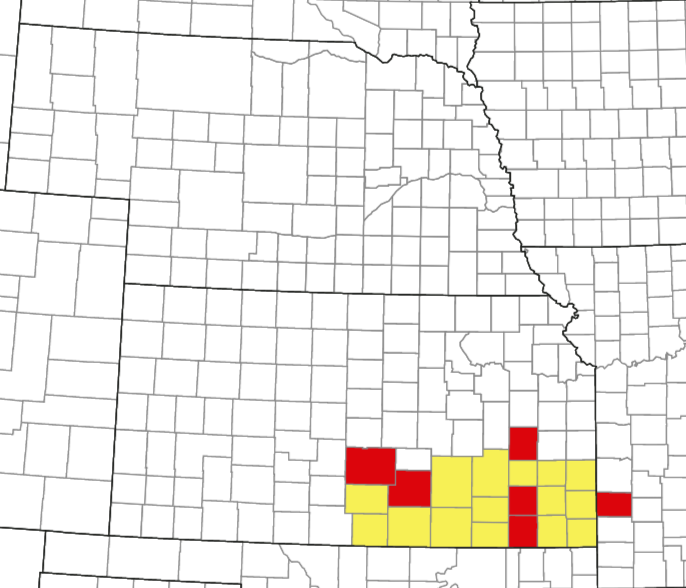
Also had several conversations regarding foliar fungicide applications. Fields have very low disease pressure right now with bacterial leaf streak being the most prevalent, and a fungicide won’t help with it. Gray leaf spot is very low in fields. Southern rust has been found in a few counties in mid- to southern- Kansas. It has not been found in Nebraska. You can view the tracking map at: https://corn.ipmpipe.org/southerncornrust/. Yield increases with automatic VT applications aren’t consistently proven in Nebraska. The following are fungicide timing studies conducted in Nebraska.
In 2008-2009, a UNL fungicide timing trial was conducted near Clay Center on 2 hybrids (GLS ratings ‘fair’ and ‘(very) good’) with a high clearance applicator. Timing over the two years included: Tassel, Milk, Dough, 25%, 33%, 50%, and 100% Dent comparing the fungicides Headline, Headline AMP, Quilt and Stratego YLD.
- 2008: No yield difference on GLS hybrids rated ‘good’ at any of the timings (Tassel, Milk, 33% and 100% Dent) nor the check when Headline or Stratego YLD were applied. For the ‘fair’ hybrid, no yield difference for any application timing nor the check for the April 30th planting except for Headline applied at milk stage (increased yield). Low gray leaf spot pressure.
- 2009: No yield difference on GLS hybrids rated ‘very good’ or ‘fair’ nor the check on any timings (Tassel, Milk, and Dough) using Headline, Headline AMP, or Quilt. Moderate gray leaf spot disease pressure.
In 2020, Dr. Tamra Jackson-Ziems and her team did another fungicide timing trial at UNL’s South Central Ag Lab near Clay Center. Fungicides were applied at planting, R1, or R3. There were no clear yield differences between applying foliar fungicide at R1 vs. R3 for any of the products except Miravis® Neo. Sometimes a product didn’t show a difference between other products or even the untreated check. There’s a picture of the data at jenreesources.com. Hybrids vary in disease susceptibility (thus response to fungicide application). With last year being a heavy southern rust year, being able to wait till at least R3 (milk) to apply a fungicide provided some additional time for the residual to work when southern really came on. I know some had to apply a second fungicide application when they automatically applied at R1. That’s just tough from an economic and resistance management perspective, in spite of higher corn prices. Thus, why I recommend waiting until disease pressure warrants the application. The main ‘plant health’ benefit observed in Nebraska when disease pressure was low (ex. 2012) was stalk strength.
July 28 South Central Ag Lab Field Day will be held from 8:45 a.m.-4 p.m. (Reg. 8:30 a.m.), near Clay Center. For all those who’ve talked with me about planting green into rye, there’s an excellent study by Dr. Amit Jhala and grad student Trey Stephens. They compare the same herbicide program with rye termination 2 weeks prior to planting or 2 weeks after planting in both corn and soybean. It was really interesting to visualize the differences in May and I’d encourage anyone interested to take a look at this now in July. Additional topics include disease, insect, and nutrient management, cover crops, and irrigation. You can RSVP at https://enrec.unl.edu/2021scalfieldday

JenREES 7/11/21
Resiliency and Rest: Resiliency is the ability to withstand hardship. As I was thinking this past weekend about the July 9th storms and various levels of damage, I was thinking how resilient people can be with the right tools. Tools such as purpose, perspective, positive relationships (talking/checking in with others), self-awareness, and faith can be of help. Another thing I’ll throw in here is rest. The sun, heat, and humidity have been intense and exhausting. Most people I’ve interacted with have been going hard trying to keep pivots going, scout fields, and/or deal with breakdowns of various sorts. We all need rest and I hope in some way, we all intentionally take some time for that, even if just a few hours. I did that too a couple afternoons to get out of the heat, which helped me.
I was also thinking how resilient living things in general can be…such as the corn plants that bent or leaned instead of broke. I don’t have much update right now on the extent of damage as each field will vary depending on growth stage, hybrid, wind and we will learn more as we spend more time in fields this coming week. For those tracking GDD for western bean cutworm moth, you can do so at: https://mesonet.unl.edu/page/data (Select “Western Bean cutworm GDD” from the drop-down menu). Right now it’s showing GDD accumulation to not be as advanced as the CropWatch article was predicting for moth flights (was predicting 75% moth flight for York on July 13th.
Tree Damage: For those with tree damage, be sure to use the ‘3 cut method’ when trimming branches from trees. Also, look for power lines before approaching the tree. You can see a picture of this method at jenreesources.com.

Japanese Beetles or ‘something is eating my plants’ was the primary question I received last week. I’m seeing less in my landscape after the windstorm, so perhaps that helped somewhat?
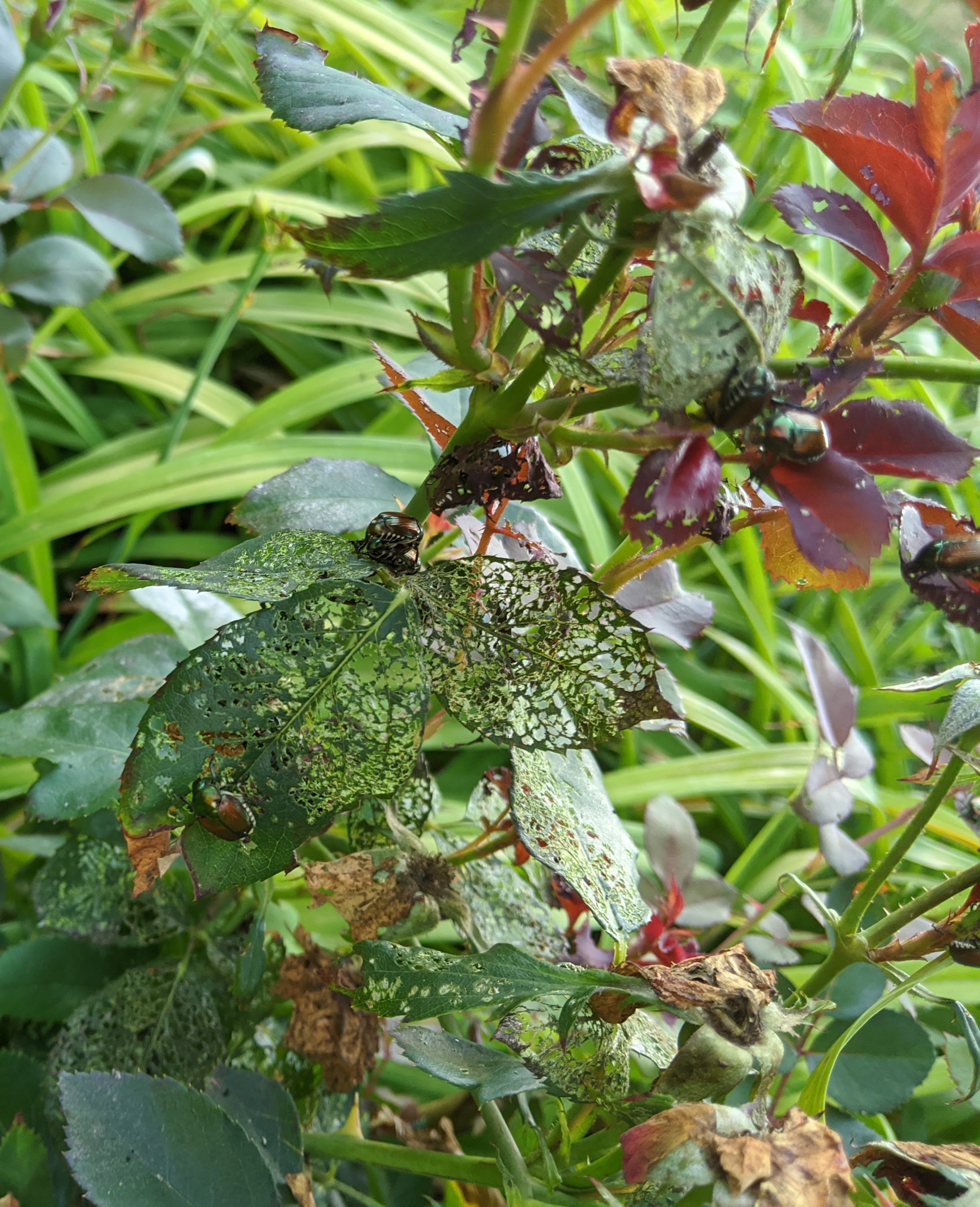
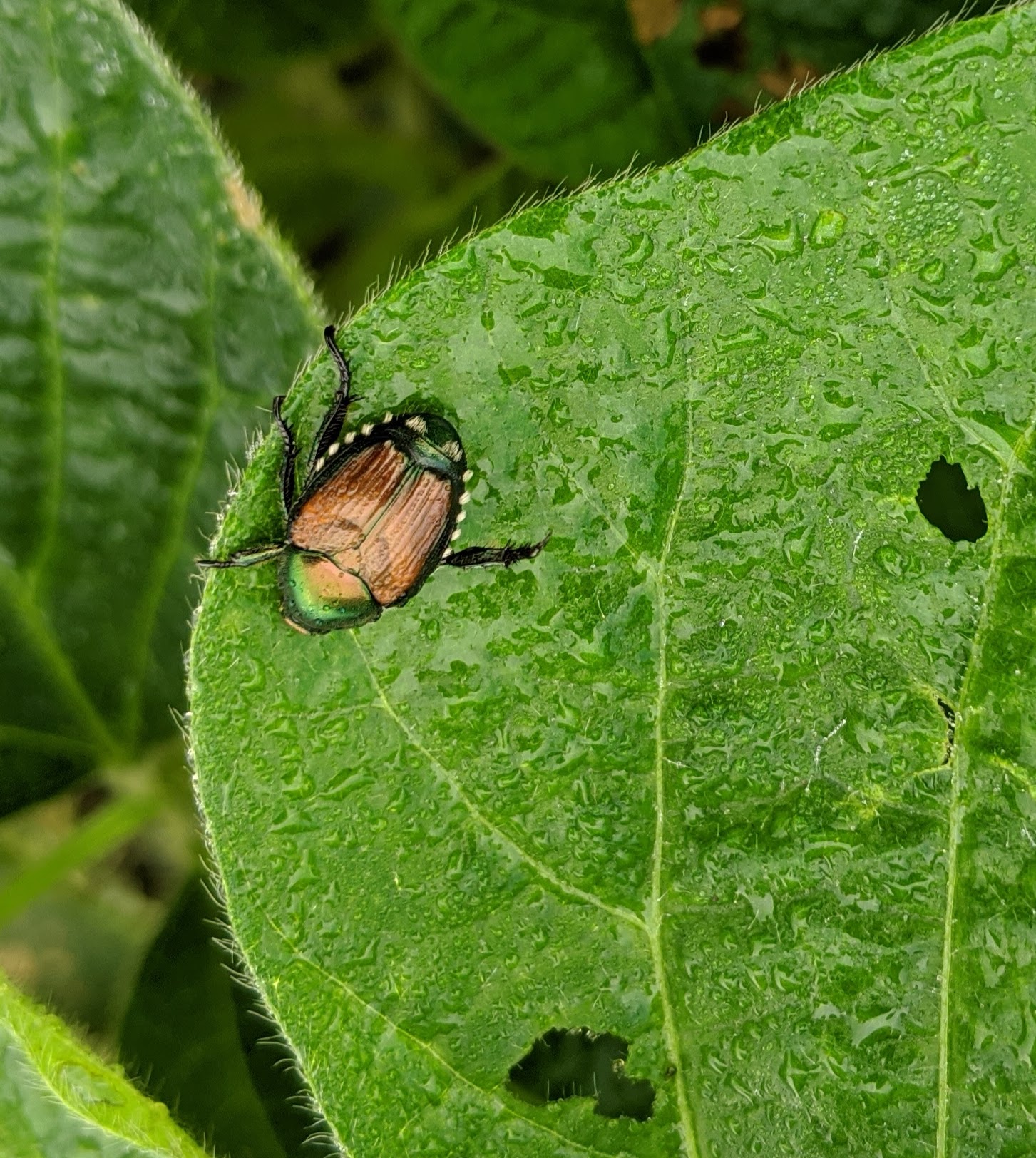
The adult beetle is ½” in length with a metallic green head and white ‘tufts’ that look like spots on its abdomen. Adults feed on 300 plant species, but their favorites are ones that are in many of our landscapes (roses, cannas, marigolds, grapes, Virginia creeper, and trees such as lindens, birch, Japanese and Norway maples, cherry, plum, peach, American elm). They also feed on soybean and corn crops. They love hot weather and full sun and feed on leaf tissue during the day (leaf tissue will look skeletonized or lacy and turn brown). Trees may be severely impacted with browning occurring from the top to bottom. Thankfully healthy trees will re-leaf next year since the underlying twigs and branches aren’t damaged-even if the entire canopy is impacted this year. It’s not recommended to remove branches or trees.
DO NOT use Japanese beetle traps!!! Research shows they attract beetles to the landscape and many homeowners I’ve talked with will attest to this!
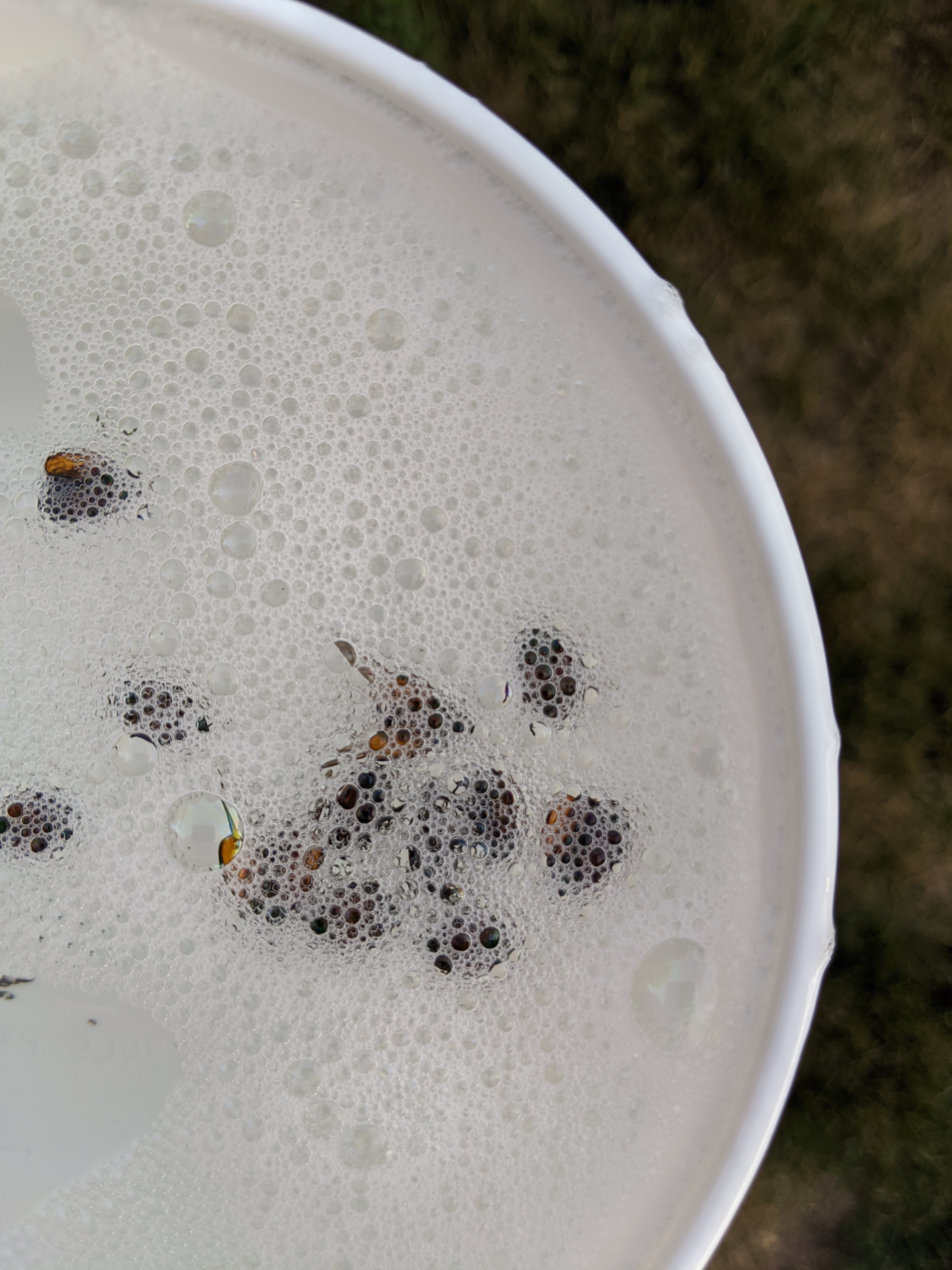
Beetle Control: Organic control options: Wait till 7-9 p.m. then knock beetles off plants into a bucket of soapy water to drown them. This method of control takes diligence over several nights. You can also spray trees with water to knock them down to the ground and then drown in soapy water. With heavy beetle infestations, it’s not uncommon to literally have scoop shovels full of the beetles when removing from trees. Neem and Pyola are two organic sprays that will protect for 3-7 days. Applying these products regularly (once per week) can also be effective as a repellent.
For conventional control options, keep in mind that Japanese beetles often impact the same flowering plants that other pollinators visit. Use insecticide products correctly to avoid damage to pollinators. Avoid spraying insecticides on windy days or when pollinators are present (best to spray late in day near dusk) and be sure to read and follow all label instructions and harvest intervals (for cherries, plums, vegetables, etc.). Conventional insecticides can provide 2 weeks of control: pyrethroid products like Tempo (Tempo can’t be used on vegetables and fruits) and Bayer Advanced Lawn & Garden Multi-Insect Killer (cyfluthrin) or Ortho Bug B Gone (bifenthrin). Sevin (carbaryl) is another option although more dangerous for bees. You can buy these products in most any farm, garden, box store…it may not be the exact products listed here, but if the active ingredient is a pyrethroid or any of those listed in parentheses above AND the product is labeled for the plant you wish to apply it to, you can apply it. Just be sure to read and follow label instructions.
Corn and Soybean Thresholds: Soybean thresholds are 20% defoliation in the reproductive stages. Thresholds for corn are: three or more Japanese beetles per ear, silks have been clipped to less than ½ inch, AND pollination is less than 50% complete. Pyrethroids are very effective against beetles. If one is concerned about flaring spidermites, a product like bifenthrin can be used.
Wellbeing Tips:
(Adapted from: Gilbert Parra, PhD; Holly Hatton-Bowers, PhD, and Carrie Gottschalk, LMHP, MS)
How Much Time do You Have?
2 Minutes:
- Breathe
- Stretch
- Laugh
- Doodle
- Acknowledge one of your accomplishments
- Say no to a new responsibility
- Look out the window
- (adapted) Faith based prayer
5 Minutes:
- Listen to music
- Have a cleansing cry
- Chat with a co-worker, friend, or family member
- Sing out loud
- Jot down dreams
- Step outside for fresh air
- Go for a brief walk
- Enjoy a snack or make a cup of coffee/tea
- (adapted) Read faith-based devotional
10 Minutes:
- Evaluate your day, Write in a journal
- Call a friend
- (adapted) Meditate, Prayer, Devotional
- Tidy your work area
- Assess your self-care
- Draw a picture
- Listen to soothing sounds/music
- Read a magazine
JenREES 7/4/21

Crops really look tremendous overall and got a report of some first tassels by July 4th as well! It’s been great to see people attending field days again the past few weeks and really appreciated the learning, sharing, discussion, and just watching people catch up with each other at them. I had mentioned before how the lack of freeze/thaw was impeding roots of crops, particularly soybeans in no-till fields. Irrigating and rain has helped them get some growth. What I hadn’t mentioned in my articles was being called to soybean fields with HPPD (Group 27) carryover from corn herbicides in 2020. We had a dry fall but had rain in March and May, so I wasn’t sure how to explain the carryover. One thing I learned last week from a discussion at the palmer amaranth field day was that the lack of freeze/thaw also impacts the ability of herbicides to breakdown. So, I appreciated learning that and am sharing if that helps anyone else as well.
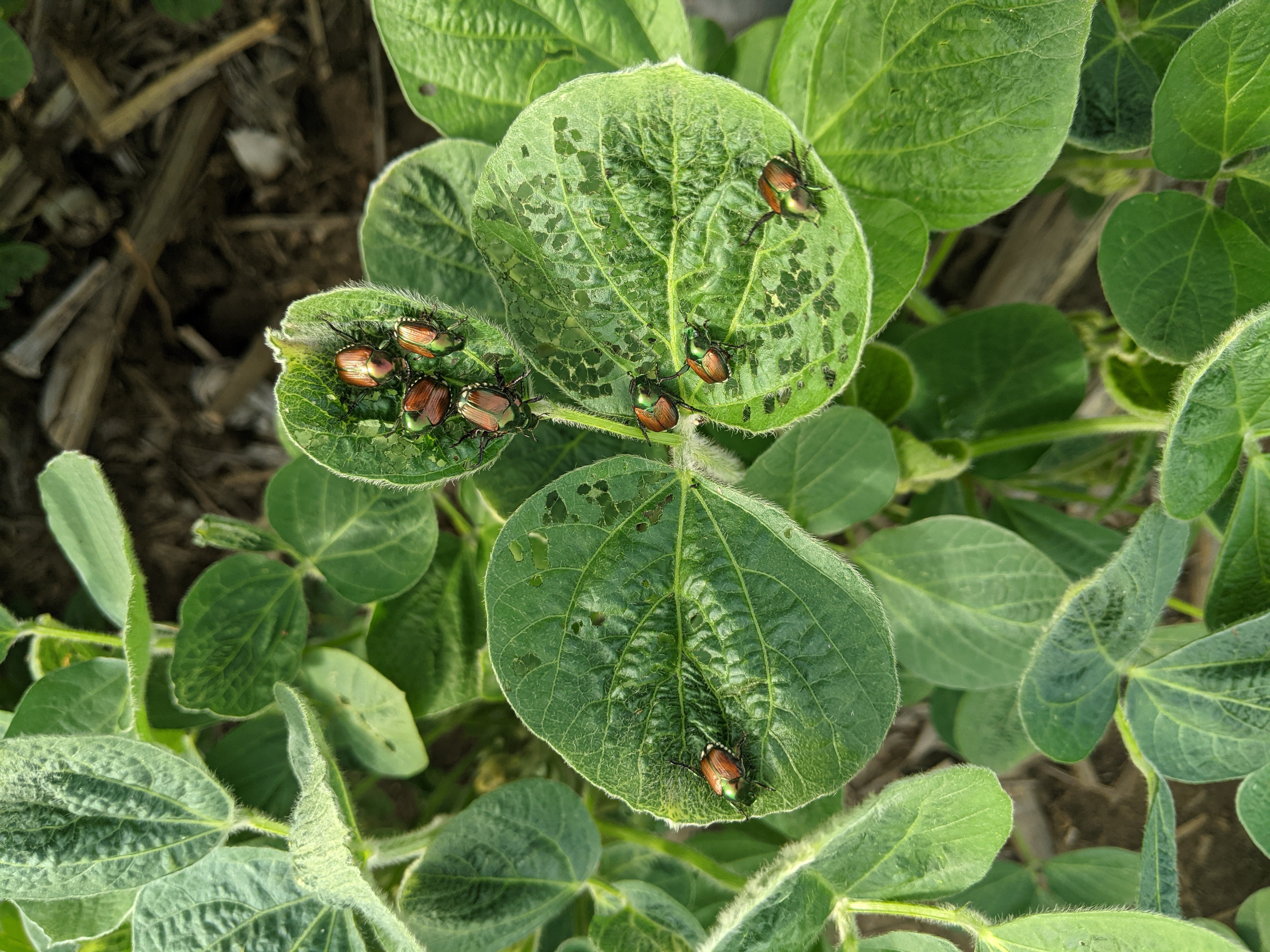
Japanese beetles are also heavy in pockets of the area. I will share more specifics next week. For those who are asking, the threshold for soybean defoliation in reproductive stages is 20%. Tom Hunt, UNL entomologist shared that pyrethroids in general are effective. However, if there’s potential for flaring spidermites due to dry conditions, bifenthrin is a consideration as it has activity for spidermites (particularly when considering soybeans). For homeowners, beetles can be dislodged off of plants right now in evening hours by knocking them into buckets of dishsoap water. Do not use pheromone traps as they will actually attract beetles to your yard!
Western Bean Cutworm: With crops nearing tassel, it’s time to be scouting for western bean cutworm moths and egg masses. There was a CropWatch article posted this week at: https://go.unl.edu/9v4a. It was predicting 5% moth flight for York on June 30th, Harvard July 2nd, and Central City July 3. I received a text from a crop consultant saying he found the first eggmass in the Central City area July 2, so that was pretty well on target! Twenty-five percent of WBC flight occurs when 2,577 degree-days Fahrenheit are reached. Entomologists recommend field scouting should occur at this point. For 25% moth flight, it’s predicting York on July 6th, Harvard area July 8th, and Central City July 9th, so we should start watching fields for sure this week. Look for egg masses laid on the upper surfaces of corn leaves, typically on the top 1/3 of the plant.
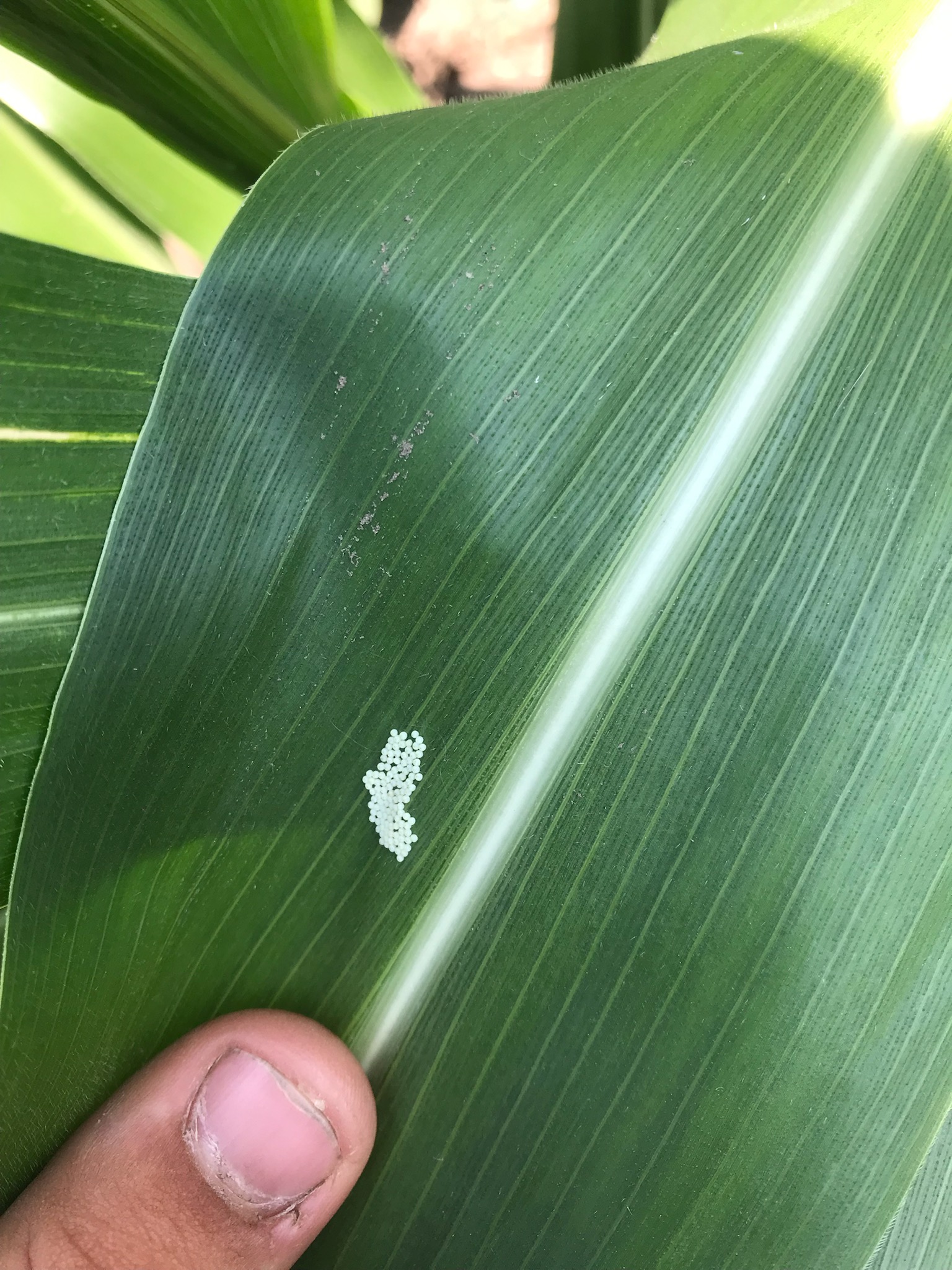
Chiggers: I should’ve written about this last week as chigger bites tend to peak around the 4th of July with more families outdoors. Chiggers (also known as redbugs or jiggers) are the immature stages of red harvest mites. They tend to hang out in moist, tall grassy/weedy areas such as along streams, road-side ditches, forested areas, lawns. But they can also hang out in moist and dry lawns with a lot of trees too. They bite humans and other animals including pets. Eggs are laid on clusters on plants and the larvae hatch and wait for their host to come along. They latch onto clothing, shoes, and fur and can hang on while working their way to the skin (often to an area where clothing is tighter like around socks, undergarments, back of knees and under armpits). They actually don’t burrow into human flesh. They only survive on a warm-blooded host for around 3 days before falling off to molt for the next stage in life cycle which doesn’t feed on humans.
They have needle-like mouthparts that allow them to pierce the skin then inject saliva that dissolves body cells in the area to aid them in feeding. Thus, they don’t feed on blood but liquefied cells. The feeding creates an allergic reaction in which many see swelling, intense itching, and small, clustered, red bumps (which can become larger welts in some). To prevent chigger bites, avoid sitting or lying on the ground when picnicking or working outdoors. Wear loose-fitting clothing and apply a repellent like DEET to shoes, socks, and pants before going into areas more favorable for chiggers. It’s also wise to take a hot shower with plenty of soap as soon as possible after being outdoors and launder clothing with hot water before re-wearing. Also launder any blankets/sheets being used outdoors. If you receive bites, rubbing alcohol can be used then apply an anti-itch cream to help reduce itching. Thankfully chiggers can’t live in the home but they can become dislodged in bedding and on floors, so laundering bedding and vacuuming is also wise. Keep lawns and shrubs well-manicured, particularly where adjacent to dwellings. If you tend to have problems with chiggers in your lawn, they can be reduced from 75-95% for several weeks with a liquid treatment of bifenthrin. Be sure to read and follow all label instructions.
JenREES 6/27/21
Crop Update: Overall, corn is looking really good with many fields around the 12 leaf stage. Soybeans were able to start growing again after some irrigation and rain. Also a note, the ET gage website is running again, so you can add ET info and view it again at: https://nawmn.unl.edu/. Grateful last Tuesday night’s storm didn’t do more widespread damage in the area than what it did! It looked pretty bad on radar, and in spite of the hail and wind, overall, many crops will recover and look a lot better in the next week. As the stripped leaves turn brown, there may be a brief point where the corn looks a little worse before more new growth shows up out of the whorl. Eventually it’ll look greener with more canopy again. Leaned plants are also righting themselves again.
It’s really hard to give a general summary as rain, hail, and wind has been so variable for the several county area. For this part of the State, crops north of Stromsburg and in the Hordville area got hit the hardest from what I’ve seen thus far. The key things to watch for in corn are stem bruising from the hail, stalk rot setting in, and rotted growing points. Some corn in the Hordville area that I looked at had deep stem bruising to the point the plants were broken off/breaking off near the ground in fields. Soybeans at the R1 stage in both areas were reduced to sticks in some fields. For fields that still have some leaves and some green to them, there are several criteria to look at when assessing hail damage to soybeans. These include determining plant stand, percent leaf defoliation, percent nodes cut off or broken over, and amount of stem damage. Determining percent leaf defoliation and subsequent yield reduction based on growth stage in indeterminate soybeans can be seen in the chart below. Hail damage charts show for R1 beans at 100% leaf loss, a 23% yield loss estimation (not including bruised stems, etc). I realize that’s really hard to accept with the way some fields look. The remaining charts can be found here. What has helped with all the hail and wind damage is the fact that we’ve had warmer temperatures to allow regrowth to immediately begin. There were new buds on soybean plants on Wednesday already and they were starting to flower again this weekend. However, that kind of loss to the canopy is difficult to recover from at R1 as weed control is also of concern. For alfalfa, watch for regrowth and so far, I’ve been seeing new growth. And, for wheat, it’s always tough to get hail so close to harvest as the grain shells out and heads break off.
| % Leaf Defoliation | |||||
| Growth Stage | 20% | 40% | 60% | 80% | 100% |
| % Yield Reduction | |||||
| V2 | 0 | 0 | 0 | 1 | 2 |
| V6 | 0 | 0 | 1 | 3 | 5 |
| R1 – R2 | 0 | 5 | 7 | 12 | 23 |
| R3 | 3 | 6 | 11 | 18 | 33 |
| R4 | 5 | 9 | 16 | 30 | 56 |
| R5 | 7 | 13 | 23 | 43 | 75 |
| R6 | 16 | 11 | 18 | 31 | 53 |
| R7 | 1 | 2 | 4 | 6 | 8 |
It will be important to work with your crop insurance adjusters as each field situation may vary. They will take stand counts and rate damage based on growth stage and percent of green leaf tissue (thus why they need to wait at least 7-10 days to determine new regrowth). Some have asked about the potential for replant options and/or forage crop options if the crop is totaled. First, you need to consider what herbicides were used. Second, for a corn situation, you need to consider if you want to go back in with corn, sorghum, or a forage crop (depending on what herbicides were used). We have such minimal data on short-season hybrids in the case of corn replant and yield. The UNL data that exists is from 1992 and it essentially says there’s yield potential for 100 bu/ac, depending on frost timing. Even though that’s old data, that’s consistent with information a Clay County farmer kindly shared with me regarding replanting corn in mid-July using 78 and 75 day relative maturity corn hybrids in 2018 and 2020. If you end up in a replant corn situation, I can share more specifics of his observations with you if you’d like to contact me.
If you find yourself in a soybean replant situation, make sure to add a seed treatment to replant soybeans as they have a high risk of seedling disease. Also, don’t plant a longer-season bean this late. I don’t know why that’s often recommended, but we would recommend going with a 2.0-2.5 maturity bean at this point in the season for our area of the State. If you drill the replant, be sure to increase seeding rate 10% (can go up to 20% for older drills) to account for the variability of seed spacing with the drill units. We often recommend increasing seeding rate by 10% for planted beans as well this late to aid in faster canopy closure. We share these tips in more detail with the research at: https://cropwatch.unl.edu/2019/strategies-delayed-soybean-planting.
Trees and Landscape Plants: Trees impacted by hail will often shoot new leaves for the leaves that were lost. It’s best to properly prune broken limbs back to the branch collar if at all possible to avoid disease setting into those limbs. You may also observe new buds occurring on shrubs, landscape plants, and garden plants, depending on how severely they were impacted.
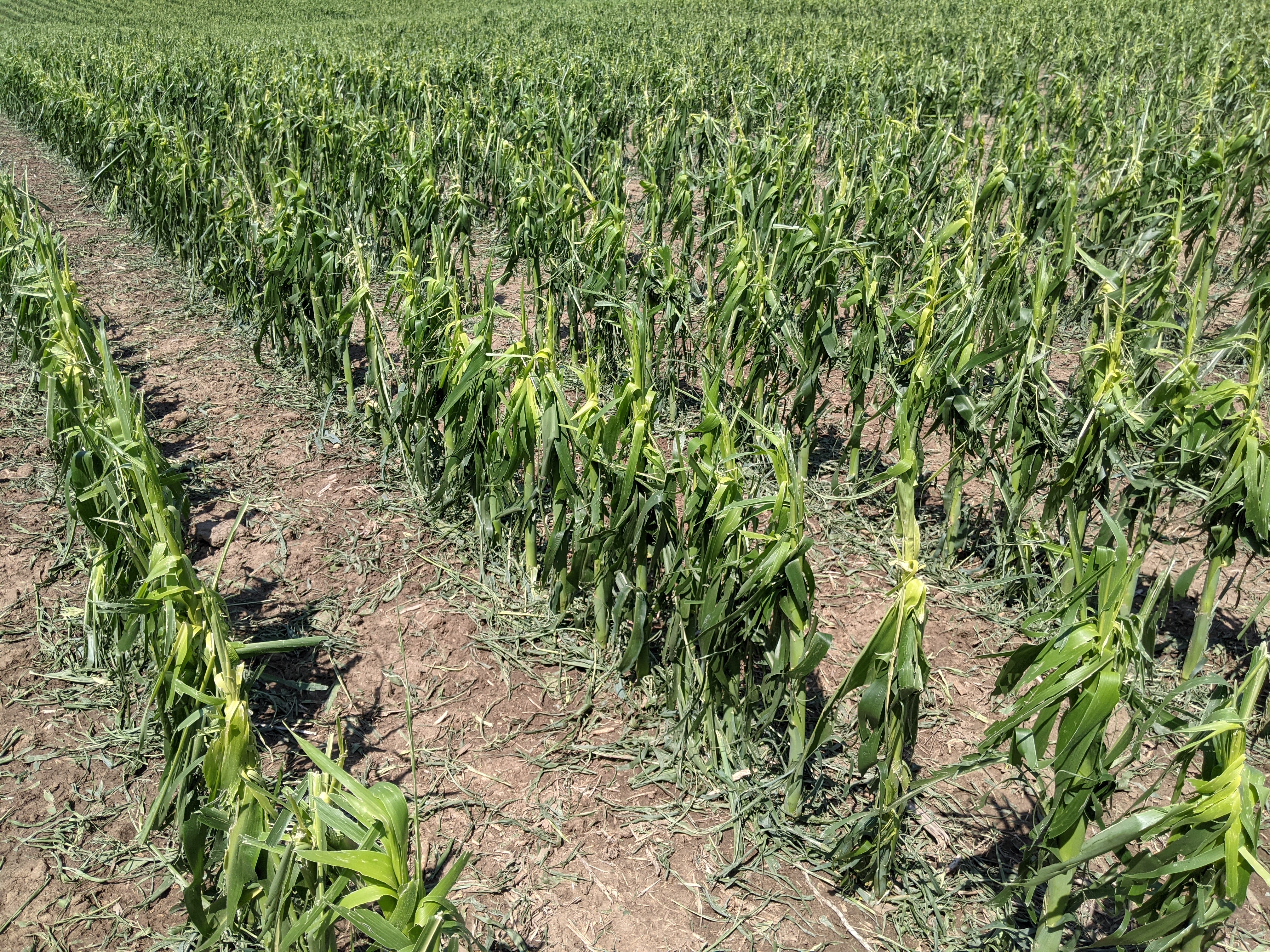

Plants in this V10-11 field were shredded back to the growing point. In this case, the hail damage to stems was mostly on the outside surface of the plants.

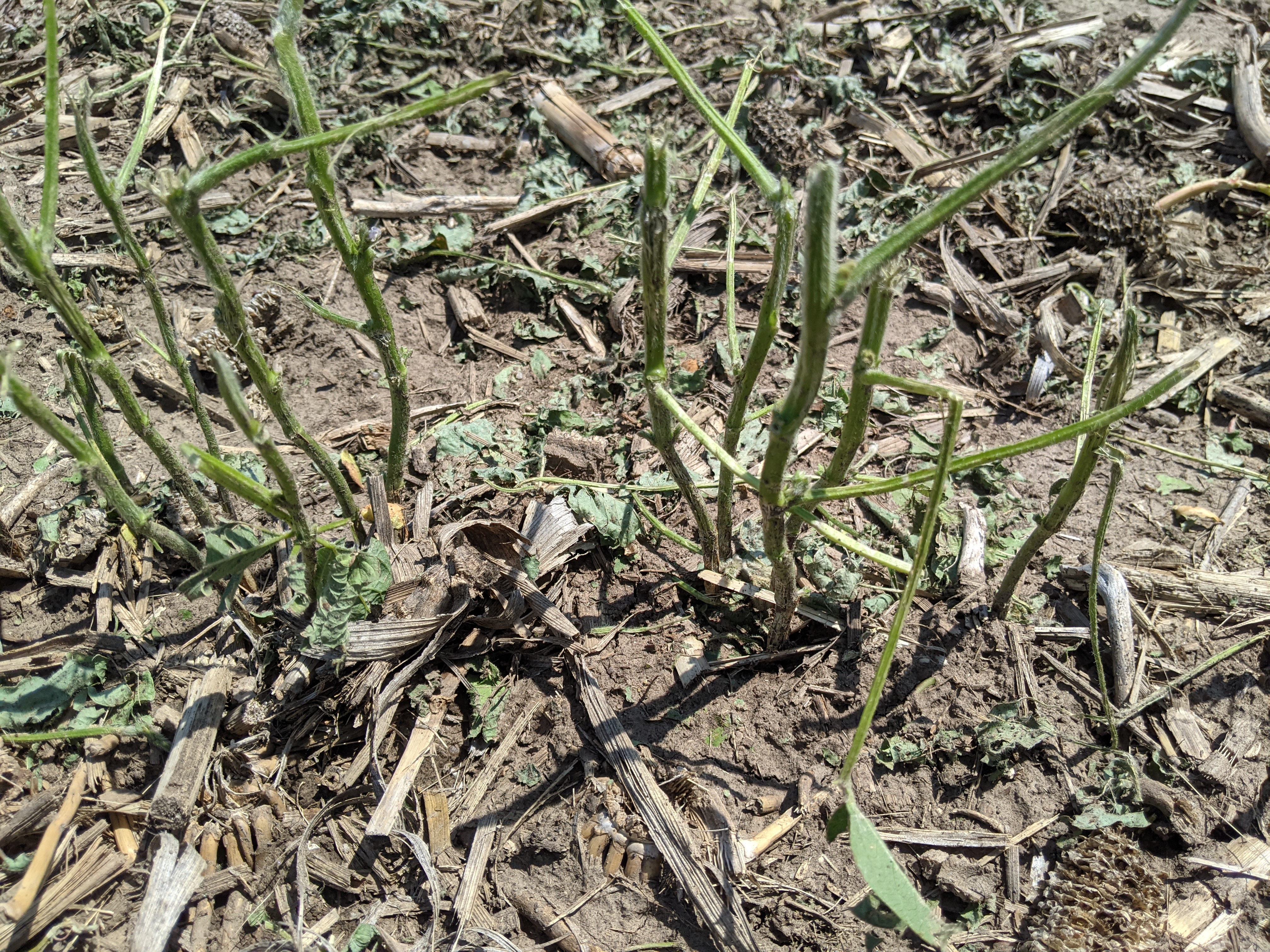


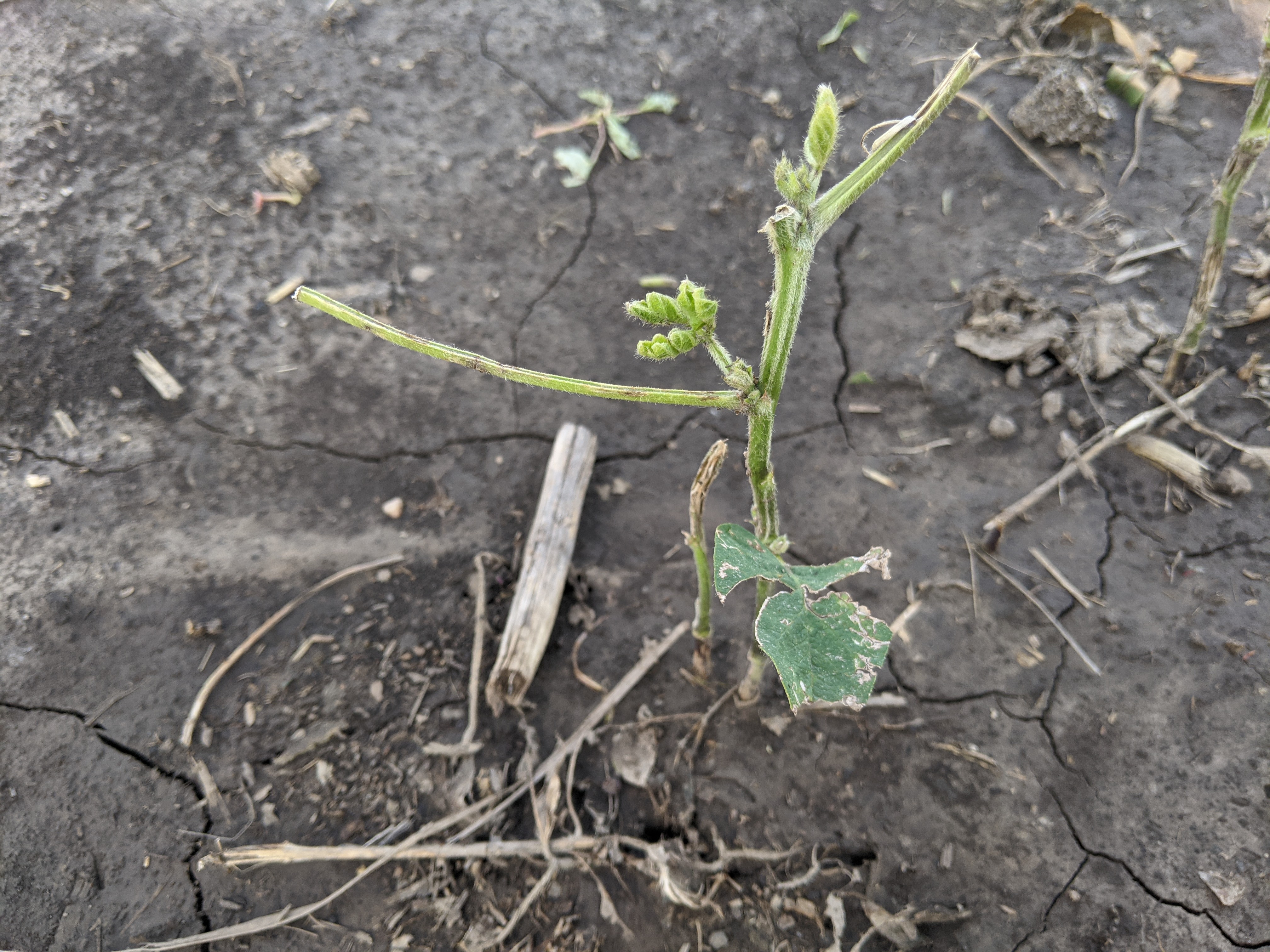
Same area of soybean field Wednesday afternoon (after previous night’s storm) and Sunday afternoon. Soybean reduced to sticks with new growth occurring Wednesday afternoon (first two pictures). New flowers occurring on soybean sticks and more growth observed Sunday afternoon (last two pictures).


