Category Archives: JenREES Columns
JenRees 11-1-20 Fall Applications
It’s November 1st as I write this. With much of harvest done, the next task for some may be fall herbicide applications and/or fall anhydrous application.
Fall Anhydrous: With nutrient management, we’re hearing more about the 4R’s. 1-Right Time is after Nov. 1st in our area NRDs. Extra important, consider soil temperature. Soil microbial activity and the conversion rate of ammonium to nitrate is very low when the soil temperature is less than 50oF. Thus, apply fertilizer-N (and manure) when the soil temperature at the 4” soil depth is below 50°F and trending cooler. You can view soil temps at: https://cropwatch.unl.edu/soiltemperature. 2-Right Source in the fall is anhydrous ammonia as it will bind to soil particles. Leaching risk is reduced in a dry fall and when applied at soil temperatures below 50°F. 3-Right Rate for each field is based on soil samples and various nitrogen credits. Can also consider splitting the application with part this fall and the remainder next season. 4-Right Place is making sure the anhydrous is deep enough. It’s also ensuring there’s a good seal, which will be something to watch in this dry fall.
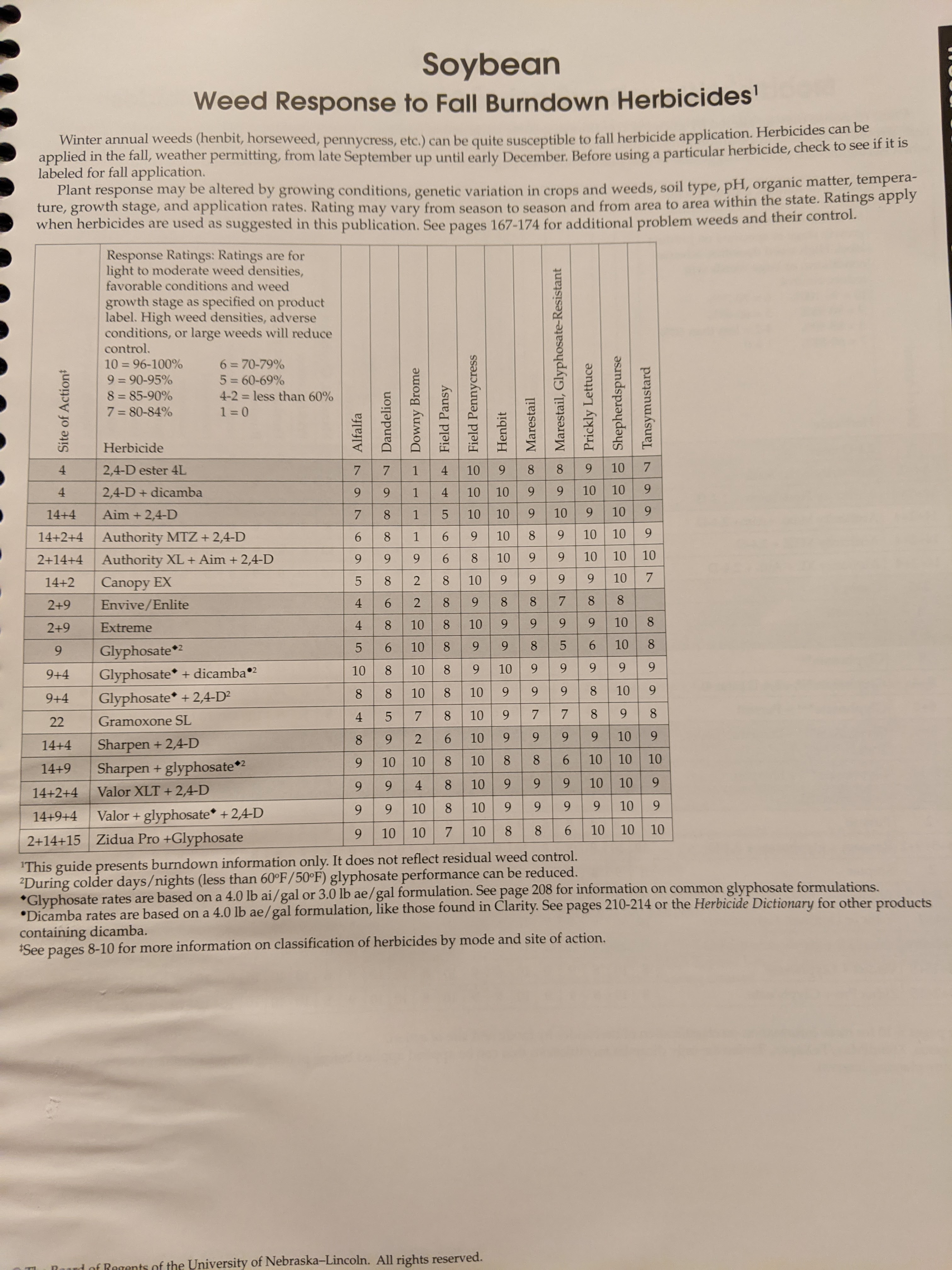
Fall Herbicide is one management tool to control winter annual weeds and marestail (horseweed); it may not be necessary for every field. It’s important to scout fields for current weed pressure. Also consider targeting fields that have a history of winter annual weeds or marestail. Nebraska research shows up to 95% of marestail germinates in the fall, so fall application can aid management. Some winter annual weeds also serve as hosts for pathogens like soybean cyst nematode (SCN): purple deadnettle (strong host), henbit (strong host), field pennycress (moderate host), shepherd’s-purse (weak host), small-flowered bittercress (weak host), and common chickweed (weak host). SCN can reproduce in the field on henbit and purple deadnettle.
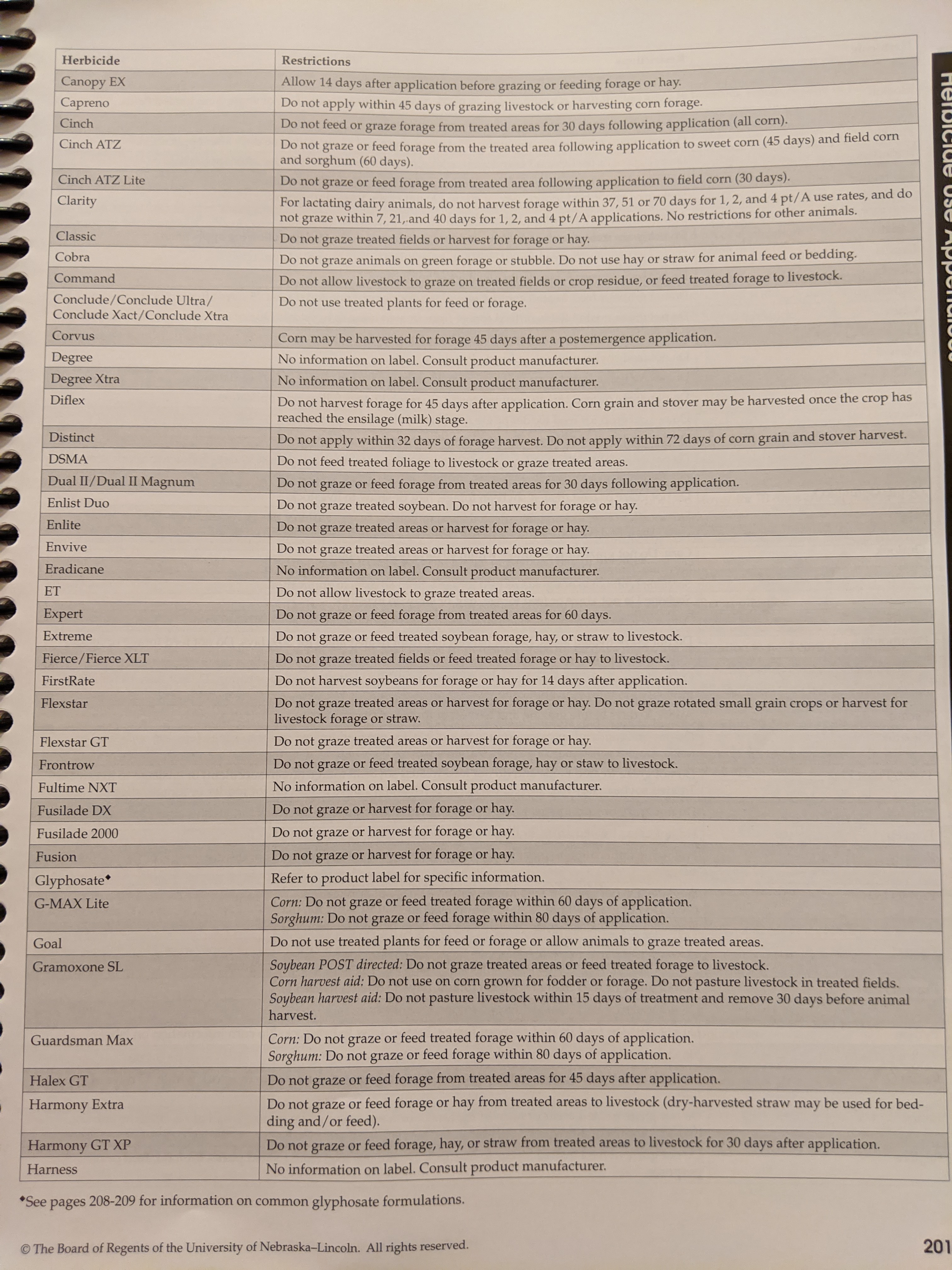
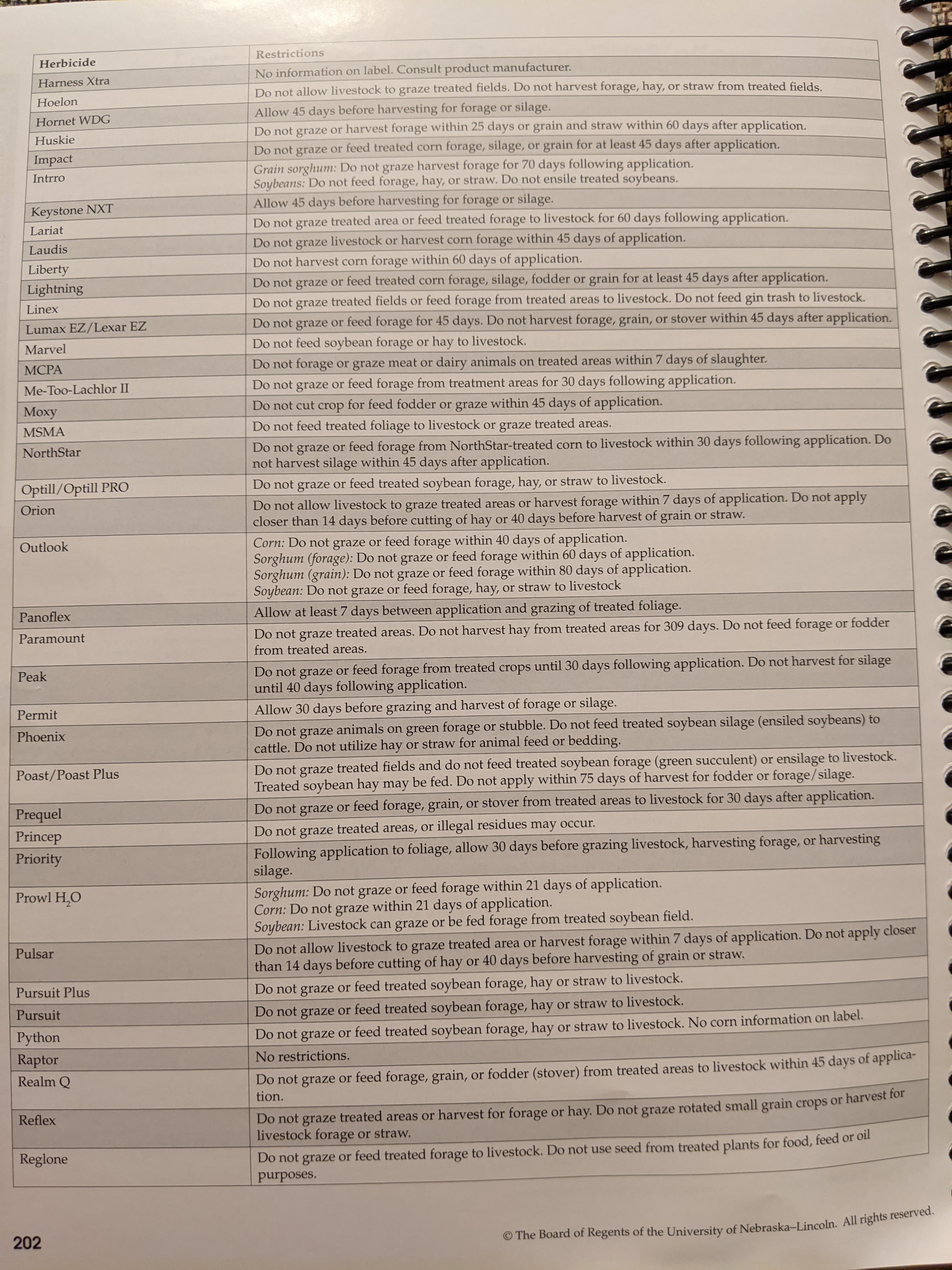
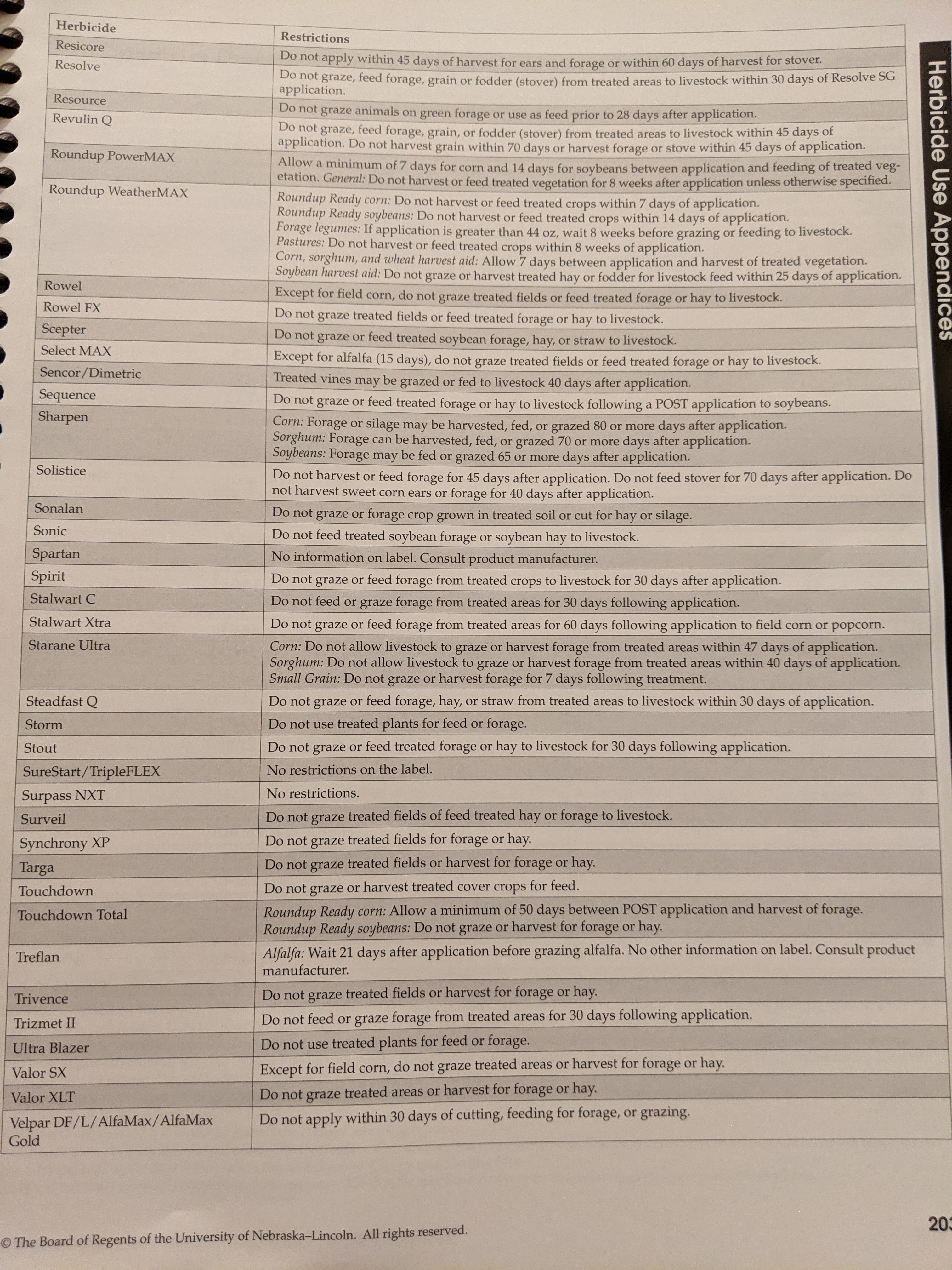
If you have a 2020 Guide for Weed, Disease and Insect Management, page 81 provides fall burndown corn herbicide options and page 127 provides soybean ones (I also show these at https://jenreesources.com/). Most products contain 2,4-D and/or dicamba. Tank-mixing a residual herbicide with a burndown product will improve marestail control because the residual activity will control marestail emerging after herbicide application. Be sure to check labels for any grazing restrictions if livestock will graze cornstalks after a fall herbicide application (You can find these on pages 200-204 of the 2020 Guide). If the label doesn’t specify and you want to be on the safe side, a rule of thumb is to use the pre-harvest interval for the amount of time to wait before grazing stalks.
Regarding temperatures, in a CropWatch article Dr. Amit Jhala and I shared the ideal temperature for applying most post-emergence herbicides is between 65°F and 85°F. Herbicides can be applied at 40°F to 60°F, but weeds may be killed slowly. When the temperature is below 40°F for an extended time after burndown, weed control will most likely be reduced, specifically for a systemic burndown herbicide such as glyphosate. Additionally, weed control may be reduced under cloudy conditions following an initial temperature drop below 40°F. With late-fall herbicide applications be sure to add labeled adjuvants to improve herbicide efficacy.
Actively growing weeds are key to achieving good control, regardless of herbicide used. Frosts of less than 25°F usually cause leaf damage to annual plants, making them poor targets for herbicide applications; however, winter annual weeds may tolerate a frost up to 20°F and continue growing when conditions improve, with little tissue damage. After weeds experience frost, active growth may not begin again for a few days. Growers should wait until new leaf tissue is produced, scout the field, and then consider applying herbicide. Generally, this would be when nighttime temperatures are 35°F or greater and daytime temperatures are at least 50°F for two consecutive days. Additionally, sunshine is needed for plants to recover.



JenREES 10-25-20

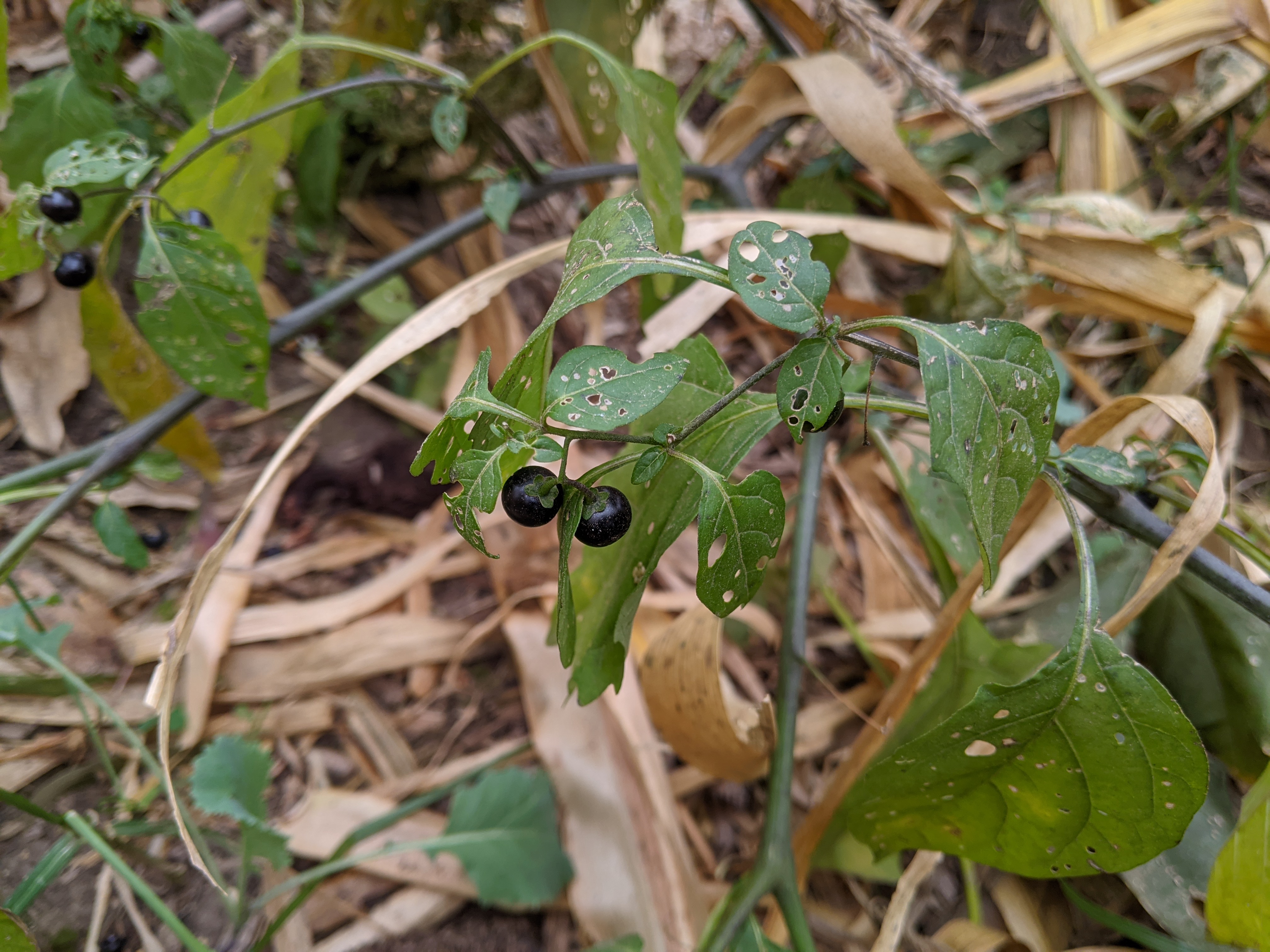
Grazing Corn Residue: Have received some questions on corn residue management. Cattle grazing can be a beneficial way of residue management if one has access to cattle. Note: I’ve been seeing quite a bit of black nightshade and some horsenettle, particularly in corn fields that had wind damage. Both species have poisonous leaves (increase concentration as plants age) and berries (decrease concentration as berries ripen). Frost doesn’t change toxin levels. UNL forage specialists say when cattle graze corn fields containing nightshade species, there’s enough dilution with the grain, leaf, and husk that poisoning shouldn’t be an issue. We’d recommend watching the cattle as some may prefer grazing the nightshade. I’ve also seen cattle prefer weeds after herbicide applications, so also watch that if fall herbicides are applied. Ultimately, would just recommend don’t turn cattle empty into stalks with significant amounts of nightshade, watch cattle, and don’t graze past the point of 50% of leaf/husk removal. Dr. Jerry Volesky shares more here: https://twitter.com/jenreesources/status/1320513145941692418?s=20.
So, how does one calculate 50% leaf/husk removal and the grazing days for cattle on corn residue? The following is information from my beef Extension colleague, Brad Schick.
- “There are 8 lbs of grazable dry matter per bushel of corn.
- Leaf and husk make up 39.6% of the dry matter in corn residue.
- Intake on corn residue fields will be close to 2% of bodyweight.

Having corn stalks to graze is a great resource for livestock producers. For dry cows, it is a relatively inexpensive feed that can typically meet or come very close to meeting nutritional needs. Grazing can also help get rid of corn remaining in the field and potentially reduce volunteer corn the following year. But are cattle really grazing stalks?
Yes and no. In everyday conversation, grazing corn stalks is said, but the stalk is the last thing cattle eat. Cattle do eat stalks, particularly if they are left on a field too long, but they are primarily consuming leaf, husk, and leftover corn. The stem or stalk makes up about 48.5% of the residue, while the leaf blade and husk make up 39.6%. Cattle will consume leaf and husk if available. That diet will consist of 52 to 55% TDN (total digestible nutrients) and 5 to 5.5% crude protein.
When thinking about how long to graze corn residue, the calculation to follow is that for every bushel of corn produced, there is 16 lbs of dry leaf and husk. The recommended grazing plan should be to remove 50% of the leaf and husk. This assumes that portions of the forage will also be lost to trampling, defecation, and other considerations such as wind. That leaves 8 lbs (16 lbs X 50%) of good forage on a dry matter basis that is available for consumption for every bushel of corn.
For example, say the field produced 200 bu/ac corn. By the calculations, there is 1600 lbs of dry matter per acre available (8 lbs X 200 bu = 1600 lbs). A 1000 lb animal will consume about 26 lbs of dried forage per day which means a 1300 lb animal will consume about 34 lbs per day. However, with lower quality forage such as corn residue, intake will be closer to 2% of bodyweight. In this example, that means closer to 26 lbs for the 1300 lb animal. So, how many days of grazing is that? By the calculations, there are 61 days of grazing for one cow grazing one acre (1600 lbs DM ÷ 26 lbs = 61 days). A general rule is about 30 cow days per 100 bushels/acre of corn produced.
Calves and replacement heifers can be also be a great option but will need a protein source in order to meet their growing requirements. Not only is grazing corn residue good for the cattle producer, but it is also good for the crop producer. Studies from the University of Nebraska-Lincoln have shown that grazing corn residue increases or at least maintains crop yields. (Grazing Corn Residue: A Win-Win for Crop and Cattle Producers).” More info. can be found at: https://go.unl.edu/fsa9.
JenREES 10-18-20
This week I don’t have a crop update, just grateful for how well harvest continues to progress and how many farmers have shared they finished this week or are near the finishing mark. It’s also heartwarming to see so many friends and neighbors rally around farmers in need across the country.

I’m also grateful to all the farmers who worked with me in on-farm research studies and plots this year! We had 20 and will share the results when the data is compiled. Six of the on-farm research studies were on nitrogen management in partnership with the UBBNRD. As harvest finishes and you turn your attention to planning for next season, one topic on your mind may be nitrogen management. There was a recent CropWatch article written with some considerations here: https://cropwatch.unl.edu/2020/planning-2021-fertilizer-n-application-following-dry-2020
Are you interested in how agricultural technologies can improve nitrogen management on your farm? Nebraska Extension received a $1.2 million On-Farm Conservation Innovation grant from USDA – Natural Resource Conservation Service which connects corn and wheat producers across Nebraska with access to cutting-edge technologies through on-farm research. The goal is for producers to get hands-on experience with new technologies to manage nitrogen more efficiently and evaluate how these technologies will work on their operations. Interested producers will be able to select from several project options. They include:
- Nitrification Inhibitors for Corn
- Crop Canopy Sensing for Corn N Management
- Crop Model Based Tools for Corn N Management and Split-Applications
- Crop Sensing for Wheat N Management.
Producers and consultants will work closely with Nebraska Extension to accomplish the project. Eligible producers who complete these studies will receive $1,300 for recognition of their time and resource commitments and to mitigate risk of potential yield (and therefore potential profit) loss. Cooperating producers will also be eligible to receive up to $1,200 for eligible technology costs associated with these studies.
Interested growers should contact me at jrees2@unl.edu, your local Extension Educator, or Laura Thompson, Director, Nebraska On-Farm Research Network at laura.thompson@unl.edu. Additional information regarding the project can be found at https://cropwatch.unl.edu/precision-nitrogen-management-farm-research-project.
Women Managing Ag Land Conference on Dec. 2nd from 11:30 a.m.-2:30 p.m. will offer learning opportunities for female farmland owners and tenants looking to improve their business management skills and navigate the challenges of owning and renting agricultural land. Attendees will have the opportunity to attend either in person or virtually via Zoom. The closest in-person event locations near Eastern Nebraska R&E Center near Mead and Holiday Inn at Kearney will have limited attendance and health measures will be implemented. The keynote address, “Finding Happiness in the Craziness of Life,” will be delivered by Kathy Peterson, a farmer from Storm Lake, Iowa, and founder of PeopleWorks, Inc. Additional topics include: “Improve your Ag Lease by Improving the Landlord/Tenant Relationship” by Extension Educator Allan Vyhnalek, “NextGen A Win-Win for Beginning Farmers & Asset Owners” by Karla Bahm with NDA, “Navigating Uncertainty in 2021: Nebraska Land Values & Cash Rental Rates” with Ag Economist Jim Jansen, and more!
Registration on or before Nov. 18, is $25. Registration on or after Nov. 19 is $30. Registrations for in-person locations will close Nov. 29. Lunch will be included at each in-person site. This conference is hosted by Nebraska Extension and inspired by Annie’s Project. More information and registration at: https://wia.unl.edu/WMAL.
JenREES 10-11-20
Crop Update: This has been an interesting harvest season and yet, overall good one. To be at October 11th with so much of the area crop harvested is a blessing! I’ve heard growers thankful for the good harvest conditions and ability to go anywhere in fields without fear of getting stuck. Many were grateful for good soybean yields.
As we get further into corn harvest, there’s perhaps disappointment experienced on corn yields and moisture variance. Honestly, I’m struggling to explain some of it. Part of it is the difference in rainfall that we received in various parts of counties this year. There’s non-irrigated fields receiving 180-220 bu/ac which is a blessing! Another part is the impact of the July 8th wind event in which some fields had greater greensnap while others had more leaned plants. Depending on severity, was estimating and now seeing/hearing a lot of 180-240 bu/ac irrigated corn in those fields. The UNL Hybrid Maize model was predicting average yields for irrigated in this area of the State based on weather conditions. I just thought we may see actual yields go a little higher with how long it took to reach black layer. Have seen a couple really high yields with longer season numbers harvested wet.
Corn also greatly varies in moisture. Non-irrigated fields are quickly reaching 15.5% and lower. Irrigated fields range from 15-23%; what I can’t explain is that for hybrids planted in the same time-period, some short season ones are staying wet while some longer season ones are dryer. Everyone who has shared this situation with me had applied fungicide to their fields for southern rust control. Some also fertigated. Ultimately, just sharing what I’ve seen and heard thus far.

Received some questions this week on sampling for Soybean Cyst Nematode (SCN). It continues to be Nebraska’s top yield-limiting soybean disease with research showing it can cause up to 40% loss. The Nebraska Soybean Board is again sponsoring free sampling courtesy of soybean checkoff dollars. You don’t need a special bag to submit samples as a quart-sized plastic zip-top bag will suffice. If you had areas of a soybean field that yielded less than expected, particularly any areas that also showed sudden death syndrome or brown stem rot, consider taking a soil sample for SCN this fall. The female nematodes live in the top 8” of soil, thus sampling is as easy as taking your fertilizer sample for the following year’s corn crop and sending part of it in for an SCN analysis.
To collect a soil sample, use a soil probe to collect soil cores from a zig-zag pattern representing the lower yielding area of the field. For comparison, it’s wise to also take another sample from a better yielding area of a field. I’ve found that around 12 cores per sample is enough to provide around a 2 cup sample of soil that will fit in a ziplock type bag (and not have excess that needs to be dumped out). Be sure to label the bag with your contact info, field name, or other ID to report the results back to you. Also be sure to fill out a completed sample submission form requesting SCN analysis and mail the samples to the UNL Plant & Pest Diagnostic Clinic (1875 North 38th Street, 448 Plant Science Hall, Lincoln, NE 68583-0722). For those who submitted samples during the summer, campus mail is better now that the University campus is open again.
Caring for Drought-stressed trees/shrubs: With the continuing dry conditions, this is a critical time to prepare woody plants for winter and prevent winter injury, especially to evergreens. Dry fall conditions can reduce the number of leaves, blooms and fruits trees produce the next season. Trees often delay the appearance of drought-stress-sometimes months or years after the stress occurs. Even after the drought has ended, trees that experience drought stress are more susceptible to secondary attack by insect pests and disease problems, such as borers and canker diseases, which can cause tree death. When watering, moisten the soil around trees and shrubs, up to just beyond the dripline (outside edge of tree leaf/needle canopy), to a depth of 8 to 12”. Avoid overwatering; but continue to water until the ground freezes as long as dry conditions persist.
JenREES 10-4-20
Corn observations: It seems amazing to me to be where we’re at with harvest and it’s only October 4th as I write this! Many farmers finished beans last week and started on corn. It’s a good feeling to be at this point; can also appreciate there’s been no rain and not a lot of breaks either. Please be safe!
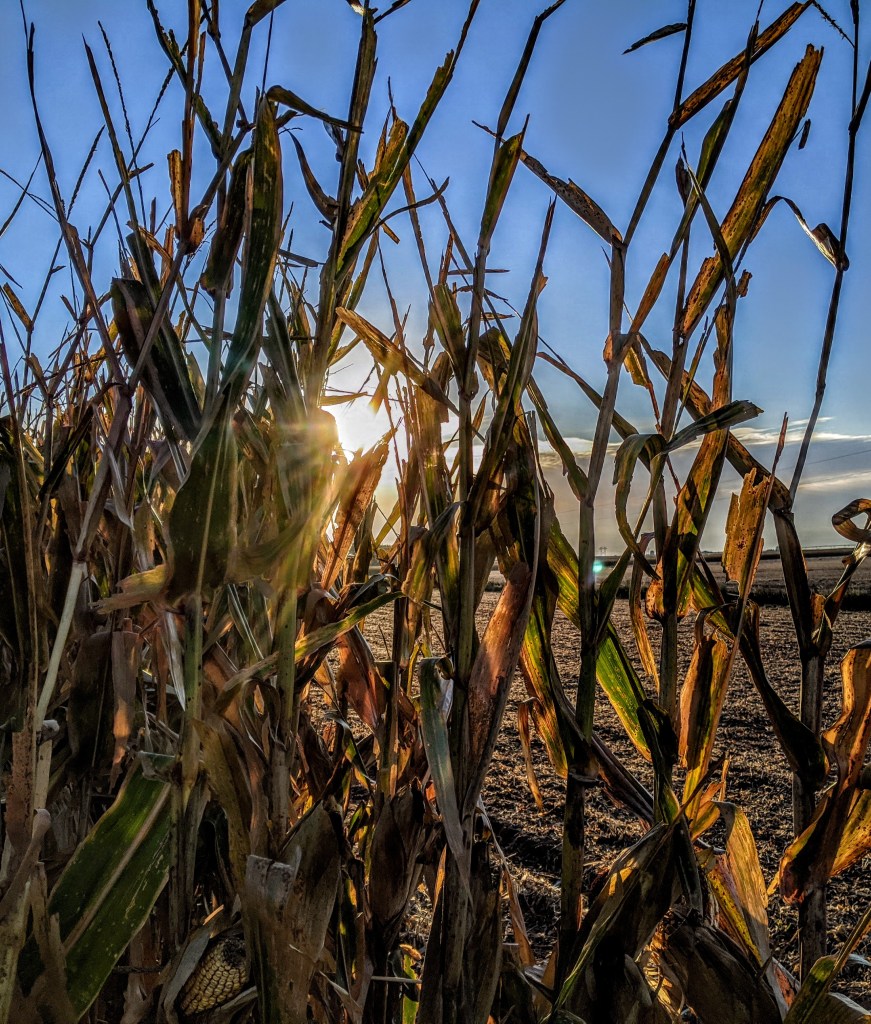
This past week was spent taking corn notes and starting to harvest corn studies. Besides harvest stand counts, I also like to look at percent stalk rot in fields. This gives an idea regarding standability and harvest priority. To do this, I use a pinch test using my thumb and first finger to pinch the elongated first or second internode above the soil line on 20 plants in an area of the field. Stalks that are compromised will “give” or “crush”. Obtain a percentage for the number of stalks that do so. Quickly doing this in five areas of the field provides a better idea of stalk health and harvest priority. Stalk quality pinch test video at: https://youtu.be/7z75VN1c51Q. So far, much of the corn is standing well. I’m mostly finding compromised stalks on plants that had premature ear droop. It will be especially important to assess stalk rot for fields that had high southern rust pressure and weren’t sprayed with a fungicide.
Another observation is some weakened ear shanks, although I can’t say this is a problem yet or even widespread. Weakened shanks makes sense on ears that prematurely drooped as that ear shank collapsed. Things we know cause weakened ear shanks and ear drop include stresses like high heat and/or moisture stress around pollination, large ears after this type of stress due to long grain fill, fungal disease like Fusarium infecting the shank, and to an extent, genetics (regarding shank diameter size). As we think of this year, we had the July 8th wind storm shortly before tassel which caused additional stress on plants. Corn also had a long fill period creating larger ears. So again, not saying this is a problem, just something to watch.
Stress cracks and broken kernels are another thing to watch for and seek to minimize. We know this can occur during the grain drying process in the bin when high moisture corn is dried with high heat followed by rapid cooling. In one conversation this week, a farm family was wondering if there were conditions that led to more stress cracks to corn in the field this year. I really don’t know. Found one publication that said internal, invisible stress cracks can also occur during kernel fill as a result of high temperatures and/or high moisture. However, the focus of the publication was viewing cracks with other types of imagery instead of the physiology, so I don’t have more to share on that. Broken kernels can also occur with harvesting higher moisture corn (above 20%), particularly with too high of rotor speed. A handful of guys have mentioned seeing broken kernels as they’ve been harvesting above 20% and shared the combine adjustments they’ve made to minimize them, so thought it may be something to mention. Combine setup is not my expertise but with a quick search, there’s a number of YouTube videos and websites regarding reducing broken kernels that may be helpful.
Corn Drydown Calculator: If you’ve never seen it or used it before, Iowa State University has a neat tool that estimates corn drydown in the field based on weather forecast for a particular area. It’s called the corn drydown calculator and you can find it at: https://crops.extension.iastate.edu/facts/corn-drydown-calculator.
Land Leasing for Solar Development Oct. 9th: Just a reminder of this virtual seminar to be held October 9th from 11 a.m. to 1 p.m. You can register at https://go.unl.edu/solarleasing. This seminar is open to the public. Farmers, landowners, and their families in areas with potential solar development have much to consider and should consider attending. This webinar will give an overview of solar development and touch on major issues to consider when negotiating a solar lease agreement. More info. on this topic at: https://cropwatch.unl.edu/2020/considerations-leasing-land-solar-development.

JenREES 9-27-20

Bean harvest was rolling this week. Hearing non-irrigated beans in the area ranging from 40-60 bu/ac and irrigated beans going 70-90+. Regarding solar radiation and some wondering about smoke impact on drydown, I ran data from 9/1/20 though 9/26/20 for Harvard and York weather stations. Then looked at long term average for this same September time-frame from 1996-2020. Both stations showed slightly higher solar radiation in 2020 compared to the long-term average for September (York: 379 and 372 langleys respectively) (Harvard: 383 and 376 langleys respectively). And, it was higher yet for 2020 when I queried Sept. 10-26 for same time periods. So, unsure solar radiation was the factor impacting drydown for this part of the State?
Small Grains and Weed Control: Been watching weed control particularly in soybean fields. For future columns/winter programs, I’d like to hear from you. What weed control approaches have worked in your soybean and corn fields? I’m curious about all systems and all types of weed control options. Please share at jrees2@unl.edu or give me a call at the Extension Office. Thanks!
In the past, I’ve shared weed control begins at harvest by not combining patches of weeds or endrows full of weeds. I realize that’s difficult to do, and for many fields, we’re past this point. From a system’s perspective, another option to aid weed control is to plant a small grain such as wheat, rye or triticale this fall. We had a whole edition of CropWatch devoted to wheat production here: https://cropwatch.unl.edu/2020/september-4-2020. Wheat provides an option for both grazing and grain. Rye provides the best option for earliest green-up/growth in the spring and longest seeding time as it can be seeded into December. Triticale provides the most biomass but produces the latest into late May/early June. All keep the ground covered from light interception penetrating the soil surface which allows weed seeds to germinate. While I’ve observed this in farmers’ fields, there’s also recent research from K-State that supports the impact of a small grain in rotation for weed control.
One study looked at marestail (horseweed) and palmer amaranth control from 2014-2015 in no-till soybeans at six locations in eastern Kansas. They also found the majority of marestail emerged in the fall (research from UNL showed up to 95% does). They compared five cover crop treatments including: no cover; fall-sown winter wheat; spring-sown oat; pea; and mixture of oat and pea. Cover crops were terminated in May with glyphosate and 2,4-D alone or with residual herbicides of flumioxazin + pyroxasulfone (Fierce). Ten weeks post-termination, palmer amaranth biomass was 98% less in winter wheat and 91% less in spring oat compared to no cover crop.
Another study in Manhattan from 2015-2016 compared fall-seeded rye; a residual tank-mix of glyphosate, dicamba, chlorimuron-ethyl, tribenuron-methyl, and AMS; and no fall application. Four spring treatments included no spring application or three herbicide tank mixes: glyphosate, dicamba, and AMS alone or with flumioxazin + pyroxasulfone (Fierce) as early preplant, or as split applied with 2/3 preplant and 1/3 at soybean planting. They found the fall rye completely suppressed marestail while fall herbicide suppressed biomass by 93% and density by 86% compared to no fall application. They also found rye to reduce total weed biomass (including palmer amaranth) by 97% or more across all spring applications. In both studies, soybean yields were best with the combination of cover crop + herbicides or the combination of fall + spring herbicides compared to no cover and no herbicides.
The way I think about this for conventional systems is that the use of a small grain in the system reduces the pressure on the chemicals for having to provide all the control. It also buys some time for chemical control, perhaps even removing one application (based on these studies, small grain delayed at least a month till 50% palmer germination). Economically, while there’s the expense of seeding and purchasing the small grain seed, what are the other economics to consider? What could the small grain provide by reducing an additional chemical application, adding a forage crop after harvest, selling seed (if there’s a market), selling straw (depending on location for moisture savings & ability to get a cover back in for weed control), etc.? Just some considerations this fall looking at weed control by adding a small grain.
JenRees 9-20-20
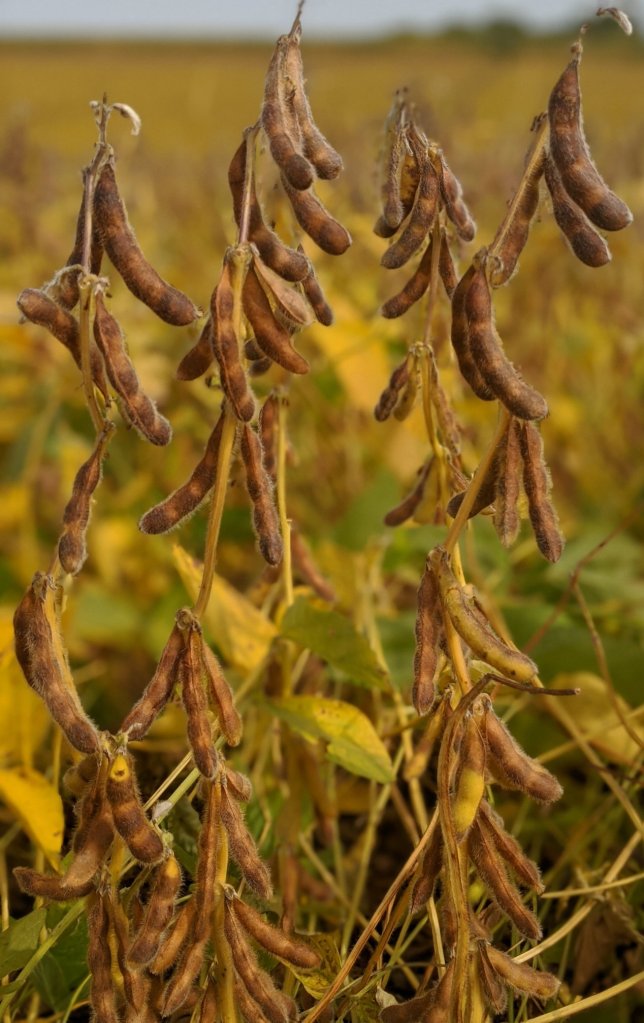
Soybeans: The past week I was mostly in soybean fields taking harvest notes for on-farm research or helping harvest plots. The non-irrigated yields have been better than anticipated for the beans just dying in fields; I can’t help but wonder what they could’ve been had there been rain in August! As noted last week, there’s a definite difference in varieties as to the number of 4-bean pods. Some varieties are loaded with pods and it’s not hard to find 4 bean pods. Others in our variety studies have a majority of 3 bean pods and it’s rare to see 4 bean ones. It will be interesting to see yields, and may be something to observe in varieties on your farms if you’re curious. Will also take a look at solar radiation data as several commented the smoke seems to be impacting drydown of irrigated soybeans.
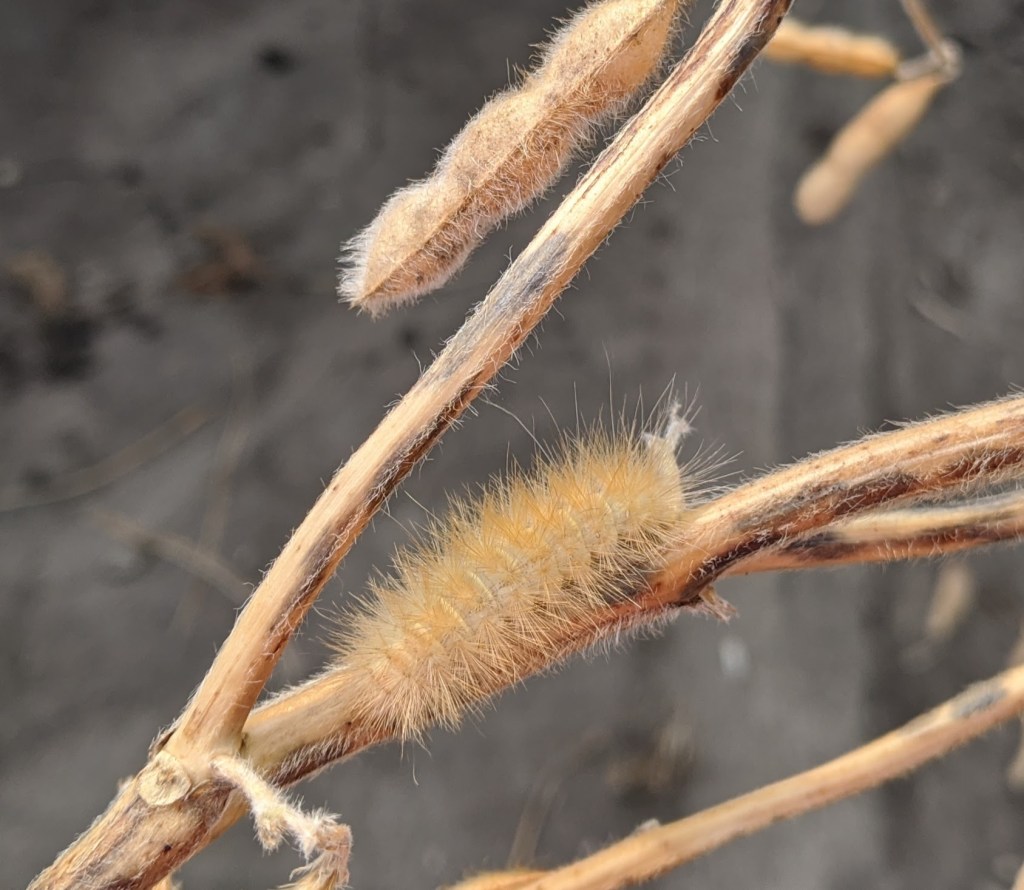
Woolly Bear Caterpillars are noticeable in soybean fields as are stink bugs and loopers; however, woolly bears are also on the move from soybean fields to find green plant tissue elsewhere. In past years, it’s not uncommon to find them crossing roads. I had a couple of reports towards the end of last week of them demolishing garden plants and shrubs. They probably don’t need controlled in all cases and not all products are as effective on them. Bifenthrin is labeled to be effective on them and can be used on a variety of plants, so that may be one option if treatment is necessary.
Stalk Nitrate Test: A corn stalk nitrate test can provide an indication if the amount of nitrogen for the corn plants was low, high, or sufficient for that year. This test involves taking an 8” sample of the stalk. It should be taken 6” above the soil line and go to 14” above the soil surface. All leaf sheaths should be removed from the stalk. 15 samples should be collected 1-3 weeks after black layer from a one acre area that represents a larger area (same soil type, etc.). Sample other areas of the field with different soil types or management. Then place stalk samples into a paper bag (don’t use plastic) and ship the samples within one day or refrigerate until shipping. It’s important to take the sample from 6-14” above the soil line because all the research to create the test was done from that area of the stalks. Also note that situations like a good grain fill season, drought, or poor ear development can all impact the test providing lower or higher numbers. This test isn’t to be used to determine nitrogen rates. It just gives a ballpark over time regarding if too much, too little or sufficient nitrogen is available on a consistent basis over years in a field. If the test results over several years are consistently high (greater than 2000 ppm), it would suggest the grower could reduce nitrate rates without impacting yields. If too low, the grower could consider additional nitrogen or adjust nitrogen management within the field. You can read more about this test here: https://store.extension.iastate.edu/product/Use-of-the-End-of-Season-Corn-Stalk-Nitrate-Test-in-Iowa-Corn-Production. My colleague, Aaron Nygren, also created a short Twitter video here: https://twitter.com/ColfaxCountyExt/status/1305982739791966208?s=20.
Sensors and ET gages: A quick reminder to remove any sensors for irrigation scheduling and ET gages from your fields before harvest. In the midst of everything else, it can be easy to forget about them!
Fall Lawn Fertilization: Early September is one of the best times to fertilize Kentucky bluegrass and tall fescue. There’s still time to apply if it’s not yet been done. One application may be all that’s needed on older lawns (10 to 15 or more years). Use a fertilizer with at least a 50% slow release nitrogen source. Two fertilizer applications are recommended on younger lawns; one in late August/ early September and one about mid-October. Use a slow release nitrogen source on the first application and a fast release nitrogen source on the second one. Avoid fertilization after late October as plant uptake is low. This causes nutrients to leach away during winter or linger in soil until spring leading to early growth. More info: How to Fertilize Turfgrass This Fall.
JenREES 9-13-20
Will miss catching up with people at Husker Harvest Days this week! Virtual field day at: https://www.huskerharvestdays.com/en/home.html.
Grateful for the rain! It provided a break, the end of irrigation, and will help with settling dust and hopefully reducing fire risk. Here’s wishing you a safe harvest as it resumes! May see some soybean shatter. Was hearing reports of soybean moisture ranging from 9-11% over Labor Day weekend on 2.0-2.5 maturity beans. Saw non-irrigated soybean fields in Nuckolls/Webster county area that died with the leaves still attached. The previous week’s heat with the lack of moisture for so long was just too much.
One area on-farm research study is a soybean maturity study. This is the third year for this study and after harvest we’ll have 9 site-years worth of data. The objective is to determine yield and economic impacts from planting 2.0-2.5 maturity beans vs. 3.0-3.5 maturity beans in April to early May. Planting a range of maturity groups can aid in spreading out harvest; we’ve found about 1 day delay for every 0.1 in maturity group. Planting a variety of maturity groups can spread risk regarding timing that heat and moisture (or lack of) are received (especially for non-irrigated beans). There’s also increased interest in earlier maturing varieties for seeding a cover crop for erosion and/or weed control or increased biomass for grazing. Our data thus far has found genetics to be the bigger yield factor as there’s high yielding genetics regardless of 2.0 to 3.5 maturing varieties.
The soybean yield equation is more complicated than determining yield for corn with final yield harder to predict. This is what it looks like followed by an example with numbers that Dr. Jim Specht shared:
[Plants/Acre X Nodes/Plant X Pods/Node X Seeds/Pod] / [Seeds/Pound X Pounds/Bushel] = Bushels/Acre
120,000 x 21 x 2 x 2.4 / [ 2500 X 60 ] = 81
Plants per acre is often less instrumental for yield as it’s inversely related to total number of seeds per plant (high population=less seeds/plant, low pop=more). We had more soybeans planted early in the area this year than I’ve ever before experienced. Early planting allows for increased nodes per plant. This year many remarked on plants being loaded with flowers; this could be partly due to the abundant sunshine. On average, Dr. Specht assumes 2 pods/node; there’s some nodes loaded with pods this year and we need to watch how they finish filling. A soybean pod contains, on average, 2.4 seeds, primarily because the 1-seed, 2-seed, 3-seed, and 4-seed pods produced by indeterminate soybean plants tend to occur in respective proportions of 10%, 40%, 50%, and ~0.1%. These proportions can vary somewhat among varieties.
As we think about the soybean yield equation, seed size (seed mass) is the component most impacted by lack of August rain or ending soybean irrigation too soon. This ranges from small (3750) to large (2250) seed/pound with most varieties today averaging about 2500 seed/pound. Last week’s rains will most likely help group three soybeans with seed size and reducing additional seed abortion.
Soybean Quality Study: The Nebraska Soybean Board and some researchers from UNL are asking farmers to help with a soybean quality study. I have sample jars in my office and all that’s required from you is to take 3 samples from a non-irrigated field and 3 samples from an irrigated field (not field corners). They will share results with the growers who participate. Please contact me at jrees2@unl.edu or 402-440-4739 if you’re interested in participating!
Overseeding Lawns can still occur as late-August through mid-September is the best time to seed bluegrass and fescue. Fescue really shouldn’t be seeded any later than this but bluegrass can be into later September if needed. It’s really important to get good seed to soil contact by preparing the seedbed. The following publications from Nebraska Extension provide step-by-step instructions: Improving Turf in Fall and Establishing Lawns from Seed. Buy blue tag certified seed from a reputable dealer.
Explore Beekeeping free webinar will be held on September 24th from 6-8 PM. The speaker will address how she uses bees on her family farms in conjunction with pollinator cover crops and fruit trees. This program will be offered in English and Spanish. Participants can register online at https://go.unl.edu/beekeeping.
JenREES 9-6-20
Harvest: Harvest has begun for some with soybeans, seed corn, and silage. For all of us as we’re on the roads, please be alert and slow down. It’s also important to talk about safety with teens who drive. With it being so dry, gravel roads are extra dusty, reducing visibility. It can be helpful to turn on headlights and be sure to slow down at intersections. On highways, slow down when coming upon slow-moving equipment. And, be aware of equipment turning. Here’s wishing everyone a safe harvest!
Nebraska Public Power District, Rural Radio, Center for Ag Safety and Health, and Nebraska Extension are teaming up to share on harvest safety with the Harvest Safety Tour. Power line, ATV, and grain bin safety demos will be on display and a free lunch will be served September 9th from 11 a.m.-1 p.m. at the big parking lot at the York County Fairgrounds. For more information call 877-ASK-NPPD.
Early and mid-group two soybeans rapidly turned last week and may be drier than one realizes in spite of having green stems. Every year it’s a challenge to harvest close to 13% moisture. There’s a dock for delivering wet beans. While not a dock, delivering soybeans below 13% moisture reduces profits because there’s fewer bushels to sell (load weight divided by 60 lbs/bu assuming 13% moisture). Selling soybeans at 8% moisture, you’re losing about 5.43% yield; at 9% moisture, it’s 4.4%; at 10% moisture, 3.3%; at 11% moisture, 2.25%; and at 12% moisture, it’s 1.14% yield loss. That doesn’t take into account additional risk for shatter losses during harvest. The following are two profit examples:
Example 1: Based on the elevator dockage numbers obtained, if the grower was to sell beans at 13.8% moisture, he/she would be docked 3% of the selling price of $8.75/bu, reducing the actual price to $8.49 per bushel. Total income per acre would be: 75 bu/ac yield x $8.49/bu = $636.75 per acre gross
Example 2. If the soybeans were harvested at 9% moisture, there would be 3.3 fewer bushels per acre to sell (4.4% of 75 bu/ac yield due to water loss): 75 bu/ac – 3.3 bu/ac =71.7 bu/ac yield x $8.75 = $627.38 per acre gross
In this example it’s better to take a dockage for selling beans at 13.8% moisture than sell them at 9%. The difference is a positive gain of $9.37 per acre or almost $1265 on a 135 acre field.
Harvesting at 13% moisture is perhaps a combination of art and luck depending on environmental conditions. Some tips to achieve this can include begin harvesting at 14% moisture, making combine adjustments and operating at slower speeds (consider these equipment adjustment tips for your combine), plan variety selection to spread out maturity and harvest (we’re finding around 1 day delay for every 0.1 difference in maturity group), and avoid harvest losses from shatter as only 4-5 beans on the ground can add up to a bushel per acre loss.
Pasture & Forage Minute: With Dr. Bruce Anderson’s retirement (former Extension Forage Specialist), a team of Extension specialists and educators are sharing pasture and forage minutes. These quick updates are also shared via email. If you’re interested in receiving them, you can sign up for the email list by going to this site: https://listserv.unl.edu/signup-anon , enter PASTURE-AND-FORAGE under ‘list name’, and your email.
Emerald Ash Borer (EAB) was found in Seward in a trap at the Blue Valley Campground in early August. We don’t recommend treatments right now in the fall. Because of the cost, treatments are only recommended for high value and/or already healthy trees. Once EAB has been confirmed within the 15 mile radius of your location, then you can begin the proper treatment applications on healthy trees. A yearly soil drench application is one option for homeowners for trees under a 20” trunk diameter. Tree care professionals are able to use additional products like trunk injections on larger trees. Contact a certified arborist for these treatments. Some products are best applied in the spring, while others can be done throughout the summer. Treatment zone considerations can be found here: https://nfs.unl.edu/documents/EABmap_2020-08-03.png. Please don’t move firewood to help prevent the spread!
JenREES 8-30-20
Grateful Nebraska held our State Fair this year! Seeing the youth competing, showcasing 4-H projects, and the excitement, smiles, and friends reconnecting from across the State this past weekend was heartwarming!
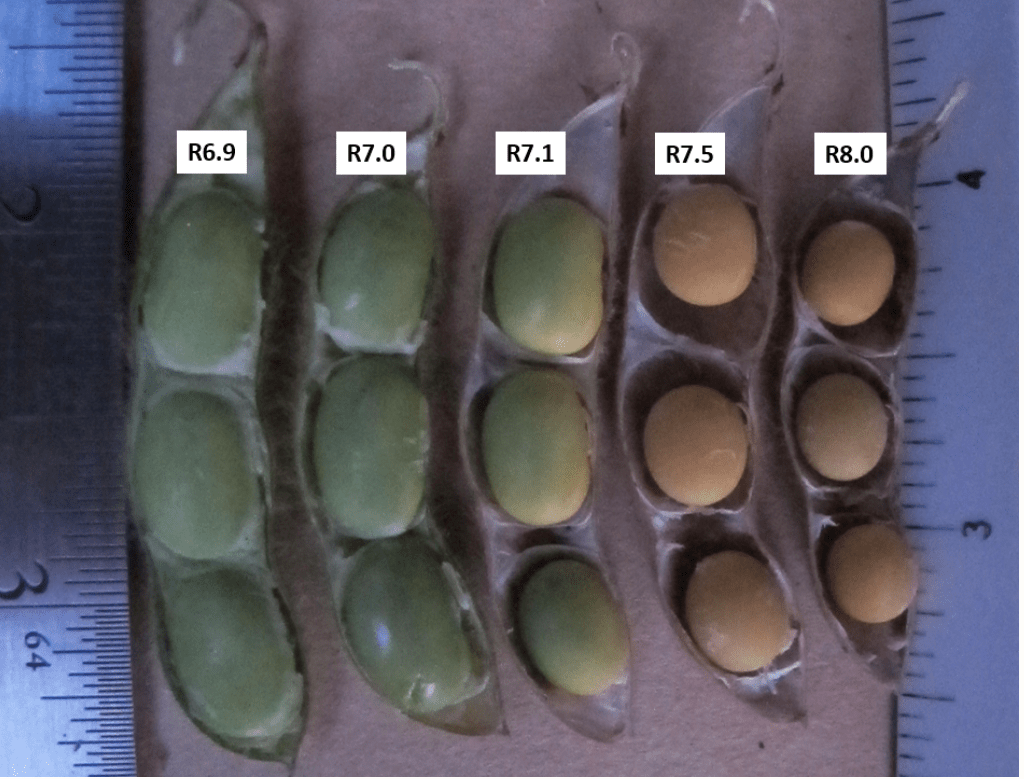
Received many calls about end of season irrigation this past week. Would encourage our farmers to finish the season well! You’ve been through much in another trying year and the past few weeks have been extra hard keeping up with irrigation, cleaning out bins, and getting combines ready in the heat. It can be tempting to just stop but would encourage you not to quit irrigating too soon, particularly on soybeans. Soybean maturity (R7) is defined when 50% (or all) of the field plants possess one mature pod (when the interior white membrane no longer clings to the seed). In most years, most leaves and pods will have changed color (from green to yellow-green or yellow) by this plant-based R7 date.
The heat has pushed crops along, but we’ve also had a great deal of humidity. Corn is moving the starch line slower in irrigated fields. That’s a good thing for fill and a harder thing regarding labor, time, and money. A lot of corn in this area is 1/3 milk and I just saw a few fields at ½ milk over the weekend.
- Corn at ¼ milk needs 3.75” (approximately 19 days to maturity)
- Corn at ½ milk needs 2.25” (approximately 13 days to maturity)
- Corn at ¾ milk needs 1” (approximately 7 days to maturity)
- Soybean at full seed (R6) needs 3.5” (approx. 18 days to maturity)
- Soybean with leaves beginning to yellow and pod membrane still attached to seeds (R6.5) needs 1.9” (approx. 10 days to maturity)
So, we’re potentially looking at one to two more irrigations yet for some of this corn and soybeans depending on the current status of your soil moisture profile, development of the crops in your particular fields, and any rain. It is recommended to allow that soil moisture profile to dry out to 50-60% depletion towards the end of the season to capture moisture in the off-season. So one way to consider this is a step-wise approach. If you typically irrigate at 35% soil moisture depletion and have around 2” left, the next week you could wait till a trigger of 40% depletion with the following week’s trigger around 50%. Again, this depends on your individual field’s soil moisture status and crop development after a taxing August.
Upon physiological maturity, corn ears begin drooping down. However throughout the area, corn ears are doing this that aren’t at ½ starch yet. These ears will black layer prematurely at the cost of yield. Dr. Bob Nielsen from Purdue shares that yield penalty can be as much as 40% at denting when there’s essentially no milk line visible and around 12% at half milk. So what causes this? The ear shank can collapse when there’s a lack of turgor pressure due to stress from the inability to keep up with crop water demand. August has been abnormally dry with warmer than average temperatures the past few weeks. Sometimes the ear shank also cannibalizes itself, similar to what can happen in stalks. Perhaps part of this can be from poor root development or lack of root development into deeper layers? In areas that have received less rain, perhaps deeper soil layers are drier in spite of having moisture in the top soil layer from irrigation? For those with conventional hybrids, European corn borer tunneling can also cause this type of collapse. There’s also some hybrids that I notice this happening more than others; perhaps genetics also plays a roll? That shank is the source for feeding the ear, so when it collapses, it weakens it. Keep an eye on ears in these fields as we approach harvest and consider getting at them sooner if possible.



 JenResources