Category Archives: Research
On-Farm Research Update
Hope to see you next week at our Nebraska On-Farm Research Updates to be held March 10 at ARDC near Mead and March 11 in York!!!

Crop Update 6-20-13
The sun has been welcomed and crops are rapidly growing in South Central Nebraska! Corn right now is between V6-V8 (6-8 leaf) for the most part. Quite a few farmers were side-dressing and  hilling corn the past two weeks. It never fails that corn looks a little stressed after this as moisture is released from the soil and roots aren’t quite down to deeper moisture.
Installing watermark sensors for irrigation scheduling, we’re finding good moisture to 3 feet in all fields in the area. The driest fields are those which were converted from pasture last year and we want to be watching the third foot especially in those fields. Pivots are running in some fields because corn looks stressed, but there’s plenty of moisture in the soil based on the watermark sensor readings I’m receiving for the entire area. So we would recommend to allow your crops to continue to root down to uptake deeper moisture and nitrogen.
The last few weeks we observed many patterns from fertilizer applications in fields but as corn and root systems are developing, they are growing out of it. We’ve also observed some rapid growth syndrome in plants. This can result from the quick transition we had from cooler temperatures to warmer temperatures, which leads to rapid leaf growth faster than they can emerge from the whorl. Plants may have some twisted whorls and/or lighter discoloration of these leaves, but they will green up upon unfurling and receiving sunlight. This shouldn’t affect yield.
Damping off has been a problem in areas where we had water ponded or saturated conditions for periods of time. We’ve also observed some uneven emergence in various fields from potentially a combination of factors including some cold shock to germinating seedlings.
We began applying sugar to our on-farm research sugar vs. check studies in corn. We will continue to monitor disease and insect pressure in these plots and determine percent stalk rot and yield at the end of the season.
Leaf and stripe rust can be observed in wheat fields in the area and wheat is beginning to turn. We had some problems with wheat streak mosaic virus in the area again affecting producers’ neighboring fields when volunteer wheat wasn’t killed last fall. Alfalfa is beginning to regrow after first cutting and we’re encouraging producers to look for alfalfa weevils. All our crops could really use a nice slow rain right now!
Sugar Applications to Crops
For the past ten years I’ve come across farmers who really believed in applications of sugar to reduce their pest populations. Being no research to my knowledge to prove it, I tucked the observation in the back of my head for future reference. With farmers looking to increase yields and looking to other farmers such as Kip Cullers for information, some of our on-farm research producers were curious about sugar applications in their operations with the hopes of increasing yield.
Nebraska On-Farm Research Corn Results
Using the application rates that Kip Cullers uses, one Clay County producer applied 3 lbs of sugar (purchased pallet of cane or beet sugar from the local grocery store) per 10 gallons of water at V7-V8 on corn in 2010-2011. Cullers also tanked mixed the sugar solution with a post-herbicide application like glyphosate but this producer didn’t do that. To simulate any affect of the water or driving through the field, he also drove through the untreated check spraying water only. Two years of research results showed no significant increase in yield. However, there was a noticeable difference in standability at harvest. This producer did not apply a foliar fungicide either year. When it came to harvest, this producer needed the reel in 2010 for the untreated check. Stalk rot ratings were taken using the pinch test two weeks prior to harvest. To him, the $1.25/acre of sugar was worth it to improve standability even if yield was not significantly improved. You can view the full research report here.

Several York County producers have also tried this with one producer finding a non-statistical 2 bu/ac yield difference with the check yielding better while the other producers found a statisically significant 2 bu/ac increase to the sugar treatment. Another producer in Hamilton County is testing this using the corn product he grows-using 1 qt of corn sugar (high fructose corn syrup) per 10 gal of water applied still at V7-v8.
In 2012, a small plot study was conducted at UNL’s South Central Ag Lab near Clay Center to determine any differences between sugar application, fungicide application, and untreated check in corn. All treatments were applied at R2. Because of the drought in 2012, there was minimal disease pressure, thus there were no significant differences between the three treatments regarding area under the disease progress curve. The untreated check did show the most stalk rot (via the push lodging test). The sugar application reduced the lodging rating by half and the fungicide application showed the lowest lodging rating. For yield, there were no significant yield differences with the untreated check yielding the highest followed by the fungicide and sugar applications. The entire study report can be found here.
In Soybeans we have had producers apply 3 lbs sugar in 10 gallons of water at R3 (beginning pod). In all years, there have been no significant differences in yield. Lodging ratings were not taken as that is more variety and water dependent.
Additional research…
has shown that application of sugar to crops increases the numbers of beneficial insects in those fields. South Dakota research entomologists showed that lady beetles benefited from a combination of prey and non-prey foods. In a follow-up study, these entomologists applied sugar sprays to soybeans and quantified the frequency of sugar feeding by analyzing the gut contents of common lady beetles in three states. They found all the tested lady beetles regularly consumed sugar-like nectar in soybean fields, even when it wasn’t applied as a supplement. They also found more lady beetles in the sugar treated plots compared to the untreated plots.
At this time we can’t explain the standability effect we’re seeing from our sugar applications to corn. Our hypothesis is that early application of sugar to corn is increasing beneficial microbes that may be keeping the exposed brace roots and stalks healthier. We hope to conduct more research in the future to answer this question.
In conclusion,
the application of sugar to corn and soybeans has not always shown increased yield. However, in nearly all of the corn studies, sugar treated plots have shown increased stalk strength at harvest. Research has also shown an increase in the number of beneficial insects in fields where sugar was applied. Further research is needed to understand the interactions aiding stalk strength in corn.
If you are interested in conducting on-farm research studies in your field, please contact any of our UNL Extension Educators or Specialists! You can also follow the conversations this year via our Facebook page and Twitter feed!
What do you think of sugar applications to crops? Have you tried this in the past and if so, what were your results?
Corn Planting Rate Research & Recs
Even with recent rain and snow events, the subsoil is still dry. You may be wondering,
“What should I do regarding corn planting rates in 2013?”
A few weeks ago, UNL Extension held our on-farm research meetings to share our 2012 Corn Planting Rate results for irrigated and dryland conditions. I always enjoy hearing our farmers share why they were interested in a certain trial and what they found out as a result.
Our farmers followed protocols of 28K, 32K, 36K, 40K (40,000 seeds/acre) or 30K, 34K, 38K, 42K/acre for irrigated production and 18K, 22K, 26K, and 30K for dryland production. 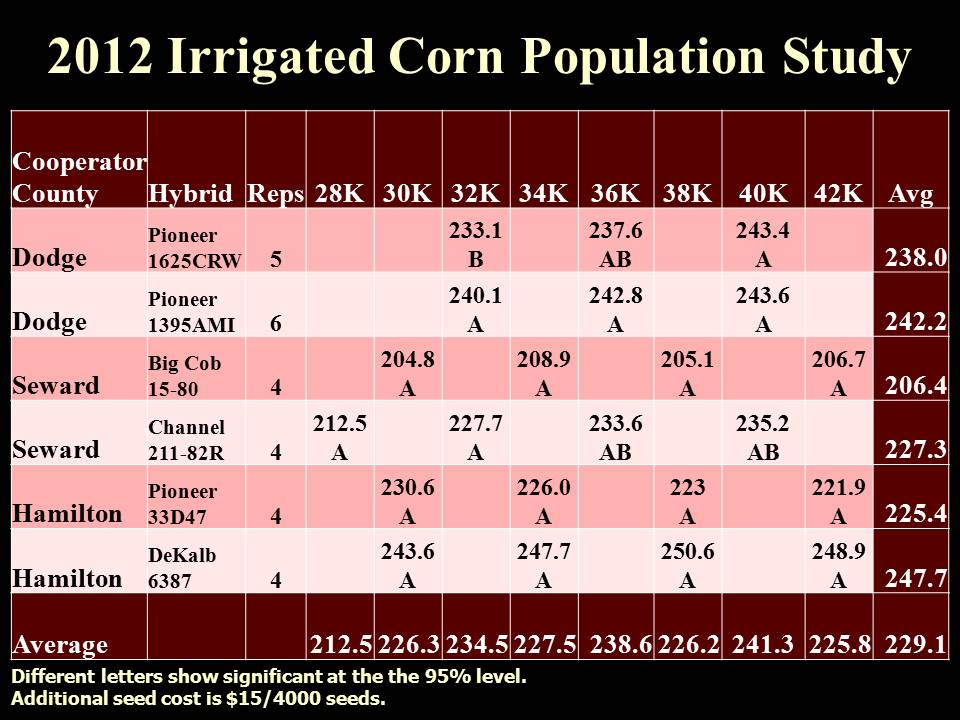
The results since 2010 continue to show us that each individual hybrid varies in its response to increasing populations; however, there is a general trend with newer hybrids that increasing population results in increased yields. Dr. Tom Hoegemeyer, UNL Agronomy Professor of Practice spoke about how our hybrids have genetically come so far in combating various stresses while maintaining yields. We know that many seed companies have conducted research to determine the population calibration curve for each hybrid to determine best recommendations for you. Thus, we’d recommend that you check with your seed dealer to determine which hybrid may fit best at which population for your operation.
Even with this data, you may question if that’s truly the best population for your field; that’s where on-farm research comes in! We recommend testing the recommended population against a higher and lower population with at least 4000 seeds/acre difference in planted population-whether irrigated or dryland. With today’s technologies, it’s not very difficult to test seeding rates for different hybrids for yourself!
So what rate should you plant this year? In the majority of our irrigated studies, economically, many hybrids maximized yields and economic returns between 32,000-36,0o0 seeds/acre. Again, this is very hybrid dependent so ask your seed dealer what he/she would recommend and test for yourself!
Regarding limited irrigation, UNL research has actually shown a negative effect of lost yield by backing off population too far in a dry year. 
Tom’s recommendation was for dryland in Eastern Nebraska, most hybrids even with the low soil moisture profile should be ok with planting 24,000-28,000 seeds/acre. I realize we have essentially no moisture in our profile. But taking probabilities of rainfall events, March-May is usually pretty good and we don’t want to short-change ourselves in yield by planting too low of populations. For Central into Western, NE, I feel 20,000-22,000 seeds/acre will work for many hybrids. Our genetics have come so far since we finished the last drought in 2007 and were planting 18,000 seeds/acre in dryland. We will just keep praying for rain and hope for the best next year! Ultimately, test this and your other on-farm questions for yourself to know what will work for your farm!
If you’re interested in conducting some seeding rate trials, please let anyone on our UNL On-Farm Research Team know! All our studies are posted on the CropWatch on-farm research page.
What planting rates are you considering for 2013?
On-farm Research
Wow, I’m sorry I haven’t published much the past two months! Much has happened though as we’re in the middle of winter Extension ag programming season! I love this time of year seeing farmers and ag industry reps-and just chatting about what happened last year and speculating about the upcoming season.
Many of you are also attending numerous meetings. You’re gathering information regarding products and production practices. You may be wondering “Will this work on my farm?” Why not go a step further and see for yourself? On-farm research is a great way to test these questions for yourself using your own equipment in your own fields!
UNL Extension has partnered with the Nebraska Corn Board and Nebraska Corn Growers to form the Nebraska On-farm Research Network. There are three main studies we are conducting state-wide: corn population, corn nutrient, and corn irrigation studies…but we are open to helping you design a valid research experiment for your field to test what you would like-and it can be for a crop other than corn.
We have some upcoming opportunities for you to learn more. On February 11 and February 12 from 9:00 a.m.-3:00 p.m. at UNL’s Ag Research and Development Center near Mead and the York Co. Fairgrounds in York respectively, growers who conducted on-farm research in 2012 will be sharing their results; you can also learn more about conducting on-farm research in your own field. There is no charge for the meetings courtesy of the Farm Credit Services of America but we do need an RSVP for meal count and handouts. Please RSVP by calling (402)624-8030 for ARDC or (402)362-5508 for the program in York. I hope to see you at these meetings as well!

Research Fertilizer Options for Your Farm
November 1 is just around the corner-the beginning of when fall fertilizing occurs in this area of the State. Hopefully many of you have taken soil samples as excess nitrate is to be expected after this drought year. This is an excellent time to consider evaluating your nitrogen program by starting an on-farm research trial!
On-farm research is using your own equipment, in your own fields, over single or multiple growing seasons allowing you to determine the most economical, efficient, and sustainable practice for the production of irrigated and/or dryland crops on your own farm.
What are the soil fertility questions you have for your farm?
Right now, with fertilizing on producers’ minds, we’re hoping you will consider a soil fertility study. We have several example nutrient protocols including the UNL N fertility rate compared to +/- 30 lbs, and considerations for nitrogen timing studies such as pre-plant, sidedress, or fertigation. You can view all these plot designs by clicking on 2012 protocols. If you are planning on applying anhydrous this fall, be sure that the anhydrous strips are the correct width, as the corn must be harvested and weight determined in a correct manner next fall.
When designing a nitrogen comparison you need to remember nitrogen is a mobile nutrient and corn roots will spread laterally. Therefore, the width of the treatments must take this into account and compensate for it. If you have a 16 row nitrogen applicator and an 8 row corn head, you will need 32 rows of each nitrogen rate. Each 32 row strip must be repeated 4 times. At harvest, in each 32 row block, you must record and weigh the center 16 rows with two separate weights i.e. 8+8 . This is done for statistical analysis purposes. Without statistics, you cannot determine if differences between treatments is the result of the nitrogen rate or because of soil variability.
What’s in It for You?
On-farm research in your own fields allows you to find answers to the questions you may have. We all read articles or hear presentations about various practices and products. The question is “Will it work on my farm?“. That’s what on-farm research allows you to find out!
UNL Extension Educators and Specialists are here to help you design your on-farm research trials, help you with data collection, and will statistically analyze the data for you at the end of the season. Correct plot setup is critical to reduce any error in favoring one treatment over another (because we know fields are variable and some portions of the field will yield better than others). The statistical analysis is another tool which helps us determine how much any yield differences between treatments are due to the treatments themselves or to chance.
So if you have an idea you’d like to try, please contact any of the UNL Extension Educators or Specialists working with on-farm research! The Nebraska On-farm Research Effort is a partnership between the Nebraska Corn Board, Nebraska Corn Growers Association, and UNL Extension.
On-farm research may sound daunting, but today’s equipment makes it easier than ever. It does take a little extra time, but our farmers conducting on-farm research feel the value of knowing the results of a study on their own piece of ground make the effort worthwhile.
What are some on-farm research studies you would like to conduct this year or that you would like our group to consider?
Field Days
Well, August has begun and so has the season for field days. Here are a few I hope you mark on your calendars and plan on 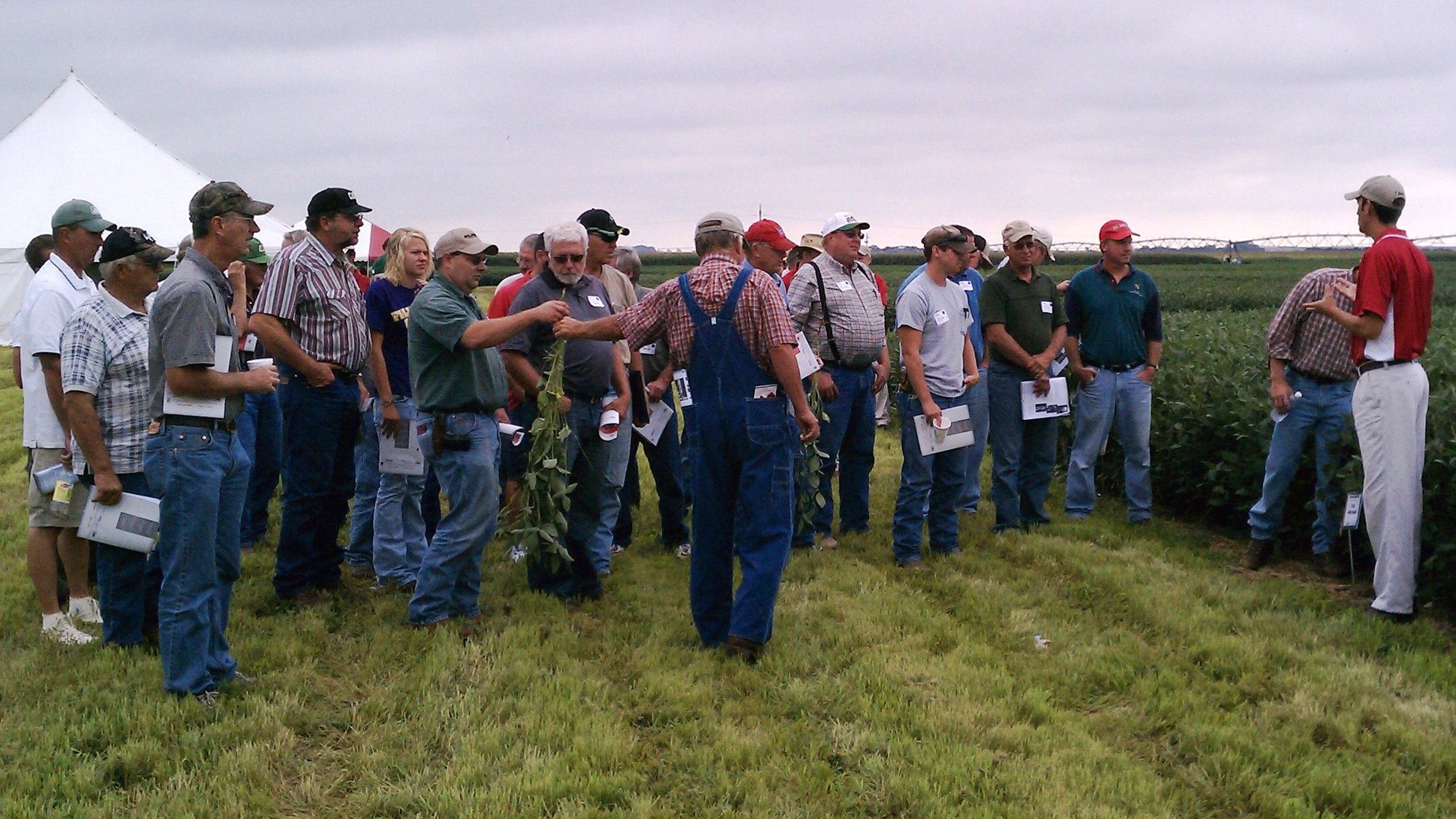 attending. Also a reminder, for all drought information from UNL Extension including crop, livestock, water, lawn, and garden, please check out http://droughtresources.unl.edu.
With the drought and a shortage of forages, if you are considering harvesting or grazing crops for forage, it is important to consider the herbicide restrictions applied to these fields. Check the labels of these herbicides to confirm that grazing restrictions or forage harvesting restrictions have been met before you turn livestock into the fields or cut the crop for hay or silage. Check out this link for more information.
Soybean Management Field Days Planned: Please mark the dates of the upcoming Soybean Management Field Days on your calendar. They are planned for August 14-17 with sessions planned for Lexington, O’Neill, Platte Center and David City. Registration for each of the Field Days starts at 9:00 a.m. with four one hour programs from 9:30 a.m. to 2:30 p.m. Topics include: Soybean Seed Treatments and Foliar Fungicides Growth Enhancement Interaction with Herbicides, Managing Land Leases and Soybean Marketing, Herbicide Carrier Rate Study and Quest for the Holy Grail in Soybean Production! Check out the sessions by going to http://ardc.unl.edu/soydays. The David City date and location is August 17th and it’s located from the Jct of 92 & Hwy 15, 1 mile east on 92 and ¾ mile north on county road.
South Central Ag Lab Field Day: Some of you have been asking about the next field day at South Central Ag Lab near Clay Center. Please mark your calendars for August 22 from 9:00 a.m.-2:00 p.m. with registration beginning at 8:30 a.m. Topics include: Weed control, timing, resistant weeds; Emerging diseases of corn and corn rootworm management options; Impacts of corn stover harvest on soil quality and greenhouse gas emissions; Variable rate nitrogen and irrigation management according to landscape variation; and Use of Soy-Water for managing soybean irrigation. There is no charge but please RSVP for a meal count by Friday, August 17 to (402) 762-4403. Hope to see you there!
York County Corn Grower Plot Tour: The York County Corn Growers Annual Plot tour will be held Thursday, August 23, 2012 from 5:30 – 7:30 p.m. This year’s cooperators are Ray and Ron Makovicka and the plot is located west of York on the Dwight Johnson farm. The plot is located ¾ miles north of Hwy 34 on Road I. Those attending will be able to check out the various corn varieties and visit with the seed company representatives. Supper will be served after the tour. Then there will be a report on 2012 practices, products used and irrigation update.
Also this year they have several different types of irrigation equipment in the field to monitor soil moisture and estimate crop ET. Systems in the field include: AquaCheck USA provided an AquaCheck soil moisture sensor system; Servitech provided the Profiler Watermark soil moisture sensor system; McCrometer provided an EnviroPro soil moisture sensor system; and AquaSpy provided AquaSpy soil moisture sensor system. Several of you have asked about wireless irrigation scheduling systems-here’s your chance to compare them all in one place!
High Heat & #Corn Pollination
With the high heat, lack of rainfall, and pollination occurring in many fields or just around the corner, questions have been 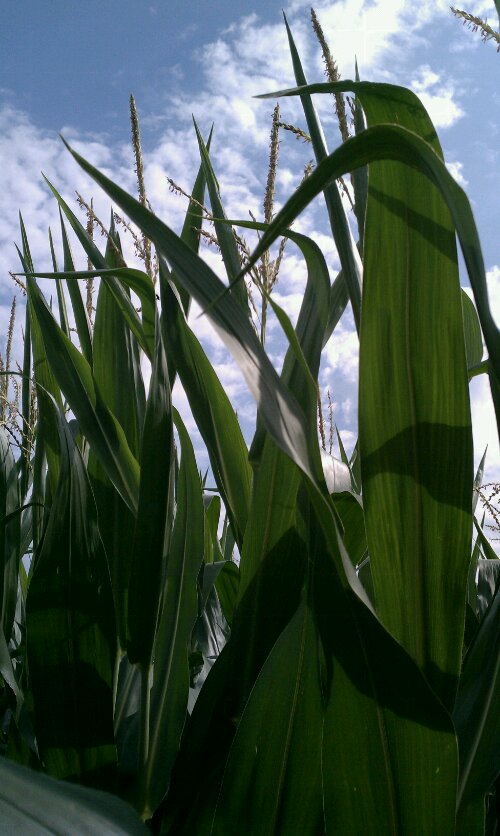 rolling in regarding how high heat affects corn pollination. Dr. Tom Hoegemeyer, UNL Agronomy Professor of Practice wrote the following article and I’m sharing it for the excellent info. Hybrid Maize simulations will be shared in this week’s CropWatch and in next week’s news article.
“Corn was originally a tropical grass from the high elevation areas of central Mexico about 7,400 feet above sea level, 2,000 feet higher than Denver. Today, corn still prefers conditions typical of that area — warm daytime temperatures and cool nights. Areas that consistently produce high corn yields share some significant characteristics. These areas — central Chile, the west slope of Colorado, etc. — are usually very bright, clear, high light intensity areas with cool nights.
This year, in the prairie states and in the Cornbelt, conditions have been dramatically less than optimal. Corn maximizes its growth rate at 86°F. Days with temperatures hotter than that cause stress. In the high yield areas, cool night temperatures — at or below 50°F — reduce respiration rates and preserve plant sugars, which can be used for growth or reproduction, or stored for yield. These are optimum conditions for corn, and interestingly, are fairly typical for areas around central Mexico where corn is native.
In years when we get high day and nighttime temperatures coinciding with the peak pollination period, we can expect problems. Continual heat exposure before and during pollination worsens the response. Daytime temperatures have consistently stayed in the upper 90s to low 100s.The high humidity, which helps reduce crop water demand, also increases the thermal mass of the air—and provides extra stored heat and insulation at night.
Corn pollen is produced within anther sacs in the anther. The plant releases new, fresh anthers each morning, starting from near the top of the tassel, on the first day of shed, and proceeding downward over several days. The process of releasing the pollen from the anthers is called “dehiscence.” Dehiscence is triggered by the drop in humidity, as the temperature rises. However, when it is extremely humid and the humidity falls very little, dehiscence may not occur at all, or it may be delayed until late in the day. If one has breezes, while the humidity is still very high, the anthers may fall to the ground before pollen is released. If the temperature rises too high before pollen dehiscence occurs, the pollen may have reduced viability when it is shed. A person experienced at hand pollination in corn will often see this happen. There will be anthers in a “tassel bag,” but little pollen. The usual solution to this is to wait a couple hours until the temperature rise reduces the humidity. However, last year we had some conditions where pollen was never released from the anthers. This can impact silk fertilization, particularly in open-pollinated situations.
Corn is a “C4 Photosynthesis” plant, making it extremely efficient at capturing light and fixing CO2 into sugars. One drawback of this system is that with high daytime temperatures, the efficiency of photosynthesis decreases, so the plant makes less sugar to use or store. High nighttime temperatures increase the respiration rate of the plant, causing it to use up or waste sugars for growth and development. This results in the plant making less sugar but using up more than it would during cooler temperatures. Heat, especially combined with lack of water, has devastating effects on silking. If plants are slow to silk, the bulk of the pollen may already be shed and gone. Modern hybrids have vastly improved “ASI” or anthesis-silk interval (the time between mid-pollen shed and mid silk). Regardless, in some dryland fields we see seed set problems because of “nick” problems between pollen and silking.
Even in some stressed areas within irrigated fields (extreme sandy spots, hard pans or compaction areas where water isn’t absorbed and held, and some “wet spots”) we can see stress-induced slow silking and resulting seed set issues. Historically, this has been the most important problem leading to yield reduction, particularly in stressful years. Once silks begin to desiccate, they lose their capacity for pollen tube growth and fertilization.
Even with adequate moisture and timely silking, heat alone can desiccate silks so that they become non-receptive to pollen. This is a bigger problem when humidity is low and on hybrids that silk quite early relative to pollen shed. Even with dew points in the 70s, when temperatures reach the high 90s to the100s, the heat can still desiccate silks and reduce silk fertility.
Heat also affects pollen production and viability. First, heat over 95°F depresses pollen production. Continuous heat, over several days before and during pollen-shed, results in only a fraction of normal pollen being formed, probably because of the reduced sugar available. In addition, heat reduces the period of pollen viability to a couple hours (or even less). While there is normally a surplus of pollen, heat can reduce the fertility and amount available for fertilization of silks. Research has shown that prolonged exposure to temperatures reduced the volume of pollen shed and dramatically reduced its viability. For each kernel of grain to be produced, one silk needs to be fertilized by one pollen grain.”


 JenResources