JenREES 2/13/22
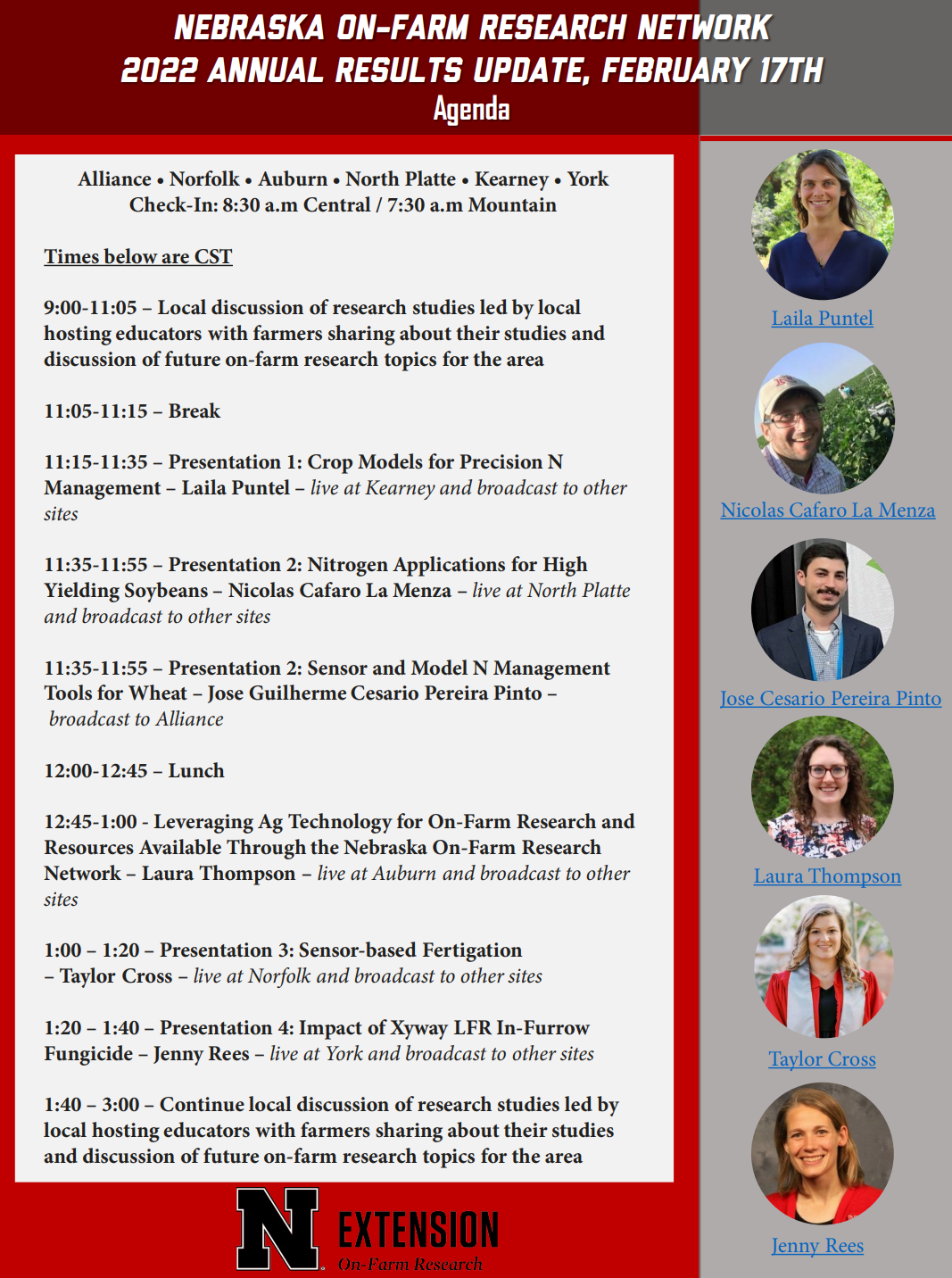
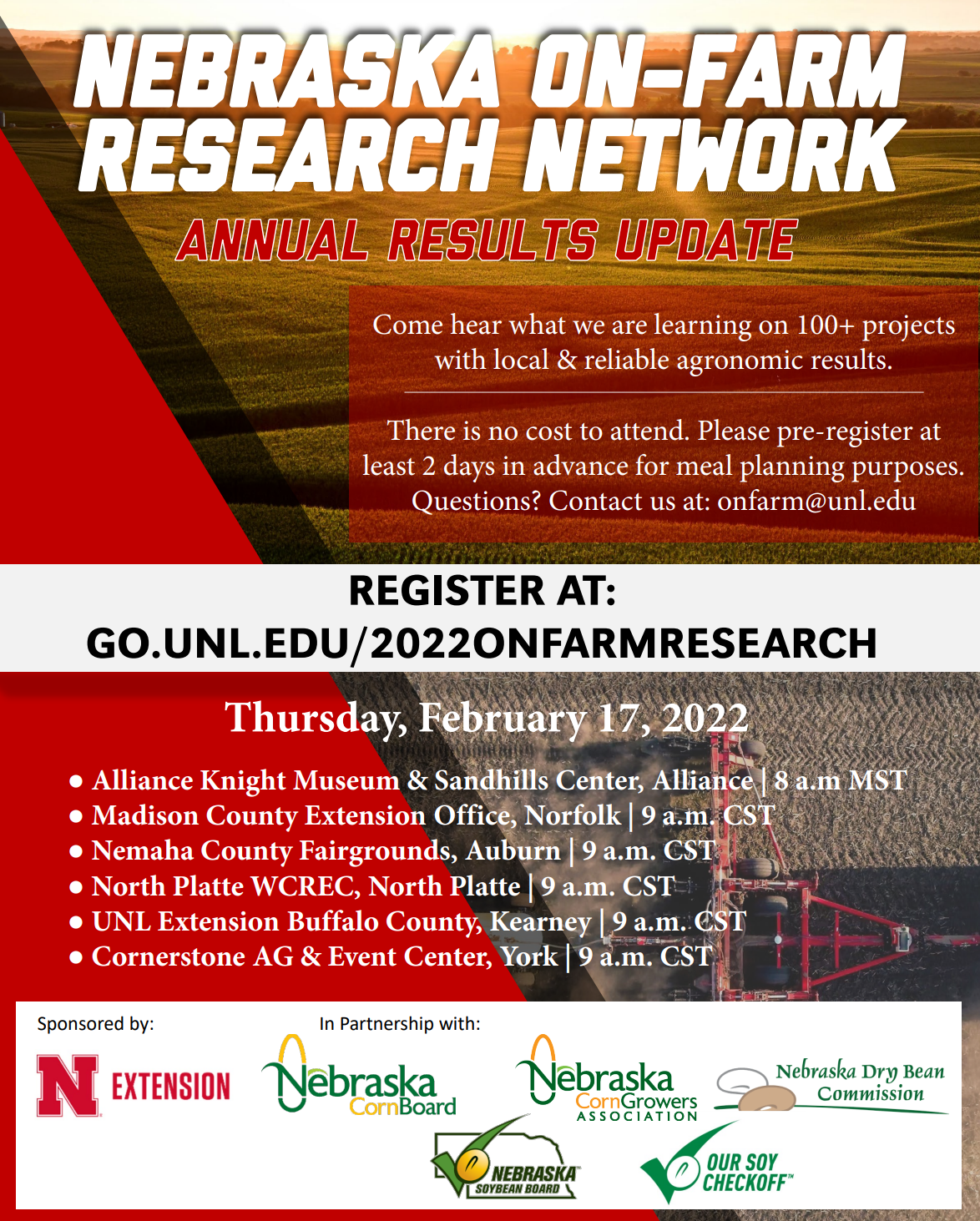
This week sharing on a variety of questions received. Also a reminder of our On-Farm Research Update meeting on Feb. 17 with closest one in York at Cornerstone Event Center at 9 a.m. (registration at 8:30 a.m.). It’s an opportunity to hear from the growers about their on-farm research studies. RSVP at 402-362-5508 or jrees2@unl.edu.
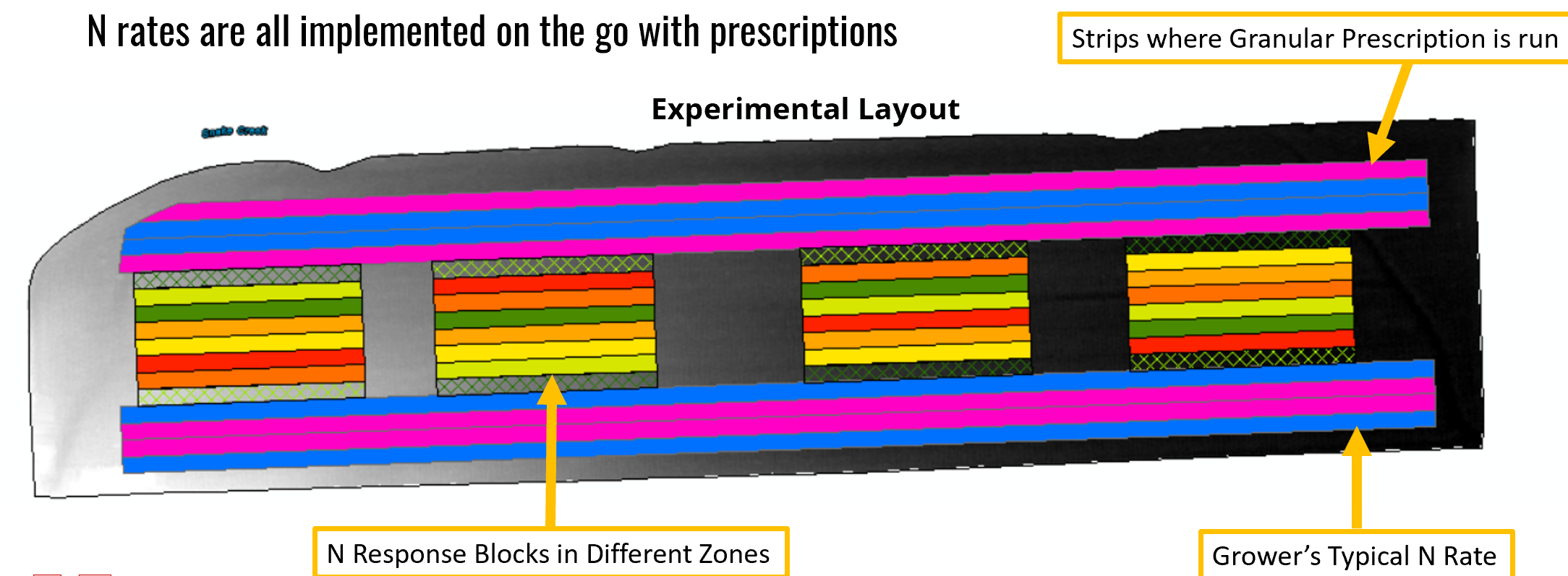
Nitrogen Models: Follow-up to last week’s column, for those interested in comparing a nitrogen model to your grower rate via on-farm research this year, please let your Granular certified service agent or Adapt N rep know in addition to your local Extension educator. We’ll set up a meeting to discuss study design for the prescriptions.
Temperature effects on storage of pesticides: With pesticide shortages and people wanting to get the products in hand, received a question on what happens if the product freezes in non-heated shops. Ultimately, the pesticide label will specify any impacts to efficacy when extreme temperature conditions occur. Another resource that may be of interest is this University of Missouri website which has a table towards the bottom which allows you to scroll through various fungicide, insecticide, herbicide products and see what the label shares: https://extension.missouri.edu/publications/g1921.
Spring planted cover crops: During our practical cover crop management discussion last Friday, we talked about oats and other small grains being known to help reduce the incidence and severity of soil-borne soybean disease pathogens causing sudden death syndrome and soybean cyst nematode in soybean. We also know small grains help with reduction in white mold with the hypothesis being the terminated cover helps intercept the spores being released from the soil surface into the canopy. The question was asked if oats planted this spring could also help if a small grain wasn’t planted in the fall. Research from University of Minnesota found spring planted oats did help with reducing SDS severity, so that could be a consideration as another tool to help.
Another question/discussion topic that continues to surface is if there’s ability to grow nitrogen prior to corn this spring. Potentially, if one thinks about herbicides differently, gets plans together now, and is willing to terminate the cover crop a little later. And, maybe one just tries some strips of this instead of whole fields? Nitrogen production is directly related to biomass growth and based on what I see in journal articles, nutrient release from cover crops occurs around 6 weeks after termination. Options for planting in March include peas, lentils, clovers. These can be terminated by herbicides or as a green manure. I’m unsure on rolling. For those who planted hairy vetch last fall, a York county producer shared that he’s had good luck using glyphosate as a burndown which kills any grasses but leaves the vetch. That allowed the vetch to keep growing to produce more biomass and thus, more nitrogen. He kills the vetch with his post-pass as HPPD chemistries (Callisto, etc.) will kill it. There’s also a few guys kicking around the idea of planting corn into a living mulch like clover. University of Wisconsin did research on kura clover but in talking with Keith Berns with Green Cover Seed, seed production is difficult so it’s hard to get that seed. Some producers in Europe have a system kind of like our on-farm research network, and are using white clover before wheat and then grazing sheep in their system. It would be interesting to try some of the clover crosses available locally or even try with red clover and see what happens in small areas of fields. If anyone is interested in trying something like this, please let me know. We’ll probably discuss more this Friday, so if you’re interested in our Practical Cover Crop Management discussion of Feb. 18 on Interseeding cover crops from 10-Noon in 4-H bldg. in York, please RSVP at 402-362-5508 or jrees2@unl.edu. The Nature Conservancy is providing lunch for that meeting for anyone who RSVPs to allow the discussion to continue over lunch.

JenREES 2/6/22
Nitrogen Rate and Nitrogen Model Studies: One topic that has much discussion at winter meetings this year is nitrogen rates. I know many people did what they could to get fertilizer applied last fall. Yet for those who are still planning on applying spring and/or in-season nitrogen, there’s also much discussion about rates. This is one of our on-farm research focuses for this year: to compare nitrogen rates. We’ve done quite a bit of research with timings and inhibitors. I think there’s more to learn when it comes to rates. And, I think there’s opportunity for all of us to work together to learn more.
One option to study this is to compare full-length strips across the field of a grower rate to 50 lb +/- that rate (or if that’s too scary, 30 lb +/- that rate). For example, if the grower rate is 180 lb N on corn/corn ground, also comparing 230 lb N/ac and 130 lb/ac. I shared the data from 5 nitrogen rate/timing studies conducted in York/Hamilton counties in a previous blog post. The data showed in 4 of the 5 studies, no more than 7 bu/ac less yield with 50 lb less N/ac and in all 5 of the studies, no more than 7 bu/ac yield increase by adding 50 lb N/Ac. This was very interesting to the grower and has been interesting to others who have commented on the studies.

Another option for comparing rates is to use precision ag tools and compare what models such as Granular, Adapt N, Maize N recommend vs. a grower rate. Nitrogen ramps (varying nitrogen rate blocks of 50 lb N/ac differences) can also be included. That may sound complicated but is less so with precision technology using prescriptions and then harvesting using yield maps. These prescriptions could also be built by zones in the field comparing a grower rate vs. a nitrogen model rate if the grower preferred. There’s a number of ways to compare nitrogen rates. We just feel this is an excellent time to try some of these things. And, on-farm research provides a way to try this on a smaller number of acres before trying it larger scale on more acres.

There is also a financial stipend for trying precision nitrogen studies via a USDA grant that Nebraska on-farm research received. So, would encourage farmers, and crop consultants/ag industry professionals to consider working with a farmer(s) to try some of these in the future. To learn more, go to: go.unl.edu/PrecisionNitrogen. For those interested in field scale nitrogen rate strips across your field, please contact me or your local Extension educator. And, if you’re interested in learning about the results of all the nitrogen studies from 2021, consider signing up for the on-farm research meeting in York on Feb. 17 at: GO.UNL.EDU/2022ONFARMRESEARCH.
Practical Cover Crop Management: I so appreciated Keith Berns sharing at our Practical Cover Crop meeting last Friday! The discussion and questions throughout that time is what I was hoping for with this meeting in all of us learning from each other and together. I’m not recording them and my goal with these meetings is the discussion/interaction/connections, so if you’d really like the information, it’d be most helpful to attend in person. This next meeting on Friday, Feb. 11 from 10-Noon at the 4-H Building in York will be on termination timing of cover crops, including planting green. I’ve asked a number of farmers to share their experiences as each does things slightly differently in their corn/soybeans with tillage practices, timing, herbicides/lack of. This is very informal with just discussion and please come with your questions and willingness to share as well! It is helpful for me to have RSVP at 402-362-5508 but I do allow for walk-ins.
Save the Date! Two newly scheduled upcoming meetings include an Estate Planning meeting in Seward at the Extension Office on March 8th at 1:30 p.m. Also, a small grain silage conference on March 17th at ENREC near Mead: HTTPS://GO.UNL.EDU/SILAGEFORBEEF2022.
JenREES 1/30/22
It’s been so great to see people at winter programs again and January just flew by! Last winter was different teaching via zoom and I’ve appreciated the interaction and discussions at meetings this year. This week sharing a few answers to questions I received and also a few additional February programs.
Weed Guides: For those who needed private applicator recertification, you were mailed a sheet of paper which shared how you can purchase a weed guide. On the paper it says that shipping is free, but I was told that’s not the case if you order it via Marketplace. In order to have free shipping, you need to mail the piece of paper with your $25 to the Pesticide Office via the address on the paper. For anyone who doesn’t need the 2022 Guide but would be ok with a 2021 Guide, please let me or your local Extension educator know and we can arrange for you to get a copy of last year’s for free.
Extension Meeting Updates: Just a note to please RSVP when attending Extension events as not everyone is as flexible as I’ve been! This helps for meals and also any covid requirements.
Update on Soil Health Conference Feb. 2: There’s now a virtual option. They are not allowing walk-ins, so regardless if you plan to attend in person or virtually, you can register at: https://go.unl.edu/vn85.
Reminder of Ag Update at Fairgrounds in Aurora this week on Feb. 2 which also qualifies for UBBNRD nitrogen certification credits. Registration at 9 a.m. with program from 9:30-4 p.m. RSVP: 402-694-6174.
Also reminder of my first of a series of meetings on Practical Cover Crop Management on Feb. 4th from 10 a.m.-Noon at the 4-H building in York. This week we will hear from Keith Berns on basics of how to get started with cover crops. We will also hear from additional farmers in how they started using cover crops in their operations. RSVP to 402-362-5508.
Feb. 8 Building Farm and Ranch Resiliency in the Age of Financial Uncertainty is the last of the Farmers and Ranchers College meetings this winter. It will be held at the Fairgrounds in Geneva with registration at 8:45 a.m. and program from 9 a.m.-Noon. The workshop will cover cash rental rates, land values, leasing strategies, landlord/tenant communication, farm and ranch succession planning and an overview of farm programs for landowners. There’s no charge and please RSVP to 402-759-3712.
Feb. 17 On-Farm Research Updates for our area will be held at the Cornerstone Event Center at the Fairgrounds in York from 9 a.m.-3:30 p.m. (registration at 8:30). Meetings like this, to me, are the most powerful as they provide an opportunity to hear directly from the growers who conducted on-farm research. Replicated, field-scale comparisons were completed in growers’ fields, using their equipment. If it wasn’t for these growers, often, I wouldn’t have the information I do to share on the various questions asked of me. Attendees will receive a complimentary copy of the 2021 Research Results Update book, which contains results from on-farm research studies, including studies on products such as Xyway in-furrow fungicide, Pivot Bio PROVEN, nitrification inhibitors, and non-traditional products. Production and technology studies include ones on hydraulic downforce, soybean practices, starter fertilizer, nitrogen rates and timing, crop models for N management, and cover crop and soil health. The Nebraska On-Farm Research Network is a statewide, on-farm research program that addresses critical farmer production, profitability and natural resources questions. Growers take an active role in the on-farm research project sponsored by Nebraska Extension in partnership with the Nebraska Corn Growers Association, the Nebraska Corn Board, the Nebraska Soybean Checkoff and the Nebraska Dry Bean Commission. Please RSVP at: GO.UNL.EDU/2022ONFARMRESEARCH. This meeting also qualifies for UBBNRD nitrogen recertification credits.
Farm Bill Decisions
Farm Bill: Been receiving questions on farm bill since before Christmas and just hadn’t taken time to dig into it till this week. Viewing charts is helpful to me, so I’ve added some to jenreesources.com, including one from Robin Reid from K-State which is helpful in understanding how program payments are triggered. If you missed the UNL/FSA farm bill webinar, you can view it at: https://go.unl.edu/x0i9. I am not running simulations this year and don’t recommend that you do it either. The Texas A&M tool is a very good tool, but it will show you a range of probabilities beyond what is realistic for this 2022 decision, barring some type of trainwreck. If you’d like to very easily see for yourself what yields and prices would be necessary to trigger program payments, download the spreadsheet from K-State (and I have an example on my blog): https://www.agmanager.info/ag-policy/2018-farm-bill/tradeoff-between-20222023-arc-and-plc.
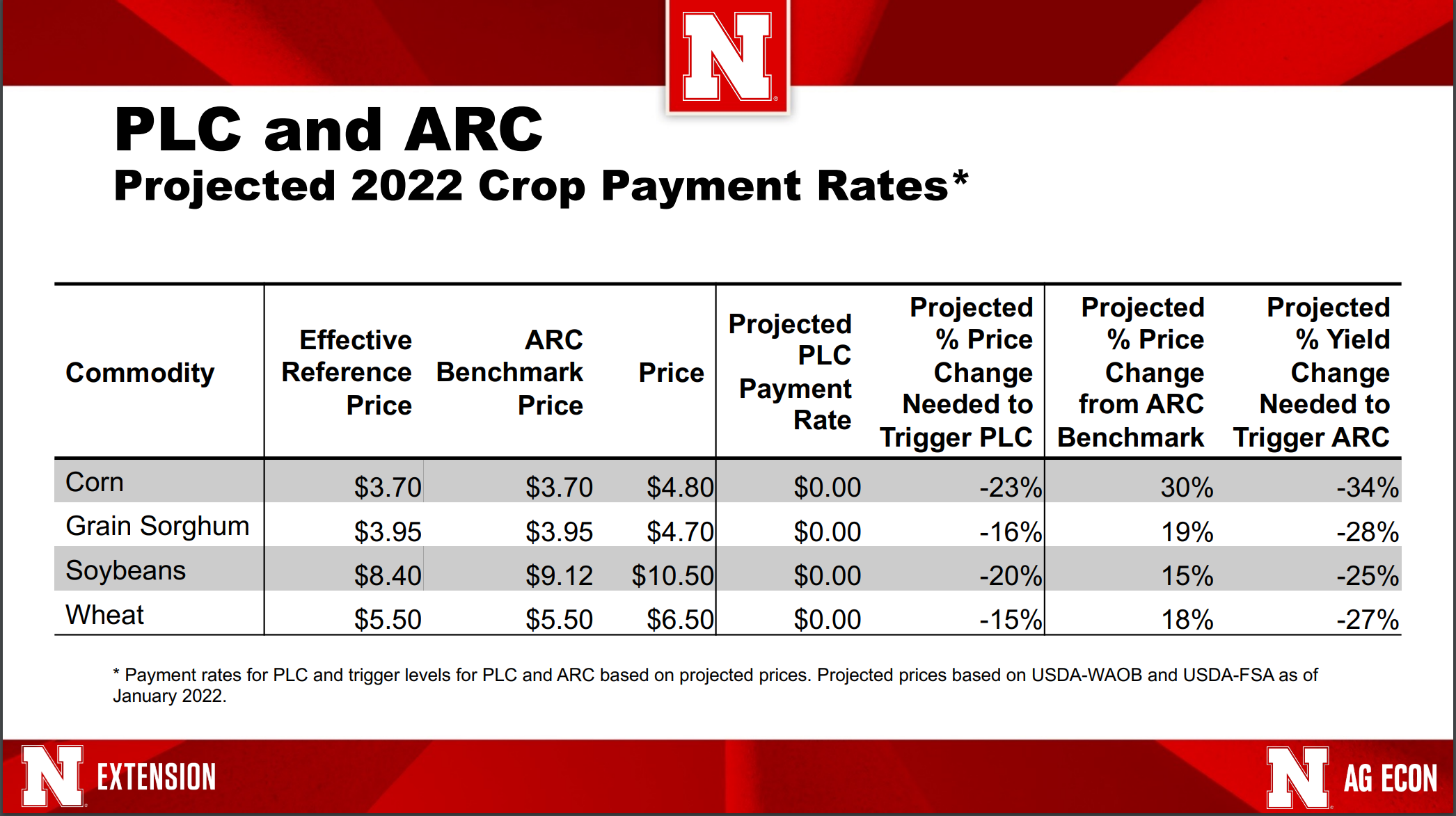
Looking at any potential payments for the 2021 crop, projected prices are substantially above the PLC price payments for crops like corn, soybean, wheat, and sorghum grown in Nebraska and would take a 23-33% price reduction to trigger a PLC payment. They’re also substantially above (30-47%) the price and would take a 30-40% county yield loss to trigger ARC-Co. I’m unsure counties with more substantial wind damage from July 9, 2021 wind storm had enough county average yield loss to trigger and ARC-Co payment…and many may have chosen PLC corn last year with the prices at the time anyway.
Decisions for 2022 need to be made by March 15, 2022. For 2022, neither ARC-Co nor PLC would be anticipated to trigger for corn, soybean, wheat, sorghum with current USDA projected prices (which are just numbers at this time). K-State does a nice job of compiling the different sources of 2022/2023 MYA prices and updating them every month here: https://www.agmanager.info/crop-insurance/risk-management-strategies/projections-and-sources-myaprices-arc-and-plc-commodity. Different election decisions (ARC-Co or PLC) can be made for crops in different FSA farm numbers if you’d like to spread risk. Fields with higher yields would be more favorable for your PLC decisions.
A consideration for ARC-Co for corn, soybean, wheat, or milo would be if a county has a lot of non-irrigated acres and one anticipates a drought event in 2022. That may look additionally favorable if the county has the opportunity to split crops into irrigated and non-irrigated decisions.
For soybean, ARC-Co is potentially a little more favorable than PLC, but still most likely won’t trigger a payment. The Soybean MYA price would need to fall below $8.40 to trigger a PLC payment and below $7.84 to trigger an ARC-Co payment with an average yield.
For corn, the MYA price would need to fall below $3.70 to trigger a PLC payment and below $3.18 to trigger an ARC-Co payment with an average yield. Robin Reid with K-State shares, “Strong export demand currently would lead us to believe that PLC payments are unlikely, but again, much uncertainty exists. A farmer could select PLC for the downside price protection or, if they are optimistic that current high prices are here to stay, selecting ARC-County would give them a higher likelihood of payment if county yields are low. In the case of irrigated corn, the likelihood of a yield loss large enough to trigger an ARC-County payment is less, so irrigated base may lend itself more to PLC.” I would note, this is true unless the county has a history of major storm events which traditionally have impacted county average yields, thus making ARC-Co irrigated also an option.
For wheat, PLC has been favorable in the past, but current prices are well above the $5.50 reference price. And for sorghum, PLC has also been favorable in the past with a $3.95 reference price, but again, current prices are well above this.
Bottom line, it’s not anticipated that either PLC nor ARC-Co will trigger program payments for 2022 at this time. I think many farmers would prefer good crops and decent prices. ARC-Co and PLC are tools for risk management and perhaps crop insurance tools will play an even bigger factor in managing risk for this coming year.



February 2022 Events
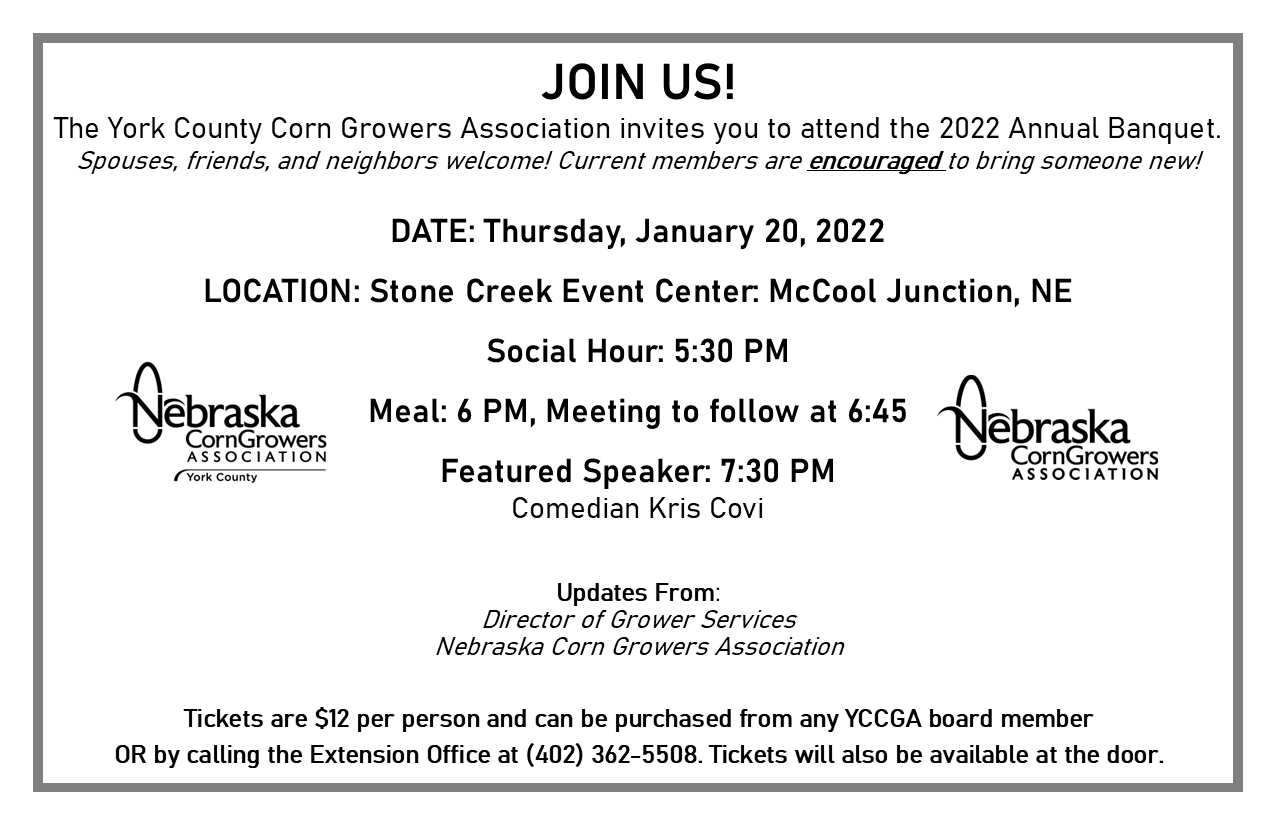
It seems like January is flying by with hitting winter programming hard! So, with only a few weeks left, wanted to get some early February programs on your radar. But first, sharing a correction for York Co. Corn Grower Banquet on evening of Jan. 20th: the social time begins at 5:30 p.m. with meal at 6:00 p.m.
For those interested in growing or utilizing sorghum, there’s two upcoming opportunities. One Jan. 26 in Lincoln regarding using sorghum food products and another Jan. 27 in Kearney regarding sorghum research. You can view topics and register here: https://www.nebraskasorghum.org/.
For those attending Crop Production Clinics, just FYI that a weed guide is provided with your registration. Reminder Hastings Jan. 19, Kearney Jan. 25, York Jan. 26 and virtual Jan. 28. Register at: https://agronomy.unl.edu/cpc.
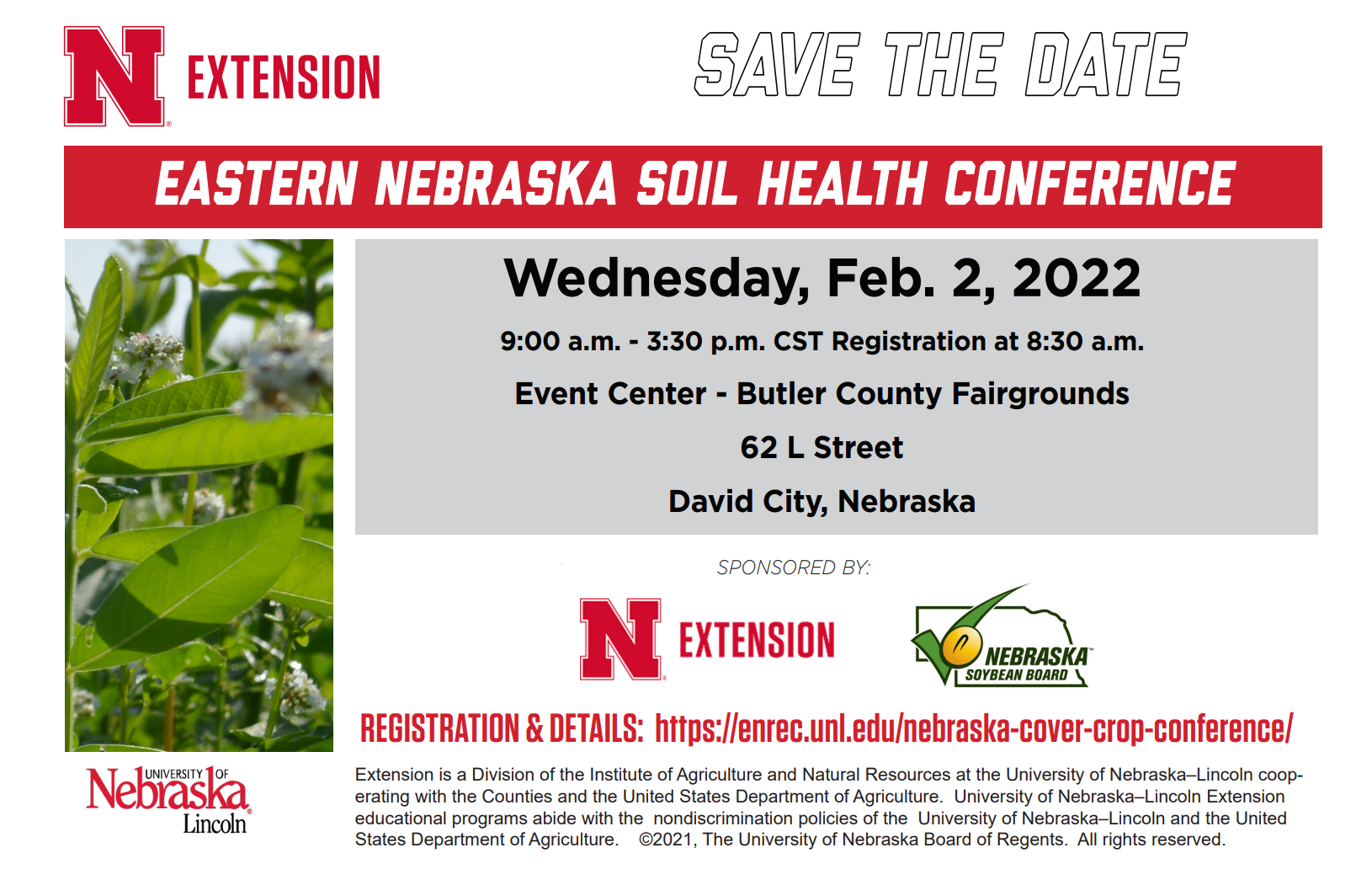
Feb. 2 Soil Health Conference: For those who’ve attended the Eastern Nebraska Soil Health Conference in the past, it will be held at David City at the Fairgrounds this year. No details yet but registration starts at 8:30 a.m. with program from 9 a.m.-3:30 p.m. Registration at: https://go.unl.edu/qe45.
Feb. 2 Hamilton Co. Ag Day will be held at fairgrounds in Aurora. This event also qualifies for nitrogen certification credits from UBBNRD. Registration begins at 9 a.m. with program from 9:30-3:30 p.m. Topics include: updates from Nebraska Corn Growers and USDA, Understanding southern power’s pricing changes and options, Understanding on-farm solar and land leasing for solar development, Nitrogen sensors, Nitrogen inhibitors and sources for 2022, Ag water dashboard, and What’s been learned from interseeding cover crops. There’s no charge and lunch is sponsored by Aurora Coop.
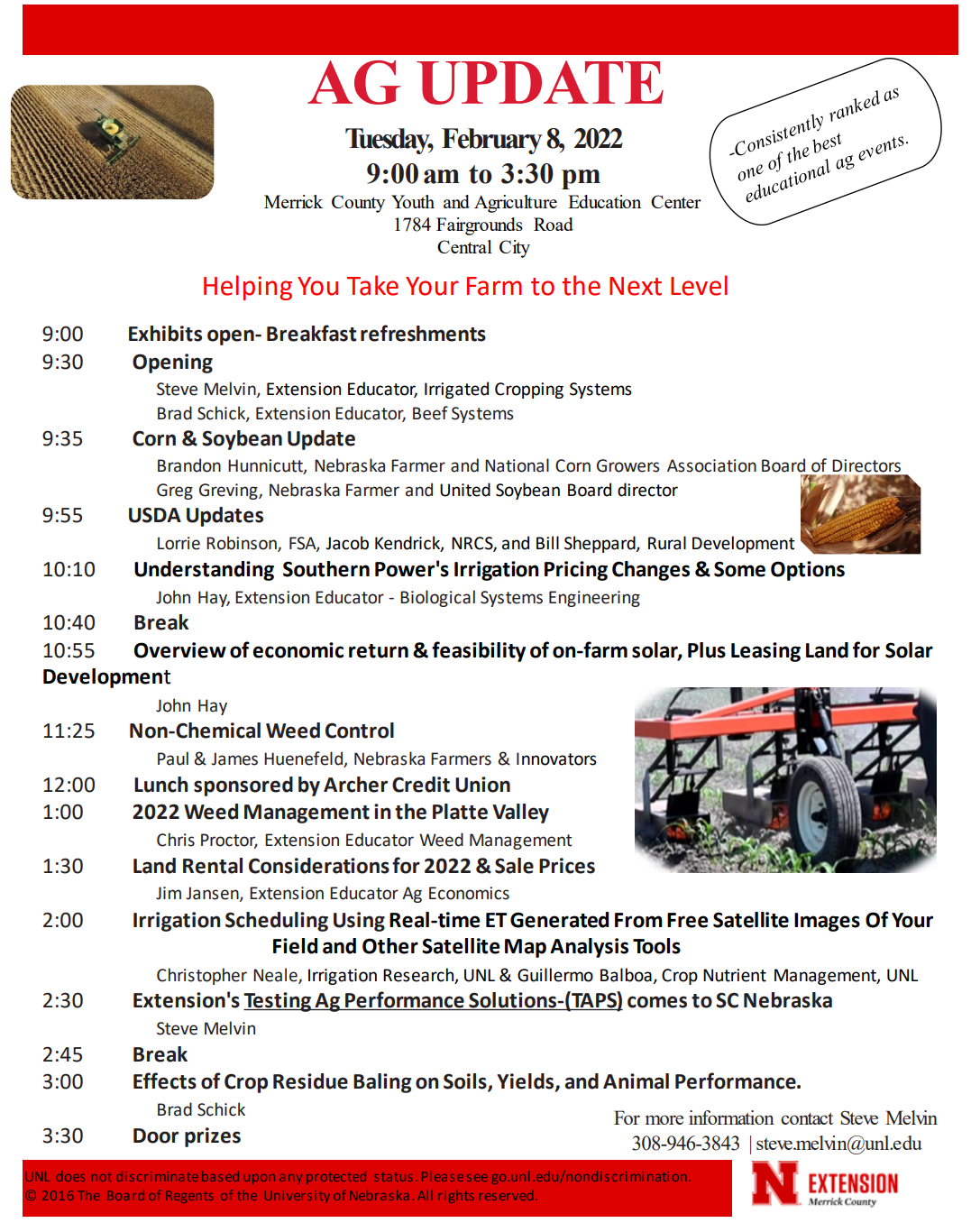
Feb. 8 is Merrick Co. Ag Update at fairgrounds in Central City. Registration begins at 9 a.m. with program from 9:30-3:30 p.m. The morning topics are similar to what is being shared in Aurora. In addition to those topics, there will be a farmer-led session on non-chemical weed control options, Weed management in the Platte Valley, Land lease considerations for 2022, Irrigation scheduling from satellite imagery, and Effects of crop residue baling on land and animal performance. There’s no charge and lunch is sponsored by Archer Credit Union.
Practical Cover Crop Management: New this year, I’m hosting a two-hour series (10 a.m.-Noon) each Friday in February at the 4-H Building at York Fairgrounds. When asked questions, I often share that a specific farmer has tried a certain practice and share what was learned, but I often don’t know the specific details farmers ask about. So, my goal with this series is that you hear directly from farmers, build connections and learn together. I envision this series being applicable to crop and livestock producers, ag industry professionals, landlords, and bankers. Please RSVP at 402-362-5508 or jrees2@unl.edu.
- Feb. 4: Back to Basics: Getting started with cover crops is an opportunity for those who have never tried covers or want to learn more. Learn the basics of timing, rates, species, and when to plant for different systems. Learn goals and what has/hasn’t worked for different farmers.
- Feb. 11: Termination timing including planting green is an opportunity to hear from farmers who plant small grains like rye and their experiences in terminating the cover crop prior to planting corn/soybeans or planting green and terminating the cover after planting corn and soybeans.
- Feb. 18: Interseeding cover crops is an opportunity to hear from farmers planting cover crops into growing corn or soybean crops. Learn about herbicide choices, species selection, goals, and what has been learned.
- Feb. 25: Reducing inputs with cover crops is an attempt to discuss numbers/economics around cover crop management. Hear how farmers are reducing nitrogen and chemical inputs by utilizing cover crops. Discuss how we can place an economic value on any soil changes.


JenREES 1/9/22
It was great to kick off winter programming last week and reconnect with people at the York Ag Expo! For those who attended pesticide training, please allow up to 3 weeks for the postcard with billing info. from NDA to be mailed to you. If you don’t receive a postcard in 3 weeks, please contact me or the local educator you received training from.
Two upcoming webinars of potential interest:
- Jan. 19: Wind & Solar Farms: Addressing land use conflicts webinar, 11 a.m., RSVP: https://nationalaglawcenter.org/webinars/windsolarlandconflicts/
- Jan. 20: Farm Bill Webinar, Noon, RSVP: https://cap.unl.edu/webinars
York County Corn Grower Banquet will be held Jan. 20th at Stone Creek in McCool Junction. Social will begin at 5:30 p.m. A supper of broasted chicken and roast beef will be served at 6:00 p.m. with program shortly after. The evening’s entertainment will be comedian Kris Covi. Kris is a Nebraska comedian who can be seen at events around the country and is known for his family friendly comedy. Tickets are $12/person and can be purchased from any York Co. Corn Grower director, the York Co. Extension Office, or at the door the evening of the 20th.
Nebraska Farm Income and Farm Policy Directions: Had several conversations the past week regarding farm income, bill, and thinking about the future. Dr. Brad Lubben recently wrote an article on this, so I’m sharing excerpts in the event you missed it. The full article can be viewed at: https://go.unl.edu/ixge.
“Farm Income: Using official state-level farm income data published by USDA’s Economic Research Service through 2020 and my projections for 2021-2024, net farm income in Nebraska is currently projected to be $8.1 billion in 2021, a sharp rise from the $5.3 billion estimate for 2020, which itself was up substantially from the $3.5 billion average over the 2015-2019 downturn. Stronger commodity prices since late 2020 coupled with reduced, but still substantial government payments led to the record income estimates.
“The record farm income levels may not last however, as forecasts through 2024 based on longer-term baseline projections from USDA and the Food and Agricultural Policy Center (FAPRI) at the University of Missouri pull Nebraska farm income back to the $5 billion to $6 billion range. An expected pullback in some commodity prices, a sharp rise in input costs, and a dramatic decline in government payments account for the drop in projected farm income.
“Safety Net: Looking closer at government payments provides insight on the role of the federal safety net as well as management decisions ahead for producers. Relying again on data from USDA’s Economic Research Service through 2020 and my projections for 2021-2024, the analysis shows government payments dropping from unprecedented levels in 2020 to minimal levels over the coming years.
“Government payments in Nebraska peaked at nearly $2.5 billion in 2020 as ad hoc COVID-19 relief rolled out primarily in the form of Paycheck Projection Program support and Coronavirus Food Assistance Program payments. That was more than double the payments of 2019, which itself was high due to the ad hoc relief in the form of Market Facilitation Program payments to combat losses related to on-going trade conflicts. Government payments dropped dramatically in 2021 as COVID-19 relief scaled back and they look to virtually disappear by 2022 except for the stable, predictable conservation payments of around $150 million per year.
“Amid the massive ad hoc payments over the past four years (trade assistance payments in 2018-2020 and COVID-19 relief payments in 2020-2021), the core part of the farm income safety net, namely commodity programs, have largely disappeared in relevance.
“Under the 2018 Farm Bill, producers had an opportunity to change their enrollment for 2019 and beyond and largely shifted toward PLC given the price projections at the time and the relative support of the ARC program versus the Price Loss Coverage (PLC) program. ARC and PLC payments in 2020 for the 2019 crop were substantial at more than $240 million (almost all PLC) but have dropped to around $50 million for 2021 and are projected at minimal levels going forward given current price levels and projections.” The rest of the article can be viewed at: https://go.unl.edu/ixge.
Figure 1. Net Farm Income in Nebraska

Figure 2. Government Payments in Nebraska

JenREES 1/2/22
Happy New Year! Wishing everyone a safe and blessed 2022! This week I’m going to share some info. on upcoming ag programs for the month of January.
The end of the year also means report time for those of us in Extension. Each year we need to justify the things we do in trying to help people with research-based information. If you would please consider helping me by completing this short 5 question survey I’d greatly appreciate it. Thanks!
https://app.sli.do/event/bWKk1cPhRG5MsLmu3Y7vkR/live/polls
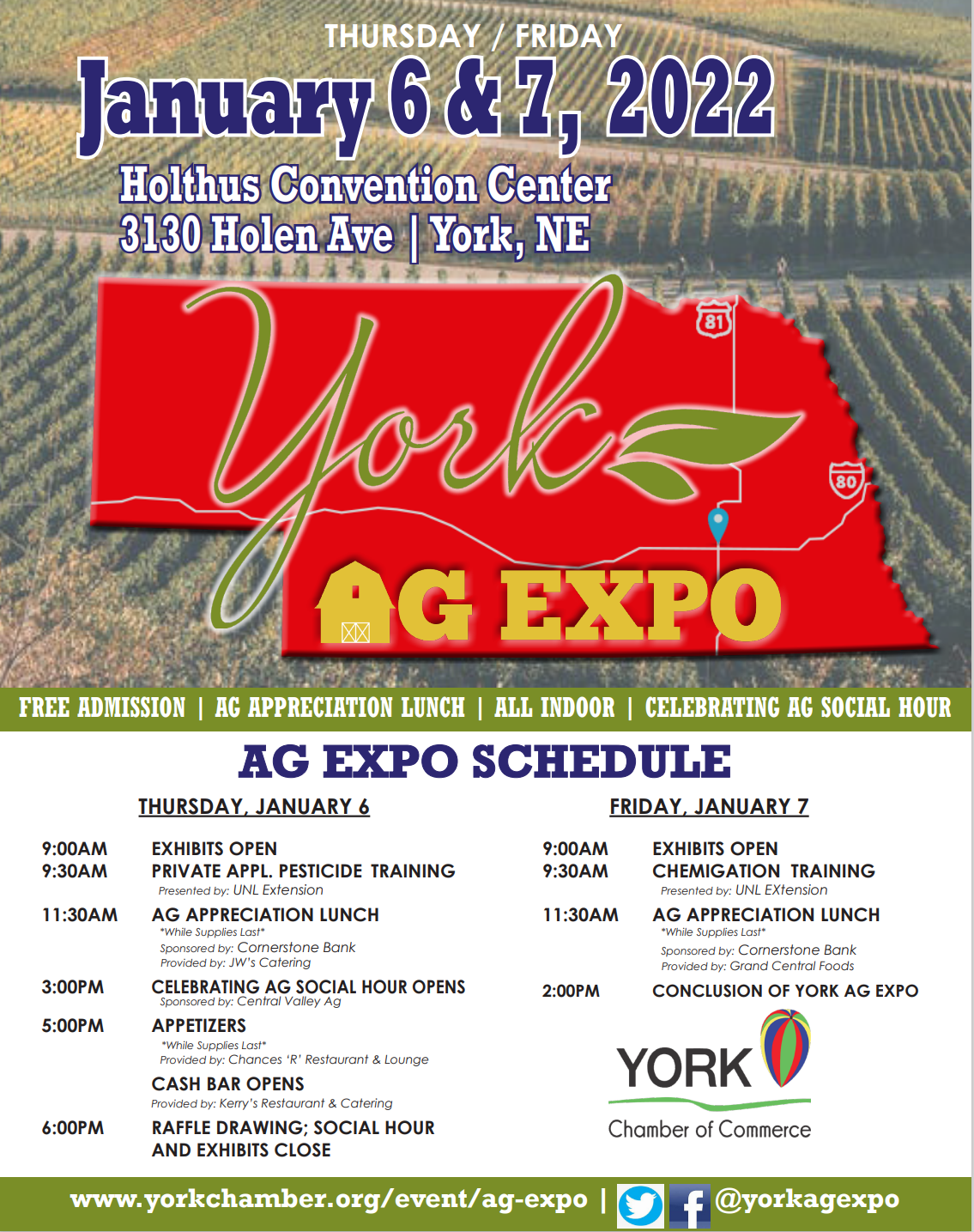
York Ag Expo will be held Jan. 6-7 at the Holthus Convention Center in York. Thank you to all the vendors and the sponsors of this event! An Ag Appreciation Lunch will begin each day at 11:30 a.m. and is sponsored by Cornerstone Bank. Pesticide Training will be at 9:30 a.m. on the 6th and Chemigation Training will be at 9:30 a.m. on the 7th. Please RSVP to 402-362-5508 or jrees2@unl.edu if you plan on attending either of these.
Crop Production Clinics are back in person this year with a larger number of locations to attend. The closest to this area are Beatrice on Jan. 13, Hastings on Jan. 19, ENREC near Ithaca on Jan. 21, Kearney on Jan. 25, York on Jan. 26 and a virtual option on Jan. 28. There’s still the pest management room which provides for commercial, non-commercial, and private applicator pesticide certification and the crop/soil/water room. We’ve also worked to create a few highly interactive sessions and will look forward to hearing feedback regarding them. You can learn more and register at https://agronomy.unl.edu/cpc.
Cow-Calf College will be held Jan. 25 at the Clay County Fairgrounds from 9:30 a.m. to 3:00 p.m. Registration starts at 9:00 a.m. This year’s program will be offered in a hybrid format through zoom & attendance in person. The 2022 Cow-Calf College will start with an in-depth look at eastern redcedar control in the morning. The afternoon will have updates by beef cow-calf specialist, Kacie McCarthy and a special presentation by Tom Field focusing on ways to engage youth in the beef industry.
This year’s program provides flexibility. For those only interested in red cedar control, you can attend the morning session, which includes development of management plans, effective integration of management tools, and use of new rangeland monitoring platforms. Those interested in bull management and strategies for transitioning the next generation of beef producers and professionals, can attend the afternoon sessions. All the sessions will be offered in-person and available via zoom. For those attending in person, lunch will be provided for those who register by calling the Fillmore County Extension Office at 402-759-3712 or Clay County Extension Office at 402-762-3644 or online at go.unl.edu/frcollege. To participate via zoom, register at go.unl.edu/onlinecowcalfcollege.
York/Hamilton Cattlemen’s Banquet is scheduled for Jan. 25, 2022 at the Holthus Convention Center in York. The evening’s entertainment will feature Greg Warren of the St. Louis, MO area. Greg is a standup comedian and was a member of the ‘Where the Field Corn Grows’ comedy tour. The evening starts at 6:30 with a cash bar, a Prime Rib meal at 7:00 with entertainment and recognition of honored guests to follow. Tickets are $25 per person, or banquet sponsorships that include two banquet tickets and recognition at the banquet are available for $150. Cattlemen’s Banquet tickets can be purchased from any of the York-Hamilton County Cattlemen’s Directors or at the Extension Offices in Hamilton and York Counties.
Also, save the date for York County Corn Growers Banquet on the evening of Jan. 20, 2022. Additional details to follow.
JenREES 12/26/21
Upcoming Farm Bill Webinar: As you consider 2022 farm bill decisions, there is an upcoming webinar from UNL on Jan. 20th at Noon. You will need to register to obtain the Zoom link and can do so at: https://cap.unl.edu/webinars.
End of Year Reporting for Extension is here. If you would please consider sharing ways that information I shared helped you this past year, I’d appreciate it. Thanks!
https://app.sli.do/event/bWKk1cPhRG5MsLmu3Y7vkR/live/polls
Evergreen Trees and Perennial Plants: The weather has been incredible overall for December which has allowed for additional things to get done. However, the fact that we’re experiencing temperature extremes and warmer weather is difficult for plants which prefer steady and colder temperatures than we’ve experienced prior to this coming week. Kelly Feehan, Extension horticultural educator, shares some thoughts below on helping alleviate winter stress to evergreens.
“Warm, sunny winter days increase the risk of winter drying and sunscald injury. A lack of soil moisture and snow cover greatly increases the risk of winter dessication. Winter dessication results in evergreens turning brown during spring. Just because an evergreen looks fine now does not mean it is not stressed. It can take an evergreen months to turn brown after a fatal injury. Just think of Christmas trees. They remain green a long time after being cut down.
Evergreens most at risk are newly planted evergreens but even established Arborvitae, Japanese Yew and some Junipers are quite susceptible. Evergreens planted in the last year or two and those planted near south facing walls of light colored homes or pavement are even more at risk.
While we may not see a lot of dessication on established spruce and pines, this does not mean they are not stressed. Especially with spruce, we continue to see an increase in diseases that are tied to moisture stress.
Winter watering is becoming increasingly important to help reduce winter drying. While adequate summer and fall watering is most beneficial, winter watering would be wise this year.
Winter watering needs to be done when temperatures are above 45 degrees Fahrenheit and early in the day for water to soak into the soil before nightfall. Water should not pool against a tree trunk and plant stems to freeze over night as this can cause damage.
When soils are dry and not frozen, apply water slowly with a slow running hose or by punching holes near the bottom of a five gallon bucket. Place the bucket over tree roots and fill it with water, allowing the water to slowly trickle out of the small holes.
About once a month, if needed, moisten the soil to about an eight inch depth from the trunk to just beyond branch tips. Placing a four inch layer of wood chip mulch over the roots of evergreens will help conserve soil moisture during the growing season and throughout winter. Mulch layers should not be too deep or piled against tree trunks.
And if you have a real Christmas tree, consider cutting off the branches and using them to protect tender perennials and young shrubs. By placing the branches over the tops of perennial plants or inserting them into young shrubs, the branches will act like a winter mulch, protecting plants from drying winds, bright sun and temperature extremes.”
Additional Certifications
Joy, Comfort, Hope. Three words the Pastors at my church have been preaching on this month. Been thinking about those impacted with much loss by the recent disasters of tornadoes out east and the wildfires and winds in Kansas. Also thinking about so many who have lost loved ones this year and the difficulty of holidays with those losses. There’s also plenty else going on in the world! All around us, people can sure use some joy, comfort, and hope right now! And thankfully, this time of year reminds us of that for those of us who celebrate Christmas; The Hope of the World came down to earth to be born to die so we can live! This Christmas may we have eyes to see those who are hurting, hands willing to help how we can, and hearts ready to share the hope within us. Have a blessed Christmas!
Pesticide Applicator Certification: Last week, I shared about changes to private pesticide applicator certification. Just to clarify, private applicators are purchasing and using restricted use pesticides on land they farm. Private applicators cannot apply to others’ land and receive a payment as they would then be considered commercial applicators. Private applicators can trade services by applying pesticides to other people’s land as long as money is not exchanged (ex. other party plants a field for the applicator in exchange for the applicator spraying his/her field).
Fumigation is no longer a topic we can teach with private pesticide training. The new law states that those who wish to fumigate need to obtain that specific certification by obtaining study materials and passing an exam (in addition to the private applicator training also required) . The fumigation materials and exam dates are the same ones commercial applicators have to take and are found at https://pested.unl.edu/ under the “commercial/non-commercial” study materials and exam sessions.
Commercial and Non-Commercial applicators are receiving payment to apply pesticides to other people’s ground (for non-commercial applicators, it’s a requirement of their job). To obtain initial certification, one has to purchase study materials for the categories the applicator wishes to apply (ex. ag plant, fumigation, etc.). All commercial and non-commercial initial applicators need to pass an exam that includes General Standards (category 00) and whatever additional certification the person is seeking. Go to https://pested.unl.edu/ and in the right-hand column, it lists certification information for commercial/non-commercial applicators. It has a direct link for the study materials and also a link for the exam sites. For recertification, the most common one for those working in ag industry would be Ag Pest Control-Plant (Category 01). The easiest way to do recertification, and what we recommend, is to attend a Crop Production Clinic. There’s one in York on Jan. 26 but you can find them all listed at https://agronomy.unl.edu/cpc. For recertification in other categories, an exam needs to be taken and passed; the dates are found at the https://pested.unl.edu/ website.
RUP Dicamba Training: Extension is not providing RUP dicamba training. This is being provided by the companies who sell RUP dicamba. Most of these are online and the 2022 trainings may not be on the websites yet. Below are the links for reference. One more thing that NDA wished us to share, any RUP dicamba product on hand that was formulated prior to 2021 is considered off-label as it doesn’t meet the updated EPA approved labels and cannot be used.
- Bayer (XtendiMax): https://www.roundupreadyxtend.com/stewardship/pages/default.aspx
- BASF (Engenia): https://www.engeniaherbicide.com/training.html
- Syngenta (Tavium): https://www.syngenta-us.com/herbicides/tavium-application-stewardship
Chemigation Training is for anyone who applies fertilizer and/or pesticides through an irrigation system. There is no charge for this training, but one does need to pass an exam whether for initial or recertification. Training and the exam can be done either at an in-person training or online for both initial and recertification. You can find the links for both options in the right-hand column of the https://pested.unl.edu/ website.
Pesticide License Updates
It’s been nice to plan winter meetings this year with more ‘normalcy’ than last year! Been getting questions regarding private applicator training. There’s several changes that we need to make you aware of.
Training options for 2022 include: in-person training via your local county Extension office (Fee $50), online training via pested.unl.edu (Fee $50), or attending Crop Production Clinics cpc.unl.edu (Fee $80). RSVP will be required for all in-person training to the county Extension office hosting the training.
One change to the training: a hard copy of the “Guide for Weed, Insect, Disease Management” will not be provided with your training materials this year and is not included in the fee cost. A weblink to view the Guide will be provided to certifying applicators. A hard copy of the Guide can also be purchased and info. will be shared when we mail out pesticide letters to applicators needed to recertify in 2022.
Due to changes in the Nebraska Pesticide Act, there are additional updates to the private pesticide safety training that may impact your operation, particularly regarding fumigation. By 2025, everyone who fumigates, needs to have a fumigation category associated with one’s pesticide license. This includes for private applicators. The fumigation category can only be obtained by purchasing the training materials from pested.unl.edu and then taking a test at an NDA walk-in testing location.
In 2022, pesticide cards (tan in color) will be printed to be thicker like a credit card since the ink would often rub off on the previous paper versions. Private applicators previously did not have categories assigned on their licenses but will in the future if they fumigate. This change will begin in phases beginning with licenses that expire in 2022. Licenses that expire in 2023 and 2024 will need to obtain fumigation certification during their pesticide renewal years.
Your new license will indicate that you received private pesticide safety training with the words “General Agriculture” and/or a code (00) printed on it. If you choose to get certified in either Soil or Non-Soil/Structural Fumigation, your license will show these as 01a and 11, respectively.
Activities that require the Soil Fumigation (01A) category include: The use of restricted use fumigants to control soil-borne insects or disease such as in potato fields or fumigation prior to planting tree nursery stock. If you wish to use soil fumigants, you will be required to pass the commercial/noncommercial Soil Fumigation (category 01a) exam to receive this certification. Training manuals are available for purchase on the pested.unl.edu website or call 402-472-1632 for more information.
Activities that require the Non-Soil/Structural Fumigation (11) category include: The use of solid or gaseous restricted use fumigants in burrows, buildings, chambers, vaults, tents, vehicles, railcars, or other vessels. The application can be for protection of commodities from insects, vertebrate animals, or pathogens that cause disease. For example, fumigation of stored grain (flat or silo storage), fumigation of rodent burrows (moles, gophers, etc. because fumigating burrow, not soil), fumigation of logs or other wood materials (under tarps or in chambers), fumigation of structures for termites or other wood destroying insects. If you wish to use non-soil, structural, or rodent burrow fumigants, you will be required to pass the commercial/noncommercial Non-Soil/Structural Fumigation (category 11) exam to receive this certification. Training manuals are available for purchase on the pested.unl.edu website or call 402-472-1632 for more information.
Activities that require a pesticide license but do NOT require fumigation categories include: the use of restricted use pesticide mists, smokes, fogs or other aerosols that are NOT labeled as fumigants. Examples of these are ‘gopher gasers’ and other products that aren’t labeled as fumigants. They typically have a smell to them whereas fumigants don’t.
This is all new for 2022 and will most likely be confusing. Please contact the Nebraska Department of Agriculture at 402-471-2351 with any questions if the fumigation activities you are doing involve a fumigation license.


 JenResources