Blessed
In May of 2004, I was a new college graduate beginning my career in Extension in Clay County. Extension is pretty nebulous when one begins…it’s about making connections and determining the needs of the people we serve.
First Days and Week
I remember the first day of my career being met in the field by two great educators in Gary Zoubek and Andy Christiansen as we discussed an on-farm research project; I was blessed to be mentored by them to understand what good Extension looked like. That weekend, we had a tornado go through the county. I remember Monday morning receiving a call from Andy letting me know it was my job to drive the county and help document the damage for the Farm Service Agency. Not knowing anyone, Deanna Peshek, our office manager, graciously volunteered to drive me around pointing out farmsteads and letting me look at fields. Since that first time, we’ve unfortunately had many tornadoes, wind/hail storms in which damage has been documented and where we’ve all worked together to help communities/farmsteads clean up and help farmers make the best decisions. It’s always been special to watch people throughout the county and area come together to help each other.
Friendships
I’m grateful to those farmers who early on introduced themselves and gave me permission to look at their fields each week so I had a better handle on crop problems and diseases. I’ve been blessed to have worked with wonderful on-farm research cooperators through the years and with NRDs/Extension/many farmers/consultants in Clay and the surrounding area with installing moisture sensors/ET gages for irrigation scheduling and in diagnosing crop problems. There are farmers/home-owners who befriended me, always taking time to chat when I went to look at their fields/lawns/trees or took time to stop in the office to visit; grateful for these friendships! Fair time has always been such a special time for me; our fair is a true gem. Very few counties can say the Fair Board, Extension Board, 4-H Council, and Extension staff all get along-and that is true of Clay County! Beyond that, we have great livestock quality, competition, and sportsmanship amongst our families which is how it should be. The focus of youth/families at the Clay County Fair has also been a blessing to me. The closing of South Central Research and Extension Center and restructure into the South Central Ag Lab had occurred a few years before I was hired, yet the excellent research conducted there remained with dedicated technicians, staff, and researchers with whom I’ve been blessed to work in addition to those at USMARC and GPVEC. And, I’ve been so blessed in Clay county and surrounding area to have relationships with newspaper staff who understand that ag drives our local economies and who strive to work with Extension. I’m also grateful for the team of ladies I’ve worked with in the Extension office and faculty and staff in surrounding counties as we’ve all worked together to serve our constituents.
New Challenge
I’ve reflected much the past month on numerous blessings God has provided me in this position since I began in Clay County. Recently, I chose to accept a new challenge in my life by accepting the York/Seward crops/water educator position which will begin April 1. This was a very difficult decision for me; one I haven’t taken lightly and one which has been bathed in prayer. I know this is where God is leading me. That doesn’t come without sadness of leaving as the people of Clay County and this surrounding area are truly special.
Thank You
Thank you for welcoming this young gal straight out of college and eventually trusting me to share research-based information with you, help you with decisions including the farm bill, look at your fields/lawns/gardens/trees, and in many cases build relationships. I will always be grateful to all of you for how you helped me and all you’ve taught me through the years!!! I’ve been assured the Clay county crops/water position with accountability region for Nuckolls/Thayer/Fillmore will be refilled and in the meantime, I will continue to assist this area in addition to my new one. Please do be patient with us during this transition. I’m thankful that agriculture is so connected and that there will be opportunities to connect at meetings in the future. Thank you again for your support of our Extension office and of me!
Upcoming Programs
- FSA Farm Bill meeting March 17 at 1:30 p.m. at Clay Co. Fairgrounds
- Water Conservation in the Landscape gardening program April 14th from 5:30-7:00 p.m. at the Clay Co. Fairgrounds
- Lawn Care program April 21st from 5:30-7:00 p.m., Clay Co. Fairgrounds
Nebraska Ag Water Management Network Conference
March 10th marks the third annual Nebraska Ag Water Management Network Conference with 2016 being the 11th year since the Network was formed! If you’re interested in learning how you can better schedule your irrigation in addition to learning about the latest in irrigation research from Nebraska Extension, consider attending this free event!

Business Succession & Estate Planning Workshop
Check out this blog post from Brandy VanDeWalle in Fillmore county on: Business Succession & Estate Planning Workshop
Precision Ag Data Workshops

Also check out additional locations at http://agronomy.unl.edu/precisionag.
Field to Market Workshops
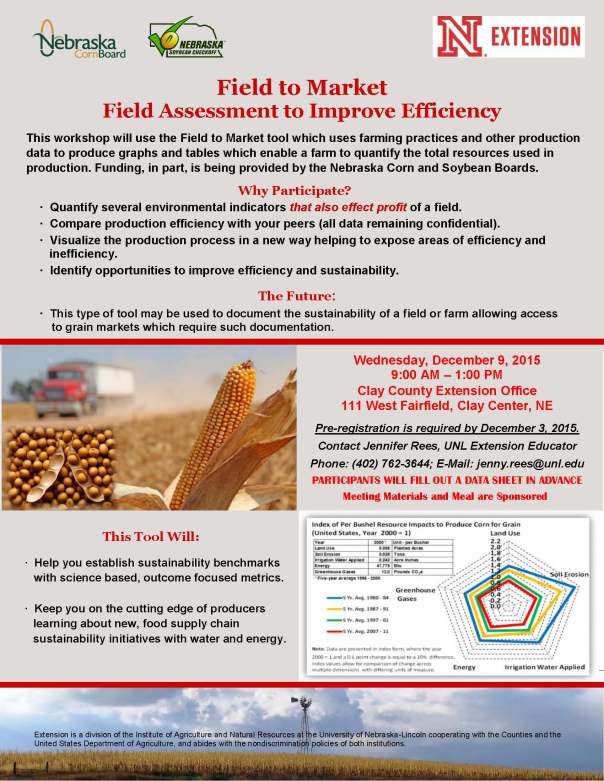
Most of the major grain buyers and companies using feed grains in food are reporting ways they are becoming more resourceful with energy, water, raw materials, and product waste streams. The consumer is asking these companies to improve the efficiency of producing and bringing their products to market. Nebraska Extension in cooperation with the Corn and Soybean Boards is conducting workshops to introduce Nebraska farmers to a tool that measures key farm efficiencies (web-based computer tool called the Fieldprint Calculator).
The field assessment workshops in Nebraska are hands-on and will show growers how to document eight sustainability and efficiency indicators via use of a laptop computer. The indicators are:
- land use,
- conservation,
- soil carbon,
- irrigation water use,
- water quality,
- energy use,
- greenhouse gas emissions, and
- water quality.
Computer laptops are provided or participants can bring your own. No prior computer knowledge is necessary and experienced users will be available to provide assistance.
Workshop Schedule
Please contact the Extension Educator listed for each site to preregister by Dec. 3.
Lincoln
Monday, December 7, 9 a.m. – 1 p.m.
UNL Extension Office in Lancaster County, 444 Cherrycreek Road
Contact: Tyler Williams, (402) 441-7180 or tyler.williams@unl.edu
Beatrice
Monday, December 7, 5:30 – 9 p.m.
UNL Extension Office in Gage County, 1115 West Scott St.
Contact: Paul Hay, (402) 223-1384 or paul.hay@unl.edu
Auburn
Tuesday, December 8, 9 a.m. – 1 p.m. Nemaha County Hospital Meeting Room, 2022 13th St.
Contact: Gary Lesoing, (402) 274-4755 or gary.lesoing@unl.edu
Geneva
Tuesday, Dec. 8, 5:30 – 9 p.m. UNL Extension Office in Fillmore County, 1340 G St.
Contact: Brandy VanDeWalle, (402) 759-3712 or brandy.vandewalle@unl.edu
Clay Center
Wednesday, Dec. 9, 9 a.m. – 1 p.m.
UNL Extension Office in Clay County, 111 West Fairfield Contact: Jennifer Rees, (402) 762-3644 or jenny.rees@unl.edu
Central City
Wednesday, Dec. 9, 5:30 – 9 p.m.
UNL Extension Office in Merrick County, 1510 18th St.
Contact: Troy Ingram, (308) 946-3843 or troy.ingram@unl.edu
Fremont
Thursday, Dec. 10, 9 a.m. – 1 p.m. UNL Extension Office in Dodge County, 1206 West 23rd St.
Contact: Nathan Mueller, (402) 727-2775 or nathan.mueller@unl.edu
Mead
Friday, Dec. 11, 9 a.m. – 1 p.m.
UNL Extension Office in Saunders County, 1071 County Road G
Contact: Keith Glewen, (402) 624-8030 or kglewen1@unl.edu
UNL Grazing Corn Residue Research
Many stalks in Nebraska are left ungrazed for various reasons. One reason I’ve heard is the potential impact of increased compaction and reduced yield of the next crop. Nebraska Extension has long-term research addressing this concern…in fact, 16 years of research conducted at the Ag Research and Development Center near Mead. There’s various components to this study and you can view the full report at: http://go.unl.edu/8mp6.
In this study, cattle were allowed to graze corn residue in the spring (February to mid-April) or the fall (November through January) and these treatments were compared to an area not grazed. Corn and soybeans were planted the spring after grazing the residue for 16 years to determine the effect of grazing on the subsequent crop yield.
In the fall grazing treatments, the corn and soybeans were planted no-till. For corn or soybeans planted into the spring grazing treatments, three tillage treatments were also implemented for nine years: no-till, ridge-till, and spring conventional till, after which all treatments were converted to no-till. This result of the tillage by spring grazing treatments for either corn or soybean yield over nine years showed no interaction and suggested the same effect on yield regardless of tillage treatment used after spring grazing.
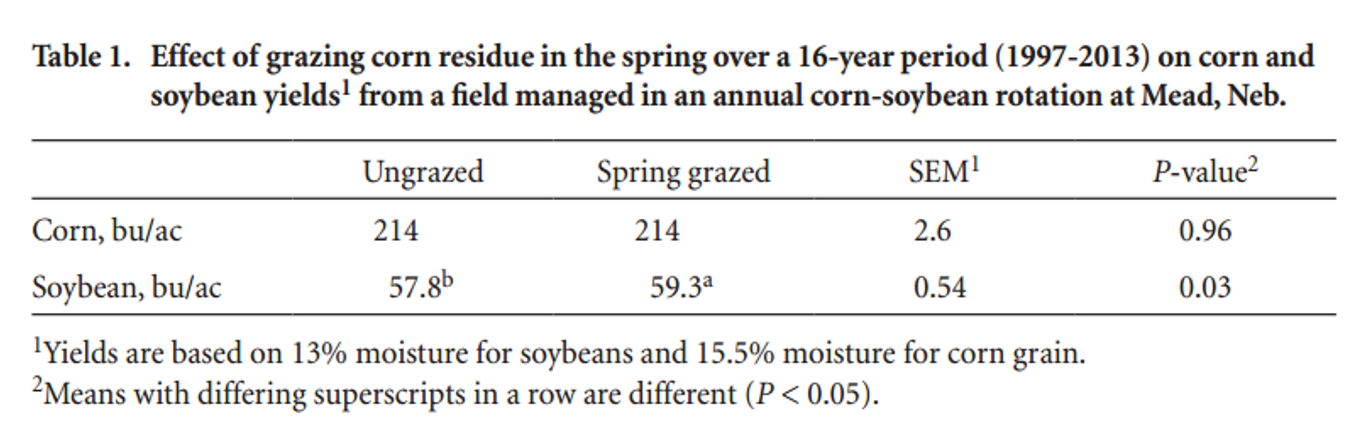
“Effect of Corn Residue Removal on Subsequent Crop Yields“, 2015 Nebraska Beef Cattle Report. Mary E. Drewnoski, L. Aaron Stalker, Jim C. MacDonald, Galen E. Erickson, Kathy J. Hanford, Terry J. Klopfenstein
Spring grazing across all tillage treatments did increase soybean yields statistically (58.5 bu/ac for spring grazed vs. 57.0 bu/ac for ungrazed) and had no effect on corn yields. The results were similar looking at 16 years of grazing vs. not grazing under no-till for both corn and soybeans in the spring; there was no yield effect found for corn and the soybeans showed a slight yield increase with grazing.

“Effect of Corn Residue Removal on Subsequent Crop Yields“, 2015 Nebraska Beef Cattle Report. Mary E. Drewnoski, L. Aaron Stalker, Jim C. MacDonald, Galen E. Erickson, Kathy J. Hanford, Terry J. Klopfenstein
Looking at a 10 year period of no-till management for both spring and fall grazed corn residue and subsequent corn and soybean crops, fall grazing statistically improved soybean yields over both spring grazing and no grazing (65.5 bu/ac vs. 63.5 bu/ac and 62.1 bu/ac respectively). No grazing effects were observed on corn yields in either season. All statistics were at the 95% confidence level meaning the researchers were 95% confident any yield differences were due to the treatments themselves vs. random chance.
Regarding compaction, in the fall, the field was typically frozen and the researchers felt any mud and compaction associated with grazing cattle was minimized; highest subsequent soybean yields were achieved with fall grazing. The spring treatment was designed to look more at potential compaction and muddy conditions after spring thaw till right before planting-thus the implementation of different tillage treatments as well. They used a stocking rate consistent with UNL grazing recommendations resulting in removal of half the husks and leaves produced (8 lbs of leaf and husk per bushel of corn grain produced). Results of this study indicate that even with muddy conditions in the spring, grazing increased subsequent soybean yields compared to not grazing regardless of tillage system used and that corn yields were not different between grazing vs. not grazing and regardless of tillage system used in the spring. This study was conducted in Eastern Nebraska in a rainfed environment with yields ranging from 186-253 bu/ac with a 16 year median yield of 203 bu/ac.
Additional Grazing Study
A five year fall grazing study (December through January) was conducted in an irrigated continuous no-till corn field at Brule, NE to determine the effect of corn residue removal via baling corn residue or fall grazing on subsequent corn yields. That environment receives limited rainfall and residue is deemed important for reducing evaporation of soil moisture in addition for catching/keeping snow on fields. Farmers were questioning the effects of any residue removal on subsequent corn yields and the study was implemented.
Treatments were 1) fall grazing at 1 animal unit month/acre (AUM), 2) fall grazing 2 AUM/ac, 3) baled, or 4) ungrazed. The researchers found that residue removal did not affect corn grain yields from 2009-2013 in the continuous corn rotation. There were no statistical yield differences with 5 year average yields of: 152 bu/ac, 155 bu/ac, 147 bu/ac and 148 bu/ac respectively for the above-mentioned treatments.

“Effect of Corn Residue Removal on Subsequent Crop Yields“, 2015 Nebraska Beef Cattle Report. Mary E. Drewnoski, L. Aaron Stalker, Jim C. MacDonald, Galen E. Erickson, Kathy J. Hanford, Terry J. Klopfenstein
Sudden Death Syndrome and Corn Residue

Symptoms of Sudden Death Syndrome (SDS) on leaves show green veins with discoloration between the veins (left photo). Signs of the blue/gray/white Fusarium fungus causing SDS on a rotted soybean root (right photo).
Grazing corn residue provides many benefits to both livestock and grain farmers, yet many corn stalks in our area are not grazed for various reasons. With as much hail as we’ve had this fall, grazing is also an option to remove ears and kernels that were lost, preventing volunteer corn next season. Normally there is less than a bushel of ear drop per acre, but we most likely have more than that in some of our fields this year. Two kernels per square foot or one ¾ pound ear in 1/100 of an acre is the equivalent of 1 bu/ac yield loss. In 30” rows, 1/100 of an acre is 174’ long if you count in one row or 87’ if you count in two rows.

Soil samples (0-8″) for soybean cyst nematode (SCN) can be taken at any time but always good to sample areas that were affected with SDS to determine if SCN is also present.
What may also be of interest to you is a recent finding between corn grain loss pre-and during harvest and sudden death syndrome (SDS) of soybean. Many asked me this this year, “Why did I see SDS this year when we’ve never had it in this field before?” It’s a great question and I often responded by saying we need to sample the areas affected with SDS for soybean cyst nematode (SCN) as the two diseases are synergistic. Sampling for SCN still remains free through your Nebraska Soybean Board Checkoff dollars and you can stop by the Extension Office for free sampling bags. Crop consultants should contact the UNL Plant and Pest Diagnostic lab directly at (402) 472-2559 if you are requesting 10 or more sampling bags.
Anything that moves soil can transport the fungal soil-borne pathogens causing these diseases. But recent research from Iowa State University also suggests that the fungal pathogen causing SDS (Fusarium virguliforme) survives on grain lost during the harvest process in fields and that SDS management in soybean actually needs to begin at corn harvest.
Studies were conducted for two years in greenhouse and in field plots with nine treatments to determine the survivability of Fusarium virguliforme (Fv) on corn and soybean residue. The treatments were: 1-Corn kernels + Fv; 2-Corn roots + Fv; 3-Corn stem/leaves/husk + Fv; 4-No residue + Fv; 5-Soybean seeds + Fv; 6-Soybean stem/leaves/pods + Fv; 7-Soybean roots +Fv; 8-Corn stalk on soil surface + Fv; 9-Corn kernels and stalk on soil surface + Fv. The researchers consistently found in both the greenhouse and field experiments that Treatment 1 of corn kernels at average harvest loss resulted in the most SDS. Treatment 2 consistently resulted in the second most SDS.

From Iowa State University, September 2010, “Good Harvest in Corn Should Help Manage SDS“.
This helps to explain why some farmers are finding SDS in fields that have been continuous corn for a period of years, are finding SDS in corn and soybean rotation when little or no SDS was previously observed, and why SDS has increased in seed corn fields that may have higher harvest losses. They did not experiment with tillage systems and their recommendation is to reduce harvest losses to reduce the risk of SDS.
Grazing residues can reduce your risk from these harvest losses and for those losses which were incurred with the hail/wind storms we’ve experienced since Labor Day. When grazing corn residue, cattle are selective. They will eat the grain first followed by the husk and leaf followed by the cob and stalk.
It’s also important to be aware of grazing restrictions from herbicides applied to row crops; you can read more about that in this post.
Forage, Feed, and Grazing Restrictions for Row Crop Herbicides
It’s nice seeing cattle being turned out into corn stalks!  One point that I haven’t mentioned recently is that we all need to be checking the herbicide label for any grazing restrictions of crop residues.
So check the labels from in-season applied herbicides to row crops and fall-applied herbicides to crop residue for any potential grazing restrictions…and any restrictions on grazing cover crops planted into crop residues following application of those chemicals to a row crop. If the label doesn’t specify any restrictions, then it should be ok. If you want to be on the safe side, a rule of thumb many chemical reps use is to use the pre-harvest interval for the amount of time to wait before grazing stalks.
Some labels will say that residue should not be grazed or baled and fed to livestock. Sometimes studies were actually conducted to know there is a safety concern. In other cases, the chemical company may not choose to conduct all the studies the Environmental Protection Agency (EPA) required for labeling due to high costs. If that’s the case, the EPA requires the strongest restrictive language be placed on the label.
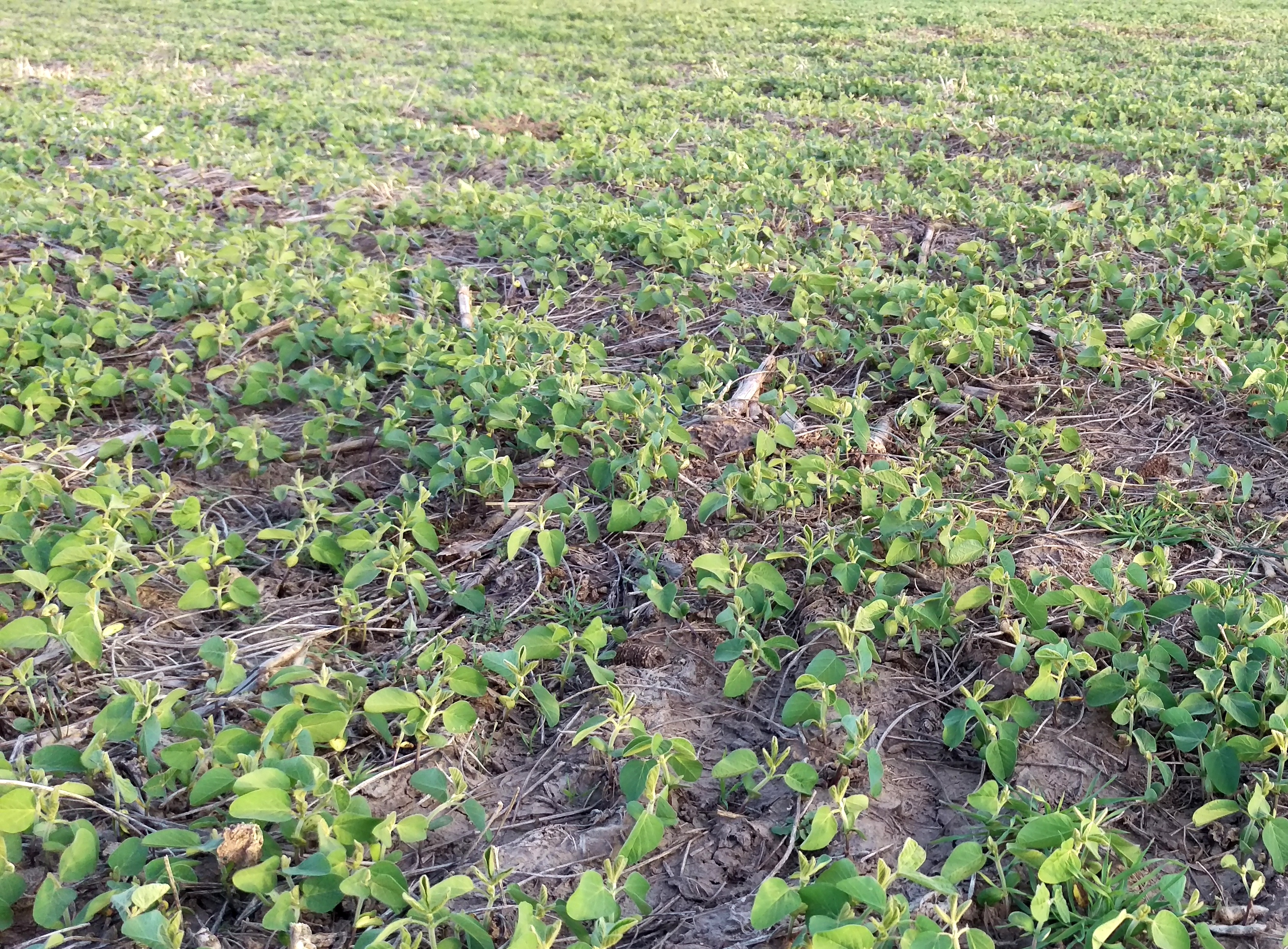
Hail/rain/wind caused for soybean shatter and harvest loss. Volunteer beans have created green fields in the area. For those considering grazing, one needs to look at any herbicide grazing restrictions from herbicides applied in-season to soybeans as well. Dr. Bruce Anderson says, “Soybeans can cause bloat, but the incidence is low. The young green ones may be more risky. Founder would be possible problem with a sudden diet change. Too many unsprouted beans in the diet could cause excess fat; I think maximum is about 3 lbs beans per cow. I’d try to limit amount of grazing for a few days, maybe feeding a very palatable supplement like a ground forage/distillers mix and reduce the amount of this supplement each day for a week or so. And keep a dry, palatable hay always available free choice.” Additional information from the University of Missouri.
Regardless, if it says there’s a grazing restriction on the label, the label needs to be followed as it is a legal document and the law. Your cattle may/may not be affected by grazing stalks or cover crops where a chemical with a grazing restriction is on the label, but there may be other concerns such as problems with the chemical affecting the calf or being retained in the cow’s milk.
For quick references, the 2015 UNL Guide for Weed Management shows Forage, Feed, Grazing Restrictions for Row Crop Herbicides on pages 174-177. A new weed guide will be released January 2016. These pages just provide a reference; it’s truly best to read and follow the label.
Wind-Hail Crop Damage Meeting

Recent wind and hail storms have created damage across our area counties in Nebraska and Kansas. This brief meeting to be held on Monday near Gladstone, NE is designed to answer farmers’ questions regarding harvest, crop insurance expectations, and what to expect regarding crop maturity and future damage. Please click on the image to enlarge.


 JenResources