Nebraska’s Advantage
This week, I’d like to share some information that came out in a white paper from the UNL  Agricultural Economics Department on the special relationship we have here in Nebraska between crops, livestock, and biofuel production capacity not found in other parts of the U.S. to the extent we have here. It’s called the “Nebraska Advantage”.
I think it’s important for all of ag industry to realize we need each other as it seems we sometimes forget how inter-dependent we are. Crop producers need the livestock and ethanol industries as they are a high percentage of our end users. Yet many times I hear of crop producers fighting livestock expansion or livestock coming into an area. The purpose of the white paper was to share the numbers of where Nebraska livestock, grain production, and ethanol production currently stands, and what Nebraska could gain if we worked to increase livestock production in-state where we have a wealth of resources with our crops, water, and biofuel production.
Nebraska currently ranks 1st in irrigated acres, 1st in commercial red meat production and is tied with Texas for cattle on feed, 2nd in corn-based ethanol production, 3rd in corn for grain production, 4th in soybean productions, 6th in all hogs and pigs, and 7th in commercial hog slaughter, and 9th in table egg layers. However, in reading this white paper, one quickly realizes we’re not taking advantage of the tremendous grain production capacity here in the State.
We export over 1/3 of our annual corn crop, at least half of the in-state production of distiller’s grains (a co-product from ethanol production that is fed to livestock), and more than 80% of our soybean meal output. Corn and soybean production have increased in our State by 50 and 25% respectively, which is a blessing due to our irrigation capacity. But increasing amounts of this grain are being shipped out-state instead of benefiting rural economies in Nebraska if it was used in-state for value-added livestock production and processing instead.
In the white paper, graphs are shown comparing Nebraska to neighboring states. These graphs show Nebraska lagging neighboring states in growth of the livestock industry. For example, while Nebraska overall increased in hog production, the inventory increased 17.2% during the first half of the decade, but declined 11.8% in the second half. In comparison, Iowa realized an increase of 31.5% within the decade. What was really interesting to me is the fact that Nebraska exports 2.5 million pigs annually to neighboring states to be finished and shipped back to Nebraska for processing, showing potential for growth in the market hog sector. The dairy sector has also declined in herd numbers in Nebraska compared to other states and Nebraska’s poultry industry (mostly egg laying hens) has declined over the past decade in spite of constant numbers across the U.S.
When one looks at Nebraska’s economy, cash receipts from all farm commodities totaled over $25.6 billion in 2012 and livestock/livestock product sales was 45% of this total ($11.6 billion). Increased employment, local tax revenue, value-added activity, and manure for fertilizer are all economic benefits of livestock expansion. The paper stated,
A base expansion scenario that includes a 25% increase in market hogs, a doubling of dairy cow numbers, a ten percent increase in fed cattle production and a tripling of egg production, along with the associated processing industries, has the potential to provide an additional 19,040 jobs, with labor income of almost $800 million and value-added activity of over $1.4 billion. This activity has the potential to generate over $38 million in local tax revenue. While this amounts to a fairly small percentage of Nebraska’s total economy, these impacts will occur almost entirely in non-metropolitan areas of the state and would be quite beneficial to rural economies.
Livestock development has been held back by various issues and policies including: limitations on corporate farming activity in Nebraska, state and local permitting processes, nuisance roles and lawsuits, and issues/concerns from the general public and interest groups. The final conclusion of the paper was that significant growth in employment and economic output throughout Nebraska is dependent upon these issues being overcome.
I would challenge all of us to keep an open mind when producers desire to diversify by including livestock in their operations or through livestock expansion. In many cases, doing so allows another person to come back to an operation, or allows someone to get started farming, which in the long run benefits our rural economies. It’s ok to ask questions, to become more educated. It’s through these questions that one learns how production practices have changed to ensure the health and welfare of our livestock and in odor reduction from the facility and manure application. You can read the entire white paper contents here.
Nebraska On-Farm Research Updates

Another one of my favorite winter meetings, and honestly, one of the most powerful farmer learning experiences I have the opportunity to take part in, is the Nebraska On-Farm Research Network and the winter Updates! Why is this such a powerful experience? Because the farmers who conduct the research are the ones presenting what they did, why they did it, and their results! The discussion amongst farmers, ag industry, and Extension is highly engaging and thought provoking. Great questions are asked. But even more powerful is the understanding that occurs on what valid research is and how to question what one sees and hears presented at meetings, in magazines, and online. The Nebraska On-Farm Research Network is sponsored by the Nebraska Corn Board and Nebraska Soybean Board via your checkoff dollars and this year we are having meetings at three locations in the State. February 13th will be at College Park in Grand Island; February 16th at the Lifelong Learning Center in Norfolk; February 17th at the ARDC near Mead and all meetings will begin at 9:00 a.m. and last till 3:00 p.m. There is no charge for these meetings but pre-registration is needed for meal count and ensuring we have enough materials and space. Please pre-register for all meeting locations by calling (402) 624-8000 or email christina.franklin@unl.edu. There are five CCA credits pending approval. Hope to see you at one or more of the meetings!
Simplification and Accuracy in Texas A&M Farm Bill Decision Tool
As I work with producers and landlords, I’ve seen a variety of understanding and preparation for inputting information into the Texas A&M Farm Bill Decision Tool. Previous blog posts have shared screenshots for inputting information. What I will do with this blog post is share how to simplify the time spent inputting information while checking for accuracy of the information inputted. You will only receive as accurate of information as what you input into the tool!

First, your best friend while inputting is the “eraser sheet” from FSA. It lists CC yields, base acres, reallocated base, but best yet, it lists planted production by year from 2009-2012. That seems to be the largest hang-up I have with producers and getting information to turn out correctly. RMA acre data often includes additional acres that were once pasture or CRP that are now in production but not accounted for in your base acres with FSA. So you have to use FSA production acres in this tool for the information to come out correctly for your farms. It also is a life-saver for farms that are joined together or split out….takes the headache out of figuring planted acres in those years! Note: The above eraser sheet is just an example so you know what one looks like. It is NOT used for inputting or double checking in the next several screen shots.

On the “edit” page when entering a farm unit, at the top of the page, you don’t need a description, but can add one if you wish. To simplify and save time on the bottom half of the page: ONLY entering CC yield and base acres for the specific crop saves a great deal of time. You don’t need basis, crop insurance, or insurance policy if you ARE NOT using this tool to make a crop insurance decision. You also only need “future acres” if you are interested in looking at crop insurance, or if you are interested in evaluating ARC-IC as an option. Inputting “0” for future acres just provides a summary of ARC-Co vs. PLC payment projections. Then press “save”.
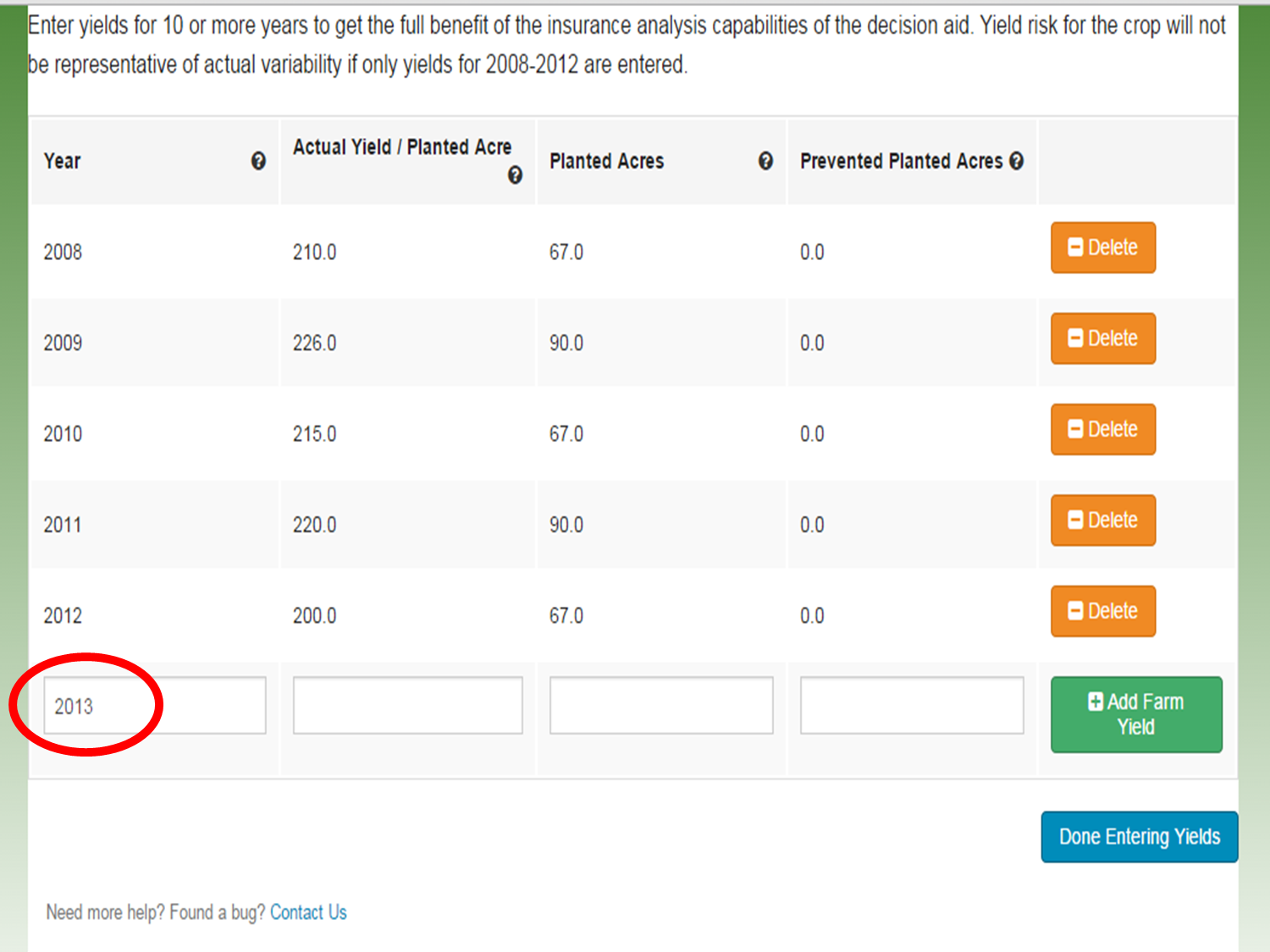
When entering yields, you need to enter one more date after all your yield data has been entered for the data to save properly. In this example, I have inputted yield data for 2008-2012. I then added “2013” and pressed “save yield data”. Not doing this step will delete your last row of yield information. On “planted acres” use production acres from FSA vs. RMA as this provides the correct acres for base reallocation decision and thus, correct potential payments based on those acres. 2008-2012 is necessary to determine updated yield. 2009-2012 acres are needed for determining base reallocation. The acres for 2008 will not influence or throw off the acres in this tool.

For crops in which you have old base acres but you have not produced since 2008, you can enter yields by adding a “0” in them as shown here. This does take time, so you can also skip this step as shown in the next screen shot without affecting your analysis.

UPDATE: If you wish to save additional time, you DON’T have to enter in “0” for yields for old base acre crops you didn’t plant from 2009-2012. Instead, on the home screen, simply hit “save” after entering in old base acres and CC yield for crops you no longer plant and skip entering yields for these crops. The output is the same (Thanks to Randy Pryor, Nebraska Educator in Saline County for this time-saving tip!)

Once all your crop information is entered for every one of your farms, you need to double check your data. First, Click on the “Yield Update” decision tool. The first screen shows what you entered and gives you a chance to check your information. Double check that your CC yields are entered correctly and that the yields look correct for what was entered. If the information is correct, then click on the “information is correct” button. If it is not, click on “home” and go back to the crop and farm where the information needs to be corrected. Note that if you had a crop that did not have CC yield on your FSA sheet because you also had no old base acres for that crop, on the “Home” screen enter “0” for CC yield and “0” for base acres. Then the County plug yield is inserted as the CC yield on this screen.

You will then see the yield updates for all your crops on all your farms that you inputted. You can print this screen for your information. A couple things to look for on this sheet. Whenever the 2013 CC Yield is higher than PLC Yield, it’s probably wise not to change that yield. Also a note for corn in particular, I like to go through all the farms and highlight the farm with the highest PLC corn yield. When having difficulty making a decision between ARC-Co vs. PLC, crops with highest PLC yields will offer the best PLC payments.

Next it’s time to look at the “base reallocation decision tool”. The first screen is a double check for you. It’s very important that the current base acres and reallocation acres match what was given you by the FSA office. Not inputting production acres based on FSA records (shown in top table) can throw off the potential base reallocation in the lower table. If the current base and potential reallocation base agrees with what was provided from FSA, simply push the “information is correct” button. If it doesn’t match, you will need to go back to the home screen and change the production acres so that the total production matches up to total base acres each year from 2009-2012 in order for the base reallocation to be correct. One more note: If you have split irrigated and non-irrigated acres, make sure to take a % of base acres assigned to the crop. (Ex. This farm has a total of 50 corn base acres. If 50% your acres are irrigated corn and you were in a county with split irrigated/non-irrigated opportunity, then assign 25 base acres to irrigated corn on the home screen and 25 base acres to non-irrigated corn). Inputting 50 corn base acres for both irrigated corn and non-irrigated corn would give you a total of 100 base acres which is 50 acres too many and will provide incorrect information.

Next you have an opportunity to select prices. I typically select USDA prices for all crops first. Then hit the “analyze” button. When the following screen appears, I click “download” then print the PDF that appears one-sided. This ensures that information for each farm number does not end up back to back with another farm number if you print two-sided. I then scroll to the bottom of this page, click “change prices” and click all the FAPRI prices, analyze, download, and print one-sided again. It does take some paper, but you’ll see why I recommend this shortly. It also allows you to keep farms separate if you’re showing results to landlords and/or tenants.
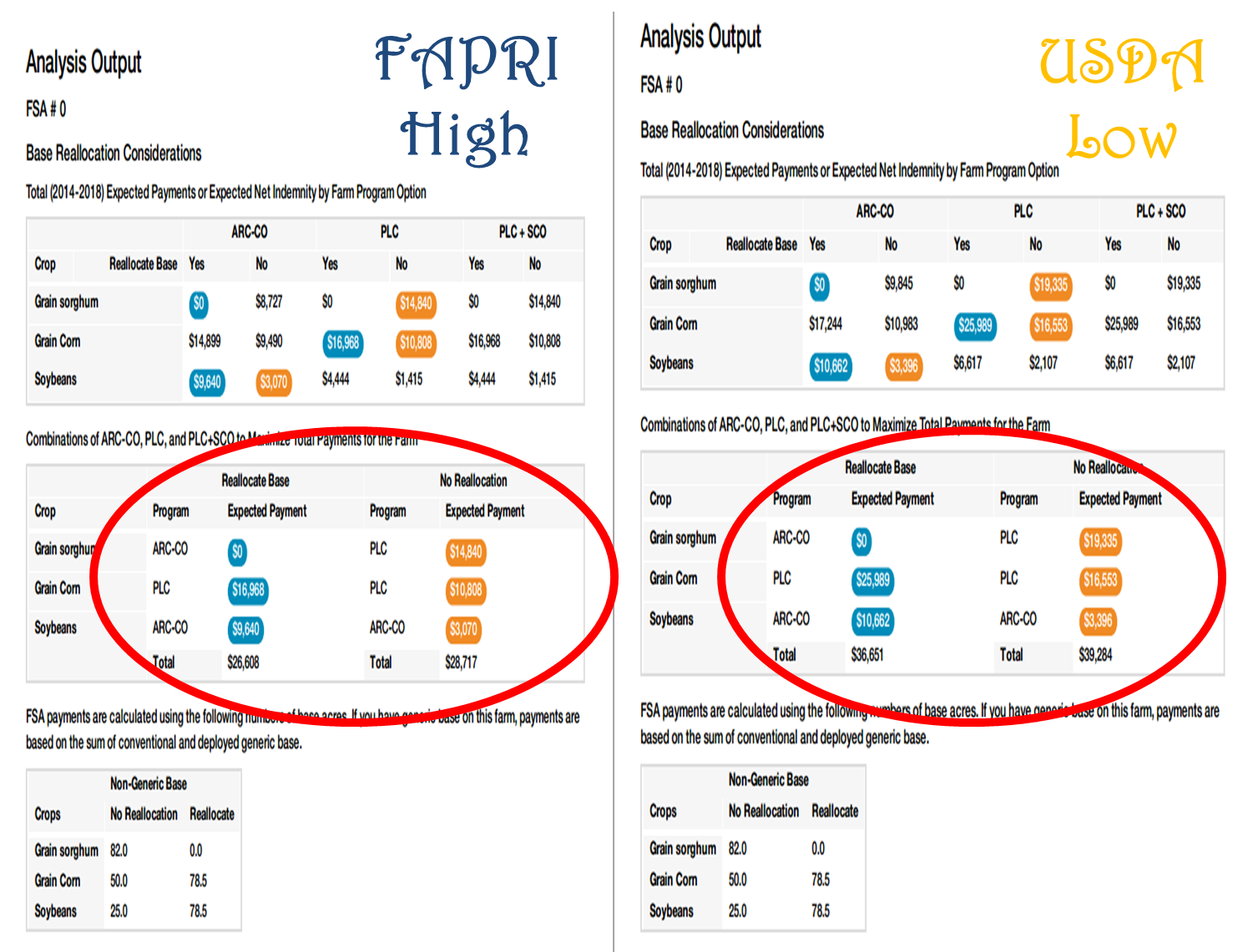
Once I print both sets of prices, the gals in my office and I staple together each farm number. We write “high” for FAPRI prices and “low” for USDA prices. I then place the High and Low together by farm number and farm by farm, go through the output with the farmers. Ultimately, I’m looking for trends when both the higher and lower prices agree. In this example, we are first looking at the base acre reallocation decision. Blue bubbles mean higher payments with reallocation; orange means higher payments without reallocation. Look at the bottom line for total payments. Notice in this example that for both low and higher prices, not reallocating the base is consistently higher. To help explain this, look at the base acre information below. What is occurring for this particular farm is a loss of grain base from 132 to 78.5 grain base acres. So essentially for this farm, the increase in corn base acres was not enough to off-set the milo payment from old base. The farmer then has to choose if he/she wants to reallocate base to what is currently planted, or retain base acres to protect grain base and obtain the milo payment. The other thing to notice is the decision of ARC-Co or PLC for each crop and how well they match between high and low prices. In this case, if the farmer chooses no reallocation, PLC is most consistent for milo and corn while ARC-Co is most consistent for soybeans. When both high and lower prices agree like this, it helps make decisions easier. You can always go back and play with the prices more, but you have to be careful with that. Remember, your decision ultimately is based on what you feel future prices will be for the next five years.
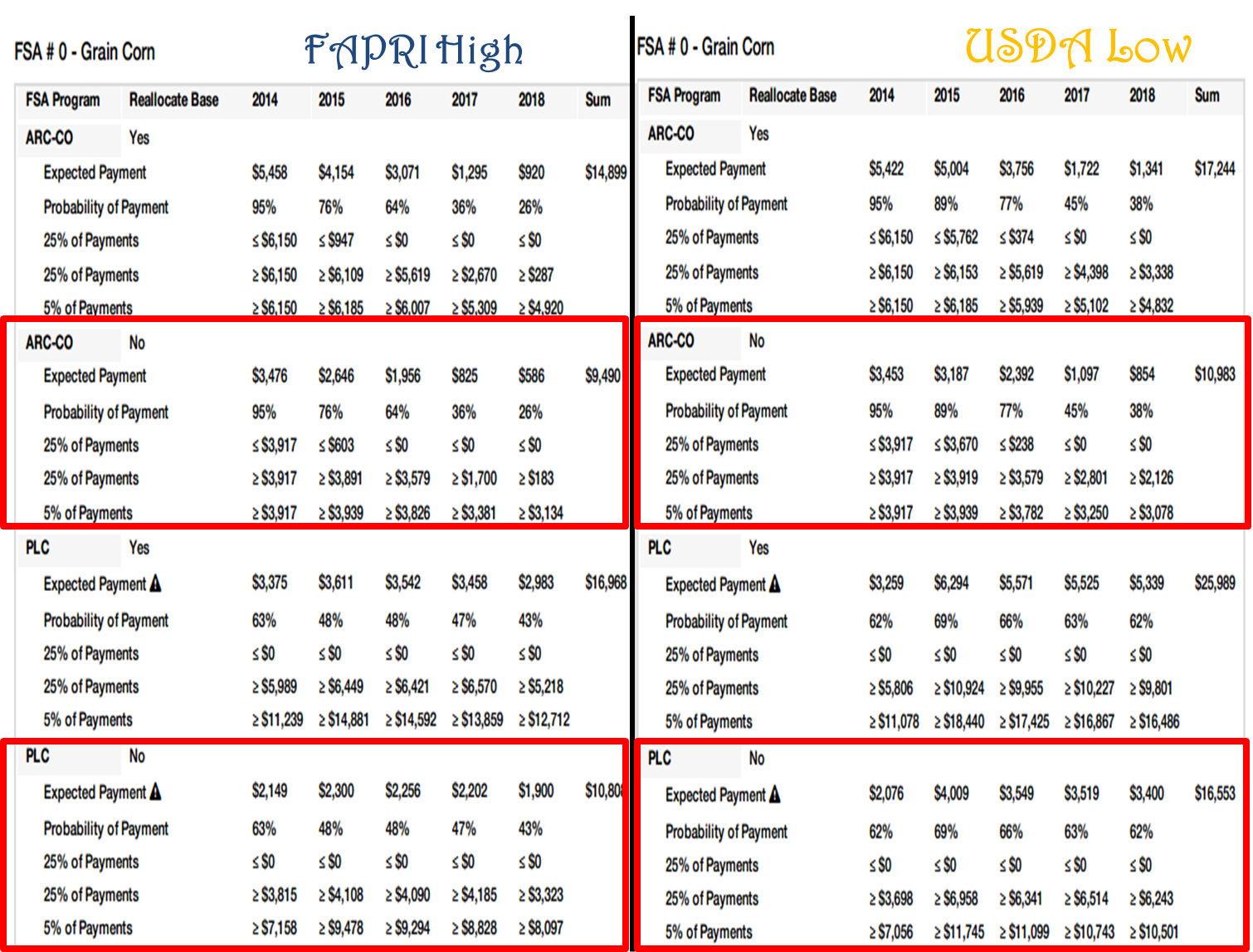
The final thing I like to do is analyze the output for higher and lower prices crop by crop, especially for farms where Corn switches decisions on the first page from ARC-Co with FAPRI prices to PLC with USDA prices. It comes down to what the producer feels prices will be the next 5 years. I compare the ARC-Co vs. PLC prices for whichever decision the farmer makes regarding base reallocation. In this example, let’s say the farmer decides to not reallocate his/her acres. We then compare ARC-Co vs. PLC for both FAPRI and USDA prices for each crop. Besides the total payment over the length of the farm bill based on these prices, I also like to compare payments year by year with both options and look at probabilities of those payments based on the projected FAPRI and USDA prices. In this situation, PLC provides higher payments in both higher and lower price situations over the life of the farm bill. ARC-Co provides slightly larger payments the first one or two years depending on price. One thing to keep in mind: If FAPRI prices are correct, then the PLC payments for years 2015-2018 go to $0 because FAPRI is estimating prices above the $3.70 trigger price for corn. So why does the tool show a PLC payment for FAPRI prices? It is taking into account 500 scenarios at one time that all have a chance of occurring in the future and the probability of payment if prices are at, above, or below the predicted FAPRI price for each year. Same for USDA prices. So it’s important to always keep this in mind when analyzing the results.
Hopefully this post was helpful to you in understanding how to simplify your input into this tool, to understand the importance of accuracy, and to understand one way of analyzing data from the Texas A&M Decision tool! You can view more information by checking out these YouTube videos.
NeATA Conference in Grand Island Will Keep You Up To Date on Emerging Ag Technologies
One of my favorite winter conferences! Interested in ag technology? Be sure to check it out!

If you are using technology in your farming operation or business, the NeATA conference is one you should attend.
Keep up with emerging ag technologies for your farm at the 2015 Nebraska Agriculture Technology Association Conference, Feb. 4-5 in Grand Island.
Constant technology advances in precision agriculture are transforming today’s farms. The 2015 Nebraska Agriculture Technology Association (NeATA) Conference on February 4-5 at the Mid-Town Holiday Inn in Grand Island, NE will focus on the latest products, practices, and services available to producers in managing tomorrow’s farm. The symposium registration starts at 8:30 am on Wednesday, Feb. 4 and the conference registration starts at 7:00 am on Thursday, Feb. 5.
NeATA is Nebraska’s newest grassroots agricultural-based non-profit associations. The association was founded by innovative Nebraska farmers and agribusiness representatives that share a common desire to stay abreast of emerging agricultural technologies. The annual symposium and conference is co-hosted by NeATA…
View original post 211 more words
THE DAY THAT COULD START YOUR STORY IN CASNR….
Great opportunity to learn more about career opportunities and majors at UNL!

 Experience the Power of Red — Spring Edition

Thursday, April 2, 8:30am-12:00p.m.
An event where you’ll learn how the College of Agricultural Sciences and Natural Resources (CASNR) prepares students for careers in everything from animals to plants, soil to climate, golf to business, mechanization to leadership, and food to forensic science.
You’ll meet faculty, staff and current students to get the scoop on what life at UNL is really like. Explore campus in person and get a true sense of the UNL CASNR experience.
Schedule:
- 8:30 a.m. Registration/Browsing Session
- 9:15 a.m. Welcome and Overview
- 9:45 a.m. Move to First Session
- 10:00 a.m. First Session
- 10:30 a.m. Move to Second Session
- 10:45 a.m. Second Session
- 11:15 a.m. Lunch/Wrap-Up/Scholarship Drawing
- 12:00 p.m. East Campus Tour (optional)
- 1:00 p.m. City Campus Experience/Tour (optional)
Register:
Please register by March 26 at http://go.unl.edu/springday
Questions:
For more information contact us at (800) 742-8800, ext. 2541 or lfrey2@unl.edu.
Additional Farm Bill Decision Tool Information
I’ve really enjoyed working with producers and landlords on looking at farm bill decisions for individual operations. A quick caution again regarding supplemental coverage option (SCO), you can only take price loss coverage (PLC) into account not PLC+SCO if you haven’t plugged the information into the Texas A&M farm bill tool correctly (meaning 10 years of yield data and all production information broken into crop insurance units for each FSA farm number). You can always discuss SCO with your crop insurance agent but the tool itself won’t provide correct output without inputting numbers correctly. You can simply remove SCO from the tool information by not selecting a crop insurance option on the first home screen of each farm unit you input into the Texas A&M tool. I have screen shots with additional information in this blog post.
I’m willing to work individually with those interested in looking at the Texas A&M tool for your decisions. Please call (402) 762-3644 to set up an appointment. You will need to bring the following with you:
- Your CC yields from FSA (the ones sent in July/August tend to have all your CC yields for all your current base acres). You could also request your FSA 156-EZ form for this information. Or better yet, ask for FSA’s eraser sheet for each of your farms.
- Your base acres and potential base reallocation information FSA sent you.
- Yield production history from 2008-2012 by crop. If you were in the ACRE program during the last farm bill, please also ask them for the screenshot of all your yield production history. Since you had to prove yields with that program, your production information is already in their system. If you weren’t in ACRE, you will need to fill out the price loss coverage form FSA sent you. You can obtain this information from your crop insurance records or from scale tickets by farm if you don’t have crop insurance information. You will not have to prove yields at the time of signing up, but please keep your records as you will need to prove how you obtained this information in the event you are spot-checked. Here’s more information regarding yields.
When determining your yield history from 2008-2012, for combined counties, FSA is looking for a total combined production (not a weighted production based on irrigated vs. dryland acres). If you have crop insurance information, add up the total production in bushels for irrigated and dryland by crop (ex. Corn) for each FSA farm number and total the acres of each production entry. Then divide production by total acres to determine your yield. It’s important you use RMA production data, not APH yield as the APH yield may incorporate other modifications to actual production.
For split counties, I’ve been recommending to keep dryland and irrigated production split on the top part of the FSA PLC form and then the combined yields at the bottom part of the form. This allows you to have the split yield information for the Farm Bill Decision Tool and also the combined yield data that FSA needs. Add up dryland production by FSA farm number and irrigated production by that farm number. When inputting data from a split county into the Texas A&M decision aid, you will need to allocate base acres on a percentage of the irrigated vs. dryland acres. For example, if 50% of the land in one FSA farm number is irrigated and you have 200 acres, then 100 acres would be used for the base acres in the decision tool for irrigated yields and 100 acres would be used in the tool for dryland yields. Your CC yield will remain the same for both irrigated and dryland by crop.
Inputting Data into Texas A&M Farm Bill Decision Tool
Last week was enjoyable working with farmers on Farm Bill decisions. I’ve decided to work with producers on an individual basis. If you are interested in help looking at your potential options using the Texas A&M model or would like another set of eyes to make sure the data was inputted correctly, please call (402) 762-3644 and Deanna or Holli will get you scheduled for a time.
One caveat is that this model is only as good as the data you input into it and your decisions
Example of FSA “eraser sheet” courtesy of Randy Pryor, Nebraska Extension in Saline County.
are based on where you feel potential prices the next five years will be. You need your CC yields and base acres from FSA as well as production history since at least 2008 (2003 if you wish to run crop insurance tool). Requesting a copy of the FSA “eraser sheet” is a great tool to check on planted and crop production planted acres and to see if reallocated base jives with the computer program. The Texas A&M simulation at https://usda.afpc.tamu.edu/ isn’t difficult to run, but it can be confusing as to what number to input where. Begin by registering at the site by providing an email address and password. Then login and you will see the following screen.
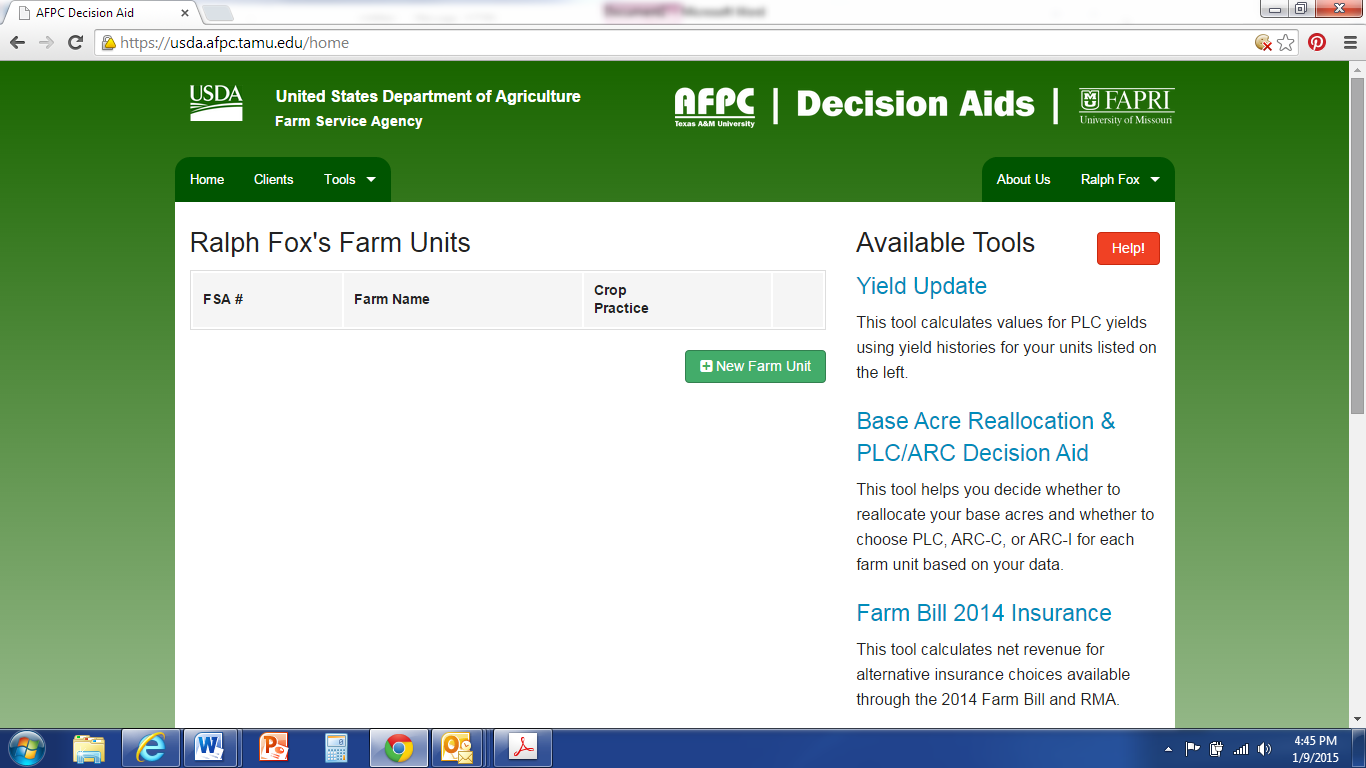
It is important for you to decide what you want the tool to analyze for you. It can analyze: yield update, base reallocation, ARC vs. PLC, and crop insurance (shown in right-hand column in screen-shot, or can also be selected from “Tools” in top drop-down menu). If you want to analyze crop insurance decisions, EACH crop insurance tract needs to be entered as a “new farm unit” under each FSA farm number. It takes a lot of time and it can be done, but that’s the only way to use this tool to also look at crop insurance including supplemental coverage option (SCO).
If you do not want to look at crop insurance decision but wish to consider the first three decisions, then for counties such as Clay County with COMBINED irrigated and dryland county yields, completing the Price Loss Coverage (PLC) Yield Worksheet (CCC-859) from FSA with your combined irrigated and dryland yields for each FSA number will greatly aid you in inputting the data. For counties with any splits in irrigated and dryland yields, I recommend placing irrigated and dryland production separately on the top of the PLC Yield worksheet, and then combining production by crop towards the bottom of the worksheet. Regardless of if your county has the opportunity for a split irrigated/non-irrigated payment, all CC yields in Nebraska are combined by crop (regardless of irrigation or not), so FSA will want a combined yield by crop on their form.
EACH crop needs to be entered as a separate farm unit. I have created a fake account to walk you through a simulation.
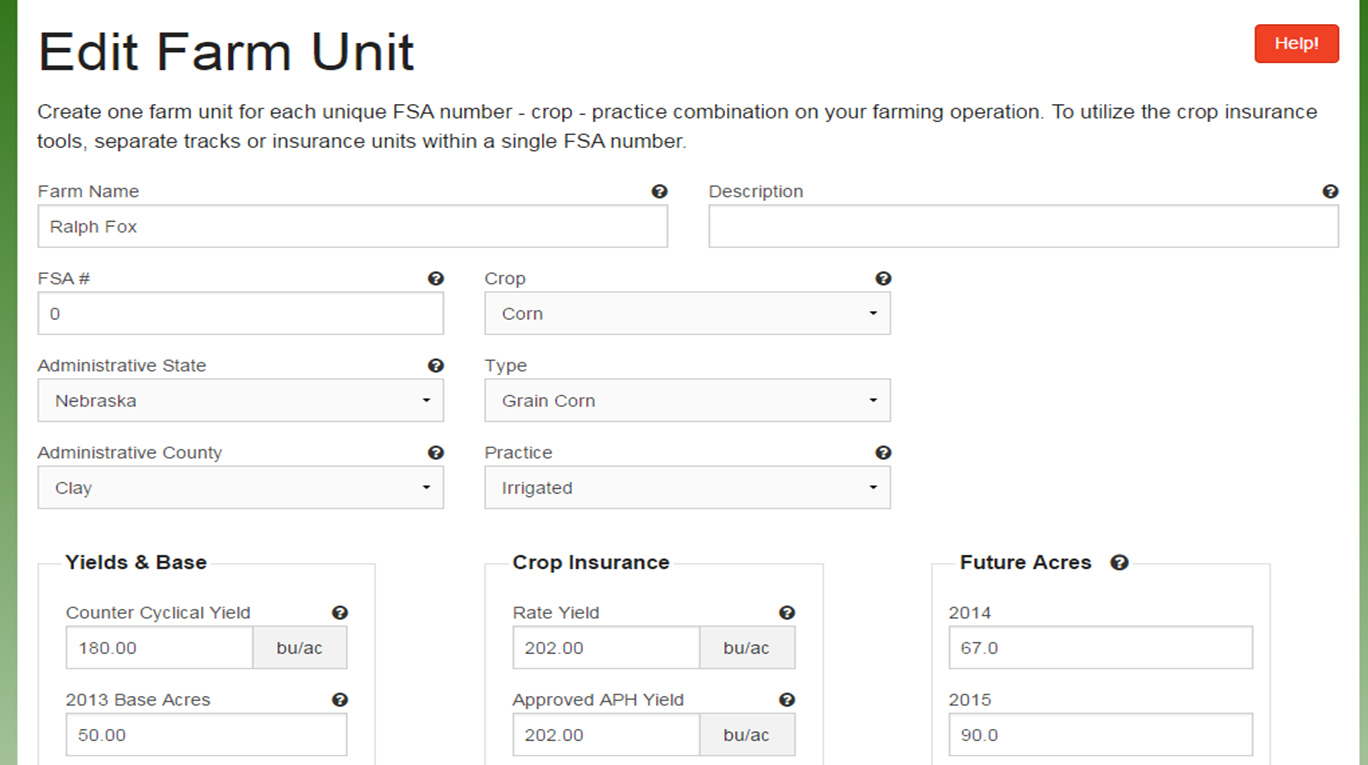
Some are having a difficult time finding “rate yield” on their crop insurance forms. It is not critical if you are not using the crop insurance tool and the same Approved APH yield can be inputted for the rate yield as well. If using the crop insurance tool, the correct rate yield from crop insurance must be used. UPDATE: If you ARE NOT interested in analyzing crop insurance information, “0” can be inserted for basis price, rate and APH yields, and select “none” for crop insurance. If you are also not interested in analyzing ARC-IC, then “future acres” can also be entered as “0”.
When entering yields, you need to enter one more date after all your yield data has been entered for the data to save properly. In this example, I have inputted yield data for 2008-2012. I then added “2013” and pressed “save yield data”. If you input 2013 yields, be sure to add a “2014” instead. Not doing this step will delete your last row of yield information.

Notice that each crop needs to be added as a separate farm unit. If using the crop insurance tool, each crop insurance tract under each FSA farm number needs to be added as a separate farm unit. Be sure to split out base acres among the tracts and be sure that the total base acres add up to the total base acres from FSA.
For entering separate crop insurance tracts, the CC yield should remain the same for all dryland tracts under one FSA farm number (same for irrigated). However, you will have to split out base acres amongst the tracts and you need to make sure the acres inputted add up; please double check this!
For your yield update and base reallocation information: For some of you, the base reallocation acres in the tool have been slightly different than what you received from FSA office. That may be because risk management agency (RMA) acres were used and were different than the production acres FSA had on file. You need to use the FSA acres for planted acres when using this model if they differ from the RMA ones.
When running this model, on many farms PLC + SCO looks favorable for some crops. A word of caution, you can consider PLC but should not consider SCO in your decision if you have not broken everything out into crop insurance tracts and included 10 years of production history into the tool. So in the decision of reallocating base acres or not, in the final summary section that gives you total numbers, anytime PLC+SCO is shown for a particular crop and you have not included the proper crop insurance info, you need to re-calculate the final total by hand using PLC ONLY from the table above that area. It normally doesn’t change the outcome that the decision tool provides, but it can. I’m not saying that SCO shouldn’t be considered, what I’m saying is that the numbers provided in the tool are not accurate if you have not inputted the data in the way needed to look at crop insurance decisions.

In this example, you notice three tabs: Base reallocation, risk chart, and per crop analysis. The green tab shows what you are looking at-in this case base reallocation. Notice there are two charts: The top one shows ARC-Co, PLC, and PLC+SCO. Blue circles indicate best option with reallocating base acres while orange circles indicate best option without reallocating base acres. The second table gives you your totals. Notice in this table and the one above that PLC+SCO are shown as the best options for corn. However, in the total, because we did not separate the crop insurance tracts in this FSA farm number and because I didn’t include 10 years of yield data, I need to recalculate the totals by looking at the top table for the next highest prices under ARC and PLC. So for this example, to refigure best reallocation of base payment total, I would take the $8093 listed in PLC, reallocation for corn since it is higher than ARC and add it to the $4612 for soybean payment to get: $12,705 for base reallocation. For no base reallocation, I would add $10,791 from PLC since higher than ARC in this example and add it to $3075 to get a total of $13,866 for no base reallocation. Most of the time, the outcome stays the same, but there are a couple instances it has changed, so wanted to make you aware of the importance of this.
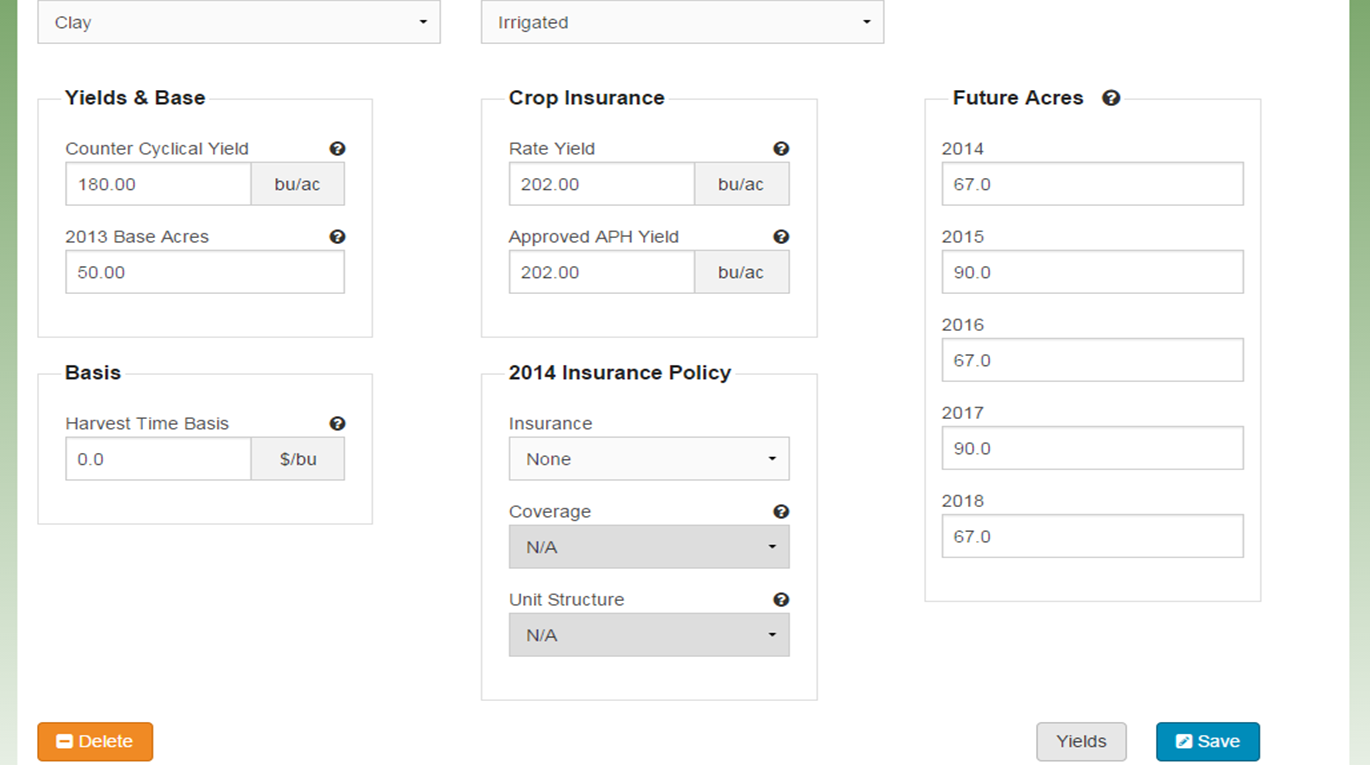
Or to get around having to hand-calculate removing SCO from the total decisions, Randy Pryor and Paul Hay, Nebraska Extension in Saline and Gage Counties respectively, discovered that if you select “no crop insurance policy” on the edit screen for each farm unit, that it automatically takes out adding SCO into your final calculated options as you can see from the next screenshot!
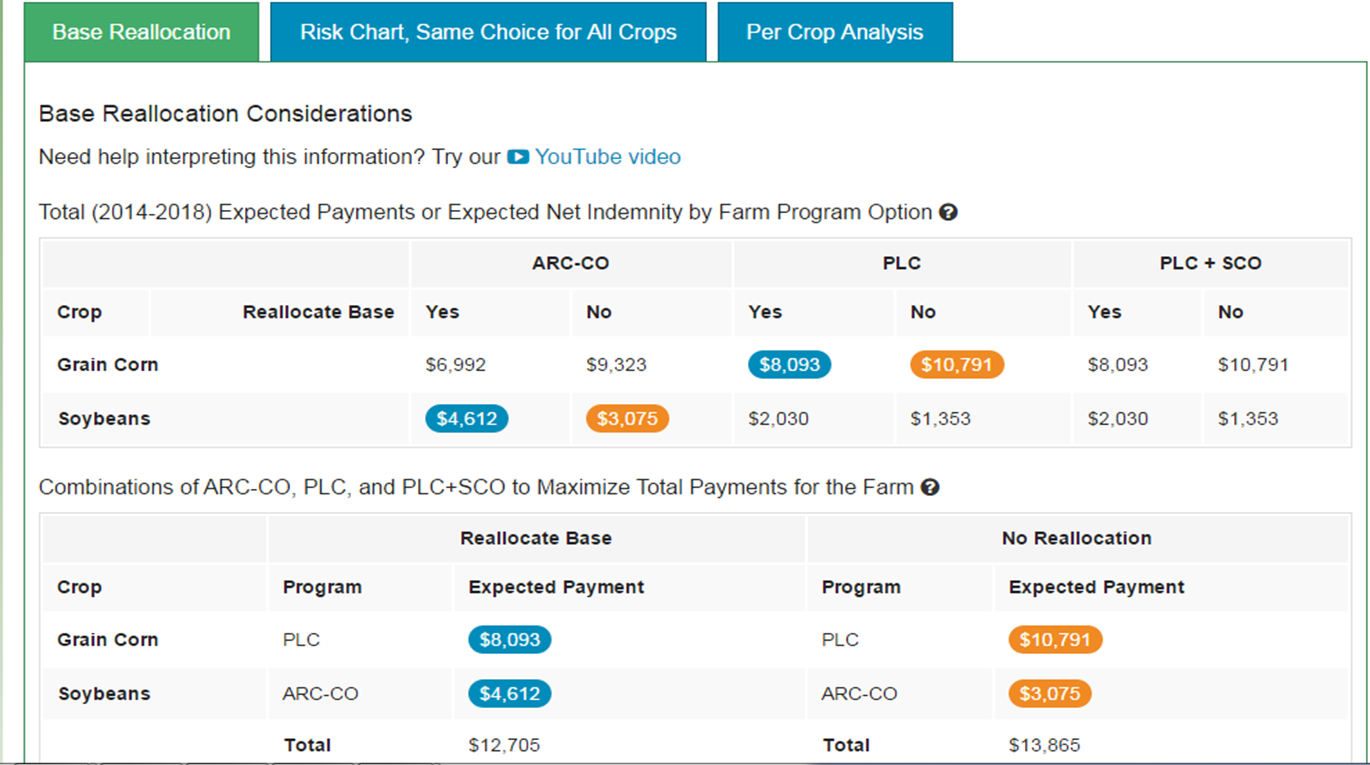
When not adding crop insurance tract info and 10 year yield history information to be able to analyze Supplemental Coverage Option (SCO), removing crop insurance from the beginning edit screens allows you to analyze base reallocation and ARC-Co vs. PLC program options without having to recalculate and remove SCO. It won’t give you a higher SCO payment number when adding information in this way.
Some of you have questioned why PLC even lists a payment when prices are inputted higher than the benchmark price of $3.70 for corn, etc. The Texas A&M tool is giving you essentially a bell curve of 500 random outputs with the distribution of that curve around the particular price you input for each crop. So with every given price you input, there’s a certain probability that the price will be at, above, or below that particular price. That’s essentially what the red, green, yellow bars are showing you on the analysis. So you’re assessing where you feel prices will be, what decision will allow you to best sleep at night, the potential of spreading out risk with several farm numbers by choosing different options, etc. You can also view the YouTube videos from Texas A&M with more information!

Winter Meetings Week Jan. 12th
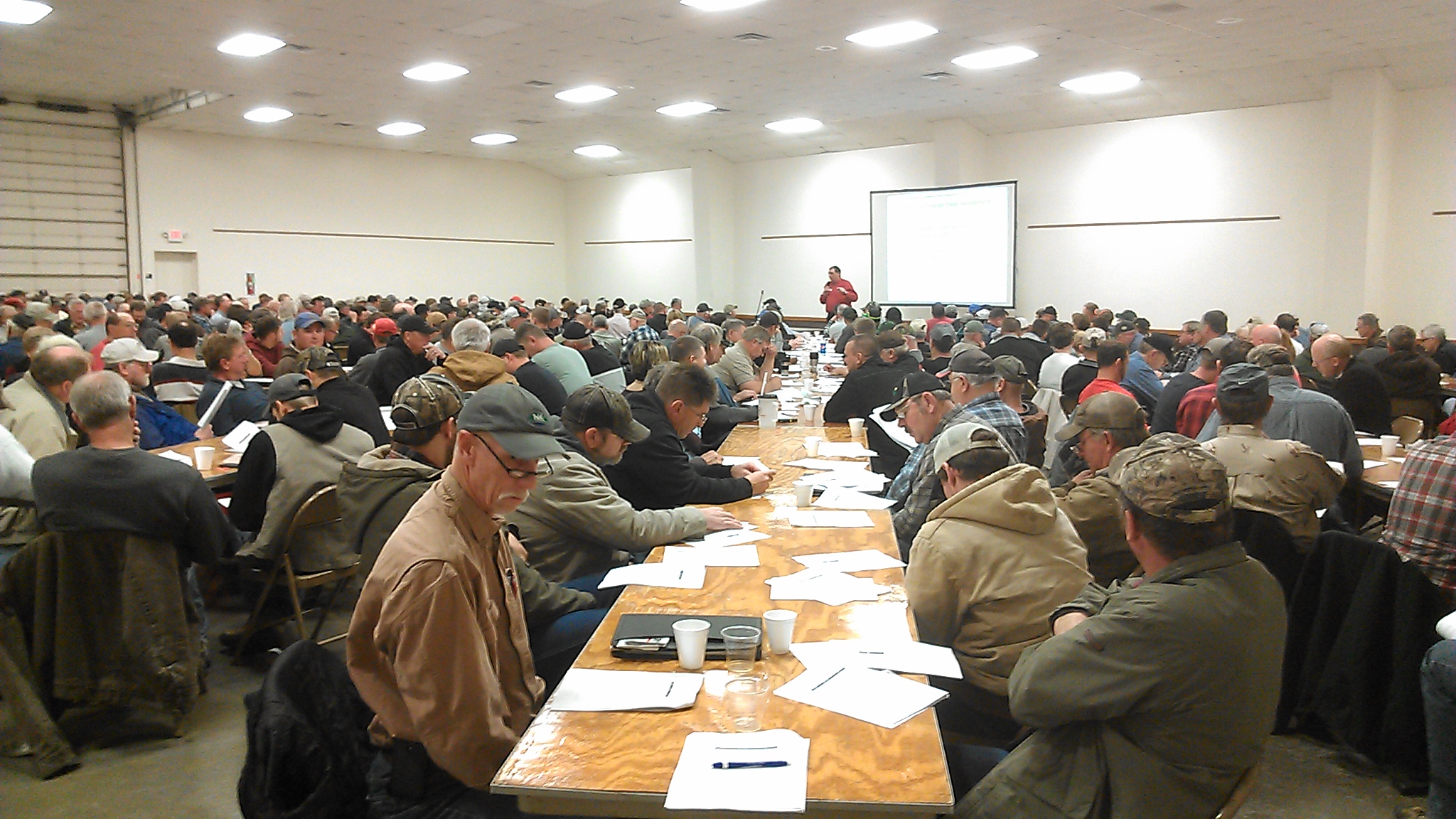
Well-attended Farm Bill informational meetings in December throughout the State.
Tis the season for winter programming! The following are a few upcoming meetings occurring this week. Winter program brochures were mailed a few weeks ago, so please check those for additional meetings. Looking forward to seeing you at upcoming meetings this winter! A reminder that if you plan to attend any of the upcoming Crop Production Clinics, that you need to register online by 3:00 p.m. the previous day of the clinic. Crop Production Clinics this week will be held in Kearney on Tuesday the 13th and at York on the 14th.
Farm & Ranch Business Succession & Estate Planning Workshops: This is a very important topic for farm families to consider! Two workshops will be held in our area; one in Blue Hill at the Community Center on January 13th and one in York at the Country Club on January 15th. The workshop will go from 9:00 a.m. to 2:30 p.m. There is no charge for the workshops, but you need to register by calling the Rural Response Hotline at 1-800-464-0258. Please register by January 10 for Blue Hill and January 12 for York.
The workshop is intended to be useful for established farm and ranch owners, for their successors, and for beginners. Topics include: the stages of succession planning, contribution & compensation, balancing the interests of on-farm and off-farm heirs; the importance of communication, setting goals, analyzing cash flow, and balancing intergenerational expectations and needs; beginning farmer loan and tax credit programs; the use of trusts, wills, life estate deeds and business entities (such as the limited liability company) in family estate and business succession planning; buy-sell agreements, asset protection, taxation (federal transfer taxes, Nebraska inheritance tax, basis adjustment), and essential estate documents. Presenters are Dave Goeller, Deputy Director, Northeast Center for Risk Management Education at UNL and Joe Hawbaker, Agricultural Law attorney from Omaha.
This workshop is made possible by the Nebraska Network for Beginning Farmers & Ranchers, the Farm and Ranch Project of Legal Aid of Nebraska, National Institute of Food and Agriculture, the Nebraska Department of Agriculture’s Farm Mediation, and the University of Nebraska Extension. More information can be found here.
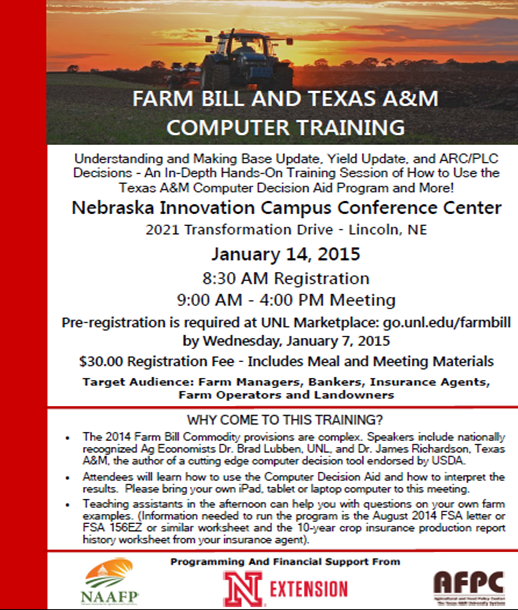
Farm Bill Education Training January 14th: For those of you that would like to learn more about the Texas A&M Agricultural Food Policy Center comprehensive Farm Bill Decision Aid computer program, a hands-on training will be held Wednesday, January 14, 2015 at the new Nebraska Innovation Campus Conference Center, 2021 Transformation Drive in Lincoln, Nebraska. Workshop presenters will be Dr. James Richardson, Ag. Economist from Texas A&M and Dr. Brad Lubben, UNL Extension Ag. Economist. Dr. Richardson is the author of new, cutting edge, computer decision tool, endorsed by USDA. Those attending will learn how to use the Texas A&M Computer Decision Aid, how to interpret the results and how managing risk is integrated into the model. Participants are encouraged to bring their own iPad, tablet or laptop computer. For information about the workshop go to: http://bit.ly/1wh96bm. Participants need to pre-register at http://go.unl.edu/farmbill. The workshop will be from 9:00 a.m. to 4:00 p.m. with morning registration and refreshments available starting at 8:15 a.m. at the new NIC auditorium. There is a $30.00 registration fee which includes the noon meal, refreshments and meeting materials. Web links to the meeting can also be purchased by contacting the Saline County Extension Office at (402) 821-2151. For additional information about the farm bill go to: http://farmbill.unl.edu.
Next Heuermann Lecture will be Jan. 13th at 7:00 p.m. at Nebraska Innovation Campus (2021 Transformation Drive in Lincoln, Nebraska) on the topic of “Genetically Modified Animals: the Facts, the Fear Mongering, and the Future”. Presenter will be: Alison Van Eenennaam, University of California – Davis, 2014 Borlaug CAST Communication Awardee. For more information, go to: http://heuermannlectures.unl.edu/. If you cannot make it to Lincoln, you can watch it live via video at the website link.
Ag Reflections from 2014
Happy New Year! Wishing all of you and your families a wonderful 2015! As I look back at 2014, there are several ag-related observations that I noted throughout the year.
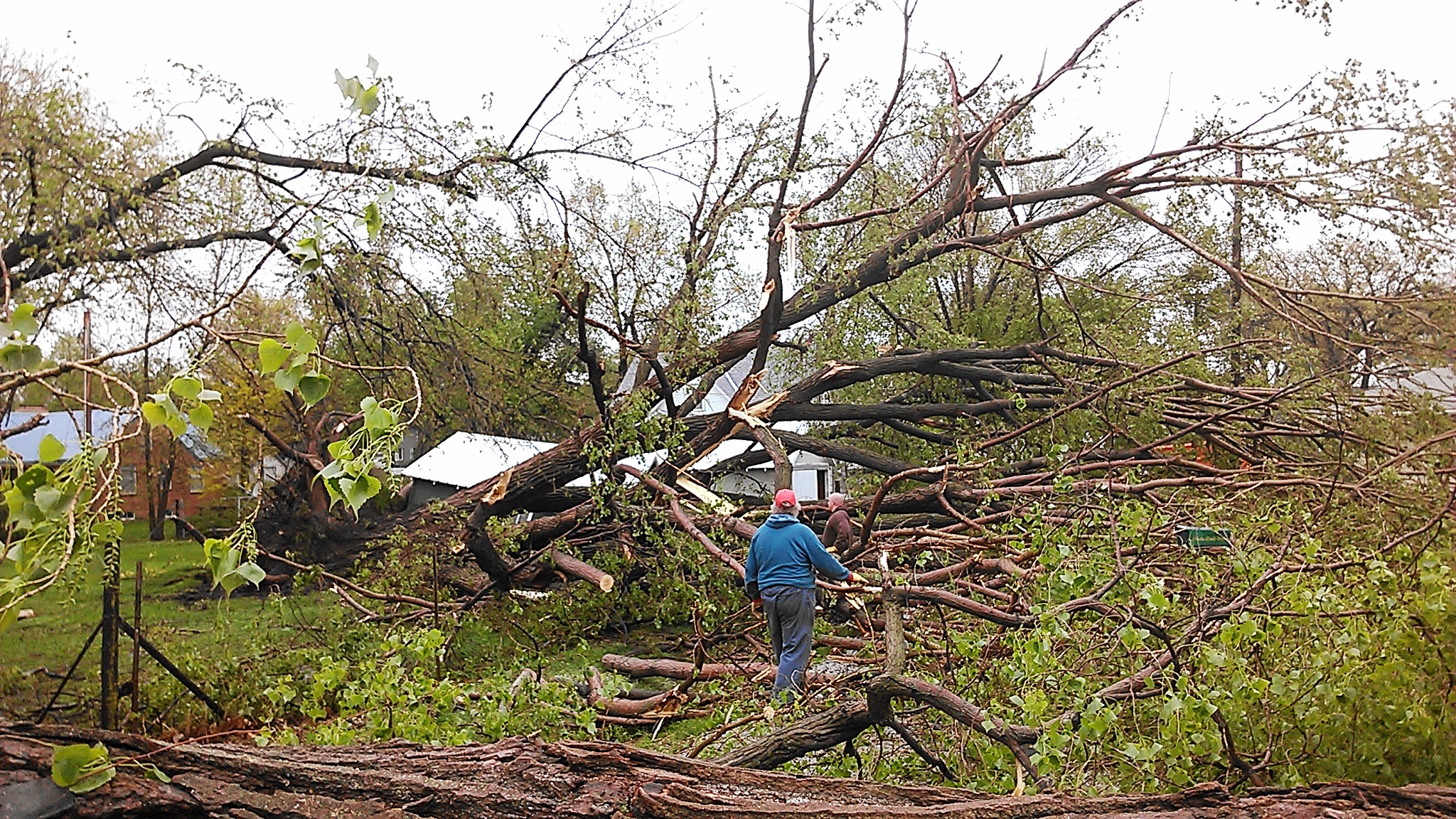
Cleanup after the tornado in Sutton on Mother’s Day 2014.
The first observation continues to be the way communities and people in this County/area pull together in difficult times. Whether after tornadoes/wind storms or helping other farm families who had an injured family member or had lost a family member, it’s just a blessing to see the way people pull together to help each other in time of need. It was also a blessing for many who were unable to harvest in 2013 due to the August 1st storm, to harvest fields in 2014, and for many in the area to experience really good irrigated and dryland yields this year.
The dry winter of 2013/14 allowed for very mellow ground during planting time. Often seeding depth ended up ½-1” deeper than intended. The dry winter also didn’t allow for good residue decomposition leading to problems during planting and ensuing stand emergence. Cutting off residue and high rains in May led to unintended consequences of replant situations when residue was moved off of farmers’ fields onto neighboring fields, suffocating emerged plants in portions of fields. I’m not sure what the solution is for the future other than it really needs to be something worked out with neighboring farmers, but perhaps mentioning it here opens an opportunity for future conversations.
Cover crops have been incorporated into more operations in recent years, yet the ultimate goal for using them remains important in determining what species/crops are used in the fields. We also realized the importance of determining amount grazed prior to turning cattle into fields (whether for grazing cover crops or crop residue), as high winds in winter 2013/14 in overgrazed fields led to soil blowing throughout the winter.
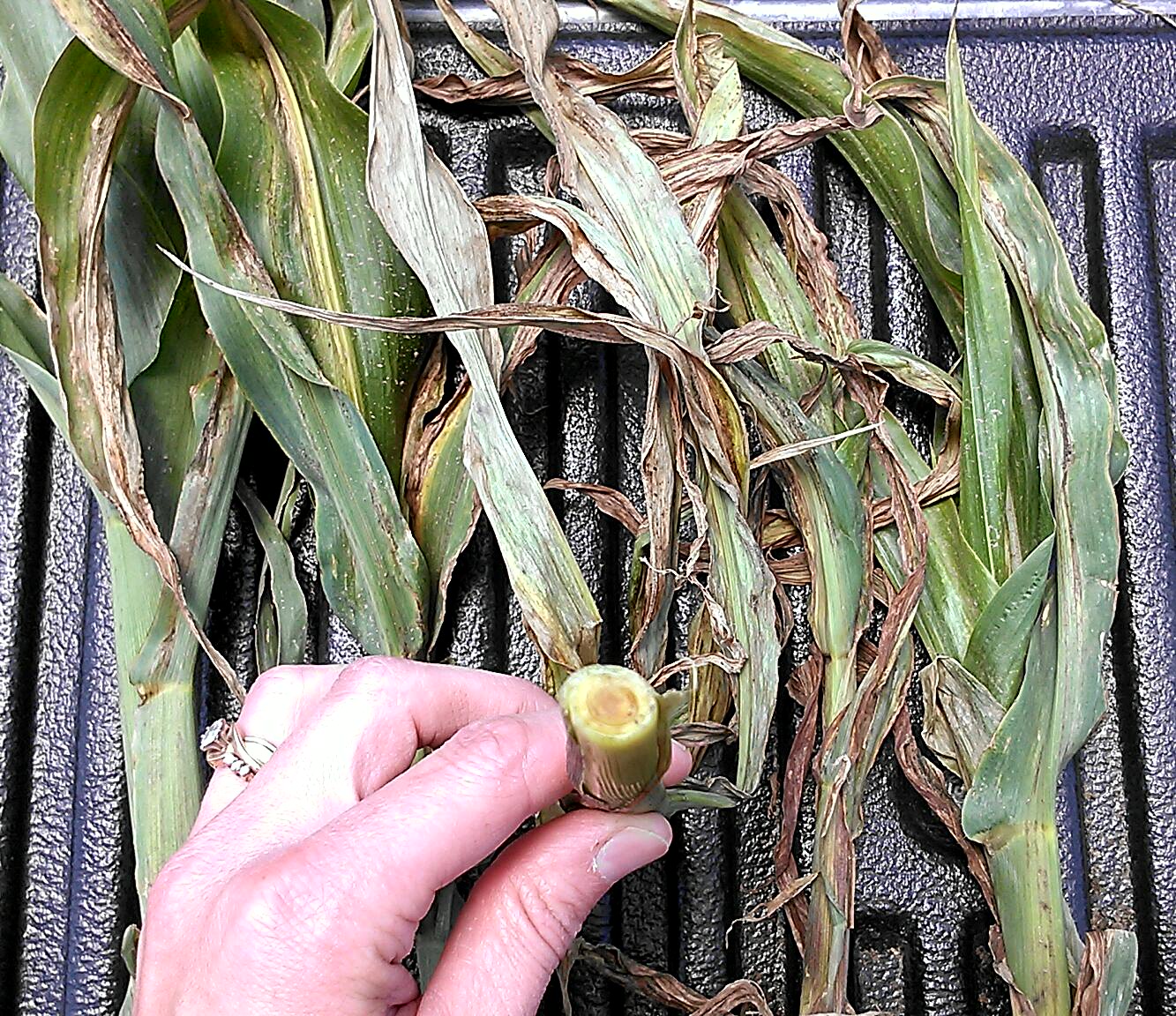
Systemic Goss’ wilt showed up in some fields that were hail and/or frost damaged by V6.
The May frost showed us emerged soybeans at the cotyledon stage held up well to the frost compared to the corn. We also again watched Goss’ wilt show up systemically by 6 leaf corn that was injured early by frost or hail in fields where Goss’ wilt had been a problem in the past. We need more research/understanding of this disease. Wheat continues to show us its resiliency as it winterkilled in portions of fields, withstood drought-stress, and then made up yield in the last 4-6 weeks.
Perfect pollination conditions coupled with high solar radiation, low night-time temperatures, and timely rain events were keys to the bountiful corn crop we experienced this year. Soybeans were more of a mixed bag. In walking fields and in conversations with farmers, I think the disappointment in some irrigated yields could be attributed to early/over-irrigation, disease problems, and planting date. UNL on-farm research showed on average a 3 bu/ac yield increase when soybeans were planted in late April to first week of May (regardless if growing season was warm/dry or cold/wet like it was this year) and those I’ve talked to who achieved 80+ bu/ac in the area this year planted in that time-frame. I’m curious if there’s something to planting a 2.4-2.5 maturity early vs. a 3.0+ maturity early as some area producers are seeing strong yields from a shorter season hybrid planted early the past few years. So if you’ve also seen this and/or are interested, that will be an on-farm research project to try next year. Please let me know if you’re interested!
Here’s wishing you a healthy and prosperous 2015!
Farm Bill Computer Training
A great opportunity to determine the best decisions for your farm!!! Please click on the photo to enlarge.


 JenResources