County Fair-Special Time of Year
Fair time is a special time of year. It’s the one time in the year where people from all parts of the county come together for the youth. Yes, there’s healthy competition involved, but 4-H and FFA are building life skills in our youth. Families congratulate each other and are excited for a youth’s job well done. It’s the one time in the year where people from all parts of the county come together for the youth.
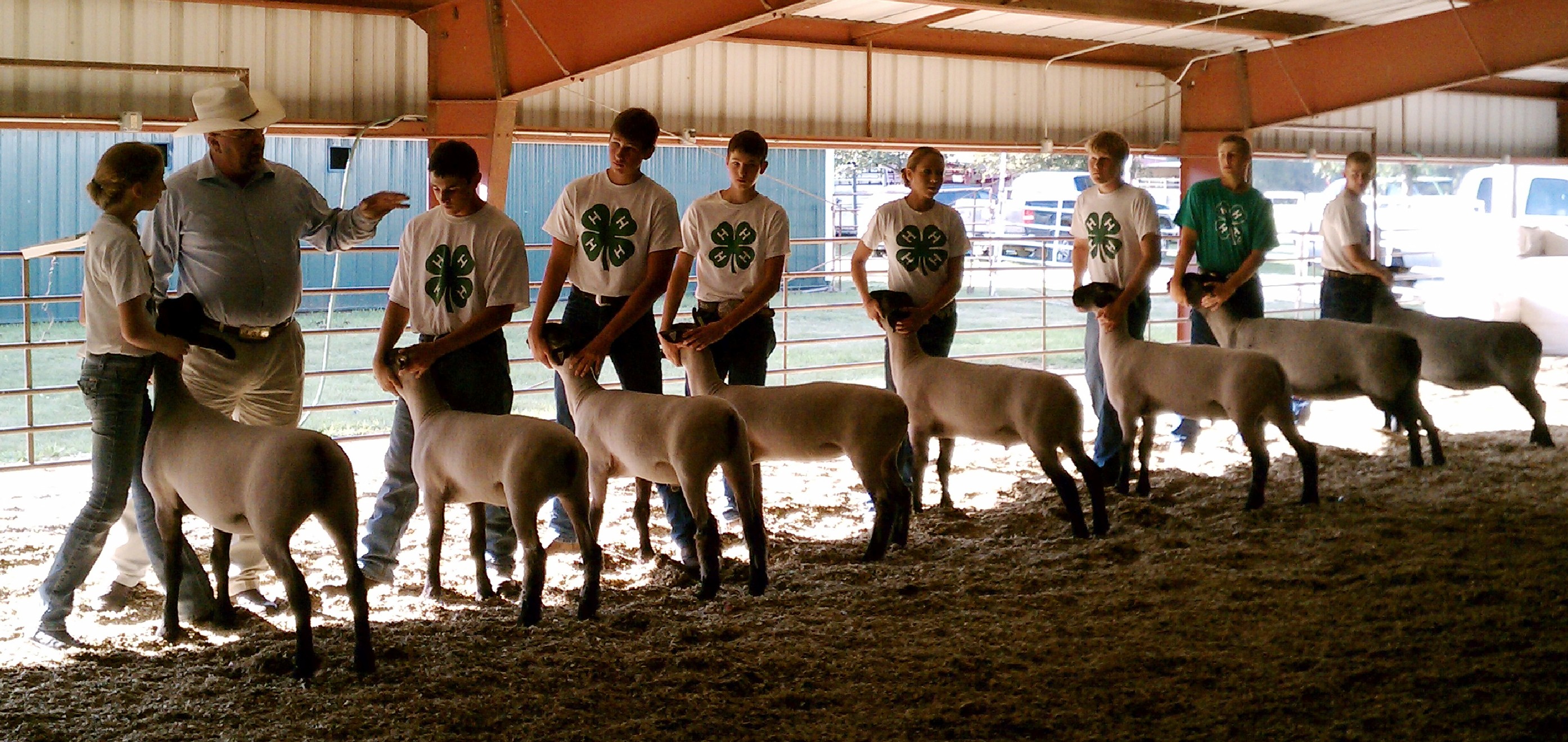
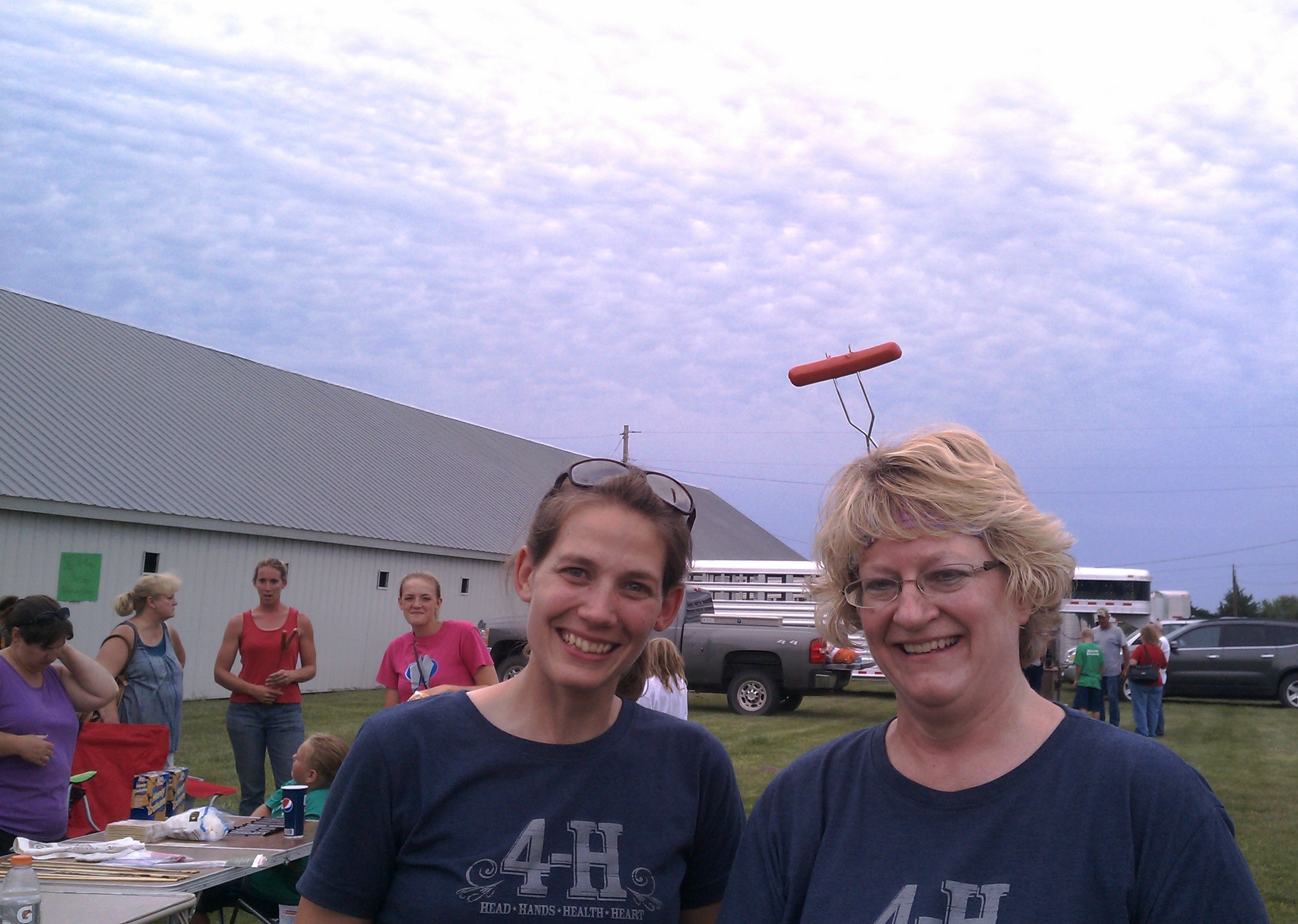
It’s always fun for me to watch the fairgrounds come alive Wednesday night as youth bring in their static exhibits and livestock entries. People are smiling and most youth-particularly the younger exhibitors-are excited. Many people, including me, checked the weather forecast throughout the fair in hopes of rain. This is the first fair in a long time that it didn’t rain Wednesday night or anytime during the fair. Thursday is a busy day with exhibits being judged, livestock being weighed in and the beginning of livestock shows. Something I always enjoy is family fun night on Thursday night. Clouds appeared and families enjoyed kiddie games, shelling popcorn, an obstacle course, and roasting hot dogs and marshmallows. Friday and Saturday continued with the remaining livestock shows and plenty of heat. Sunday brought a fun beef-fitting contest where youth of various ages and clubs worked together. It also brought smiles watching the young children tell their stories and show animals in the Rainbow Classic, watching all our top showmen compete in the Round Robin Showmanship Contest, and wonderful support from all our buyers at the Livestock Auction; we’re thankful for your support.
While probably most people are hot and tired by fair’s conclusion Sunday evening, it’s always a little saddening to me to watch the fairgrounds become empty so quickly again. Deanna and Holli in our office spend a great deal of time preparing for it as do all the youth, parents, grandparents, and 4-H leaders; thank you for all you do and the time you all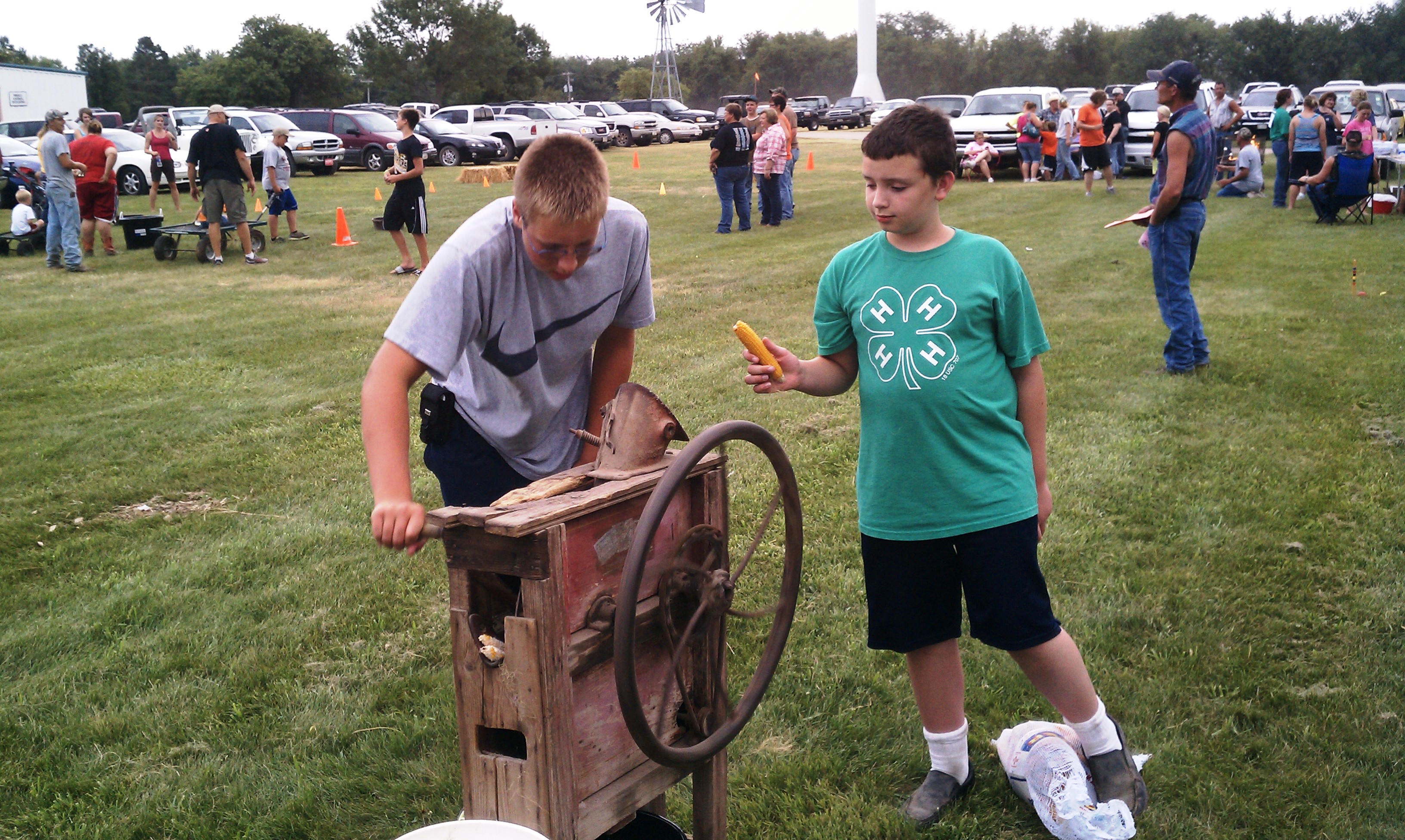 invest in our youth! Thank you to the Fairboard members who spend countless hours preparing the Fairgrounds and always take care of things during fair with a smile-no matter how often they have to plunge the toilets! Thank you to 4-H Council for your help on various committees, your work with the food stand and BBQ, and for all you do. Thank you to all our superintendents and to all our volunteers; without you our 4-H program and fair wouldn’t be possible. Thank you to Tory and the Clay Co. News for all your support and coverage of our fair. We have something so special in our county and I truly feel blessed to work in Clay County! We may not have big-time entertainment at the fair, but I love our fair. I love how the focus is on our 4-H and FFA youth and families; many other counties would love to have that. Our numbers and entries are similar to counties much larger than us and I appreciate the quality brought to the fair each year from our youth. Thank you to everyone for making the 2012 Clay County Fair a success!

#Corn yield predictions across the corn belt
A follow-up to my last blog post predicting corn yields for our local area this week in south-central Nebraska. Here’s some 2012 yield predictions for throughout the corn belt from an article my colleagues in Agronomy and Horticulture and I posted this week’s CropWatch newsletter.
July 10, 2012
Forecasted Corn Yields Based on Hybrid-Maize Model Simulations
Most Sites, Except Northeast, Dip Below Long-term Average Yields
The weather is hot, dry, and windy. Corn is pollinating in much of the state and growers are asking how the weather will impact potential corn yields for 2012. To answer this, we ran in-season corn yield predictions using the Hybrid-Maize Model developed by researchers in the UNL Department of Agronomy and Horticulture. This model simulates daily corn growth and development and final grain yield of corn under irrigated and rainfed conditions.
|

The Hybrid-Maize model predicts yields based on no nutrient limitations, no disease or insect pressure and an “optimal management” scenario. Hybrid-Maize is helpful in understanding how current in-season weather conditions are affecting corn growth and potential yield for the current year and in comparison to previous years.
Hybrid-Maize model can be used during the current crop season to forecast end-of season yield potential under irrigated and rainfed conditions. To do so, Hybrid-Maize uses observed weather data until the date of the yield forecast and historical weather data to predict the rest of the season. This gives a range of possible end-of-season yields. This range of simulated yields narrows as corn approaches maturity.
Hybrid-Maize was used around July 1 to predict 2012 end-of-season corn yield potential throughout the Corn Belt, including locations in Nebraska, Iowa, South Dakota, and Illinois (Figure 1). Sites in Nebraska include Holdrege, Clay Center, Mead, Concord, and O’Neill. Separate yield forecasts were performed for irrigated and dryland corn for those sites where both irrigated and rainfed production is important (in Nebraska: Clay Center, Mead, and Concord). Underpinning inputs used for the simulations include weather data provided by the High Plains Regional Climate Center (HPRCC) and the Illinois Water and Atmospheric Resources Monitoring Program (WARM) and site-specific information on soil properties and typical crop management (planting dates, hybrid maturity, and plant populations).
Corn Yield Potential (Yp) forecasts, as well as the underpinning data used for the simulations, can be seen inTable 1. The long-term, predicted yield potential based on 30 years of weather data (fourth column from the right) is then compared to the range of predicted 2012 corn yield potential (three columns on the right), which includes the yield potential simulated under the most likely scenario of weather expected for the rest of the season (median) and for relatively favorable and unfavorable scenarios for the rest of the season (75th and 25th percentiles) based on historical weather data.
In general, when comparing the median predicted yield for 2012 to the long-term, 30-year average yield potential, 2012 yields are trending lower than the long-term yields (Table 1). Below-normal rainfall coupled with high rates of daily water use due to high daytime temperatures, are the factors leading to the below-average yield potential predicted by Hybrid-Maize for dryland corn across the Corn Belt. An exception is Brookings, S.D. where rainfall has been favorable so far and rates of water use are relatively low compared with other locations.
In the case of irrigated corn in Nebraska, the model is predicting a median yield potential six to seven bushels below the long-term average irrigated yield potential at Holdrege, Clay Center, and Mead due to above-normal temperatures which hasten crop development and increase night respiration. However, this is not consistent throughout the state. Predictions of irrigated corn yield potential are only slightly below (Concord) or even above (O’Neill) the long-term average in northern Nebraska due to cooler weather.
These are simulations and again are based on optimal conditions for crop growth, that is, no limitations by nutrients and no incidence of diseases and insects. Nevertheless, they provide an idea on how in-season weather conditions can impact corn yield potential under irrigated and rainfed conditions. Last year, we saw a similar situation when in-season yields dropped off from the long-term average due to extreme high temperatures by late July and then climbed back up with cooler night temperatures and a long grain-filling period in August. These yield predictions are based on a snapshot in time. Actually, in the current 2012 season, there is still a good chance of having a near or above-average corn yield potential at locations where weather conditions are favorable during the rest of the season as indicated by the 75th percentile yields shown in Table 1. However, if hot, dry conditions continue through much of July, we would expect yield predictions to fall. We will follow-up with predictions later on in the season.
Patricio Grassini, Research Assistant Professor, UNL Department of Agronomy and Horticulture
Jenny Rees, UNL Extension Educator
Haishun Yang, Professor, UNL Department of Agronomy and Horticulture
Ken Cassman, Professor, UNL Department of Agronomy and Horticulture
Table 1. 2012 In-season Yield Potential Forecasts using UNL Hybrid-Maize Model |
|||||||||
|---|---|---|---|---|---|---|---|---|---|
| Location, state | Water regime | Soil type¶ & initial water | PP¶ (ac-1) | RM¶ (days) | Planting date† | Long-term yield potential (bu/ac)‡ | 2012 forecasted yield potential (bu/ac) | ||
| 75th | Median | 25th | |||||||
| Holdrege, NE | Irrigated | Silt loam | 32.4k | 113 | April 27 | 248 | 257 | 241 | 228 |
| Clay Center, NE | Irrigated
Rainfed |
Silt clay loam
100% ASW |
32.4k
24.0k |
113 | April 23
April 23 |
250
146 |
263 153 |
244 123 |
232 103 |
| Mead, NE | Irrigated
Rainfed |
Silt clay loam
100% ASW |
32.4k
28.0k |
113 | April 30 | 240
160 |
251 173 |
234 145 |
218 129 |
| Concord, NE | Irrigated
Rainfed |
Silt loam
100% ASW |
32.4k
29.0k |
104 | May 3 | 235
154 |
244 180 |
232 148 |
223 110 |
| O’Neill, NE | Irrigated | Sandy loam
100% ASW |
32.4k | 106 | May 3 | 225 | 255 | 231 | 221 |
| Brookings, SD | Rainfed | Silt clay loam
100% ASW |
30.0k | 98 | May 4 | 120 | 150 | 132 | 99 |
| Sutherland, IA | Rainfed | Silt clay loam
100% ASW |
31.4k | 99 | May 1 | 168 | 190 | 157 | 127 |
| Gilbert, IA | Rainfed | Loam
100% ASW |
32.4k | 110 | April 26 | 200 | 227 | 187 | 171 |
| Nashua, IA | Rainfed | Loam
100% ASW |
32.4k | 99 | May 1 | 198 | 225 | 191 | 156 |
| Monmouth, IL | Rainfed | Silt loam
100% ASW |
32.4k | 112 | April 27 | 212 | 229 | 186 | 161 |
| DeKalb, IL | Rainfed | Silt clay loam
100% ASW |
32.4k | 111 | May 1 | 201 | 252 | 197 | 165 |
| Bondville, IL | Rainfed | Silt clay loam
100% ASW |
32.4k | 114 | April 20 | 197 | 206 | 156 | 140 |
| ¶ Simulations based on dominant soil series, average planting date, plant population (PP) and relative maturity (RM) of most widespread hybrid at each location (Grassini et al., 2009), assuming 100% available soil water in the top 40 inches at the beginning of the growing season. ‡ Average (20+ years) simulated yield potential (Yp) | |||||||||
2012 #Corn Yield Predictions
The past few weeks I’ve received questions on how the weather conditions are impacting corn yields. One way to help predict this is by running the Hybrid Maize model developed by researchers in the Agronomy and Horticulture Department at UNL. I ran Hybrid Maize model simulations for various planting dates in the Clay Center, NE area. This model predicts corn yields using weather data under “perfect conditions”-nothing such as nutrients or water is limited and there is no disease or insect pressure in these simulations. Reality is that all these things do occur. To use the model, I input current season weather data from the High Plains Regional Climate Center which allows me to compare the current growing season weather conditions and potential yield impacts to a long term median 30 years worth of weather and yield data.
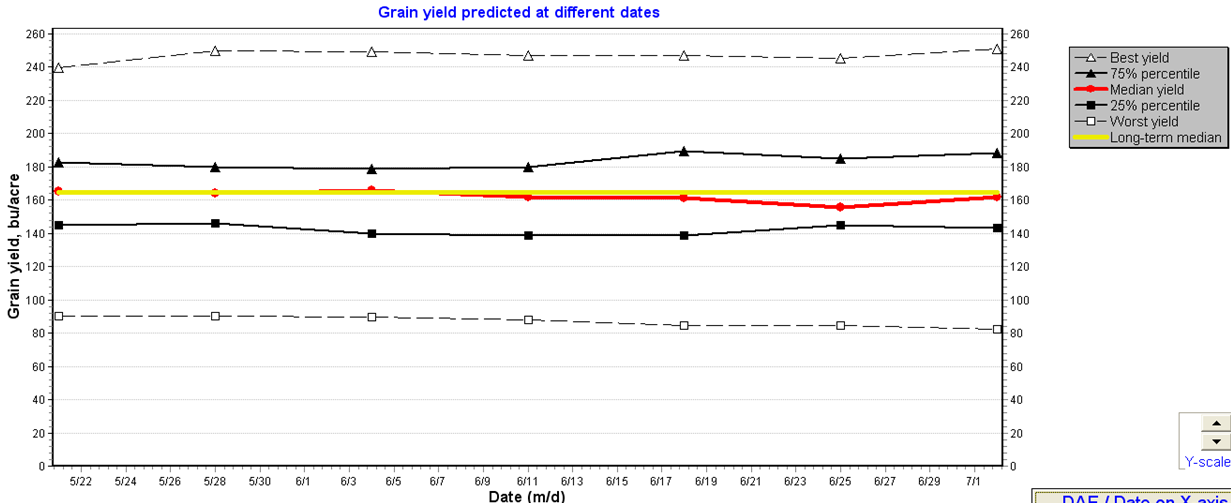
For the simulations I ran right now using Clay Center weather data, I found that overall, we are trending below the 30 year median average yields for both irrigated and rainfed corn. Right now the long-term median yield for all irrigation simulations is trending towards 259 bu/ac at planting populations of 32,000 seeds/acre with 113 or 115 day relative maturities. The following are a few simulations and please check out this week’s CropWatch to view simulations across the Corn Belt. Click on the images below to view them closer up. Compare the 2012 median yield line (in red) to the long-term median line (yellow).
- Mar. 27 planting date, 115 day rm: Best yield 300 bu/ac. Predicted mean is 241 bu/ac.
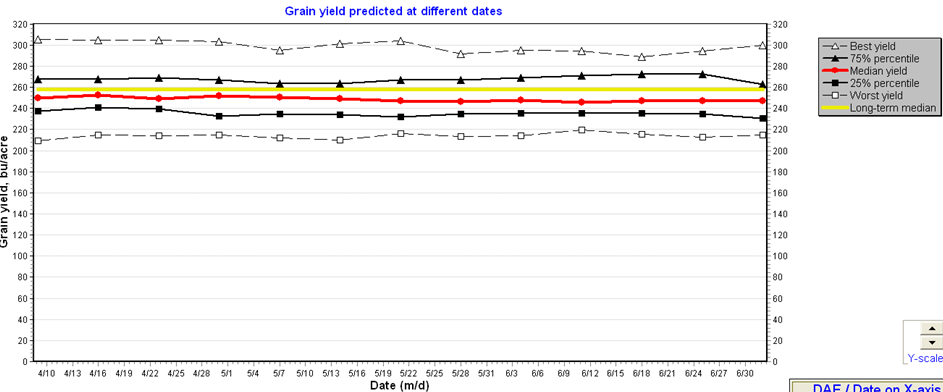
- Apr. 15 planting date, 113 day rm: Best yield 293 bu/ac. Predicted mean is 242 bu/ac.

- Apr. 15 planting date, 115 day rm: Best yield 200 bu/ac. Predicted mean is 253 bu/ac.
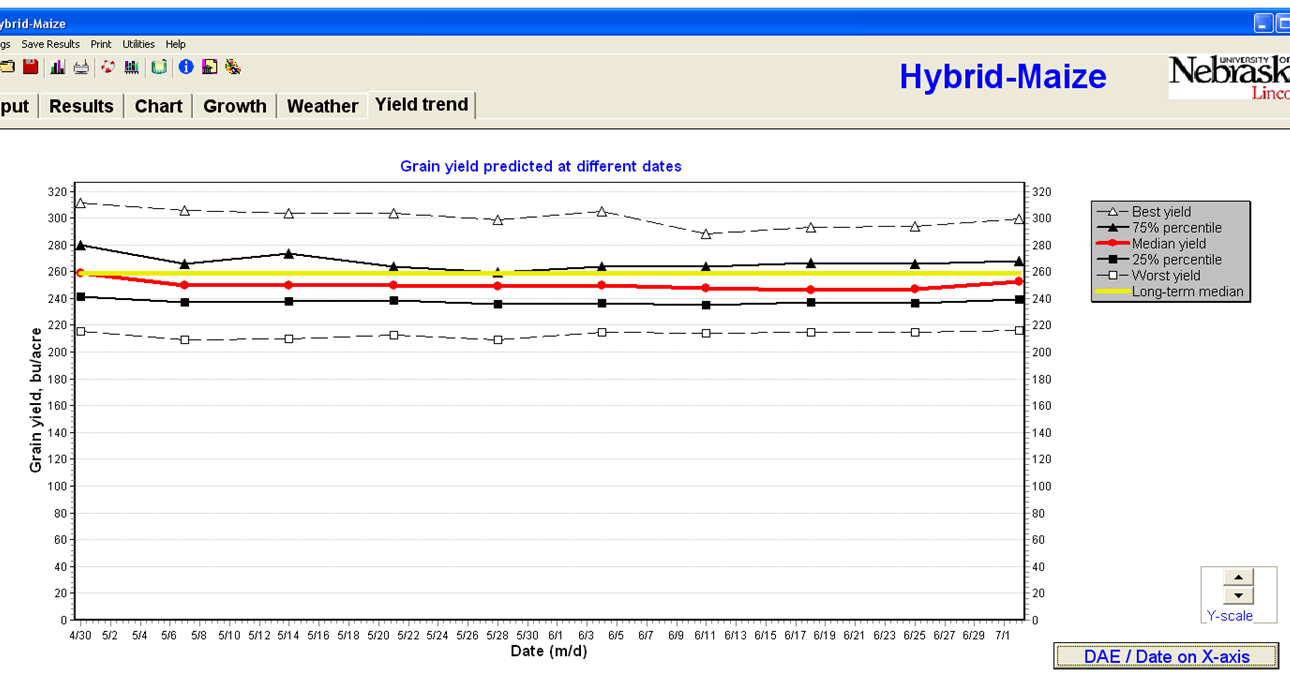
- May 1 planting date, 113 day rm: Best yield is 286 bu/ac. Predicted mean is 248 bu/ac.

- May 1 planting date, 115 day rm: Best yield is 293 bu/ac. Predicted mean is 252 bu/ac.

- May 15 planting date, 113 day rm: Best yield is 310 bu/ac. Predicted mean is 253 bu/ac.
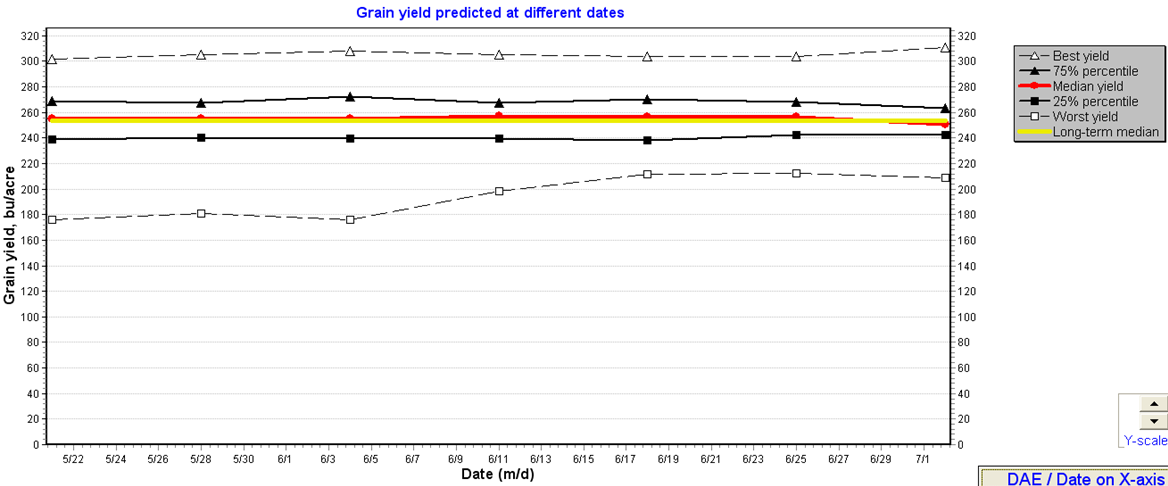
The best comparison is the predicted mean to the long-term median so right now we’re seeing a slight drop below the long-term median for all the planting dates and relative maturities run in these simulations. However, if we receive cooler night-time temperatures and a longer fill period like last year, we may see these yield trends turn up.
For rainfed conditions, I did not run optimal simulations. I ran real-time water limited situations assuming full soil moisture from 0-40” into the profile at the beginning of the season. Here are the results for a planting population of 22,000 plants/acre with 113 day relative maturities:
- Mar. 27 planting date, 115 day rm: Best yield is 202 bu/ac. Predicted mean is 140 bu/ac vs. long term median of 163 bu/ac.
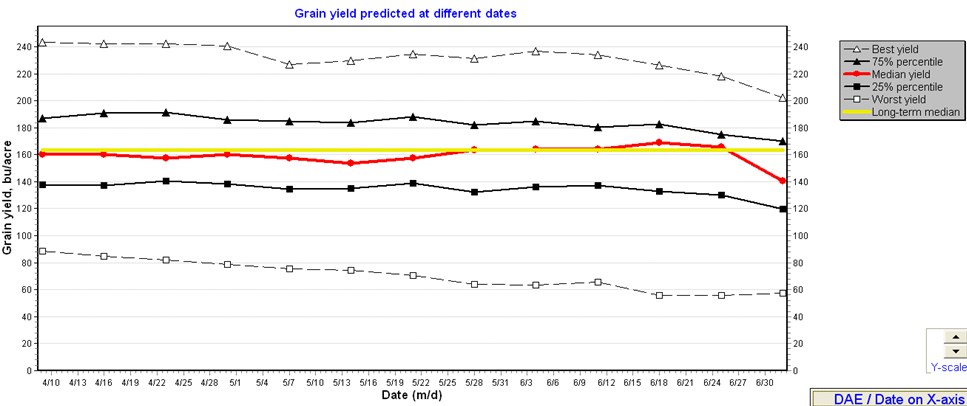
- April 15 planting date, 113 day rm: Best yield is 224 bu/ac. Predicted mean is 146 bu/ac vs. long term median of 167 bu/ac.

- May 1 planting date, 113 day rm: Best yield is 223 bu/ac. Predicted mean is 152 bu vs. long term median of 167 bu/ac.
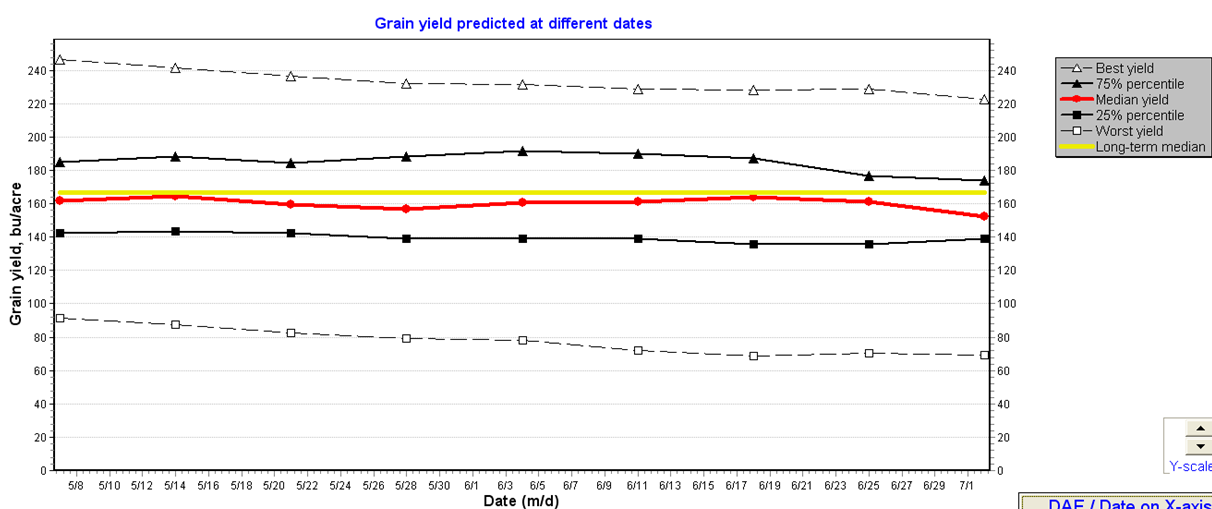
- May 15 planting date, 113 day rm: Best yield is 250 bu/ac. Predicted mean is 161 vs. long term median of 165 bu/ac.
Tomato Troubles!
Here’s a good post from Elizabeth Killinger, UNL Extension Educator, regarding all the tomato troubles we are currently seeing in the garden. You can also check out the following YouTube video by Sarah Browning, UNL Extension Educator.

Vegetable gardening has become more and more popular. It is a way to relax, if you consider pulling weeds relaxing, and is also a way to grow your own groceries. Tomatoes are grown in over 86 percent of gardens in the United States. There are many common diseases and problems that can plague tomatoes in the home garden. With a little help you can keep your tomatoes in tip top shape.
Early blight is a common tomato disease. It is caused by a soil-borne fungus. Rain water, or overhead irrigation, can cause the soil and fungi to splash onto the lower leaves of the plant. The infection starts as leaf spots on the lower leaves then causes yellowing then eventually causes the stems to turn brown. The infection works its way up the plant causing the foliage to die.
There are ways to help prevent the spread of this fungal…
View original post 574 more words
High Heat & #Corn Pollination
With the high heat, lack of rainfall, and pollination occurring in many fields or just around the corner, questions have been 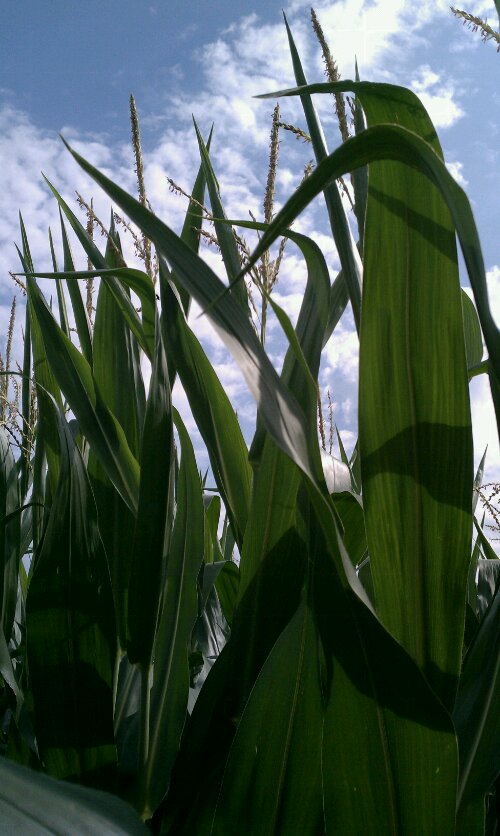 rolling in regarding how high heat affects corn pollination. Dr. Tom Hoegemeyer, UNL Agronomy Professor of Practice wrote the following article and I’m sharing it for the excellent info. Hybrid Maize simulations will be shared in this week’s CropWatch and in next week’s news article.
“Corn was originally a tropical grass from the high elevation areas of central Mexico about 7,400 feet above sea level, 2,000 feet higher than Denver. Today, corn still prefers conditions typical of that area — warm daytime temperatures and cool nights. Areas that consistently produce high corn yields share some significant characteristics. These areas — central Chile, the west slope of Colorado, etc. — are usually very bright, clear, high light intensity areas with cool nights.
This year, in the prairie states and in the Cornbelt, conditions have been dramatically less than optimal. Corn maximizes its growth rate at 86°F. Days with temperatures hotter than that cause stress. In the high yield areas, cool night temperatures — at or below 50°F — reduce respiration rates and preserve plant sugars, which can be used for growth or reproduction, or stored for yield. These are optimum conditions for corn, and interestingly, are fairly typical for areas around central Mexico where corn is native.
In years when we get high day and nighttime temperatures coinciding with the peak pollination period, we can expect problems. Continual heat exposure before and during pollination worsens the response. Daytime temperatures have consistently stayed in the upper 90s to low 100s.The high humidity, which helps reduce crop water demand, also increases the thermal mass of the air—and provides extra stored heat and insulation at night.
Corn pollen is produced within anther sacs in the anther. The plant releases new, fresh anthers each morning, starting from near the top of the tassel, on the first day of shed, and proceeding downward over several days. The process of releasing the pollen from the anthers is called “dehiscence.” Dehiscence is triggered by the drop in humidity, as the temperature rises. However, when it is extremely humid and the humidity falls very little, dehiscence may not occur at all, or it may be delayed until late in the day. If one has breezes, while the humidity is still very high, the anthers may fall to the ground before pollen is released. If the temperature rises too high before pollen dehiscence occurs, the pollen may have reduced viability when it is shed. A person experienced at hand pollination in corn will often see this happen. There will be anthers in a “tassel bag,” but little pollen. The usual solution to this is to wait a couple hours until the temperature rise reduces the humidity. However, last year we had some conditions where pollen was never released from the anthers. This can impact silk fertilization, particularly in open-pollinated situations.
Corn is a “C4 Photosynthesis” plant, making it extremely efficient at capturing light and fixing CO2 into sugars. One drawback of this system is that with high daytime temperatures, the efficiency of photosynthesis decreases, so the plant makes less sugar to use or store. High nighttime temperatures increase the respiration rate of the plant, causing it to use up or waste sugars for growth and development. This results in the plant making less sugar but using up more than it would during cooler temperatures. Heat, especially combined with lack of water, has devastating effects on silking. If plants are slow to silk, the bulk of the pollen may already be shed and gone. Modern hybrids have vastly improved “ASI” or anthesis-silk interval (the time between mid-pollen shed and mid silk). Regardless, in some dryland fields we see seed set problems because of “nick” problems between pollen and silking.
Even in some stressed areas within irrigated fields (extreme sandy spots, hard pans or compaction areas where water isn’t absorbed and held, and some “wet spots”) we can see stress-induced slow silking and resulting seed set issues. Historically, this has been the most important problem leading to yield reduction, particularly in stressful years. Once silks begin to desiccate, they lose their capacity for pollen tube growth and fertilization.
Even with adequate moisture and timely silking, heat alone can desiccate silks so that they become non-receptive to pollen. This is a bigger problem when humidity is low and on hybrids that silk quite early relative to pollen shed. Even with dew points in the 70s, when temperatures reach the high 90s to the100s, the heat can still desiccate silks and reduce silk fertility.
Heat also affects pollen production and viability. First, heat over 95°F depresses pollen production. Continuous heat, over several days before and during pollen-shed, results in only a fraction of normal pollen being formed, probably because of the reduced sugar available. In addition, heat reduces the period of pollen viability to a couple hours (or even less). While there is normally a surplus of pollen, heat can reduce the fertility and amount available for fertilization of silks. Research has shown that prolonged exposure to temperatures reduced the volume of pollen shed and dramatically reduced its viability. For each kernel of grain to be produced, one silk needs to be fertilized by one pollen grain.”
Elizabeth Killinger, UNL Extension Educator in Hall Co. did a good job of explaining the common lawn fungal diseases we are seeing right now so sharing her post!
Fungus can be both a good and a bad thing. Mushrooms on pizza are an example of good fungus. Fungus in lawns, on the other hand, are nearer the other end of the spectrum. There are a few common turf fungal infections to be on the lookout for in your lawn this season and some measures you can take to keep them at bay.
Dollar spot is one fungal disease that is common in lawns. This fungus doesn’t discriminate in the type of turf that it infects, but it is most common in Kentucky bluegrass. The symptoms will be 4-6 inch straw colored patches in the lawn. The grass blade itself will have a bleached lesion, or spot, with a reddish-brown margin that extends across the grass blade.
There are several practices you use to deal with dollar spot. Some of the recommended cultural practices include irrigating in the early…
View original post 583 more words
#Crop Update
While every growing season is unique and there’s an element of risk involved, this year seems to take the cake. 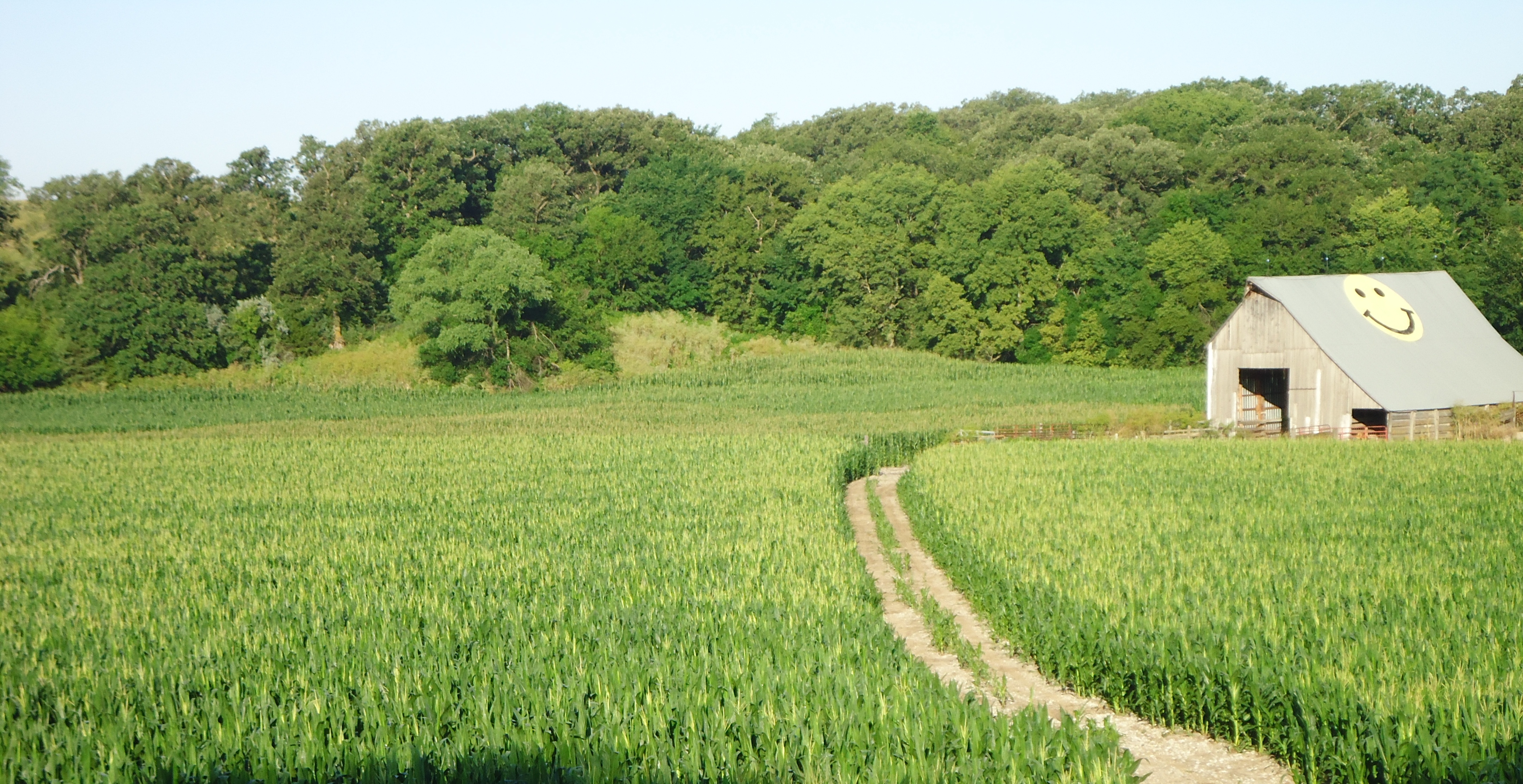

Drought conditions have affected much of Nebraska. In our area in south-central Nebraska particularly in our southern tier of counties, we’re seeing brown pastures and alfalfa that stopped growing. Wheat was harvested nearly a month early and yields range from 0-50 bu/acre depending on if it was hit by the hail storm Memorial Day weekend which totaled it out.
I’m unsure how many planting dates we currently have in Clay County! The spring planting season went so well with corn and many beans being planted in April. Soybeans planted in April that haven’t received hail are forming a nice canopy. Corn that hasn’t received hail should be tasseling by beginning of July. One Clay Co. field planted in March was only 3 leaves from tasseling when I took this picture this week and looks great (it’s probably 2 leaves by now!).  Adding another picture from a farmer friend Bob Huttes near Sprague, NE showing his field currently tasseled out and love the smiley face barn 🙂
But then there’s the hail damaged fields. The hail pattern has been fairly similar all year for this area of the State with some producers receiving four consecutive hail events on their fields. Every week of May was spent helping our producers determine replant decisions, particularly for soybeans…leaving irrigated stands of 85K and dryland stands of 60-65K when beans were smaller before stem bruising was so severe later. We would leave a stand one week and end up needed to replant after the hail hit again the following week. Some farmers got through the first two hail storms but the Memorial Day weekend storm did them in. I never saw hail like where ground zero of this storm occurred. After replanting after that weekend, they received yet another hail storm last week with the wonderful, much needed deluge of rain we received in the county. My heart hurts for these farmers yet for the most part they have good attitudes and are making the most of it. That’s the way farming is…lots of risk, thus an abundance of faith and prayer is necessary too. One farmer I talked to has had hail on his house seven times this year (including prior to planting).
Pivots have also been running like crazy prior to the rain last Thursday night where we received 3.30-4.40 inches in the county. Installing watermark sensors for irrigation scheduling, we were able to show the farmers that there was truly moisture deeper in the soil profile and attempted to convince them to hold off. It’s a hard thing to hold off on  water when the neighbors are irrigating, but several farmers who didn’t irrigate told me they were able to let the rain soak in and their plants
 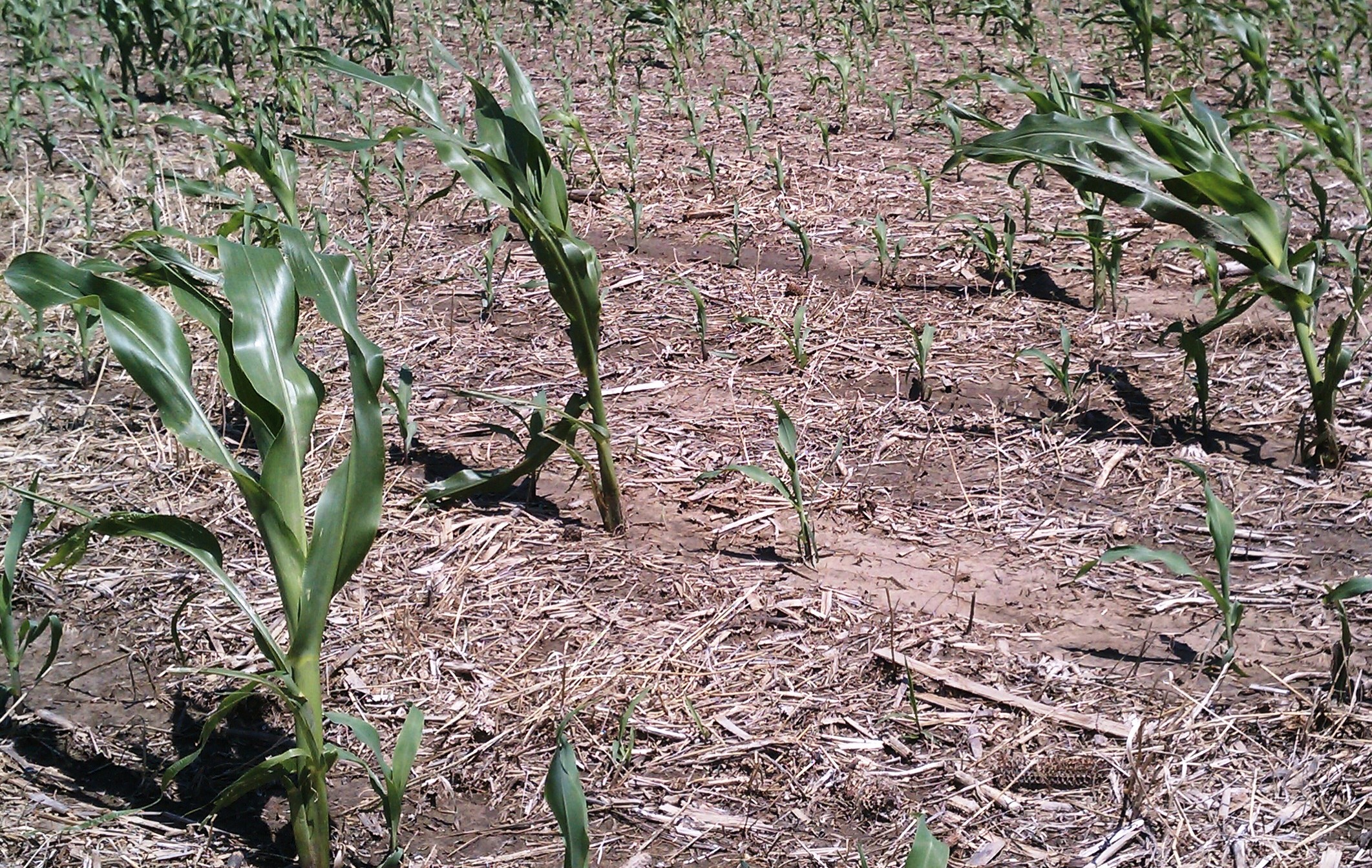 weren’t leaning after that rain because the ground wasn’t saturated prior to the rain event.
Crop Water Use Comparison Study
Water use efficiency (or crop water productivity) is important in crop production. The seed Industry has invested scientific  efforts and financial resources into developing hybrids and varieties that can better tolerate environmental stresses such as water stress.
Rainfed corn has increased in acres, replacing sorghum year after year. This trend may be partly due to the basis price, herbicide options, and newer corn hybrids bred with root systems to better withstand water stress. In 2009 the question was posed, “Is sorghum still the most crop-water-use-efficient crop, given newer corn hybrids in rainfed fields are providing decent yields and more herbicide options?” To answer the question the Nebraska Grain Sorghum Board funded a project in south-central Nebraska.
On-farm research was conducted for three years in rainfed production fields near Lawrence with the most adapted and high-yielding corn, sorghum, and soybean hybrids and varieties for that area. The research was conducted in no-till fields where the previous crop had been sorghum. A randomized complete block design with three replications was used.
Corn and soybean were planted between May 5 and May 7; sorghum planting ranged from May 19 to May 28. Corn was planted at 20,000 seeds/acre, soybean at 135,000, and sorghum at 65,000. Rainfall in this area varied greatly from 2009 to 2011: 2009 was dry with only 10 inches of rain during the growing season; 2010 had 16 inches, and 2011 had 20.5 inches from May 1 to October 15.
To monitor soil moisture, Watermark sensors were placed at 1-, 2-, 3-, and 4-foot depths in each plot and the readings were  recorded hourly throughout the growing season via Watermark dataloggers. Data were compiled and analyzed to determine crop water use efficiency (CWUE) values. The CWUE values were determined from the Watermark soil moisture data, actual crop water use (evapotranspiration), and grain yield for each crop.
Results: Table 1 shows actual crop evapotranspiration (ET) in inches, grain yield, and crop water use efficiency for each crop in each year. Corn was the most water use efficient of the three in 2009. Sorghum results in 2009 might have been different if rainfall had occurred to activate the sorghum herbicide as grass pressure was heavy in the sorghum plots that dry year. In 2010-2011, sorghum yielded the most, had good weed control, and had the best crop water use efficiency value.
| Table 1. Crop water use efficiencies in on-farm field trials conducted near Lawrence, Nebraska, 2009-2011. | |||||||||
| 2011 ET (in) |
2011 Yield (bu/ac) |
2011 CWUE (bu/in) |
2010 ET (in) |
2010 Yield (bu/ac) |
2010 CWUE (bu/in) |
2009 ET (in) |
2009 Yield (bu/ac) |
2009 CWUE (bu/in) |
|
| Corn | 22.0 | 127.2 | 5.8 | 23.3 | 101.2 | 4.3 | 14.5 | 97.5 | 6.7 |
| Soybean | 21.3 | 61.3 | 2.9 | 22.0 | 44.0 | 2.0 | 14 | 33.4 | 2.4 |
| Sorghum | 17.3 | 138.9 | 8.0 | 21.3 | 118.0 | 5.5 | 13.7 | 77.4 | 5.6 |
Overall in this study, sorghum had a crop water use efficiency of at least 5.5 bu/inch; corn, at least 4.3 bu/inch, and soybean, at least 2.0 bu/inch. These results show sorghum’s continued value as a crop that efficiently uses water. Sorghum produced more grain per unit of water used than corn or soybean, an important benefit in water-limited environments. On a three-year average, sorghum resulted in 1.2 bu/inch and 3.5 bu/inch more grain production per inch of water used than corn and soybean, respectively. This study did not compare sorghum or soybean with new “drought-tolerant” corn hybrids. Graphs, charts, and production information can be found here.
Acknowledgements: Special thanks to John Dolnicek of Lawrence, Nebraska for allowing this research to be conducted on his farm and for all his help and efforts to make it a successful study and to the Nebraska Grain Sorghum Board for funding this study.
Soil Crusting in #Soybeans Causing Concerns
On May 6, quite a storm was unleashed in south central Nebraska. Soybeans that had been planted two to three days before the storm seem to have emerged fine, while those planted May 5-6 tend to have uneven emergence and crusting. This is occurring regardless of tillage type, residue cover, etc. Many farmers have been running pivots to help the soybeans break through the ½- to 2-inch crust, often applying an inch of water before they see stand improvements.
The primary question for growers has been “Should I replant?”
UNL on-farm research has shown less than 1.4-2.0 bu/ac yield difference between planting 90,000 and 180,000 seeds/acre. (See report.) In our research, 90% of the planted stand was achieved at both seeding rates in irrigated 30-inch rows in no-till and ridge-till fields.
Consider what was found in 2006 in one dryland field in Nuckolls County where populations of 100,000, 130,000, and 160,000 seeds/acre were planted. This field was at the cotyledon stage when it was hailed. Some plant stands dropped to 67,000. Yield was 4 bu/ac less than in the 160,000 seed/acre planting that had a final stand of nearly 98,000. The average yield in the field was 40 bu/ac. While this is only one field and one year of research, it is an example of how soybean plants can compensate for reduced populations by branching and how August rains in dryland can still allow reasonable yields to be produced.
UNL research conducted by Dr. Jim Specht, UNL Soybean Physiologist, also has shown that for every day planting is delayed after May 1, there is the potential to lose 1/4 to 5/8 bushel per day. As we near the end of May and early June and consider that late planting yield penalty and the dry soil conditions (particularly in dryland fields), along with the seeding rate results from this UNL on-farm research, we are recommending that growers leave stands in many fields. Based on our on-farm research, leaving dryland stands of at least 65,000 plants/acre and irrigated stands of 90,000 plants/acre is likely a better choice than replanting.
We realize that there are some larger gaps in various rows in the field, and while we don’t like to see that, the gaps are disappearing as plants continue to grow and branch out. Keep in mind that a gap in one plant row will be compensated by plants in the adjacent flanking rows. They will form extra branches to take advantage of the sunlight, thus single-row gaps may not be as yield-reducing as you might think — especially in 15-inch row spacings.
We’re also seeing how resilient soybeans are. Some soybeans have been in the ground for two weeks and in many cases, are fairly healthy below the crust. Soybean seedlings emerge by pulling (not pushing) their cotyledons upward. The seedlings rely on the cotyledons as a reserve source of carbohydrate, protein, and lipid to support early seedling development until leaflets open for photosynthesis. When a seedling tries to pull its cotyledons through a crack in the crust, the crack may be too small and the cotyledons may be stripped off.
The plumule, which is the seedling stem tip and its undeveloped leaves above the cotyledonary node, may remain, but 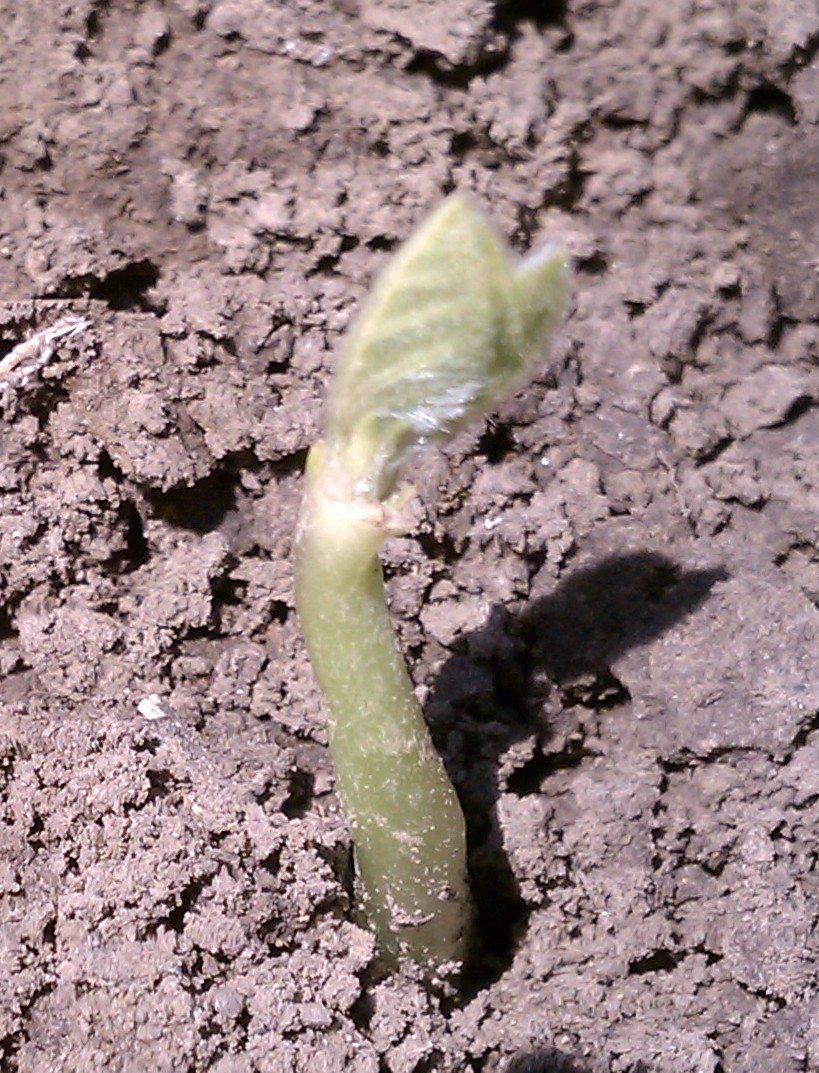 without the cotyledons to serve as a carbon and nitrogen source, development of new seedlings with small leaflets will be slow. These plants may not become competitive with surrounding plants in terms of pod and seed production. Therefore, when counting seedlings to determine plant stand after a soil crusting event, count only the seedlings that have at least one cotyledon. You can count seedlings missing cotyledons if they have large unifoliolate leaves that will soon unroll such as the picture on this page.
Recommendation: When deciding whether to replant your field, consider UNL research findings that showed a minimal yield difference between stands of 90,000 and 180,000 seeds/acre. We recommend leaving irrigated soybean plant stands of 90,000 or more and dryland plant stands of 65,000 or more. Uniformity of plant stands is also important, but “patch” planting may be used to deal with local areas of low plant stands.
For more information on reduced soybean planting rates, see the April 20, 2012 CropWatch story, Drop Soybean Seeding Rate and Save $10-$18 per Acre.
Future of Rural America
Sunsets over rolling hills of green pastures and straight corn rows. Barely seeing above soybeans I was walking to remove  weeds. Attending a small school that provided an excellent education with opportunities to participate in a variety of activities to become more well-rounded. These are a few of numerous memories of growing up on the farm and in a rural community that I hold dear. While I enjoy hearing my grandparent’s stories of what life was like for them farming 60 years ago and even enjoy watching the Nebraska State Cornhusking Contests held each year, I also realize times have changed and don’t have a false sense of nostalgia about what rural means today. While technological advances allow our farmers to produce more food for more people with less inputs and less water than ever before, what hasn’t changed about rural communities is the hard work ethic, dedication, risk, determination, and reliance on Faith and family to get through each year.
Last week I had the opportunity to participate in the Rural Futures Conference held in Lincoln. For me, it was the best conference I’ve attended; the energy and enthusiasm from 450 people gathering from a variety of backgrounds all to discuss the future of rural America was refreshing to say the least. My favorite part of the conference was the first evening. The key note speaker Joel Sartore, a Nebraska native who is also a National Geographic photographer, challenged us to maintain a positive attitude and to look for the opportunities that were available in our small towns. For example, one town in Kansas was all about a certain sparrow where they would take people out on field trips to “listen”-they didn’t even get to “see” the sparrow-and people paid money for that! There was also a town in Oklahoma where all they had was rattlesnakes…so they made the most of that too and created a huge attraction around snake handling, pics with snakes, snake skinning, etc.
My favorite part of the conference occurred after that during the youth panel. A panel discussion with Caleb Pollard,  Executive Director of Valley Co. Economic Development in Ord, NE; Amanda Crook, Graduate Student; Anne Trumble, Executive Director of Emerging Terrain in Omaha; Jim McClurg, University of Nebraska Board of Regents; and University of Nebraska Med Center’s Bob Bartee answered questions moderated by Dr. Ronnie Green, IANR Vice Chancellor. The young people struck a chord with me-most likely cause we were of similar age. Some key take-away quotes:
- Vibrant organizations identify strong leadership.
- Failure can be a good thing as it can lead to the next innovation.
- To go some place and change the trajectory of history is exciting!
- We need to change the way we place young people into jobs….we don’t offer young people jobs; we offer them opportunities.
These young people were so excited about living in Nebraska! Some of them had spent time elsewhere before choosing to move back to Nebraska and eventually choosing to find a small town to raise their families or have the rural way of life. Another theme that emerged throughout the conference was the need to get young people involved in the local community such as youth representatives on city council, etc. even as early as when they’re in high school. Some people think small town communities in Nebraska are dead…but that’s not necessarily the case. It mostly depends on leadership-a strong leader will rally the town around an idea to grow it or create opportunities. That’s what’s happening in Ord, NE with Caleb Pollard. Another example comes from Fairfield Iowa. Sometimes it just takes the right person to ignite a spark and help the rest of the town see the possibilities. Nebraska has so much to offer!
Frans Johansson, author of The Medici Effect, was also a phenomenal speaker! He spoke about creating breakthrough innovations by thinking outside the box and working at intersections of different disciplines/cultures, etc. Key points I obtained from him include:
- New ideas are combinations of existing ideas.
- People who change the world try FAR more ideas.
- Diverse teams can unleash an explosion of new ideas.
- Find inspiration from fields/cultures other than our own.
- Look for the smallest executable step-essentially don’t eat the elephant in one bite.
- Stepping into intersections isn’t risky-it’s risky to do the same thing over and over again.
Maybe these aren’t earth-shattering new concepts, but good reminders for a task as large as creating a Rural Futures Institute…and frankly for anything in life.
There was much discussion about the role of a University/State/Community Colleges in trying to save rural communities…how is this done…how build partnerships and trust…how to provide incentives to faculty working in creative/innovative ways in a structured academic setting when it comes to promotion and tenure…and even if the University changed its incentives, how does that bode if a faculty member moved on to another University? How are incentives provided to teams and excellent team work? We are standing at the crossroads…maybe an intersection right now in academia which can shape the future of creatively rewarding innovative work while still maintaining needed structure in the promotion/tenure process. I remain positive that we’ll find a way to work through this!
There were discussions in small groups regarding the meaning of rural. What does it entail? Often we think of agriculture-and I would argue that’s a strong part of rural-but it’s also much more…health care, infrastructure, industry, schools, broadband, etc. Some were saying we need to use the term non-metro instead of rural in order to get away from the ag connotation. Yet others felt the discussion was too focused away from agriculture on other components of rural and missing ag as a key component. Needless to say, the entire conference provided interesting discussion, dialogue, and a chance to meet people from a variety of backgrounds. It truly provided an opportunity to look for intersections with which to create innovative ideas for the future.
There was also the reality that hit during focused group conversations that there are also problems that need to be addressed in rural communities that weren’t touched on at this point: poverty; crime; infrastructure; food deserts; building trust and interfacing with university, college, and other partners, etc. Overall it was a thought-provoking conference and has the feel that several small steps can be achieved in the coming year. I would encourage you to check out the Web page and follow the Facebook page. You can also check out the Twitter Conversation at #RFC2012. This conference was also not just focused on Nebraska as the focus was the Great Plains and people from numerous states attended. I’m looking forward to seeing the small executable steps that will occur in the future and am also looking forward to doing my part to maintain strong rural communities as I’d like to see the next generation enjoy the rural life and learn the values I did growing up!


 JenResources