Blog Archives
Wheat Ergot Update
Numerous calls have come in on the wheat ergot situation. It must have been the perfect environmental conditions for this to happen this year in such a wide area and I need to take some time to figure out why this year during conditions that also favored scab and not a few years ago with similar environmental conditions.
Two main questions have been raised: “Can I save back seed” and “can I bale and graze straw?”. I don’t recommend that you save back seed, yet many seed fields in the area most likely were affected as well. Seed can be sifted on a gravity table to help clean it so that is an option-but most farmers don’t have means for doing this so ultimately I wouldn’t recommend our farmers to save back seed.
In regards to baling straw and grazing, while walking harvested fields, I was noticing some ergot in heads that were too short to go through the combine heads. Ultimately, the few kernels in a large amount of straw would be so dilute, I wouldn’t expect there to be problems with grazing the straw. If you’re concerned about using wheat straw for feeding or bedding, you can always dilute it with alfalfa or another feed to reduce chances of ergotism in livestock even further. I should point out that I’m talking about wheat straw in which the wheat grain has been harvested. I would not recommend feeding wheat straw that was just cut with the ergot contaminated and wheat grain in tact. If you plan to feed straw in that situation, I’d recommend sending samples to a Vet Diagnostic Center for alkaloid testing.
A third question I’ll throw in here is should you plant 2nd year wheat if that is your rotation. While it is not assumed that ergot will happen every year and while the chances of ergot happening a second year are not great, it’s best management practices to go ahead and rotate to be on the safe side as any sclerotia (black fungal ergot fruiting bodies) would be lying on the soil surface and can produce spores that could affect the next wheat crop. Again, this isn’t guaranteed to be a problem again next year (unlike things such as tan spot or septoria that are likely to show up in wheat on wheat fields), but to be on the safe side, I would recommend rotating. Dr. Stephen Wegulo also wrote an article on ergot in wheat at the following site.

CropUpdate: 7-5-11
Last week was a blur of phone calls but it’s great to receive them and know so many of you are doing your best to wait for your soil to be depleted before scheduling your first irrigation! There are some of you in the Little Blue NRD who haven’t received the rains the past few weeks and have hit the 90-100 trigger on your watermark sensors to schedule your first irrigation. Most of you reading this won’t have to irrigate till after tassel (and then you can take into account the 3rd foot in your average)! The 90-100 trigger relates to 35-40% soil moisture depletion and is proven by research via Dr. Suat Irmak at South Central Ag Lab for our silty clay soils. Waiting for the trigger, regardless if you’re on load control or not, will still allow you at least a week to 10 days before you have to worry about getting behind. Please continue to call with questions. There’s also a discussion topic on my blog for your comments/questions.
Corn and beans are looking good overall, are closing canopies, and corn is rapidly growing. Wheat is being combined in the southern tier of counties and there has been quite a range of yields due to the dry weather producing small heads and disease issues such as scab, smut, and ergot. Scab (Fusarium Head Blight) is a concern when we receive rain and high humidity during and around flowering. We were recommending fungicides at that time. Some people escaped it, some put the fungicide on, and others didn’t-so there’s a range of yields out there from that. Common bunt (stinking smut) is the smut that creates clouds of black spores when you’re combining and the grain smells like fish. Loose smut is loose in the head and doesn’t form a kernel shape like common bunt does. Both can be prevented by not saving contaminated seed and using fungicide seed treatments at planting.
Ergot is one I hadn’t seen in wheat since I’ve been here but have in roadside grasses. Ergot is caused by a fungus that infects the wheat head during cool, wet conditions during flowering. Like the fungus that causes scab, it simply replaces the normal pollination process and instead, a black/purple hard fruiting body (sclerotia) is eventually formed. Before this is formed, a sugary drop called honeydew is formed which then turns into the sclerotia. It’s a problem for our producers because I don’t know that you can set your fans to blow it out like you can for light, scabby kernels since ergot sclerotia are denser. The problem with ergot is that it contains toxic alkaloids (one is like LSD)…in fact, it’s blamed that ergot-contaminated grain is what caused the Salem Witch Trials. These alkaloids are also toxic to livestock so contaminated grain should not be fed or even blended off for livestock. Federal grain standards classify wheat as ergot infested when it contains more than 0.3% sclerotia. If you are finding ergot-contaminated grain in your fields, do not save seed back next year; start over with disease free certified seed. The sclerotia will live on top of the soil for a year (they will produce spores next growing season so don’t plant contaminated wheat fields back into wheat, barley, oats, or triticale). Mowing roadside ditches and keeping wheat fields free of other grasses can help prevent ergot infested grasses from spreading the ergot fungus to wheat via blowing spores and rain splash. More information can be found by checking out the UNL Extension publications Head, Grain, and Seed quality on the http://cropwatch.unl.edu/web/wheat/disease Web site.
White Heads in Wheat
The last week I have received questions about white heads in wheat. An excellent resource from UNL to determine various wheat head disorders can be found here. If the heads are completely bright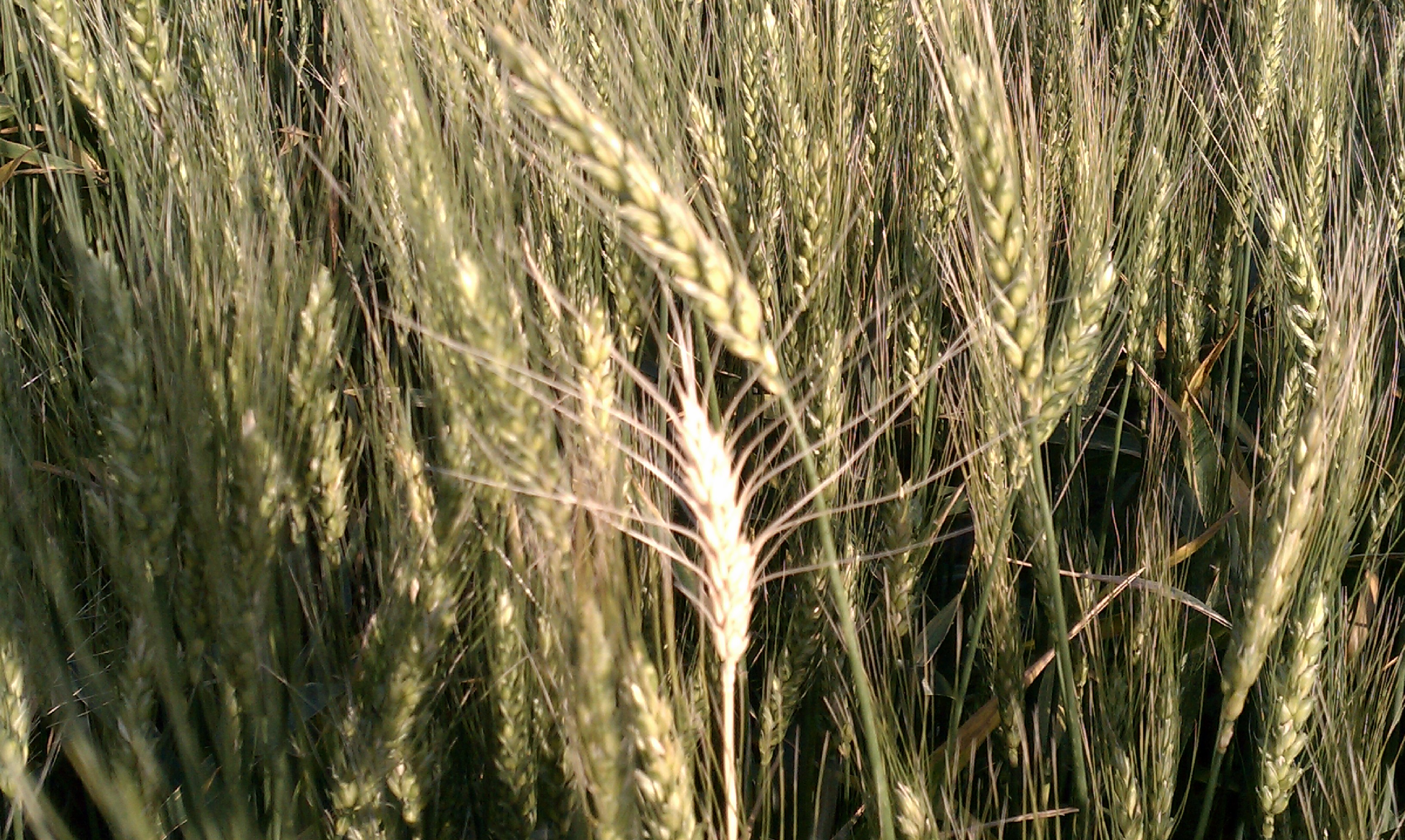 white and you can easily pull those heads out of the stem, the culprit is the wheat stem maggot. This insect will sever the stem above the top node so that the stem upward to the head are white while the rest of the plant remains green. I usually only see a few of these types of heads scattered around in fields and there’s no recommendations for managing it
 because damage isn’t considered economical.
If your heads have white or pink colored kernels in them in addition to regular looking kernels, chances are the discolored kernels have Fusarium Head Blight also known as head scab. The kernels eventually may have a brown discoloration to them and the stem just below the head may also turn a brown-purple color. The Fusarium fungus that causes head scab is the same that causes stalk rot in corn. Wheat on corn rotations in no-till systems have a greater potential of scab in wheat, but these situations don’t mean that scab will always occur. Ultimately, rainy, humid conditions for a 2 week period around flowering is the primary factor for allowing scab to occur.
If you are finding scab in your fields, there’s nothing to spray or do now. Set your combine to blow out the lighter, shrunken, scabby kernels to help avoid dockage at the elevator. I would also recommend to avoid saving back scab-infested seed. Plan to purchase certified seed instead for next year and be sure to have a fungicide seed treatment applied to it to avoid problems with smut.
Rootless Corn Syndrome
Heavy rains in previous weeks have washed soil away from developing roots in some fields. Plants now up to 4-5 leaf stages in affected areas are hanging on by the main radical root. Some plants haven’t been able to survive while others have. Looking closely, brace roots are developing at the crowns of affected plants and eventually, they will begin to kink themselves to pull the plants upright again. There’s not much to do in this situation, but if you have the ability to get soil built up around the root base by cultivating, that can help. If not, an irrigation or rainfall may also help.
Often I see rootless corn syndrome as a problem with smaller plants-3 leaves or less-in which the seed was planted shallow to allow for planting in wet soils. Windy conditions and lack of soil moisture near the surface can allow for poor root development leading to rootless corn syndrome. Thus, I recommend planting corn 2″ deep and not planting shallow to avoid this problem later on.
Llama-4-H Experience
Saturday was a neat day at the Clay County Fairgrounds starting with the 5K and 10K runs in which I heard 65 people ran or walked in! It was exciting to see the crowd that turned out to watch this first year event and hopefully it’s conducted again because it seemed like a success for the first year! After the road race, it was our Regional 4-H Dairy Cow and Goat show. That’s always an enjoyable show as it is laid back and fun-but it’s also a reminder that fair is just around the corner!
Following the dairy show, we tried something new. Some 4-H families adopted some rescue llamas so they were hoping to show them. While livestock isn’t my strong suite, I know nothing about llamas so we opted for an exhibition this year. A 4-H Club from Polk County generously came down and ran the exhibition for us.
It was interesting watching showmanship as the youth held the halters high but not close to the llamas’ mouths and they never changed sides when the judge walked past. Probably the most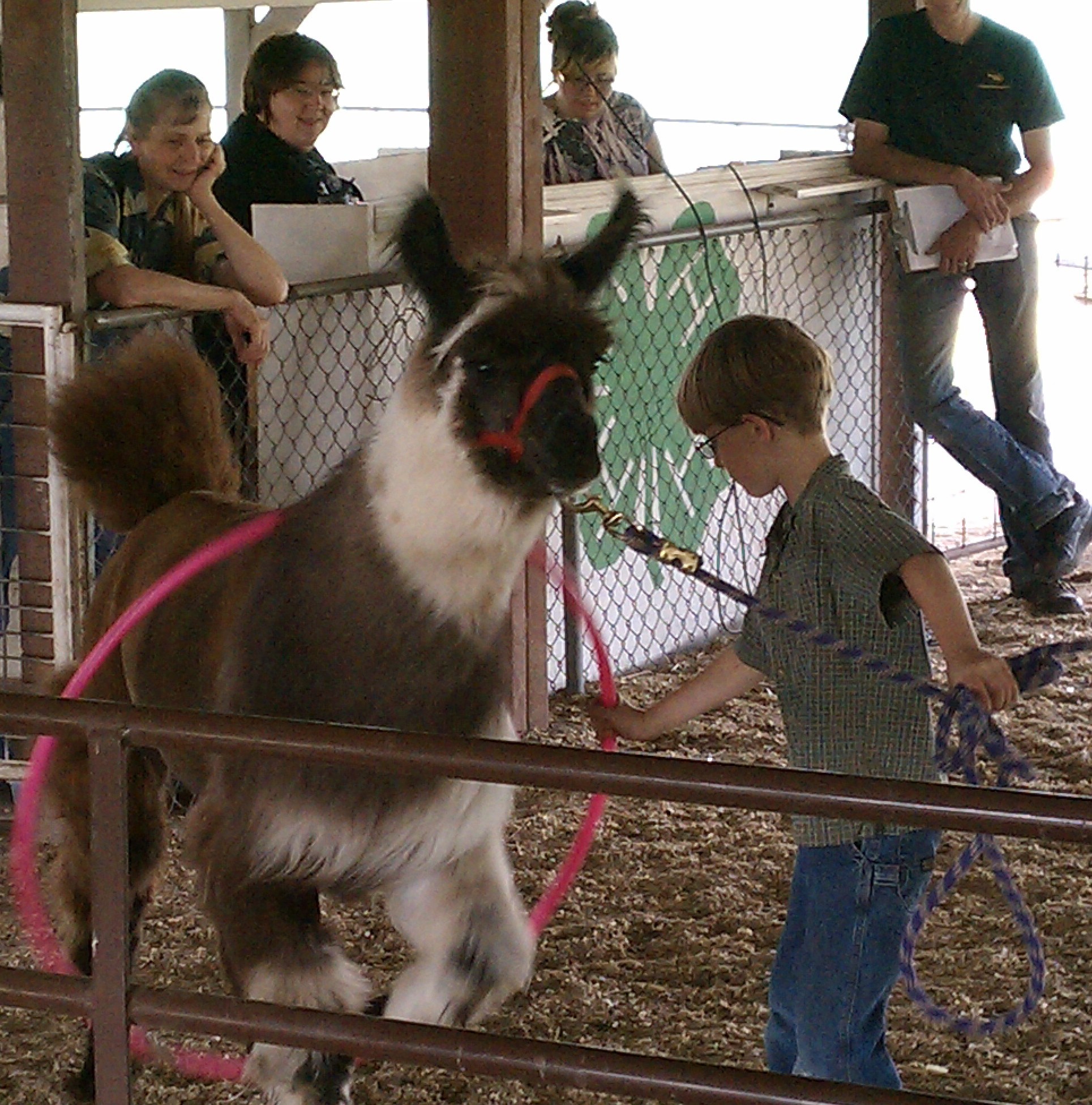 interesting part was watching the obstacle course. Essentially it’s like a glorified trail’s course for horses, only more interesting! Youth had to pick up a hula hoop and put it around his or herself then have the llama essentially walk through it. The llama had to back between logs, walk over bridges, change pace, and in different spots it had to put two feet in a ring laying on the ground and the youth had to do things like show the judge the llama’s hooves or teeth! Needless to say, it was very interesting and I think everyone watching learned a great deal!
Discussion: Irrigation Scheduling
I’m adding this post as a discussion topic as we get into the growing season for producers to post their irrigation scheduling questions or to share what their sensors and ET gages are reading. With the Nebraska Ag Management Network, we’ve learned that producers often need other producers to check their readings with-kind of like a support group for producers involved with this effort. That’s because it’s hard to not irrigate when neighbors are irrigating and your irrigation scheduling tools are telling you that you don’t need to irrigate! We’ve had some good discussions in the past so I look forward to the discussions this coming year!
Telling our Ag Story
On Wednesday I had the opportunity to attend a conference for UNL and ISU Extension Educators regarding animal rights and animal welfare and the importance of how we tell our agricultural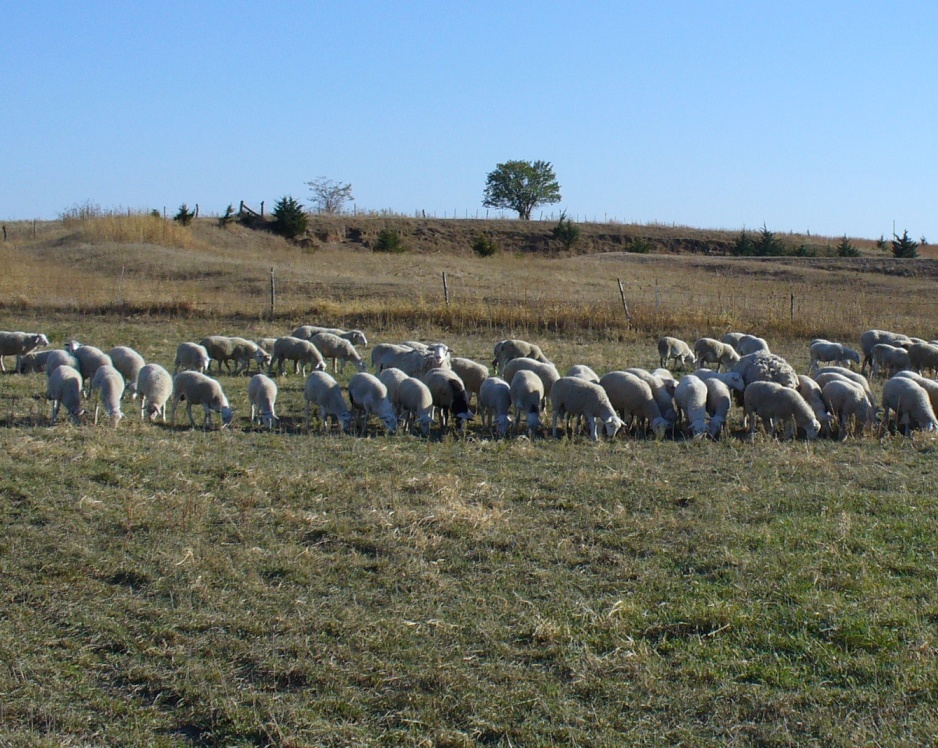 stories to a public increasingly disconnected from where their food comes from. I learned so much and wanted to share.
Dr. Candace Croney from The Ohio State University shared that animal welfare defined to most of us in production agriculture is stewardship-our animals are entrusted to us, use is acceptable, and we have the obligation to treat those animals humanely. She defined animal rights as animals have certain characteristics similar to humans (ex. mental capabilities) and thus have rights. Relationships with pets have become the new paradigm regarding how all animals should be treated. A key message driven home to me was we need to consider how we say our message. So often we position animal care as an economic issue instead of an ethical one. We say things like “We take care of our livestock because if we didn’t, we wouldn’t make any money”…so people focused on animal rights hear from that message the reason we care for animals is for profit…which leads to the next thought that if profit drops, care for the animals is potentially at risk. We instead need to address ethical issues and find ways to connect with the public meaningfully. Charlie Arnot from the Center for Food Integrity said it this way, “We need to first communicate ethics, then science, then economics”.
I also have been guilty of saying “we just need to provide more education about what we do”. But that again isn’t completely correct. While the science of why we do what we do is important to us, ethics are more important to the general public. In a survey from the Center for Food Integrity, when asked what factors influence confidence that food comes from humanely treated farm animals, the fact that the producer worked with a veterinarian ranked first in increasing their confidence, but the fact that what the producer did was science based ranked dead last. Instead of first going to science, begin with showing we’re interested in doing what’s right. For instance, tell the person thank you for his/her question and that you can tell he/she cares for animals as you do too. Then go on to explain why you do what you do to care for your animals rather than provide a data dump of scientific facts. Science can be mixed in, but show the ethics of what you do first. Go beyond the traditional “food, shelter, water” as that doesn’t resonate; it’s expected as that’s what we also provide to our pets. Train people who work for you and make sure they truly do care for the animals as you train them. Determine the message for your operation. The best part is this is free; with good people it just requires a change in commitment and being consistent with your message.
I also appreciated so much of what Trent Loos, Nebraska Rancher and host of “Loos Tales” radio show said. “The message we leave out is why we have animals and agriculture”. The vast majority of the public cares about reasonably priced, safe, healthy food for their families. Our message should be that “we convert animal resources into human resources such as food, fiber, pharmaceuticals, fuels, and products to improve human lives”. It’s a matter of changing our terminology and way of thinking. We shouldn’t say we “slaughter” animals in the U.S….instead “we respectfully harvest plants and animals.”
With the growing disconnect between the general public and where food comes from, we need to be ready to tell our story anytime/anywhere. I’ve often caught myself saying “it’s been busy” when asked how things have been going. I’ve been retraining myself to continue for 20-30 seconds explaining what I’ve been doing which usually sparks a conversation about something regarding agriculture. Part of my reason for this was to help people better understand Extension, but in doing this, I can also help people better understand production ag today. Whether it’s in the line at the grocery store, at church, at a ball game, or wherever, we all have the opportunity and responsibility to share with those around us our agricultural story because no one else can tell your story for you. As Trent Loos said in closing, “If it is to be, it’s up to me”.
Wheat Scab Prevention
Wheat is nearing heading in much of the area and is flowering farther south. Because the flag leaf and one below contribute over 80% of the yield for wheat, producers have been asking if a fungicide is needed this year. We haven’t had disease pressure regarding rust or powdery mildew so far, so I’ve been recommending to wait till closer to heading and see what weather conditions are like. If you are considering foliar fungicide products such as Headline, Quilt and Stratego for example, these cannot be applied once the head begins to flower according to the labels.
The Fusarium fungus causing Fusarium Head Blight (or Scab) is
favored by humid, moist conditions for about a 2 week period around and during flowering. If scab is a concern for you, you will want to continue monitoring the situation and apply products like Caramba and Prosaro when the plants are early in their flowering stage. We used to say aim for fungicide application between 15-50% flowering. Instead, I would say aim for that application shortly after your heads fully emerge or as early flowering as possible. My reasoning for this is that so often wheat begins to pollinate shortly after full head emergence and by the time airplanes get to your fields, your wheat may be too far along for the fungicide to work as effectively as it should. Remember, the wheat head will begin to flower in the center of the head first.
The fungicide product also needs to be on at least 4 hours before a rain event. This is very tricky to time fungicide applications for scab as you’re typically applying them because it’s raining or rain is in the forecast. These products are curative products that are locally systemic, so they will also provide at least a 2 week residual and kill fungi causing leaf and stripe rust, tan spot, septoria leaf blotch, and powdery mildew. That’s why I was suggesting to consider waiting on foliar fungicide applications this year to potentially save money by making one application during heading with as little disease pressure as we have seen. Both Caramba and Prosaro have a 30 day pre-harvest interval, so that’s another thing to keep in mind. Products, rates, and further information can be found starting on page 219 of the 2011 UNL Guide for Weed, Disease, and Insect Management.
Dr. Stephen Wegulo, UNL Extension Wheat Pathologist, writes articles for Crop Watch at http://cropwatch.unl.edu nearly every week, so you can keep up with wheat diseases and fungicide information by checking that out. You can also sign up to receive scab alerts at the following Web address: http://scabusa.org/fhb_alert.php.
Residue Concerns
The recent rains have left their impact on fields throughout the county and Nebraska in general. I’ve received several questions this week regarding flooded fields and how to help crops buried beneath piles of residue.
For flooded fields, Bob Nielsen with Purdue University wrote an excellent article to address these concerns. In short, our cooler temperatures will help plants survive better, but plants completely submerged under water in saturated soils for more than 48 hours don’t stand much of a chance for survival. You can read his entire article here.
If there’s one thing I would like to see farmers reconsider, it’s stalk chopping. It seems like every year we deal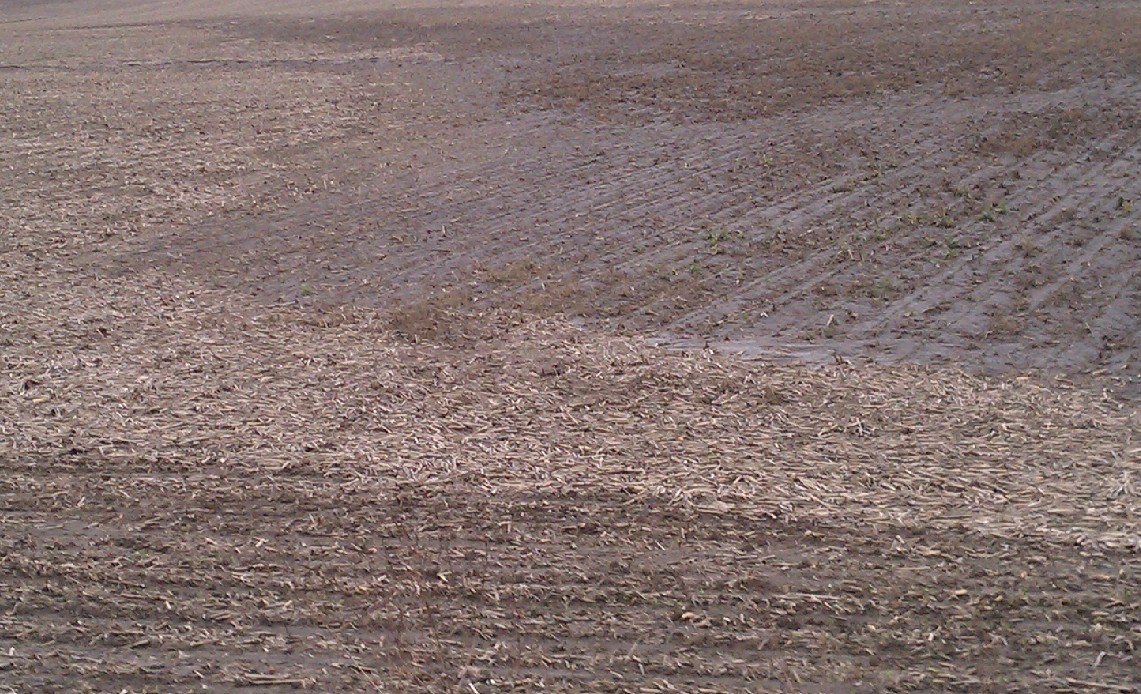 with heavy rains washing stalks from fields where they pile in certain areas of the fields burying plants, covering roadside ditches or jamming creeks. Talking to my colleagues and to several area farmers, we’ve all considered burning as an option. However, burning may only get the top-most dry material while the material underneath is still wet and won’t burn. Another farmer correctly pointed out that there’s usually so much silt intermingled with the residue that it’s hard to get a good burn anyway.
Keith Glewen, UNL Extension Educator in Saunders Co. suggests you consider harrowing or possibly rotary hoeing the stalks, knowing that the depth of stalks and the period of time which elapses following a heavy rain event are important factors in determining success or failure in managing the unwanted stalks. There’s a short amount of time to get that residue off those plants if there’s no light getting down to them. In some situations in the county, residue is up to 1 ft. deep over the top of plants. Harrowing can help even out the field and emerged seedlings may be damaged, but the growing point for corn is still below ground at this point. For emerged beans, the growing point would be above ground so harrowing wouldn’t be a good option. With the rains again today and forecast for more in the future, I’m not even sure that harrowing is much of an option right now for corn as it will take awhile to get back into the fields. In places where 1 ft. of residue is burying plants and the inability to get to those piles with the wet conditions, I don’t expect much plant survival there.
For now we’ll have to wait and see. In the mean time, evaluate your operation and the need for chopping stalks. If you don’t detach the stalk it won’t move. UNL on-farm research found no yield benefit to shredding vs. not shredding stalks in the research which can be found here.
Wheat Update
It’s been a quiet year so far regarding wheat, so it didn’t surprise me when the calls started rolling in this week regarding wheat looking yellow. Most wanted to know if we had disease issues out there. Looking at fields throughout Nuckolls and Clay counties, I saw very little disease overall. That’s most likely due to the dry conditions we’ve had and the fact that many fields I looked at were wheat on corn or soybean stubble. Wheat on wheat fields had disease such as tan spot or septoria leaf blotch on the leaves. I did not see any powdery mildew or rust in any of the fields I looked at.
So why are some fields yellow? Well, most likely it’s due to a combination of factors. We had a dry fall and winter. Some wheat had winter injury and some just never developed a good root structure due to lack of moisture. Dr. Drew Lyon, UNL Extension Dryland Cropping Systems Specialist, also shared with me that poor root structure could also be a result of not having a firm seed bed during planting. Without a firm seed bed, roots aren’t allowed to develop like they should, can’t explore the soil for nutrients, and are more exposed to the potential for crown and root rots. Fall-applied fields often had sprayer wheel
tracks showing green wheat in the wheel tracks and yellow wheat elsewhere-most likely the compaction from wheels allowed for better establishment, created a depression where moisture held, and allowed for less nitrogen loss.
Fall applied nitrogen may have been lost due to the dry fall and winter. It appears that fields with spring applied nitrogen look better due to moisture this spring after application. There’s also environmental reasons for yellow wheat. The cold soil temperatures may not have allowed for nitrogen release to the plants yet-we may see a change by next week. Many places in south central Nebraska have experienced dry conditions creating yellow-brown lower leaves and a blue cast to the wheat. I have pictures of wheat with ice crystals on it from some of the cold snaps we experienced. Cell rupture of that plant tissue could also have caused the yellowing of those lower leaves.
Bottom line, right now there’s nothing you can really do for the yellow wheat and warmer temperatures may allow for nitrogen uptake in the future if the nitrogen wasn’t already lost. Right now there’s nothing to be worried about regarding fungal disease concerns. I’d recommend you continue scouting your fields for powdery mildew and rust and consider a fungicide application if needed (need to protect the flag leaf). I’ll keep you updated on what I’m finding in the fields!


 JenResources