Blog Archives
Wordless Wednesday: Technology in Ag
Captured pics of slides at last week’s Nebraska Ag Technology Association Conference. What comments do you have about them?


On-farm Research
Wow, I’m sorry I haven’t published much the past two months! Much has happened though as we’re in the middle of winter Extension ag programming season! I love this time of year seeing farmers and ag industry reps-and just chatting about what happened last year and speculating about the upcoming season.
Many of you are also attending numerous meetings. You’re gathering information regarding products and production practices. You may be wondering “Will this work on my farm?” Why not go a step further and see for yourself? On-farm research is a great way to test these questions for yourself using your own equipment in your own fields!
UNL Extension has partnered with the Nebraska Corn Board and Nebraska Corn Growers to form the Nebraska On-farm Research Network. There are three main studies we are conducting state-wide: corn population, corn nutrient, and corn irrigation studies…but we are open to helping you design a valid research experiment for your field to test what you would like-and it can be for a crop other than corn.
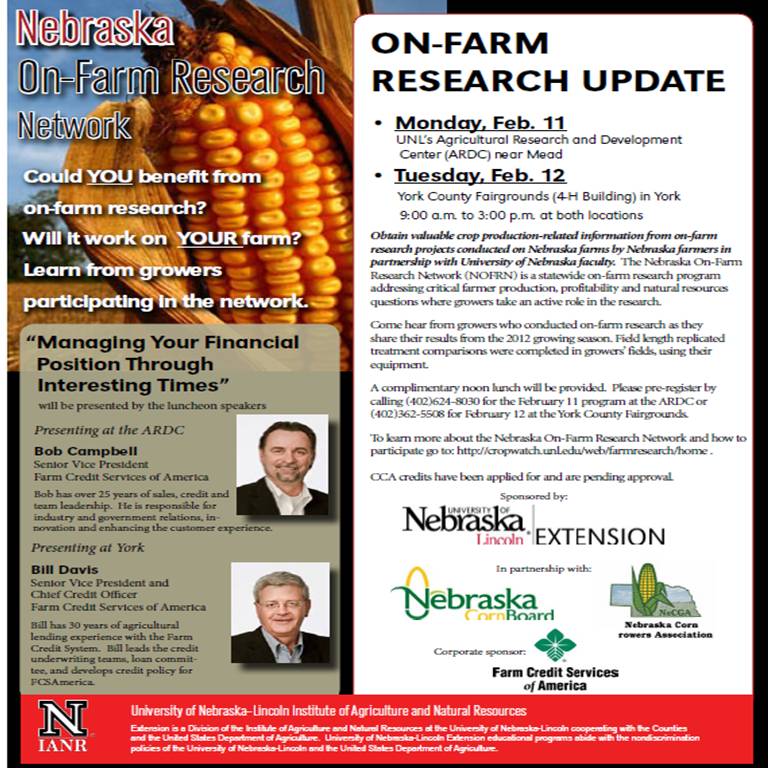
We have some upcoming opportunities for you to learn more. On February 11 and February 12 from 9:00 a.m.-3:00 p.m. at UNL’s Ag Research and Development Center near Mead and the York Co. Fairgrounds in York respectively, growers who conducted on-farm research in 2012 will be sharing their results; you can also learn more about conducting on-farm research in your own field. There is no charge for the meetings courtesy of the Farm Credit Services of America but we do need an RSVP for meal count and handouts. Please RSVP by calling (402)624-8030 for ARDC or (402)362-5508 for the program in York. I hope to see you at these meetings as well!
Social Media for Business
Check out these great opportunities to learn more about social media for your business!

UNL Extension in Seward County will be hosting the Social Media & Mobile Technology for Ag Businesses Webinar Series starting on January 17, 1:00 p.m. at the Extension Office, 216 S. 9th St, Seward, NE 68434. This is a partnership effort with Penn State, Ohio State and University of Nebraska Extension. You can register by calling 402-643-2981 or register at http://go.unl.edu/xmd. Note that there is no charge for attending one or all of these one hour webinars if you join me at the Extension Office.
- January 17 – Mobile Usage and Payment Technology
- January 24 – Introduction to Linkedin and Pinterest
- January 31 – Maps/Apps – Mobile & Location based Marketing
- February 7 – SM Analysis Tools for Facebook, Twitter, Pinterest
- February 14 – Top 10 Trends and Cool Tools in Social Media
- February 28 – Keeping Up with the “Technology”
- March 7 – Getting the most from Facebook
View original post 52 more words

Research Fertilizer Options for Your Farm
November 1 is just around the corner-the beginning of when fall fertilizing occurs in this area of the State. Hopefully many of you have taken soil samples as excess nitrate is to be expected after this drought year. This is an excellent time to consider evaluating your nitrogen program by starting an on-farm research trial!
On-farm research is using your own equipment, in your own fields, over single or multiple growing seasons allowing you to determine the most economical, efficient, and sustainable practice for the production of irrigated and/or dryland crops on your own farm.
What are the soil fertility questions you have for your farm?
Right now, with fertilizing on producers’ minds, we’re hoping you will consider a soil fertility study. We have several example nutrient protocols including the UNL N fertility rate compared to +/- 30 lbs, and considerations for nitrogen timing studies such as pre-plant, sidedress, or fertigation. You can view all these plot designs by clicking on 2012 protocols. If you are planning on applying anhydrous this fall, be sure that the anhydrous strips are the correct width, as the corn must be harvested and weight determined in a correct manner next fall.
When designing a nitrogen comparison you need to remember nitrogen is a mobile nutrient and corn roots will spread laterally. Therefore, the width of the treatments must take this into account and compensate for it. If you have a 16 row nitrogen applicator and an 8 row corn head, you will need 32 rows of each nitrogen rate. Each 32 row strip must be repeated 4 times. At harvest, in each 32 row block, you must record and weigh the center 16 rows with two separate weights i.e. 8+8 . This is done for statistical analysis purposes. Without statistics, you cannot determine if differences between treatments is the result of the nitrogen rate or because of soil variability.
What’s in It for You?
On-farm research in your own fields allows you to find answers to the questions you may have. We all read articles or hear presentations about various practices and products. The question is “Will it work on my farm?“. That’s what on-farm research allows you to find out!
UNL Extension Educators and Specialists are here to help you design your on-farm research trials, help you with data collection, and will statistically analyze the data for you at the end of the season. Correct plot setup is critical to reduce any error in favoring one treatment over another (because we know fields are variable and some portions of the field will yield better than others). The statistical analysis is another tool which helps us determine how much any yield differences between treatments are due to the treatments themselves or to chance.
So if you have an idea you’d like to try, please contact any of the UNL Extension Educators or Specialists working with on-farm research! The Nebraska On-farm Research Effort is a partnership between the Nebraska Corn Board, Nebraska Corn Growers Association, and UNL Extension.
On-farm research may sound daunting, but today’s equipment makes it easier than ever. It does take a little extra time, but our farmers conducting on-farm research feel the value of knowing the results of a study on their own piece of ground make the effort worthwhile.
What are some on-farm research studies you would like to conduct this year or that you would like our group to consider?
Fall Fertilizing Considerations
With the early harvest and potential product discounts, producers may be considering fall fertilization soon. I can appreciate the reasons for it such as the product discounts, covering acres, and the fact that we don’t know what spring weather will bring in order to fertilize before planting.
At the same time applying nitrogen when a growing crop is not present allows for nutrient loss and we continue to see nitrates in groundwater increase in some areas. Check out the following Webcasts regarding research from UNL Soil Fertility Specialists as you consider nutrient application and the addition of nitrogen inhibitors.
Guidelines for Fall Fertilizing
If you do apply fertilizer in the fall, the Natural Resources District (NRD’s) have provided guidelines so please check specifically with them. Both UBBNRD and LBNRD have said no fall fertilization before November 1st and recommend no fall fertilization when soil temperatures are above 50°F. This is because the conversion of anhydrous ammonia is much slower once soil temperatures are consistently below 50°F. Please see the CropWatch Soil Temperature page for a map of current soil temperatures.
LBNRD also recommends but doesn’t require a nitrogen inhibitor placed with the anhydrous in the fall. No liquid or dry nitrogen fertilizer can be applied between November 1st and March 1st without receiving a fertilizer permit. With the fertilizer permit, producers will be required to put a nitrogen inhibitor in with their dry or liquid fertilizer.
Two exemptions are provided in the spreading of manure, sewage, and other by-products conducted in compliance with state laws and regulations, and the applications of pre-plant starter nitrogen to fall seeded crops, such as wheat.
A few other considerations from UNL Soil Fertility Specialists:
- Take soil samples as soil nitrates may be higher than normal this fall-particularly in dryland fields.
- Dry soils are difficult to sample and may affect results. Soil organic matter and soil nitrate results should be fine, but some soil pH and potassium may be affected by the dry conditions.
- Knife applications, including sealing of anhydrous ammonia injection tracks, also may be more difficult in dry soil conditions.
- Monitor rain and snow infiltration between now and the next growing season and make fertilizer adjustments next spring if excessive rain may have caused leaching.
Additional Resources
Landlord Tenant Cash Lease Workshops
Cash rent questions are the top question I receive in the office and are difficult to answer directly. There’s no great formula or survey that can provide a magic number for every situation. The following post provides some thoughts regarding this.
One thing we do know is that developing farm cash leases that meet the needs of both landlord and tenant while maintaining a positive relationship will be the goal of a UNL Extension workshop series. The Landlord/Tenant Cash Lease workshops will be held in November and December at sites across the state. It is helpful if both the tenant and landlord can attend together.
Topics
UNL Extension educators will present on the following topics, providing information and common sense tips for landlords and tenants.
- Expectations from the lease, including goal setting for the rental property
- Lease communication, determining appropriate information sharing for both the tenant and landlord
- Tips for farm leases that include relatives
- Alternative cash lease arrangements, flexible provision considerations for your situation
- How the 2012 drought affects leases, irrigation systems, grain bin rental, and other topics related to leases will be discussed as time allows.
These free workshops are sponsored by the Nebraska Soybean Board and the North Central Risk Management Agency. A meal and handouts are included. Participation is limited. To register, contact the local UNL Extension office hosting the workshop.
For more information, contact Allan Vyhnalek, UNL extension educator in Platte County, at 402-563-4901 or avyhnalek@unl.edu.
Dates and Locations
- Dakota City — Nov. 5, 11 a.m. – 3 p.m., USDA Service Center, 402-987-2140
- Pender — Nov. 7, 11 a.m. – 3 p.m., Fire Hall, 402-385-6041
- Wayne — Nov. 7, 5:30 p.m. – 9 p.m., Fire Hall, 402-375-3310
- Curtis — Nov. 8, Noon – 3:30 p.m., NCTA Ag Industry Education Center, 402-367-4424
- McCook — Nov. 8, 5:30 – 9 p.m., Fairgrounds, 308-345-3390
- Imperial — Nov. 9, 11 a.m. – 3 p.m., Fairgrounds, 308-882-4731
- Fairmont — Nov. 13, 11 a.m. – 3 p.m., Legion Hall, 402-759-3712
- Fairbury — Nov. 13, 11 a.m. – 3 p.m., 4-H Building/Fairgrounds, 402-729-3487
- Blue Hill — Nov. 13, 5:30 – 9 p.m., Community Center, 402-746-3417
- Lexington — Nov. 14, 11 a.m. – 3 p.m., Extension Office, 308-324-5501
- North Platte — Nov. 14, 5:30 – 9 p.m., West Central Research, 308-532-2683
- Hastings — Nov. 15, 11 a.m. – 3 p.m., Fairgrounds, 308-461-7209
- Grand Island — Nov. 15, 5:30 – 9 p.m., Extension Office/College Park, 308-385-5088
- Humboldt — Nov. 27, 11 a.m. – 3 p.m., Ag Building/Fairgrounds, 402-852-2970
- Auburn — Nov. 27, 5:30 p.m. – 9 p.m., Nemaha Co. 4-H Building, 402-274-4755
- Hartington — Nov. 29, 11 a.m. – 3 p.m., City Auditorium, 402-254-6821
- Nebraska City — Nov. 29, 5:30 – 9 p.m., Kimmel Center, 402-267-2205
- Blair — Dec. 4, 11 a.m. – 3 p.m., City Office, 402-426-9455
- Tekamah — Dec. 4, 5:30 – 9 p.m., First National Bank Northeast, Nebraska meeting room, 402-374-2929
- Burwell — Dec. 5, 11 a.m. – 3 p.m., Legion Club, 308-346-4200
- Arcadia — Dec. 5, 5:30 – 9 p.m., Legion Club, 308-728-5071
- Bloomfield — Dec. 6, 11 a.m. – 3 p.m., Community Center, 402-288-5611
- O’Neill — Dec. 6, 5:30 – 9 p.m., Courthouse Annex, 402-336-2760
- Elba — Dec. 11, 11 a.m. – 3 p.m., Community Center, 402-745-1518
- Albion — Dec. 11, 5:30 – 9 p.m., Casey’s Community Building, Fairgrounds, 402-395-2158
- Neligh —Dec. 12, 11 a.m. – 3 p.m., Legion Hall, 402-887-5414
- Osceola — Dec. 13, 11 a.m. – 3 p.m., Fairgrounds, 402-747-2321
On Farm Research
 As harvest rolls to a close you most likely noticed some field variability or have some questions about how various products or production practices may work on your farm. Every year during the winter, UNL Extension educators share research conducted by your peers-other farmers-in their own fields and often those presentations are very interesting to our clientele.
With the advance of farming technologies, it’s easier than ever for more farmers to conduct research on their own farms. Depending on the study, there may be additional time involved, but overall, the farmers I’ve worked with who have conducted on-farm research say they obtained answers to their questions and the power was knowing it was research based on their own farm.
Last winter the two on-farm research groups in Nebraska combined to form the Nebraska On-Farm Research Network. With help from the Nebraska Corn Growers and Nebraska Corn Board, three State-wide studies were rolled out in addition to other studies that producers wanted to conduct on their own farms. That data is still being collected and analyzed right now and results will be presented this winter.
So as you think about the 2012 season, what are the questions you have? Consider working with your local Extension Educator to design a valid research-based experiment to answer the questions on your farm. To learn more, please check out the CropWatch on-farm research page.
What studies would you like to see our group research on-farm in 2013?
Cover Crops after Harvest
The past few months I’ve received several questions on cover crop options particularly after corn or soybean harvest.
Key highlights from this CropWatch article from 
- Most cover crops need at least 30 days of growth to start being effective and many should have 60 days or more days to provide full benefits.
- Cover crop cocktails should be used as much as possible. The diversity in the mixture builds microbial and physical soil function and reduces the risk of failure.
- Check with your local USDA FSA Office and your crop insurance provider regarding the use of cover crops with your farm programs.


 JenResources