Blog Archives
Wheat Planting Resources
This dry fall has raised questions about winter wheat planting…should I plant or delay? How much seed should I drop? My wheat has emerged but how do I assess my stands?
UNL Extension’s CropWatch newsletter has featured several wheat articles from Bob Klein, UNL Extension Cropping Systems Specialist and other Extension faculty. Since they’re on several different CropWatch release dates, I decided to put all the info. in one place for you. Hope this helps!
Recommendations to Compensate for Delayed Winter Wheat Seeding and Improve Yield Potential
For those who have waited to plant winter wheat, Bob Klein, UNL Extension Cropping Systems Specialist, says to increase wheat seeding rate 10-15 lbs per acre (150,000-225,000 seeds/acre) per week for every week delayed after the seeding rate for our area. Hessian fly free seeding dates range from September 25 for most of our area to September 28 in southern Nuckolls and most of Thayer Co.
For no-till, he recommends automatically increasing seeding rate an additional 50%. So if you’re a dryland no-till producer planting in October, he would recommend seeding 90 lbs to 120 lbs maximum of wheat seed. For irrigated wheat, start at at least 90 lbs/ac and increase 15-20 lbs/acre every week later than suggested seeding date but don’t exceed a maximum of 180 lbs/acre of seed.
Determining the Seeding Rate for Your Winter Wheat
A review of seedling rates vs. yield potential: On the average, there are 22 seeds per head and 5 heads per plant, or 110 seeds per plant. With an average seed size of 15,000 seeds per pound or 900,000 seeds per bushel, a pound of average-sized seed with 80 percent germination and emergence has a yield potential of approximately 1.5 bushels per acre. Seeding 40 lb of seed with a weight of 15,000 seed per pound has a yield potential of 60 bushels per acre.
Seedbed Conditions and Seeding Equipment Affect Timing of Wheat Seeding
Paul Jasa, UNL Extension Engineer says to make sure the drill is running lower in back than normal. Transfer more drill weight to the back of the drill and add extra weight to the drill. This will allow for penetration into dry, hard soil, forcing the seed into the soil and insuring seed-to-soil contact. Also, don’t seed wheat too shallow. When using disc drills, plant at a depth of 2 inches or more.
Additional Resources:
- Fertilizer Options for Dryland Wheat: Is Wait and See a Good Option?
- Grasshopper Management Considerations in Emergent Winter Wheat
- Use of Seed Treatment Fungicides to Improve Wheat
- Guides to Winter Wheat Variety Selection
- How Wheat Seeding Date Affects Yields
- Assessing Winter Wheat Stands and Estimating Yield Potential
Latest 2012 #Corn Yield Predictions
2012 Corn Yield Potential Forecast Based on Aug. 27 Hybrid-Maize Simulation: Irrigated corn yield potential is predicted to be 2-8% below long-term average, while dryland yield potential in much of the Corn Belt will be moderately to severely reduced, falling 22-67% below normal. Predictions are assuming no stress during pollination and fully irrigated fields with no equipment, disease, or insect problems.
|

Simulations were run for dryland corn in Iowa, Illinois, and South Dakota, and for both irrigated and dryland corn in Nebraska. Simulations were based on the typical planting date, hybrid relative maturity, plant population, and soil properties at each location. Underpinning data used in these simulations are provided in Table 1. To evaluate the impact on potential production at 12 sites across the Corn Belt (Figure 1), we used the Hybrid-Maize model to estimate end-of-season yield potential based on actual weather up to August 27, and historical long-term weather data to complete the season using data from each of the past 30 years. This approach gives a “real-time,” in-season estimate of expected yield potential (the median value shown in Table 1) depending on weather conditions from August 27 until the corn crop reaches maturity.
August 27 projections give a narrower range than our projections based on August 13 simulations, and, at some locations the crop reached blacklayer during the past week (Mead, Concord, O’Neill, and Nashua, Iowa). Projected yield potential since August 13 has not changed by more than 7% across all locations, except for the two locations in west central Illinois (Monmouth) and south central Illinois (Bondville) where predicted dryland yield has increased by 30% due to good rains and cooler weather. It should be noted, however, that if unusually hot, dry weather occurred during pollination at these Illinois locations, such a large yield improvement would not be expected due to reduced seed set. Still, projections of final yield potential are below the long-term average at all sites, under both irrigated and dryland conditions (Table 1).
The bottom line is that 2012 irrigated yields will be moderately lower than the long-term averages (2-8% below normal), while dryland corn yield potential in much of the Corn Belt will be moderately to severely reduced (22-67% below normal). It is important to keep in mind that yields can be even lower at places where both prolonged drought and high temperature stress at pollination have occurred. Also, greater field-scale variability is being observed this year in irrigated fields due to the inability of some irrigation systems to keep up with crop water use demand, problems with pivot irrigation nozzles and uneven watering, and additional stresses from insects and diseases. Such problems can contribute to reduced yields at irrigated sites of more than the 2-8% simulated by the model.There is a modest yield loss (5-8%) for locations in South Dakota (Brookings) and west central and north central Illinois (Monmouth and DeKalb) while a moderate yield loss of 22-28% is predicted for dryland corn in central and northeast Iowa (Gilbert and Nashua). Severe yield loss of 32-67% is projected for dryland corn in south central, eastern, and northeastern Nebraska (Clay Center, Mead, and Concord), northwest Iowa (Sutherland), and south central Illinois (Bondville) (Table 1). In contrast to large loss of yield potential in these dryland systems, the projected losses in yield potential at all irrigated sites are modest at about 2-3% in south central Nebraska (Clay Center, Holdrege), and 7-8% in east and northeast Nebraska (O’Neill, Concord, and Mead) (Table 1). Projected irrigated yield potential since August 13 has increased by about 3% due to cooler weather during the past two weeks.
Patricio Grassini, Research Associate Professor, Agronomy and Horticulture Department
Jenny Rees, UNL Extension Educator
Haishun Yang, Associate Professor, Agronomy and Horticulture Department
Kenneth G Cassman, Professor, Agronomy and Horticulture Department
Earlier Hybrid-Maize Predictions
| Table 1. 2012 In-season yield potential forecasts as of August 17 using UNL Hybrid-Maize Model | |||||||||
|
|
|||||||||
| Location, State | Water Regime | Soil Type¶& Initial Water |
Plant Pop.¶ (ac-1) |
Relative Maturity (days) |
Planting Date¶ | Long-term Yp (bu/ac)‡ |
2012 Forecasted Yp (bu/ac) | ||
| Median | |||||||||
|
|
|||||||||
| Holdrege, NE | Irrigated | Silt loam | 32.4k | 113 | April 27 | 248 |
243 | ||
| Clay Center, NE | Irrigated
Rainfed |
Silt clay loam
100% ASW |
32.4k
24.0k |
113 | April 23
April 23 |
250 146 |
242 98 |
||
| Mead, NE | Irrigated
Rainfed |
Silt clay loam
100% ASW |
32.4k
28.0k |
113 | April 30 | 240 160 |
224 53 |
||
| Concord, NE | Irrigated
Rainfed |
Silt loam
100% ASW |
32.4k
29.0k |
104 | May 3 | 235 154 |
218 90 |
||
| O’Neill, NE | Irrigated | Sandy loam
100% ASW |
32.4k | 106 | May 3 | 225 |
207 | ||
|
|
|||||||||
| Brookings, SD | Rainfed | Silt clay loam
100% ASW |
30.0k | 98 | May 4 | 120 |
110 | ||
|
|
|||||||||
| Sutherland, IA | Rainfed | Silt clay loam
100% ASW |
31.4k | 99 | May 1 | 168 |
104 | ||
| Gilbert, IA | Rainfed | Loam
100% ASW |
32.4k | 110 | April 26 | 200 |
145 |
||
| Nashua, IA | Rainfed | Loam
100% ASW |
32.4k | 99 | May 1 | 198 |
155 | ||
|
|
|||||||||
| Monmouth, IL | Rainfed | Silt loam
100% ASW |
32.4k | 112 | April 27 | 212 |
189 | ||
| DeKalb, IL | Rainfed | Silt clay loam
100% ASW |
32.4k | 111 | May 1 | 201 |
190 | ||
| Bondville, IL | Rainfed | Silt clay loam
100% ASW |
32.4k | 114 | April 20 | 197 |
134 | ||
|
|
|||||||||
| ¶ Simulations based on dominant soil series, average planting date, and plant population (PP) & relative maturity (RM) of most widespread hybrid at each location (Grassini et al., 2009).
‡ Average (20+ years) simulated yield potential (Yp). |
|||||||||
More on Last #Irrigation
It’s been a long irrigation season thus far, but we are so thankful for irrigation in this part of the Country during this drought of 2012! Questions continue to roll in regarding last irrigation for corn and soybeans. Corn at 1/2 starch only needs 2.25″ to finish up so it’s important to know what your soil moisture status is. For most irrigated producers, at 1/2 starch, you should be finished irrigating.
For soybeans at R5 or beginning seed fill, you still need about 6.5″ to finish out the crop. At R6 when the seeds are filling, that drops to 3.5″. At R7 when you begin to see leaves yellowing, that is beginning maturity and you are finished irrigating. They key is we don’t want to fill the profile going into the fall as we’d like to replenish the profile with fall and spring rains and winter snow. However, with soybeans, it’s also critical not to stop irrigating too soon during seed fill.
Gary Zoubek, Extension Educator in York County sheds more light in the following video produced by UNL’s Market Journal.
#UNL South Central #Ag Lab Field Day
We have a great field day coming up on August 22 at South Central Ag Lab near Clay Center. Check out the flyer below for more details and hope to see you there!

Field Days
Well, August has begun and so has the season for field days. Here are a few I hope you mark on your calendars and plan on 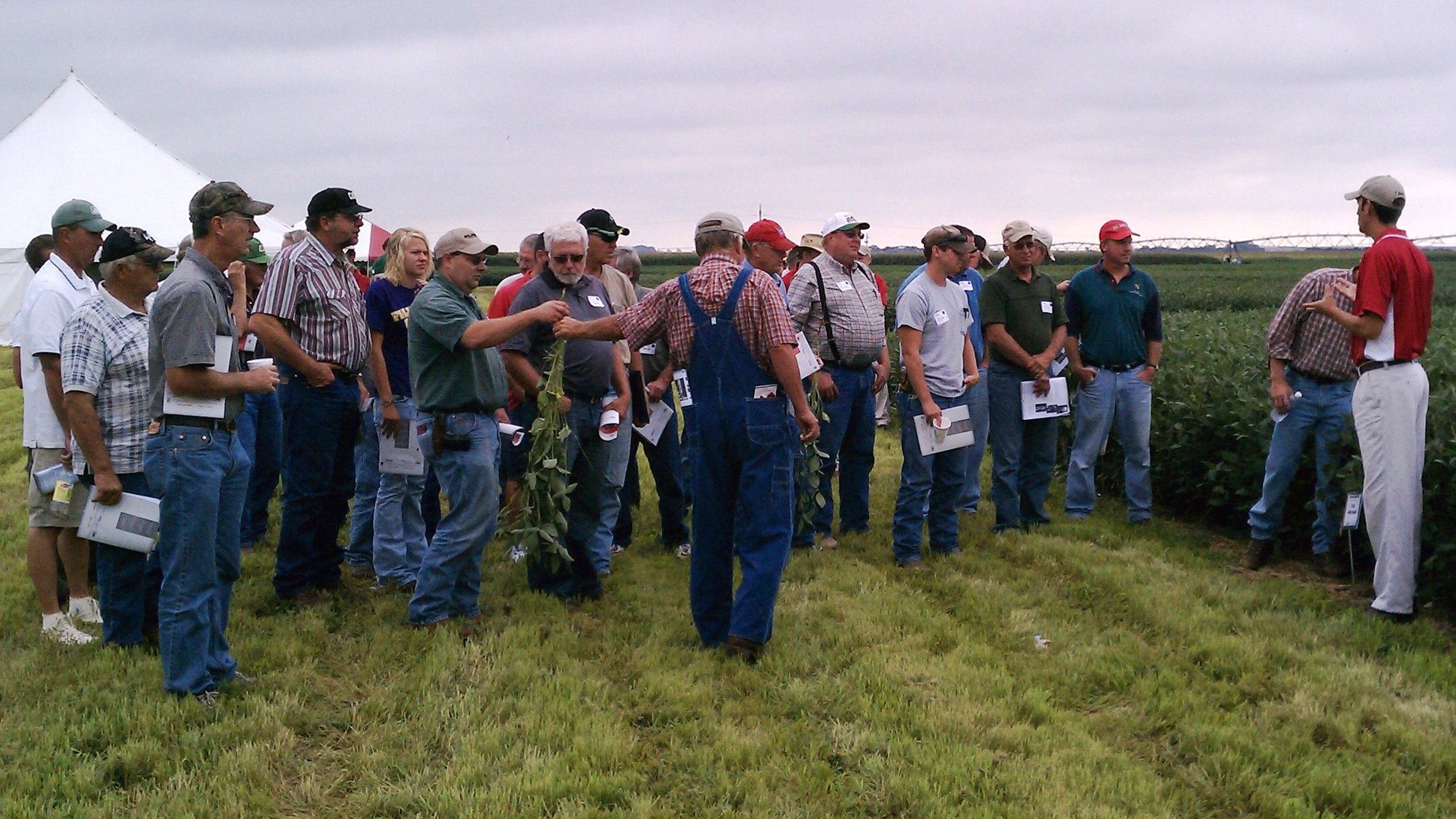 attending. Also a reminder, for all drought information from UNL Extension including crop, livestock, water, lawn, and garden, please check out http://droughtresources.unl.edu.
With the drought and a shortage of forages, if you are considering harvesting or grazing crops for forage, it is important to consider the herbicide restrictions applied to these fields. Check the labels of these herbicides to confirm that grazing restrictions or forage harvesting restrictions have been met before you turn livestock into the fields or cut the crop for hay or silage. Check out this link for more information.
Soybean Management Field Days Planned: Please mark the dates of the upcoming Soybean Management Field Days on your calendar. They are planned for August 14-17 with sessions planned for Lexington, O’Neill, Platte Center and David City. Registration for each of the Field Days starts at 9:00 a.m. with four one hour programs from 9:30 a.m. to 2:30 p.m. Topics include: Soybean Seed Treatments and Foliar Fungicides Growth Enhancement Interaction with Herbicides, Managing Land Leases and Soybean Marketing, Herbicide Carrier Rate Study and Quest for the Holy Grail in Soybean Production! Check out the sessions by going to http://ardc.unl.edu/soydays. The David City date and location is August 17th and it’s located from the Jct of 92 & Hwy 15, 1 mile east on 92 and ¾ mile north on county road.
South Central Ag Lab Field Day: Some of you have been asking about the next field day at South Central Ag Lab near Clay Center. Please mark your calendars for August 22 from 9:00 a.m.-2:00 p.m. with registration beginning at 8:30 a.m. Topics include: Weed control, timing, resistant weeds; Emerging diseases of corn and corn rootworm management options; Impacts of corn stover harvest on soil quality and greenhouse gas emissions; Variable rate nitrogen and irrigation management according to landscape variation; and Use of Soy-Water for managing soybean irrigation. There is no charge but please RSVP for a meal count by Friday, August 17 to (402) 762-4403. Hope to see you there!
York County Corn Grower Plot Tour: The York County Corn Growers Annual Plot tour will be held Thursday, August 23, 2012 from 5:30 – 7:30 p.m. This year’s cooperators are Ray and Ron Makovicka and the plot is located west of York on the Dwight Johnson farm. The plot is located ¾ miles north of Hwy 34 on Road I. Those attending will be able to check out the various corn varieties and visit with the seed company representatives. Supper will be served after the tour. Then there will be a report on 2012 practices, products used and irrigation update.
Also this year they have several different types of irrigation equipment in the field to monitor soil moisture and estimate crop ET. Systems in the field include: AquaCheck USA provided an AquaCheck soil moisture sensor system; Servitech provided the Profiler Watermark soil moisture sensor system; McCrometer provided an EnviroPro soil moisture sensor system; and AquaSpy provided AquaSpy soil moisture sensor system. Several of you have asked about wireless irrigation scheduling systems-here’s your chance to compare them all in one place!
2012 Last Irrigation Scheduling
While farmers may be tired of irrigating right now, I think all who have irrigation are thankful for it in such a dry year. Honestly, thankfully with our irrigation we have some of the best looking crops in the Corn Belt right now. Even so, with corn that hasn’t been replanted nearing dent or stages of starch fill, you may be wondering how to schedule for your last irrigation.
For those of you in our Nebraska Ag Water Management Network using watermark sensors, the goal is to use them to determine when the soil profile reaches 60% depletion (for silty-clay soils in our area aim for an average of 160 kpa of all your sensors). You may be thinking, “An average of 90kpa was hard enough!” but as Daryl Andersen from the Little Blue Natural Resources District points out, you’re only taking an additional 0.30 inches out of each foot. So if you’re averaging 90kpa on your three sensors, you have depleted 2.34 inches in the top three feet so you still have 0.96 inches left (see the Soil Moisture Depletion Chart). If you add the fourth foot (using a similar number from the third foot), it would bring the water available to the plant up to 1.28”.
At beginning dent corn you need 24 days or 5 inches of water to finish the crop to maturity. If you subtract 1.28 from 5 you will need 3.72” to finish out the crop. Corn at ½ milk line needs 13 days or 2.25” to finish the crop to maturity-so subtracting it from 1.28 would be only 0.97”.
Soybeans at the beginning of seed enlargement (R5) need 6.5”. Soybeans in R6 or full seed which needs 3.5 inches yet for maturity. Subtracting off the 1.28” in the four foot profile would lead to 2.22”. The UNL NebGuide Predicting the Last Irrigation of the Season provides good information on how determine your last irrigation in addition to showing charts on how much water the crop still needs at various growth stages.
Several people I’ve talked to who have been irrigating using watermark sensors aren’t replenishing the second foot, so you may have a few rounds yet to go on corn and beans. For a quick way to know where you’re at, think about irrigating this way as explained by Daryl Andersen at the Little Blue Natural Resources District:
One way to look at this is by the numbers of days left. At 1/4 starch, there are about 19 days before maturity so you can let your sensors average 130kpa on the first week and 150kpa on the next week. If these targets are met during the week, you would put on about 1 inch of water. By going to these numbers, it might give you a higher probability for rain in the next couple of weeks. I’m hoping for many answered prayers that we will see rain in August!
High Heat & #Corn Pollination
With the high heat, lack of rainfall, and pollination occurring in many fields or just around the corner, questions have been 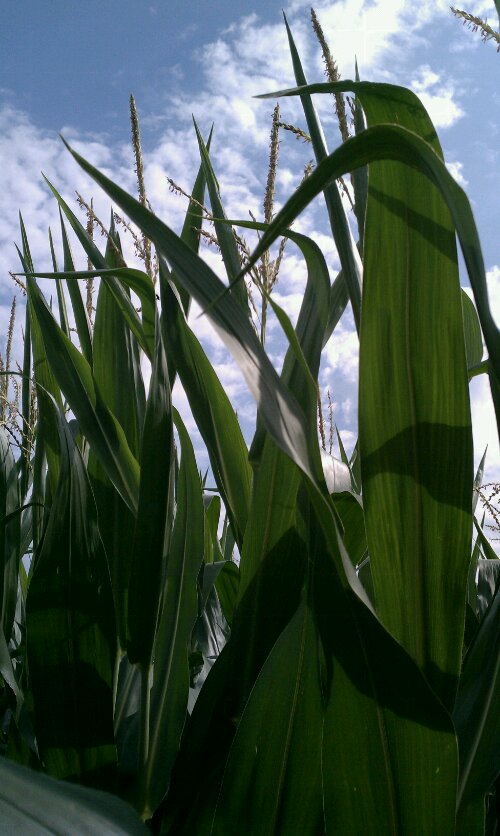 rolling in regarding how high heat affects corn pollination. Dr. Tom Hoegemeyer, UNL Agronomy Professor of Practice wrote the following article and I’m sharing it for the excellent info. Hybrid Maize simulations will be shared in this week’s CropWatch and in next week’s news article.
“Corn was originally a tropical grass from the high elevation areas of central Mexico about 7,400 feet above sea level, 2,000 feet higher than Denver. Today, corn still prefers conditions typical of that area — warm daytime temperatures and cool nights. Areas that consistently produce high corn yields share some significant characteristics. These areas — central Chile, the west slope of Colorado, etc. — are usually very bright, clear, high light intensity areas with cool nights.
This year, in the prairie states and in the Cornbelt, conditions have been dramatically less than optimal. Corn maximizes its growth rate at 86°F. Days with temperatures hotter than that cause stress. In the high yield areas, cool night temperatures — at or below 50°F — reduce respiration rates and preserve plant sugars, which can be used for growth or reproduction, or stored for yield. These are optimum conditions for corn, and interestingly, are fairly typical for areas around central Mexico where corn is native.
In years when we get high day and nighttime temperatures coinciding with the peak pollination period, we can expect problems. Continual heat exposure before and during pollination worsens the response. Daytime temperatures have consistently stayed in the upper 90s to low 100s.The high humidity, which helps reduce crop water demand, also increases the thermal mass of the air—and provides extra stored heat and insulation at night.
Corn pollen is produced within anther sacs in the anther. The plant releases new, fresh anthers each morning, starting from near the top of the tassel, on the first day of shed, and proceeding downward over several days. The process of releasing the pollen from the anthers is called “dehiscence.” Dehiscence is triggered by the drop in humidity, as the temperature rises. However, when it is extremely humid and the humidity falls very little, dehiscence may not occur at all, or it may be delayed until late in the day. If one has breezes, while the humidity is still very high, the anthers may fall to the ground before pollen is released. If the temperature rises too high before pollen dehiscence occurs, the pollen may have reduced viability when it is shed. A person experienced at hand pollination in corn will often see this happen. There will be anthers in a “tassel bag,” but little pollen. The usual solution to this is to wait a couple hours until the temperature rise reduces the humidity. However, last year we had some conditions where pollen was never released from the anthers. This can impact silk fertilization, particularly in open-pollinated situations.
Corn is a “C4 Photosynthesis” plant, making it extremely efficient at capturing light and fixing CO2 into sugars. One drawback of this system is that with high daytime temperatures, the efficiency of photosynthesis decreases, so the plant makes less sugar to use or store. High nighttime temperatures increase the respiration rate of the plant, causing it to use up or waste sugars for growth and development. This results in the plant making less sugar but using up more than it would during cooler temperatures. Heat, especially combined with lack of water, has devastating effects on silking. If plants are slow to silk, the bulk of the pollen may already be shed and gone. Modern hybrids have vastly improved “ASI” or anthesis-silk interval (the time between mid-pollen shed and mid silk). Regardless, in some dryland fields we see seed set problems because of “nick” problems between pollen and silking.
Even in some stressed areas within irrigated fields (extreme sandy spots, hard pans or compaction areas where water isn’t absorbed and held, and some “wet spots”) we can see stress-induced slow silking and resulting seed set issues. Historically, this has been the most important problem leading to yield reduction, particularly in stressful years. Once silks begin to desiccate, they lose their capacity for pollen tube growth and fertilization.
Even with adequate moisture and timely silking, heat alone can desiccate silks so that they become non-receptive to pollen. This is a bigger problem when humidity is low and on hybrids that silk quite early relative to pollen shed. Even with dew points in the 70s, when temperatures reach the high 90s to the100s, the heat can still desiccate silks and reduce silk fertility.
Heat also affects pollen production and viability. First, heat over 95°F depresses pollen production. Continuous heat, over several days before and during pollen-shed, results in only a fraction of normal pollen being formed, probably because of the reduced sugar available. In addition, heat reduces the period of pollen viability to a couple hours (or even less). While there is normally a surplus of pollen, heat can reduce the fertility and amount available for fertilization of silks. Research has shown that prolonged exposure to temperatures reduced the volume of pollen shed and dramatically reduced its viability. For each kernel of grain to be produced, one silk needs to be fertilized by one pollen grain.”
#Crop Update
While every growing season is unique and there’s an element of risk involved, this year seems to take the cake. 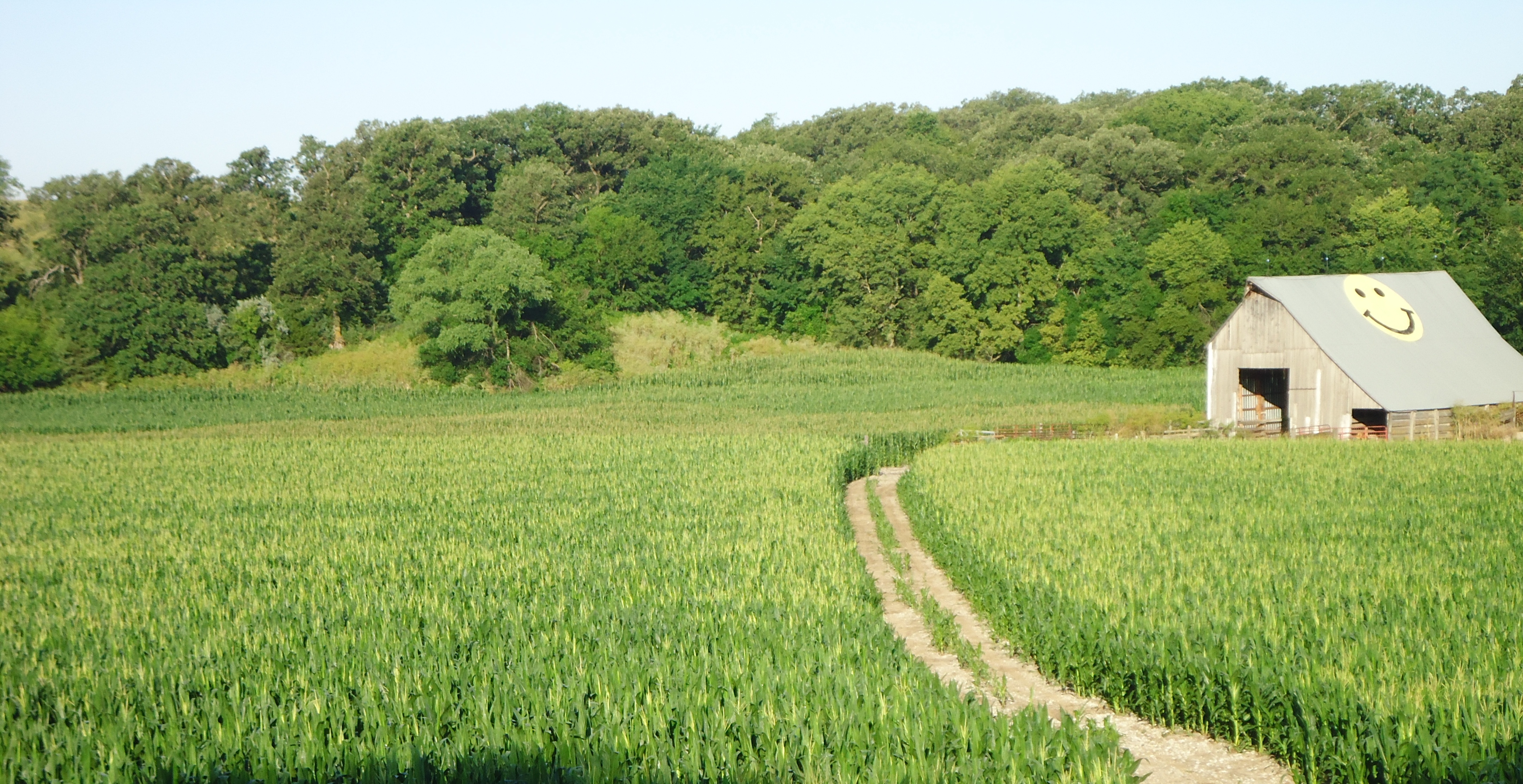

Drought conditions have affected much of Nebraska. In our area in south-central Nebraska particularly in our southern tier of counties, we’re seeing brown pastures and alfalfa that stopped growing. Wheat was harvested nearly a month early and yields range from 0-50 bu/acre depending on if it was hit by the hail storm Memorial Day weekend which totaled it out.
I’m unsure how many planting dates we currently have in Clay County! The spring planting season went so well with corn and many beans being planted in April. Soybeans planted in April that haven’t received hail are forming a nice canopy. Corn that hasn’t received hail should be tasseling by beginning of July. One Clay Co. field planted in March was only 3 leaves from tasseling when I took this picture this week and looks great (it’s probably 2 leaves by now!).  Adding another picture from a farmer friend Bob Huttes near Sprague, NE showing his field currently tasseled out and love the smiley face barn 🙂
But then there’s the hail damaged fields. The hail pattern has been fairly similar all year for this area of the State with some producers receiving four consecutive hail events on their fields. Every week of May was spent helping our producers determine replant decisions, particularly for soybeans…leaving irrigated stands of 85K and dryland stands of 60-65K when beans were smaller before stem bruising was so severe later. We would leave a stand one week and end up needed to replant after the hail hit again the following week. Some farmers got through the first two hail storms but the Memorial Day weekend storm did them in. I never saw hail like where ground zero of this storm occurred. After replanting after that weekend, they received yet another hail storm last week with the wonderful, much needed deluge of rain we received in the county. My heart hurts for these farmers yet for the most part they have good attitudes and are making the most of it. That’s the way farming is…lots of risk, thus an abundance of faith and prayer is necessary too. One farmer I talked to has had hail on his house seven times this year (including prior to planting).
Pivots have also been running like crazy prior to the rain last Thursday night where we received 3.30-4.40 inches in the county. Installing watermark sensors for irrigation scheduling, we were able to show the farmers that there was truly moisture deeper in the soil profile and attempted to convince them to hold off. It’s a hard thing to hold off on  water when the neighbors are irrigating, but several farmers who didn’t irrigate told me they were able to let the rain soak in and their plants
 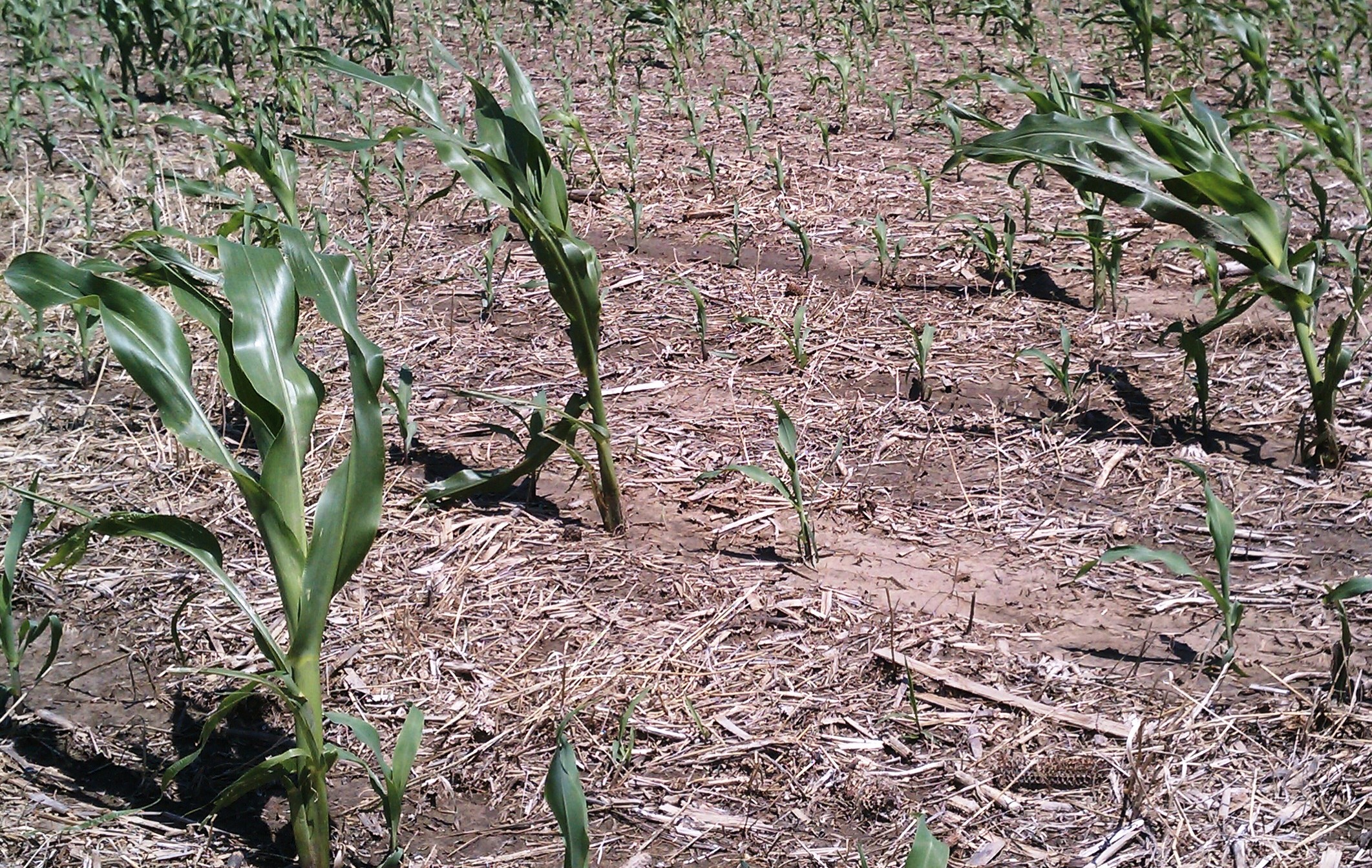 weren’t leaning after that rain because the ground wasn’t saturated prior to the rain event.
Crop Water Use Comparison Study
Water use efficiency (or crop water productivity) is important in crop production. The seed Industry has invested scientific  efforts and financial resources into developing hybrids and varieties that can better tolerate environmental stresses such as water stress.
Rainfed corn has increased in acres, replacing sorghum year after year. This trend may be partly due to the basis price, herbicide options, and newer corn hybrids bred with root systems to better withstand water stress. In 2009 the question was posed, “Is sorghum still the most crop-water-use-efficient crop, given newer corn hybrids in rainfed fields are providing decent yields and more herbicide options?” To answer the question the Nebraska Grain Sorghum Board funded a project in south-central Nebraska.
On-farm research was conducted for three years in rainfed production fields near Lawrence with the most adapted and high-yielding corn, sorghum, and soybean hybrids and varieties for that area. The research was conducted in no-till fields where the previous crop had been sorghum. A randomized complete block design with three replications was used.
Corn and soybean were planted between May 5 and May 7; sorghum planting ranged from May 19 to May 28. Corn was planted at 20,000 seeds/acre, soybean at 135,000, and sorghum at 65,000. Rainfall in this area varied greatly from 2009 to 2011: 2009 was dry with only 10 inches of rain during the growing season; 2010 had 16 inches, and 2011 had 20.5 inches from May 1 to October 15.
To monitor soil moisture, Watermark sensors were placed at 1-, 2-, 3-, and 4-foot depths in each plot and the readings were  recorded hourly throughout the growing season via Watermark dataloggers. Data were compiled and analyzed to determine crop water use efficiency (CWUE) values. The CWUE values were determined from the Watermark soil moisture data, actual crop water use (evapotranspiration), and grain yield for each crop.
Results: Table 1 shows actual crop evapotranspiration (ET) in inches, grain yield, and crop water use efficiency for each crop in each year. Corn was the most water use efficient of the three in 2009. Sorghum results in 2009 might have been different if rainfall had occurred to activate the sorghum herbicide as grass pressure was heavy in the sorghum plots that dry year. In 2010-2011, sorghum yielded the most, had good weed control, and had the best crop water use efficiency value.
| Table 1. Crop water use efficiencies in on-farm field trials conducted near Lawrence, Nebraska, 2009-2011. | |||||||||
| 2011 ET (in) |
2011 Yield (bu/ac) |
2011 CWUE (bu/in) |
2010 ET (in) |
2010 Yield (bu/ac) |
2010 CWUE (bu/in) |
2009 ET (in) |
2009 Yield (bu/ac) |
2009 CWUE (bu/in) |
|
| Corn | 22.0 | 127.2 | 5.8 | 23.3 | 101.2 | 4.3 | 14.5 | 97.5 | 6.7 |
| Soybean | 21.3 | 61.3 | 2.9 | 22.0 | 44.0 | 2.0 | 14 | 33.4 | 2.4 |
| Sorghum | 17.3 | 138.9 | 8.0 | 21.3 | 118.0 | 5.5 | 13.7 | 77.4 | 5.6 |
Overall in this study, sorghum had a crop water use efficiency of at least 5.5 bu/inch; corn, at least 4.3 bu/inch, and soybean, at least 2.0 bu/inch. These results show sorghum’s continued value as a crop that efficiently uses water. Sorghum produced more grain per unit of water used than corn or soybean, an important benefit in water-limited environments. On a three-year average, sorghum resulted in 1.2 bu/inch and 3.5 bu/inch more grain production per inch of water used than corn and soybean, respectively. This study did not compare sorghum or soybean with new “drought-tolerant” corn hybrids. Graphs, charts, and production information can be found here.
Acknowledgements: Special thanks to John Dolnicek of Lawrence, Nebraska for allowing this research to be conducted on his farm and for all his help and efforts to make it a successful study and to the Nebraska Grain Sorghum Board for funding this study.
Soil Crusting in #Soybeans Causing Concerns
On May 6, quite a storm was unleashed in south central Nebraska. Soybeans that had been planted two to three days before the storm seem to have emerged fine, while those planted May 5-6 tend to have uneven emergence and crusting. This is occurring regardless of tillage type, residue cover, etc. Many farmers have been running pivots to help the soybeans break through the ½- to 2-inch crust, often applying an inch of water before they see stand improvements.
The primary question for growers has been “Should I replant?”
UNL on-farm research has shown less than 1.4-2.0 bu/ac yield difference between planting 90,000 and 180,000 seeds/acre. (See report.) In our research, 90% of the planted stand was achieved at both seeding rates in irrigated 30-inch rows in no-till and ridge-till fields.
Consider what was found in 2006 in one dryland field in Nuckolls County where populations of 100,000, 130,000, and 160,000 seeds/acre were planted. This field was at the cotyledon stage when it was hailed. Some plant stands dropped to 67,000. Yield was 4 bu/ac less than in the 160,000 seed/acre planting that had a final stand of nearly 98,000. The average yield in the field was 40 bu/ac. While this is only one field and one year of research, it is an example of how soybean plants can compensate for reduced populations by branching and how August rains in dryland can still allow reasonable yields to be produced.
UNL research conducted by Dr. Jim Specht, UNL Soybean Physiologist, also has shown that for every day planting is delayed after May 1, there is the potential to lose 1/4 to 5/8 bushel per day. As we near the end of May and early June and consider that late planting yield penalty and the dry soil conditions (particularly in dryland fields), along with the seeding rate results from this UNL on-farm research, we are recommending that growers leave stands in many fields. Based on our on-farm research, leaving dryland stands of at least 65,000 plants/acre and irrigated stands of 90,000 plants/acre is likely a better choice than replanting.
We realize that there are some larger gaps in various rows in the field, and while we don’t like to see that, the gaps are disappearing as plants continue to grow and branch out. Keep in mind that a gap in one plant row will be compensated by plants in the adjacent flanking rows. They will form extra branches to take advantage of the sunlight, thus single-row gaps may not be as yield-reducing as you might think — especially in 15-inch row spacings.
We’re also seeing how resilient soybeans are. Some soybeans have been in the ground for two weeks and in many cases, are fairly healthy below the crust. Soybean seedlings emerge by pulling (not pushing) their cotyledons upward. The seedlings rely on the cotyledons as a reserve source of carbohydrate, protein, and lipid to support early seedling development until leaflets open for photosynthesis. When a seedling tries to pull its cotyledons through a crack in the crust, the crack may be too small and the cotyledons may be stripped off.
The plumule, which is the seedling stem tip and its undeveloped leaves above the cotyledonary node, may remain, but 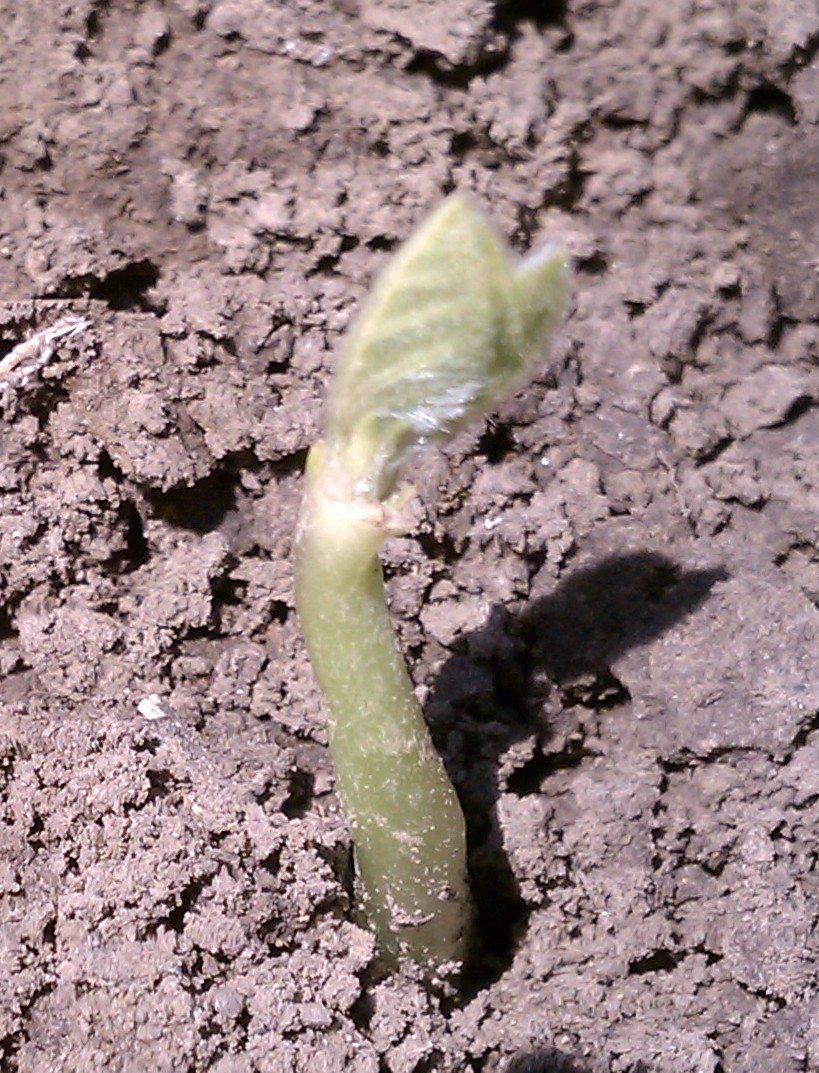 without the cotyledons to serve as a carbon and nitrogen source, development of new seedlings with small leaflets will be slow. These plants may not become competitive with surrounding plants in terms of pod and seed production. Therefore, when counting seedlings to determine plant stand after a soil crusting event, count only the seedlings that have at least one cotyledon. You can count seedlings missing cotyledons if they have large unifoliolate leaves that will soon unroll such as the picture on this page.
Recommendation: When deciding whether to replant your field, consider UNL research findings that showed a minimal yield difference between stands of 90,000 and 180,000 seeds/acre. We recommend leaving irrigated soybean plant stands of 90,000 or more and dryland plant stands of 65,000 or more. Uniformity of plant stands is also important, but “patch” planting may be used to deal with local areas of low plant stands.
For more information on reduced soybean planting rates, see the April 20, 2012 CropWatch story, Drop Soybean Seeding Rate and Save $10-$18 per Acre.


 JenResources