Blog Archives
On-farm Research
Wow, I’m sorry I haven’t published much the past two months! Much has happened though as we’re in the middle of winter Extension ag programming season! I love this time of year seeing farmers and ag industry reps-and just chatting about what happened last year and speculating about the upcoming season.
Many of you are also attending numerous meetings. You’re gathering information regarding products and production practices. You may be wondering “Will this work on my farm?” Why not go a step further and see for yourself? On-farm research is a great way to test these questions for yourself using your own equipment in your own fields!
UNL Extension has partnered with the Nebraska Corn Board and Nebraska Corn Growers to form the Nebraska On-farm Research Network. There are three main studies we are conducting state-wide: corn population, corn nutrient, and corn irrigation studies…but we are open to helping you design a valid research experiment for your field to test what you would like-and it can be for a crop other than corn.
We have some upcoming opportunities for you to learn more. On February 11 and February 12 from 9:00 a.m.-3:00 p.m. at UNL’s Ag Research and Development Center near Mead and the York Co. Fairgrounds in York respectively, growers who conducted on-farm research in 2012 will be sharing their results; you can also learn more about conducting on-farm research in your own field. There is no charge for the meetings courtesy of the Farm Credit Services of America but we do need an RSVP for meal count and handouts. Please RSVP by calling (402)624-8030 for ARDC or (402)362-5508 for the program in York. I hope to see you at these meetings as well!

Research Fertilizer Options for Your Farm
November 1 is just around the corner-the beginning of when fall fertilizing occurs in this area of the State. Hopefully many of you have taken soil samples as excess nitrate is to be expected after this drought year. This is an excellent time to consider evaluating your nitrogen program by starting an on-farm research trial!
On-farm research is using your own equipment, in your own fields, over single or multiple growing seasons allowing you to determine the most economical, efficient, and sustainable practice for the production of irrigated and/or dryland crops on your own farm.
What are the soil fertility questions you have for your farm?
Right now, with fertilizing on producers’ minds, we’re hoping you will consider a soil fertility study. We have several example nutrient protocols including the UNL N fertility rate compared to +/- 30 lbs, and considerations for nitrogen timing studies such as pre-plant, sidedress, or fertigation. You can view all these plot designs by clicking on 2012 protocols. If you are planning on applying anhydrous this fall, be sure that the anhydrous strips are the correct width, as the corn must be harvested and weight determined in a correct manner next fall.
When designing a nitrogen comparison you need to remember nitrogen is a mobile nutrient and corn roots will spread laterally. Therefore, the width of the treatments must take this into account and compensate for it. If you have a 16 row nitrogen applicator and an 8 row corn head, you will need 32 rows of each nitrogen rate. Each 32 row strip must be repeated 4 times. At harvest, in each 32 row block, you must record and weigh the center 16 rows with two separate weights i.e. 8+8 . This is done for statistical analysis purposes. Without statistics, you cannot determine if differences between treatments is the result of the nitrogen rate or because of soil variability.
What’s in It for You?
On-farm research in your own fields allows you to find answers to the questions you may have. We all read articles or hear presentations about various practices and products. The question is “Will it work on my farm?“. That’s what on-farm research allows you to find out!
UNL Extension Educators and Specialists are here to help you design your on-farm research trials, help you with data collection, and will statistically analyze the data for you at the end of the season. Correct plot setup is critical to reduce any error in favoring one treatment over another (because we know fields are variable and some portions of the field will yield better than others). The statistical analysis is another tool which helps us determine how much any yield differences between treatments are due to the treatments themselves or to chance.
So if you have an idea you’d like to try, please contact any of the UNL Extension Educators or Specialists working with on-farm research! The Nebraska On-farm Research Effort is a partnership between the Nebraska Corn Board, Nebraska Corn Growers Association, and UNL Extension.
On-farm research may sound daunting, but today’s equipment makes it easier than ever. It does take a little extra time, but our farmers conducting on-farm research feel the value of knowing the results of a study on their own piece of ground make the effort worthwhile.
What are some on-farm research studies you would like to conduct this year or that you would like our group to consider?
On Farm Research
 As harvest rolls to a close you most likely noticed some field variability or have some questions about how various products or production practices may work on your farm. Every year during the winter, UNL Extension educators share research conducted by your peers-other farmers-in their own fields and often those presentations are very interesting to our clientele.
With the advance of farming technologies, it’s easier than ever for more farmers to conduct research on their own farms. Depending on the study, there may be additional time involved, but overall, the farmers I’ve worked with who have conducted on-farm research say they obtained answers to their questions and the power was knowing it was research based on their own farm.
Last winter the two on-farm research groups in Nebraska combined to form the Nebraska On-Farm Research Network. With help from the Nebraska Corn Growers and Nebraska Corn Board, three State-wide studies were rolled out in addition to other studies that producers wanted to conduct on their own farms. That data is still being collected and analyzed right now and results will be presented this winter.
So as you think about the 2012 season, what are the questions you have? Consider working with your local Extension Educator to design a valid research-based experiment to answer the questions on your farm. To learn more, please check out the CropWatch on-farm research page.
What studies would you like to see our group research on-farm in 2013?
Wheat Planting Resources
This dry fall has raised questions about winter wheat planting…should I plant or delay? How much seed should I drop? My wheat has emerged but how do I assess my stands?
UNL Extension’s CropWatch newsletter has featured several wheat articles from Bob Klein, UNL Extension Cropping Systems Specialist and other Extension faculty. Since they’re on several different CropWatch release dates, I decided to put all the info. in one place for you. Hope this helps!
Recommendations to Compensate for Delayed Winter Wheat Seeding and Improve Yield Potential
For those who have waited to plant winter wheat, Bob Klein, UNL Extension Cropping Systems Specialist, says to increase wheat seeding rate 10-15 lbs per acre (150,000-225,000 seeds/acre) per week for every week delayed after the seeding rate for our area. Hessian fly free seeding dates range from September 25 for most of our area to September 28 in southern Nuckolls and most of Thayer Co.
For no-till, he recommends automatically increasing seeding rate an additional 50%. So if you’re a dryland no-till producer planting in October, he would recommend seeding 90 lbs to 120 lbs maximum of wheat seed. For irrigated wheat, start at at least 90 lbs/ac and increase 15-20 lbs/acre every week later than suggested seeding date but don’t exceed a maximum of 180 lbs/acre of seed.
Determining the Seeding Rate for Your Winter Wheat
A review of seedling rates vs. yield potential: On the average, there are 22 seeds per head and 5 heads per plant, or 110 seeds per plant. With an average seed size of 15,000 seeds per pound or 900,000 seeds per bushel, a pound of average-sized seed with 80 percent germination and emergence has a yield potential of approximately 1.5 bushels per acre. Seeding 40 lb of seed with a weight of 15,000 seed per pound has a yield potential of 60 bushels per acre.
Seedbed Conditions and Seeding Equipment Affect Timing of Wheat Seeding
Paul Jasa, UNL Extension Engineer says to make sure the drill is running lower in back than normal. Transfer more drill weight to the back of the drill and add extra weight to the drill. This will allow for penetration into dry, hard soil, forcing the seed into the soil and insuring seed-to-soil contact. Also, don’t seed wheat too shallow. When using disc drills, plant at a depth of 2 inches or more.
Additional Resources:
- Fertilizer Options for Dryland Wheat: Is Wait and See a Good Option?
- Grasshopper Management Considerations in Emergent Winter Wheat
- Use of Seed Treatment Fungicides to Improve Wheat
- Guides to Winter Wheat Variety Selection
- How Wheat Seeding Date Affects Yields
- Assessing Winter Wheat Stands and Estimating Yield Potential
Cover Crops & Fall/Spring Forage Options
With corn being harvested for silage, corn maturing early, and livestock producers looking for forage options, I’ve received questions about seeding cover crops or forage options. Mike Burgert from the Clay County Natural Resources Conservation Service also wanted me to share the concern of the loss of reside and the increased likelihood of soil erosion. He said if harvesting crops for forage takes place on a USDA program participant’s “highly erodible” acres, this would likely not be an approved conservation system and could cause ineligibility for USDA programs on all of their land in programs. He also said they have cost share for drought related practices (cover crops for forage on cropland, stock water well/pipe/cross fencing/water facility, etc.).
Dr. Bruce Anderson shared the following information: Before planting anything, review your herbicide history. Prior use of contact herbicides like glyphosate won’t cause any problems, but some herbicides have a long soil residual effect that could prevent successful establishment of some crops. Double crop choice is likely to be different for rainfed and irrigated conditions. One ton (dry weight) of forage production is likely to use 4-5 inches of water. For rainfed conditions, a crop that will winter kill is preferred in order to accumulate soil water from snow melt and spring rainfall for the next crop. For irrigated conditions, forage production will be more with a crop that survives winter and is spring harvested—although irrigation for the forage and following crop will likely need to be increased compared with no double cropping.
Fall Forage options: Determine when the forage crop is to be harvested and how it will be used. For fall-harvested hay or silage, oats or other spring cereals will outyield all other options. Plant about 100 lb. of seed per acre. Various legumes like hairy vetch, field peas, or winter peas can be added to increase protein concentration a percentage point or two, but they are unlikely to increase dry matter yield; the forage from the cereal alone will meet most cattle protein needs. Also be wary of spending more for the seed than the extra protein might be worth. For grazing this fall and winter, turnips and oats (separately or in a mixture) usually will provide the most feed.
Early planting and emergence (irrigation or soil moisture must be available immediately) is essential for successful fall forage. Plantings after Labor Day rarely produce sufficient growth for mechanical harvest in the fall and the amount of fall grazing becomes negligible for plantings made after mid-September. Even earlier planting dates may be needed for sites north of the Platte River. Later plantings should consist of winter cereals. Also, the chances for successful establishment are low unless soil is sufficiently moist to at least an eight-inch depth at time of planting.
Spring Forage Options: For spring forage, the winter cereals rye, triticale, and wheat tend to be the best choices. Rye is your best choice for early spring pasture and produces much growth before being terminated for timely planting of a row crop. Some rye varieties also provide enough fall growth for some light grazing if planted early enough. Rye also may be the most reliable crop when planted under stressful conditions. Rye has some drawbacks. It turns stemmy and matures much earlier than triticale or wheat, with a loss in feed value and palatability, although this should not be an issue if harvest ends in time for spring planting of a row crop. Also, it should not be used in fields that will be used to grow grain wheat due to potential contamination that could lead to discounts/dockage when wheat grain is sold.
Triticale holds on to its feed value best into late spring. This makes it well suited for hay and silage, or for stretching grazing well into June if grazing begins two or three weeks later than it could begin with rye. Triticale often is more susceptible to winter injury than rye and wheat.
Winter wheat will provide very little grazing for fall. During spring, forage quality and acceptance is very high but forage yield is less than rye and triticale. It can be grazed and then allowed to produce grain if grazing ends when plants begin to joint and elongate.
Mixtures often can be desirable and can be designed for individual needs. For example, an early planting of 30 lb. of oats plus 75 lb. of winter rye per acre may provide both fall grazing from the oats and spring grazing from the rye.
#Crop Update
While every growing season is unique and there’s an element of risk involved, this year seems to take the cake. 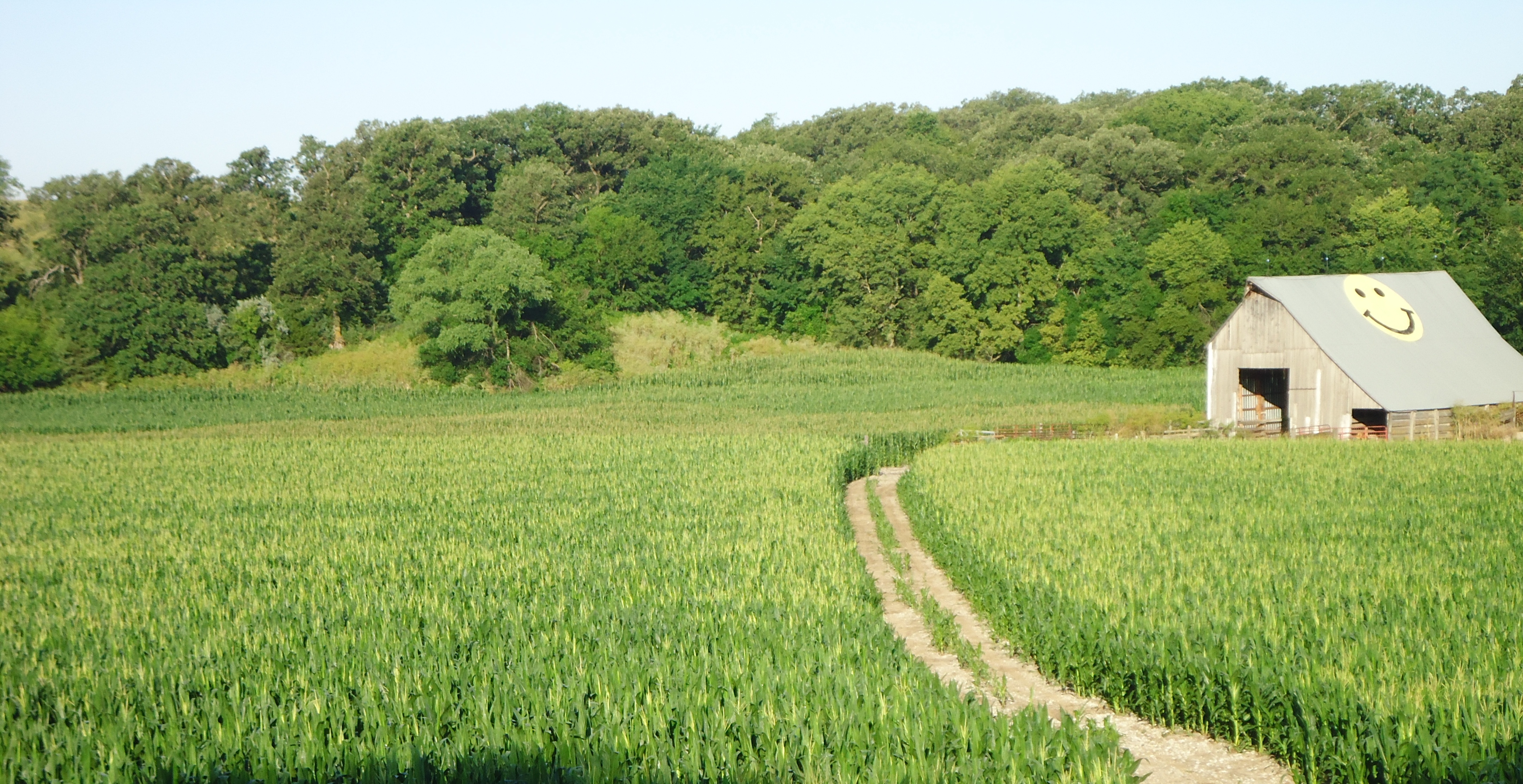

Drought conditions have affected much of Nebraska. In our area in south-central Nebraska particularly in our southern tier of counties, we’re seeing brown pastures and alfalfa that stopped growing. Wheat was harvested nearly a month early and yields range from 0-50 bu/acre depending on if it was hit by the hail storm Memorial Day weekend which totaled it out.
I’m unsure how many planting dates we currently have in Clay County! The spring planting season went so well with corn and many beans being planted in April. Soybeans planted in April that haven’t received hail are forming a nice canopy. Corn that hasn’t received hail should be tasseling by beginning of July. One Clay Co. field planted in March was only 3 leaves from tasseling when I took this picture this week and looks great (it’s probably 2 leaves by now!).  Adding another picture from a farmer friend Bob Huttes near Sprague, NE showing his field currently tasseled out and love the smiley face barn 🙂
But then there’s the hail damaged fields. The hail pattern has been fairly similar all year for this area of the State with some producers receiving four consecutive hail events on their fields. Every week of May was spent helping our producers determine replant decisions, particularly for soybeans…leaving irrigated stands of 85K and dryland stands of 60-65K when beans were smaller before stem bruising was so severe later. We would leave a stand one week and end up needed to replant after the hail hit again the following week. Some farmers got through the first two hail storms but the Memorial Day weekend storm did them in. I never saw hail like where ground zero of this storm occurred. After replanting after that weekend, they received yet another hail storm last week with the wonderful, much needed deluge of rain we received in the county. My heart hurts for these farmers yet for the most part they have good attitudes and are making the most of it. That’s the way farming is…lots of risk, thus an abundance of faith and prayer is necessary too. One farmer I talked to has had hail on his house seven times this year (including prior to planting).
Pivots have also been running like crazy prior to the rain last Thursday night where we received 3.30-4.40 inches in the county. Installing watermark sensors for irrigation scheduling, we were able to show the farmers that there was truly moisture deeper in the soil profile and attempted to convince them to hold off. It’s a hard thing to hold off on  water when the neighbors are irrigating, but several farmers who didn’t irrigate told me they were able to let the rain soak in and their plants
 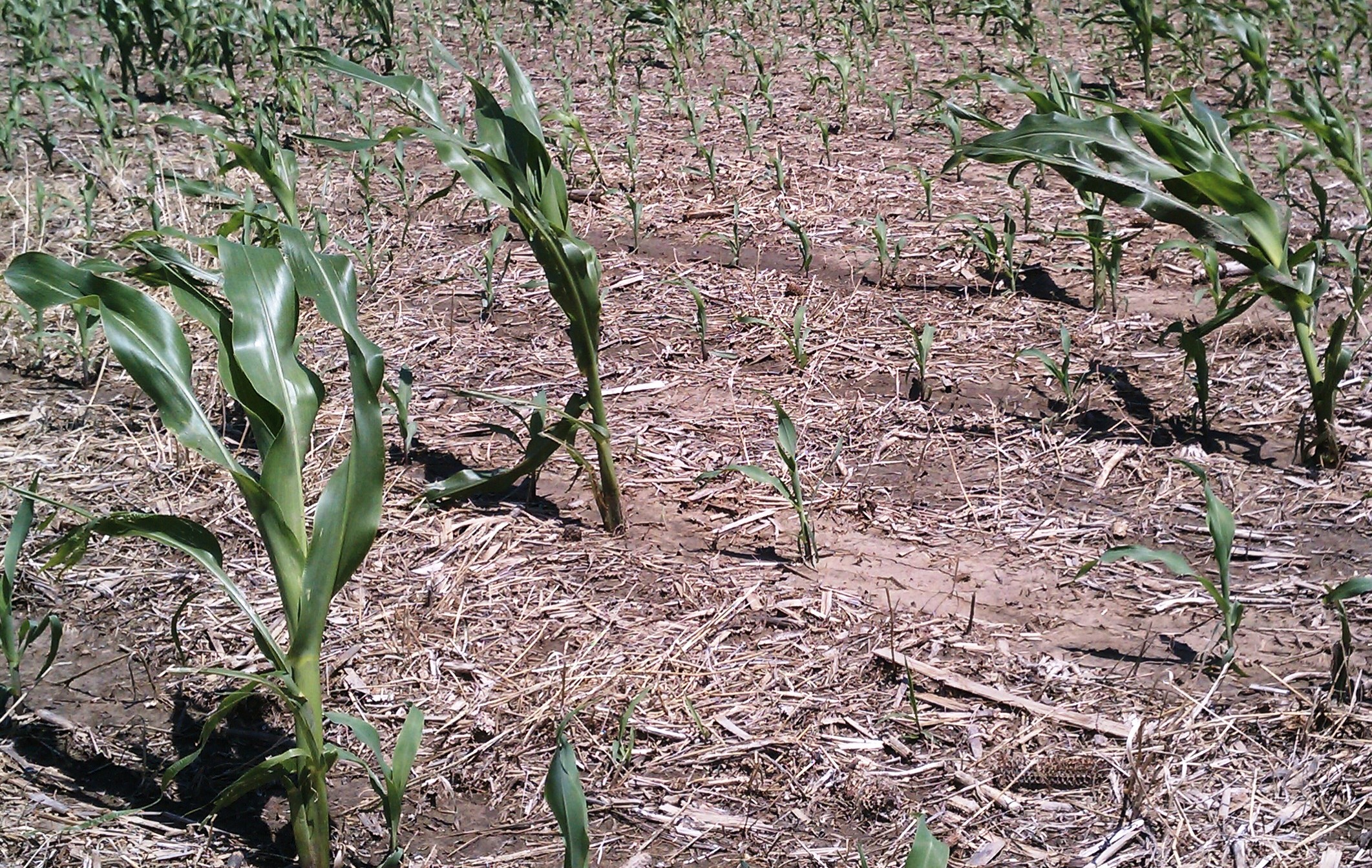 weren’t leaning after that rain because the ground wasn’t saturated prior to the rain event.
The Season for #ag & #horticulture Questions!
This past week was a blur of calls, questions, and visits to homes and fields but it was a great week and flew by staying very busy! I’ll touch on a few of the common questions I’ve received this week.
Trees: Some trees such as willows, hackberries, tops of maple trees, ash, and black walnut are just taking time leafing out. Some trees leafed out once already and dropped leaves. Things that may have caused this were the sudden flux of temperatures from very warm to cool and the strong winds we received. Some trees have also unfortunately had herbicide drift damage that caused leaves to drop. On those trees, watch for new buds as nearly every situation I’ve looked at thus far have new buds forming after about a week-10 days. With all these situations, give the trees a few weeks to leaf out again and if they’re still not doing it, feel free to give me a call. Trees are interesting plants as sometimes environmental impacts that happened 3-5 years ago will show up that much later-and sometimes environmental impacts show up right away!
Disease/Insect issues: This year has been a strange year all around but with our warm winter, I was concerned about an increase in diseases and insects. Thus far, we’re experiencing increases in both-so hang on-it may be a long growing season! Our high humidity, warm temps, and heavy dews have created perfect conditions for fungal diseases on our trees, ornamental plants, lawns (I’m currently fighting a bad case of powdery mildew-as a plant pathologist it is kind of pretty but I don’t like what it’s doing to my lawn!), and in our wheat and alfalfa crops and some pasture grasses. Fungicides may help in some of these situations, increasing airflow can also help as can more resistant varieties or hoping the weather will change. In the case of most ornamentals, we don’t usually recommend doing anything. The same goes for insects as insecticides can help in some situations. I’ve received several calls this past week of people afraid they had herbicide drift damage. While there were a few cases of that, many of the cases were actually fungal leaf spots on leaves. There are various fungicides and insecticide products available from home/garden centers, etc. Be sure to read and follow all label directions and only apply the product on places the label specifies it can be applied.
Crops Update: Later this week we may have a better idea on the extent of storm damage and if some fields will need to be 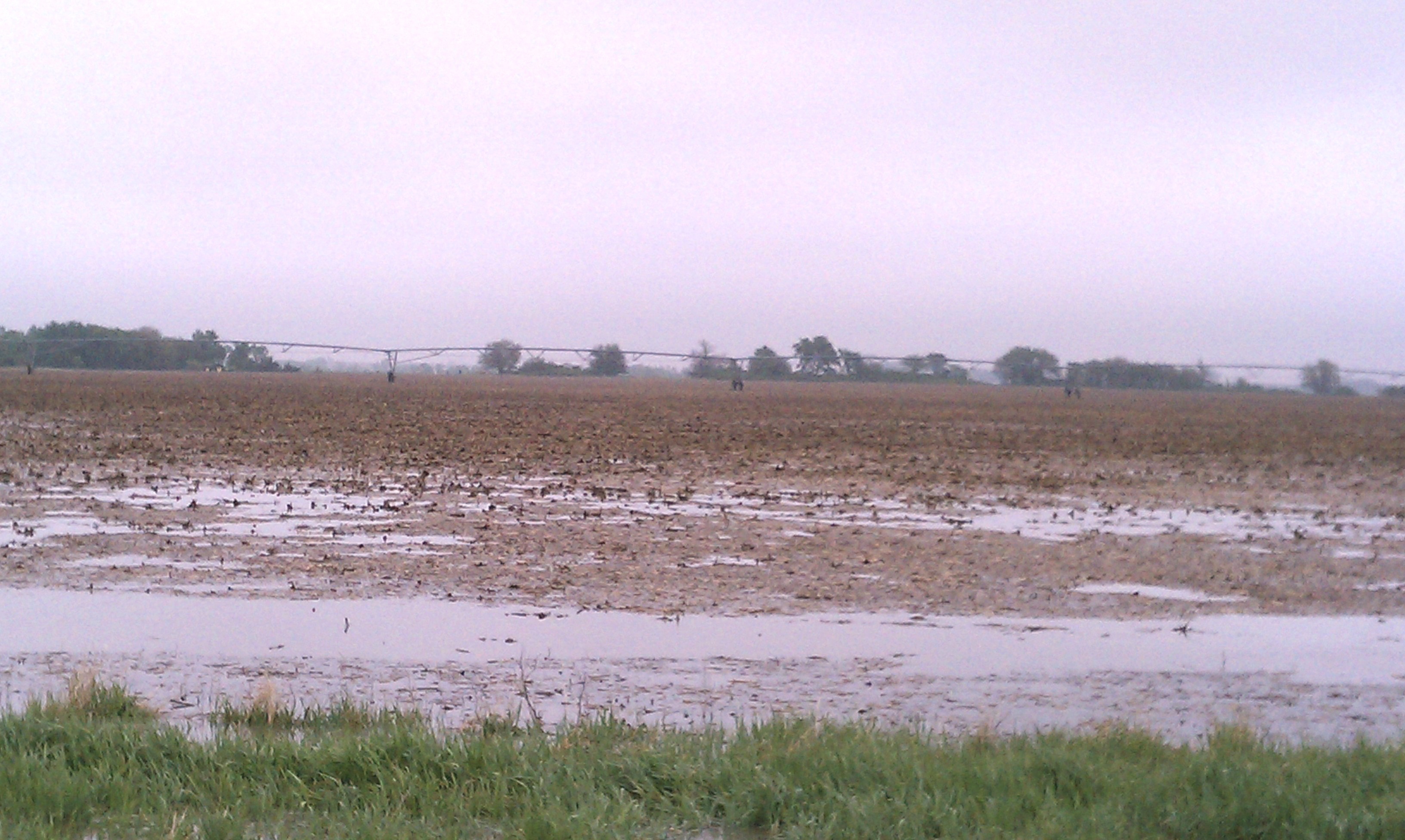 replanted after the storms from last week. Dr. Bob Nielsen from Purdue University reported that most agronomists believe young corn can survive up to about four days of ponding if temperatures are relatively cool (mid-60’s F or cooler); fewer days if temperatures are warm (mid-70’s F or warmer). Soil oxygen is depleted within about 48 hours of saturation and we know soil oxygen is important for the root system and all the plant’s life functions. So we’ll have to wait and see what happens.
Have also had a few calls regarding rye cover crops. When rye is killed out and decomposing, it releases toxins that can affect the germination of other cereal crops such as corn if it’s going to be planted into that rye cover crop. Thus we recommend at UNL that the producer kill the rye and then wait at least two weeks to prevent any major damage to the crop. I realize at this point with the rains to get in and kill that crop on top of waiting an additional two weeks, we’re getting close to the end of the month and will most likely be looking at reduced yields…and depending on maturity, you may need to consider different seed if you end up having to plant in June. If you have specific questions about this, please let me know and we can talk through some situations.
Stripe rust and powdery mildew have been obliterating mid-lower canopies of many wheat fields. I’ve received several calls on why wheat canopies are yellow-that’s the main reason but other factors such as the dry spell prior to these rains and/or deficiencies in nitrogen/sulfur or some viruses may also have been factors. Wheat in Nuckolls County last week was beginning to flower. Fungicides such as Prosaro, Folicur, or Proline are labeled for up to 50% flowering and cannot be applied after that. Remember the wheat head begins pollination in the middle-so if you’re seeing little yellow anthers at the top or bottom of that head, you’re towards the end of flowering. All those products have a 30 day pre-harvest interval-which has been the other main question-are we going to be harvesting in a month? I do believe we’ll be harvesting a month earlier than normal just because pretty much everything in wheat development is about a month ahead of schedule. I still feel the 30 day window for the fungicide application is worth it with the large amount of disease pressure we’ve seen. Wheat in Clay Co. and north still may have time for a fungicide application; those products mentioned above will help prevent Fusarium Head Blight (scab) as well as kill the fungi causing disease already present on your leaves. A list of all fungicide products, pre-harvest restrictions, and rates can be found here. Also check out my previous blog post with video on scouting for wheat diseases.
The other major disease appearing in wheat is barley yellow dwarf virus. This is a virus vectored by bird cherry oat aphids which we were seeing earlier this year. Unfortunately, this disease causes the flag leaves to turn bright yellow-purple causing yield loss (at least 80% of the yield comes from the flag leaf) as there’s nothing you can do once the virus manifests itself in those leaves. If you have a large incidence of barley yellow dwarf in your fields, you may wish to reconsider spraying a fungicide as the fungicide won’t kill the virus; however, it will help kill the fungi on the remainder of your leaves and potentially help protect some yield from the two leaves below the flag leaf.
Spring Miller Moths!
They’re everywhere! Finding ways to get inside homes, lining the sides of houses, and swarming around lights at night. The
For homeowners, if you have shrubs or bushy plants around your homes, you may notice more of these millers as they reside in these types of areas. There’s no chemical for controlling them. Some things you can do are change your outside lights from white to yellow and keep outside lighting to a minimum. Also caulking can help. Ultimately, they’re a short term nuisance and more information about their life cycle and management from Dr. Bob Wright, UNL Extension Entomologist, can be found at our UNL CropWatch Web site.
Cash Rent Questions
Cash rent questions continue to be the primary question I receive and it’s been hard for me to keep sharing numbers based on the UNL or USDA surveys as I question how useful the surveys alone really are. I caught up with Al Vyhnalek, Extension Educator in Platte Co. during the crop production clinics. Al’s specialty is risk management. He shared the following with me which may be helpful to you as well. This isn’t research-based or based on surveys; it’s based on land productivity and yield potential. But it’s another potential tool to reach a starting point for cash rent considerations. The numbers discussed below assume the landlord owns the irrigation equipment.
“Farmers and landowners alike want to know what they should offer or charge for farmland next year. The question is simple, while the answer is more complicated. There is no formula or equation available that will definitively provide an objective value for farm or pasture land. The caller wants to know what the UNL or USDA survey of cash rental rates says to help them determine the correct starting point for discussing cash rent for the following year. While I am glad to provide that information and do provide that information, I am more uncomfortable than ever in providing that information. Why am I not feeling good about that? Because the price of cash rent for a piece of farm ground should be based on the productivity of the ground. It is important to think about the value being tied to yield potential.
One quick way to do the calculation of productivity is to take the last 5 year average corn and/ or soybean yields for the farm you are renting times the local elevator price for 2012. This calculation equals the estimated gross income per acre. Take that number multiplied by 25-30% for corn or 30-33% for soybeans with the lower percentages for dry land crops and the higher ones for irrigated acres. It gets you to a starting point for that cash rent negotiation. Many want to set rent based on the 2011 high price of about $7.00 per bushel, but that price has never been available for the 2012 crop. Using the 2012 fall elevator price is more realistic of what might happen next year. Using this information as a starting point and combining it with the information from the surveys will help with fair negotiations of the cash lease. The example percentages were determined by working through UNL budgets when determining cost/acre.
As an example – 200 bushel irrigated corn times $5 per bushel (2012 harvest price) is $1,000 gross per acre. 30% of 1000 is $300 per acre (corn acres). Soybeans: 60 bushel beans times $11 per bushel is $660 times 33% is $220 per acre – landlord’s share. If we have 1/2 acres beans and 1/2 acres corn then average the two rent numbers – or $260 per acre average for the farm. That is how I think we should arrive at a discussion point for cash rents in the upcoming year based on productivity.” For more information, please contact Allan Vyhnalek, 402-563-4901 or e-mail AVYHNALEK2@unl.edu.


 JenResources