Author Archives: JenBrhel
Harvest Soybean Moisture
What a beautiful September we’ve had thus far! Seed corn harvest has begun and non-irrigated corn is rapidly turning. Soybean harvest will most likely occur by this weekend the way early-season beans are turning.
One note, I’ve noticed droopy ears for several weeks now. It can be due to various environmental X genetic factors such as the high night-time temps coupled with cloudy weather both impacting photosynthesis with specific genetics. I also often observe ear droop to be associated with Fusarium crown rot. Estimated yield losses can be from 12-40% per ear (depending on if the shank pinching occurred during late or early dent stage, respectively). Also, scout fields for shank integrity and seek to prioritize harvest of fields with any increased risk of ear drop.
As we approach soybean harvest, perhaps a frustrating, yet important topic, is seeking to harvest soybeans as close to 13% (the elevator standard) as possible. The frustration is it seems to be such an art and luck in order to do so. For the last several years, it seems that the beans are often drier than what one realizes in spite of green stems and sometimes even leaves remaining on the beans. Test the beans for moisture earlier than you think they may be ready. There’s years like last year when I didn’t even bring this topic up with the hot, dry winds. Hopefully we don’t have a repeat of that.
To avoid beginning harvest when the soybeans are too dry, consider beginning harvest at 14% moisture making combine adjustments and operating at slower speeds as necessary. While there is a dock of around 2.5% for the first 2 points delivering wet beans (the percentage differs by Coops), delivering soybeans much below 13% moisture reduces profits because there’s fewer bushels to sell (load weight divided by 60 lbs/bu assuming 13% moisture). Selling soybeans at 8% moisture, you’re losing about 5.43% yield; at 9% moisture, it’s 4.4%; at 10% moisture, 3.3%; at 11% moisture, 2.25%; and at 12% moisture, it’s 1.14% yield loss. That doesn’t take into account additional risk for shatter losses during harvest. Only 4-5 beans on the ground can add up to a bushel/acre loss due to shatter. The following are profit examples for a field that’s yielding 75 bu/ac:
Example 1. If the grower was to sell beans at 13.8% moisture, he/she could be docked 2.5% of the selling price of $9.60/bu, reducing the actual price to $9.36 per bushel. Total income per acre would be: 75 bu/ac yield x $9.36/bu = $702 per acre gross
Example 2. If the soybeans were harvested at 9% moisture, there would be 3.3 fewer bushels per acre to sell (4.4% of 75 bu/ac yield due to water loss): 75 bu/ac – 3.3 bu/ac =71.7 bu/ac yield x $9.60 = $688.32 per acre gross. In this example it’s better to take a dockage for selling beans at 13.8% moisture than sell them at 9%. The difference is a positive gain of $13.68 per acre or around $1846.80 on a 135 acre field.
Example 3. If the soybeans were harvested at 12% moisture, there would be 0.86 fewer bushels per acre to sell (1.14% of 75 bu/ac due to water loss): 75 bu/ac – 0.86 = 74.14 bu/ac yield X $9.60 = $711.74 per acre gross. If you can’t hit 13%, it’s still pretty profitable to sell them for 12% moisture compared to the other examples.
One more note, we tend to see around 1 day delay in harvest for every 0.1 difference in maturity group. Here’s wishing you a safe and profitable harvest!


Various Resources
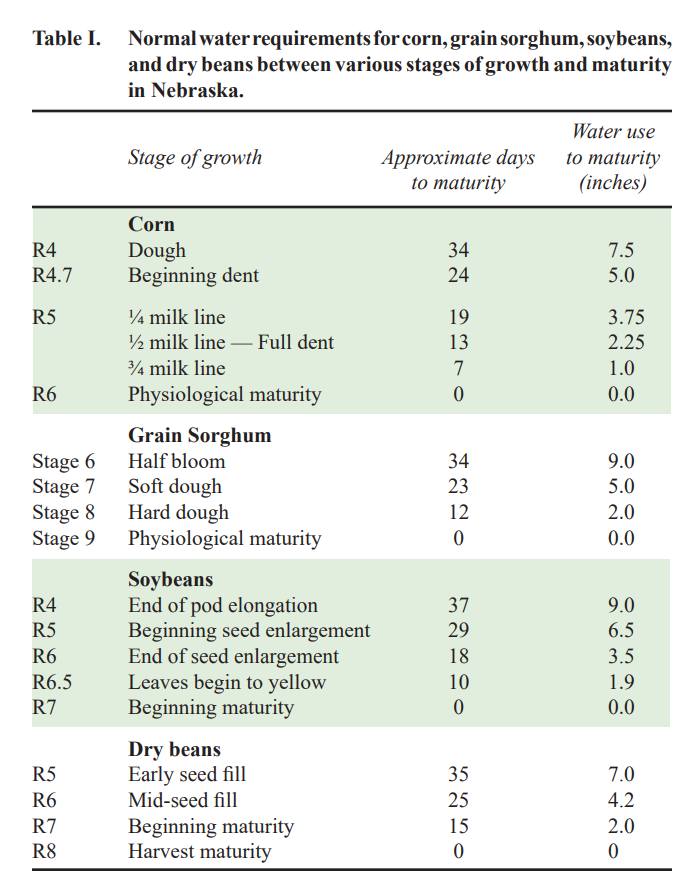
Water use till maturity for Corn: Beginning Dent 5”, ¼ milk 3.75”; ½ milk 2.25”; ¾ milk 1”.
Water use till maturity for Beans: Beg. Seed 6.5”; Full Seed 3.5”; Leaves beg yellow 1.9”.
The Nebraska State Fair is occurring and this past week/weekend was a full one for the 4-H side with FFA projects to be showcased next weekend! Extra special to me are the 4-H identification contests where youth compete to show their knowledge. This year, the York County 4-H youth received Champion Intermediate Horticulture ID team, Champion Intermediate Weed ID team, and Reserve Champion Senior Weed ID Team! So proud of all the youth who competed this year and in the past!
Southern rust of corn was the most frequent question I received last week. The recommendation from research shows there’s no additional benefit to spraying when the corn is two weeks prior to full dent. https://cropprotectionnetwork.org/publications/an-overview-of-southern-rust. Corn is also rapidly progressing in maturity due to the high night-time temperatures we’ve had. This results in corn plants burning sugars at night instead of filling kernels as deeply which can impact yields.

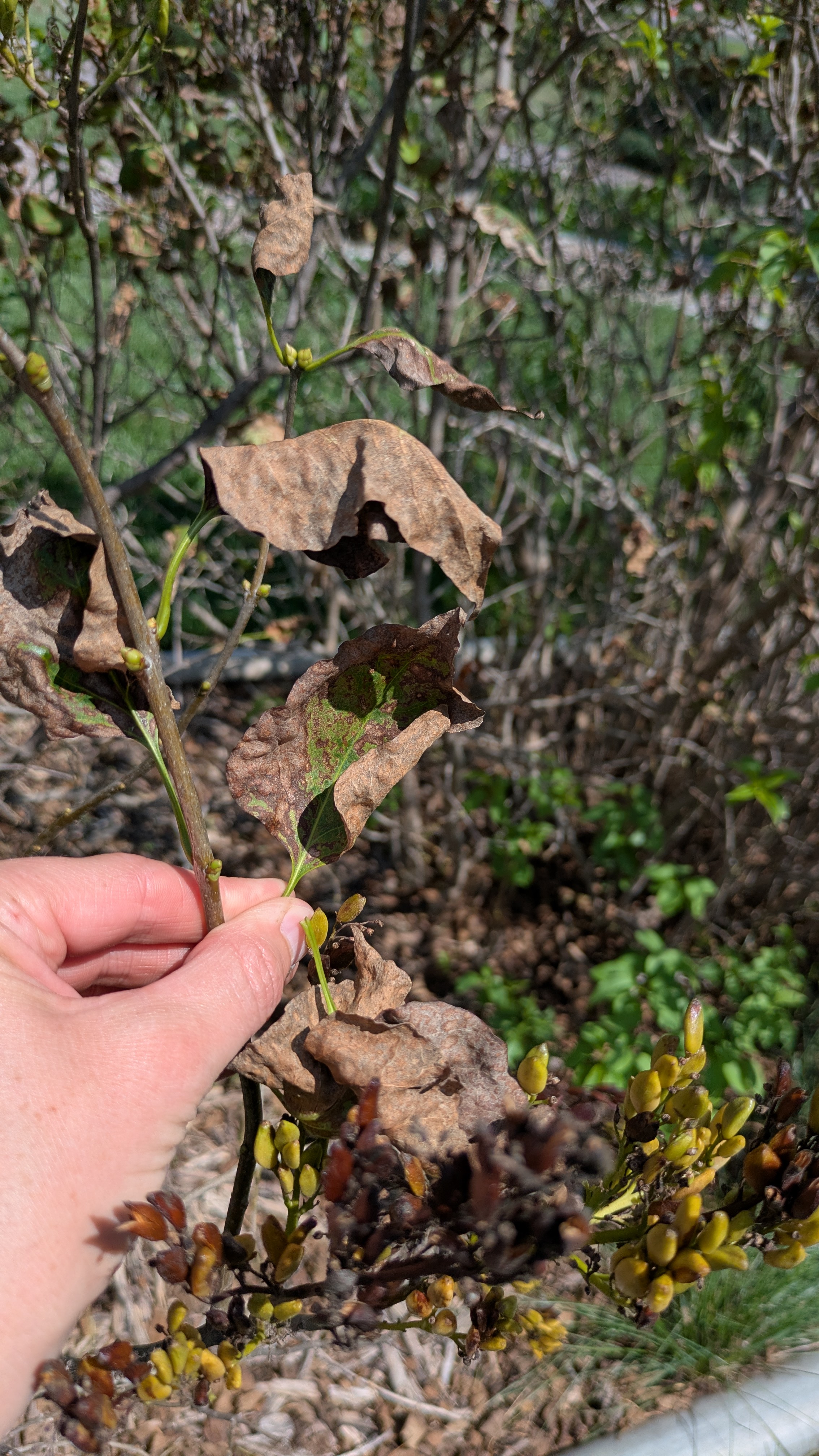
Leaf spot on lilacs: have received a number of calls about lilacs that appear to be “dying”. The culprit is pseudocercospora leaf spot, which is caused by a fungus. The leaves will brown and fall off the lilacs and you will most likely see new growth occurring. Stems are still pliable and buds are still green. Nothing to do other than to rake up the leaves that fall as the fungus can survive in the leaves for two years. More detailed information: https://extension.missouri.edu/media/wysiwyg/Extensiondata/Pro/PlantDiagnosticClinic/Docs/leaf-spot-on-lilac.pdf.
An additional note, fungal leaf spots are found on a number of trees and shrubs right now due to the humid conditions with heavy dew. You may observe impacted leaves fall off early with new growth beginning on the trees/shrubs. Again, nothing to worry about or do for now.
Fall Armyworms have been on the rise over the past few weeks in pastures, alfalfa, lawns, and some crop fields. It will be important to keep watching newly seeded small grain, alfalfa, and cover crop fields this fall. Caterpillars ¾ inch or longer are close to maturity and can be harder to control with an insecticide. There’s a number of conventional and organic insecticides that can be used. Products with 0 day grazing restrictions in pastures include Warrior II, Mustang Max, Beseige, and Prevathon. While it’s not updated, a Q/A for consideration can be found here: https://cropwatch.unl.edu/2021/fall-armyworms-pastures-alfalfa-small-grains-cover-crops-and-lawns/.
Resources: Wanted to share a number of resources. First, a reminder if you have a verbal crop lease you wish to terminate, that must be done by September 1st. More specific information here: https://cap.unl.edu/news/terminating-verbal-farmland-lease-nebraska/. We recommend transitioning verbal leases to written ones and a great resource to help you do that is Ag Lease101 https://aglease101.org/doclib/ where they have various free templates to help.
There have been a number of recent webinars regarding how the Big Beautiful Bill impacts ag. In case you missed them, here’s some recorded webinars:
- Impacts of the Big Beautiful Bill to Ag: https://cap.unl.edu/more-than-one-big-beautiful-impact-ag/
- Changes to Ag Taxes: https://cap.unl.edu/lets-talk-taxes-webinar/
York County Corn Grower Plot Tour and Shrimp Boil will be held September 2, 2025 from 5:30-7:30 p.m. just north of 1603 Road F, Bradshaw, NE. Seed reps will showcase their hybrids, we’ll hear an update from Nebraska Corn, and enjoy a delicious shrimp boil meal (shrimp, sausage, corn, and potatoes). Guess the highest yield without going over and win a $50 gas card. Must be present at the winter Corn Grower Banquet to win. All are welcome! Members are asked to bring a friend and potential member.


Nebraska Soil Health Coalition
Soil Health Success Stories: This week I’m sharing on the Nebraska Soil Health Coalition. I’ve watched this effort since 2019 and am grateful for the leadership, vision, dedication, and endurance of the Board individuals who have successfully completed the beginning efforts of this Coalition! Some background from their website at: https://www.nesoilhealth.org/, “In recognition of the need to achieve more rapid and widespread adoption of soil health practices with multiple benefits, the Nebraska Legislature passed LB 243 in 2019. The legislation created a 17-member Healthy Soils Task Force (HSTF) task with developing a Nebraska Healthy Soils Initiative. The Healthy Soils Task Force concluded that healthier soils produced through best soil management practices improve yield stability, produce greater financial returns over time, reduce the need for chemical inputs, increase water infiltration rates and water storage capacity making soil more resilient to drought, flooding, and erosion, and protect and improve water quality.”
“In May of 2023 a group of committed individuals decided to establish an independent, non-profit Soil Health Coalition in Nebraska. The purpose of the Coalition is to advance producer-centered education, outreach, and adoption of soil health principles to build resilient farms, ranches, and communities across Nebraska.”
What I appreciate is the three-pronged, four metric approach that is different than what has been built in other states. The three prongs include: producer learning communities, demonstration/education sites, stakeholder visioning groups. The fourth metric includes Outcomes (soil health benchmarks, improved economics, community growth, success stories).
The other difference is the building of “Hubs” that include producers and stakeholders (medical, financial, consulting, community, etc.) in the surrounding communities of around a 9-county area. Hub 1 began in the Hastings and surrounding area with Hub 2 rolling out now in Southwest NE.
The producers participated in economic interviews with the Soil Health Institute (SHI) and socio-behavior interviews with Dr. Julie Snorek. Why is this important? SHI seeks to quantify economics of conventional vs. regenerative ag practices. By interviewing producers in a similar region, the economics and practices of that region can better be quantified and relevant to those producers.
What was learned? 20 farmers who had adopted soil health management strategies for at least 5 years (cover crops, reduced tillage, Sentinel Ag, etc.) were interviewed. For irrigated corn/soybean, it was found that overall, producers were able to reduce expenses by adopting soil health practices by a total of $147.19/ac for corn and $88.27 for soybeans. Added value from revenue such as grazing provided a total value of soil health practices of $152.94/ac for corn and $89.73/ac for soybean. Non-irrigated corn soybean saw a total value of $197.80 for corn and $102.12 for soybean for adopting soil health management practices. The full fact-sheet can be found here and is worth a read!
On the socio-behavioral side, the producers shared about isolation in adopting practices different than their neighbors, the importance of producer learning communities/peer networks to be vulnerable in sharing successes and failures, independence they felt in reducing the need to pay entities for inputs, farming being more fun/interesting in trying different practices, and also the need for alternative markets. The joy for me in attending the Celebration Event last week was seeing a glimmer of the hard work and dedication of the Board realized with producers and stakeholders presenting outcomes and the ability to have economics around these topics that are meaningful to Nebraska producers. Our hope is that more producers who are watching on the fringes will join us in adopting soil health practices in the future! More info. at: https://www.nesoilhealth.org/.
Water use till maturity for Corn: Beginning Dent 5”, ¼ milk 3.75”; ½ milk 2.25”; ¾ milk 1”.
Water use till maturity for Beans: Beg. Seed 6.5”; Full Seed 3.5”; Leaves beg yellow 1.9”.


Register now to reserve your seat: https://cvent.me/WMzLdk.
Cloudy Days and Corn Tip-Back
Received a number of questions about tip-back in corn and also how the cloudy/smoky days could impact yields. First wanted to mention the difference between pollination concerns vs. tip-back concerns.
Pollination concerns are when the green silk remains attached to the ovule that should have formed a kernel if it had pollinated. Gently husking back an ear and shaking it will reveal where pollination occurred on the ear where the brown silks detach. Green silks remain attached where pollination did not occur. Tip back is when the ovule pollinated but the kernel later aborted (looks shrunken/shriveled) due to some reason, often some type of stress.
This week’s UNL CropWatch shared yield potential for different places in the Midwest using weather modeling and comparing it to a 30-year average. The data clearly shows low solar radiation (which includes photosynthetically active radiation (PAR)), meaning photosynthesis is reduced. In spite of that, the article is suggesting for non-irrigated corn, nearly 100% of above-average yields for the Beatrice area, and nearly 75% chance of above-average yields near the Clay Center and Mead areas. For irrigated corn, it’s estimating 50% near-average yields for Clay Center, 75% near-average yields for Beatrice, and 50% above-average yields for Mead. These estimations are just based on weather and don’t account for stand losses, disease, insects, etc. The full article is at: https://go.unl.edu/tkz6.

Dr. Roger Elmore and Dr. Tom Hoegemeyer wrote a CropWatch article several years ago about the impacts of cloudy days on different stages of corn development. The full article can be found at: https://go.unl.edu/sv06 and the following are excerpts from it.
“Early et al., 1967,…shaded plants around the “reproductive phase” for 21 days as well as during the “vegetative stage” for 54 days and the “maturation phases” for 63 days. Shading during reproductive stages reduced plant yields the most, but 30% shading during the maturation stages ― what we consider the seed set and grain-fill periods (R2-R6) ― not only reduced yield per plant 25% to 30% but also reduced kernels per plant and the amount of protein per plant.
Researchers in a new study shaded plants from silking to maturity (R1-R6) (Yang et al., 2019). They also found reductions in yield and biomass with more shading resulting in more losses. Shading reduced yields more with higher plant populations than with lower populations.”
If you’re seeing tip-back concerns, it could be due to the consecutive days of cloudy skies reducing photosynthesis. But it’s also important to understand the hybrids in your fields. Hybrids are very specific in how they handle stress such as heat, drought, and cloudy weather during and shortly after pollination. Some hybrids have long ears, and in counting kernels, 30-40 kernels per row with a 1-2” tip-back may be “normal”, especially if there are a larger number of rows around for a decent total kernel number per ear. Plant populations also can play a roll in tip-back. So, not all tip-back is a concern. Knowing the hybrid and counting total kernels per ear can tell a bigger story. We will have to wait and see how the remainder of the grain fill season progresses to better understand any potential yield impacts from the cloudy days.


August 2025 Events
Thank you to all who helped make the 2025 York County Fair a success! I didn’t get out to the fields this past week so sharing reminders on some upcoming field days.
Aug. 5 Grazing Cover Crops Field Day of area farmer Alex Daake will be held from 4-6 p.m. at 4136 Superior Rd. near Utica, NE. Alex split a pivot into 4 quarters where he rotates corn, soybeans, rye for seed, and grazed cover crops. The focus will be primarily on what he’s doing for grazing covers and the economics of this system where pasture is limited for cattle production. Alex also has an on-farm research nitrogen study on the corn portion of this pivot where he’s looking at reducing nitrogen inputs due to the grazed cover crops. He’s monitoring the nitrogen strips with Sentinel Fertigation. If you’re interested, you’re welcome to RSVP to jrees2@unl.edu. Walk-ins are also welcome and cookies/water will be provided by Nebraska On-Farm Research.
Aug. 7 South Central Ag Lab Field Day will be held 8:45 a.m.-3:10 p.m. (Registration at 8:30 a.m.) Attendees can tailor their schedule by selecting from various presentations and interactive demonstrations (Irrigation, Diseases, Insects, Weeds (including robotic weeders), Nutrients). There is no charge and CCA credits will be provided. Please RSVP at: go.unl.edu/scalfieldday.
Dan Snow is the keynote speaker and will discuss nitrate challenges in groundwater. This talk will cover findings from a study with the Upper Big Blue NRD and UNL focusing on nitrate and agrichemical levels in the vadose zone across 12 water quality management zones. Lunch talks also feature a farmer panel discussion, providing an opportunity for attendees to engage and interact at the local level.
The SCAL Research Farm is located at 851 Hwy. 6 near Harvard, NE. Directions: 13 miles east of Hastings on Hwy. 6 or 4.5 miles west of the intersection of Hwy. 14 and Hwy. 6 north of Clay Center. Field day GPS coordinates: 40.575256, -98.137824. More info please call (402)762-3536.
Soybean Management Field Days will be held Aug. 12-15. Topics will vary by location and the first three days are twilight tours from 6-8 p.m. There is no charge but registration is requested two days in advance at: https://enreec.unl.edu/soydays/.
- Tuesday, Aug. 12 – Ravenna, NE. Lonnie and Scott Bohn farm 6:00 p.m. to 8:00 p.m. (5:30 p.m. – Registration)
- Wednesday, Aug. 13 – Concord, NE. UNL Haskell Ag Lab 6:00 p.m. to 8:00 p.m. (5:30 p.m. – Registration)
- Thursday, August 14 – Weeping Water, NE, Rick Meyer farm 6:00 p.m. to 8:00 p.m. (5:30 p.m. – Registration)
- Friday, August 15 – Mead, NE, UNL Eastern Nebraska Research, Extension & Education Center – (10:00 a.m. – Registration)
Aug. 25 Regenerative Ag Field Day will feature area farmer Jordan Uldrich. The field day will be from 10 a.m.-Noon, ½ mile east of 1606 County Road J, Geneva, NE. Lunch will be provided following the field day. Jordan has interseeded cover crops into his corn to aid with soil health and weed management. He will also discuss the economics of alternative farming practices. For more information, please call Andrew at 402-590-7096.


JenResources 7/27/25
White Mold in Soybeans Questions: There’s no need to worry about spraying if you don’t have a history of this disease in your fields. If you did have white mold in 2023, there’s potential for it in 2025. There’s also a lot of confusion about what white mold looks like. If one is in a corn/soy rotation, corn residue in a soybean field often has a “white fungal” growth on it this time of year. That’s due to saprophytic fungi doing their job in decaying that organic material; nothing to worry about! There’s also many types of mushrooms that are involved with decaying organic material that one might find in a field. Seeing mushrooms does not mean they’re going to create white mold. The fungus that causes white mold of soybeans creates mushrooms from black sclerotia that look like mouse droppings. When you scout within a soybean canopy, the mushrooms will be attached to the sclerotia on the soil surface. They also have a specific look to them. You can learn more from Dr. Dylan Mangel, Extension Soybean Pathologist, in this CropWatch article: https://go.unl.edu/opv3.

County Fairs: Thanks to all who made the Seward and Fillmore County Fairs a success! This week is the York County Fair; the website that contains the schedule of events and ability to purchase tickets is at: http://www.yorkcountyfair.com/. For those interested in exhibiting items in Open Class, you can find the Fair Book in the Extension Office or online at: https://go.unl.edu/c2qn. Entry times are Tuesday, July 29 from 6-8 p.m. and Wednesday, July 30 from 8-11 a.m.
Testing Moisture in Forages: Dr. Mary Drewnoski sent out the following info. after a summer grazing field day, “accurate moisture testing is key to preventing spoilage and heating in hay and to ensuring proper fermentation in silage. Below are a few options, along with pros and cons:
Koster Moisture Tester
How it works: Uses a small scale and heating unit to determine moisture by weight loss.
Pros: High accuracy (considered the “gold standard”). Works for hay, silage, and other forages.
Cons: Slower process (20–60 minutes per sample). Requires a power source.
More info & instructions: UTIA Publication (PDF)
Where to buy: Koster Tester Website or search online for deals. Price is now around $500 (double a few years ago when I bought mine).
Hay Windrow Moisture Testers
How it works: Dish-style handheld electronic probes for quick readings in windrows or chopped samples.
Pros: Fast and easy to use in the field. Measures a wider range of moisture (13–70%) compared to standard bale probes, making them suitable for silage.
Cons: Less precise than Koster. Can require good sample prep for consistency.
Where to buy: There are mean options on Amazon or a simple google search with this term will give you option. Price range: $200–$400
DIY Option: If you already have a hand held bale probe, here’s a way to adapt it: Progressive Forage Article
Microwave Oven Method
How it works: Drying a forage sample in the microwave to measure weight loss.
Pros: Very low cost (just need a microwave and scale). Works for both hay and silage.
Cons: Time-consuming and requires caution (fire hazard if overheated and results in potential for increased error). Not as convenient for field testing.
Directions: UNL CropWatch Article
Crop Update 7/21/25
Crop Update: Pollination is occurring and with the news on social media, received a number of calls regarding corn tassels this week. Last year, I had seen some “tassel wrapping” in a few hybrids but hadn’t said anything as I didn’t receive calls on it. This year it’s far more widespread throughout the country. What is meant by tassel wrapping is the last few leaves are tightly wrapped around the emerging tassel so that only a small portion of the top is pollinating and showing. As I’ve watched these tassels the past two years, they try hard to emerge from the leaves. Some hybrids are able to push out of the leaves better. Some will push out through the side of the leaves. The tassels then look strange with what parts are able to shed pollen once they emerge from the wrapped leaves.
In some of the hybrids, there’s enough pollen being shed from refuge plants and the tassel tops, that they should still pollinate ok. There’s a few with less pollen shed, yet there’s also corn pollinating in nearby fields. Hopefully there won’t be pollination issues. It will be important to watch your specific fields for pollination.
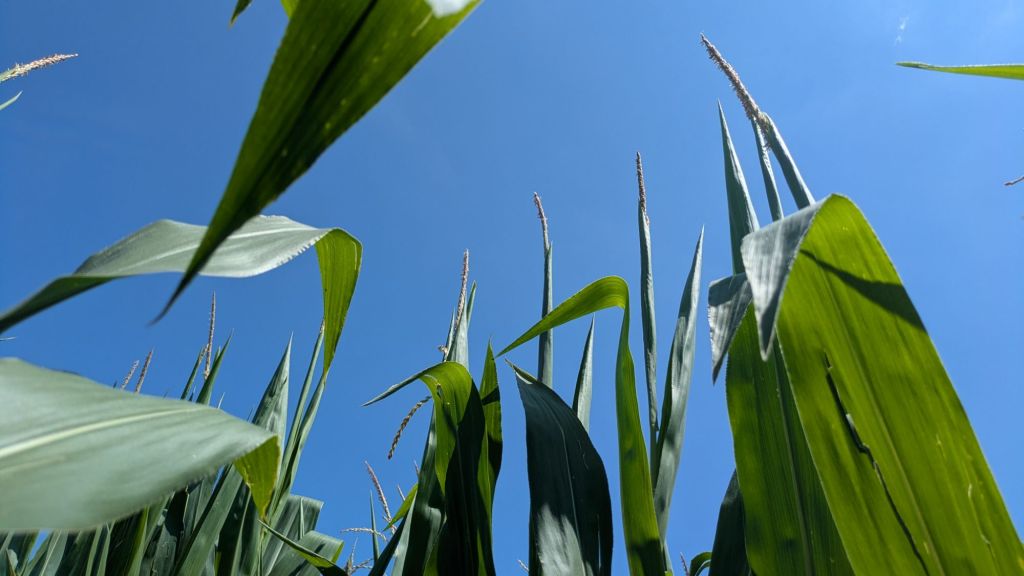


No one likes to see these things happen. There’s been a number of things shared as to what’s going on. Some are calling this environmental. I’ve heard a number of people talking about either generic dicamba or status applications to corn. I’ve been in the fields looking at this for 10 days and would encourage you to walk into the signed plots of the different companies and local County Corn Grower plots. If this was an environment or dicamba issue alone, entire counties of acres would be impacted because of being in a similar environment and because of how much dicamba is used in post-herbicide applications. This unfortunately appears to be genetic as I’m only seeing it in specific genetics. When across companies, they’re genetically related.
Southern rust was also found in Nebraska last week and in our area, it was found in Butler and Polk counties even though Butler isn’t lit up on the map. It’s at low incidence and not a level to spray yet. I’m still saying to wait till at least milk if you’re still planning on a fungicide app to reduce potential pathogen resistance and for best economic thresholds: https://corn.ipmpipe.org/southerncornrust/.
Summer Grazing Field Day: Alex Daake in the Utica area is hosting a field day on Tuesday, August 5th from 4-6 p.m. at 4136 Superior Rd, Utica. He took a pivot and divided it into quarters. One quarter is soybean, corn, grazed mix for 1 year, grazed mix for 2 years. Cereal rye is also taken for seed after the grazing. He rotates the quarters each year. The field day will primarily focus on how Alex is grazing covers, the cover crop mixes used, and how he feels it’s improving the soil. Come learn about what he’s doing, why, and the economics. On the quarter with corn was 2 years of previous grazing. He has an on-farm research nitrogen study on that ranging from 0-150 lb N/ac. He is also using satellite imagery from Sentinel Nutrient Mangement to determine which plots, if any need additional nitrogen. It will be a great afternoon of learning and sharing! Please RSVP to me at jrees2@unl.edu or 402-440-4739 if you’re interested in attending. Cookies and drinks will be provided.
South Central Ag Lab Field Day will be held Thursday, August 7th near Clay Center from 8:45 a.m.-3:10 p.m. (Reg. 8:30 a.m.). The day is designed so you can pick and choose which topics you’d like to attend. More info. at: https://enreec.unl.edu/south-central-agricultural-laboratory-field-day/.
JenResources 7/14/25
It was a blessing to get away for the national ag agents conference and then on vacation! The keynote speaker was Dwayne Fisher who is the VP Marketing and partner at Champion Produce Sales in Idaho. His speech was about relationships. My takeaway from him was, “The more, more, more is creating less, less, less when it matters most, most, most. When we don’t feel we have time for one more thing, pause and take time to do something for someone else. (Regarding people)-Notice them, Value them, Serve them, Encourage them. We can’t replace Relationships.” This was a helpful reminder and “shot in the arm” for me; hopefully, helpful in some way for you too.
For the ag tour, I learned about wool production and marketing and toured a sheep ranch that was 45 miles from Yellowstone National Park in the mountains. The rancher shared the challenges of grazing thousands of sheep in the mountains with wolves and bears migrating from the park and killing sheep. The specific wolves and bears have to be tracked and ID verified before they can be eliminated. They work with experts to use drone technology and game cameras to help identify the specific animal. At the wool-buying stop, we learned that China dictates the market based on weekly wool sales in Australia. Australia sells more wool in one week than what the U.S. sells in 1 year. The take-home from the wool-buying stop was to buy more natural fibers like wool and cotton.
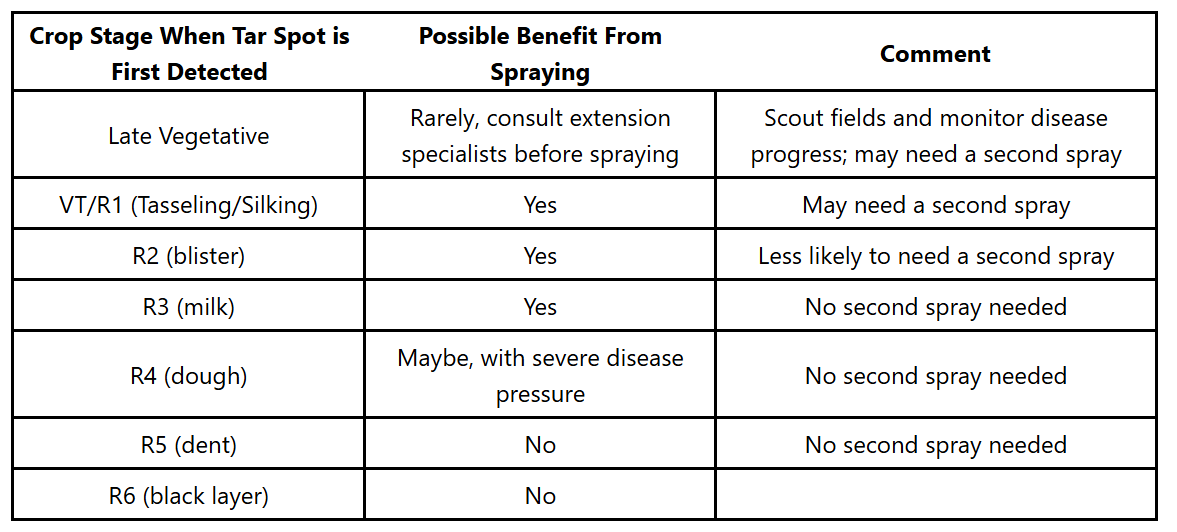
Fungicides: Received many questions last week on fungicide applications to corn and soybeans. First, tar spot is still at low levels where it’s been found in fields and hasn’t hit the 5-7% thresholds. It prefers temps in the 60’s-70’s, which to me explains why we’ve mostly seen it get worse in fields at the end of the growing season. I realize a lot of fungicide is going on corn. Economically and threshold-wise, I’d wait as long as possible before applying a fungicide. The research from Indiana showed that it was still economical to apply through milk-early dough stage. Waiting will allow for residual for when you may need it later in the season if tar spot or southern rust take off. There won’t be residual left for those making apps now. Just for consideration as the economics don’t justify multiple applications.


For soybeans, if the field had never had white mold in the past, I would not worry about a fungicide for white mold. If it’s a seed corn/soybean or corn/soy rotation field and had white mold in the past, one could aim for one fungicide application at full flower (R2). If you’ve had 2 years of corn followed by beans this year, you probably don’t need a fungicide. And, if you planted soybeans green into a small grain, again, you shouldn’t need a fungicide as we’ve seen small grains keep white mold at bay. I realize I’m more conservative with recs compared to most, but this is based on economic thresholds and understanding the pathogen and crop rotation history. Also, a reminder if you’re interested in using plant nutrition in either corn or soy for on-farm research, please let me know.
Summer Grazing Field Day July 24 will be held at Eastern NE Research & Extension Center near Mead from 9 a.m.-2 p.m. (Registration at 8:30 a.m.). The cost is $20 and they are requesting RSVP for lunch count. More info here: https://beef.unl.edu/news/summer-grazing-field-day-strategies-beat-slump/. The day will be casual and discussion-based. Take a look at the summer phase of a double-crop annual forage system—where warm-season forages like sudangrass (with or without sunnhemp) are being grazed by both cow/calf pairs and stockers. Additional topics include:
- How to manage warm-season annuals to get the most out of them
- What the performance data says (ADG, stocking rate, carrying capacity)
- How the economics compare between cow/calf and stocker systems
- New prussic-acid free sorghum-sudangrass variety
- Virtual fencing in action

Plant Nutrition and Disease
Tar spot of corn was found in several Nebraska counties. We are not recommending fungicide applications at this time due to the research from Purdue University and other states. They found it best to wait till disease severity was 5-7% and corn was from tassel to dough stage of development. More info. at: https://jenreesources.com/2025/06/17/tar-spot-of-early-corn-update/.
What to do now:
1-Scout fields and wait till a 5-7% threshold on leaves before applying fungicide
2-Observe fields as to which hybrids have more tolerance to tar spot
3-When irrigating, consider less frequent and deeper irrigations, https://go.unl.edu/vipj
4-Consider plant nutrition?
In managing pests and pathogens, few mention plant nutrition or alternative options. Healthy humans and animals are less prone to disease; why not the same with plants? A book called “Mineral Nutrition and Plant Disease” shares published research on roles of minerals in aiding or managing disease. It was written by Dr. Don Huber, Professor Emeritus of Plant Pathology from Purdue University and there’s an updated version that I have.
There’s a lot of unknowns about tar spot and its control. Dr. Huber shared that the tar spot lesions contain oxidized manganese in addition to the fungal spores. Several journal articles referenced the black “freckles” in Goss’ wilt and the vascular plugging in the systemic version also contain oxidized manganese. When manganese is oxidized, it creates a manganese deficiency in the area which doesn’t allow for photosynthesis. The area runs out of energy and can’t defend itself resulting in disease expansion. Many of us in ag understand that micronutrients are chelated in plants in the process of applying specific herbicides. Companies have developed products to help with chelation and to stimulate plants sooner from the shut-down that occurs from applying herbicides.
I’m wondering about the opportunity to use plant nutrition right now to help stimulate plant defense mechanisms? We may need fungicide at some point, but we don’t right now. I have no research on this, but to me, it makes sense. When we have early symptoms of a cold, we’re told to take zinc to stimulate our defense system. Manganese and Zinc both travel in the xylem and they aid in plant defense signaling. Addition of zinc and copper in particular can reduce manganese oxidation, aiding in plant defense responses. Thus, wondering if zinc, copper, and manganese may help with preventing and fighting tar spot? Boron and sulfur could play a role too. The addition of Calcium increases the oxidation, so it shouldn’t be used alone for this situation. Manganese, Zinc, Copper, Boron, Sulfur all aid in defending plants against pathogens.
If you’re interested in trying something in plant nutrition and would like to work with me via on-farm research, please let me know. I also need to share that many plant pathologists disagree with the thought of using plant nutrition: https://cropprotectionnetwork.org/publications/mythbusting-tar-spot-separating-fact-from-fiction.
For those in industry, many of you have products in trials that reduce the chelation processes and/or that help stimulate plants after being shut down (ex. from 10 days to 2-3 days) after a pesticide application. I’m curious if aiding crops out of chelation/shut down sooner helps with reducing pest/pathogen pressure? How can we better share what we observe with each other?


Tar Spot of Early Corn Update
Received several calls about tar spot yesterday and today. As of right now, it’s been confirmed by UNL at LOW incidence (1-2 lesions per leaf) in Saunders, Pierce, and Clay (on 6/16/25), Polk, and Seward Counties (on 6/17/25). I really appreciate Craig Anderson and Mike Byers bringing me leaf samples to confirm. I also appreciate those who were calling to hear of any confirmations from leaf samples.


There’s a lot of fear surrounding this disease, and still some unknowns. We haven’t seen tar spot in Nebraska this early. It would be helpful if consultants/agronomists would confirm samples to Dr. Tamra Jackson-Ziems, the UNL Plant and Pest Diagnostic Lab (tar spot testing is free), or a local Extension Educator so that we have the most accurate information to provide. Tamra will update the tar spot map at: https://cropprotectionnetwork.org/maps/tar-spot-of-corn.
We are NOT recommending fungicide application in fields where tar spot is confirmed in these early vegetative stages.
Reasons for not applying fungicide now:
1-Economics: Corn economics are already a struggle. When tar spot appeared in the early vegetative stages, research from Dr. Darcy Telenko’s lab at Purdue University showed it wasn’t economical to apply at V6-V7 as it didn’t suppress disease enough. It was economical when the corn reached tassel stage or beyond. I show the research data below and you will also see the chart on the website link I shared above. In this post, Dr. Telenko shares 7 years of experience dealing with tar spot when it occurs early in the season and how to make fungicide decisions.
*Some Quick Tips & Tools for Preparing for Tar Spot in Corn-Dr. Darcy Telenko
*Tar Spot: What to look for in corn and making an informed fungicide application-Dr. Darcy Telenko
*Crop Disease Forecasting Tool for Tar Spot
2-Applications: Dr. Tamra Jackson-Ziems shared that some products say “no more than 2 applications per year”. Using those active ingredients now would mean you could use them again around tassel but no later when you may need the fungicide to finish the season. (See Dr. Telenko’s posts above).
3-Resistance management and integrated pest management. The photo below shows the economic threshold is 5-7% leaf severity for tar spot before it’s economical to spray. We’re a long way from that threshold on leaves confirmed for tar spot thus far. Avoiding unnecessary fungicide applications and using two modes of action when fungicides are applied may help in delaying resistance.
What to do now:
1-Continue to scout fields and wait till a 5-7% threshold on leaves before applying fungicide (see photo below)
2-Observe fields as to which hybrids have more tolerance to tar spot
3-When irrigating, consider less frequent and deeper irrigations
4-Consider plant nutrition? Manganese, Zinc, Copper, Boron, Sulfur all have a role in defending plants against pathogens. Will share more thoughts in another blog post.
Slide courtesy of Dr. Tamra Jackson-Ziems, UNL and Dr. Telenko, Purdue University. Fungicide application at V6-V7 resulted in negative economic return and similar disease pressure as the non-treated areas. Best fungicide timing for disease suppression occurred from tassel to milk and for economic return from tassel to dough.


 JenResources