Category Archives: Crop Updates
Spring Miller Moths!
They’re everywhere! Finding ways to get inside homes, lining the sides of houses, and swarming around lights at night. The
For homeowners, if you have shrubs or bushy plants around your homes, you may notice more of these millers as they reside in these types of areas. There’s no chemical for controlling them. Some things you can do are change your outside lights from white to yellow and keep outside lighting to a minimum. Also caulking can help. Ultimately, they’re a short term nuisance and more information about their life cycle and management from Dr. Bob Wright, UNL Extension Entomologist, can be found at our UNL CropWatch Web site.
Crop Science Investigation Camp
This is the first year we are doing a Crop Science Investigation (CSI) Big Red Camp for youth! We’d encourage any youth who enjoy plants, science, and agriculture who are 15-18 years old and who are interested in having fun learning about these topics to check this out! Big Red Camps are open to youth in any State. Please help spread the word!

Are you interested in science, agriculture, plants, crops, insects, or diseases? If so, join our team of detectives to solve crop-related problems in the Crop Science Investigation (CSI) Big Red Camp! Become a detective while participating in hands-on sessions to learn about and increase your knowledge of crops, science, and agricultural careers. Youth detectives will interact with agronomic professionals across Nebraska to solve experiments in: nutrient management; managing disease, insect and weed problems; water management; crop production, and much more! Do you have what it takes to become a CSI detective?
There are a variety of careers related to plant sciences such as: Agricultural Communicator; Agronomist; Cro p Consultant; Crop Insurance Adjuster; Educator; Co-op Manager; Farmer or Rancher; Farm Credit Banker; Field or Lab Researcher; Plant Breeder; Soil or Water Conservationist; Seed, Fertilizer, or Chemical Sales; or Technical Representative.
Scholarships are available in the amount of $300 to participants…
View original post 172 more words
Cornhusker Economics Conference
The Cornhusker Economics Conference will focus on the ag outlook and management decisions for farmers and ranchers at  Clay Center on February 29th at the Clay County Activities Building at the Clay County Fairgrounds. The program will run from 10:00 a.m.-2:30 p.m. with registration beginning at 9:30 a.m. The conference will cover key topics affecting farm management and production decisions for 2012. It is offered by UNL Extension and the UNL Department of Agricultural Economics and is sponsored in part by funding from the Nebraska Soybean Board.
Dan O’Brien of Kansas State University will share his insight on grain and oilseed outlook and risk management decisions in today’s uncertain markets. While market volatility shows the need for sound hedging strategies, concerns about futures market performance and the recent MF Global bankruptcy affecting hedge margin accounts raise questions about the best path ahead for managing market risk. O’Brien will bring his experience and analysis of futures market performance to bear on the issues and discuss implications for producer decisions.
Shane Ellis, livestock marketing specialist at Iowa State University, will discuss the outlook for livestock markets and producer profitability. With outlook for meat demand and continued reductions in cattle supplies, the market fundamentals look strong, but must weigh against grain supplies and feed prices. Ellis will bring his expertise to the situation and provide guidance for producer marketing and production decisions in 2012.
The land market has also been moving in the past year and UNL Extension Educator Allan Vyhnalek will use his local knowledge and analysis to discuss land markets and leasing arrangements with implications for producer decisions. The closing session will feature a focus on agricultural policy and the direction for new farm programs. Brad Lubben, policy specialist, will discuss the policy outlook in Washington and the major policy developments that could affect agriculture in 2011. Then, Lubben will team with UNL Extension educators to discuss specific directions for the new farm bill and implications for farm programs, conservation programs, and risk management decisions.
There is a $25 registration fee to cover programming expenses for speakers, materials, and the noon meal. Please RSVP to Jenny Rees at the Clay County Extension Office at (402) 762-3644 or jrees2@unl.edu by Feb. 27 so we can obtain a meal count. Hope to see you at the excellent conference!
Crazy?
Crazy? Perhaps! Which according to one of my farmer friends is a little typical of me when I put my mind to figuring out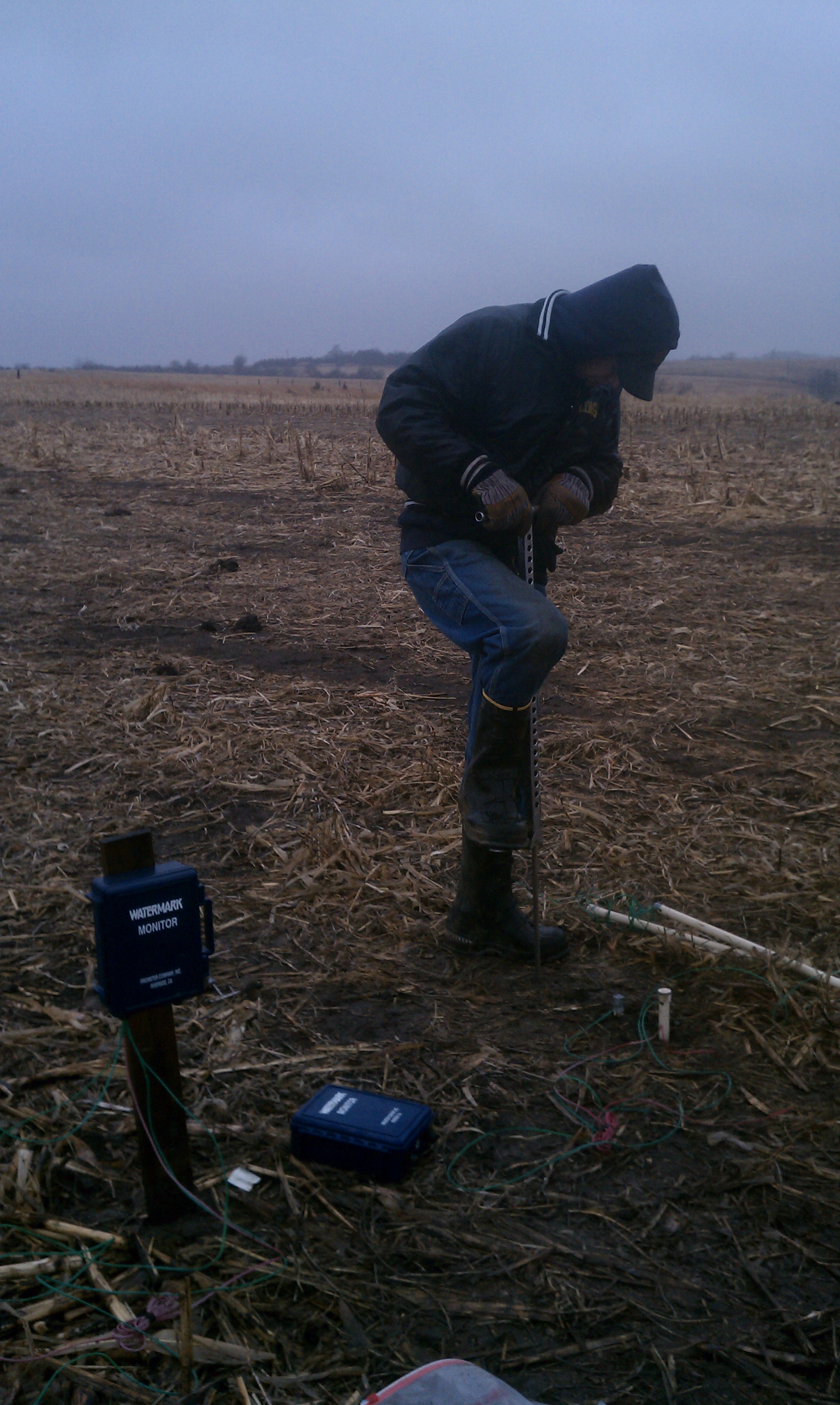 something. So I had been analyzing my crop water use data from my dryland corn, sorghum, soybean crop water use comparison study. It’s the one where we had coon problems this year and ended up trapping a skunk! I noticed how much the soil moisture profile had been depleted and knowing we’ve received minimal precip during fall and winter, I wondered what our soil moisture profile would be for dryland fields by planting. During a meeting yesterday I thought it would be good to install some watermark sensors to determine soil moisture profile recharge with the pending storm. Problem was I was at a meeting over 100 miles from my equipment and the pending storm was starting today. But I was still determined to get them in the ground as early as possible in order to measure the soil moisture status. So I woke up at 4:00 a.m. to heavy rain. Great! It was such a gorgeous day yesterday, and the past week…past month… The first thing my colleagues had asked me when I told them my idea was “Why didn’t you think of this sooner?” Answer: “Guess I needed a precipitation event!”
So I drive to the field in the rain, get the gear together and start installing the sensors. First foot went in easy with the rain that had soaked in. Then it seemed like I tried for 20 minutes (although probably not near that long) putting all my weight on the soil probe to get the 2nd foot in. Wind-driven rain soaked my jeans since I didn’t have rainpants on…fingers were numb from the cold. I  kept telling myself this will still hopefully be worth it! On the research data from this field, the second foot was driest of all the crops (was depleted well above plant available water). I got the third foot in and John, the man who farmed the field appeared.
While he thought it was crazy he graciously volunteered to help as he always does. He put in the rest of the sensors while I
hooked everything up.
The last several years we have been blessed to have a fully charged profile going into planting. Even with this rain/snow event, I’m not sure we will have that in dryland fields in this area of Nebraska. So I thought it would be interesting to know 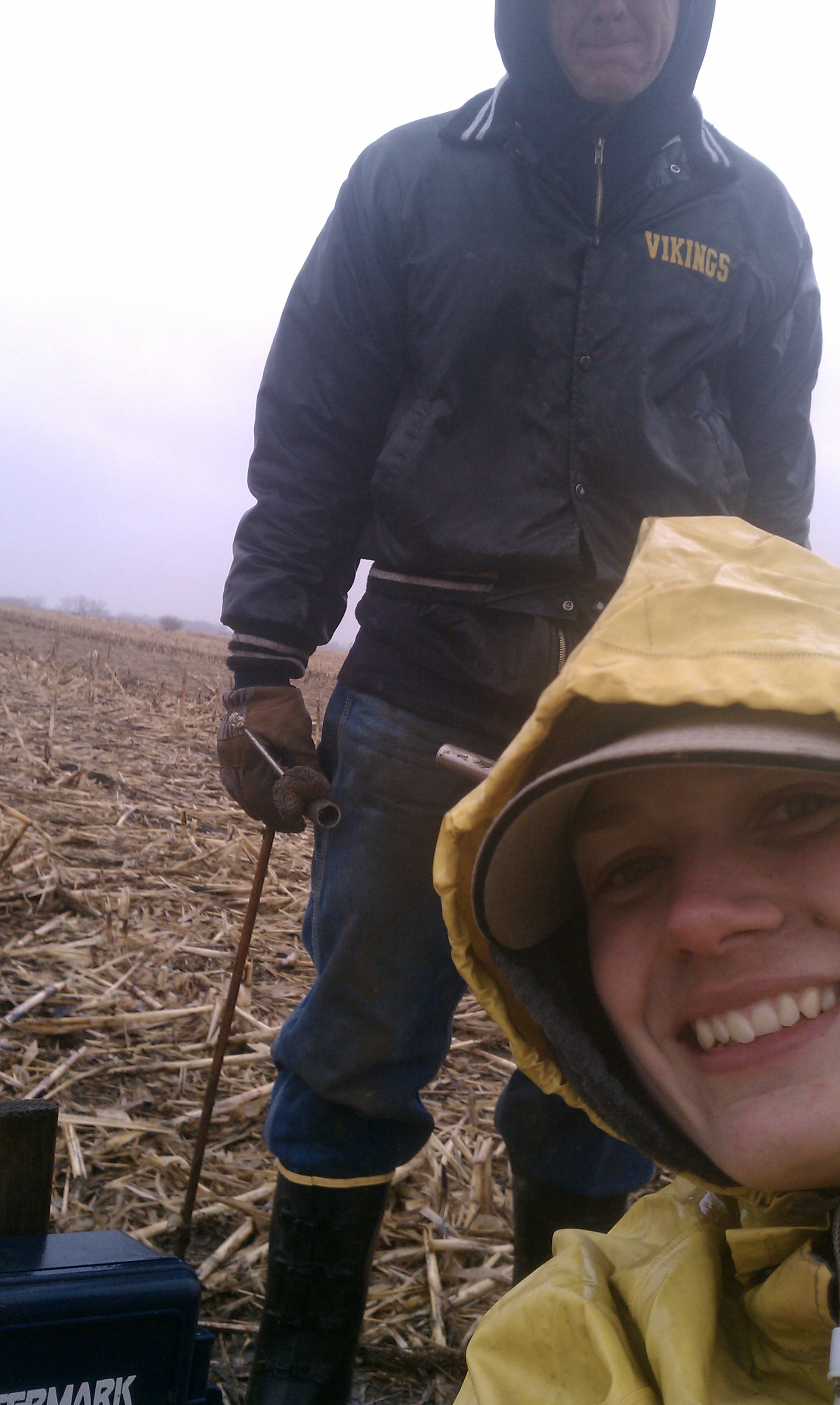 where we stood before planting and figured the farmers may want to know that as well. Perhaps a little crazy regarding installing the sensors on such a bad weather day but hoping the data in the end will benefit our farmers and be worth it!
Cash Rent Questions
Cash rent questions continue to be the primary question I receive and it’s been hard for me to keep sharing numbers based on the UNL or USDA surveys as I question how useful the surveys alone really are. I caught up with Al Vyhnalek, Extension Educator in Platte Co. during the crop production clinics. Al’s specialty is risk management. He shared the following with me which may be helpful to you as well. This isn’t research-based or based on surveys; it’s based on land productivity and yield potential. But it’s another potential tool to reach a starting point for cash rent considerations. The numbers discussed below assume the landlord owns the irrigation equipment.
“Farmers and landowners alike want to know what they should offer or charge for farmland next year. The question is simple, while the answer is more complicated. There is no formula or equation available that will definitively provide an objective value for farm or pasture land. The caller wants to know what the UNL or USDA survey of cash rental rates says to help them determine the correct starting point for discussing cash rent for the following year. While I am glad to provide that information and do provide that information, I am more uncomfortable than ever in providing that information. Why am I not feeling good about that? Because the price of cash rent for a piece of farm ground should be based on the productivity of the ground. It is important to think about the value being tied to yield potential.
One quick way to do the calculation of productivity is to take the last 5 year average corn and/ or soybean yields for the farm you are renting times the local elevator price for 2012. This calculation equals the estimated gross income per acre. Take that number multiplied by 25-30% for corn or 30-33% for soybeans with the lower percentages for dry land crops and the higher ones for irrigated acres. It gets you to a starting point for that cash rent negotiation. Many want to set rent based on the 2011 high price of about $7.00 per bushel, but that price has never been available for the 2012 crop. Using the 2012 fall elevator price is more realistic of what might happen next year. Using this information as a starting point and combining it with the information from the surveys will help with fair negotiations of the cash lease. The example percentages were determined by working through UNL budgets when determining cost/acre.
As an example – 200 bushel irrigated corn times $5 per bushel (2012 harvest price) is $1,000 gross per acre. 30% of 1000 is $300 per acre (corn acres). Soybeans: 60 bushel beans times $11 per bushel is $660 times 33% is $220 per acre – landlord’s share. If we have 1/2 acres beans and 1/2 acres corn then average the two rent numbers – or $260 per acre average for the farm. That is how I think we should arrive at a discussion point for cash rents in the upcoming year based on productivity.” For more information, please contact Allan Vyhnalek, 402-563-4901 or e-mail AVYHNALEK2@unl.edu.
Fall herbicides & Grazing Corn Stalks
With the increasing problem of controlling weeds such as marestail (horseweed), UNL has recommended using fall applied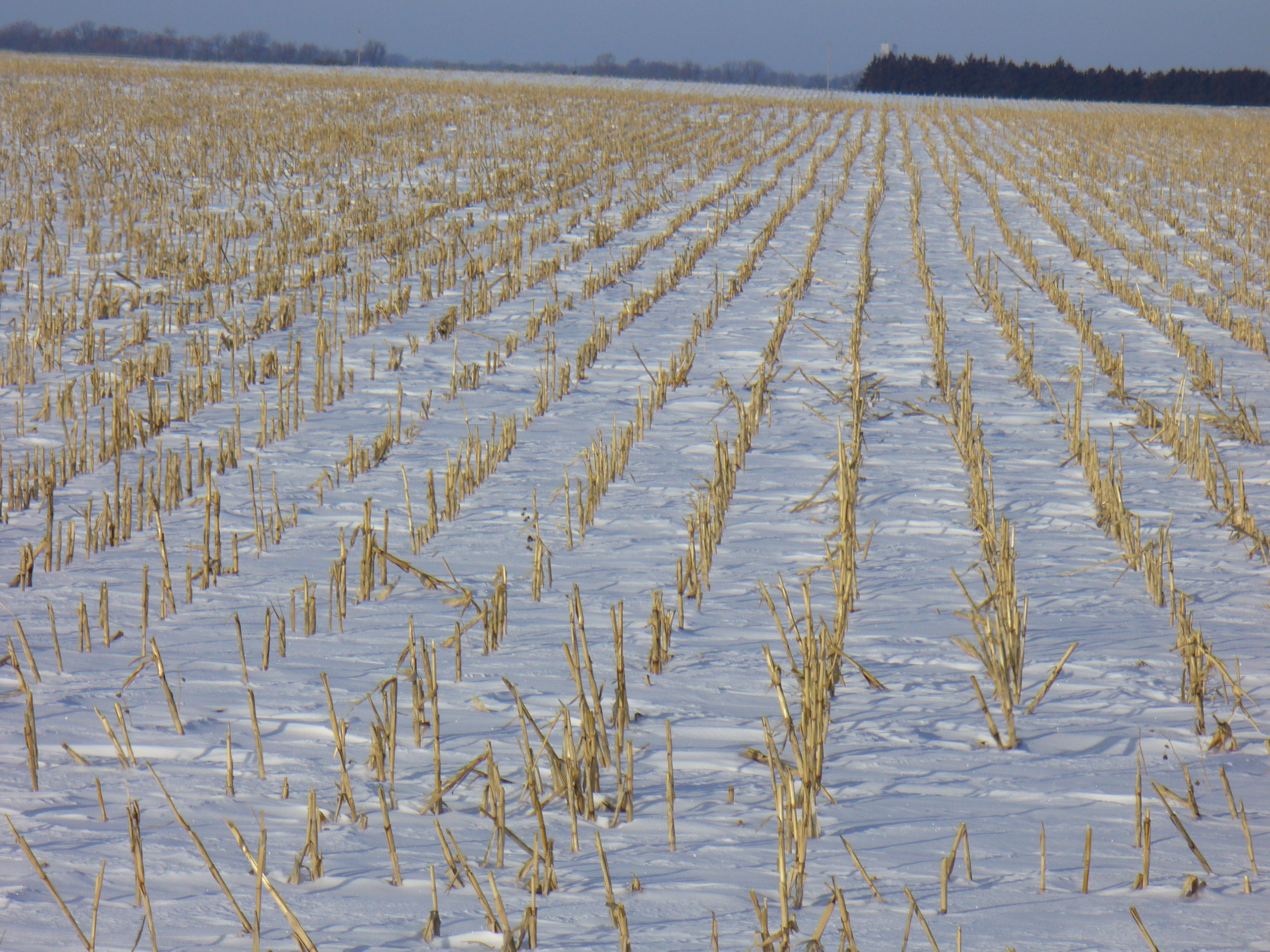 herbicides to help control this in addition to winter annual weeds. This practice usually does help with weed control, but I hadn’t thought about the considerations when grazing corn stalks until I received a recent question on it. The farmer wanted to see if it was safe for his cattle to graze corn stalks after a fall herbicide had been applied. The label wasn’t clear so he gave me a call.
I won’t provide information for the various herbicides that can be applied in the fall, but I will recommend that if you are planning on having your cattle graze stalks, that you check to see if a fall herbicide was applied and check the pesticide label to determine if there are any grazing restrictions with that pesticide.
If the label doesn’t specify any restrictions, then it should be ok. If you want to be on the safe side, a rule of thumb many chemical reps use is to use the pre-harvest interval for the amount of time to wait before grazing stalks. Some labels will say that residue should not be grazed or baled and fed to livestock. Sometimes studies were actually conducted to know there is a safety concern. In other cases, the chemical company may not choose to conduct all the studies the EPA required for labeling due to high costs. If that’s the case, the EPA requires the strongest restrictive language be placed on the label. Regardless, if it says there’s a grazing restriction on the label, the label needs to be followed. Your cattle may not be affected by grazing stalks where a chemical with a grazing restriction is on the label, but there may be other concerns such as problems with the chemical affecting the calf or being retained in the cow’s milk.
I’m still recommending utilizing our corn stalks by grazing and utilizing fall-applied herbicides for weed control. I just also recommend you check the pesticide labels on fields where a fall herbicide has been applied to determine any grazing restrictions or safety concerns.
Farm Research
Every winter, producers in our Greater Quad County on-farm research group meet to discuss the past year’s results and to 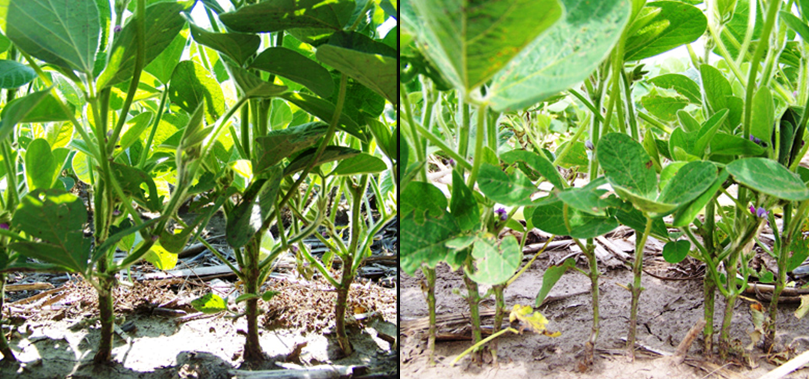 brainstorm which projects they wish to test the following year. Very popular studies from the past few years include soybean planting rates and planting dates and corn planting rate studies. These studies are randomized and replicated and conducted on full-length farmers’ fields.
Every year we share on-farm research results with our clientele. These results are often the highlight of many programs as the research is being conducted on your peers’ farms. Whether during pesticide trainings, crop production clinics, Extension news columns, Market Journal, or the Nebraska Farmer, these results have been presented and you as our clientele have preliminarily showed that you were interested in changing your farming practices as a result of what you learned.
Now, we’d like to see how many of you did change your practices as a result of this information. Please go to: http://www.surveymonkey.com/s/TPCJCGF and fill out a very short survey to let us know what you have changed in your farming operation. Your comments will help us in estimating the value of these on-farm research efforts to you and to our farmers who are faithfully conducting these studies. You can also find the direct link off the http://clay.unl.edu home page if you’d rather just click on it there. Please do take a few minutes to fill out this survey for us-it’s much appreciated!
Also, anyone interested in conducting on-farm research is welcome to attend our Greater Quad Co. results meeting on December 20 at 1:00 p.m. at the 4-H Building in York. We will also have some UNL researchers share results with the group. Please let me know if you plan to attend!
2011 Corn Yield Predictions
Harvest is nearly complete! In early August, I shared a post regarding in-season yield predictions from the Hybrid Maize model. At that time, I showed how 2011 predicted yields had been tracking with the 30 year long term average yields up until early August. At that point, the 2011 predicted yields took a steep drop due to high night time temperatures. High night time temperatures don’t allow for the corn plant to shut down at night. The plant engages in respiration, essentially burning sugars that should be converted into yield.
Some interesting things happened with the weather this year to make yields more favorable than what once was predicted. While silking to beginning dent occurred in 20 days or less in several Nebraska fields this year, the weather cooled off during the filling process. Some fields stayed at ¼ starch for nearly three weeks. Looking at fields, kernels continued to get deeper, heavier, and expand to help cover some of the pollination problems observed earlier in the year. During this time, yield predictions from the Hybrid Maize model showed that yields had the potential of returning close to the long-term median yields and it was interesting watching the trendlines move back up toward normal. This seemed to be truer for 113 day hybrids vs. 110 day hybrids.
For example, a 110 day hybrid planted April 15 at 32,000 seeds/acre showed a predicted yield of 227 bu/acre compared to 240 bu/acre long-term median. But a 113 day hybrid planted the same day showed a predicted yield of 244 bu/acre compared to a 248 bu/acre long term median yield.
So what happened in your fields? While yields have been decent, on average, I’m not seeing the trend towards the long-term median yields in our area in general. Dryland yields I think have been better than expected but irrigated yields potentially not as good as anticipated by many.  Hybrid Maize predicts yields based on perfect conditions-nothing limiting and no pest/disease issues. In many fields, corn was planted then sat in cool, wet soils. We had stand losses due to Pythium in some fields or due to loose residue that was piled in areas of fields after heavy rains. We also had varying degrees of pollination problems and the high night temperature stresses which reduced yields. Regardless, yields are still very good in spite of another interesting growing season! Please share what you’ve been seeing for yields in your fields!
Table 1: Hybrid Maize 2011 Predictions from Simulations (through Oct. 30, 2011)
Date RM Population Long-Term Median Yield 2011 Predicted Yield
Apr. 15 110dy 32,000 240 bu/acre 227 bu/acre
Apr. 15 113 dy 32,000 248 bu/acre 244 bu/acre
May 1 110dy 32,000 241 bu/acre 234 bu/acre
May 1 113dy 32,000 260 bu/acre 245 bu/acre
May 10 110dy 32,000 244 bu/acre 235 bu/acre
May 10 113dy 32,000 258 bu/acre 258 bu/acre
Water Jamboree & Removing Irrigation Scheduling Equipment
Last week was fun and somewhat exhausting teaching with my colleagues in Extension and several area Agencies at the Water Jamboree at Liberty Cove in Lawrence. Water Jamboree started over 15 years ago to teach 5th and 6th graders about the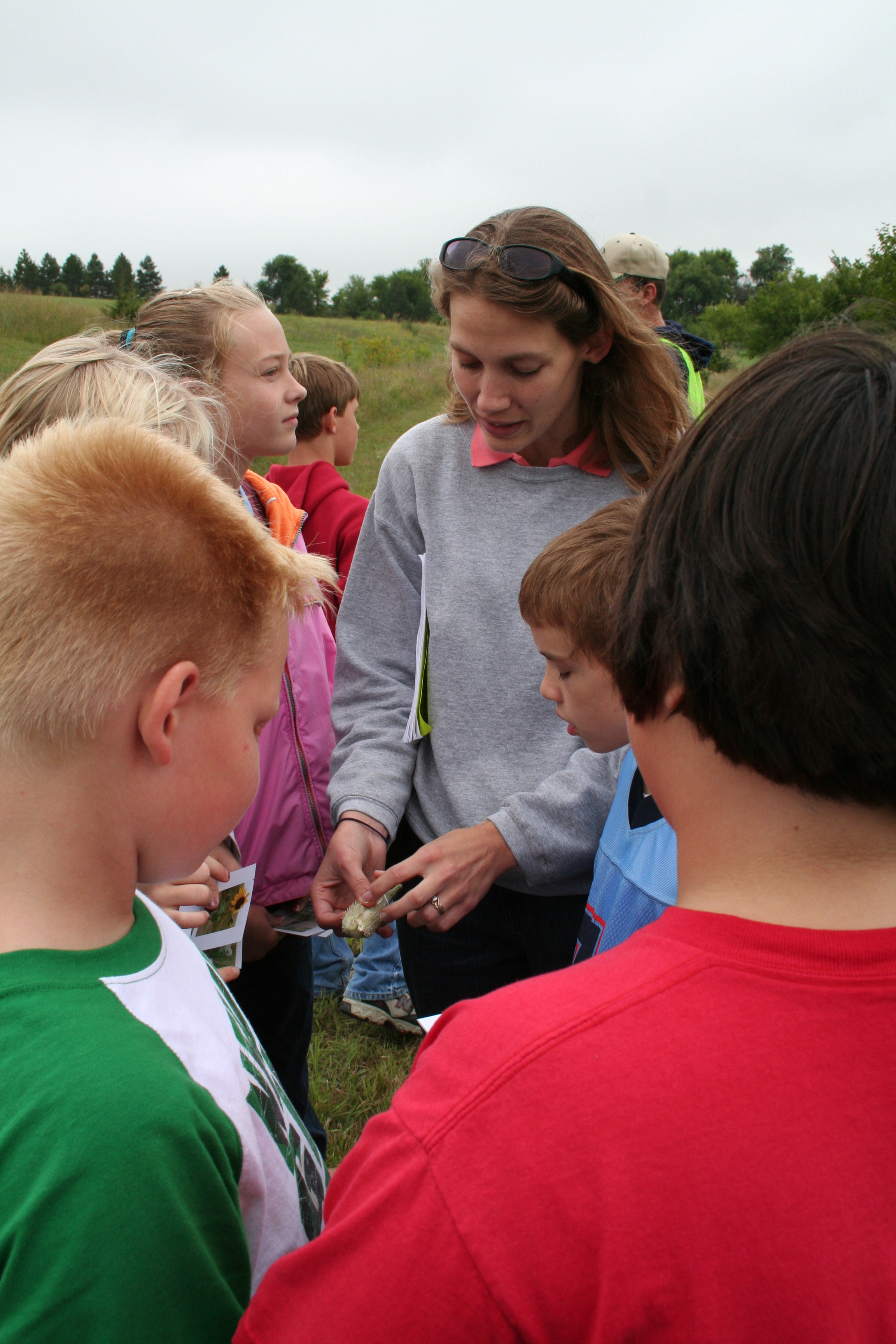 importance of water and water-related subjects. Nearly 800 youth learned about where water goes when it goes down the storm drain, about irrigation and siphon tubes, the aquifer, life inside and outside of the lake, mosquitoes, water movement, and much more. Holli Weber and I utilized the nature trails through the tallgrass prairie to teach a session on life outside the lake focusing on the importance of plants as buffers to filter chemicals and allowing youth to run through the trails doing a photo ID scavenger hunt of the area plants (also to burn off energy!). While I’ve done this session the past 5 years, this year I took time to show the youth specific characteristics to ID grasses. God created each plant unique and I was showing them how Indiangrass has rabbit ears when you pull the leaves back from the stem…or the M/W on the smooth brome leaves. It was fun watching the youths’ faces light up and then try to find these and other characteristics for themselves while on the trails. It was a great day, although I really don’t know how teachers do it day in and out! I wish I could’ve attended something like this when I was young! A special thanks goes to Marlene Faimon at the Little Blue NRD for coordinating this each year.
After Water Jamboree, I headed to my research plot at Lawrence. It’s been a trying year of coon damage and most recently a skunk inside our traps instead of the coons (and it still smelled like skunk out there!). Anyway, I was pulling watermark sensors and the 1st and 2nd foot ones were really rough but the 3rd and 4th feet came out easily. So just a reminder, when pulling watermark sensors, clamp a vice grip below the cap, twist and pull up. I’ve taken out hundreds of these and have only pulled apart four. If your sensor won’t pull up, simply take a spade and dig around the sensor and also bring a jug of water with you. This is the first time I’ve had to dig sensors out but the water really helped as I got it to run down the tube, it eventually loosened at the base to pull out easily without removing the sensor from the pvc pipe. Sensors can be gently washed with a hose or in a bucket of water using your fingers to gently clean them-don’t use a brush. Allow to dry and store in your shed, garage, basement, etc. Also a reminder (although I should’ve done this during the cold of Husker Harvest Days), to get your ET gages inside. Pour out the water and empty the ceramic top by pulling out the tube and then store that inside where it won’t freeze during the winter.
Farm Safety During Harvest
Combines have been rolling in the area soybeans and dryland corn. This is a busy time for farm families, but don’t let the rush to get the crop in compromise safety. Farming is one of the most hazardous occupations in the U.S. Here is a quick list of reminders for a safe harvest season.
It’s important to teach children these safety tips so they learn safety by habit as they live and work on the farm. Keep children and grandchildren away from equipment and machinery. Children who are involved in operating machinery and equipment should be properly trained by an adult on each piece they operate. It is always fun for kids to ride in the combines, or on the tractor fenders, but if there is not an extra seat and a seatbelt, it’s not a good idea. Tractor operators can be distracted by these extra riders and not keep their full attention on operating the equipment. All it takes is a sudden stop or swerve for the extra passengers to be thrown off or more serious injuries to occur. Keep kids out of grain wagons and bins and always be watchful for children and adults when moving machinery.
Double check to make sure all machinery is working properly and that safety shields are in place. When moving equipment, especially grain augers, watch for power lines, keeping equipment at least ten feet from them. Don’t get into grain wagons or bins while the grain is moving. Many people have seen the demonstrations of how quickly a person can be sucked under the grain and suffocated. Probably the hardest one to follow, yet easiest safety tip to do is to shut down moving equipment when it gets plugged. It only takes a few extra seconds and is well worth it to save a limb. People who think “nothing will happen to me” are those at the greatest risk for something to happen because they do not practice safety as they should. Farm accidents happen so quickly; don’t let them happen to you or your family!
Try to move equipment during the daylight hours. If you must move equipment at night, make sure tractor lights are working properly and slow moving vehicle signs are visible. It may even be helpful to put lights on grain wagons or on equipment you are pulling for other drivers to see them in time. You may have someone follow you in a vehicle with flashers to warn others of a slow moving vehicle ahead. Be cautious of other drivers as they get anxious to pass, especially if they try to pass while you intend on turning. For all of us on the road, it’s important to slow down and stay alert when we encounter harvest equipment on the road. During this Farm Safety Week, I’m wishing everyone a safe and bountiful harvest!


 JenResources