Category Archives: Discussion Topics
Wordless Wednesday: Technology in Ag
Captured pics of slides at last week’s Nebraska Ag Technology Association Conference. What comments do you have about them?


On Farm Research
 As harvest rolls to a close you most likely noticed some field variability or have some questions about how various products or production practices may work on your farm. Every year during the winter, UNL Extension educators share research conducted by your peers-other farmers-in their own fields and often those presentations are very interesting to our clientele.
With the advance of farming technologies, it’s easier than ever for more farmers to conduct research on their own farms. Depending on the study, there may be additional time involved, but overall, the farmers I’ve worked with who have conducted on-farm research say they obtained answers to their questions and the power was knowing it was research based on their own farm.
Last winter the two on-farm research groups in Nebraska combined to form the Nebraska On-Farm Research Network. With help from the Nebraska Corn Growers and Nebraska Corn Board, three State-wide studies were rolled out in addition to other studies that producers wanted to conduct on their own farms. That data is still being collected and analyzed right now and results will be presented this winter.
So as you think about the 2012 season, what are the questions you have? Consider working with your local Extension Educator to design a valid research-based experiment to answer the questions on your farm. To learn more, please check out the CropWatch on-farm research page.
What studies would you like to see our group research on-farm in 2013?
Cover Crops after Harvest
The past few months I’ve received several questions on cover crop options particularly after corn or soybean harvest.
Key highlights from this CropWatch article from 
- Most cover crops need at least 30 days of growth to start being effective and many should have 60 days or more days to provide full benefits.
- Cover crop cocktails should be used as much as possible. The diversity in the mixture builds microbial and physical soil function and reduces the risk of failure.
- Check with your local USDA FSA Office and your crop insurance provider regarding the use of cover crops with your farm programs.
How many of you are planting cover crops this year? Which cover crops are you planting? What reasons did you decide to plant cover crops?
Latest 2012 #Corn Yield Predictions
The 2012 corn growing season has been unusually hot and dry. To evaluate the impact on potential production at 12 sites across the Corn Belt, we used the Hybrid-Maize model to estimate end-of-season yield potential based on actual weather up to August 13 and historical long-term weather data thereafter. (Data from each of the past 30 years was used.) This approach gives a “real-time,” in-season estimate of expected yield potential (the median value shown inTable 1), and the most probable range (25th to 75th percentiles) depending on weather conditions from August 13 until the corn crop reaches maturity.
By comparing this range of possible simulated end-of-season yield potential against the long-term average (long-term Yp, fourth column from right in Table 1), it is possible to estimate the likelihood for below-average (25th percentile), average (median), or above-average (75th percentile) yields. Comparing estimated 2012 yield potential versus the long-term average gives the size of the expected yield difference. While the 25th percentile projection is most likely if weather conditions are harsher than normal from August 13 until crop maturity, the 75th percentile scenario is more likely if weather is more favorable than is typical at a given site. There is roughly a 50% probability that final yield potential will fall between the 25th and 75th percentile levels, a 75% chance that yield will be at or below the 75th percentile, and a 25% probability that it will be at or below the 25th percentile value.
Simulations were run for dryland corn in Iowa, Illinois, and South Dakota, and for both irrigated and dryland corn in Nebraska. Simulations were based on the typical planting date, hybrid relative maturity, plant population, and soil properties at each location. Underpinning data used in these simulations are provided in Table 1. Details about the Hybrid-Maize model and our simulation forecast methods can be found in a previous CropWatch article.
As the season progresses, the range of yield outcomes shrinks and the 25th and 75th percentile values converge toward the median value. Indeed, August 13 projections give a much narrower range than our projections two weeks earlier based on July 30 simulations. The good news is that projected yield potential since July 30 has stabilized or even increased slightly at 7 of 12 sites as weather has improved, especially during the most recent week. The bad news is that projections of final yield potential are below the long-term average at all but two sites.
Dryland Corn
Even in hot, dry years like 2012, parts of the Corn Belt escape untouched and catch adequate rainfall. This appears to be the case in the northern tier of the Corn Belt (e.g. Brookings, South Dakota) and near the Great Lakes (e.g. Dekalb, Illinois) where projected dryland yield potential is within 2% of the long-term average. In contrast, there is moderate yield loss of 26-33% for dryland corn in south central Nebraska (Clay Center), central and northeast Iowa (Gilbert and Nashua), and west central Illinois (Monmouth). Severe yield loss of 40-65% is projected for dryland corn in eastern and northeastern Nebraska (Mead, Concord), northwest Iowa (Sutherland), and south central Illinois (Bondville).
Irrigated Corn
In contrast to large loss of yield potential in these dryland systems, drought years like 2012 highlight the value of irrigated agriculture and the stability it provides to our food system. Although hotter than average temperatures have shortened the grain filling period at all irrigated sites, which reduces yield potential somewhat, projected decreases are modest at about 5% in south central Nebraska (Clay Center, Holdrege), and 10% in east and northeast Nebraska (O’Neill, Concord, Mead). High grain prices are likely to offset the impact such losses will have on profits from irrigated corn.
Model Reliability
Given the severity of reductions in yield potential at some locations, and the apparent lack of negative impact at others, the question arises as to how reliable these projections are? In areas with relatively little heat or water stress, past experience indicates that predictions of yield potential using Hybrid-Maize are robust. In contrast, we would expect predictions of yield loss to be underestimated by Hybrid-Maize in areas where there was high temperature stress during the critical two to three day period of pollination, or where there were large water deficits that severely reduced development of the leaf canopy before tasseling. Both phenomena are not well accounted for in the current version of the model although we plan to release an improved version of Hybrid-Maize later this year that addresses these deficiencies.
Summary
The bottom line is that 2012 will be a difficult year in terms of U.S. corn production. Although irrigated yields will be somewhat lower than long-term averages, dryland corn yield potential in much of the Corn Belt will be moderately (25-33% below normal) to severely reduced (40-65% below normal). Where both prolonged drought and high temperature stress at pollination occurred, yields could be reduced by 65% or more. The final outcome will be determined by weather conditions until maturity. Fortunately, predicted weather patterns indicate a trend toward more normal temperatures and rainfall in many places.
While 2012 will certainly be a significant drought year, episodic droughts of this magnitude have occurred at regular intervals in the U.S. Corn Belt over the past 100 years of recorded weather data. Nebraska is fortunate that about 70% of total corn production comes from irrigated systems, and that improved agronomic management practices such as conservation tillage and more stress-tolerant hybrids can significantly reduce dryland corn yield losses under moderate drought. But there is little that can be done to mitigate the impact of severe, prolonged drought especially when coupled with high temperature stress at critical growth periods.
Patricio Grassini, Research Associate Professor, Department of Agronomy and Horticulture
Jenny Rees, UNL Extension Educator
Haishun Yang, Associate Professor, Department of Agronomy and Horticulture
Kenneth G Cassman, Professor, Department of Agronomy and Horticulture
| Table 1. 2012 In-season yield potential forecasts as of August 13 using UNL Hybrid-Maize Model | ||||||||
|
|
||||||||
| Location, State |
Water Regime |
PP¶(ac-1) |
RM¶ (days) |
Planting Date¶ |
Long-term |
2012 Forecasted Yp (bu/ac) |
||
|
75th* |
Median |
|||||||
|
|
||||||||
| Holdrege, NE |
Irrigated |
32.4k |
113 |
April 27 |
248 |
239 |
232 |
|
| Clay Center, NE |
Irrigated |
32.4k |
113 |
April 23 |
250 |
241 |
237 |
|
| Mead, NE |
Irrigated |
32.4k |
113 |
April 30 |
240 |
221 |
216 |
|
| Concord, NE |
Irrigated |
32.4k |
104 |
May 3 |
235 |
210 |
208 |
|
| O’Neill, NE |
Irrigated |
32.4k |
106 |
May 3 |
225 |
212 |
203 |
|
|
|
||||||||
| Brookings, SD |
Rainfed |
30.0k |
98 |
May 4 |
120 |
127 |
118 |
|
|
|
||||||||
| Sutherland, IA |
Rainfed |
31.4k |
99 |
May 1 |
168 |
110 |
99 |
|
| Gilbert, IA |
Rainfed |
32.4k |
110 |
April 26 |
200 |
157 |
144 |
|
| Nashua, IA |
Rainfed |
32.4k |
99 |
May 1 |
198 |
152 |
147 |
|
|
|
||||||||
| Monmouth, IL |
Rainfed |
32.4k |
112 |
April 27 |
212 |
161 |
143 |
|
| DeKalb, IL |
Rainfed |
32.4k |
111 |
May 1 |
201 |
227 |
204 |
|
| Bondville, IL |
Rainfed |
32.4k |
114 |
April 20 |
197 |
110 |
105 |
|
|
|
||||||||
| ¶ Simulations based on dominant soil series, average planting date, and plant population (PP) and relative maturity (RM) of most widespread hybrid at each location (Grassini et al., 2009). ‡ Average (20+ years) simulated yield potential (Yp). * 75th percentile yields, which represent favorable and unfavorable weather scenarios for the rest of the season. |
||||||||
Drought: Resources & Options for Corn
Well, the heat isn’t letting up. Sixty-nine Nebraska counties are allowed to hay and graze Conservation Reserve Program (CRP) lands. In our area these counties include: Hamilton, Hall, Webster, Nuckolls, and Thayer. From Teri Post at the Webster Co. FSA office, this means that: “If it (CRP) is hayed, it cannot be sold and cost to the livestock person cannot exceed the 10% reduction on contract payment. Paperwork MUST be completed prior to anything being done. If you do not have livestock but do have a CRP contract, you can lease your acres to a livestock producer. They have also released CP25 (wildflower mix) for grazing only. If you prefer to sell the hay and you qualify for managed haying, you may do that but you will be assessed a 25% payment reduction rather than the 10% with emergency release. Also keep in mind that use of emergency haying or grazing restarts the time clock for when you can hay or graze next. If you use the emergency hay or graze release, even if you hayed or grazed in a prior year you are now eligible to hay or graze again.”
Nebraska Farmers who have drought damaged corn which could be swathed and baled, chopped, or grazed can list that on the Nebraska Hay and Forage Hotline. The hotline is available free of charge for buyers and sellers to list feed resources. Call the hotline at 1-800-422-6692 to list the forage you have or to list your need for forage. I’ve been contacted by Extension 
UNL Extension has developed a Drought Resource Web resource that pertains to crop and livestock producers. Some of you have been asking about options for dryland crops right now. Research has shown benefits to the following crop if stubble height is left at least 10 inches tall when haying or cutting silage from drought damaged corn fields. Leaving a higher stubble height will also reduce the nitrate levels in the forage that has been cut.
When it comes to your options on what to do with weather-damaged corn, Dr. Bruce Anderson, UNL Extension Forage Specialist and Tom Dorn, UNL Extension Educator, recommend to consider the following points before harvesting your crop as forage:
- If grain prices remain high, grain yield may not need to be very high to justify selecting grain harvest over forage harvest.
- Sometimes leaving the corn residue can result in increased yield next year and that increase may provide more value than that resulting from forage use. See NebGuide G1846, Harvesting Crop Residues for information on evaluating your situation.
- Check labels of all chemicals applied to be sure they are cleared for forage use and that the minimum harvest interval has been met.
- Check with the USDA Farm Service Agency and your crop insurer to maintain compliance with farm programs and crop insurance requirements.
- Nitrate concentrations can reach toxic levels in weather-damaged corn. The harvest method can affect the nitrate, a particular concern when its being fed to livestock. Leaving a tall stubble (8 or more inches) will reduce nitrate risk but note eliminate it. Choose the harvest method accordingly.
Silage may be the safest method of harvest as fermentation usually (but not always) reduces nitrate levels and risk. Yield is about one ton per acre of silage for each harvested foot of earless corn plant (not counting the tassel). Feeding value is about 70% to 80% of well-eared corn silage. Corn with some grain (less than 50 bushels) tends to produce about one ton of silage for every five bushels of grain with a feed value about 80 to 90% of regular corn silage.
Harvest timing is critical with silage to ensure the correct moisture for proper fermentation. Plants probably are about 80% moisture now and the desired moisture level for silage is about 65%. Plants with any green leaves usually are too wet to chop for silage. For proper moisture, most leaves may need to be dead before chopping. The stalk and ear hold amazingly high water concentrations. For corn with no grain, even if all leaves are dead, the whole plant (and silage) moisture can be 70% if the stalk is still green and alive. Once plants actually die they can rapidly dry down. There are several ways to reduce moisture content:
- If corn has pollinated, delay silage harvest until all chances of increased biomass tonnage have passed or plants naturally dry down to appropriate moisture levels.
- Corn can be windrowed and allowed to partially dry before chopping.
- Excessively wet material can be blended with drier feeds such as ground hay, cracked grain, or dried distillers grains. However, this can take a lot of material — about 500 lb of grain or hay to reduce each ton of chopped corn with 85% moisture down to 70% moisture.
- Silage inoculants may improve fermentation and preservation of drought-damaged silage.
Green Chop: Green chop minimizes waste but may be the most dangerous way to salvage corn. If present, nitrates will start to change into nitrites (about 10 times as deadly) as green chop begins to heat. Chop and immediately feed only an amount that animals will clean up in one feeding. Chop and feed two or three times per day instead of providing excess feed from a single chopping. If any green chop remains two hours after feeding, clean out bunks. Never feed green chop held overnight because nitrites can be exceptionally high. Be sure to allow plenty of bunk space (36 inches per cow is recommended) so boss cows don’t overeat and timid cows can get their share.
Hay: Hay may be the most difficult method of mechanical harvest, especially if ears have started to form – the stalk and especially the ears will be slow and difficult to dry. If possible, use a crimper when windrowing. Unlike with silage, nitrate levels do not decrease in hay after it is baled. Some of the nitrate risk can be reduced by cutting to leave a tall stubble, about 8 inches. Tall stubble also will elevate the windrow off the ground, allowing air to circulate better through the forage and aid in drying.
Grazing: Challenges with grazing include acidosis risk for cattle not accustomed to grain if ears have started to fill (smart cows will selectively graze ears), waste from excessive trampling, availability of drinking water, perimeter fencing, and nitrates. Reduce acidosis risk by feeding increasing amounts of grain similar to feedlot step-up rations before turning into standing corn that has much ear development.
Reduce waste by strip-grazing with at least two or three moves per week; daily is best. Back fences are not needed because regrowth is not expected. Water can be hauled in as with winter corn stalks or lanes might be constructed with electric fence to guide animals back to water sites that are nearby. If strip grazing, animals can walk back over previously grazed areas since back fences aren’t needed.
Perimeter fences can be built using the same fencing as for winter stalks. Cows are likely to respect such fencing but inexperienced calves may not remain where desired. To better control calves, use a double strand of electric wire and/or a more visible barrier such as electric polyrope or polytape. Animals not already experienced with electric fences may need some exposure and training before moving them to a corn field.
Nitrates usually are not a problem with grazing since the highest concentration is in the stem base, the plant part least likely to be consumed. Risk increases, though, if animals are forced to “clean-up” a strip before moving to fresh feed and when corn plants are short (probably less than 3 to 4 feet tall) with small, palatable stem bases. Tests for nitrate concentration (whole plant and just the bottom 8 inches of the stem base) can be made prior to grazing to assess risk. If nitrate levels are risky, the hazard can be reduced by offering enough desirable forage to discourage consumption of hazardous plant parts as a major component of diet. Also, delaying grazing until plants more fully mature often lowers nitrate risk. NebGuide G1865, The Use and Pricing of Drought-Stressed Corn, offers additional information.
Windrow Grazing: This method includes cutting as you would for hay and then grazing the windrows rather than baling them. It eliminates the cost of baling, transporting bales, feeding bales, and maybe hauling manure. It also eliminates any flexibility in feeding location and may reduce opportunities to sell the corn forage.
Windrowing tends to preserve forage quality better than allowing plants to stand. Usually it is easier to strip graze windrows than standing corn because building fences and estimating strip size are easier. Snow cover rarely causes problems if animals already know the windrows are there. They will use their hooves and face to push snow aside to access the windrow. Thick ice, however, can cause a significant barrier. Follow appropriate management recommendations listed earlier for hay and grazing for best utilization and safety.
Additional Resources: US Drought Monitor Map and High Plains Drought Monitor Map
#Crop Update
While every growing season is unique and there’s an element of risk involved, this year seems to take the cake. 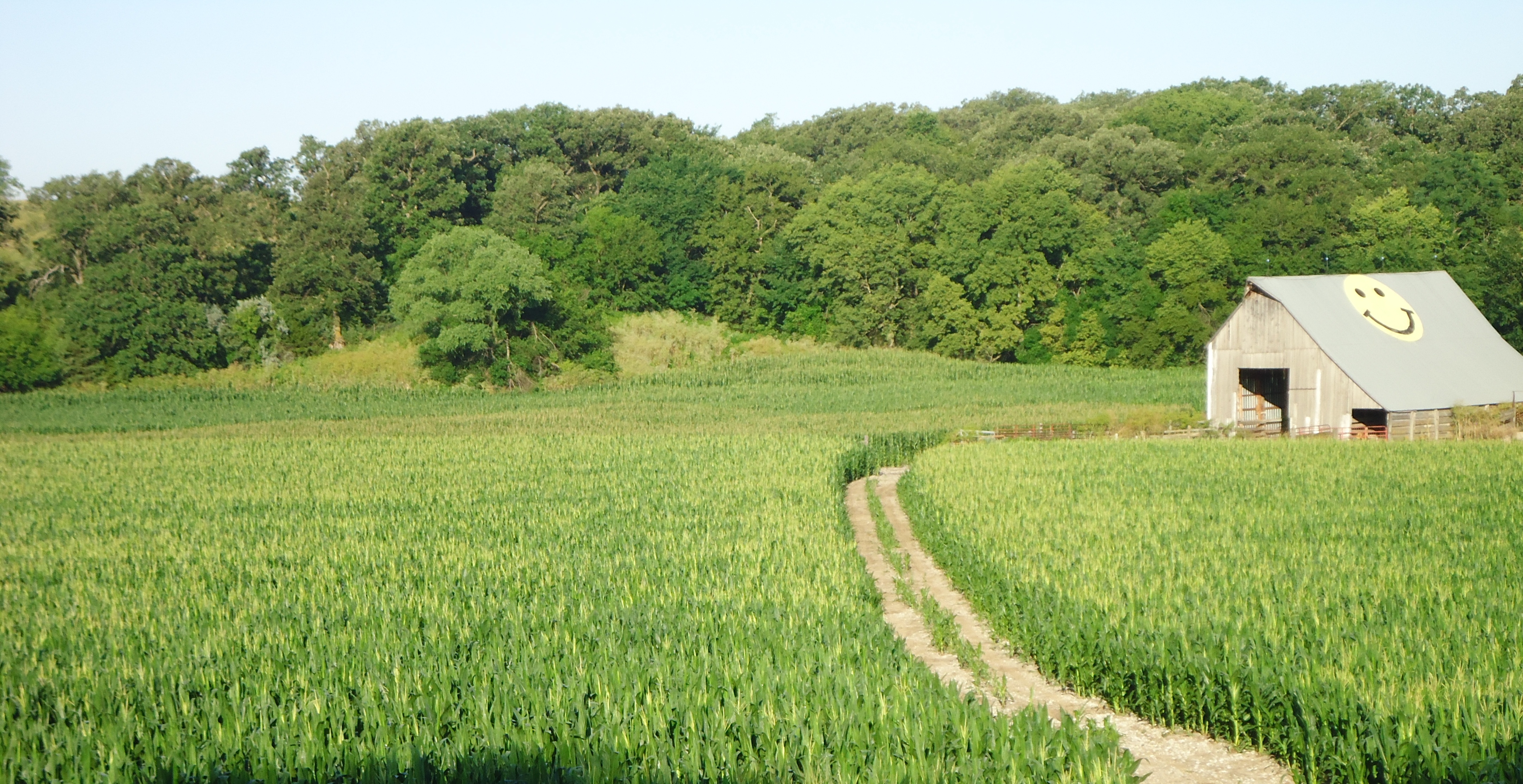

Drought conditions have affected much of Nebraska. In our area in south-central Nebraska particularly in our southern tier of counties, we’re seeing brown pastures and alfalfa that stopped growing. Wheat was harvested nearly a month early and yields range from 0-50 bu/acre depending on if it was hit by the hail storm Memorial Day weekend which totaled it out.
I’m unsure how many planting dates we currently have in Clay County! The spring planting season went so well with corn and many beans being planted in April. Soybeans planted in April that haven’t received hail are forming a nice canopy. Corn that hasn’t received hail should be tasseling by beginning of July. One Clay Co. field planted in March was only 3 leaves from tasseling when I took this picture this week and looks great (it’s probably 2 leaves by now!).  Adding another picture from a farmer friend Bob Huttes near Sprague, NE showing his field currently tasseled out and love the smiley face barn 🙂
But then there’s the hail damaged fields. The hail pattern has been fairly similar all year for this area of the State with some producers receiving four consecutive hail events on their fields. Every week of May was spent helping our producers determine replant decisions, particularly for soybeans…leaving irrigated stands of 85K and dryland stands of 60-65K when beans were smaller before stem bruising was so severe later. We would leave a stand one week and end up needed to replant after the hail hit again the following week. Some farmers got through the first two hail storms but the Memorial Day weekend storm did them in. I never saw hail like where ground zero of this storm occurred. After replanting after that weekend, they received yet another hail storm last week with the wonderful, much needed deluge of rain we received in the county. My heart hurts for these farmers yet for the most part they have good attitudes and are making the most of it. That’s the way farming is…lots of risk, thus an abundance of faith and prayer is necessary too. One farmer I talked to has had hail on his house seven times this year (including prior to planting).
Pivots have also been running like crazy prior to the rain last Thursday night where we received 3.30-4.40 inches in the county. Installing watermark sensors for irrigation scheduling, we were able to show the farmers that there was truly moisture deeper in the soil profile and attempted to convince them to hold off. It’s a hard thing to hold off on  water when the neighbors are irrigating, but several farmers who didn’t irrigate told me they were able to let the rain soak in and their plants
 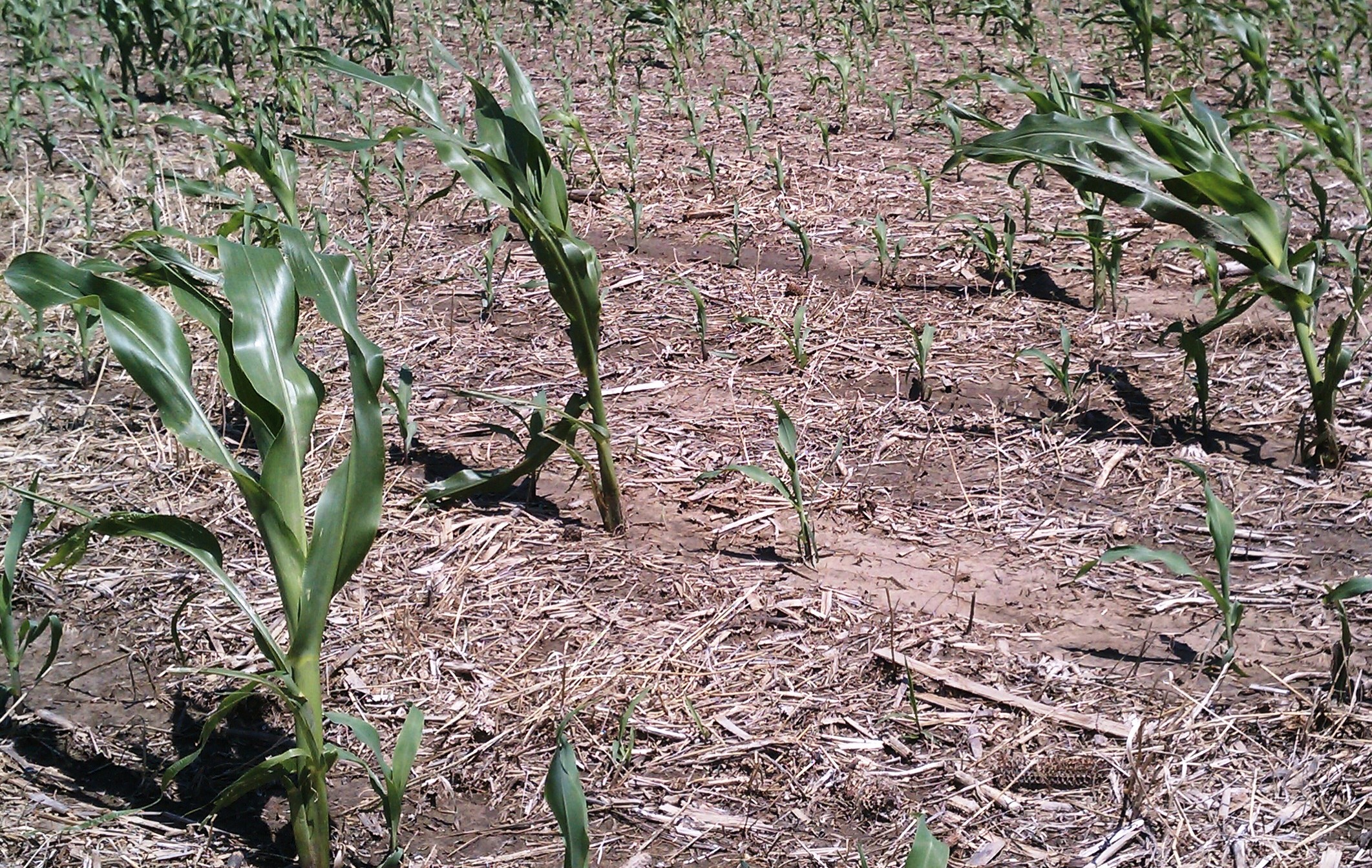 weren’t leaning after that rain because the ground wasn’t saturated prior to the rain event.
Future of Rural America
Sunsets over rolling hills of green pastures and straight corn rows. Barely seeing above soybeans I was walking to remove  weeds. Attending a small school that provided an excellent education with opportunities to participate in a variety of activities to become more well-rounded. These are a few of numerous memories of growing up on the farm and in a rural community that I hold dear. While I enjoy hearing my grandparent’s stories of what life was like for them farming 60 years ago and even enjoy watching the Nebraska State Cornhusking Contests held each year, I also realize times have changed and don’t have a false sense of nostalgia about what rural means today. While technological advances allow our farmers to produce more food for more people with less inputs and less water than ever before, what hasn’t changed about rural communities is the hard work ethic, dedication, risk, determination, and reliance on Faith and family to get through each year.
Last week I had the opportunity to participate in the Rural Futures Conference held in Lincoln. For me, it was the best conference I’ve attended; the energy and enthusiasm from 450 people gathering from a variety of backgrounds all to discuss the future of rural America was refreshing to say the least. My favorite part of the conference was the first evening. The key note speaker Joel Sartore, a Nebraska native who is also a National Geographic photographer, challenged us to maintain a positive attitude and to look for the opportunities that were available in our small towns. For example, one town in Kansas was all about a certain sparrow where they would take people out on field trips to “listen”-they didn’t even get to “see” the sparrow-and people paid money for that! There was also a town in Oklahoma where all they had was rattlesnakes…so they made the most of that too and created a huge attraction around snake handling, pics with snakes, snake skinning, etc.
My favorite part of the conference occurred after that during the youth panel. A panel discussion with Caleb Pollard,  Executive Director of Valley Co. Economic Development in Ord, NE; Amanda Crook, Graduate Student; Anne Trumble, Executive Director of Emerging Terrain in Omaha; Jim McClurg, University of Nebraska Board of Regents; and University of Nebraska Med Center’s Bob Bartee answered questions moderated by Dr. Ronnie Green, IANR Vice Chancellor. The young people struck a chord with me-most likely cause we were of similar age. Some key take-away quotes:
- Vibrant organizations identify strong leadership.
- Failure can be a good thing as it can lead to the next innovation.
- To go some place and change the trajectory of history is exciting!
- We need to change the way we place young people into jobs….we don’t offer young people jobs; we offer them opportunities.
These young people were so excited about living in Nebraska! Some of them had spent time elsewhere before choosing to move back to Nebraska and eventually choosing to find a small town to raise their families or have the rural way of life. Another theme that emerged throughout the conference was the need to get young people involved in the local community such as youth representatives on city council, etc. even as early as when they’re in high school. Some people think small town communities in Nebraska are dead…but that’s not necessarily the case. It mostly depends on leadership-a strong leader will rally the town around an idea to grow it or create opportunities. That’s what’s happening in Ord, NE with Caleb Pollard. Another example comes from Fairfield Iowa. Sometimes it just takes the right person to ignite a spark and help the rest of the town see the possibilities. Nebraska has so much to offer!
Frans Johansson, author of The Medici Effect, was also a phenomenal speaker! He spoke about creating breakthrough innovations by thinking outside the box and working at intersections of different disciplines/cultures, etc. Key points I obtained from him include:
- New ideas are combinations of existing ideas.
- People who change the world try FAR more ideas.
- Diverse teams can unleash an explosion of new ideas.
- Find inspiration from fields/cultures other than our own.
- Look for the smallest executable step-essentially don’t eat the elephant in one bite.
- Stepping into intersections isn’t risky-it’s risky to do the same thing over and over again.
Maybe these aren’t earth-shattering new concepts, but good reminders for a task as large as creating a Rural Futures Institute…and frankly for anything in life.
There was much discussion about the role of a University/State/Community Colleges in trying to save rural communities…how is this done…how build partnerships and trust…how to provide incentives to faculty working in creative/innovative ways in a structured academic setting when it comes to promotion and tenure…and even if the University changed its incentives, how does that bode if a faculty member moved on to another University? How are incentives provided to teams and excellent team work? We are standing at the crossroads…maybe an intersection right now in academia which can shape the future of creatively rewarding innovative work while still maintaining needed structure in the promotion/tenure process. I remain positive that we’ll find a way to work through this!
There were discussions in small groups regarding the meaning of rural. What does it entail? Often we think of agriculture-and I would argue that’s a strong part of rural-but it’s also much more…health care, infrastructure, industry, schools, broadband, etc. Some were saying we need to use the term non-metro instead of rural in order to get away from the ag connotation. Yet others felt the discussion was too focused away from agriculture on other components of rural and missing ag as a key component. Needless to say, the entire conference provided interesting discussion, dialogue, and a chance to meet people from a variety of backgrounds. It truly provided an opportunity to look for intersections with which to create innovative ideas for the future.
There was also the reality that hit during focused group conversations that there are also problems that need to be addressed in rural communities that weren’t touched on at this point: poverty; crime; infrastructure; food deserts; building trust and interfacing with university, college, and other partners, etc. Overall it was a thought-provoking conference and has the feel that several small steps can be achieved in the coming year. I would encourage you to check out the Web page and follow the Facebook page. You can also check out the Twitter Conversation at #RFC2012. This conference was also not just focused on Nebraska as the focus was the Great Plains and people from numerous states attended. I’m looking forward to seeing the small executable steps that will occur in the future and am also looking forward to doing my part to maintain strong rural communities as I’d like to see the next generation enjoy the rural life and learn the values I did growing up!
Protecting #Nebraska #Ag & #Farm Transition
A few weeks ago I shared some thoughts with you regarding what I learned from an animal welfare conference. We have an opportunity to hear more in at a much closer location-Sutton Community Center in Sutton-on March 12th at 6:00 p.m. Dewey Lienemann, UNL Extension Educator will be presenting on “Protecting Nebraska Agriculture” following a meal sponsored by the Sutton Chamber of Commerce Ag Committee as well as area Cattlemen Associations, Breeders & Feeders, and Ag Producer groups. Anyone interested is invited to attend-and I would encourage anyone who possibly can to attend. This topic not only affects livestock producers, it affects crop producers, and consumers as well. It’s very important to understand how various interest groups are attacking animal agriculture and why and how we in rural America can share our stories. Please pre-register by contacting Tory Duncan at (402) 773-5576 or ccntory@gmail.com or Todd Mau at (402) 773-5224 or todd@toddstrailers.com.
Another opportunity for learning more about family farm transition is with the last Farmers/Ranchers College program this year. It will be March 15 in Friend at the San Carlos Community Room (next to the Pour House) with meal beginning at 6:00 p.m. (Registration at 5:30 p.m.) The program entitled “Discussing the Undiscussabull” will be presented by Elaine Froese from Manitoba, Canada. Froese’s expertise in helping families get unstuck is sought after across the country. She has worked with families in business for over 20 years and is now coaching the next generation. Elaine believes that change is an opportunity, not a threat…she has practical tools to help people discuss the “undiscussabull” to make their dreams come true. In order to save your spot and reserve a meal, registration is needed by calling the Fillmore County Extension office at (402) 759-3712. The Farmers & Ranchers College is sponsored by area agribusiness, commodity groups in collaboration with the University of Nebraska-Lincoln Extension.
Women in #ag #farm Transition
Last week I attended the Women in Ag Conference in Kearney. It’s always a great conference to see many friends and meet  new ones who live and work in agriculture! I also enjoyed teaching a very engaged group of women the second day about crop science investigation. It was fun for me to see them dig into the hands-on activities!
The first session I attended was by Dave Specht from the UNL Ag Economics Dept. He does a great job of relating to the audience and talked about “Woman’s Influence-the Key to Generational Business Transitions”. Dave has a consulting business on the side and as part of that business he meets with families to develop a farm transitional plan based on the Continuity Quotient he developed. The Quotient contains 7 parts and I’ll share some key highlights via questions he raised that stuck out to me. Perhaps they’ll raise more questions for you as well.
1-Business/Estate Planning: The goal of the business/estate plan is to reduce the number of surprises to the farm and family members upon death of the farm owner. Is your plan coordinated with all the advisers in the operation and does it consider the perspectives of all the generations involved in the operation? Is it even documented and has it been communicated to the entire family before the owner passes away?
2-Communication: Are family members able to openly discuss the farm and what it means to them?
3-Leadership Development: No one is ever “ready to take ownership”; it is learned along the way. Opportunities for the next generation to make decisions need to be allowed. Often we hear of exit plans, but is there an “entrance plan”-a strategy to invite the next generation back to the farm?
4-I didn’t catch the name of this point but essentially Dave was saying that if the next generation is always asking his/her parents for a bailout, that it delays the trust that the person can someday operate the farm. How the next generation handles personal finances is important in showing he/she can someday run the operation.
5-Personal Resilience: How does the next generation handle challenges? Does the person retreat and avoid them or does the person look for ways to overcome them and use it as a growing experience? If the person retreats, he/she may not be wired for ownership in the future.
6-Retirement/Investment Planning: When will the older generation plan to retire? How much will the farm support (meaning how many people)? Where will retirement cash flow come from? The goal is to not rely on the next generation to generate your entire retirement income.
7-Key non-family employees: Sometimes the most valuable family business asset goes by a different name! Is the vision for the family farm communicated to these employees? How you talk about employees to next generation and how you talk to next generation about the employees is important in dictating future partnerships; someday the employees and next generation will be partners.
I would recommend checking out Dave’s Web site at http://www.davespecht.com for more information. He provides communication and consultation about farm transition and financial planning. Life is so short! Make sure you have a plan in place that follows the keys Dave provided above!
Cash Rent Questions
Cash rent questions continue to be the primary question I receive and it’s been hard for me to keep sharing numbers based on the UNL or USDA surveys as I question how useful the surveys alone really are. I caught up with Al Vyhnalek, Extension Educator in Platte Co. during the crop production clinics. Al’s specialty is risk management. He shared the following with me which may be helpful to you as well. This isn’t research-based or based on surveys; it’s based on land productivity and yield potential. But it’s another potential tool to reach a starting point for cash rent considerations. The numbers discussed below assume the landlord owns the irrigation equipment.
“Farmers and landowners alike want to know what they should offer or charge for farmland next year. The question is simple, while the answer is more complicated. There is no formula or equation available that will definitively provide an objective value for farm or pasture land. The caller wants to know what the UNL or USDA survey of cash rental rates says to help them determine the correct starting point for discussing cash rent for the following year. While I am glad to provide that information and do provide that information, I am more uncomfortable than ever in providing that information. Why am I not feeling good about that? Because the price of cash rent for a piece of farm ground should be based on the productivity of the ground. It is important to think about the value being tied to yield potential.
One quick way to do the calculation of productivity is to take the last 5 year average corn and/ or soybean yields for the farm you are renting times the local elevator price for 2012. This calculation equals the estimated gross income per acre. Take that number multiplied by 25-30% for corn or 30-33% for soybeans with the lower percentages for dry land crops and the higher ones for irrigated acres. It gets you to a starting point for that cash rent negotiation. Many want to set rent based on the 2011 high price of about $7.00 per bushel, but that price has never been available for the 2012 crop. Using the 2012 fall elevator price is more realistic of what might happen next year. Using this information as a starting point and combining it with the information from the surveys will help with fair negotiations of the cash lease. The example percentages were determined by working through UNL budgets when determining cost/acre.
As an example – 200 bushel irrigated corn times $5 per bushel (2012 harvest price) is $1,000 gross per acre. 30% of 1000 is $300 per acre (corn acres). Soybeans: 60 bushel beans times $11 per bushel is $660 times 33% is $220 per acre – landlord’s share. If we have 1/2 acres beans and 1/2 acres corn then average the two rent numbers – or $260 per acre average for the farm. That is how I think we should arrive at a discussion point for cash rents in the upcoming year based on productivity.” For more information, please contact Allan Vyhnalek, 402-563-4901 or e-mail AVYHNALEK2@unl.edu.


 JenResources