Category Archives: JenREES Columns
JenREES 8-30-20
Grateful Nebraska held our State Fair this year! Seeing the youth competing, showcasing 4-H projects, and the excitement, smiles, and friends reconnecting from across the State this past weekend was heartwarming!
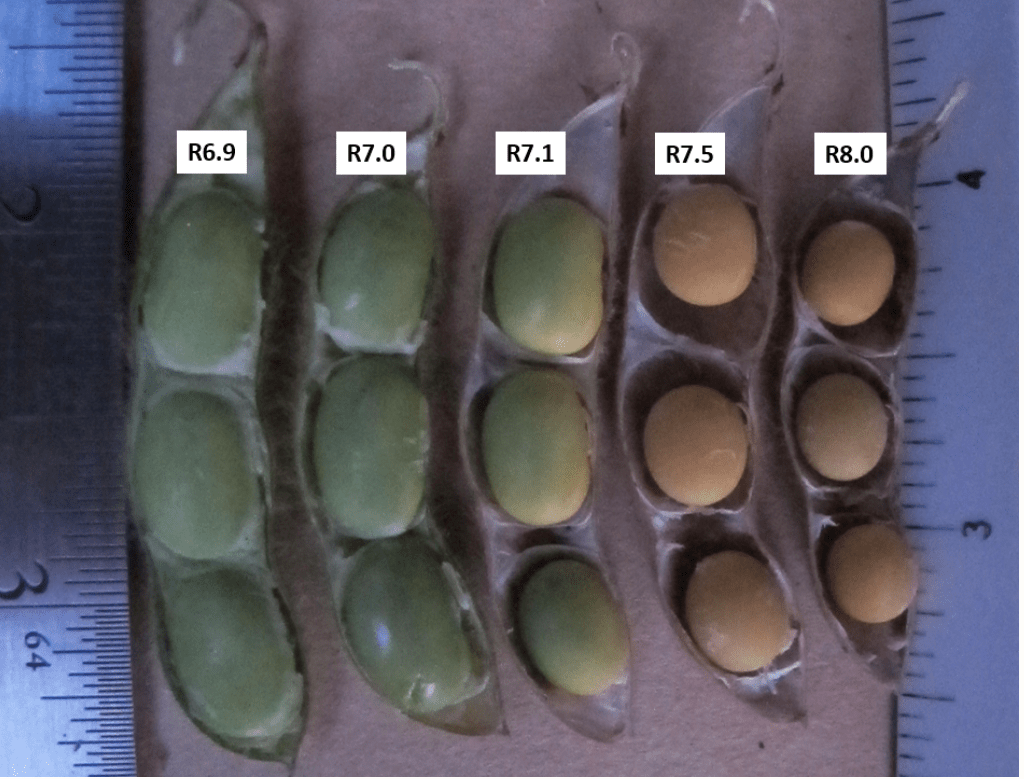
Received many calls about end of season irrigation this past week. Would encourage our farmers to finish the season well! You’ve been through much in another trying year and the past few weeks have been extra hard keeping up with irrigation, cleaning out bins, and getting combines ready in the heat. It can be tempting to just stop but would encourage you not to quit irrigating too soon, particularly on soybeans. Soybean maturity (R7) is defined when 50% (or all) of the field plants possess one mature pod (when the interior white membrane no longer clings to the seed). In most years, most leaves and pods will have changed color (from green to yellow-green or yellow) by this plant-based R7 date.
The heat has pushed crops along, but we’ve also had a great deal of humidity. Corn is moving the starch line slower in irrigated fields. That’s a good thing for fill and a harder thing regarding labor, time, and money. A lot of corn in this area is 1/3 milk and I just saw a few fields at ½ milk over the weekend.
- Corn at ¼ milk needs 3.75” (approximately 19 days to maturity)
- Corn at ½ milk needs 2.25” (approximately 13 days to maturity)
- Corn at ¾ milk needs 1” (approximately 7 days to maturity)
- Soybean at full seed (R6) needs 3.5” (approx. 18 days to maturity)
- Soybean with leaves beginning to yellow and pod membrane still attached to seeds (R6.5) needs 1.9” (approx. 10 days to maturity)
So, we’re potentially looking at one to two more irrigations yet for some of this corn and soybeans depending on the current status of your soil moisture profile, development of the crops in your particular fields, and any rain. It is recommended to allow that soil moisture profile to dry out to 50-60% depletion towards the end of the season to capture moisture in the off-season. So one way to consider this is a step-wise approach. If you typically irrigate at 35% soil moisture depletion and have around 2” left, the next week you could wait till a trigger of 40% depletion with the following week’s trigger around 50%. Again, this depends on your individual field’s soil moisture status and crop development after a taxing August.
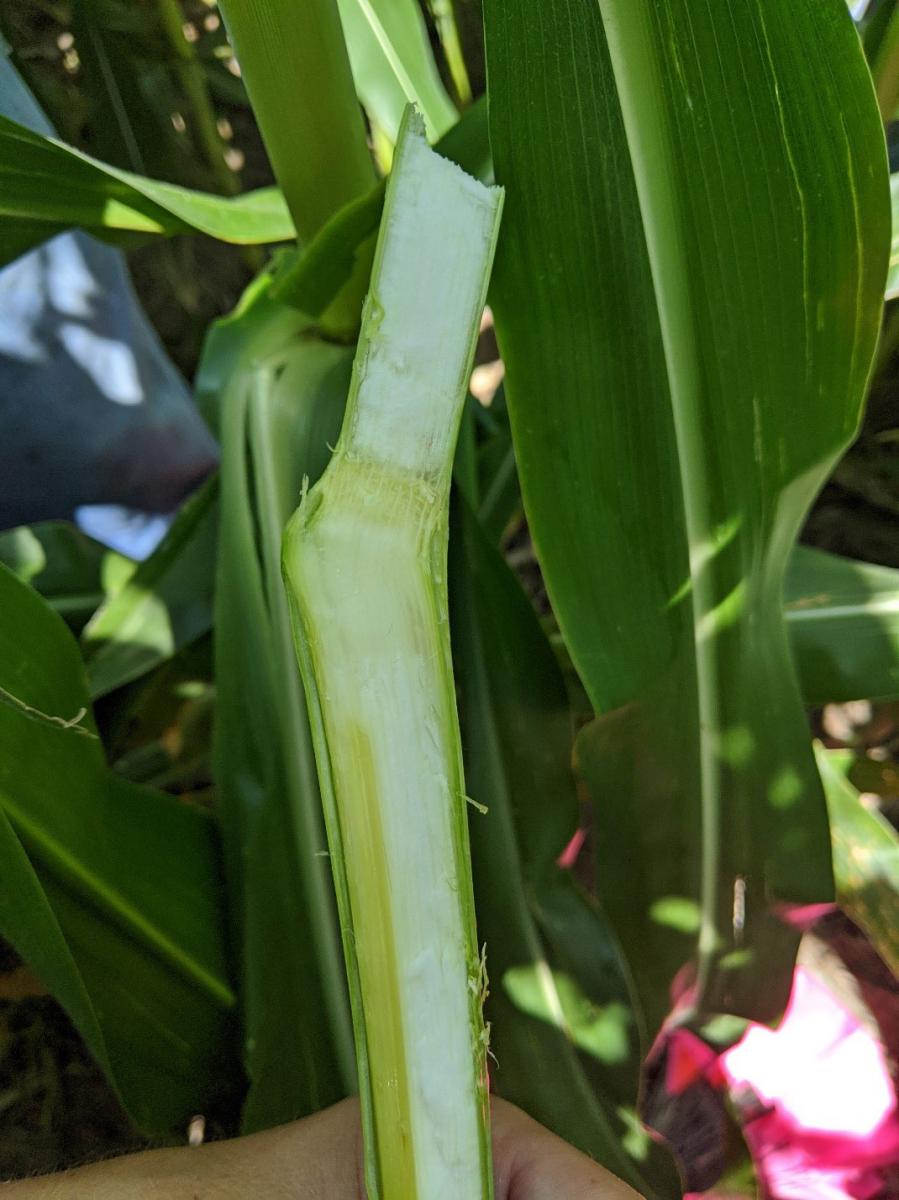
Upon physiological maturity, corn ears begin drooping down. However throughout the area, corn ears are doing this that aren’t at ½ starch yet. These ears will black layer prematurely at the cost of yield. Dr. Bob Nielsen from Purdue shares that yield penalty can be as much as 40% at denting when there’s essentially no milk line visible and around 12% at half milk. So what causes this? The ear shank can collapse when there’s a lack of turgor pressure due to stress from the inability to keep up with crop water demand. August has been abnormally dry with warmer than average temperatures the past few weeks. Sometimes the ear shank also cannibalizes itself, similar to what can happen in stalks. Perhaps part of this can be from poor root development or lack of root development into deeper layers? In areas that have received less rain, perhaps deeper soil layers are drier in spite of having moisture in the top soil layer from irrigation? For those with conventional hybrids, European corn borer tunneling can also cause this type of collapse. There’s also some hybrids that I notice this happening more than others; perhaps genetics also plays a roll? That shank is the source for feeding the ear, so when it collapses, it weakens it. Keep an eye on ears in these fields as we approach harvest and consider getting at them sooner if possible.

JenREES 8-16-20
Crop Updates: For the past week, crops used around 0.22” per day in the York area, around 0.20” as one goes east towards Ithaca and closer to 0.25” per day going south towards Harvard and Guide Rock (based on High Plains Regional Climate Center data posted on CropWatch).
As we think about water use the finish the year, the following come from the NebGuide Predicting the Last Irrigation of the Season found at: https://go.unl.edu/k74n:
- Corn at Beginning Dent needs 5” of water (approximately 24 days to maturity)
- Corn at ¼ milk needs 3.75” (approximately 19 days to maturity)
- Corn at ½ milk (Full Dent) needs 2.25” (approximately 13 days to maturity)
- Corn at ¾ milk needs 1” (approximately 7 days to maturity)
- Soybean at beginning seed (R5) needs around 6.5” (approx. 29 days to maturity)
- Soybean at full seed (R6) needs 3.5” (approx. 18 days to maturity)
- Soybean with leaves beginning to yellow (R6.5) needs 1.9” (approx. 10 days to maturity)
Spent a lot of time last week looking at ear development in fields, particularly those impacted by the July 8th windstorm. Also appreciated a long conversation with John Mick with Pioneer on what he was seeing. For the most part, I’m seeing a lot of ‘normal’ ears that vary in the amount of tip back from lack of pollination and/or kernel abortion. Less commonly seen are ears with 3/4 husks. On plants that were pinched, continue to see messed up secondary and/or tertiary ears after the loss of the primary ear. On plants that bent and righted themselves, seeing a variety of things. Some are more ‘normal’ while other ears are much smaller that either didn’t pollinate well and/or had kernel abortion.
Last month, had mentioned a curious thing regarding how many hybrids are putting on multiple ears on the same ear shank, on the primary ear node. It’s far more than I’ve ever seen before. In sharing some observations with Dr.’s Tom Hoegemeyer and Bob Nielsen, they share it’s most likely a genetic X environmental response under excellent growing conditions or some other phenomena. As I continued to see these ears in fields and husk them back, for the most part, they don’t appear to be detrimental to the main ear, which is good. So it’s more of a curiosity than anything.
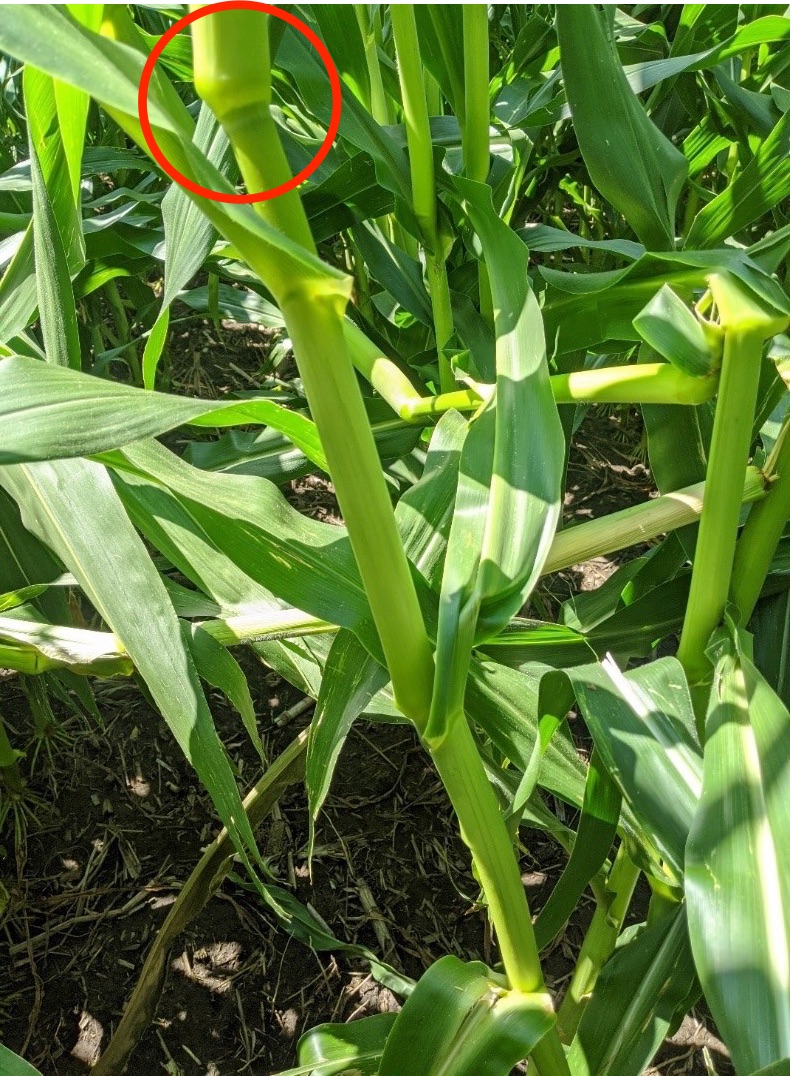
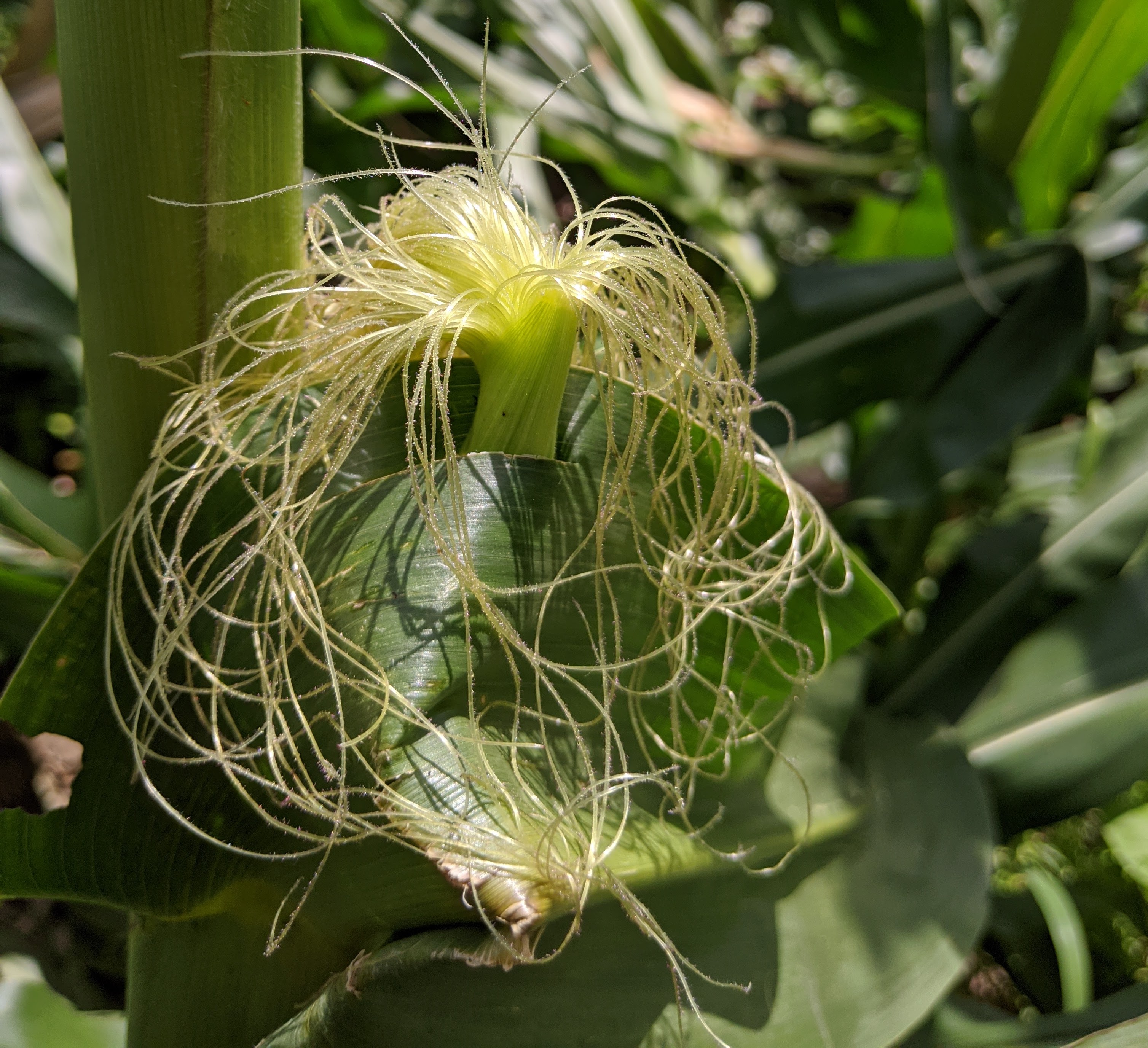
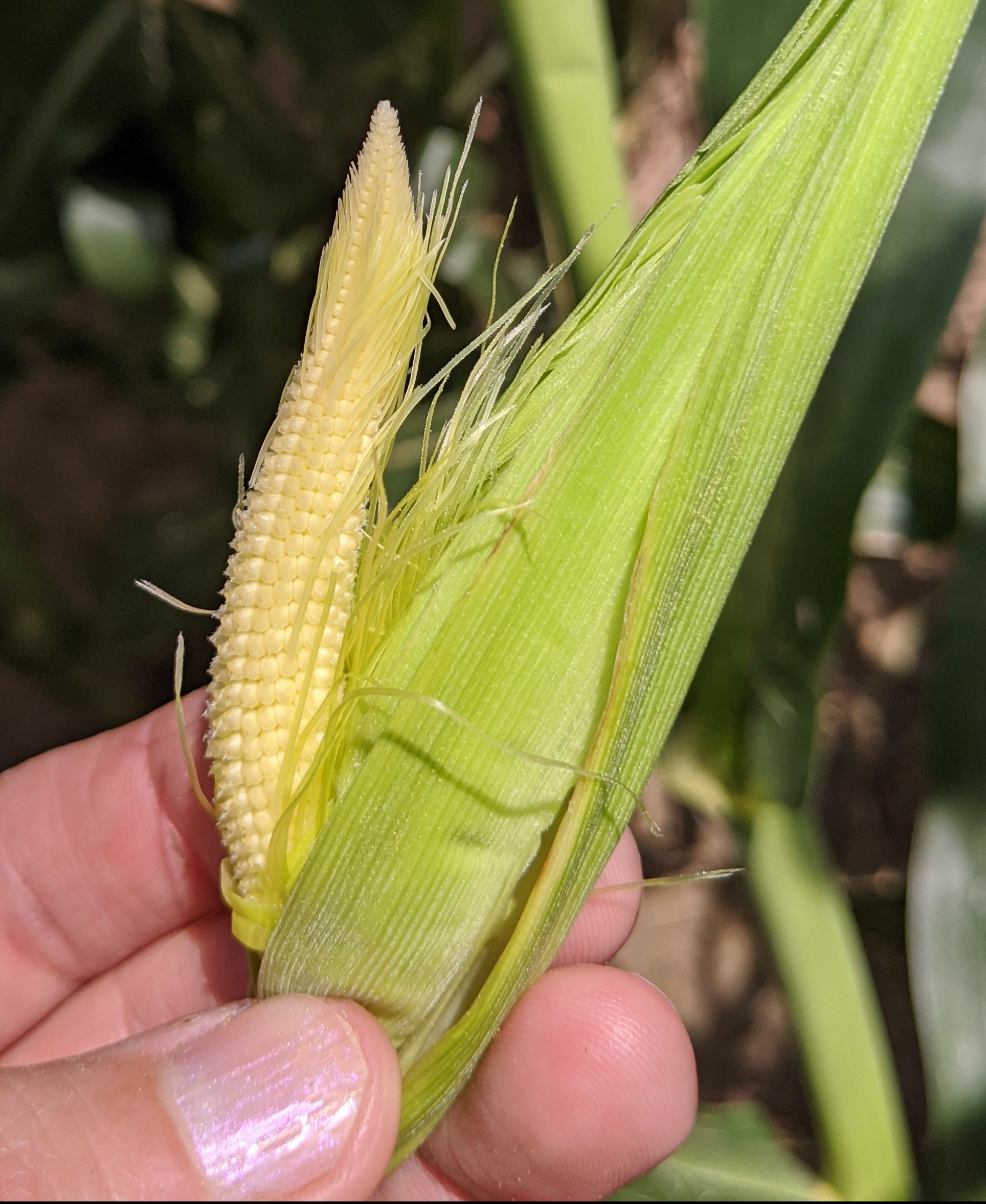
Many of us probably don’t examine ear shanks much in comparison to the ears. However, when one does look at ear shanks, one will observe they are similar to the corn stalks in that there are nodes and internodes. Each node also produces a leaf (in this case a husk leaf) instead of a collared leaf such as what happens on the main stalk. And each node (on stalk and on ear shank) has an axillary meristem which allows for ear development. Normally, there must be genetic or hormonal suppression so that only one main ear is formed on a shank at a stalk node. It’s not uncommon for us to observe an ear on different nodes of the stalk (ex. Nodes 12 and 13). What is more uncommon is to observe multiple ears on different nodes of the same ear shank, such as what is being observed this year.
Renovating Lawns: If your lawn is in need of repair, now through mid-September is a great time-perhaps the best time-to do so! This resource, Improving Turf in the Fall at https://go.unl.edu/rz9z is a great one to walk you through renovation depending on your situation. Some lawns can be easily improved by adding fertilizer this fall and/or overseeding. Some may need total renovation, which starts with a glyphosate (Roundup application) followed by waiting at least a week to then prepare the soil for planting.


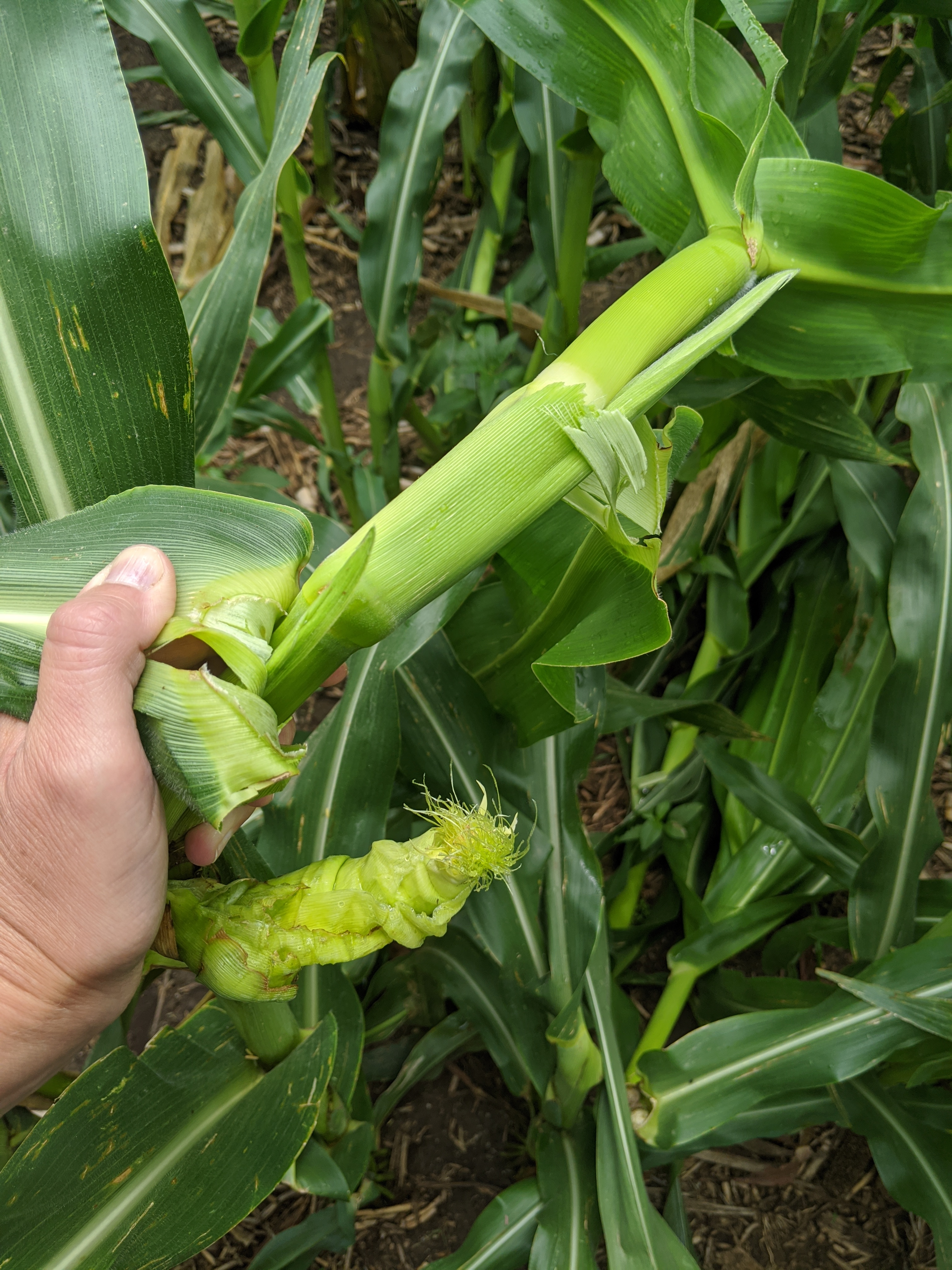
Multiple ears on the same ear shank (with husk tissue on left and husked on right). Doesn’t appear to be impacting main ear in most fields I’ve seen these in. And, this is occurring on primary ear nodes and within fields (not just in endrows or in lower population areas).
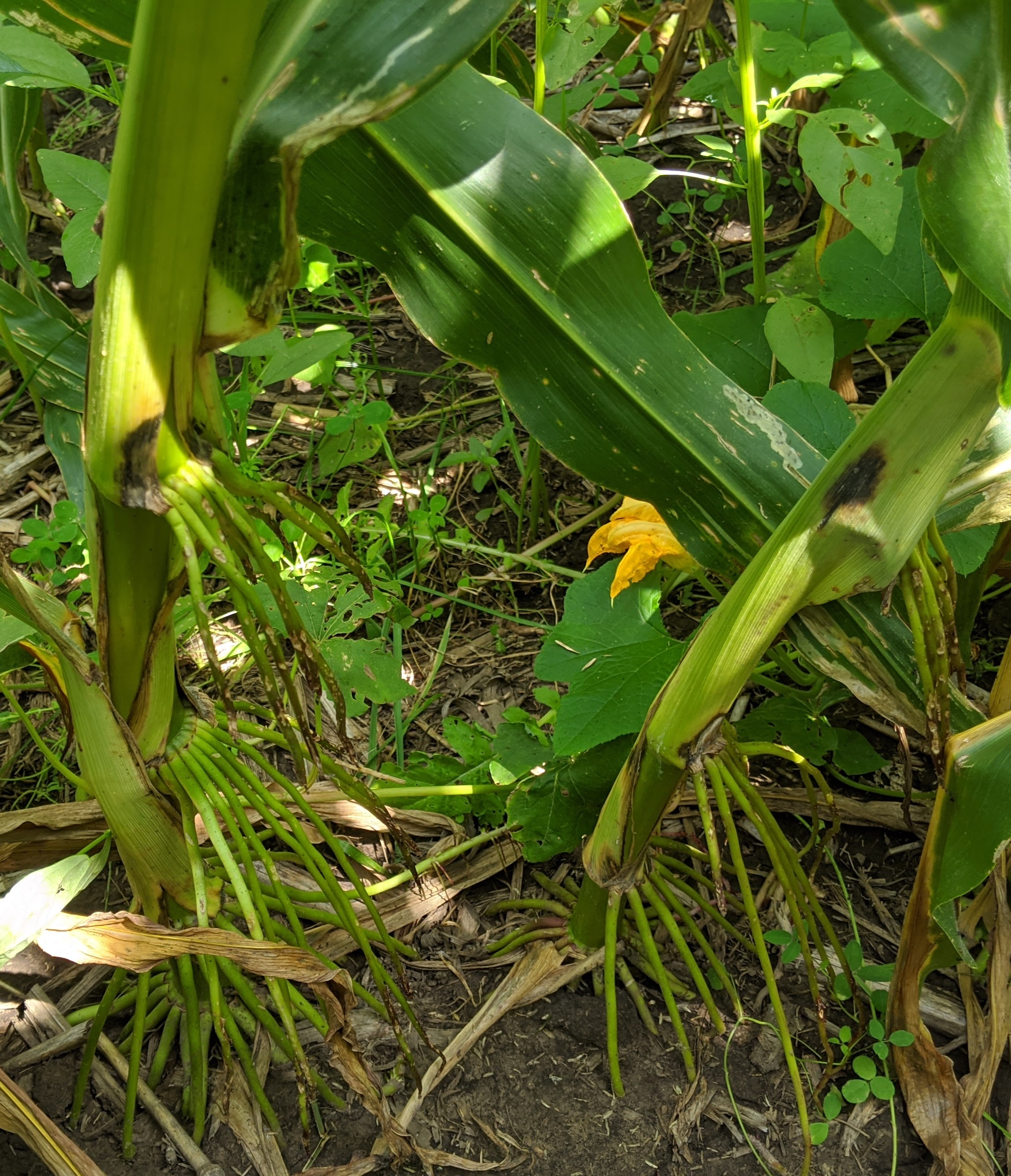
Pretty impressive brace root development on leeward side of plants that tried righting themselves.

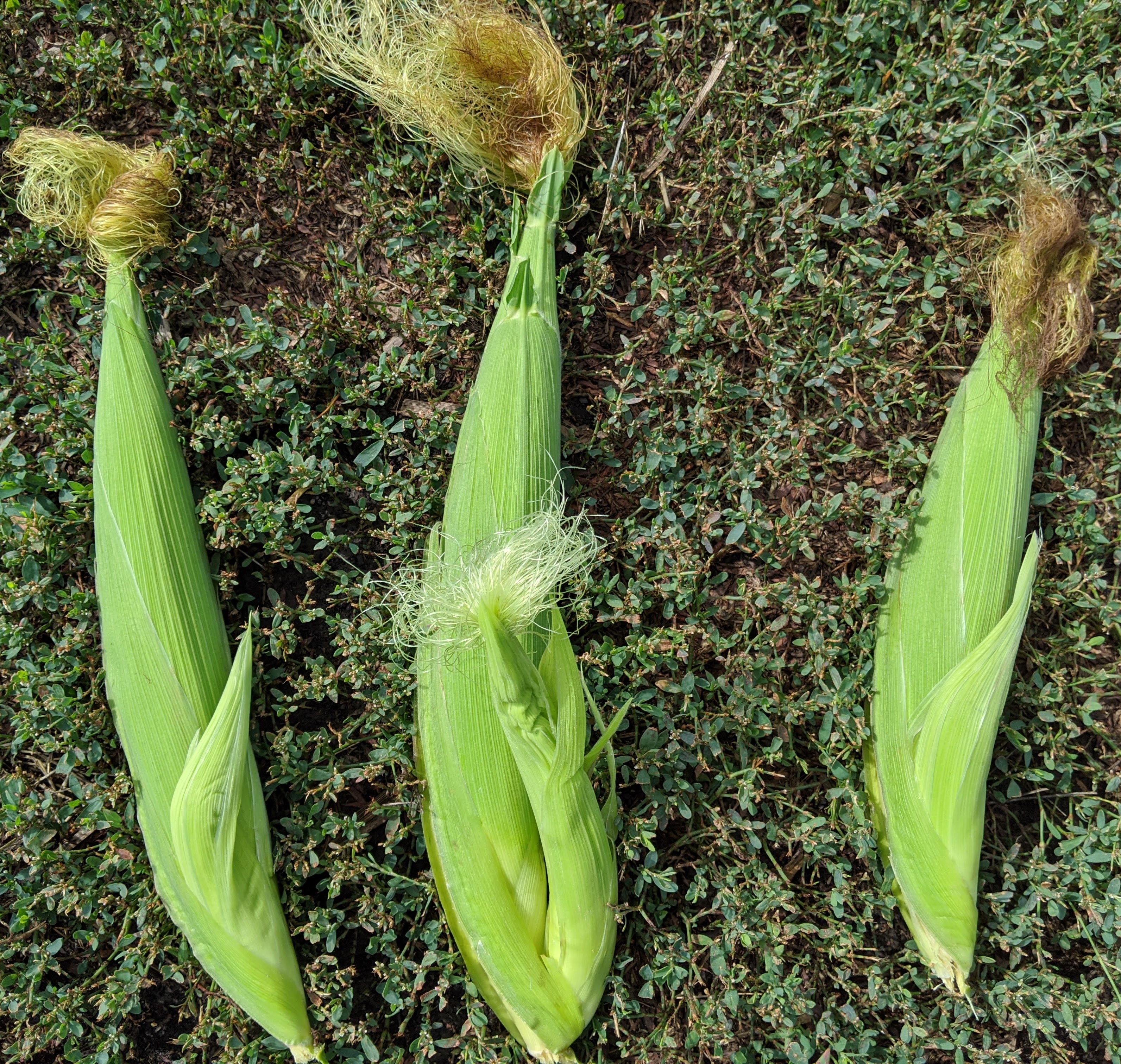
Ears from the plants with the brace roots from above photo. These are pretty decent with some tip back, but otherwise more ‘normal’. Other plants like this have ears that have poor kernel set.

Seeing some ears with 3/4 husk.
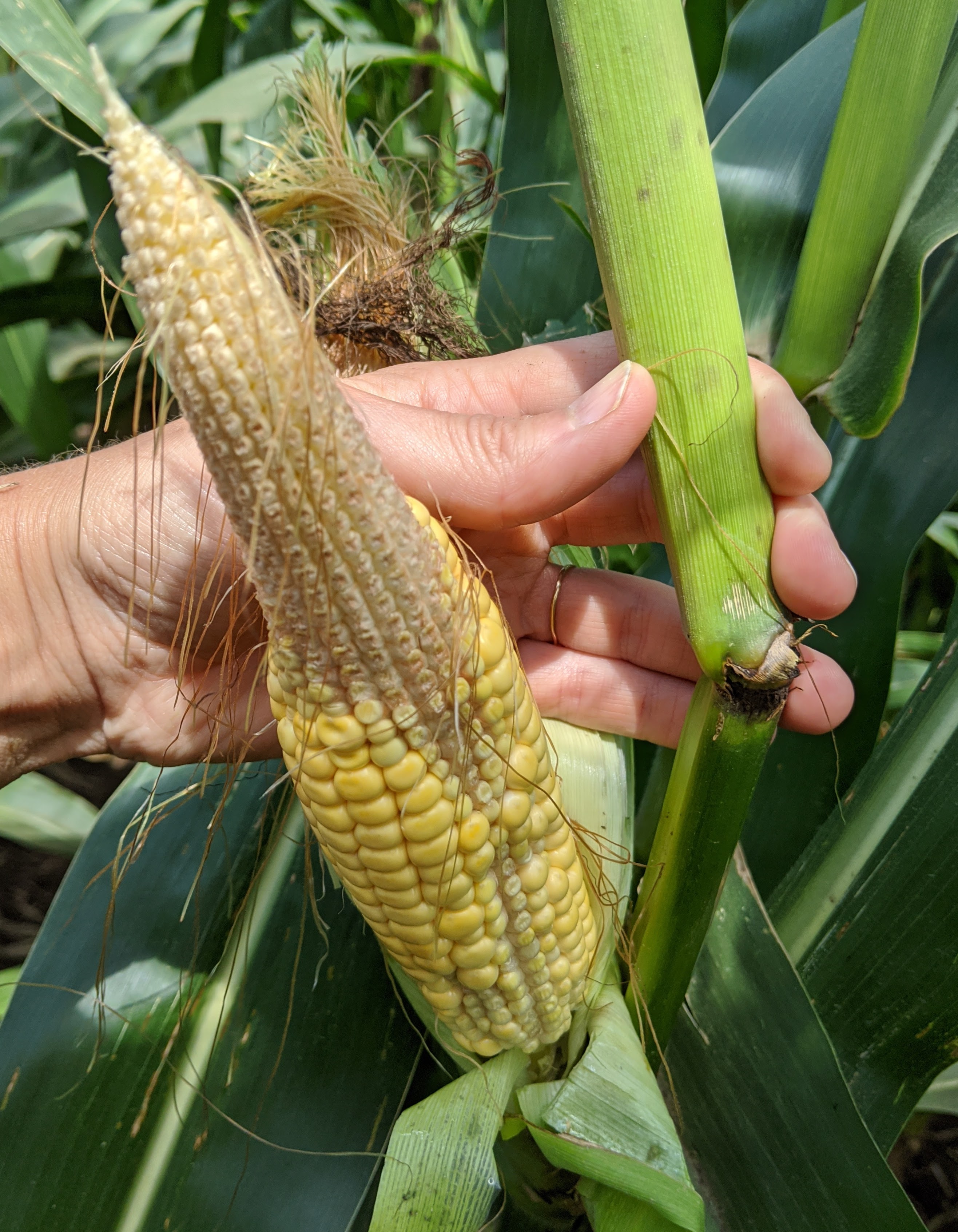
Bent plant that tried righting itself with a ‘zippered’ appearance to ear and poor pollination in addition to kernel abortion.

Plant with loss of the primary ear showing multiple ears on the secondary and tertiary ear nodes.
JenREES 8-9-20
Fair: As fairs wrapped up in the area, in my opinion, it was a great way to cap off the summer for the youth. So much has been taken away from them and I really appreciate Ag Societies working hard with Extension staff to give the youth an opportunity to showcase their projects! There were several moments throughout fair where I thought “this is why we do this”…to watch youth and adults so excited to see the ribbons on projects, watching siblings and club members supporting each other, families helping other families, and friends catching up. Fair did look different this year. But it forced us to think about things differently with the blessing of some changes may be kept as a result! Thank you to all the Ag Society, 4-H Council members, Extension staff, newspaper staff, and volunteers who gave youth and adults alike the opportunity to showcase projects and safely gather at fairs! Thank you also to health departments for advising on directed health measures and providing PPE and nurses who helped with screenings!
Crop Updates: I didn’t get into the field much this past week but the primary questions I received were regarding tip back on corn, spidermites flaring, and if it was too late to spray fungicides in corn. The answer to the latter is no. If southern rust is showing up pretty good low-mid canopy of your field, it’s something to consider to help with stalk strength as that’s my concern. I’m hearing of some guys having to apply a second round of fungicide due to rust. Hard for me to see guys spending the money to do that thus prefer avoiding automatic tassel applications. While I’m not aware of research to prove it, I think coverage is another issue. Consider asking the aerial applicator to use 3 gallons/acre to increase coverage. I hear some are refusing to do more than 2 gallons/acre and I think that’s part of the problem. Some farmers are also chemigating fungicide and insecticide through the pivot in hopes of improving coverage.
Typically we’d say southern rust occurs on the top side of leaves unless severe, whereas common rust typically occurs on both sides of leaves. On leaves that were flipped over from the wind, I’m seeing southern rust spores (confirmed via microscope) on the undersides of leaves that are now technically facing upward, but not on the ‘normal’ top side of leaf (an interesting observation that a crop consultant asked me about and then I also saw this week to confirm it truly was southern).
Spidermites continue to flare 7-10 days later because most of the products used don’t kill eggs. Sometimes second applications are needed. Insecticides with activity against eggs and immature stages (not adults) include Zeal, Oberon, and Onager whereas the pyrethroid (Bifenthrin products like Brigade in corn and soybeans) and organophosphate products (like Lorsban used in soybean) can help with adults but not eggs. Product has to come in contact with the mites. Thus at least 3 gallons/acre are recommended with aerial applications. Entomologists share aerial applications early in the morning or late in the evening can be more effective to avoid hot rising air away from plants (be careful of inversions). With twospotted spider mite, perhaps all that can be accomplished is to slow the rate of population increase.
Tip back on corn occurs most often from some sort of stress. For this year having good pollination weather, some are surprised regarding how much tip back we’re seeing. It’s important to count kernels long as there may be more kernels than one realizes in spite of tip back occurring. You can tell approximate timing of stress events by the appearance of the kernels. If kernel formation isn’t evident, the stress occurred before or during pollination. If kernels are very small or appeared to have died, the stress was after pollination as the kernels were filling. Water stress is a major stress outside of temperature as to kernels not pollinating and/or aborting. Each ovule (and later, each kernel), competes for water and nutrients. Water and nutrients are necessary for pollen tube formation down silks to fertilize ovules. Water and nutrients are necessary to fill individual kernels with the tips being sacrificed for filling kernels at the base of the ear first.
CARES Act Tax Planning for Farmers: The CARES Act included the Payroll Protection Program (PPP) and Economic Injury Disaster Loans (EIDL), which many farmers utilized. However, several other provisions didn’t get as much attention. For tax planning this fall, check out this helpful info. from Tina Barrett: https://go.unl.edu/re6e.
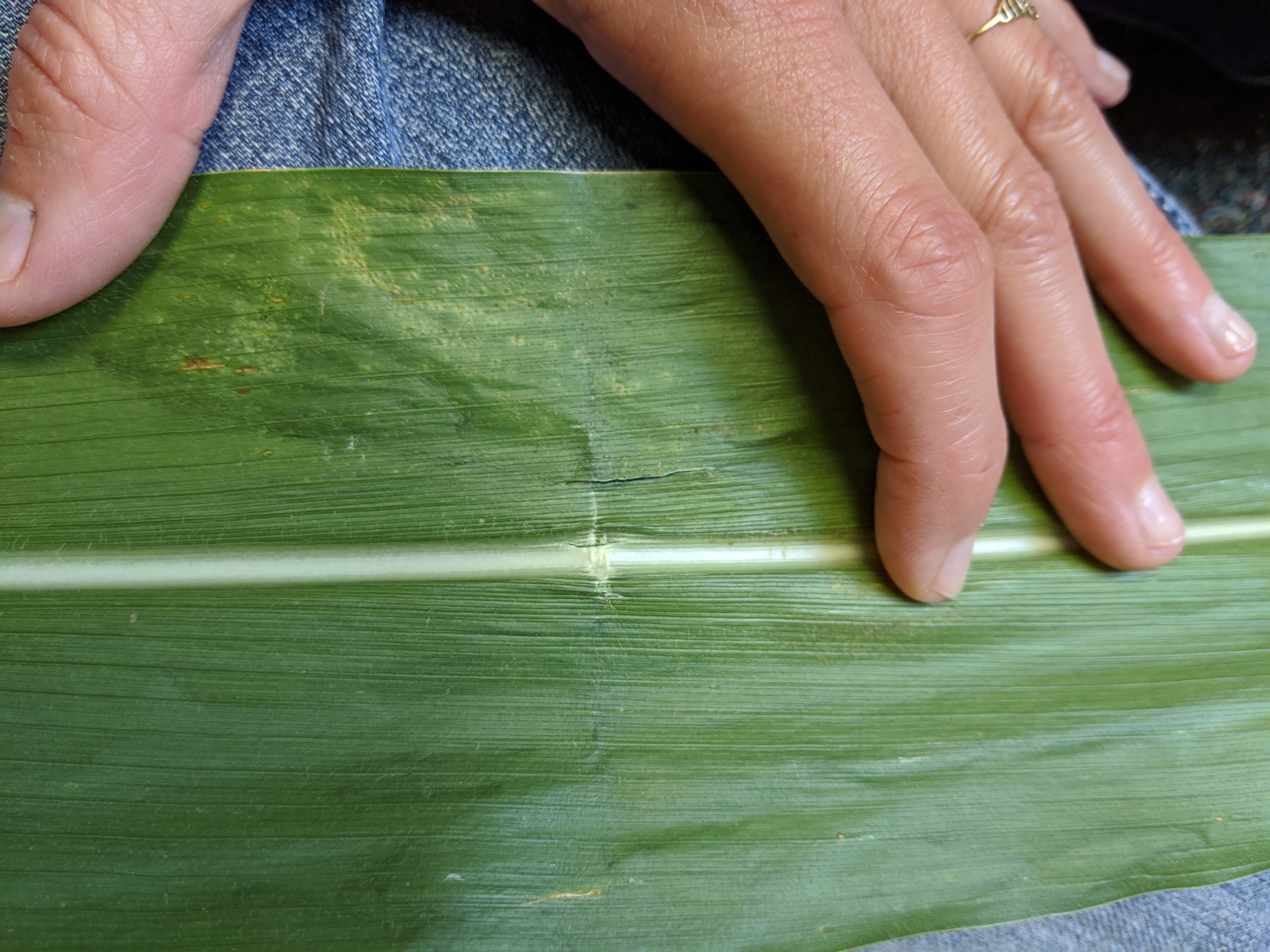
True topside of leaf that was flipped over with windstorm to be on underside. Can see indentations of lesions but not pustules.
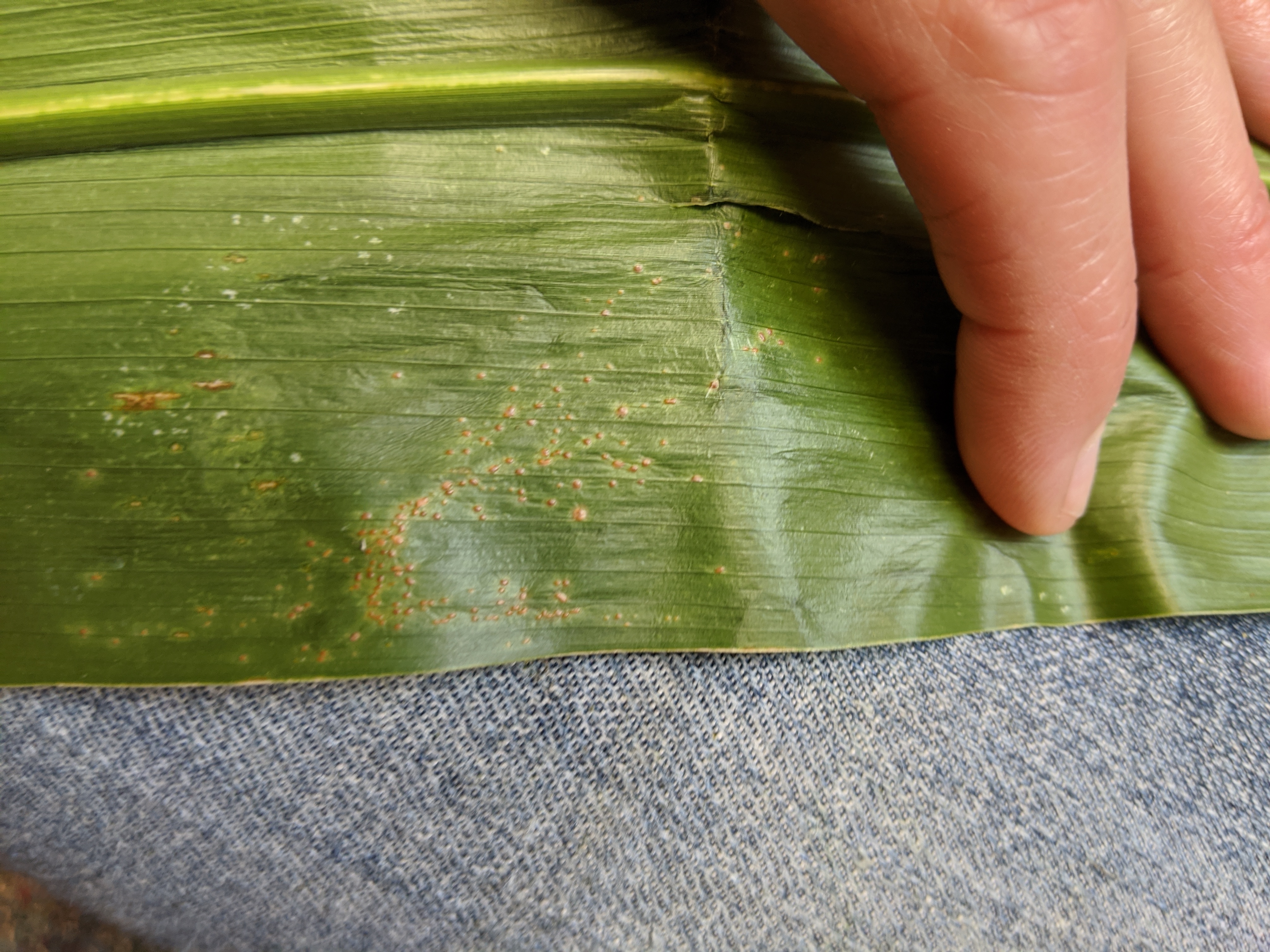
True bottomside of leaf that after being flipped over with windstorm was showing as the top side. Notice the pustules on this side of the leaf.

Under the microscope, the spores were truly southern rust (oval-shaped). Common rust pustules are circular in shape.
JenREES 8-2-20
York and Seward County Fairs: Here’s wishing the best to all the youth competing in the York and Seward County Fairs this week!
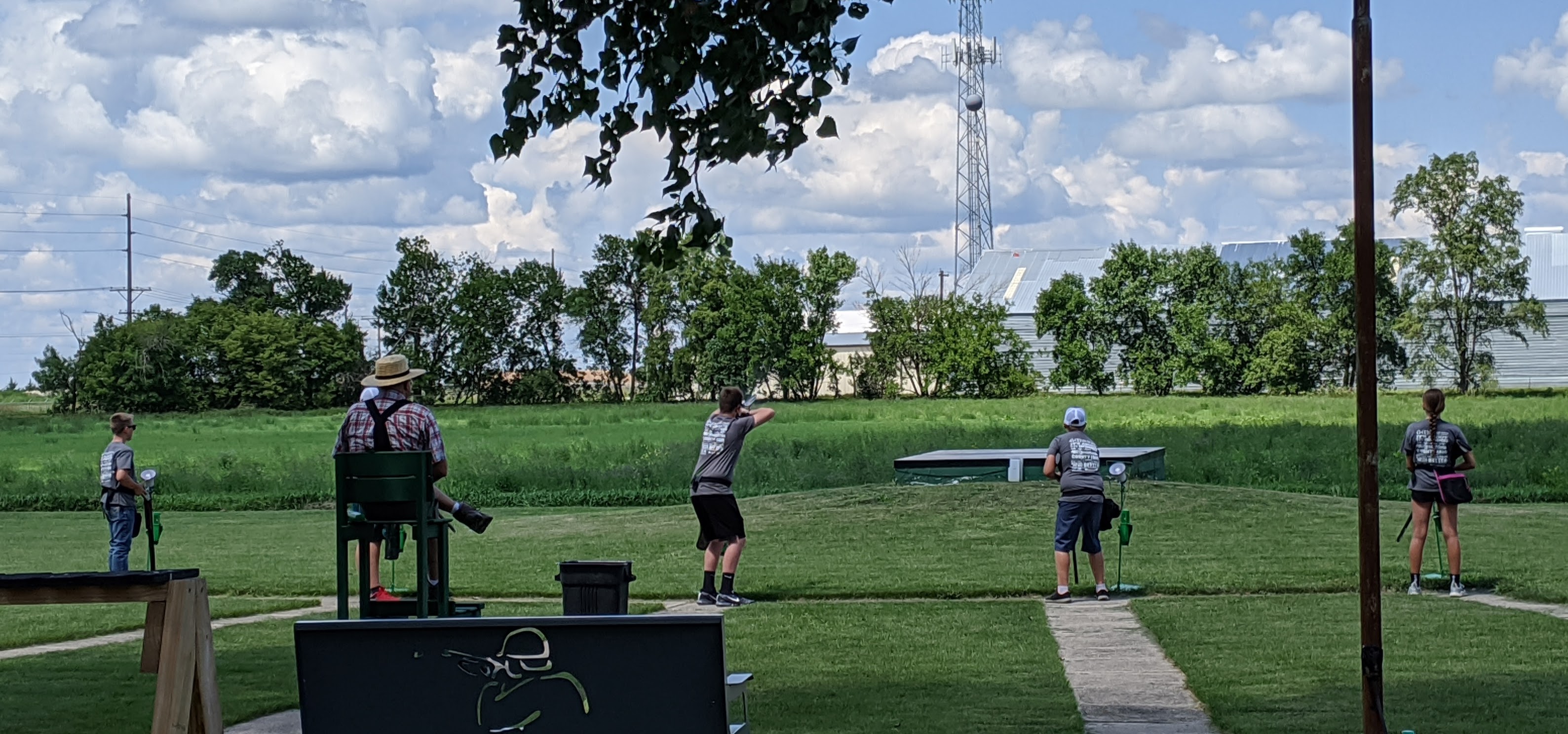
One group of youth competing at the York Co. 4-H Trap Shooting competition today.
Crop Update: It’s unfortunately not hard to find southern rust in fields anymore as I’m finding it in every field I walk into. Incidence is mostly confined to lower canopies with the highest I’ve seen so far on the ear leaf. What’s concerning to me is the amount of rust I’m seeing (ear leaf and below) in canopies of fields that have already been sprayed. Some fields sprayed in mid-July will be out of residual soon, which is also concerning to me. Physoderma brown spot, which moves with water and isn’t a significant pest, can be confused with southern rust. While it can look bad, a major difference with Physoderma is that there’s no raised pustules (bumps) on the leaves. I haven’t seen gray leaf spot at ear leaves or above yet. I’ve added pictures of what I’m seeing on my blog at jenreesources.com. There’s been some questions about ‘late season’ Nitrogen applications. I’ve had to ask how late is ‘late season’; brown silk has always been the latest I recommended. Most University research considered ‘late season’ as by tassel time. I haven’t found any University research that has said applications should be made later than brown silk or would be beneficial past this time.
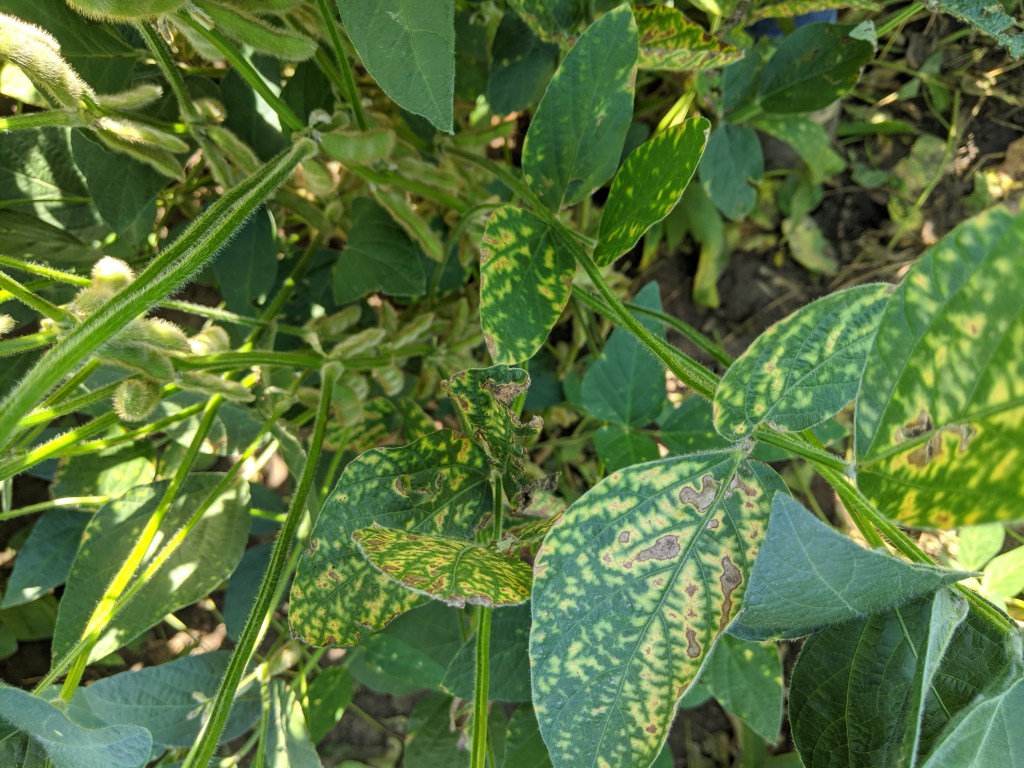
In soybeans, there’s a disease called Phyllostichta leaf spot that I had never before seen.

Phyllostichta leaf spot. Photo courtesy John Mick, Pioneer.
It’s one caused by a fungus that begins often as brown lesions on leaf margins and can move between leaf veins. In learning more about it, it can be residue born or seed transmitted. It doesn’t sound like anything to be too concerned about, just something different that’s been seen in some fields this year.
Painted lady butterflies are the orange and brown butterflies that are flying now that are often confused for monarchs. A painted lady female can lay up to 500 pale green eggs on plants individually instead of in egg masses. The larvae (called thistle caterpillars) hatch in around a week and can feed from 2-6 weeks depending on weather conditions. They feed on around 100 different host species including thistles, soybeans, asters, zinnias, etc. These butterflies are often used in schools to teach students about complete metamorphosis using the life cycle of a butterfly.

Painted lady butterfly (underside) on soybean leaf.
Soybean Defoliators: In addition to thistle caterpillars, other defoliators including various worms, grasshoppers, Japanese beetles are also present. Thresholds for damage for all soybean defoliators is 20% defoliation of plants during the reproductive stages. If you’re unsure what 20% defoliation in soybean looks like, check out the graphic in CropWatch at: https://go.unl.edu/7qjg. It’s actually a good graphic to keep on one’s phone as it’s very easy to over-estimate 20% defoliation.
Unsolicited Seeds from China: I haven’t heard of anyone in this area officially receiving a packet yet. USDA is aware that people across the country have received suspicious, unsolicited packages of seed that appear to be coming from China. USDA’s Animal and Plant Health Inspection Service (APHIS) is working closely with the Department of Homeland Security’s Customs and Border Protection, other federal agencies, and State departments of agriculture to investigate the situation. Anyone in Nebraska who receives an unsolicited package of seeds should immediately contact Julie C. Van Meter at 402-471-6847) or Shayne Galford at 402-434-2346. Please hold onto the seeds and packaging, including the mailing label, until someone from your State department of agriculture or APHIS contacts you with further instructions. Do not plant seeds from unknown origins. At this time, there’s no evidence indicating this is something other than a “brushing scam” where people receive unsolicited items from a seller who then posts false customer reviews to boost sales.
Squash Vine Borers tend to be a problem at some point every year. If you’re seeing zuchinni, squash, or pumpkin plants looking wilted and suddenly dying, check the stems at the base of the plant. If you see insect frass (like sawdust), squash vine borers are most likely the culprit. You can remove the plants and discard if you’re done with them. Otherwise, you can also slit the stems and kill the larvae. Then cover the stem base with soil to encourage new root growth. There’s only one generation a year and it’s too late to apply insecticides (should be applied to plant base beginning in late June-mid-July). Some master gardeners also say wrapping the base of stems with aluminum foil discourages moths from laying eggs.
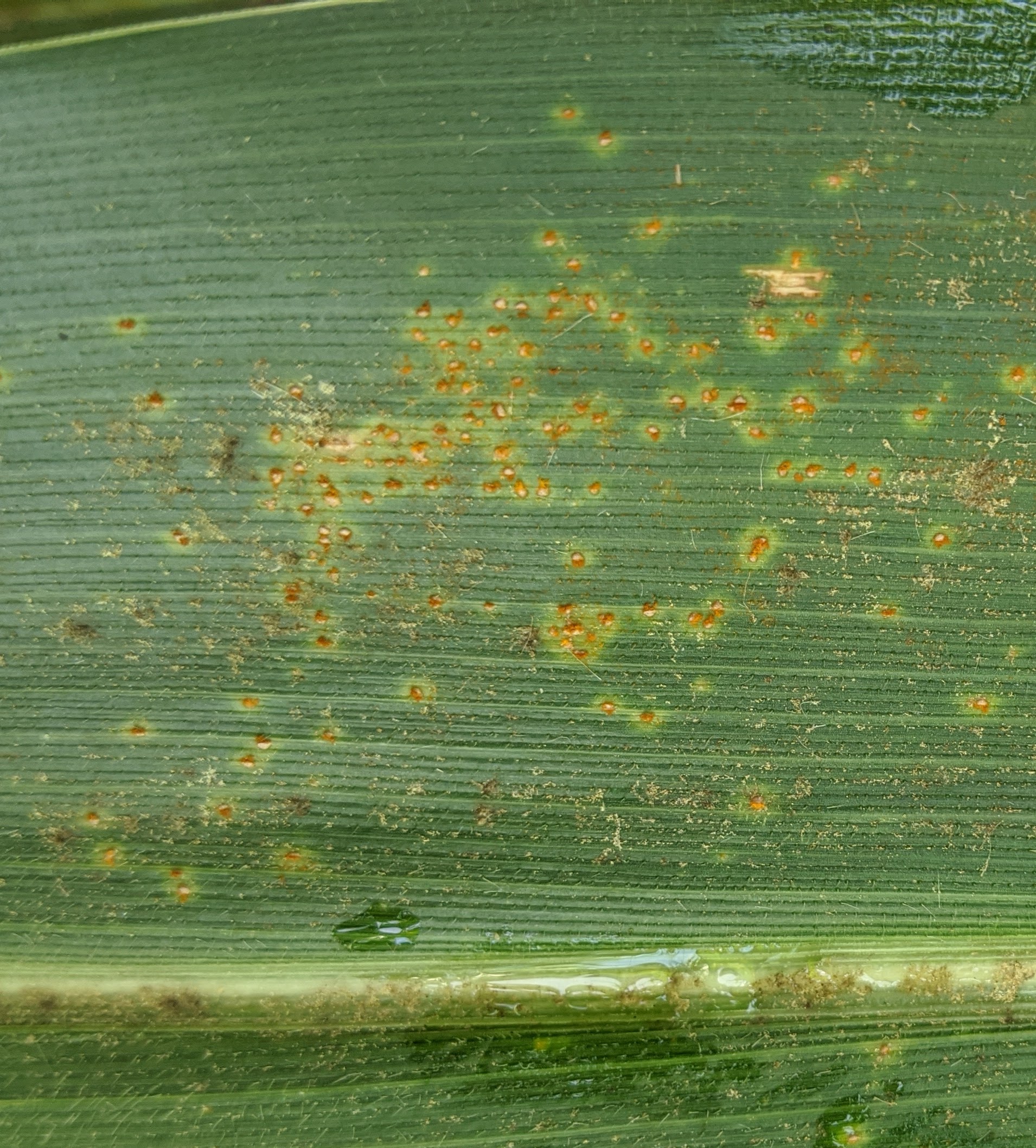
Southern rust: Small, orange to tan clustered pustules primarily on the upper sides of leaves.

Physoderma brown spot: the tiny clustered tan spots (below mid-rib) and purple blotches on mid-rib that also occur around leaf axils and on outer stalk tissue. Upper left-hand corner of this picture is bacterial leaf streak.


Physoderma brown spot on outer stalk tissue. It looks bad but not penetrating beyond the outer stalk tissue.
JenREES 7-26-20
Crop Update: Grateful to see how corn ears in wind damaged fields were able to expand and expose silks to pollen! Noticing on the primary ear node one normal ear and another 1-2 small ears on the same node in some hybrids-more common this year than I’ve noticed before. Unsure what to think of it; just an observation. Southern rust has been confirmed in 19 Nebraska counties at low incidence and severity; levels not necessary for fungicide applications yet (in my opinion). Last week I shared UNL data that showed no yield differences between a check treatment vs. various growth development timings (through 100% dent) and various fungicides in two low and moderate disease years. For those dealing with spidermites, it’s important to determine whether the plants have two-spotted or banks grass mites as they differ in control. For more information, check out this information: https://go.unl.edu/idsm.
Virtual Field Days: As someone who enjoys field days and meetings to see and catch up with people, it’s been hard to not have field days this year! Thankfully we can share information via technology. The following are resources for weed management and wheat production/variety info:
- South Central Ag Lab Weed Science Field Day: https://go.unl.edu/2020weedfieldday
- Glyphosate Resistant Palmer Amaranth Field Day: https://go.unl.edu/palmer-amaranth2020
- Wheat Field Days (Part 1 Production background): https://mediahub.unl.edu/media/13563
- Wheat Field Days (Part 2 Varieties): https://mediahub.unl.edu/media/13564
Tree Problems: Trees are important to any landscape, whether in town or on the farm!

Cedar tree in windbreak that suddenly died.
Often, there’s stories behind their planting and it’s always hard to see them decline/die. The #1 killer I’ve found of cedar windbreaks is landscape fabric used as a weed barrier when trees are planted. No matter what the product says or who tells you it will tear as the tree grows, it rarely does. It does a great job with weed control! And, 5-15 years down the road, it’s understandably forgotten. Once the tree trunk expands to where the original edge of the hole is, the trunk often can’t tear the fabric right at the soil line while the trunk above and below it tries to expand. Sometimes a tree can survive for awhile with the choking. However, if you ever see a tree that dies quickly with no other apparent reason, it usually
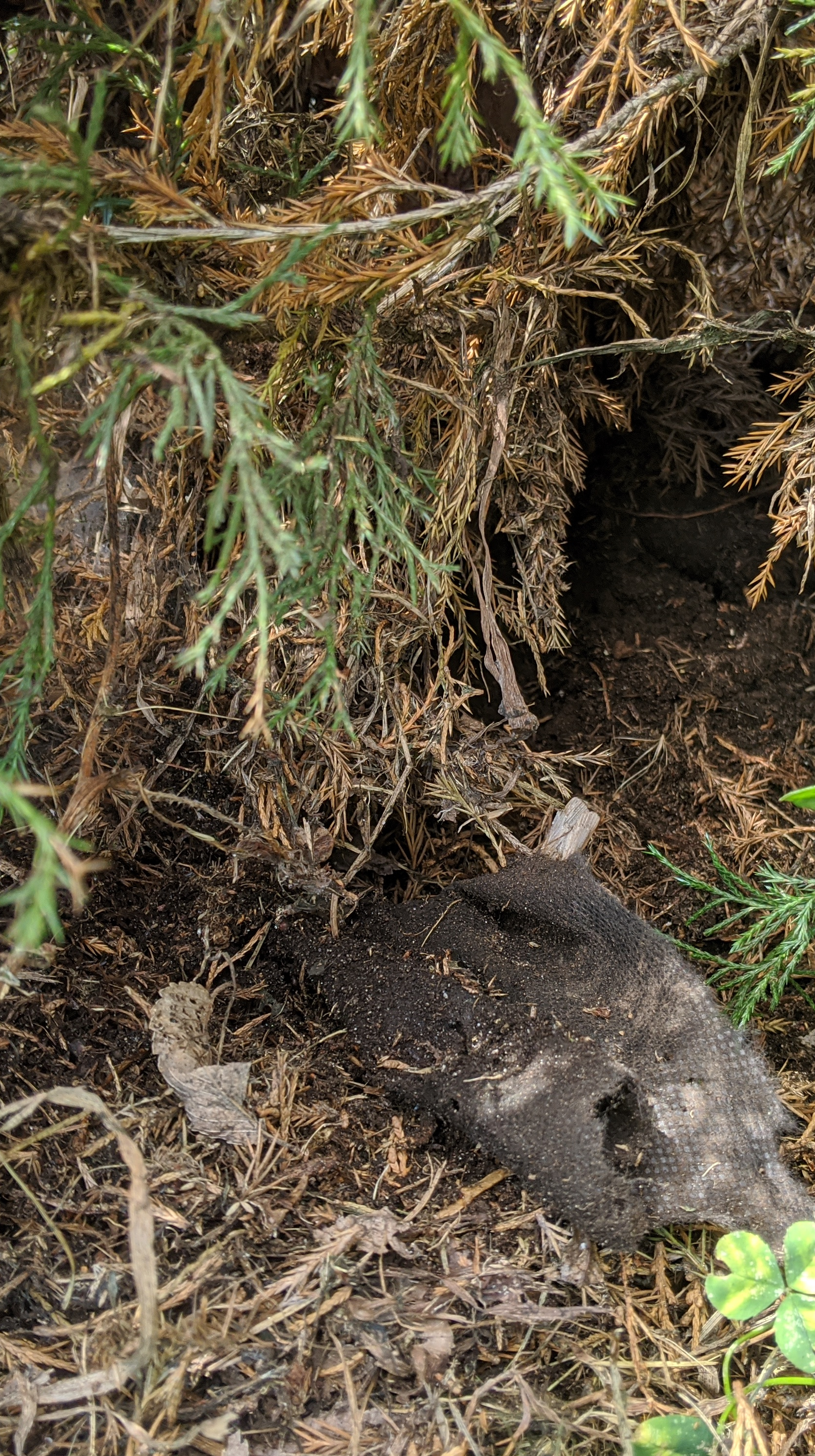
Landscape fabric I cut away from the tree. There was a clear indentation in the trunk where the tree was being choked (not pictured).
is due to something with the root system or choking somehow on the tree. I realize it’s a pain, but with as much work and money that goes into windbreaks, it’s a really good idea to take some time and pull weed barrier away from the tree trunks. A long-handled tool with tines can help but just make sure to carefully get all the way to the trunk to release any potential choking (I often have to get under the tree and cut the fabric next to the trunk to accomplish this). This goes for weed barrier used for any trees and shrubs. Weed barrier with rock is one of the biggest killers of plants I see in landscapes.
Bagworms are also impacting cedars, spruce, and various shrubs. Right now I recommend using Bifenthrin as it irritates the bagworms and makes them leave bags to be better exposed to the product. It has a two week residual and is used as an insecticide for many plant situations. Get really good coverage of the trees/plants when applying.
A number of fungal diseases are impacting evergreen trees. Many started the past few springs due to wet, humid weather. They are showing up worse now with recent humidity. The good news is trees can be treated with various fungicide products next spring that can be obtained from local hardware, farm, and landscape stores. PLEASE read and follow the label (can pull the label back in the store) regarding if the tree/plant is labeled for the product. I’ve been called out to disasters this year when the wrong products were applied to trees for which they weren’t labeled.
Japanese beetles continue to be a problem. Hopefully they’ll be finished in the next few weeks. Apply products at dusk to reduce harm to pollinators. Natural products include Neem and Pyola oil that can be applied every week. Conventional insecticides can provide 2 weeks of control: pyrethroid products like Tempo and Bayer Advanced Lawn & Garden Multi-Insect Killer (cyfluthrin) or Ortho Bug B Gone (bifenthrin).
York County Fair Open Class: Quick note for those exhibiting in York County Fair’s Open Class, we ask that you have entry tags completely filled out including mailing address PRIOR TO fair this year. Entry tags can be obtained from the York Co. Extension Office and Wagner Decorating. All rules same as last year except Needlework is limited to 3 entries per exhibitor. Exhibits can be dropped off on the WEST side of Ag Hall Tues. Aug. 4th from 6-8 p.m. and Wed. Aug. 5th from 8-11 a.m. Volunteers will take items into buildings as much as possible.
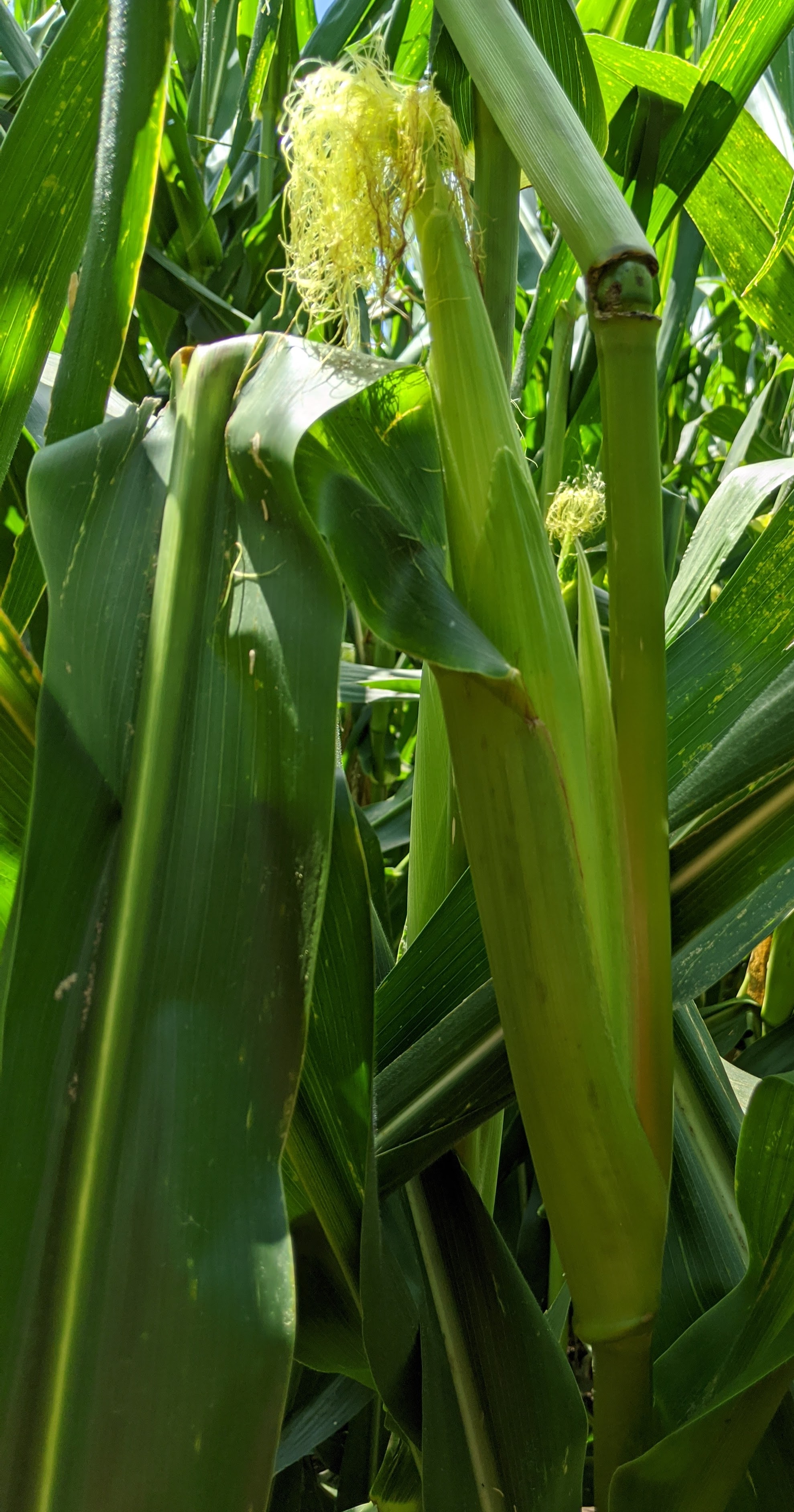
Ears able to elongate and expose silks to pollen on wind-damaged plants. Notice bent ear leaf that had been covering silks last week and bent node where plant was trying to right itself.
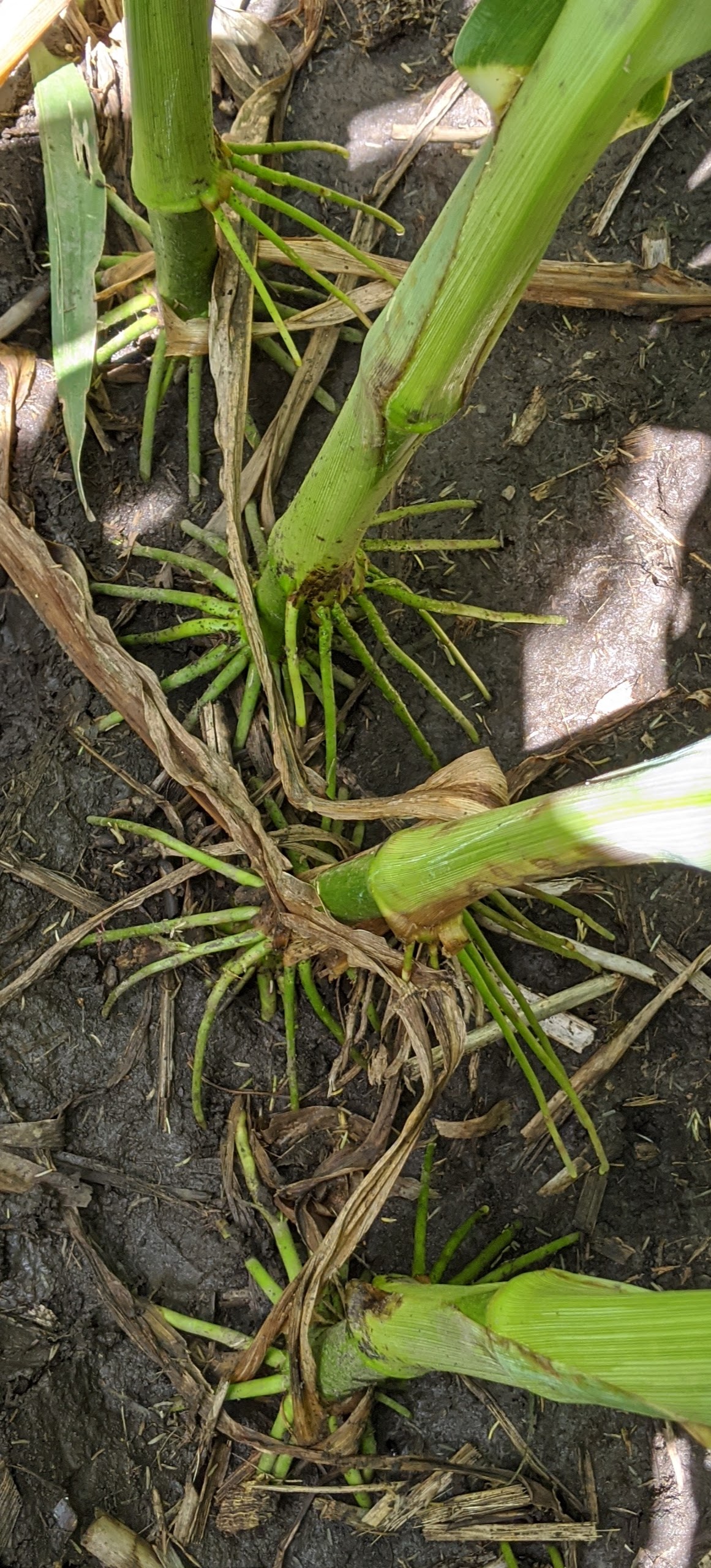
Second set of brace roots on leeward sides of plants now found the soil to support the plants with developing ears. Notice the emphasis placed on brace roots on that side instead of the windward side.
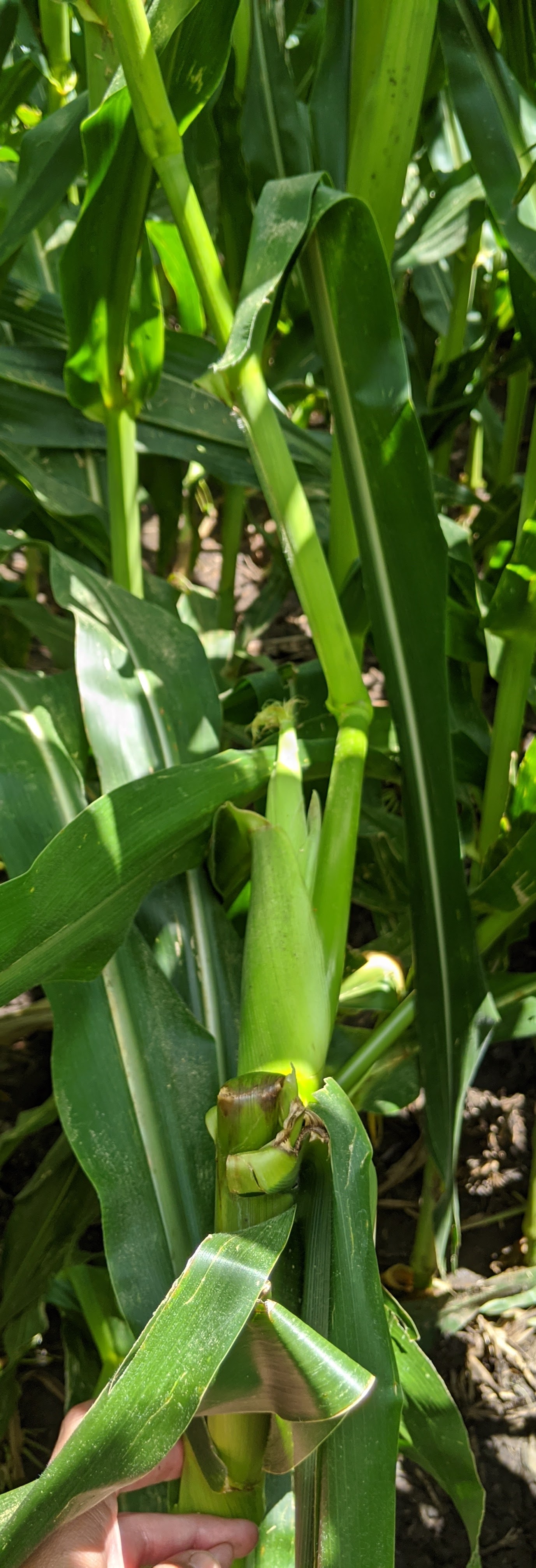
Seeing a lot of this. Pinched plants that bent at various angles to right themselves are fairly brittle and tend to snap as ears continue to develop and as one walks through fields.
The tertiary ear became the main ear on some bent plants. Notice the ear shoots of the primary and secondary ear (green things sticking out of nodes) on this plant and the messed up tertiary ear.
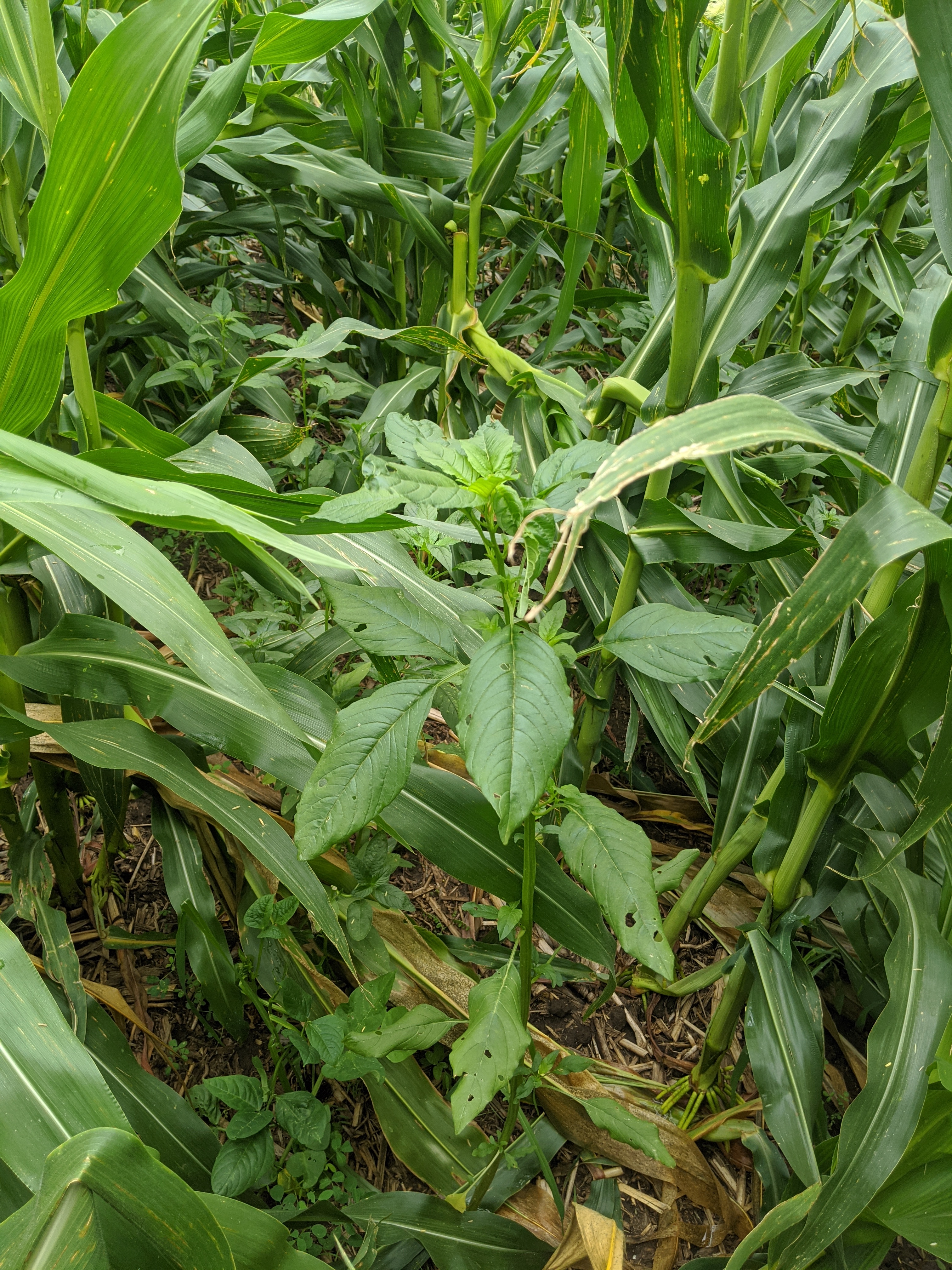
Hard to tell from this picture, but even the waterhemp righted itself in this field. This plant’s main stem actually goes to the left in the corn row but was pushed down under some broken corn so bent upright in the center of the row.
Have seen more of this for some reason this year. Solid ear with 1 or 2 additional ears on the primary ear node. Several hybrids across companies.
JenREES 7-19-20
Crop Update: The smell of pollen is in the air! Did you know each tassel contains around 6000 pollen-producing anthers? Two good articles from Dr. Bob Nielsen, Purdue University at https://go.unl.edu/x5tv.
How does heat impact pollination? Dr. Tom Hoegemeyer, former UNL Professor of Practice, shared that high humidity, without a drop in humidity during the day, can delay pollination or prevent pollen from leaving anther sacs. While heat over 95°F depresses pollen production, one day of 95-98°F has no or little yield impact when soil moisture is sufficient. After 4 consecutive days, there can be a 1% loss in yield for each day above that temperature. Greater yield loss occurs after the fifth or sixth day. Thankfully we’re not in a high heat pattern during this critical time of pollination!
My concerns regarding pollination: bent ear leaves covering silks in wind-damaged fields. Seeing a great deal of this. Also seeing silks continuing to elongate and grow through broken mid-ribs to increase exposure to pollen. Will continue to observe impacts.
Preliminary storm prediction center weather data showed a total of 93 wind, 11 hail, and 13 tornado damage reports on July 8th in Nebraska. Univ. of Wisconsin found lodged plants had yield reductions of 2-6% (V10-12 stage), 5-15% (V13-15 stage), and 12-31% (V17 and after stages). For greensnapped plants (below ear), Iowa State found in the worst case situation, yield reduction may range up to a 1:1 percent broken:yield loss. It’s possible these losses will be as low as 1:0.73 or even 1:0.50. We have an article in this week’s CropWatch (https://go.unl.edu/cwy2) with more detailed information. Recovery pics also at https://jenreesources.com.
Southern Rust was confirmed at low incidence and severity in Fillmore, Nuckolls, and Jefferson county fields this past week (probable for Thayer). Received questions on fungicide applications. In conversations, it seems like there’s fear of making the wrong decision and ultimately pressure to apply them. I realize economically it’s easier to justify adding a fungicide with insecticide when insect thresholds are met to save application costs. Most fungicide studies focus on VT applications; however, yield increases with automatic VT applications aren’t consistently proven in Nebraska.
In fact, in 2008-2009, a UNL fungicide timing trial was conducted near Clay Center on 2 hybrids (GLS ratings ‘fair’ and ‘(very) good’) with a high clearance applicator. Timing over the two years included: Tassel, Milk, Dough, 25%, 33%, 50%, and 100% Dent comparing the fungicides Headline, Headline AMP, Quilt and Stratego YLD.
- 2008: No yield difference on GLS hybrids rated ‘good’ at any of the timings (Tassel, Milk, 33% and 100% Dent) nor the check when Headline or Stratego YLD were applied. For the ‘fair’ hybrid, no yield difference for any application timing nor the check for the April 30th planting except for Headline applied at milk stage (increased yield). Low gray leaf spot pressure.
- 2009: No yield difference on GLS hybrids rated ‘very good’ or ‘fair’ nor the check on any timings (Tassel, Milk, and Dough) using Headline, Headline AMP, or Quilt. Moderate gray leaf spot disease pressure.
Thus I’ve recommended waiting till disease pressure warrants the application (have personally recommended apps as late as hard dough in previous years). Hybrids vary in disease susceptibility (thus response to fungicide application). The main ‘plant health’ benefit observed in Nebraska when disease pressure was low (ex. 2012) was stalk strength and that may be something to consider again in this lower disease year. Regarding any improved water use efficiency for drought-stressed plants, the peer-reviewed research published on this was in 2007. The researchers found slightly increased efficiency in well-watered plants, but it was reduced in water-stressed plants. They suggested fungicide use in water-stressed plants could potentially negatively influence water use efficiency and photosynthesis.


Same area of a York County Field taken morning of July 9th (left photo) and morning of July 13th (right photo). Grateful to see how plants are re-orienting themselves in many impacted lodged fields!
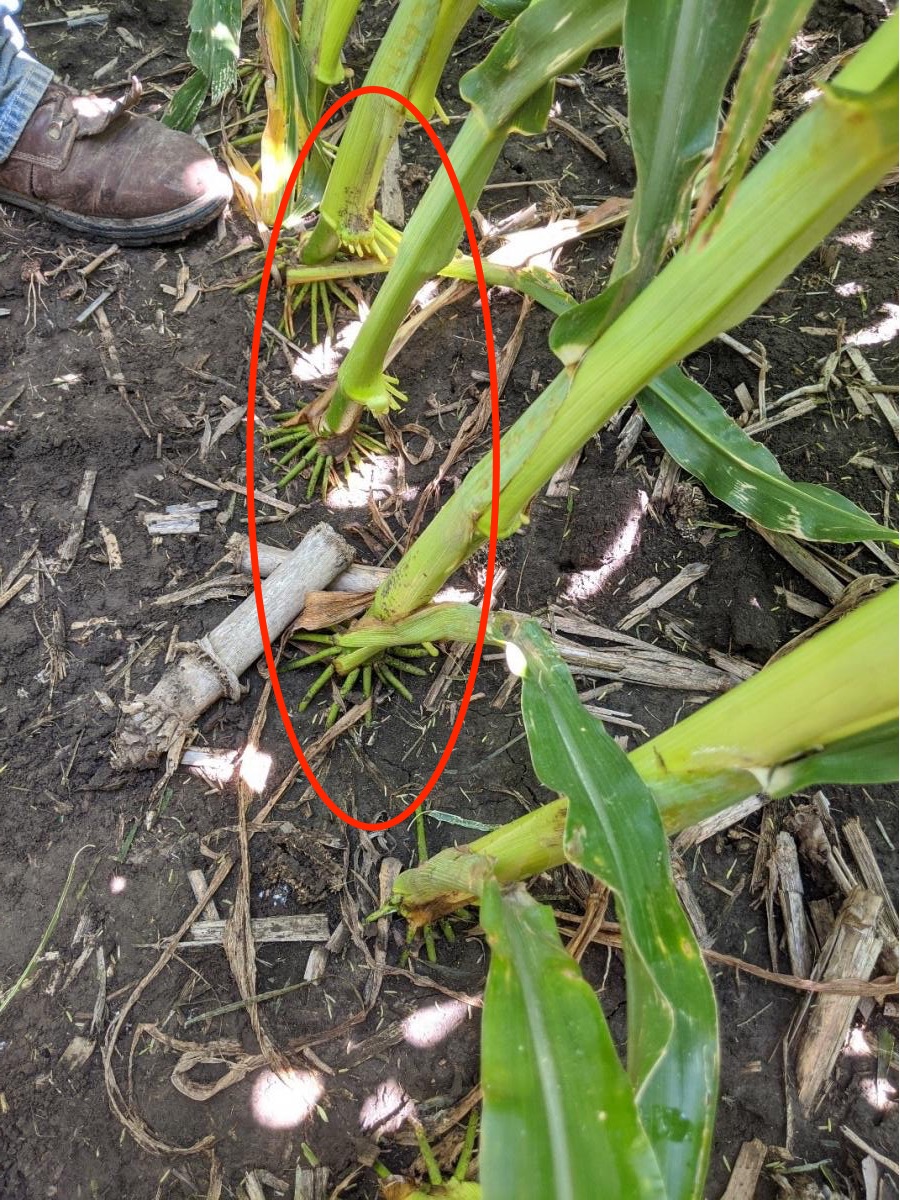
Plants re-orienting themselves by ‘pushing’ and establishing more brace roots on the leeward (leaned side) helping roots reconnect with soil on the windward side. Notice the additional brace root development within the circled area of this photo.
Plants reorienting themselves at each node at various angles and bends. Nodes become thicker to aid in reorientation.
Splitting open of thickened node. Additional cell division and/or elongation occurring at these nodes appears to help ‘push’ the stalk upward (geotrophic response).

Consistently seeing bent ear leaves covering silks in wind-damaged fields. Will have to watch any impacts to pollination.
Also seeing how either the ear or silks are working their way through tears in leaves or silks elongating to the side of the plant to try to pollinate.

Severely greensnapped field of later-planted corn.


Seeing some new growth on some greensnapped plants. Dissecting the growth revealed baby corn ears (they won’t amount to anything). Just shows the resiliency in plants regarding how they’re created to survive and reproduce. I never cease to be amazed by their Creator!

Seeing this very minor. Ear trapped within thickened husk/stalk tissue so forcing itself through side of plant. Silks visible first.
Opened this one to see curving of ear and some potential pinching occurring where ear was trapped above where it was forcing out of husk. Will be interesting to see any pollination and ear development impacts on plants like this.
JenREES 7-12-20
Wind-damaged Corn: The evening/early morning hours of July 8-9 caused quite a bit of  damage to corn fields for some of you reading this. It’s always hard to see crop damage. For field corn, it came at a critical time prior to pollination. The severity and amount of recovery for every field situation will vary depending on the soil moisture at time of the wind, root mass structure, hybrid planted, severity of leaning/bent/snapped plants, and growth stage of the plants. It will also depend on where the bending and snapping of those plants occurred. ‘Recovery’ encompasses the plants righting themselves, re-establishing roots, and re-orienting leaves as they have the ability to bend and grow up towards the sunlight in areas of the plant where plant tissues were not yet lignified (hardened). We know hybrids have been bred to better withstand greensnap. We know that plants that are leaning due to root lodging may have better ability to upright themselves (and have seen this in some fields since the storm). We also know that it is harder for plants near tasseling to upright themselves compared to plants at earlier vegetative stages.
What to expect? It really depends on the conditions outlined above. We all will learn a lot and I encourage us to share what we are observing. For fields very close to tassel with severe bending near ears, we may see pollination, possibly even ear formation issues. There may be fields that were leaning and will have minimal impacts after uprighting themselves. The main research I can find regarding corn lodging yield impacts comes from the University of Wisconsin in 1988. In the study, they manually lodged corn at various growth stages over 2 years to determine yield impacts. Corn lodged at V10-V12 resulted in a yield reduction of 2-6%. Corn lodged at V13-15 resulted in a yield reduction of 5-15%. Corn lodged after V17 resulted in a 12-31% yield reduction.
What to do? Recommend waiting, observing, call your crop insurance adjuster. Don’t apply products right now. Economically, we need to see how each field recovers before putting more into the crop. Plants are already stressed so give them time to try to recover. A respected agronomist shared another point with me-that adding heavy amounts of water right now can add weight onto the plants and keep them sticking together when they’re trying to separate. For those who were planning on fertigation, I’ve seen soil sample results and heard from several people that we’re seeing increased mineralization this year in fields due to the heat. It may be worth a tissue and/or soil test to see if you really need additional nitrogen (final application at brown silk). Regarding fungicides, my recommendation prior to the storm was to wait till at least brown silk (or after) due to low disease pressure, uneven growth stages in fields, waiting for southern rust, and economics; I stand by that after this storm. Fungicides can’t help much with the plant stress being experienced.
Spidermites have been found in low levels in corn, but in some cases, fairly high levels in soybean. Higher levels have been observed in stressed fields (due to off-target herbicide damage and/or beans stressed due to drought). If you’re noticing pockets in fields that appear to be yellow/brown/dying and spreading, check the top side of the leaf for stippling (yellow needle-like pin-pricks) and undersides for webbing and mites. Seeing them in non-stressed beans at low levels as well. Check out this information from Illinois for guidelines on when and how to control: http://bulletin.ipm.illinois.edu/?p=5080.
Gardening Resources: Nebraska Extension is hosting a series of 12 virtual learning sessions for home gardeners to discuss timely issues around vegetable gardening and trees. Each session will include a short (15-20 minute) presentation on the specified topic and opportunities for participants to chat about their issues and “ask the expert”. Sessions will be each Tuesday through September at 7 p.m. CST. Participants can register via go.unl.edu/grobigredvirtual – you can register for all the sessions you’re interested in at one time. You can also view the series via this Facebook post: https://www.facebook.com/events/1195072680839800.

JenREES 7-5-20
Corn: Corn plants are rapidly growing and at or nearing tasseling soon. One sign of rapid

Wrinkled/wavy leaf edge symptoms of rapid growth of corn.
growth is to look at the new leaf edges. Sometimes there will be a white margin, more transparent look, wrinkles, or notches in them. All of those are signs of rapid growth which take place during cell division.
Fertigation and Irrigation: Some fertilizer is occurring now before tassel. I also recommend 30 lbs of N at brown silk if needed. This is based on research from Purdue University sharing today’s hybrids use 30-40% of their total Nitrogen from flowering through maturity. In the past, some have asked about applying fertilizer during pollination. The following information is from Dr. Tom Hoegemeyer, Plant Breeder and UNL Professor of Practice Emeritus, “Pollination mostly occurs between 8:30 a.m. and Noon. Thus, as a precaution, I would not run a pivot on pollinating corn from 6 a.m. to Noon. When the temperature is 90°F to 95°F, the pollen is killed by heat and is seldom viable past 2 p.m. That leaves lots of time to run pivots, apply N, etc. when it won’t harm pollination. Silks tend to be viable for three or four days at these temperatures, so if a plant isn’t pollinated one day, generally the next day will work just fine. (If nitrogen is needed), I’d recommend that nitrogen go on as soon as practical. Corn nitrogen use is very high during the pre-tassel growth phase and again at kernel growth, from one to three weeks post pollination. About seven to ten days post pollination (before brown silk) lower N will start causing kernel abortion and serious yield loss in corn.” The UNL recommendation for fertigation is to use 30 lb of N with 0.25″ of water or 50-60 lb of N with 0.50″ of water.
Insects and Diseases: Thus far, insects and diseases have been pretty minimal in corn. Seeing some spidermites in low numbers. Japanese beetles are showing up in areas where they’ve traditionally been more of a problem. In corn, the threshold is 3 or more beetles per plant, clipping silks to ½” or less, with pollination less than 50% complete. The hard thing about the beetles is they have a long emergence of 3-4 weeks where they don’t all emerge at the same time…and they live as an adult for 3-4 weeks. The threshold for corn rootworm beetles for silk clipping is similar. Light trap data for western bean cutworm is showing moths are beginning to appear in low numbers. They prefer laying eggs on upper leaf surfaces of corn in late whorl stage to early tassel (however, I’ve seen them lay eggs on the underside of leaves and on leaves closer to developing ears in high heat). The current UNL economic threshold for treatment is 5-8% corn plants with eggs or larvae.
And, often there’s discussion about fungicide applications at tassel time or throwing in a

Corn ears with primordial tips looking like this are just one of several abnormalities (including ear abortion, barren plants, bouquet ears, pop-can ears) that can occur when NIS is applied to corn plants from V10-VT.
fungicide with an insecticide (or vice versa) to save an application cost. I shared a great deal about this a few weeks ago; please be very careful with growth stages and what is applied in the tassel time. With uneven emergence, not all plants in the field will be tasseling at the same time, which allows for corn ear abnormalities when NIS in particular is added to the tank (or is in the product formulations) and applied just prior to tasseling. That’s why I prefer to see fungicide applications delayed to at least full brown silk and preferably later if there’s no disease pressure to warrant the application.
Research at UNL South Central Ag Lab showed we can still apply fungicide to dough stage with no yield difference, particularly in low disease pressure years. The research also didn’t show an automatic yield increase with tassel applications. This allows us to account for southern rust which has occurred at some point all but two years of my Extension career. With tight economics, it just makes more sense to me to delay fungicide applications to when disease warrants it vs. applying too early as some have had to repeat applications (when southern rust occurred after applying too early). It’s also just good resistance management to not apply when disease and insect pressure doesn’t warrant it. Also be aware that we can see corn leaf aphids flare after fungicide applications as the fungicide kills a natural fungus that keeps their numbers in check. Aphids also can interfere with pollination by covering tassels.
Soybeans: As soybeans approach R3 (beginning pod), that’s the critical time to avoid

Japanese beetle on soybean. Japanese beetles can be identified by their metallic green heads and white tufts of hair on the abdomen that look like white spots.
water stress in soybean (similar to tassel for corn). We recommend avoiding irrigating during flowering whenever possible to reduce disease pressure (such as white mold and SDS). Don’t pull insecticide triggers too early for soybean defoliators. UNL recommends 20% defoliation at reproductive stages from all defoliators.
JenREES 6-28-20
Independence Day: As we approach July 4th this year, I can’t help but think how

different it may be on many levels, particularly from all that’s occurring in our Country. Our flag is one of the most beautiful things to me because it represents so much…many willingly put their lives on the line for my freedom and freedom for all of us…many dying to do so. The flag and patriotism, gratitude for this Country, those who serve(d), and families left behind means much to me (most likely to many of you as well). My hope and prayer is that this Independence Day also provides an opportunity for families to talk about our independence, freedoms, patriotism, respect, and that freedom isn’t free. I hope that in spite of all the challenges and division occurring that we would pause, remember, and be grateful that we live in the greatest Nation in the world! We are so blessed!
July 4th Food: To ensure you’re staying safe from food-borne illness and for fun family recipes, check out this information from our Food experts: https://food.unl.edu/july-food-calendar#4th!
Crop Update: Corn and soybean have been rapidly growing in spite of having difficulty in closing canopies this year. Dr. Roger Elmore shared a paper with me on high winds altering corn leaf architecture (will share more next week). So it may be part of what we’re seeing in addition to hybrid differences? Many continue to contact me about bacterial leaf streak and there’s nothing outside of hybrid tolerance to do for it. Seems like hail occurs weekly in some part of the State. Resource: https://cropwatch.unl.edu/hail-know/assess-my-damage.
Chiggers: For whatever reason, chiggers, ticks, mosquitoes all find me. There’s all kinds of information/hypotheses available as to why some people tend to get bites more than others. Never have chiggers gotten me as bad as this year! As bites tend to peak around the 4th of July with more families outdoors, here’s some things to consider. Chiggers (also known as redbugs or jiggers) are the immature stages of red harvest mites. They tend to hang out in moist, tall grassy/weedy areas such as along streams, road-side ditches, forested areas, lawns. But they can also hang out in moist and dry lawns with a lot of trees too. They bite humans and other animals including pets. Eggs are laid on clusters on plants and the larvae hatch and wait for their host to come along. They latch onto clothing, shoes, and fur and can hang on while working their way to the skin (often to an area where clothing is tighter like around socks, undergarments, back of knees and under armpits). They actually don’t burrow into human flesh. They only survive on a warm-blooded host for around 3 days before falling off to molt for the next stage in life cycle which doesn’t feed on humans.
They have needle-like mouthparts that allow them to pierce the skin then inject saliva that dissolves body cells in the area to aid them in feeding. Thus, they don’t feed on blood but liquefied cells. The feeding creates an allergic reaction in which many see swelling, intense itching, and small, clustered, red bumps (which can become larger welts in some). To prevent chigger bites, avoid sitting or lying on the ground when picnicking or working outdoors. Wear loose-fitting clothing and apply a repellent like DEET to shoes, socks, and pants before going into areas more favorable for chiggers. It’s also wise to take a hot shower with plenty of soap as soon as possible after being outdoors and launder clothing with hot water before re-wearing. Also launder any blankets/sheets being used outdoors. If you receive bites, rubbing alcohol can be used then apply an anti-itch cream to help reduce itching. Thankfully chiggers can’t live in the home but they can become dislodged in bedding and on floors, so laundering bedding and vacuuming is also wise.
Keep lawns and shrubs well-manicured, particularly where adjacent to dwellings. If you tend to have problems with chiggers in your lawn, they can be reduced from 75-95% for several weeks with a liquid treatment of bifenthrin. Be sure to read and follow all label instructions.
JenREES 6-21-20
Crop Update: The National Weather Service in Omaha shared that it’s been the 2nd hottest June on record (150 years) and the 2nd windiest June (72 years). It’s truly taken its toll on people, plants, and animals. It’s also resulted in increased stress levels with much to be done (spraying, hilling/cultivating, fertigating, changing herbicide plans, etc.) as crops rapidly grow.
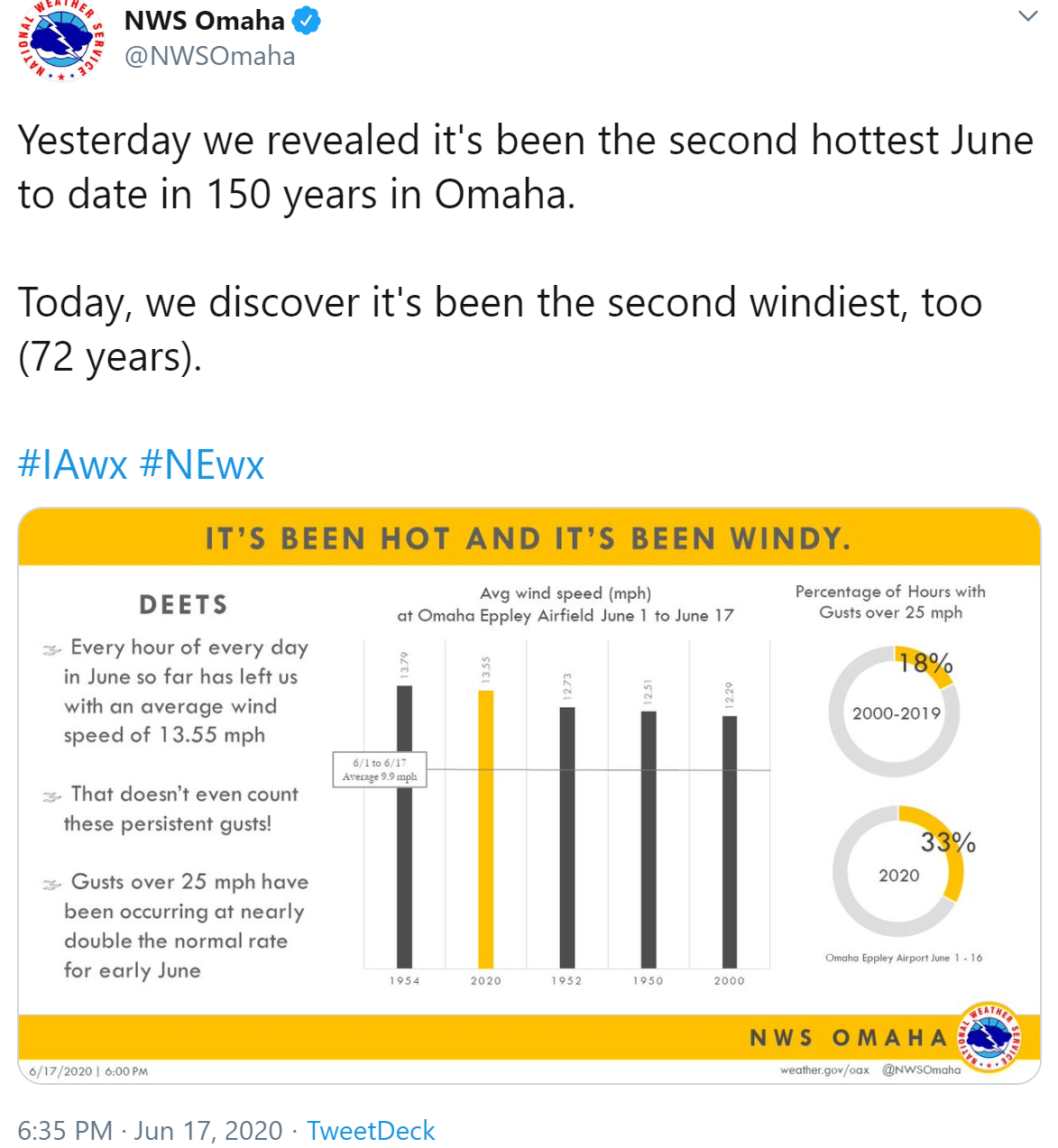
Tweet from NWS Omaha on June 17, 2020.
Since the Memorial Day rains, I’ve observed bacterial leaf streak (BLS) on corn in fields.

Bacterial leaf streak on susceptible hybrid this past week.
BLS has long, narrow, red/brown colored lesions that follow leaf veins. The lesions also have a yellow halo when backlit. Upon close examination, the lesion edges are wavy, which differentiate it from gray leaf spot. It started fairly minor, but some more susceptible hybrids are showing higher levels of lesions right now. There’s also been a number of whitish colored lesions on leaves from wind damage/sand blasting (if they

Been receiving a number of questions on white-colored lesions on leaves. Some are just due to wind damage. Some situations are herbicide related. A number of people are starting to notice BLS developing from these damaged areas on the leaves, particularly on more BLS susceptible hybrids.
weren’t due to herbicide situations). It’s from some of these wind damaged areas that BLS is also occurring. The bacterium causing BLS can infect directly through stomata; however, it can also infect through wounding. So the wind-driven rains and also high winds with sand blasting have also increased the incidence and severity of BLS in fields. Fungicides aren’t effective on it and it’s not known to result in yield loss.
Received a number of field calls/questions regarding herbicide application problems. Also recognize the challenge in figuring out a plan B, C, or D with some fields. Some practical things for those still needing to spray: know what traits are in what fields and double/triple check with whoever is spraying that the right product is going to the correct field. Double check the crop growth stage and the label as to what can be in the tank mix to avoid crop damage. Don’t go by plant height as there’s short beans that are flowering now and shorter corn in no-till and/or cover crop situations that is further along than one may realize. Proper tank/boom/nozzle cleanout is also always important to avoid crop damage to the next field being sprayed. And, spraying in high winds doesn’t help any of us.
For irrigation, UNL research shows we can wait till 35% depletion in the top 2 feet prior to tassel or top 3 feet once tasseling occurs. There’s a number of reasons why farmers have been irrigating: applying fertilizer, activating herbicide, small/replant crops with shallow roots, softening the topsoil for brace root establishment, and some may not be needing to water. There’s an article in this week’s CropWatch by Steve Melvin regarding irrigating considerations during the vegetative stages. We have a CropWatch poll to learn where people obtain their evapotranspiration (ET info.). Please help us by filling it out at: https://go.unl.edu/wxqv. There’s also ET and GDD info. available from CropWatch at: https://cropwatch.unl.edu/gdd-etdata and the NAWMN ETgage site (ET info. only) at: https://nawmn.unl.edu/ETdata/DataMap. The recent weather has helped with moving roots down. From digging plants and watching moisture sensors, many area fields from V7-10 have roots at least at 12” and below now.
Light Trap Reports: Light trap data can aid in scouting for various moth/butterfly pests. The closest light trap reports for the area are at UNL’s South Central Ag Lab near Clay Center and the Eastern NE Research and Extension Center near Mead. You can find all the reports online for the State at: https://entomology.unl.edu/fldcrops/lightrap.
Field Days: Weed Science (Clay Center) and Palmer Amaranth (Carleton) Field Days are cancelled for this year. Dr. Amit Jhala and his team are working on ways to present the data and information virtually. Nathan Mueller shared a self-guided tour is setup at the 2020 Jefferson County Winter Wheat Variety Trials in cooperation with Brian Maust (Variety Trial Technician) and Mark Knobel (hosting farmer). It’s located north of Fairbury on Hwy 15, then east 1 mile on 716th Rd, then 3/4 of a mile north on 569th Ave, east side of the road marked with a UNL sign. You can take a self-guided tour by grabbing a handout in the realtor box at the plots. It’s asked that you not walk/damage the wheat (i.e. pulling heads) and stay in the wide walking alleys. Please bring your own hand sanitizer so you can use it after touching the realtor box. Will keep you updated on additional information regarding these and other field days as details are released.

Also seeing low levels of woolly bear caterpillars in soybeans. This guy was moving with the wind/heat trying to get in lower canopy. Thresholds for soybean defoliation: 30% defoliation for anything defoliating soybean in vegetative stages and 20% with insects present in the soybean reproductive stages.


