
Ag and Flex Lease Workshop
Cash lease questions are continually one of the top questions I answer in the office. We’d encourage landlords, tenants, and spouses to attend this or a workshop near you to hear the most updated information for the coming year!

Grubs — Husker Hort

Happy Summer! June 20th marked the start of the summer season. Summer means a good time for cookouts, picnics, swimming, and grub control. Not exactly what you had in mind for summer fun? Knowing the pest and its habits can help keep you from spending all of your summer fun time dealing with grubs.
Youth Crop Scouting Competition — Views from VanDeWalle

Connecting Youth with Crops… Looking for a fun club project? Want to unite your club members? Running out of ideas for club meetings? If you answered, “yes” to any of these questions, help is on the way! Nebraska Extension is pleased to present the 3rd annual Crop Scouting Competition for Nebraska youth. Youth interested in […]
Crop Updates-May 2016
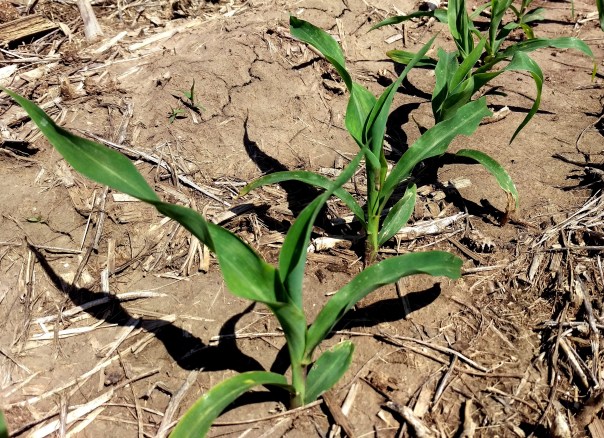
May 27: Sunshine has been welcomed for corn amidst the rains we’ve received. Corn ranges from 1-4 leaf depending on emergence dates. For those who put the majority of nitrogen application pre-plant, soil and/or foliar samples may be necessary to determine the extent of nitrogen available to the crop throughout the season.
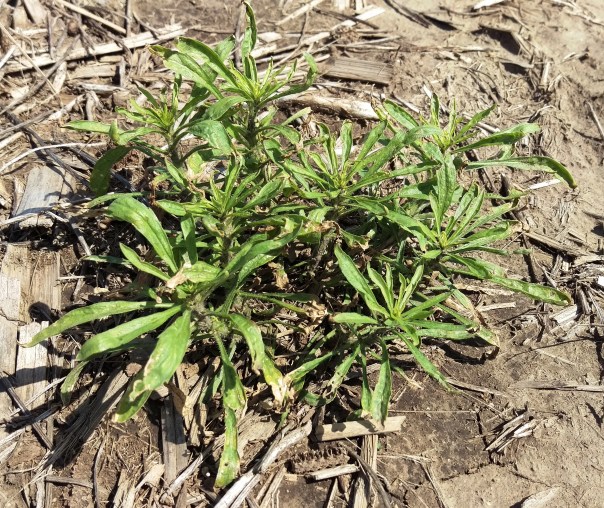
May 27: Receiving numerous calls on marestail escapes in corn this year. At this point, there’s no options guaranteed for 100% control. Our Guide for Weed Management shows options for 80% control right now including: Buctril + atrazine, Buctril + dicamba, Hornet, Realm Q, Resolve SG/Solida or Resolve Q, and Status. Please read and follow all label instructions. For soybeans, options are even more limited and control mostly goes down to 70%. Page 116 of our Guide for Weed Management provides options for consideration.
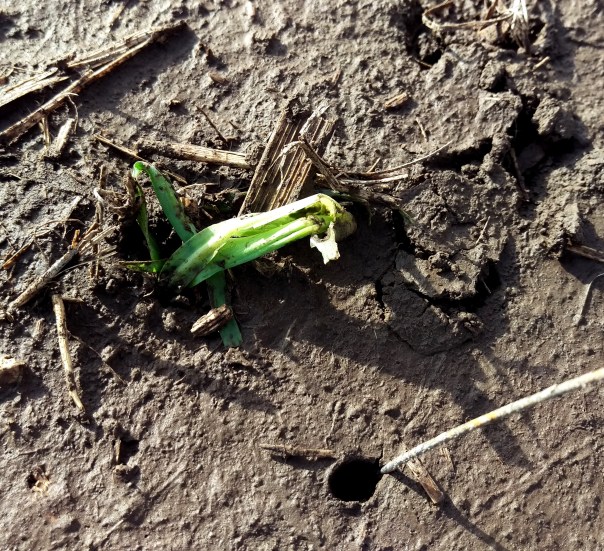
May 27: Also was called to a field for unique situation to me. Field had been two years of soybeans before planted to corn this year and had received hail 2 days before and over 4″ of rain within a few day period. Night crawler trails and holes the diameter of pencils existed throughout the field. The hail-stripped leaves were being moved down into holes. Where the stripped leaves were still attached to plants, the entire plant was bent over into the holes. It’s a unique situation in which the corn will hopefully outgrow with warm weather and sun. This unique occurrence is also mentioned at the following Purdue University website: http://extension.entm.purdue.edu/pestcrop/2010/issue9/index.html
May 23: Corn is looking good for the most part with few major concerns yet. Some have commented on the yellow-looking corn. This is most likely due to cool, wet soils rather than any nutrient issues. There may be field-specific issues such as saturated soils, compaction, and some herbicides that can cause this yellowing too. Also had a call on cutworms in seed corn but not widespread calls on this yet. Extension Educators have set up light traps for tracking cutworm moths and you can find that information here: http://go.unl.edu/rhhe. Cutworms will cause the most damage the first 7 days after corn emergence so scouting is important. The York County Corn Grower Plot was planted on April 24th with the corn currently at 2 leaf stage. Special thanks to Ron, Ray, and Brad Makovicka for hosting and the work put into this plot each year!
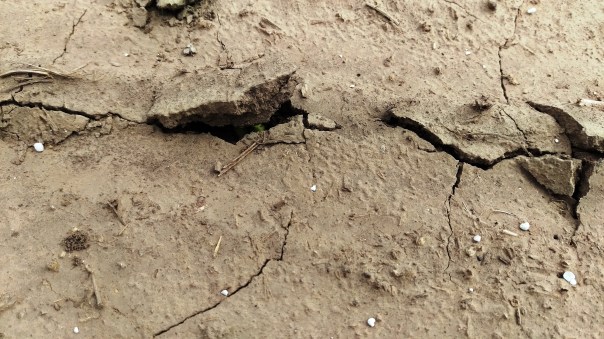
May 23: Soybeans are emerging and the concern several have discussed is crusting. Soybeans have an amazing ability to push through crusted soil and we were hoping for rains this past weekend to soften the soil and help them along. I’ve watched soybeans lose both cotyledons when trying to push up through the soil. Surprisingly these can survive if the growing point is still intact, and a small plumule will begin to develop.
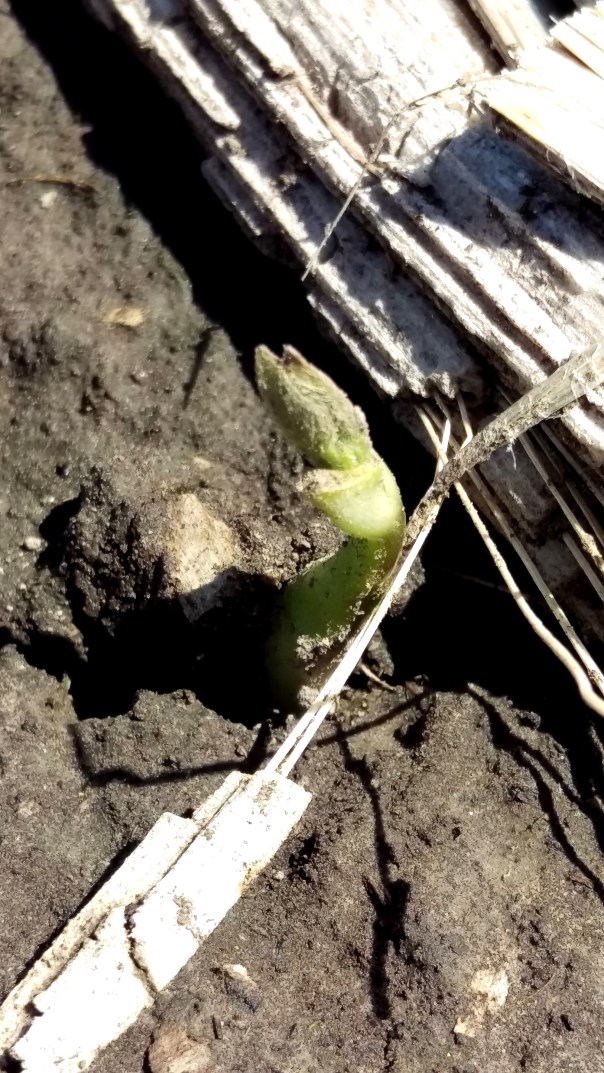
The plumule, which is the seedling stem tip and its undeveloped leaves above the cotyledonary node, may remain, but without the cotyledons to serve as a carbon and nitrogen source, development of new seedlings with small leaflets will be slow. These plants may not become competitive with surrounding plants. Therefore, when counting seedlings to determine plant stand after a soil crusting event, count only the seedlings that have at least one cotyledon. You can count seedlings missing cotyledons if they have large unifoliolate leaves that will soon unroll. Information from Purdue University shows that losing both cotyledons can lead to 2-5% yield loss.

May 15: After last week’s storms, some have wondered how long their germinated seed and emerged plants could survive under water. There isn’t a great deal of research regarding germinated corn hybrid seed. From some corn inbred research, it is not expected that germinated seed can survive in flooded conditions for more than four days. Within 48 hours, soil oxygen becomes depleted and crusted soils from heavy rains can lead to reduced emergence. A two day flooding event after soybean seed germination and imbibition (water uptake) reduced soybean stands from 20-43% in research conducted in the early 2000s. Corn less than 6 leaf growth stage at temperatures less than 77F can survive around four days. Temperatures higher than 77F may only allow those emerged plants to survive around 24 hours. As waters recede and for those who received hail on young corn, it will be important to monitor your plant stand. The high rains received early May 2015 in Nuckolls and Thayer counties resulted in a number of early corn diseases including bacterial soft rot and systemic goss’ wilt which reduced plant stands. We also saw an onset of anthracnose and a Xanthomonas bacterial disease that we couldn’t do anything about. Correct diagnosis will also be important. We would recommend monitoring your plant stand in ten areas of your field, counting plants from two adjacent rows in each area and assessing the distance of gaps between plants. Digging in the areas where gaps occur can help determine if seedlings still have an opportunity to survive. Seedlings that have leafed out underground or are corkscrewed will most likely not develop normally and may never make it out of the ground; it’s a judgement call on your part. An article is also provided in CropWatch this week to help with stand assessment for corn replant decisions at: http://go.unl.edu/iic6. One thing to keep in mind with the final decision table from Iowa State is that it all rests on an assumption of optimum planting of 35,000 seeds/acre planted in a window between April 20-May 5. That may or may not be a realistic assumption for your field conditions. Another thing to keep in mind is that while on average, as planting dates move into May, corn yields tend to drop, 2016 may not be an average year and the best planting date for 2016 with the weather conditions we’ve had may not have been the earliest ones. Regarding gaps, ISU shares gaps from 1.3-2.8 feet result in an additional 2% yield reduction while 4-6 foot caps result in an additional 5% yield reduction.
May 1: It never ceases to amaze me how quickly planting occurs each year! Corn planted the week of April 10th has emerged and for those fields that received hail from last week’s storms, I’m hoping we don’t see disease issues later on. Also of note, some have asked me about the CropWatch soil temperatures as they are higher than what some of you have been measuring in your fields before planting. The CropWatch soil temps at http://cropwatch.unl.edu/cropwatchsoiltemperature are averages of 24 hours under bare soil which may be different than the residue conditions in your fields and is an average of the entire day vs. one point in time. This may help explain some of the differences.
Many stands of alfalfa are lush green with over a foot of growth at this point. I looked at some alfalfa in Clay County that got dinged by cold temperatures in areas of the field and stopped growing. At this time I’m also finding quite a few aphids and a few alfalfa weevils. A disease common this time of year called spring black stem can be observed in nearly all alfalfa fields right now in the lower canopies. This disease consists of small black lesions on the leaves which eventually cause the leaves to turn yellow and drop. Normally this disappears with later cuttings as humidity and rainfall are typically high during the first cutting and can be managed with cutting the alfalfa. One option to consider according to Dr. Bruce Anderson, our Extension Forage Specialist, is to consider cutting alfalfa before bloom. He shares that weather can cause long delays and alfalfa doesn’t bloom very aggressively during spring. Bruce felt there were advantages to cutting alfalfa when it is 15-20” tall before bloom during first cutting including: weather compared to later spring, spread out alfalfa harvest if you consider cutting one field earlier, reduction in insect and disease problems by early harvest, and high feed value. It also potentially allows the second cutting to be ready before the summer heat which can lower forage quality. Disadvantages include lower yield from cutting early which could be made up in later harvest, regrowth may be slower if cut early, and the need to allow for longer recovery after first or second cutting to maintain long-term stands. So, harvesting before bloom may be something you wish to test in one of your fields this year and consider how this works for you, especially if you did have some frost damage or are having insect/disease issues in your alfalfa right now.
Wheat Updates-May 2016

May 27: Wheat is in the milk to soft dough stages of filling with later heads still pollinating in Clay/Nuckolls county fields. Stripe rust greatly increased in severity, particularly on susceptible varieties. This photo is showing progression on Overland. I haven’t seen stripe rust yet in fields planted to Wolf. Barley yellow dwarf is appearing in small amounts in more fields, but is limited to field corners/borders thus far.

May 23: (Photo: barley yellow dwarf in wheat-characterized by yellow-purple flag leaves. It is vectored by aphids). Wheat is in the late flowering to beginning milk stage in many Clay/Nuckolls county fields. Stripe rust increased in severity this past week in more susceptible varieties and barley yellow dwarf is also appearing more often in patchy areas of fields.
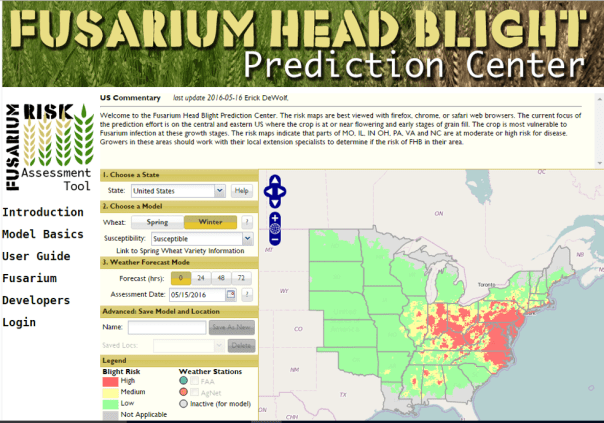
May 15: Rain is falling this morning in parts of our area and wheat is in a variety of heading and flowering stages. While the risk management tool at: http://www.wheatscab.psu.edu/ still says “low risk” I’ve been concerned it had the potential to be higher with our growth stage and weather conditions. Last week I received numerous wheat fungicide questions. Caramba and Prosaro are the two products you can apply legally once your wheat is flowering. Twinline is off-label once flowering begins. Yes, it has metconazole in it (also active ingredient in Caramba) in addition to a strobilurin, but it only legally can be applied to Feekes 10.5 which is full heading and is off-label once flowering occurs. Caramba and Prosaro will help prevent scab in addition to kill the rust already occurring in your plants. Unfortunately, I was also starting to see barley yellow dwarf appearing in Nuckolls County fields. This virus is vectored by a number of aphid species. We’d been seeing aphids and stripe rust for a month at this point but both remained below threshold levels/low incidence. Barley yellow dwarf can be identified by the flag leaf turning a bright yellow-purple color. With 80% of wheat yield coming from the flag leaf and there being nothing you can do about barley yellow dwarf, this also needs to be part of your decision making process if you were planning on applying a fungicide for preventing scab/controlling stripe rust.
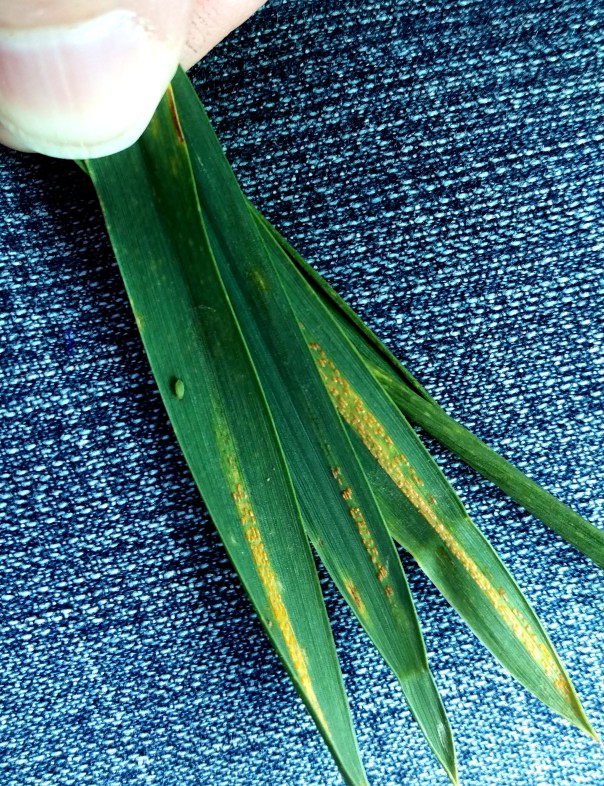
May 9: We’ve been seeing stripe rust in wheat for over a month now, but the amount of rust has remained low. Some have chosen to spray wheat at this point; however I’m also concerned about the potential for Fusarium Head Blight (scab) in wheat. Fusarium head blight is caused primarily by Fusarium graminearum, the same fungus causing Fusarium stalk, root, and ear rot in corn. The fungus survives the winter in corn and other small grain residue and then releases spores in the spring. However, wheat planted into soybean ground can still be affected by scab because the fungal spores can be wind-blown in addition to being water-splashed to wheat that is in the flowering stage.
According to research, wheat is susceptible from flowering through soft dough development stage. “Typical” fungicides used for control of fungal leaf diseases are off-label thus illegal to apply once the wheat has flowered and they do not have activity on the Fusarium fungus causing scab of wheat. Management for scab includes the use of the preventive fungicides Caramba or Prosaro. Both are labeled for headed and flowering wheat. There’s a 30 day pre-harvest restriction for both. Rainfast varies from ¼ hour to 2 hours or when dry depending on environmental conditions. Both fungicides can help prevent scab and control rust on the plant.
Research from the US Wheat and Barley Scab Initiative (which is a combined effort of several Universities in the U.S. and Canada) has found that the best prevention using these products occurs when wheat is headed and 30% of the plants are in the beginning flower stage. Application within five days of these criteria still showed positive results. This research also showed that application before or after this time period greatly reduced effectiveness of preventing scab. Understandably, the economics of fungicide application are difficult in wheat, yet, if you are aiming to make one application, this could be your best option for both scab prevention and controlling rust in your plants. The risk map for scab can be found at: http://www.wheatscab.psu.edu/. With wheat at heading to beginning flower and rain/humidity this risk in reality could be higher for us.
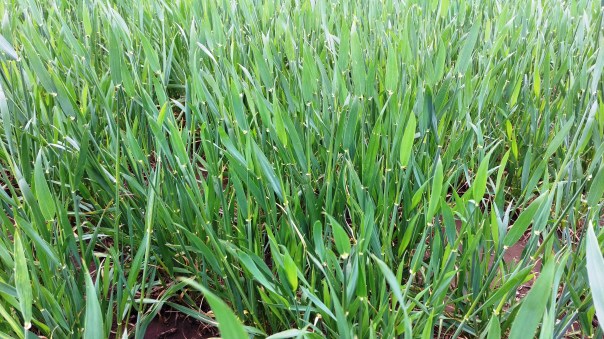
May 1: Wheat progressed quickly in one week! Wheat in Clay and Nuckolls counties have flag leaves emerged even though wheat is really short. The color is getting better thanks to moisture, root establishment, and nitrogen uptake. I also didn’t see an increase in rust incidence this past week and aphid numbers were holding steady. For those asking about fungicides, I’m still hoping we can hold off a little longer with current wheat economics, especially since in those counties rust wasn’t increasing due to the colder temps. With warmer temperatures this coming week, please be checking your wheat. If possible, one option that could be more economical in non-irrigated situations would be to consider treating your wheat once during flowering with either Caramba or Prosaro (as these products both prevent scab at the proper application timing and also kill fungal diseases including rust already present on the leaves). We’ll have to see what happens with rust development and with how long it takes for heads to emerge. There’s also been consistency with some varieties rated high for rust resistance where I have yet to find rust in them-so that’s a good thing!

Preemergents Can Only Do So Much
Elizabeth shares great tips on crabgrass prevention in an unconventional year!

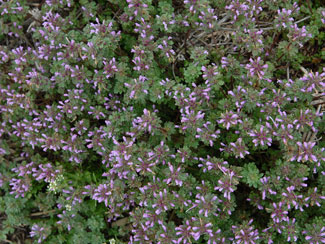 Applying preemergent now won’t help with henbit. Photo from cropwatch.unl.edu
No matter how a hard we try, we can’t predict Mother Nature, especially in Nebraska. The weather this year, throws all of my previous application recommendations for crabgrass preemergence herbicides out the window. On the bright side, we have been enjoying plenty of days with warm temperatures and so have our lawns and the weeds in them.
View original post 635 more words
Ag Day 2016
On March 15, 2016, we will celebrate National Ag Day. The Agricultural Council of America began celebrating Ag Day in 1973 with the desire to recognize and celebrate the contribution of agriculture in our everyday lives. This program encourages every American to understand how food and fiber products are produced; value the essential role of agriculture in maintaining a strong economy; and appreciate the role agriculture plays in providing safe, abundant, and affordable products.
Farm Facts
Today, each American farmer feeds more than 144 people which is a large increase from 25 people in the 1960s. Today’s farmers also produce 262 percent more food with 2 percent fewer inputs (labor, seeds, feed, fertilizer, etc.), compared with 1950. Farm and ranch families comprise just two percent of the U.S. population. According to the American Farm Bureau Federation, America’s rural landscape is comprised of around 2.2 million farms with 97 percent of U.S. farms being operated by families – individuals, family partnerships or family corporations.
Nebraska Facts
Regarding Nebraska, the Nebraska Department of Ag reports in its “2016 Ag Facts” card that cash receipts contributed almost $25 billion to Nebraska’s economy in 2014 and 5.9 percent of the U.S. total.
- Nebraska’s ten leading commodities (in order of value) for 2014 cash receipts are cattle and calves, corn, soybean, hogs, wheat, dairy products, chicken eggs, hay, dry bean and potatoes.
- Every dollar in agricultural exports generates $1.27 in economic activities such as transportation, financing, warehousing and production.
- Nebraska’s $7.2 billion in agricultural exports in 2014 translates into $9.2 billion in additional economic activity.
- Nebraska’s top five agricultural exports in 2014 were soybean and soybean meal, corn, beef and veal, feeds and fodder, and hides and skins.
- Nebraska had 49,100 farms and ranches during 2014; the average operation consisted of 921 acres.
- In 2014, Nebraska had 25 operating ethanol plants with a total production capacity of 2.125 billion gallons.
- Nebraska ranked 2nd among states in ethanol production and utilized 43% of the state’s 2014 corn crop.
- Livestock or poultry operations were found on 49% of Nebraska farms.
- 1 in 4 jobs in Nebraska is related to agriculture.
- From east to west, Nebraska experiences a 4,584 foot elevation difference and the average annual precipitation decreases by one inch every 25 miles.
- Between 2007-2012, Nebraska experienced a 5% increase in the number of farms and 10% increase in the number of new farmers.
Future of Agriculture
As we look at the future of agriculture, many challenges and opportunities lie ahead. We are tasked with feeding over 9 billion people by 2050 with less land and water resources and more efficient inputs…essentially do more with even less while being environmentally sustainable. Water quantity and quality will continue to be important. We are in an exciting time of technological advancements providing numerous opportunities for young people to attain careers in agriculture. Technological advancements with seed and animal genetics; variable rate applications of fertilizer, water, seed/hybrids and other inputs; the use of unmanned aerial systems (UAS), satellite, or other aerial technologies; and much more. Perhaps the largest challenge agriculture faces is the continually growing disconnect between our consumers and from where their food originates. Social media, internet, TV personalities, and activist groups have done much to share mis-information and spread fear regarding production agriculture. Many farm families are working to share their own farm stories which is wonderful and I would encourage more to do so! Perhaps in some ways we in agriculture are our own worst enemies? I wonder if we could exponentially change the course of this growing disconnect if by instead of the divisions that occur based on production practices and marketing we would unite together under a common mission? Perhaps one of providing the opportunity of consumer choice in a world where our ultimate goal is to provide a safe, abundant, and affordable food supply?


 JenResources