Youth Discover Crop Science
An excellent opportunity for youth to become detectives and have fun while learning about crops and science! Consider having a youth you know attend this Big Red Camp and learn more about agriculture careers! There are also scholarships available to attend!

Are you interested in science, agriculture, plants, crops, insects, or diseases? If so, join our team of detectives to solve crop-related problems in the Crop Science Investigation (CSI) Big Red Camp! Become a detective while participating in hands-on sessions to learn about and increase your knowledge of crops, science, and agricultural careers. Youth detectives will interact with agronomic professionals across Nebraska to solve experiments in: nutrient management; managing disease, insect and weed problems; water management; crop production, and much more! Do you have what it takes to become a CSI detective?
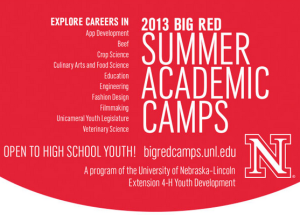
There are a variety of careers related to plant sciences such as:Agricultural Communicator; Agronomist; Crop Consultant; Crop Insurance Adjuster; Educator; Co-op Manager; Farmer or Rancher; Farm Credit Banker; Field or Lab Researcher; Plant Breeder; Soil or Water Conservationist; Seed, Fertilizer, or Chemical Sales; or Technical Representative.
Scholarships are available in the amount of $300 to participants who…
View original post 243 more words
Mobile Ag Apps from UNL
This week I saw an article from agriculture.com that had ranked UNL’s Market Journal app as the Number 1 agriculture app! I’ve also felt it was the 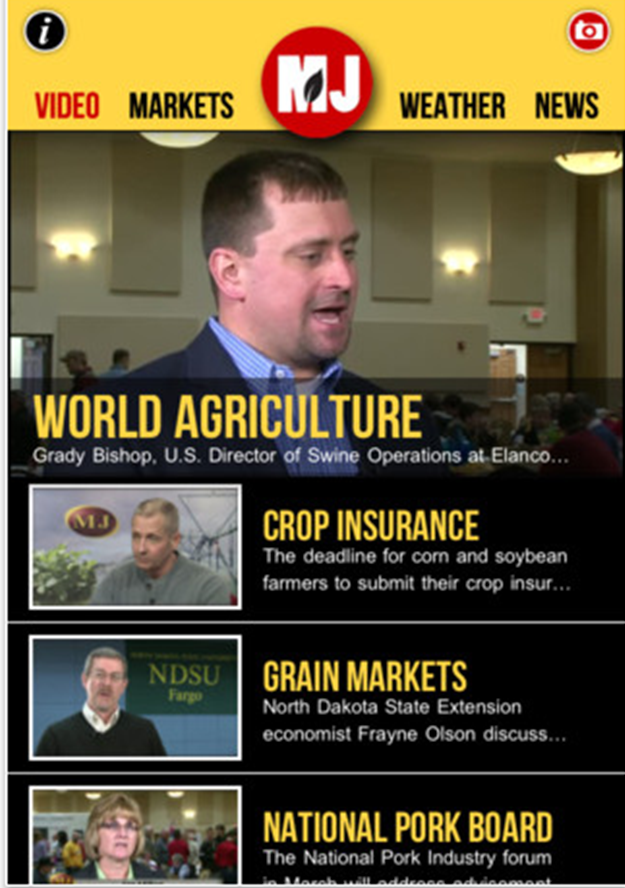 best ag app from UNL providing markets, each week’s show segments via YouTube, weather, and all the CropWatch articles in a one-stop app.
So being snowed in right now, I thought it would be a good time to share some new apps developed by UNL. The newest ag apps are for livestock. Some of you are in calving season and UNL Extension just released the NUBeef-BCS (body condition scoring) and NUBeef-Anatomy apps that may be helpful. They are available on the Apple App Store and will be via Google Play shortly.
NUBeef-BCS allows producers to visually assess their cow herd using a number system that objectively describes the amount of condition or fat reserve of the animal. Body condition score describes the relative fatness of a cow based on a nine point scale. When using the NUBeef-BCS app, producers can simply take photos of their beef cows and then score cows at important times throughout the year, such as at weaning and before the start of calving and breeding season. Taking pictures of the same cow multiple times throughout the year allows producers to better manage the herd according to Rick Rasby, UNL Beef Specialist. He said one of the challenges during winter is producers want to score body conditions, but cows have their winter hair coats. The app includes drawings of cows in different body condition scores that also can help with that. An added component to the app is an education component and is designed for instructors to use at all levels-from high  school, junior college, and four-year colleges. The app has a group of cows that have already been body condition scored that can be pulled up and used to practice scoring.
The NUBeef-Anatomy app provides visual and text information about the muscles and bones of the beef carcass. The user can navigate through the carcass by displaying cross-sections and then touch any muscle or bone to display the respective physical and chemical properties. Check out the NUBeef YouTube channel for more info. or watch Feb. 1’s segment of “Market Journal”.
A listing of all mobile apps from UNL Extension can be found here.
Keeping Your Farm in the Family for the Next Generation
I would encourage any farmers, spouses, and adult children to consider attending this Farmers and Ranchers Program! Communication and fair transition plans are keys to keeping family ties and the family farm strong. I’ve watched too often where communication doesn’t occur-even most recently with my extended family-and the heartache caused as a result. Work on the communication and transition plan now before it’s too late!
The final Farmers & Ranchers College program for the 2012-13 programming year will be held on March 14, 2013 starting at 6:00 p.m. with a meal and the program to follow. It will be held at Evening with Friends Restaurant in Milligan and will feature Dr. Ron Hanson, Neal E. Harlan Professor of Agribusiness, Ag Economics Dept., UNL. A description of Hanson’s program is provided below.
The entire process for mapping out a succession plan to transfer the eventual ownership of a family farm from one generation (parents) to the next generation (their adult children) can be an overwhelming task for many families. Where does this process even begin? Who makes the final decisions? Can you be fair to everyone involved? What if there is not good communications within the family? How do you keep emotions and personal jealousies from taking over and preventing good decision making? These…
View original post 348 more words
Wordless Wednesday: Technology in Ag
Captured pics of slides at last week’s Nebraska Ag Technology Association Conference. What comments do you have about them?


Ag: What’s Around the Corner & Down the Road
In December, Dr. David Kohl, Professor Emeritus from Virginia Tech spoke at the Farmers and Ranchers College. Dr. Kohl always has great insight and for those who read his articles, it’s extra special to hear him fit what he knows and sees all together into one talk! He moves fast and my pen was flying but I’ll do my best to summarize some key points I took away.
Dr. Kohl talked about how to become a “cut above super producer”. Essentially much of this comes down to a profit plan (60-30-10) where 60% of profit focuses on efficiency then growth. One way to do this is to focus on doing better before you worry about getting bigger. 30% needs to build working capital. The final 10% he says to do what you want with it but don’t let 10% become 60%. Dr. Kohl shared a statistic where 19% of producers (85% of whom were grain producers) who had an income of around $85,000 spent 1000% on living expenses. I heard a similar remark from Tina Barrett with the Nebraska Farm Business Association at a different meeting. Producers need to know what your family living expenses are and get them under control.
He also shared some questions regarding working capital for producers to consider.
1) Is your inventory protected? 2) How long will inventory take before it becomes cash? 3) Are contracts/receivables good? Know who you’re doing business with. He gave several examples of how those with too much debt took others under with them. 4) As you’re writing a lot of checks out now for prepaids realize you won’t see financial capital for 8-12 months. Thus, how much working capital is absolute cash? He recommended having at least 1-2 months available. 5) Look at your lines of credit and payables.
Dr. Kohl gave a stat that there’s a 500:1 odds of a business making it to the 5th generation. Some qualities of a long-lived business include strong sense of core values, frugality, transition/planning (and he emphasized this is not an estate plan), professional development (1% of revenue should go to employee improvement and development), and building relationships. He also shared the primary pitfalls of transition being the younger generation taking over an unprofitable business, younger generation acquiring rusted out, worn out and faded out assets, and assuming non-farm sibling(s) has/have no interest in farm assets.
There are many reasons to be optimistic about agriculture as well. By the year 2050 we need 100% more food, fiber, and fuel and 70% of that will come from new technologies. One in six jobs is related to agriculture. There’s a place for everyone-conventional, natural, organic, local-just know that they all won’t do the same in feeding the world. It was a very interesting presentation! You can read another perspective from Brandy VanDeWalle’s blog!
Great comments from Chris Chinn regarding the Paul Harvey Poem “So God Made A Farmer” and how it applies to the Modern Farm!!! I am a football fan, though, and can relate to everyone who got a little tear in their eye after watching this commercial. Please share the YouTube video as for every view, Dodge will make a donation, up to $1 million, for the Future Farmers of America (FFA)!

I’m not a big football fan but I do love spending time with my husband. My husband watches one football game a year on TV, and that’s the Super Bowl. Many of my friends tell me how lucky I am that Kevin doesn’t watch more sports on TV. I think I’m lucky because my sweet farmer fell in love with me! I am like a lot of other people, I watch the Super Bowl for the half time show and the commercials. This year though, I wanted to watch the game because the Ravens had Michael Oher playing for them. The movie the ‘Blind Side’ was based on his life. Michael was adopted by the Tuohy family in Tennessee and they helped Michael grow in many ways, mostly just by loving him and giving him a place to call home. (I love that movie because it reminds me there…
View original post 1,138 more words
On-farm Research
Wow, I’m sorry I haven’t published much the past two months! Much has happened though as we’re in the middle of winter Extension ag programming season! I love this time of year seeing farmers and ag industry reps-and just chatting about what happened last year and speculating about the upcoming season.
Many of you are also attending numerous meetings. You’re gathering information regarding products and production practices. You may be wondering “Will this work on my farm?” Why not go a step further and see for yourself? On-farm research is a great way to test these questions for yourself using your own equipment in your own fields!
UNL Extension has partnered with the Nebraska Corn Board and Nebraska Corn Growers to form the Nebraska On-farm Research Network. There are three main studies we are conducting state-wide: corn population, corn nutrient, and corn irrigation studies…but we are open to helping you design a valid research experiment for your field to test what you would like-and it can be for a crop other than corn.
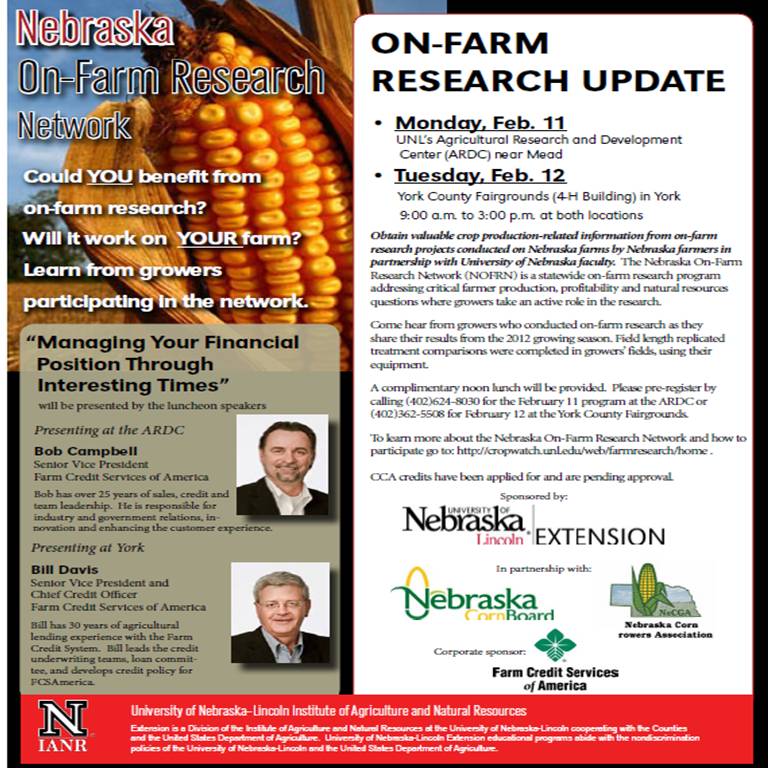
We have some upcoming opportunities for you to learn more. On February 11 and February 12 from 9:00 a.m.-3:00 p.m. at UNL’s Ag Research and Development Center near Mead and the York Co. Fairgrounds in York respectively, growers who conducted on-farm research in 2012 will be sharing their results; you can also learn more about conducting on-farm research in your own field. There is no charge for the meetings courtesy of the Farm Credit Services of America but we do need an RSVP for meal count and handouts. Please RSVP by calling (402)624-8030 for ARDC or (402)362-5508 for the program in York. I hope to see you at these meetings as well!
Social Media for Business
Check out these great opportunities to learn more about social media for your business!

UNL Extension in Seward County will be hosting the Social Media & Mobile Technology for Ag Businesses Webinar Series starting on January 17, 1:00 p.m. at the Extension Office, 216 S. 9th St, Seward, NE 68434. This is a partnership effort with Penn State, Ohio State and University of Nebraska Extension. You can register by calling 402-643-2981 or register at http://go.unl.edu/xmd. Note that there is no charge for attending one or all of these one hour webinars if you join me at the Extension Office.
- January 17 – Mobile Usage and Payment Technology
- January 24 – Introduction to Linkedin and Pinterest
- January 31 – Maps/Apps – Mobile & Location based Marketing
- February 7 – SM Analysis Tools for Facebook, Twitter, Pinterest
- February 14 – Top 10 Trends and Cool Tools in Social Media
- February 28 – Keeping Up with the “Technology”
- March 7 – Getting the most from Facebook
View original post 52 more words
Great opportunity for women in agriculture interested in learning more about risk management! Brandy VanDeWalle, Extension Educator in Fillmore County is hosting this series of workshops.
Soon 2012 will be in the books and with the New Year approaching, what a better time to set resolutions for your business! Developing management and decision-making skills for farms and ranches is becoming more important than ever before. Today’s volatile agricultural markets can increase your risk if not managed properly. The University of Nebraska-Lincoln Extension is offering a program to address these issues.
Annie’s Project is a six-week course designed especially for farm women to help them develop their management and decision-making skills for their farms. Sessions include brief presentations, discussions focused on the participant’s questions, and computer training to use spreadsheets. Annie’s Project gives farm women the opportunity to learn from agricultural professionals and network with other women in similar situations.
Annie was a woman who grew up in a small town in Northern Illinois. Her goal was to marry a farmer and she did. Annie spent her…
View original post 121 more words


 JenResources