Blog Archives
July 2024 Crop Update
The past 10 days, my top questions have been around fungicide recommendations, control of Japanese beetles, and hail damage. I feel there’s an increasing segment of agronomy that is focused on preventing pests based on fear. I’m grateful for those agronomists who only recommend products when warranted by scouting.
Some thoughts, although not popular, for consideration. Fungicide for white mold in soybean is pricey. If the field didn’t have a history of white mold, I wouldn’t recommend applying a fungicide for white mold. For seed corn fields without a history of white mold, I’d wait to see if white mold develops. If too fearful, would only apply one application at R2. Only fields with a history of white mold would I be considering preventive fungicide applications. And in those fields, if the beans had been planted green into a small grain and/or if a biological product with activity against white mold was used, would suggest scouting and applying only if white mold was present. Fungicide efficacy ratings: https://cropprotectionnetwork.s3.amazonaws.com/soybean-foliar-efficacy-2024.pdf.
Hail: Looked at quite a bit of hail damage in Clay/Fillmore counties last week. Always so hard to see beautiful crops impacted or destroyed. Some hail resources for you: late vegetative/tasseling in corn: https://go.unl.edu/y3of, Soybean decisions: https://go.unl.edu/z7ad; and hail damage info. on my blog at https://jenreesources.com.
Corn Diseases: There’s very little I’ve seen in fields. Bacterial leaf spot (BLS) is common on hybrids and can be confused with gray leaf spot. BLS has longer, thinner lesions with wavy lines when looking at the lesions closely. I’ve seen quite a bit of Goss’ wilt, as early as V8. There’s nothing we can do for either BLS or Goss’s as bacterial diseases, but it’s good to be aware they’re occurring.
Tar spot has been found in Richardson, Nemaha, Saunders, Dodge, Colfax counties but not in our area. Southern rust has been found in northeast Kansas. I still recommend waiting on fungicide applications until we need them. Research found that products applied between tasseling and milk when tar spot was present in low amounts (5%) was effective in controlling tar spot most years. So, waiting could be wise with tight economics, particularly if tar spot, gray leaf spot, and southern rust come in later.
Japanese Beetles in crop fields: Usually the beetles congregate in areas in the field and not whole fields. So even at a 20% defoliation in soybeans during reproductive stages, it’s been hard to pull triggers for spraying because it’s not field-wide defoliation (and we’ve seen soybeans recover in the past). For corn, the threshold is 3 beetles per ear with silks clipped less than ½” and 50% or less of the field is pollinated. A challenge with Japanese beetles is that we have another potentially 4-6 weeks of emergence from grassy areas. So, one can spray an insecticide, but it’s not uncommon to see the beetles damaging fields again once the residual wears off. Spidermites can also be flared upon insecticide applications. Some consider a border app since they begin feeding in the borders. So, those are all things to consider.
Sevin and Japanese Beetles: For homeowners, PLEASE read the pesticide labels before applying products (even if you’ve used that same product in the past). I do mention Sevin as a product that can be applied in different situations in this guide: https://go.unl.edu/xgd6, but not all Sevin formulations are the same; thus, not all the same plants are labeled! We’ve unfortunately seen some plants injured to the point of death in the past. So please, double check that the plant is labeled before applying an insecticide product to control the beetles.

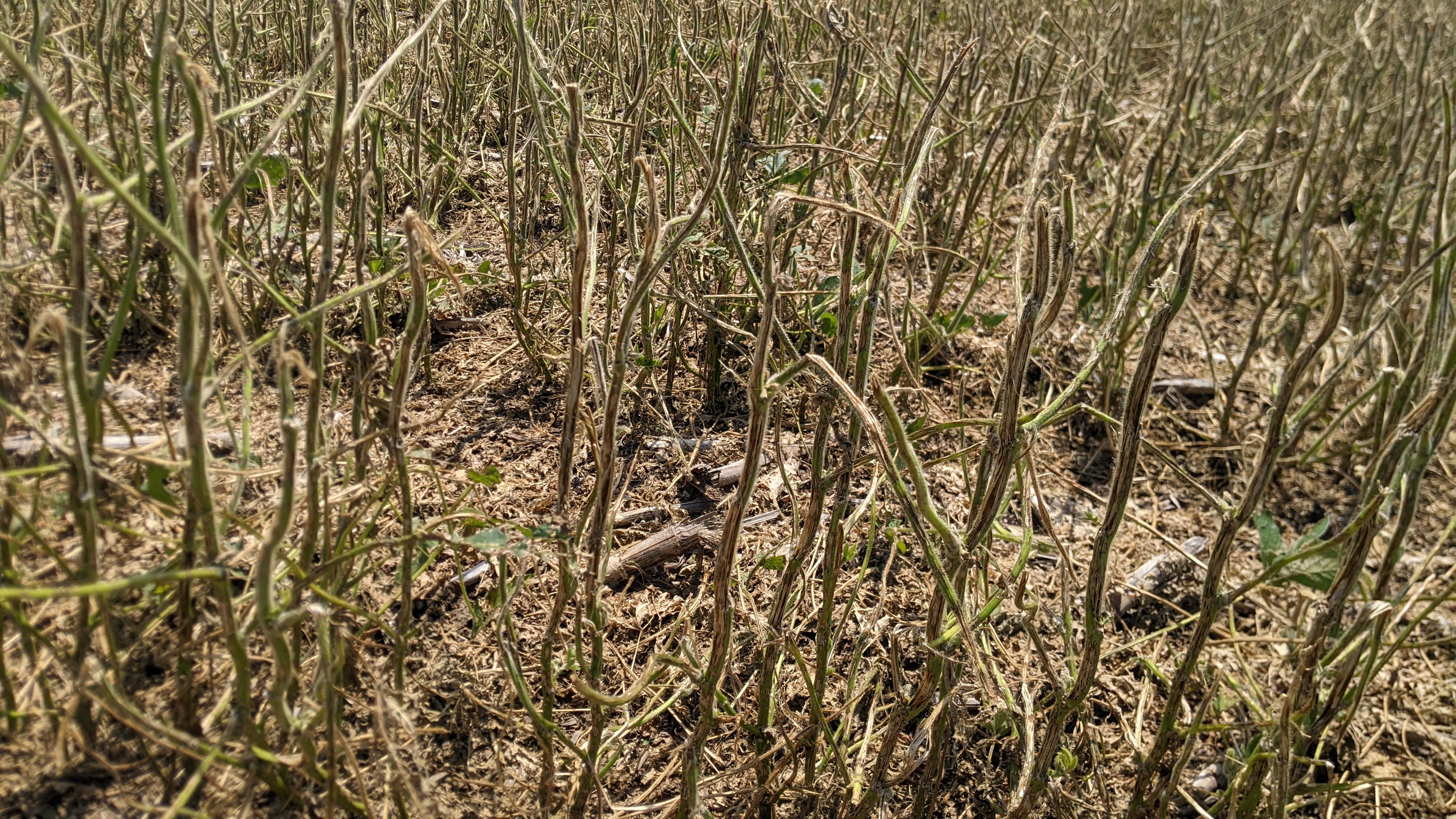


For soybean damage, the situations with pictures shown here (other than the top right) will recover. These fields are already showing new growth in axillary buds including new leaves and flowers. While some canopy was lost, they will look a lot better in 7-10 days. Look for areas of the field (lower right picture) that were protected such as by trees and/or pivot tires, to determine the original development stage when the soybeans were damaged. In the case of the upper right photo, those beans were planted the week of April 10th and were already at a strong R4 to beginning R5. By R5, soybeans will not recover because all new node, leaf, and pod development ceases. If considering to replant any beans, there’s risk of using later than a 2.5 maturity variety with a July 15th planting date in reaching maturity before a frost. By July 20th, aiming for closer to a 2.0 maturity is wise. Also, if you’re replanting into soybeans, we’ve found a fungicide seed treatment is wise as phytophthora root rot tends to be a problem in replant.
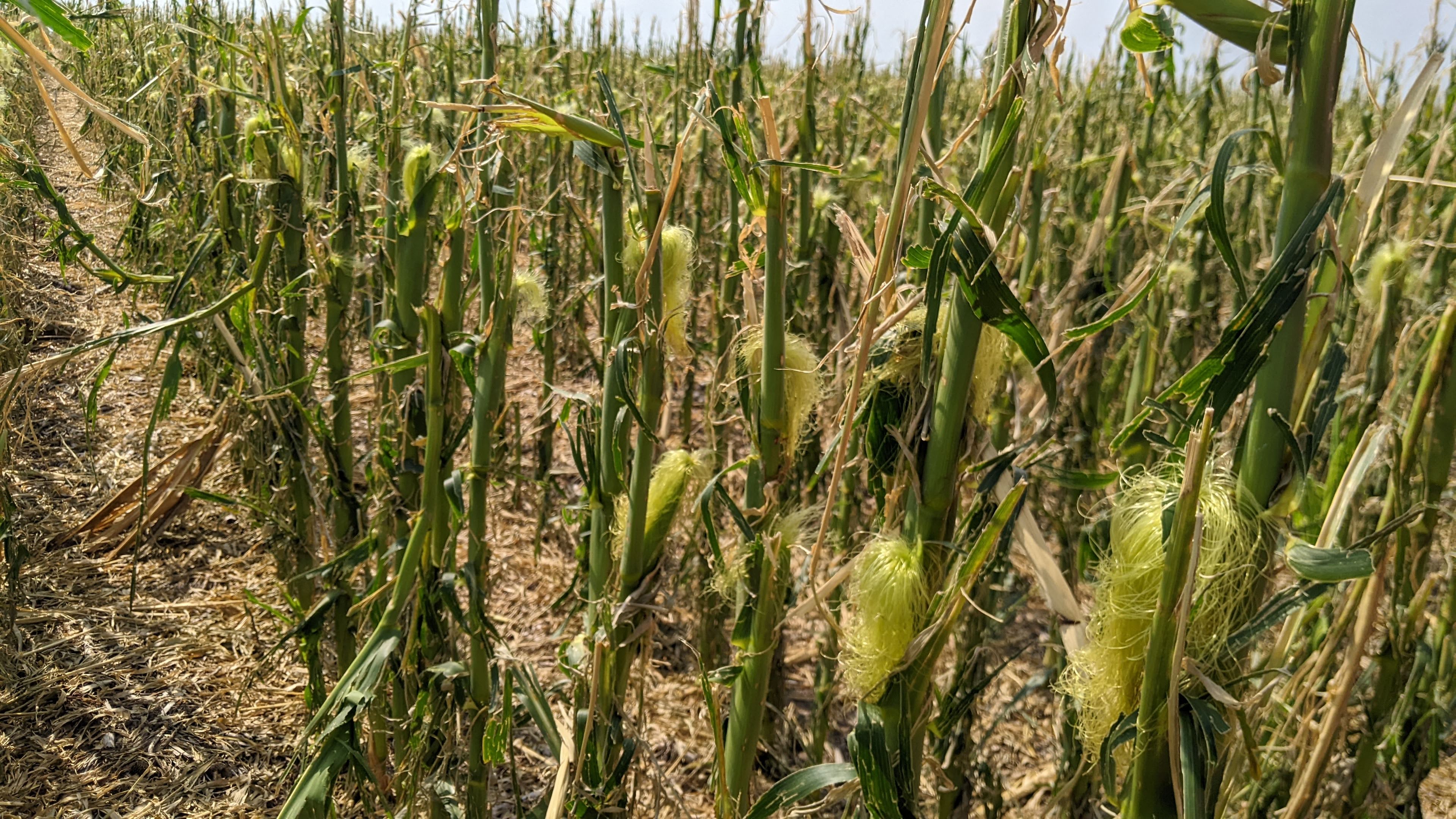


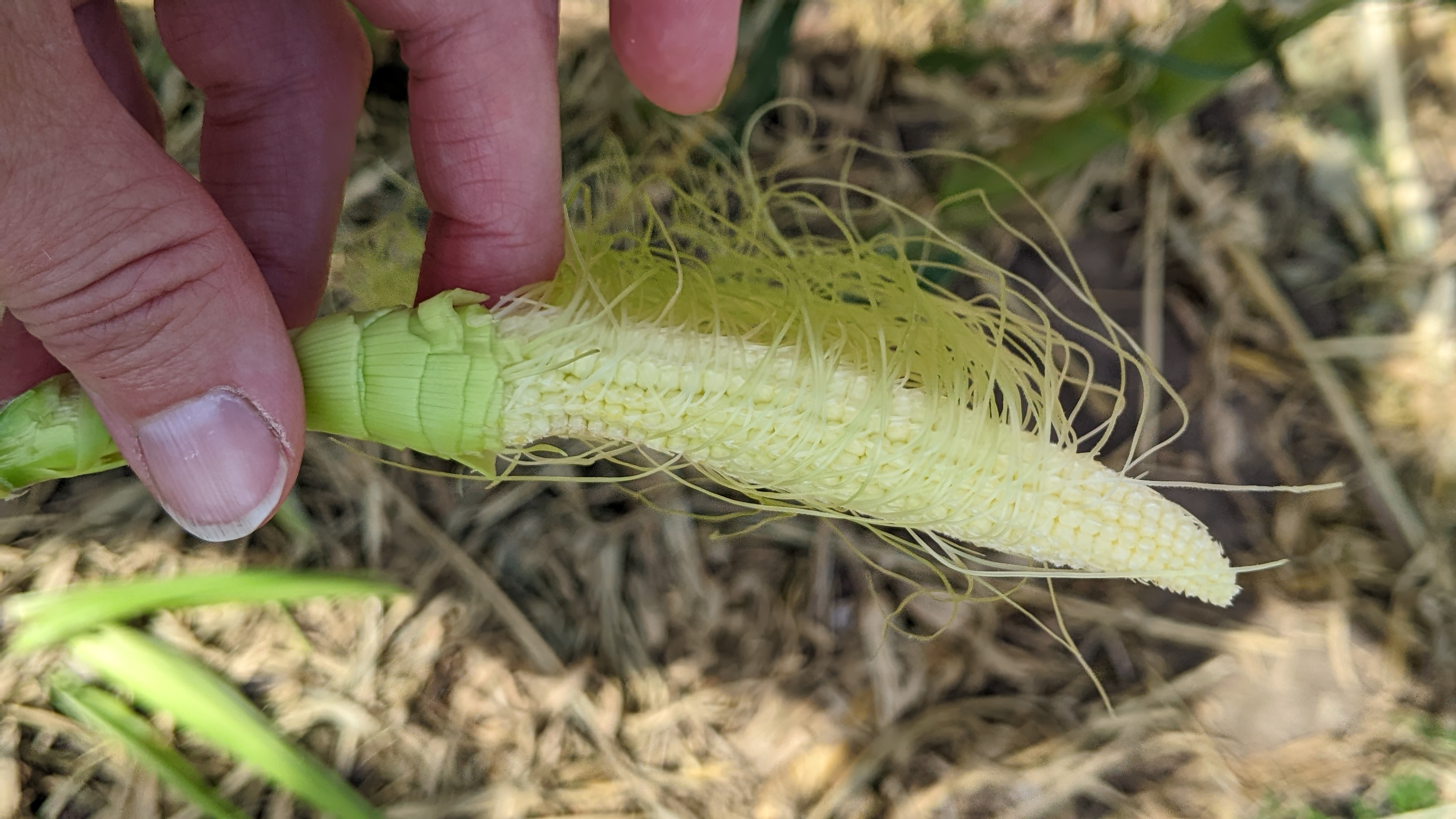


For corn, much of the corn I looked at has mostly leaf stripping and will be ok. There’s also bent/broken plants. Fields vary in the amount of stem bruising. When taking stand counts, I push a little hard on plants to see if they break off when I’m taking counts. A rule of thumb we’ve used in the past: every plant in 1/1000th of an acre we give 10 bu/ac to. So, a count of 12 plants has a potential of 120 bu/ac. That may seem crazy; it depends on how things pollinate, how damaged the ears are, final stand, etc. but it has been in the ballpark in enough cases for me to still use it as a guideline for making hail damage decisions.
In these photos, the fields were far more severely damaged. There’s fields like we saw in 2023 where 1/3 of the field or less still has tassels (top left and middle photos). We saw crop insurance delay that decision in the past to see how the ears would pollinate. I’m not sure what they will decide this year. I was seeing a few brown silks in some of these field situations, but it’s super early too. There’s also a large number of dead tassels in these fields (bottom right photo) that won’t provide any pollen. Tassels remaining tend to be wrapped in the newer leaves but as you see in bottom, middle photo, the tassel is trying to shed pollen inside the trapped leaves. Ears may be misshapen and damaged due to hailstones and/or being damaged and unable to emerge from sheaths (bottom left photo).
What we learned in the past is that palmer comes in quickly once the canopy opens. One can consider warrant with drops as a layby depending on how much Group 15 had been used in the field. Most chose not to go that option. Some seeded covers like brassicas/small grain into fields not totaled (flew on or haggie). Most let the palmer grow.
In the top right photo when fields were totaled, some allowed the weeds to grow and grazed with cattle or sheep. Some seeded a summer annual cover like sorghum sudan/sudangrass/pearl millet. In 2023, several crop producers chose pearl millet so they didn’t have to worry about prussic acid poisoning for those bringing in livestock or wanting to hay. Others just waited till later in the year, shredded down the stalks and planted in a small grain like oats or rye. The “blessing” with a decision in July is it can allow for more time to make a decision compared to if we were in June and the primary option was to replant. That perhaps was the biggest lesson I learned last year in working with producers. If you have specific questions or want to talk through decisions, please give me a call.
Also, it’s important to recognize that these disaster events create loss…in this case, loss of crops, pivots, bins, not only in irrigated acres but in a lot of non-irrigated acres that had more potential than most have seen in years, much less their lifetime. It’s ok to have a range of emotions surrounding this. And, it’s common to feel stressed, numb, and not want to make a quick decision. If I’ve learned one thing in my career, it’s the fact that as people, we all just need to talk about the stress and emotions we all face at times with someone we trust. My biggest piece of advice is to talk to someone just to get outside of one’s own head. There’s so much stress in life, not to mention in ag. The most common comment I’ve heard from people the past several years was they just appreciated being able to share with someone about the stress and what they were feeling. There’s also a number of mental wellness resources on the front page of CropWatch at https://cropwatch.unl.edu.
Resources:
- Summer annual forage grasses: https://extensionpubs.unl.edu/publication/g2183/2013/pdf/view/g2183-2013.pdf
- Making soybean replant decisions-what we learned: https://go.unl.edu/z7ad
- Corn damage to late vegetative/tasseling corn: https://go.unl.edu/y3of

More information and registration at: https://www.grazemastergroup.com/events.

JenREES 7/30/23
150th York County Fair: Hoping you can attend the 150th York County Fair this week! Full Schedule of

events at: http://www.yorkcountyfair.com. Raffle tickets are being sold for the York County Fair Foundation with proceeds used for projects at the fairgrounds. Only 400 tickets will be sold at $50.00 each. A total of 56 drawing winners will receive $150.00 each and the winning tickets get put back in the drawing for additional chances to win. Drawings will occur weekly from the first week of October 2023 through the last week of September 2024 (and daily winners during the 2024 York County Fair). Tickets can be purchased from Ag Society or Fair Foundation members, at a Fair booth in the Mercantile building during the County Fair, or at the York Co. Extension Office till Sept. 30 (or until all tickets are sold).
Weather Impacts: I keep saying we’re a long way from harvest and it seems like we continue to face difficulties. For me, it keeps reminding me that I’m not in control but I can look to and trust the One who is. Many worked so hard to keep livestock safe. Feel for those who unfortunately lost livestock to the heat and humidity. Farm Service Agency (FSA) asked that we remind producers of the Livestock Indemnity Program and to report livestock losses within 30 days of the losses occurring. Please call your local FSA office to provide an official notice of loss. The local office will share with you what is needed for appropriate documentation of losses.
It was a blessing to receive a widespread 2” of rain on Saturday morning! Also good to see something planted into some hail damaged fields. As storms continue to occur in different areas, what I’ve shared earlier in regards to forages still applies. Summer annuals can still be planted through Aug. 15 (unsure on haying depending on weather, but definitely can graze).
Flying/spreading oats, rye or other small grains with or without brassicas continues to be an option as well. Palmer is emerging. 2,4-D amine and 2,4-D ester are both labeled as “anytime” for applying before seeding any small grain. Read the specific label for any restrictions. Oats give the most fall forage. Earliest greenup in the spring is rye followed by wheat followed by triticale. Triticale will provide the most spring biomass but it comes on late (think June time-frame for haying).
Drought: By Friday afternoon, non-irrigated fields rapidly turned, were firing, and using fields for forage was the question, particularly from Nuckolls Co. I think most were just thinking ahead to having plans in place should they be needed. Reminder again, the field needs to be released by crop insurance. I called Dr. Mary Drewnoski to talk through grazing corn in brown silk to milk stages. We’re treating this as immature corn. So the considerations we gave before were the fact that nitrates would exist but that cattle would self-adapt as they graze the tops first. Any ears present will be mostly water. Mary’s main concern at this point was how much could be knocked down and under-utilized by allowing the full field vs. larger strip grazed areas. One can supplement with a few pounds of grain or with hay. She mentioned to not feed a non-protein nitrogen source (ex. lick tubs) when feeding high nitrate forages. Don’t turn out empty and allow access to plenty of fresh water. If plants end up completely brown before they’re released by crop insurance, it won’t change the nitrate concentration of those plants. Options at that point are still grazing or ensiling. For those who’ve shared they really want to hay the corn, know that your nitrate concentration will be highest with that option. Cut at least 8-12” above the ground. I would recommend sampling for nitrates after baling and also only consider this option if you have the ability to grind those bales and mix in a ration. Do NOT harvest or graze for at least three days following rain that “breaks” drought conditions. The rain causes an uptake of nitrogen from the soil, which is translocated into the plant. After three days, the nitrogen will have been converted to plant protein and is no longer in dangerous form.
Whether for drought or hail damage, for those trying silage, reposting Dr. Bruce Anderson’s silage info. “Fermentation usually (but not always) reduces nitrate levels and risk. Yield is about one ton per acre of silage for each harvested foot of earless corn plant (not counting the tassel). Feeding value is about 70% to 80% of well-eared corn silage. Corn with some grain (less than 50 bushels) tends to produce about one ton of silage for every five bushels of grain with a feed value about 80 to 90% of regular corn silage. Harvest timing is critical with silage to ensure the correct moisture for proper fermentation. Desired moisture level for silage is about 65%. Plants with any green leaves usually are too wet to chop for silage. For proper moisture, most leaves may need to be dead before chopping. The stalk and ear hold amazingly high water concentrations. For corn with no grain, even if all leaves are dead, the whole plant (and silage) moisture can be 70% if the stalk is still green and alive.
Once plants actually die they can rapidly dry down. There are several ways to reduce moisture content. If corn has pollinated, delay silage harvest until all chances of increased biomass tonnage have passed or plants naturally dry down to appropriate moisture levels. Corn can be windrowed and allowed to partially dry before chopping. Excessively wet material can be blended with drier feeds such as ground hay, cracked grain, or dried distillers grains. However, this can take a lot of material — about 500 lb of grain or hay to reduce each ton of chopped corn with 85% moisture down to 70% moisture. Silage inoculants may improve fermentation and preservation of drought-damaged silage.”




Late Season Hail Damage Resources


A special thank you to the Nebraska Extension team who shared during today’s hail damage meetings! They were well attended with nearly 120 participants between the two locations. Hopefully the information was of help as you talk with your crop insurance adjuster and know what to expect going forward. Below are the resources we provided and additional items including presentations that were discussed. Contact information for the speakers is listed at the bottom of this post. We will continue to add resources to this page if you’d like to check back. Thanks!
Presentations:
- Dr. Justin McMechan’s Presentation: Corn and Soybeans Hail Panel 2018
- Jenny Rees Presentation: StormDamageDiscussion-8-13-18
- Steve Melvin Irrigation Information: Irrigation Scheduling for Hail Damaged Crops
General Hail Damage Resources:
UNL Extension Hail Know web site: https://cropwatch.unl.edu/hailknow
Hail Damage Videos:
- Hail Damage Evaluation and Management in Soybeans
- Hail Damage Evaluation and Management in Corn
- Weed Management Considerations Following Hail
UNL CropWatch Storm Damage: https://cropwatch.unl.edu/storm-damage-response-information
Irrigation:
Corn at Beginning Dent needs 5” of water; ¼ milk = 3.75”; ½ milk (Full dent) = 2.25”; ¾ milk = 1”. Soybean at beginning seed (R5) = 6.5”; R6 full seed = 3.5”; leaves beginning to yellow = 1.9”.
NebGuide Predicting the Last Irrigation of the Season. Use the last page to walk through an example of how much water you may need to finish out the crop for crop insurance purposes. Also realize that severely hail damaged plants may progress more rapidly than the number of days for each growth stage listed in this NebGuide and that damaged plants may not use as much water as mentioned here. http://extensionpublications.unl.edu/assets/pdf/g1871.pdf
Crop coefficients chart by growth stage: https://nawmn.unl.edu/GrowthStageData
Forages:
If anyone is taking hail damaged corn for silage, Dr. Mary Drewnoski is interested in samples prior to and after ensiling and is willing to help with sample analysis cost. Even if silage has already occurred, we’d be interested in samples after ensiling. Please contact her if interested (contact info. at bottom of this post).
The three links below are the ones that answer specific questions. The first article answers a few questions regarding forage considerations for hail-damaged corn and soybean. The over-riding decisions will be based on planting date. Sudangrass or sorghum x sudangrass crosses and millets are still appropriate until August 15, although seed supplies of these are dwindling. After that, we are looking at oats/turnips. Drilling these directly into the stubble is the best option for planting. There was also a great discussion regarding earlage and we need to create an article regarding that topic.
https://cropwatch.unl.edu/2018/forage-cover-crop-considerations-after-hail-corn-and-soybean
This article addresses nitrate concerns when grazing forage cover crops: https://cropwatch.unl.edu/2018/reducing-nitrate-concerns-when-grazing-forage-cover-crops
This article addresses cover crops:
https://cropwatch.unl.edu/2018/cover-crops-soil-health-storm-damaged-fields
| COVER CROP | USE/GOAL | WHEN TO PLANT | HOW TO SEED | RATE (PER ACRE) |
ADDITIONAL NOTE |
|---|---|---|---|---|---|
| OATS | Weed Management | By Sept. 1 | Drill best. Can fly on. | 30-40 lbs | * |
| OATS/RYE MIX | Weed Management | By Sept. 1 | Drill best. Can fly on. | 30 lbs each | * |
| OATS | Forage | By Sept. 1 | Drill best. Can fly on. | 80-90 lbs | * |
| OAT/RYE MIX | Forage | By Sept. 1 | Drill best. Can fly on. | 30-40 lbs of rye and 50-60 lbs oats | * |
| BRASSICAS (TURNIP, COLLARD, RAPESEED)-NOT OILSEED RADISHES | Cover ground, forage, nitrogen uptake | By Sept. 1 | Fly on for quicker establishment. | 5-6 lbs | — |
| RYE | Weed management, cover ground, forage, nitrogen uptake | After Sept. 1 | Drill best. Can fly on. | 50-60 lbs | * |
| *If adding a brassica to any of these small grain options, only 2 lb/ac is needed. Rapeseed isn’t as well known, but is an inexpensive and good option for consideration. | |||||
Other Forage Considerations
- Earlage: For fields where the ear is now the top-most plant portion, silage is not a good option, but earlage can be. This resource from North Dakota State University, Harvesting, Storing and Feeding corn as Earlage, provides good information on earlage.
- Grazing: Whenever possible, attempting to harvest the corn first would be best. It’s not a good idea to graze the corn with ears on the stalks. A better option would be to harvest the corn and graze afterward, following considerations that we used for the downed corn situation in 2017. See Down Corn: Problem or Opportunity for Cattle Producers?
- Silage: The following are good silage resources — Silage Considerations (UNL BeefWatch) and videos from the Silage for Beef Cattle Conference.
Grain Quality/Mold/Mycotoxins/Grain Storage:
Diplodia ear rot is perhaps the most common with these types of storms. Good news, Diplodia does not have a mycotoxin associated with it. Bad news is this fungus explodes on an ear creating light-weight ears and explodes in grain bins.
It will be wise to assess which fields/portions of fields are affected the worst with mold. Consider not storing any of that grain as it will be difficult to manage and keep from getting worse in storage. You will also need to assess which fields have increased risk of stalk rot by using the pinch test (Use your thumb and first finger to pinch the stalk internode above the soil line. If it easily crushes, the plant has stalk rot). Consider harvesting those portions of fields or fields most affected by stalk rot first.
Ear Rot Diseases and Grain Molds: http://extensionpublications.unl.edu/assets/pdf/ec1901.pdf
Stalk Rot Diseases: http://extensionpublications.unl.edu/assets/pdf/ec1868.pdf
Sprouting of Corn Kernels: https://cropwatch.unl.edu/sprouting-corn-kernels-hail-damaged-ears
Tips for Testing Storm Damaged Corn (Veterinarian perspective): https://cropwatch.unl.edu/storm-damaged-corn-tips-testing-and-using
Grain Storage Resources: https://cropwatch.unl.edu/grain-storage-management
Crop Insurance Questions:
Every field situation may vary. If you have hail insurance, the insurance adjuster should evaluate ear damage in addition to percent defoliation and stalk breakage.
Ask your insurance adjuster how they assess grain quality damage.
- What are their rules?
- Do they go by the COOP results for mold/mycotoxin/dockage?
- Do they require the insurance agent to come out and take a sample for mold/mycotoxin?
- Do they require you to call them before you put grain into your bin? (This is especially the case if aflatoxin may be of concern. We don’t anticipate that being a problem with this storm damage. However, if they require a sample for mold/mycotoxin in general, they may ask you to call them to take a sample before the grain gets put into a bin).
- If you do have presence of mold and/or mycotoxin, it’s best to have it documented before the grain goes into the bin. If the grain gets out of quality and the mold and/or mycotoxin increases in your bin by spring, if it wasn’t documented at harvest, you may not get compensated.
Mary Drewnoski Daren Redfearn Justin McMechan
Extension Beef Nutritionist Extension Forage Specialist Extension Crop Systems
402-472-6289 (402) 472-2662 (402) 624-8041
mary.drewnoski@unl.edu dredfearn2@unl.edu justin.mcmechan@unl.edu
Steve Melvin Jenny Rees
Extension Educator Extension Educator
(308) 946-3843 (402) 440-4739
steve.melvin@unl.edu jrees2@unl.edu
JenREES 6-24-18
Crop Update: What a blessing to have rain this past week! Grateful for how it provided much needed moisture into the top two feet in many cases. Updated soil moisture status will be at http://jenreesources.com. Some in our area and in other parts of the State received wind, hail damage, and flooding to crops. This week’s CropWatch at http://cropwatch.unl.edu shares information for those situations. A few summarizing points: for those with greensnap or with severe hail damage, you may wonder what potential yield may be based on your planting date and current plant stand. The following chart from Iowa State University and explanation of how to understand it may be helpful: https://crops.extension.iastate.edu/cropnews/2009/05/assessing-corn-stands-replanting.

Source: Iowa State University
For those with flooding, corn in the V7-10 leaf stage can survive for about 7-10 days in flooded water. Temperatures above 86F can result in greater stress on those plants than if the temps remain cooler than that during that time. Another consideration for the future, it’s not uncommon to find a disease called ‘crazy top’ of corn when the tassels begin to emerge. We’ve seen this the past several years where creeks or areas along waterways or field edges were ponded. There’s nothing you can do to prevent this.
For those with hail damage, damage from V7-10 leaf corn can result in a number of situations depending on the severity of hail. Minimal yield loss is assumed for leaf damage in crop insurance charts. Final plant stands will be important which will account for broken off plants that don’t recover. Stem bruising also isn’t factored in. For corn, bacterial diseases tend to be my larger concern at these growth stages. Bacterial top rot is one in which the plant dies from the top down and has a strong odor to it and creates a soft, slimy mess. Goss’ wilt is another concern-particularly systemic Goss’ wilt. You can check for this if you have a dying plant that doesn’t have a soft rot by taking a
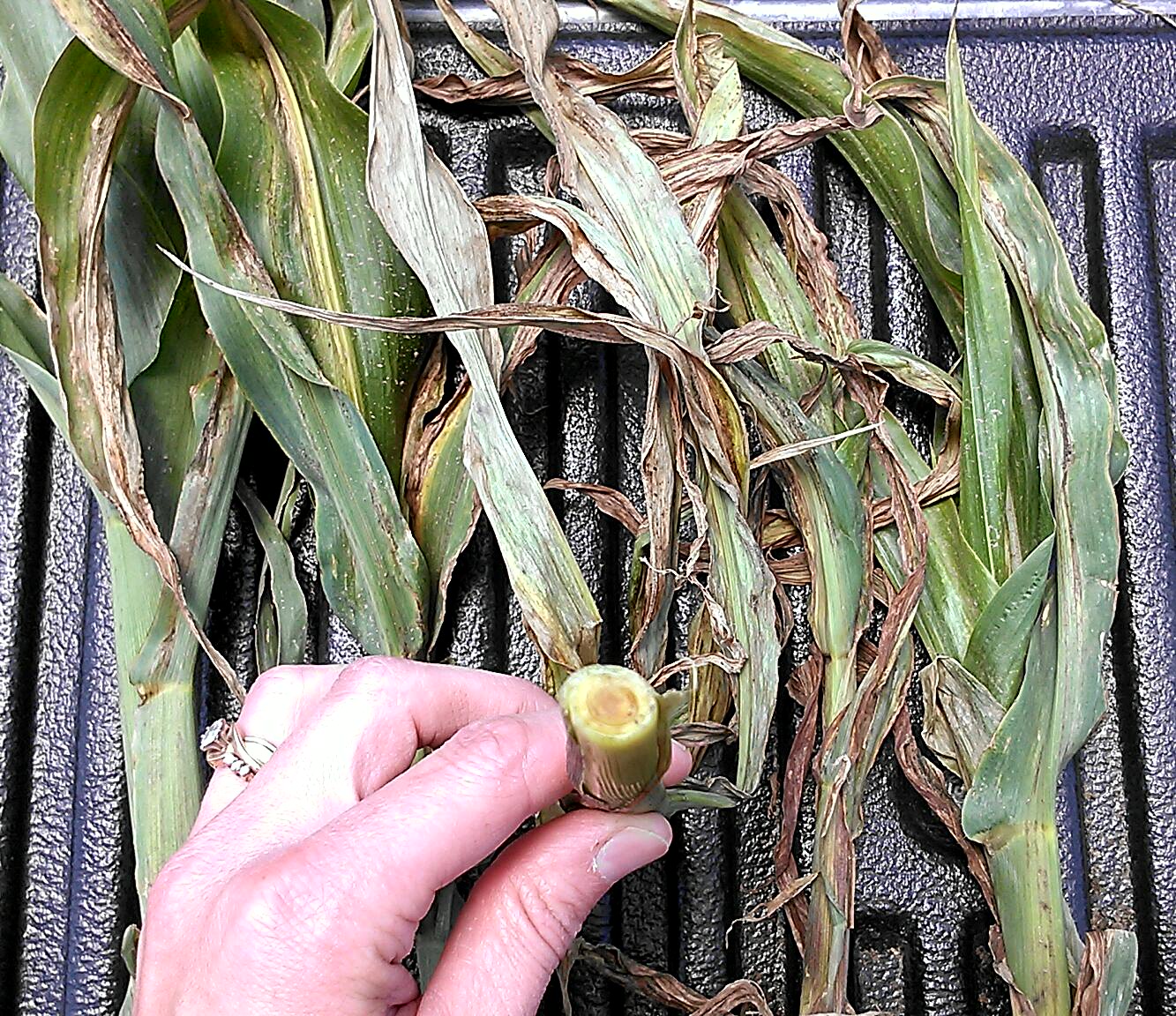
Cross-section of stem showing systemic Goss’ wilt in the discolored vascular bundles.
cross section of the stem and looking for discoloration of the vascular bundles. You can also send plants like this to the Plant and Pest Diagnostic Lab in Lincoln for confirmation.
Regarding fungicide use on hail damaged corn, Iowa State and the University of Illinois did studies finding similar results. Both found no statistical difference in applying a fungicide vs. the untreated check in spite of small numerical differences. Regarding timing, the Iowa State study simulated hail damage at tassel and applied fungicide an average of 3 days and 8 days post-hail. There were no statistical differences on yield of the timing of the applications either. They did find statistically less fungal diseases in the hail-damaged plots vs. the non-hail damaged plots and speculated it was due to more air flow and less leaf area available for disease to occur. I have observed that fungicide can help with stalk strength and maintaining whatever green tissue remains when we had the 2013 hail storm in Clay County at brown-silk to blister corn. But this early, it’s hard to justify a fungicide application based on the data that’s available. If you’re interested in testing this for yourself, the following is an on-farm research Fungicide Protocol for Hailed Corn and Soybean.
For hail damage on soybean, many of the beans are at flowering or approaching flowering. Again, stem bruising isn’t counted in crop insurance assessments. I haven’t really observed bacterial or other disease issues necessarily from stem bruising in soybean. What tends to be more of an issue is those plants hardening off and becoming brittle to walk through. For soybeans, the blessing is that often new buds form and you will see increased branching which can help with canopy closure…it just can hurt right now when soybeans were already near canopy and we’re trying to reduce additional inputs for weed control. Things to consider are that pods may be closer to the ground from this increased branching and you may need to harvest earlier to help with getting beans that become brittle before snapping off in wind storms. I leave plant stands of near 60,000 plants/acre based on our soybean pop studies that received hail damage. If you want to prove any replanting differences to yourself, you may wish to consider the following Soybean Replant Protocol. We’d recommend waiting on herbicide apps till some new growth occurs, which is difficult when I’ve watched palmer essentially be not affected by hail and put on two new leaves within a few days in the past. Last year we started making herbicide apps 5-7 days post-hail. Additional hail resources are at a new resource called ‘Hail Know’ at: https://cropwatch.unl.edu/hailknow. There’s a lot of info I haven’t transferred to this site yet…but you can view photos and comments on hail recovery at numerous growth stages over time at my blog under the ‘Storm Damage’ category: https://jenreesources.com/category/storm-damage-2/.
Last week I shared the following video regarding determining timing of off-target dicamba movement to soybean: https://youtu.be/rQid7-vX-TU. Sharing again with an increase in the number of fields that were experiencing cupped symptoms last week.
Hail Damage
On-Farm Research Protocols:


Hail and wind damage occurred throughout the area I serve last week. Overall, I’ve been encouraged by the regrowth observed on corn and soybean plants affected by the June 14th storm. We were blessed with warmer weather and sunshine that allowed for regrowth to occur in many situations other than some fields around the Deweese area.


You can look for regrowth on leaves within the whorl of corn plants and on the axillary buds of soybeans. Even what appeared to be soybean ‘sticks’ may show regrowth by now.

The concerns I have for plants affected by these storms is all the stem bruising on both corn and soybeans and the potential for bacterial diseases to affect corn.
For those of you affected by June 16th storms, we recommend to wait a week to assess damage and any decisions. I realize we’re also at a critical stage for replant decisions as we continue later in the season. Ultimately, decisions need to be made on a field by field basis.
Resources:
- CropWatch Hail Damage Resources
- Resources from storm damage in 2014
- Fungicide Use After Hail or Wind
Fungicide Application
There’s no good research to Dr. Tamra Jackson-Ziems or my knowledge to support this. Fungicides only control fungal diseases. Bacterial diseases are favored after hail events and we have already seen bacterial leaf streak in the area prior to the storm. From past-years’ experience of prior wind/rain events, we can expect to see more of it in about a week. Fungicides won’t help that disease nor Goss’s wilt which is another we often see come in after hail events.
However, if you’re considering this, I’d like to have several farmers prove it to yourselves with on-farm research this year so we do have data for the future. It’s this simple. All you do is spray fungicide in enough width to complete 2 combine passes. Then skip an area for 2 combine passes. Then treat again and repeat across the field. Fungicide Protocol for Hailed Corn and Soybean. Please let me know if you’re interested in this!
Timing of fungicide app: ISU did a study to simulate hail damaged corn at tassel stage within an average of 3 or 8 days post-hail. They didn’t find the timing to provide any yield effects. They also didn’t find a statistical yield increase (90% confidence level) in fungicide application to hail damaged plants vs those which weren’t hailed although they also reported a numerical increase in 12 of the 20 fields.
Herbicide application: I spoke with Dr. Amit Jhala, Extension Weed Specialist for his thoughts regarding this. He said ultimately herbicides shouldn’t be applied to stressed weeds in order to achieve greatest efficacy. The concern for many including me right now is how well the weeds survived the hail and how quickly they are regrowing compared to the damaged corn and soybeans. This again is a field by field assessment regarding how well your corn and soybean regrowth is occurring and how rapidly your weeds are. I watched one palmer plant in one field after June 14 storm: 1 day post hail and 2 days post hail put on two sets of leaves in that time period. I also took pictures of soybeans reduced to sticks while 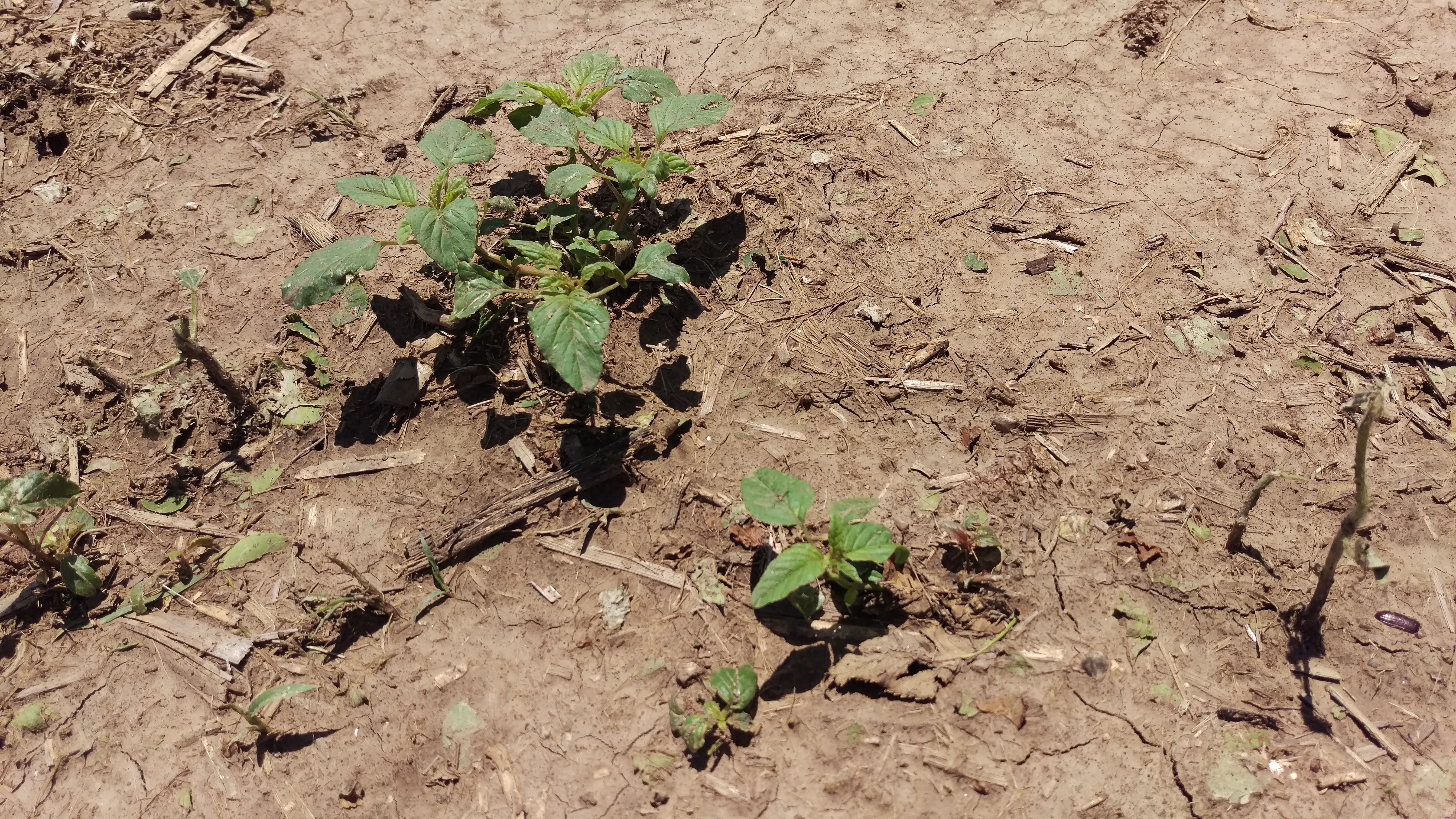 waterhemp in that field was virtually untouched. I think many are trying to wait 5-7 days post-hail to apply herbicides but there were some fields I was suggesting to apply over the weekend with the recovery already occurring and less damage.
Corn replant: The biggest concerns with corn would be stands, eventual stalk rot/downed corn due to stalk bruising, and bacterial diseases. I’ve essentially watched stands reduced over the course of the growing season after early-season hail storms mostly due to bacterial diseases like Goss’ wilt. It will be important to have your crop insurance adjuster look at the field again prior to harvest. Splitting the stems of damaged plants across the field can help you assess any damage to growing points; they should be white/yellow and firm not brown and soft. Tattered leaves that are wrapped around the whorl should eventually turn brown and break off with the wind. They can sometimes impede new growth from the whorl as well though.
Soybean replant: Soybeans can compensate so greatly for reduced stands. From hail at this stage in the past, we’ve said to leave stands of non-irrigated at 60,000 plants per acre and irrigated at 75,000 plants per acre. Some soybeans reduced to sticks are shooting axillary buds. My biggest concern on soybeans is the stem bruising which isn’t accounted for in hail adjustments. If you want to prove replanting or not to yourself, consider slicing in soybeans next to the old row in strips across your field. Be sure to inoculate the soybeans and be sure to take prior stand counts. Soybean Replant Protocol.
There’s nothing like doing these studies and seeing the results on your own ground or from your peers’ farms. In 2006, I worked with a grower in the Lawrence, NE area on a non-irrigated soybean plant population study where he tested seeding rates of 100K, 130K, and 160K seeds/acre. He received hail at the cotyledon stage and because he was non-irrigated, chose to leave the stand. His actual stand counts were 74.4K, 89.4K, and 97.9K plants/acre respectively for the previous mentioned seeding rates which resulted in yields of 38.6, 40.6, 42.7 bu/ac respectively. Another soybean replant study occurred near Columbus, NE where the grower had an average plant stand of 75,000 plants per acre on June 11th. He chose to replant five strips across the field at a diagonal to the existing rows. The replanted soybeans ended up yielding 1 bu/ac less than the original plant stand. I realize it’s hard to want to do these extra steps for on-farm research, but this is why it’s important; it’s the way to answer these questions for yourself! Please contact one of our team members if you’re interested in on-farm research this year!
Wind-Hail Crop Damage Meeting

Recent wind and hail storms have created damage across our area counties in Nebraska and Kansas. This brief meeting to be held on Monday near Gladstone, NE is designed to answer farmers’ questions regarding harvest, crop insurance expectations, and what to expect regarding crop maturity and future damage. Please click on the image to enlarge.
Crop Update June 9
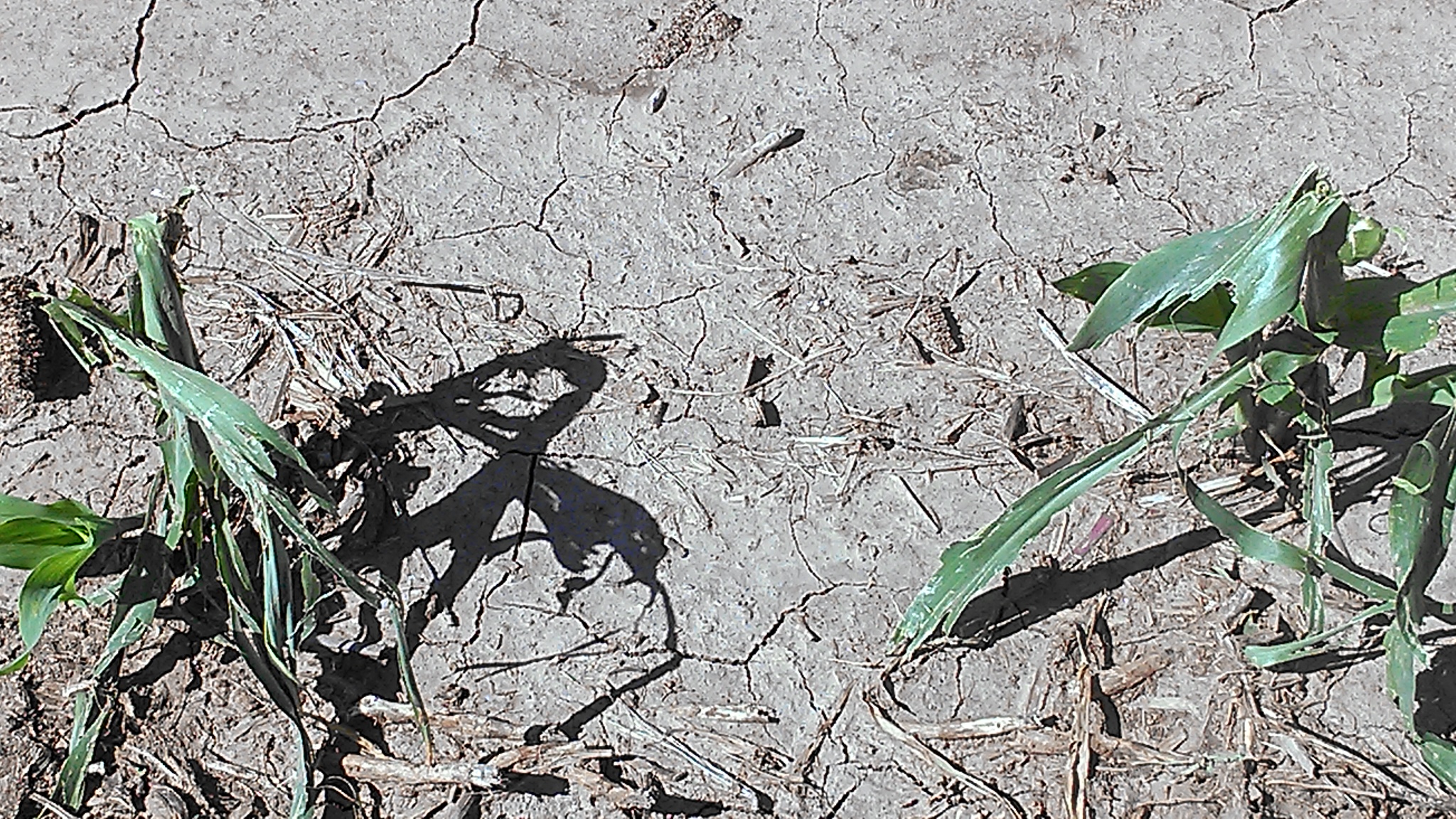
Corn that was hail-damaged on June 3rd is starting to regrow. Leaves wrapped up in the whorl are beginning to slough off as wind and warm temperatures cause the damaged tissue to die and break off. For more information on how stand loss impacts yield, please check http://cropwatch.unl.edu.

Some corn plants more severely affected were reduced to stems. Sometimes no new growth is appearing while in other plants new growth can be seen. I split open the stem on this plant since no new growth was apparent and the center looked discolored.
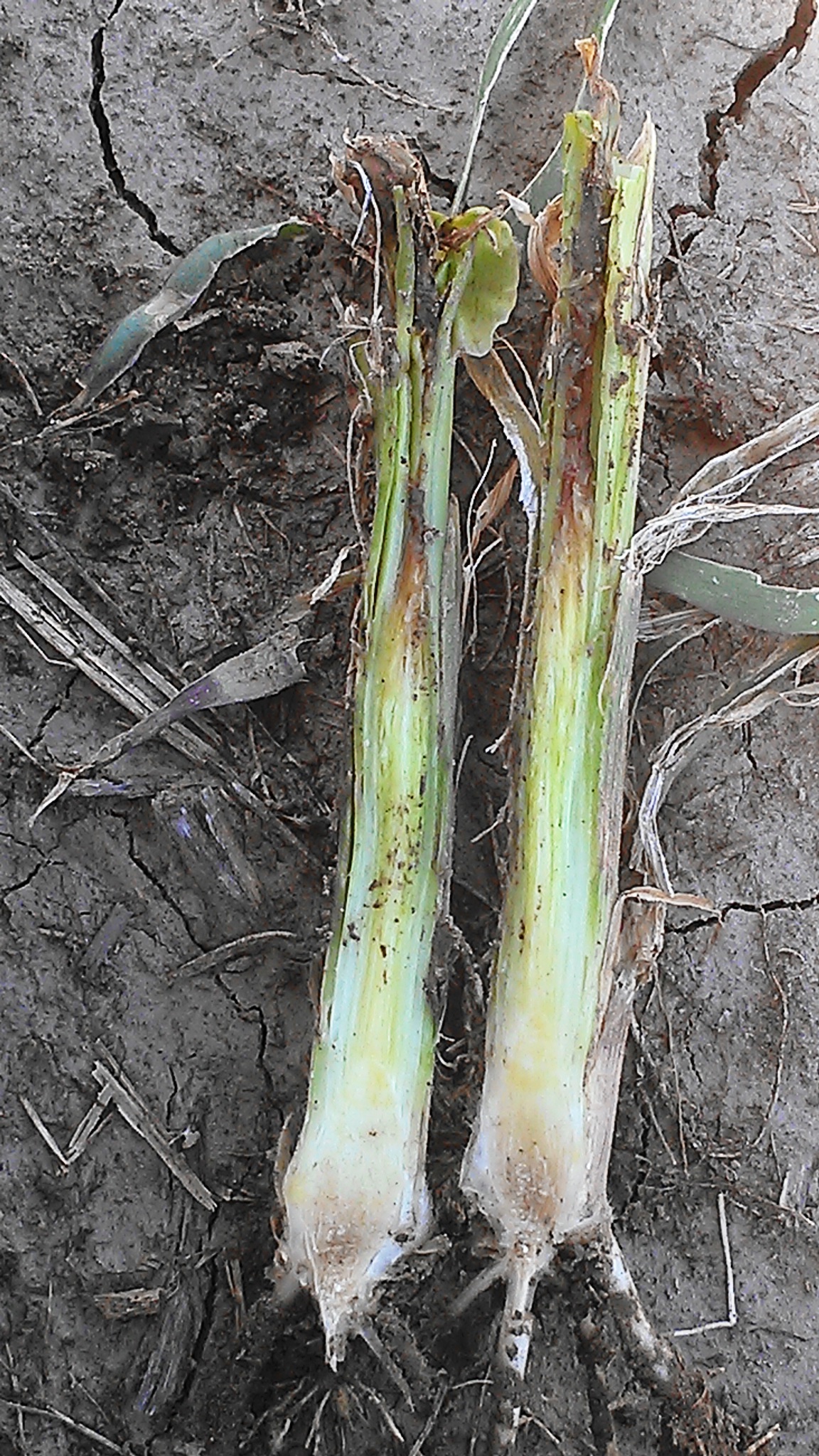
In this corn plant, a bacterial rot has set in as can be seen from the discoloration at the upper portion of this plant and the discoloration at crown area. This plant may not survive. This is typical of what we were seeing in Nuckolls/Thayer counties with the 8-10″ of rain they received there. My concerns for corn at this point are bacterial diseases such as this or Goss’ wilt that may continue to reduce stands through the season. Some growers are considering a fungicide application but fungicides don’t target bacterial diseases. We’d recommend anyone considering this to consider an on-farm research experiment and I’d be happy to help set this up for you.

These soybeans were reduced to stems yet are showing new growth 5 days later. UNL research has shown that soybean stands can be greatly reduced without a significant yield effect. Several growers are considering replanting; we’d recommend taking into account the research or conduct an on-farm research experiment to see any differences for yourself like this farmer did. The other thing we have looked for is bruising on stems and some flooded areas truly did not have plants survive. For more information, please check out http://cropwatch.unl.edu.
Crop Update June 5
This year I was counting my blessings as we made it through May with no tornadoes in Clay County and no Memorial Day storms! Yet history seems to repeat itself on days. Last year, hail went through the counties north of us on June 3. This year, hail hit us on June 3rd….an estimated 30% of Clay County. Please also see the resources listed at the end of this post for more specific information regarding decision-making.
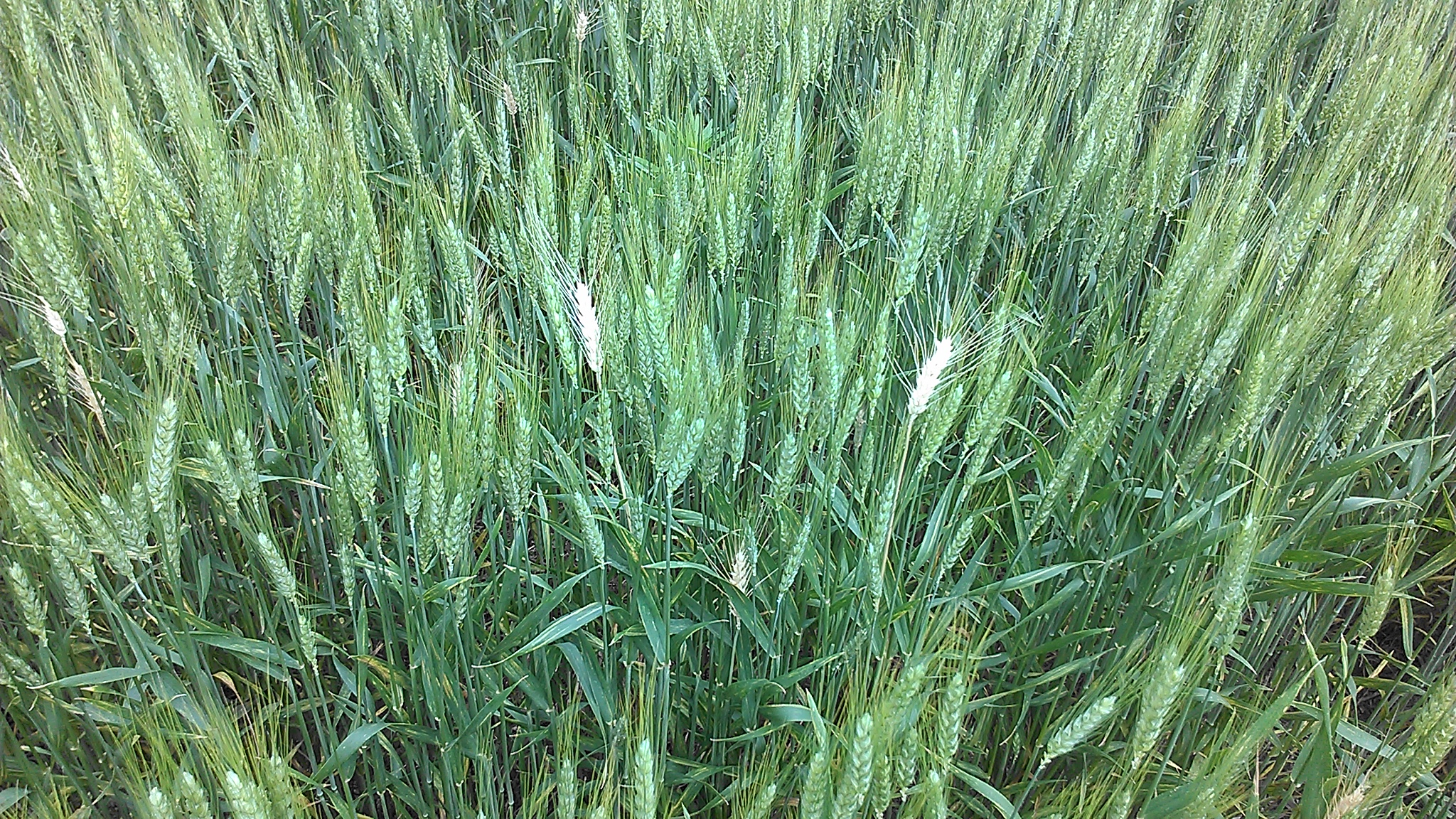
Earlier that day, I had looked at wheat in a number of counties where white heads were appearing in wheat. Most often they easily pulled from the head and weren’t more than 2% of fields. Those were attributed to wheat stem maggot. The white heads that were hard to pull from the stem were most likely due to some late frosts that we had in the area.

The evening of June 3rd resulted in various rainfall totals throughout the county and hail damage to an estimated 30% of the County. This photo is of the west fork of the Upper Big Blue River that was flooding many fields along Hwy 6 between Hwy 14 and Sutton.

This was June 4: Water along both sides of Hwy 6 from Hwy 14 to Sutton and over the road in a few areas. The road was closed on June 5th after another 3-4 inches fell in the area Thursday night. Portions of fields were flooded throughout the County and we’ll have to see how long it takes for water to recede and what temperatures do to determine any replant situations.
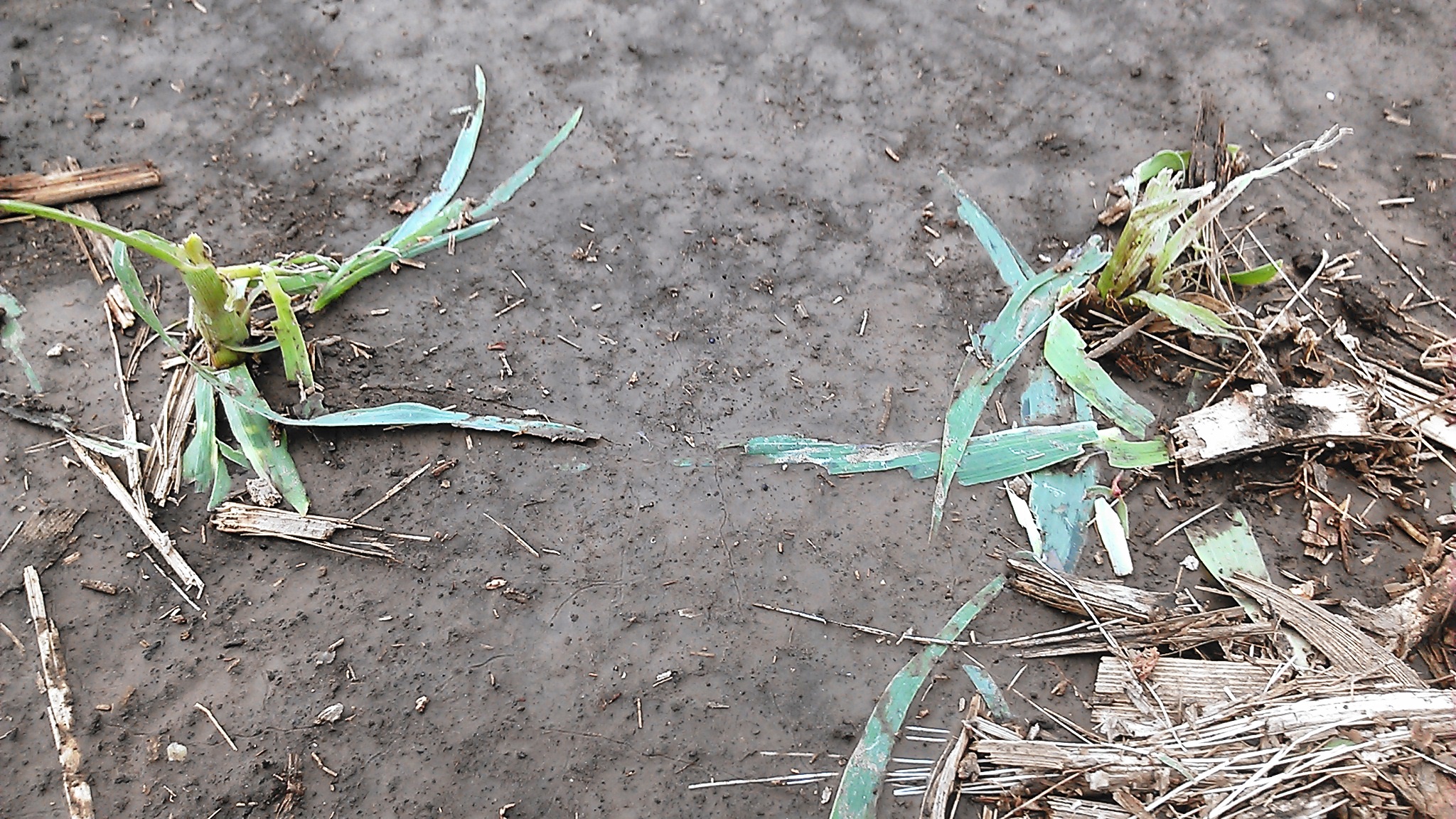
Corn in the V5-V6 stage ranges in hail damage. The worst damage of plants were reduced to sticks. Time will tell how well the plants recover. I’m concerned about bacterial diseases in corn-particularly Goss’ wilt showing up later…but also a bacterial rot that we were seeing in Nuckolls and Thayer Co. after the heavy rains they received last month.
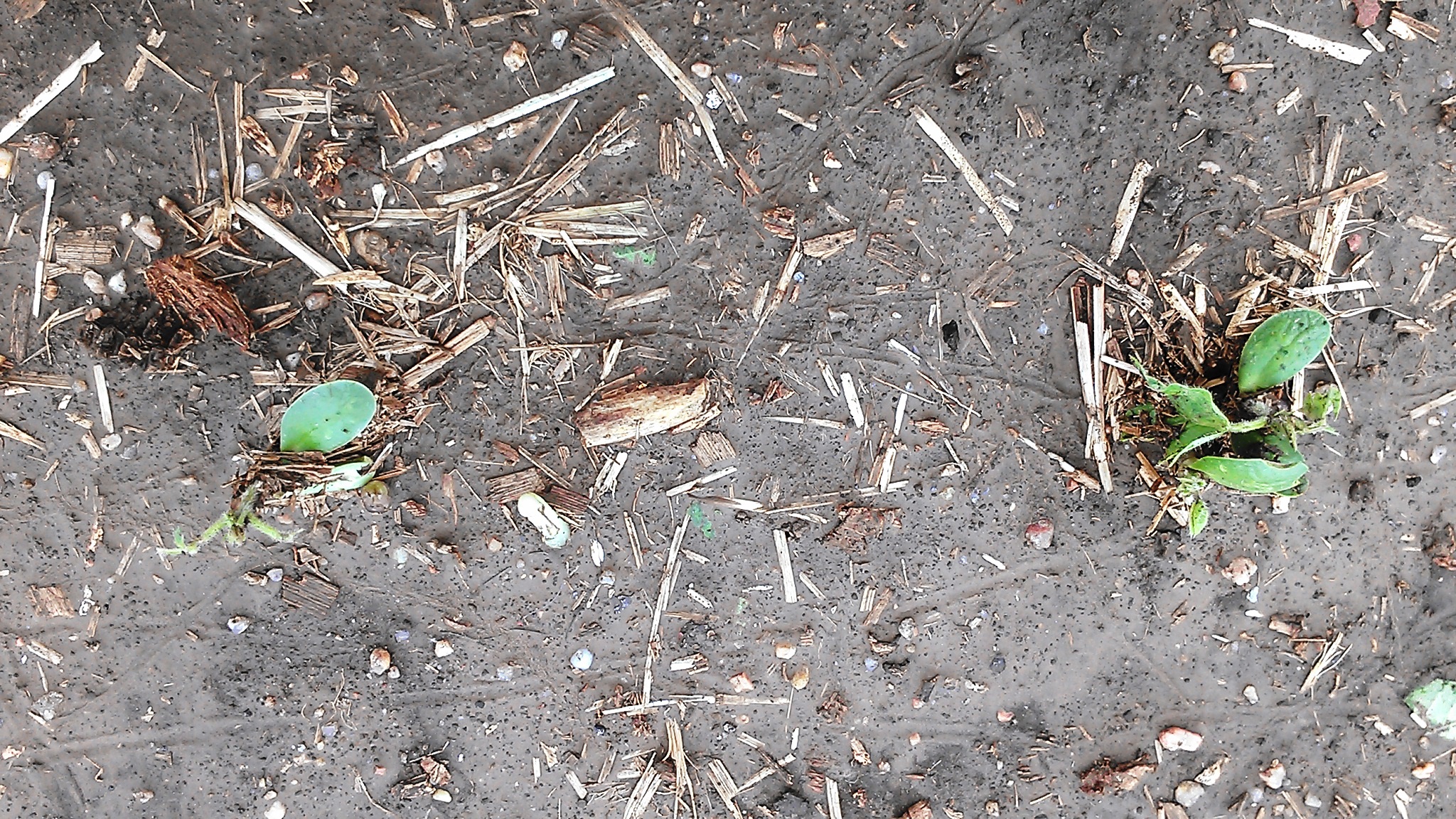
Soybeans ranged from planted to V3 in the County. Many of the hail-damaged beans still had a cotyledon attached. In the past, I’ve seen new plumules shoot from the top of the stem when the growing point wasn’t too damaged. We again will need to wait and see what happens.

First cutting alfalfa is down in much of the County waiting to be baled.

Severely hailed wheat field. You can also see the amount of stripe rust present in this field. We estimated 75-80% of wheat heads in this field were broken over and wouldn’t fill the heads.
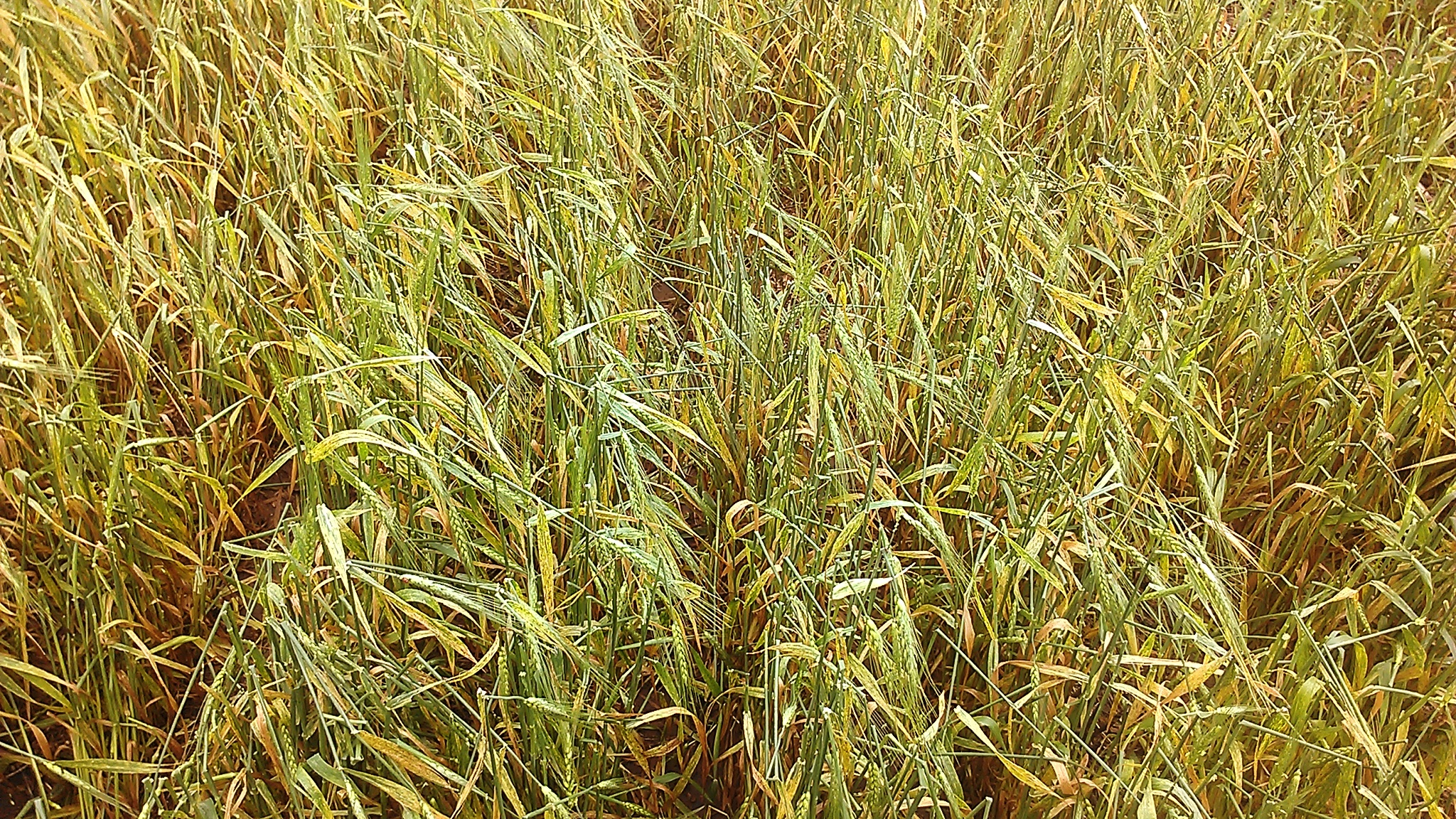
Another hail-damaged wheat photo. We have a great deal of stripe rust of wheat in the County and some farmers with livestock have chosen to hay wheat that is severely affected by stripe rust. Some did spray fungicide which has held the rust back. Others are going to just see what happens yield-wise.
For more information on hail and replant decisions, please see:
Corn Progression After August 2013 Storm
On August 1, 2013, a severe wind and hail storm damaged 170,000 acres of corn and 86,000 acres of soybeans in Clay County, Nebraska. Corn at the time of the storm was from brown silk-blister. While the storms in the Gibbon/Blue Hill areas occurred a little earlier in the growing season, the following photos show the progression of damage in the event it can be of help to those affected by 2014 storms.

Field on August 2nd that was totaled out and planted to cover crops. Where crop insurance allowed, producers considered various forage options.

Some producers chose to spray fungicides on fields with more foliar leaf tissue such as this one.

Hail damage to stalks shown 4 days after the storm.

Splitting the stalks open 4 days after the storm resulted in seeing stalk rot already beginning to set in.
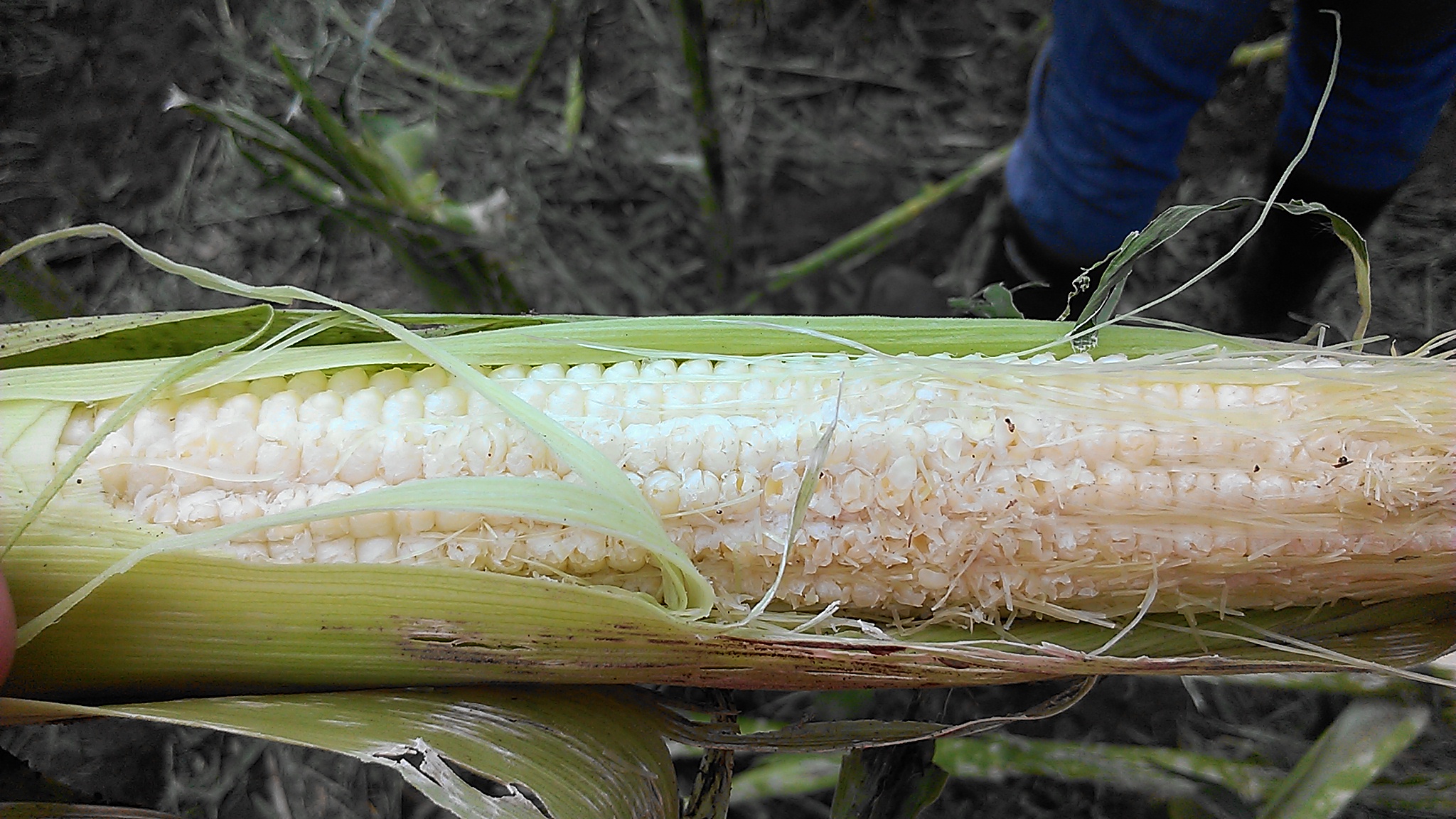
Corn on August 2nd in blister stage in which hail stones made kernels all mushy on one side of the ears.

Corn ear on August 6th. Notice moldy kernels appearing on side where hail damaged ear.
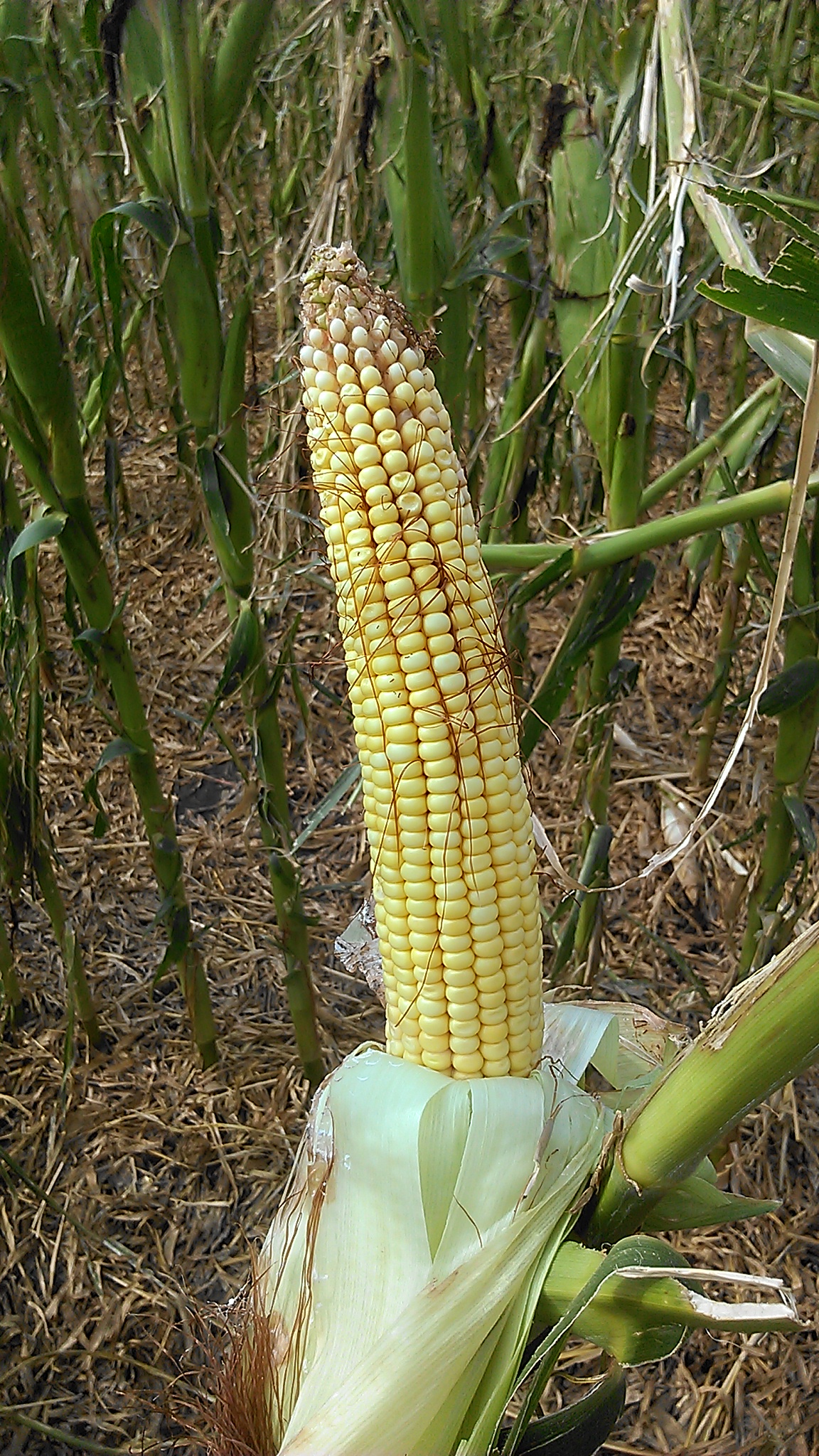
Six days after the storm, the good side of the ear that didn’t receive hail damage.

Six days after the storm, the side of the ear that received hail damage.
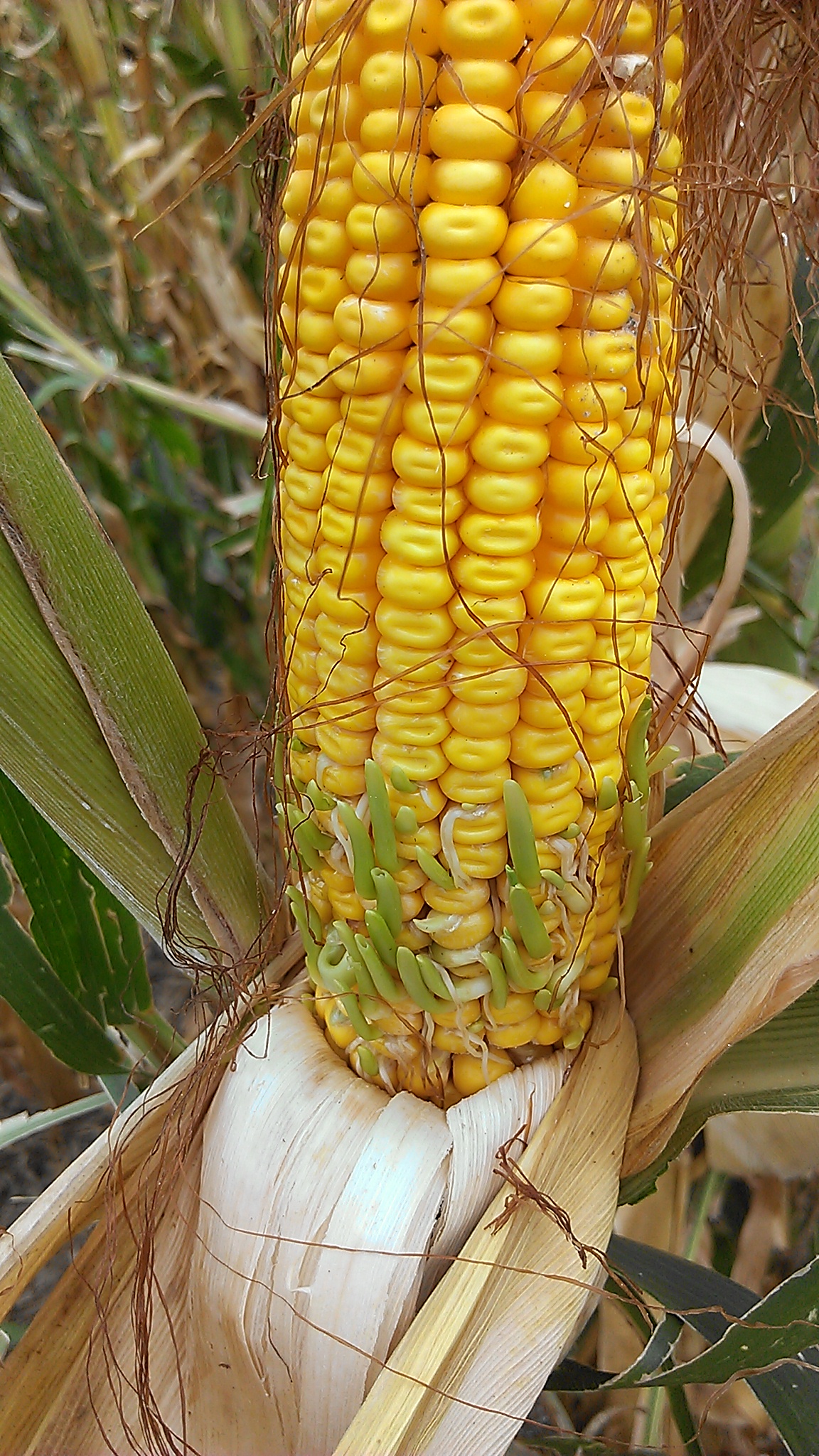
33 days after the storm, kernels on the “good” side of ears were beginning to sprout.
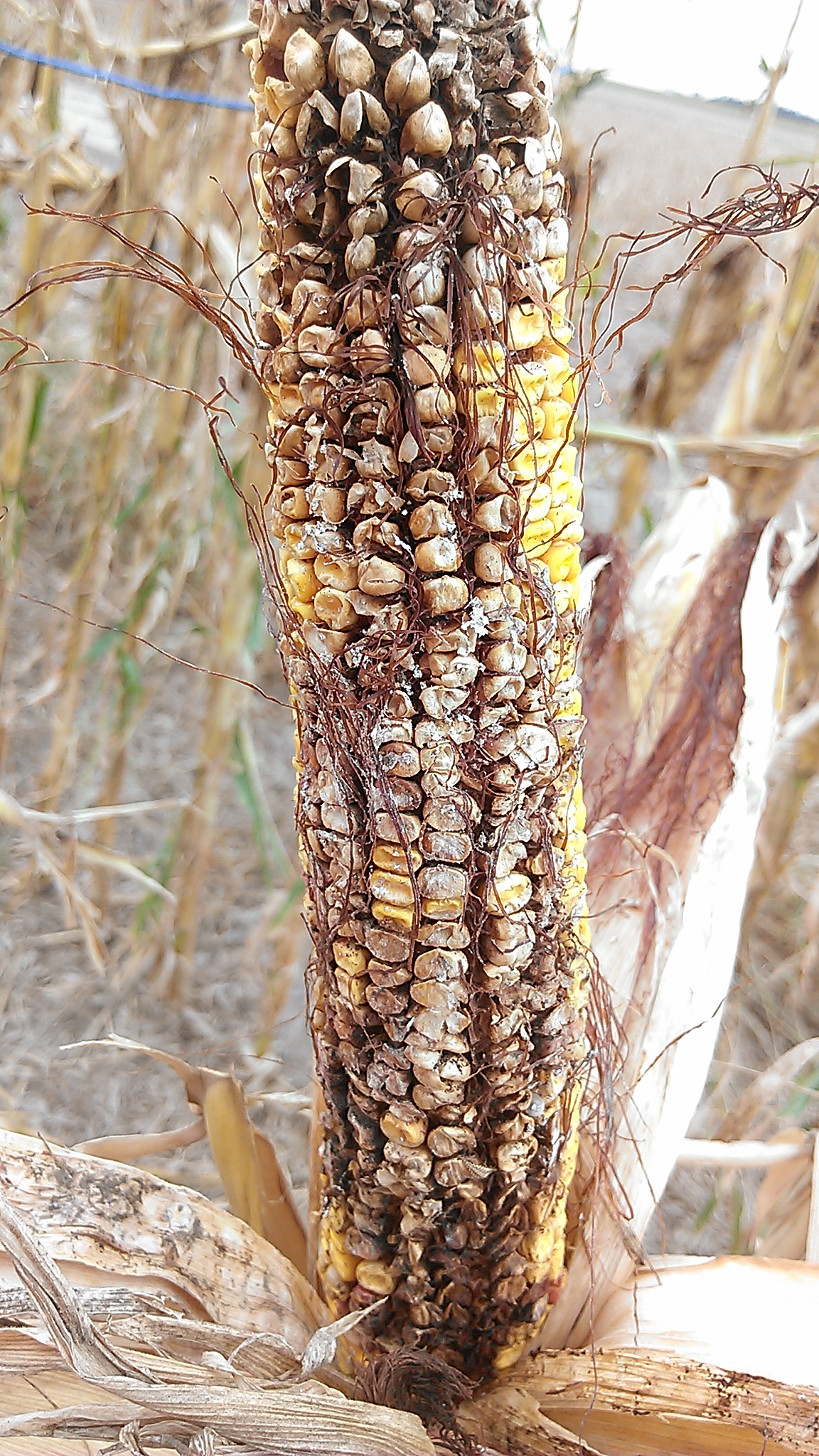
33 days after the storm: Diplodia set in creating light-weight ears and brittle kernels. Sprouting occurring on damaged kernels on sides of ears. The presence of mold does not automatically mean a mycotoxin is present. Producers also wondered about the safety of feeding moldy grain to livestock.


 JenResources