Category Archives: JenREES Columns
JenREES 9-16-18
Great to see many farm families at Husker Harvest Days last week and also great to see harvest getting started! Just a reminder for all of us to watch for equipment on the roads and allow for extra time to slow down, particularly with the speed limit changes. Dawn, dusk, and the evening can be the hardest times to see equipment and it can be difficult to see how wide or long the equipment extends. Harvest is hard work and a lot of hours yet is also a blessing to finish the growing season. Here’s wishing everyone a safe harvest season!
Harvest: As storm and drought-damaged corn is being harvested, just a reminder that grain should be tested for presence of ear molds and any potential mycotoxins now in addition to moisture/test weight. I’m hearing some differences in what’s all being tested when the harvest sample is taken, so be sure to talk to your insurance agent about this. It’s important to also test for mold and potential mycotoxins as that gives you an indication of what’s in the grain, particularly if any grain is going into the bin. We’d recommend not binning the worst damaged fields/areas of fields, particularly if you have a lot of diplodia in the field. Drying grain to 14% moisture as quickly as possible will stop most fungal growth and we recommend drying to 13% if diplodia is an issue in your corn ears. I’m also consistently hearing about light test weights in the storm damaged grain.
Rapid crop dry down has been a topic of conversation; I’ll share more next week. Briefly, grain moisture loss occurs when husks lose their color, when portions of the ear are exposed above the husk, with looser husks around the ears, when ears turn down, and when there’s fewer and thinner husk leaves. For those asking about dying patches in soybean fields (in which pods are not filling seeds), I’m consistently finding anthracnose in samples but am unsure it’s always been the cause. The concern with rapid dry down in corn is just how quickly these plants are cannibalizing stalks to keep filling ears, the amount of stalk rot in fields, and large ears (watch for potential weakened ear shanks due to various stresses). I test for stalk rot using a pinch test where I pinch the internode between the lower plant nodes for 20 plants and determine a percentage throughout portions of fields. Consider harvesting fields with higher amounts of stalk rot/weakened ear shanks first and also consider harvesting at higher moisture. I’m finding stalk quality quickly deteriorating, even in non-storm damaged fields.
For those with palmer amaranth on field edges, just a reminder that 99% of the seed is still viable going through that combine. Thus, the combine is one of the best ways of spreading palmer throughout your field and from field to field. My recommendation from observing palmer spread the past five years is to avoid combining field edges, strips, or patches where palmer is an issue. Instead, disk down the field edges to bury the seed and then plant an inexpensive small grain like bin-run wheat to reduce early germination next spring. Some have also planted rye. I don’t know if shredding vs. one-time disking is as effective this time of year (since palmer shoots seed heads at the soil line too but unsure if if produces viable seed past mid-September here). As I’ve spoken during pesticide trainings and other meetings, farmers have also shared their experiences. Some farmers shared they took this advice and reduced the problem the successive year and didn’t spread it through their fields (even if they were no-till farmers and had to till the field edges one time). I’ve had other farmers share they combined that field edge or patch and could tell the following year exactly where the combine went for the first few passes within the field as the palmer was a problem there. So, just another consideration as it takes a system’s approach for everything we do including weed management; palmer management begins right now with harvest.
Another management consideration is to harvest soybeans as close to 13% (the elevator standard) as possible. And, I realize this is easier for me to write about than to actually do depending on many factors! Soybeans delivered below or above 13% moisture lose potential profit. At greater than 13% moisture, there is a moisture dock on the scale ticket for delivering wet beans, resulting in a lower price per bushel. And with less than 13% moisture, profit is lost because there are fewer “bushels” to sell rather than a dockage on the ticket. There are fewer bushels because the load weight is divided by 60 pounds per bushel (assuming 13% moisture) rather than by the actual pounds per bushel for the moisture content of the beans at the time of delivery. If you sell soybeans at 8% moisture, you’re losing about 5.43% of your yield; at 9% moisture, it’s 4.4%; at 10% moisture, 3.3%; at 11% moisture, 2.25%; and at 12% moisture, it’s 1.14% yield loss. That doesn’t take into account additional risk for shatter losses during harvest. For a field that’s yielding 75 bu/ac, harvesting it at 9% results in selling 3.3 fewer bushels per acre based on weight because you’re not selling the water that you’re entitled to sell if the beans were at 13% moisture. With soybeans priced at $7/bushel, that’s a loss of about $23 per acre (with greater loss when soybean price increases).

Fusarium (white/pink/gray) is the primary ear mold on this hail-damaged ear with Pennicillium (blue-green) as secondary.

Gibberella stalk rot (related to Fusarium and looks similar). Gibberella is characterized by breakage at the node with pink discoloration within the pith tissue and black fungal structures (not clear in this photo) on the outside of the stalk node.

Seeing soybeans dying in patches like this in a number of fields where early death led to reduced pod fill. Finding anthracnose on stems but unsure it’s always the cause. Not always finding phytophthora or sudden death syndrome either in these patches.

Palmer amaranth is often observed along field edges. Consider not running the combine through edges or patches with palmer to help avoid spreading it throughout your field.
JenREES 9-7-18
By the time this is printed in newspapers, we’ll be remembering September 11th. Grateful for all the first responders and all who have served our Country to defend our freedom since that day. Grateful for the sacrifices their families have made as well. Thinking of and praying for the families of those who lost their lives in the attacks and in defense of our Country since. May we never forget!
Encouragement: The wet weather has created challenges with harvest, making silage, increasing ear/stalk rots, kernel germination, and dampening spirits. So seeking to encourage: grateful for the soil moisture profile recharge the rain has provided and how it’s allowing pastures to recover and cover crops to grow! It’s really special to live in a State where our State Fair is now so ag and family focused! It was wonderful seeing so many farm families during the fair and I look forward to seeing many during Husker Harvest Days too! Thankfully harvest will be here soon and we’ll appreciate the sunshine that much more when we see it again!
Sprouted Kernels: I’m seeing and hearing of kernel sprouting in hail damaged and drought stressed corn in addition to corn hybrids that have tighter husks and upright ears. Sprouting is also occurring in soybean. So why are we seeing this?
 Prior to full maturity it comes down to a hormonal imbalance within the kernels between gibberellin and abscisic acid (ABA). According to a study by White, et. al (2000), Gibberellin production with the lack of ABA allowed for kernel germination while less Gibberellin and more ABA deterred kernel germination. At full maturity, very little ABA is left in the kernel (in both corn and soybeans) which allows them to germinate in correct conditions after harvest.
These conditions include temperatures above 50ºF and moisture. Thus the continuous drizzle and rain we’ve experienced can allow for sprouting within soybean pods. In corn, sprouting under those conditions typically occurs at the base of the ear first but we’re also seeing it in exposed ear tips. We’ve also seen Fusarium and Gibberella ear rot fungi occurring in ears that have been damaged by hail and/or insects in ears. These fungi also produce gibberellins which can aid in the hormonal imbalance and stimulate kernel germination.
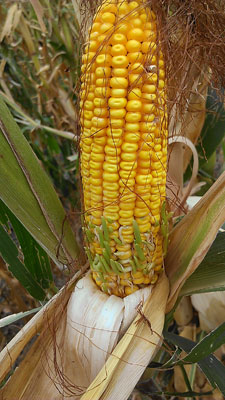
If you’re seeing kernel sprouting in your field, make sure your crop insurance adjuster is aware of the situation and submit samples for kernel damage due to mold and sprouting. Also check for mycotoxins prior to harvest if ear molds are a problem in your field. The local co-op will decide whether to accept the load based on percent damage and the standards they need to follow. If the load is rejected, contact your crop insurance agent to determine your next step.
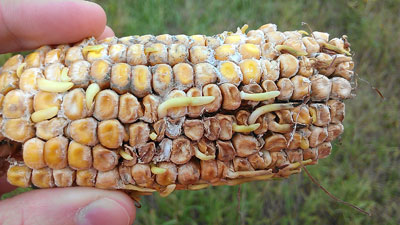
Sprouted kernels lead to higher kernel damage and more fines in a load. Keys for harvest will include
- harvesting early,
- drying it to 14%, potentially drying at a high temperature to kill the sprout,
- screening out fines, and
- monitoring stored grain closely for hot spots, mold, and additional sprouting grain.
With the moisture continuing to exacerbate corn ear molds,particularly in hail damaged fields, you may also decide to take the grain for silage instead. More information regarding correctly making silage can be found at: https://cropwatch.unl.edu/2018/silage-hailed-corn.
Husker Harvest Days Cornstalk Baling Workshop: Baling of cornstalk residue has been an increasing topic of interest among growers. Reasons are many including residue management when cattle don’t graze a field, use of residue as a feedstuff, and as was the case in 2017, to bale up much of the downed ears with the cornstalks. With this interest, we’ve had individuals contact us about custom baling residue as an additional income source. With the topic of residue baling comes many questions. These include:
- What is the nutrient value of the residue removed from the field?
- What are the impacts of residual removal on subsequent yields and field soil properties?
- What is the feed value of that residue?
- How do I best set my current equipment to bale corn residue?
- Is my current equipment the best to bale corn residue?
This year, Nebraska Extension, Farm Progress, and several forage equipment manufacturers are partnering in a Corn Residue Baling Workshop at Husker Harvest Days (September 11-13). The workshop will be from 1:30-2:00 p.m. daily in the fields adjacent to the haying demonstrations, which begin at 2 p.m. Equipment manufacturers who have committed to the demonstration include: CNH, AGCO, Rowse Rakes, Vermeer, and John Deere.
Some of the manufacturers will be showcasing the same equipment in this workshop and in the haying demos. Each manufacturer will talk briefly about their equipment and specific settings that might be needed to make their machinery work better on residue. Because of the high moisture content of the corn residue during the Husker Harvest Days Show, equipment demonstrations of baling residue are not a possibility; however, videos of the manufacturers’ equipment in action can be viewed in the University of Nebraska Institute of Ag and Natural Resources building.
JenREES 8-26-18
Reminder of South Central Ag Lab Field Day August 29th from 8:25 a.m.-4 p.m. (Registration at 8 a.m.)! 10.5 CCA credits have been applied for. More information at: https://go.unl.edu/zvwx
Crop Update: The rain last weekend was a blessing to many. It along with cooler temperatures has allowed for deeper kernels and delayed corn maturity. In fact, if we were to stay at the high temperatures we were experiencing, the Hybrid Maize model was predicting maturity in our area anywhere from 1-3 weeks early. Now, it’s mostly just predicting one week early (for anything that isn’t already mature). It also is showing above average yields for non-irrigated corn where drought-stress and hail weren’t a factor. Irrigated yields are showing near average according to the model for most fields in the area. You can see all the graphs and read more in this week’s CropWatch at http://cropwatch.unl.edu. Corn has reached black layer in many of the hail damaged fields I’ve looked at and some of the drought-stressed fields will begin harvest in a few weeks. The rain also greatly helped the soybeans, even in drought-stressed areas.
However, the rain also greatly increased stalk rot in fields, particularly in hail damaged ones. We weren’t seeing a large amount of mold in the first 7-10 days post-hail in hail damaged fields that were late dough to early dent. Now, nearly 21 days later, we’re seeing fungal growth increasing with the moisture and humidity within the husks of corn ears. It will be very important to check your fields to determine worst ones and worst areas of fields regarding stalk rot and kernel damage. Those areas should be harvested first if they’re being taken for grain and we’re recommending to fill any contracts with grain from those areas first. In checking for stalk rot, I prefer a ‘pinch test’ compared to a ‘push test’. With the pinch test, take your thumb and first finger and pinch the stalk internode that occurs between the lower nodes above the soil line. Do this for 20 plants in an area and get a percentage for those that crush. Then do this for several areas of your field. This gives you an indication of the level of stalk rot for your field and worst affected areas.
Cover Crops: With recent crop insurance determinations on these damaged fields, I’ve received an increasing number of questions regarding cover crop use. We’re already seeing weeds germinating in these fields due to open canopies, so weed control is one considerations for using a cover crop right now. Other reasons expressed have been for excess nitrogen uptake and also for a forage option. Dr. Mary Drewnoski, Extension Beef Nutritionist, Dr. Daren Redfearn, Extension Forage Specialist, and I talked through options to consider right now.
Always check with your crop insurance agent before seeding a cover crop into hail-damaged fields. It’s also important to check replant, forage and grazing restrictions regarding the herbicide program you used and any delay necessary before seeding a cover crop and any forage restrictions to grazing a cover crop. (See Replant Options and Herbicide Rotation Restrictions and Forage, Feed, and Grazing Restrictions for Row Crop Herbicides, both excerpted from the 2018 Guide for Weed, Disease, and Insect Management in Nebraska, EC130.)
In general, we’re at an interesting time for making cover crop decisions. Typically we use September 1 as the divider between planting small grains such as oats that will winterkill and winter hardy cereals such as rye or triticale (planted after September 1). Even with brassicas such as turnips, collards, or rapeseed, we’d recommend the cutoff for seeding to be within the next two weeks. Because of this time frame, mixes may be beneficial because they’ll take advantage of whatever weather we have for the rest of the season. Simple, inexpensive mixes may allow for at least something to become successfully established. So, for those looking at something to winterkill, oats could be planted yet this week as could a mix of oats and brassicas. However, after this week, we’d be looking at either adding something like rye or triticale to the mix or just switching to the more winter-hardy small grains. And honestly, while it isn’t mentioned in the table, if a person’s goal is cover the ground for weed management, bin-run wheat is also an inexpensive option. Your local seed supplier can provide seeding rates for cover crop options and we’ve provided a table with these options, depending on your goals, at http://cropwatch.unl.edu.
Yellow or red tops in corn plants: For a month now, we’ve observed yellow tops in corn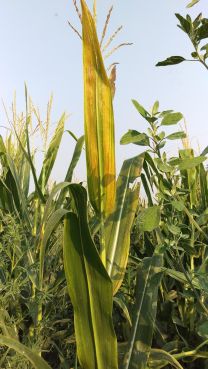 plants. Plants that contain ears and are turning yellow from the top to the middle of the plant can be occurring because of anthracnose top dieback or another disorder called ‘top leaf death or dieback in corn‘. Some plants with this discoloration truly do have anthracnose spores present on the stalk and sheaths. However, there have been other situations where I couldn’t find the presence of anthracnose spores. In those situations, the plants were often on compacted areas of field edges, always had a nice ear on the plant, and sometimes had tillers as well. Dr. Bob Nielsen at Purdue mentioned they had found what’s called ‘top leaf death’ in corn in situations where they experienced more drought or heat stress. Those plants had leaf discoloration similar to anthracnose top dieback, but without the presence of the spores. So, for those situations where I’m not finding anthracnose spores, I’m calling it this top leaf death disorder. You can read more about this at: https://www.agry.purdue.edu/ext/corn/news/timeless/topleafdeath.html.
| COVER CROP | USE/GOAL | WHEN TO PLANT | HOW TO SEED | RATE (PER ACRE) |
ADDITIONAL NOTE |
|---|---|---|---|---|---|
| OATS | Weed Management | By Sept. 1 | Drill best. Can fly on. | 30-40 lbs | * |
| OATS/RYE MIX | Weed Management | By Sept. 1 | Drill best. Can fly on. | 30 lbs each | * |
| OATS | Forage | By Sept. 1 | Drill best. Can fly on. | 80-90 lbs | * |
| OAT/RYE MIX | Forage | By Sept. 1 | Drill best. Can fly on. | 30-40 lbs of rye and 50-60 lbs oats | * |
| BRASSICAS (TURNIP, COLLARD, RAPESEED)-NOT OILSEED RADISHES | Cover ground, forage, nitrogen uptake | By Sept. 1 | Fly on for quicker establishment. | 5-6 lbs | — |
| RYE | Weed management, cover ground, forage, nitrogen uptake | After Sept. 1 | Drill best. Can fly on. | 50-60 lbs | * |
| *If adding a brassica to any of these small grain options, only 2 lb/ac is needed. Rapeseed isn’t as well known, but is an inexpensive and good option for consideration. | |||||
JenREES 8-19-18
Hail Damage Info: Thank you to all who attended our hail damage meetings last Monday and we truly hope the information was helpful. It was a lot of information at one time, so I have compiled it at: https://jenreesources.com/2018/08/14/late-season-hail-damage-resources/.
The ‘blessing’ in the timing of these later-season storms is in the reduced kernel moisture and shorter length of time till harvest. This is important to reduce the time for fungal growth in the ears. If you missed the meeting, presentations and information are at the link above. The main key I will stress: Please, ask your crop insurance agent how he/she wants to handle grain quality at harvest. Does the agent want to take samples for mold/potential mycotoxin? Does the agent go off of COOP samples? Does the agent require samples prior to going in the bin? These are key questions as we do know there is fungal growth on damaged ears. The presence of fungal growth does not automatically mean the presence of a mycotoxin. However, if grain quality isn’t handled and documented correctly at harvest, it can mean the loss of compensation if grain goes out of quality in storage. If anyone is taking hail damaged corn for silage, Dr. Mary Drewnoski is interested in samples prior to and after ensiling and is willing to help with sample analysis cost. Even if silage has already occurred, we’d be interested in samples after ensiling. Please contact me if interested. I will share additional considerations next week, but please check out the weblink above (or if it’s easier just go to http://jenreesources.com). Please let me know if you have any questions!

One week after the August 6, 2018 hail storm, stalk rot is setting in where stones hit the stems. This is regardless if fungicide was sprayed on fields at some point this season.
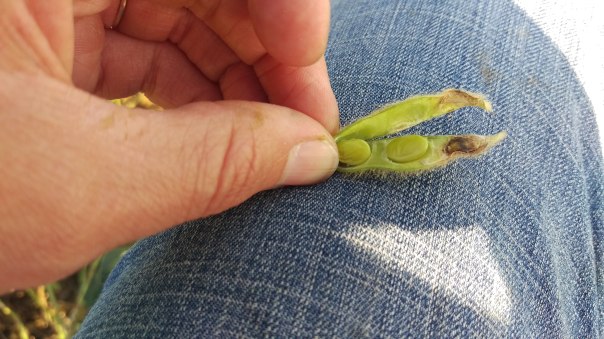
Soybean plants vary in damage. Many pods have moldy seeds where hail affected them or where they are no longer able to fill. We don’t tend to worry about molds in soybean and our experience has been these become light-weight and blow out the back of the combine at harvest.

Seven days after the August 6, 2018 storm, fungal growth and mold is present on ears, but pretty much only the places where hail stones hit the kernels. Corn was at late dough to early dent at the time of this storm. The growth is minimal compared to what I’ve seen on ears when damaged earlier than this when more moisture was present in kernels. Fusarium which is fluffy and white/pink in color, is what I’m seeing mostly on the specific hail stone or any insect damage on ears (I took this pic after the ears were passed around at the meetings, so the fungi don’t show up well). Fusarium has the potential to create the mycotoxins vomitoxin or fumonisin-but the presence of Fusarium (or related fungus Gibberella) does not automatically mean the presence of a mycotoxin. Diplodia (white growth see at top of photo near base of ear) is showing up more now with the additional moisture events. Diplodia does not have a mycotoxin associated with it. However, it will greatly explode on an ear creating light-weight ears and kernels and can be a problem in grain storage. It is what caused the most problem in the 2013 and 2014 hail storms. It also creates problems in tight-husked ears that remain upright and moisture gets into the base of them.
York County Corn Grower Plot Tailgate will be held from 5-7 p.m. on August 23rd. The plot is located east of York on Road 14 between Roads O and P on the north side of the road. View hybrids and visit with company representatives. Also, provide your estimate of the highest yield of the plot without going over. The winner will be awarded a Yeti cooler at the York County Corn Grower banquet in November. Pizza and beverages will be provided. Hope to see you there!
South Central Ag Lab Field Day will be held Wednesday, Aug. 29 from 8:55 a.m. to 4 p.m. at 851 HWY 6 near Harvard, NE. The day will begin with registration at 8:30 a.m., followed by tours of research sites through 4 p.m. Keynote speaker for the lunch is Mike Boehm, University of Nebraska-Lincoln Harlan Vice Chancellor for the Institute of Agriculture and Natural Resources and University of Nebraska vice president. Participants will be able to choose from four of the following six tours during the day. View program brochure for schedule.
Topics include the latest research in: Cover crops to corn issues; Corn insect management; Comparisons of variable rate irrigation and fertigation to fixed rate and impacts of cover crops on soil quality; Nitrogen fertilizer management (inhibitors and sensors) in irrigated corn; Corn and soybean disease updates; and Opportunities and challenges for weed control in soybean. CCA credits have been applied for. To register, please go to: https://go.unl.edu/2018scalfieldday by Aug. 26 for lunch planning purposes. Directions: 13 miles east of Hastings on Hwy 6 or 4.5 miles west of the intersection of Hwy 14 and Hwy 6. north of Clay Center.
Hamilton County Corn Grower Plot Tour will be held August 29th beginning at 11 a.m. The field location is just west of M Road and Hwy 34 on the south side (4 miles west of the Hwy 34 and 14 junction in Aurora), just past the viaduct. The program will feature Tom Hoegemeyer talking about the history of corn and how plant breeders have improved the yields. Kelly Brunkhorst, Executive Director of the Nebraska Corn Board will round out the program with an update on trade, the farm bill, and tariffs. Lunch starts at noon at the Oswald Farm followed by the featured speakers. The farm is located from L Road and Hwy 34 (5 miles west of the Hwy 34 and 14 junction in Aurora), 1 mile south to 12th Rd., then 1/2 mile west on the south side of the road.
Irrigation Field Days: Field days on Aug. 27 and 28 will demonstrate soil water measuring tools in production fields designed to help growers feel confident with their irrigation scheduling decisions. The demonstrations will show several irrigation scheduling equipment systems that were installed in the field this summer and have been recording data. Field Days will be located:
- August 27 – near Broken Bow. The August 27 presentation will be part of the Custer County Corn Growers 2018 Field Day at the Jeremy Coleman farm near Broken Bow. The tour will start at 5:30 p.m. at the field site, located five miles west of the intersection of Hwy 2 and Callaway Road then south ¾ mile on 433 Road. A meal will be served about 6:30 p.m. at Coleman’s shop one mile east of the field on Road 798. The educational program will be presented during the meal.
- August 28 – near Bradshaw. The August 28 tour will start at 12 p.m. with field demonstrations of the irrigation scheduling equipment, followed by a meal and presentations in the farm shop. The Bruce Hudson farm is at 2405 Road G, Bradshaw. That is 3.5 miles east of Polk on Hwy 66 to Rd G and 2 .7 miles south or from Benedict (Hwy 81 & State Spur 93C) 6 miles west to Rd G and 2.25 miles north.
JenREES 8-12-18
Crop Update: I’m so sorry to all affected by Monday night’s hail/wind storms! For those reading this before Monday, a reminder of hail damage meetings we’re having Monday Morning, 10 a.m. at the Utica Auditorium and Monday Afternoon, 1:30 p.m. at the Fairgrounds in Central City. I will post key points of what’s discussed at http://jenreesources.com after the meetings. Please also check out our Hail Know Website at https://cropwatch.unl.edu/hailknow and take the survey on the page to help us better know how to serve you with that resource.
This week’s CropWatch at http://cropwatch.unl.edu shares two different dicamba-related articles. One is a case study to walk through the forensic analysis for off-target dicamba movement showing how it originated from a corn field. The other goes into more detail regarding soybean still producing a new node every 3.7 days upon off-target dicamba movement (as long as the apical meristem has not been killed). It’s truly a significant piece of information, because without it, the assumptions within the forensic analysis don’t work!
Also, you have an opportunity to share your voice and input. This past week we’ve heard that EPA is planning to make their decision by mid-August on whether or not to extend registrations of XtendiMax®, Engenia®, and FeXapan® in order to help inform the seed and chemical industry for next year’s purchases. Some of you have called or talked with me about this. A few have understandably been pretty upset that these products are getting so much blame when, in this part of the State, much off-target dicamba movement starts from corn applications. That doesn’t get as much press nationally. While I’ve tried hard to share the story here and am grateful to our media partners who have helped me, I’m one very small voice. I have no idea what will happen; my concern is the bigger picture-potentially losing dicamba period as a tool in our toolbox.
So you have an opportunity to share your voice in Nebraska Extension’s survey that will be shared with the EPA: https://www.surveymonkey.com/r/JWDCY3C. Share your opinion on Xtend technology. Share your opinion on where you’ve discovered off-target movement from in 2017 and 2018. Share your opinion on dicamba. The results will also be compiled and shared on CropWatch and winter meetings. Thank you for considering this!
Aphids and Frogeye: I’ve also received a handful of questions regarding corn leaf aphids in corn and frogeye leaf spot in soybean. Both have rapidly increased in some corn and soybean fields. At beginning dent and various stages of starch-fill corn, I just have a hard time putting anything else into this crop. So I haven’t been recommending insecticides and there’s no thresholds this late to support it. In fields I checked from last week to this week with corn leaf and bird cherry oat aphids, I’ve also seen an explosion of beneficial insects and mummification occurring of aphids, which is helpful. Regarding frogeye, it’s one where we recommend a product containing a high amount of strobilurin at R3 or R5. Many beans are at R6 or almost there, so again, I’m having a hard time putting any more money into this. High humidity and leaf wetness for 12 hours or more will rapidly increase frogeye, so the worst situations I’ve seen through the years are in gravity-irrigated fields. Also, seeing a number of soybean defoliators in fields. Please check out this CropWatch article at: https://cropwatch.unl.edu/2018/soybean-defoliators to better help understand how much defoliation can occur in soybean.
Lawn Renovation: For those seeking to improve your lawn or get one established, August is a great time to do so! I really like this resource for this purpose: https://go.unl.edu/rz9z. If you’d prefer to watch videos, Backyard Farmer has a series of Lawn Renovation videos, but this link gets you to the most recent one regarding fall renovation: https://youtu.be/Fxd1NUQ8ScQ.
JenREES 8-5-18
Thank you to all who made the York County Fair go so smoothly! It’s always a joy to see the 4-H and FFA youth and families rewarded for the hard work they put into their projects!
Crop Update: I didn’t get out to the field much this week with fair but did spend a few

Bird cherry oat aphids on ear husks and green leaf aphids on leaves of plants in this non-irrigated field. Lady beetle larvae predators also present.
hours one afternoon. There are portions of the area I serve that have been blessed with rains and look really good. The main thing that I’m seeing a lot more of this week is aphids in corn fields. This can be common in fields where fungicide is applied as the fungicide kills a beneficial fungus that attacks aphids. Some aphid species are also attracted to moisture stressed crops. The heat has also pushed the crop along quickly. We have another yield forecasting article in this week’s CropWatch at http://cropwatch.unl.edu where we talk about the impact of the heat on yields. As of right now, based on comparing this year to 30 years of weather data, it’s appearing corn may reach maturity 1-3 weeks early. Irrigated yields are estimated to be near average and above to near average for non-irrigated corn (where drought is not a factor). These yield forecasts are based on simulations under ‘perfect conditions’ (with no nutrient loss, disease etc.) but they can give us an indication of what may happen if we continue with higher heat conditions.
Unfortunately, pockets in the area continue to miss rains. The drought monitor still is not

Drought-stressed soybean field.
reflecting the drought in this part of the State; at this point, I’m unsure what else either Al Dutcher or I can do about this. One farmer reminded me drought occurred in the same area in 2006, 2012, and now 2018-six years apart each time. Driving the area, hardest drought-stressed crops really took a turn this past week with corn in hard dough to early dent with some kernel abortion and soybeans are beginning to abort pods and quit filling seeds. One question has been on weighing taking corn for silage or not. If you have at least an estimated 50 bu/ac grain in most of the field other than highly compacted areas, it may be more profitable to keep for grain (unless you’re looking for cattle feed). The following are some resources to consider further:
- July 2018 BeefWatch article on considerations for green chop/silage for cattle feed, include best management practices, etc.: https://go.unl.edu/e3y5
- July 2018 K-State article for considerations on taking corn for silage or grain: https://enewsletters.k-state.edu/beeftips/2018/07/02/considerations-for-use-of-drought-stressed-corn-for-cattle/
- All UNL Drought Resources: http://droughtresources.unl.edu
Dicamba: We’ve often mentioned the research showing a soybean plant producing a new node every 3.7 days upon reaching V1 stage. And, I’ve used that in the forensics assessment for determining a timing for off-target dicamba movement. One question I’ve had was “Do soybean plants continue to produce a new node every 3.7 days upon being affected by off-target dicamba?” My assumption in the forensic analysis I have used is that a new node continued to be produced every 3.7 days in spite of off-target dicamba. However, the only way to really test this would be to have the same soybean variety in both an Xtend and non-Xtend version. We will release a CropWatch article next week in which a situation like this occurred at the Eastern NE Research and Extension Center. Dr. Jim Specht counted nodes in both the non-Xtend variety with off-target dicamba and the Xtend variety that wasn’t affected. He found the same number of nodes in spite of the dicamba affected non-Xtend variety being shorter in height and having less canopy. So that in itself is good information for use in forensic assessments. However, he also found plants in which a higher off-target dicamba dose affected the top-most growing point. When that occurred, the number of nodes was affected.
Last year, a group of us released a dicamba survey during Soybean Management Field Days. Reminder those are upcoming this week (https://enre.unl.edu/soydays)! The survey helps us understand your perspectives about dicamba and this year we’ve added questions regarding using Xtend technology. Hopefully it will provide helpful information for all of us and the results will be shared via CropWatch and winter meetings. We’d encourage and be grateful for any soybean growers to participate at: https://www.surveymonkey.com/r/JWDCY3C.
South Central Ag Lab Field Day: Please hold August 29, 2018 for UNL’s South Central Ag Lab (SCAL) Field Day near Clay Center! Attendees can choose which sessions you would like to attend. Options include the latest SCAL research in the areas of Irrigation/Water Use; Nutrient Management; Weed, Disease, and Insect Management; Cover Crops; and Cropping Systems. CCA credits will be available and there’s no charge to attend. Will have more specifics for you next week but please hold the date for now!
Vine Crop Problems: The following resource explains options for diagnosing various problems with cucumbers, squash, and melons: https://hortnews.extension.iastate.edu/2011/8-24/cucurbitwilt.html.
JenREES 7-28-18
Crop Update: By the time you read this I truly hope and pray we’ve received some rain for the entire area who receive this! Al Dutcher and I have been somewhat frustrated regarding the drought monitor reacting to short-term precipitation events over long-term trends. We both spoke at a meeting this week where he shared parts of this area have 6-8″ deficits dating back to the beginning of our water year (October 1). The soil moisture sensor ground-truthing I’ve been doing with area farmers shows that the larger rains only helped the top two feet of the profile and rains have been spotty since. I think the driest portion of the area seems to be from Lawrence to Bladen south. Drought monitor did put a portion of our area back into ‘abnormally dry’ again and you can see the updated soil moisture readings for the region at http://jenreesources.com.
We were blessed with cooler temperatures which helped slow the crop progression. The heat was pushing crops along quickly which can negatively impact yields as we discussed in a recent CropWatch article. The cooler temps with humidity and leaf wetness also favored gray leaf spot, though, and I’ve seen it move up to a leaf below the ear in several fields in several counties this past week. Every field situation may differ so it’s important to check your specific fields.
Soybean Management Field Days: It’s hard to believe but this is the 20th year of Soybean Management Field Days! They will be held August 7-10 at four locations across the State beginning with 9 a.m. registration and concluding at 2:30 p.m.:
Kenesaw — Tuesday, Aug. 7, Dean Jacobitz Farm
Albion — Wednesday, Aug. 8, John and Mike Frey Farm
Hartington — Thursday, Aug. 9, Ed Lammers Farm
Cedar Bluffs — Friday, Aug. 10, Ray Jr. and Kevin Kucera
- Marketing, Risk Management and Farm Policy
- Weed Management: Cover Crops and Weed Control, Conventional vs. Traited, Soybean Variety Production
- Cover Crops: Managing Soybean Insects and Pathogens
- Cover Crops and Soybean Production Irrigation Management, Soil Fertility, and Cover Crop Research
Horticulture Update: It’s been a tough year for garden produce! The heat has affected flower set, pollination, and fruit production on many types of plants. I’ve also received many questions about tomato leaves curling. Leaf curling can be due to many things such as water stress, virus, and herbicides. Much of what I’m seeing now is water stress-related where uneven watering is occurring or because of the amount of leaves present (especially on heirloom plants) and the plant’s inability to keep up with transpiration. Have also received questions on bumpy tomato stems. The ‘bumps’ are actually adventitious roots (also known as tomato stem primordia) where if they touch the soil they’d form roots. Above ground, they are just these bumps and are present when we have high humidity or overwatering. These conditions are also being favored by the heavier one-time rain events that have been received during the growing season this year.

Squash vine borers causing tunneling in crown and vines of zucchini plants.
Also lots of questions this week regarding cucumber, squash, and melon vines dying! There’s a number of potential culprits. Most affected zucchini (including mine) and pumpkins contain squash vine borers. The female moth lays eggs at the base of plants where the eggs will hatch and the caterpillars will bore into the stem. The borer is white or cream colored with a brown head and can get to be 1″ long. They tend to prefer squash over melons and cucumbers. So what can you do now? Kathleen Cue, Extension Educator in Dodge County shares “If plants look good but holes in the stem indicate infestation, a knife can be used to cut with the grain of the stalk to find the borers. Use the point of the knife to pierce them and don’t be surprised if more than one borer is found in a stem. Once the borers are removed, cover the cut area with soil to encourage new roots higher up on the stem. Champion pumpkin growers will place soil over many nodes (the place where leaves emerge from the stem) along the length of vines to encourage lots of rooting. This gives plants greater resiliency if the squash vine borer has destroyed the crown of the plant.” So, if you’re still desiring more squash and pumpkins, that’s one option for you. If your plants are completely destroyed, you can just remove all the dead material to remove any actively feeding caterpillars as well. For next year, make sure to rotate the area where you plant your vine crops. Area master gardeners have shared they put aluminum foil around the stem base of vine crops to keep the borer larvae from penetrating the vines. Another option is to apply insecticides like carbaryl or permethrin around the base of stems. Trapping the adults in June by using yellow-colored containers filled with water can provide an indication when the moths are flying. You can then use floating row covers over the plants to prevent egg laying and remove them once flowering begins to allow pollination to occur. I will discuss other vine crop problems next week.
Reminder of York County Fair this week!
JenREES 7-22-18
Crop Update: This past week was fairly interesting with southern rust being confirmed in a few Fillmore, Thayer, and Saunders County fields. We would recommend to continue scouting fields as the disease was low incidence at all these sites. There also were a number of questions regarding fungicide applications.
For those asking about chemigating fungicides, it’s important to ensure the fungicide

On-Farm Research design for those considering chemigation vs. none of fungicide (could also use this for 2 different irrigation amounts instead). Can have more pies than this for smaller area if desired-we would just need at least 4-5 pies of each of same area. Data can be collected throughout field normally during harvest via yield monitor and we can use software to determine yields within the pies as long as we know the angle degrees you used.
product label allows for chemigation and to follow the recommended irrigation amount if specified on the label. If an irrigation amount isn’t specified, Tamra Jackson-Ziems and I were talking about trying to apply with as small amount as possible (perhaps like 0.25″). She has chemigation data at 0.25″ vs. 0.50″ vs. ground application from 2005-2007, but not vs. aerial application. The data had a high degree of variability numerically in the yield data in spite of non-statistical differences. The only other info I could find was the University of Georgia recommends only 0.10″ on chemigation using fungicides, but they didn’t show any data. I encourage those who can to please consider doing this as an on-farm research study where chemigation occurs in pies throughout the field with other pies left untreated. I realize it’s not popular to leave areas untreated, but it may be of interest to you. For those asking about comparing aerial vs. chemigation for corn, that would be very difficult with one pivot with true research involving replication. Perhaps it could be done if a producer had a couple of quarters side by side, planted the same day with same hybrid and crop rotation where we could truly compare via research. If you do and that’s of interest to you, please contact either Tamra or myself. A couple have also discussed maybe applying half a pivot aerially and the other half via chemigation and just taking observations, which may also be beneficial to you.
We also released a few CropWatch articles this week on differentiating growth regulator herbicide injury in soybean and using a forensic method to diagnose off-target dicamba
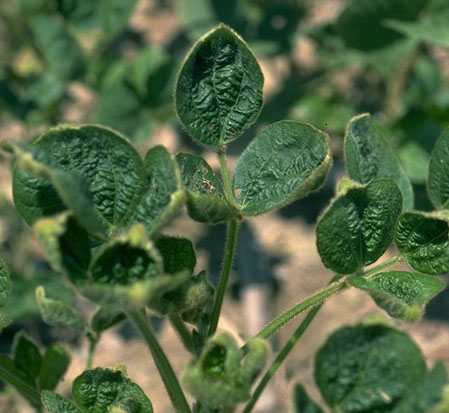
Dicamba on Soybean: Because dicamba negatively affects leaflet margin cell division, direct dicamba exposure to nearly fully developed leaflets results in in a “draw-string” injury symptom at the leaflet tips, thus shortening the leaflet length. Keep in mind, however, that the translocation of dicamba from directly exposed leaflets to very young leaf primordia developing at new nodes at the main stem apex will also induce leaf cupping in those yet to emerge leaflets, even though these very young leaflet primordia were not directly exposed to dicamba. The same can be true for new trifoliolates occurring from additional stem branching at lower nodes. Photo via Purdue University.
injury in soybean. Please check them out at http://cropwatch.unl.edu. I hadn’t heard anyone really explain the difference between 2,4-D and dicamba in how they work in plants so felt that information was important in addition to the fact dicamba is highly translocateable and 2,4-D isn’t. That also has been important in home-owner discussions regarding off-target movement to garden produce. And, a reminder to all home-owners that weed control products used in lawns and empty lots often contain dicamba and/or 2,4-D…so it’s important to read those labels regarding environmental conditions in applying them and also when you can/can’t use grass clippings as mulch.
Buzzing Beetles: This past week, several people came to the office or called
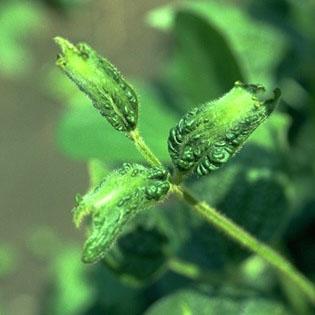
2,4-D on Soybean: 2,4-D impacts cell division in the more central (major vascular) portion of the leaflet. Low-dose 2,4-D exposure induces injury that results in a “narrowed, strap-shaped” leaflet in which the leaflet veins are made more parallel. This 2,4-D-induced injury is often accompanied by a rugose leaf surface ― a botanical term describing a rough leaf surface of irregularly spaced bumps/wrinkles and prominent ridged/corrugated leaf veins. Low-dose 2,4-D exposure will also lessen leaflet area, but differently, by narrowing/elongating the leaflet. 2,4-D is also not highly translocatable, wheras dicamba is. Photo via Purdue University.
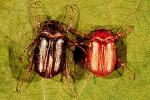
regarding large green beetles flying around that sounded like bumble bees. These are called Green June beetles. They only fly during the day. There are also smaller green beetles with white spots (tufts of hair) around the abdomen; those are Japanese beetles. Japanese beetles feed on crops in addition to favorites such as Linden trees and knockout roses. Both have larval forms that are white grubs and both have a one year life cycle. In the beetle form, both adult beetles are fond of ripe fruit such as grapes, berries, plums, and peaches. As larvae, the grubs feed on decaying organic matter and grass roots in the soil. However, the June beetle larvae can reach 2″ long creating larger tunnels in lawns and pastures as they move in the soil.
Some have said, “I thought June beetles were golden/tan!” And you would be correct! There’s several types of “June” beetles. The most common and perhaps most damaging is known as the June beetle or masked chafer which is golden/tan in color and has a one year life cycle. There’s also a May/June beetle (also known as the 3 year grub) which tends to do more damage in range/pasture ground. Those beetles are tan to brown/near black in color.
When it comes to damage, start looking for browning areas of turf occurring late July, throughout August, and early September. The turf may look like drought stress or fungal disease; however, if you can gently roll the turf back like a carpet, it’s most likely grubs (and you should also find the presence of grubs). Other signs of grubs can include birds, skunks, etc. tearing up your lawn. White grubs in general feed on decaying organic matter, lawn and ornamental roots in the soil. Grubs don’t tend to be an issue in fescue lawns or lawns that are low maintenance or newly established. They tend to prefer Kentucky bluegrass lawns that are highly maintained with fertilizer and irrigation. They also may be spotty in their feeding such as under yard lights or on irrigated slopes. The threshold level for turfgrass damage by masked chafer larvae is 8-10 white grubs per square foot of lawn…so I would assume that to be the case for all grub species. One or two grubs per square foot is normal and does not require control. If grub control is needed, products like Sevin or Dylox provide the best control for mature grubs and should be watered in after application.
-
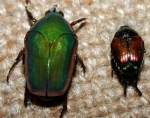
- Green June Beetle (left) and Japanese beetle (right). Photo via Purdue Entomology.
-
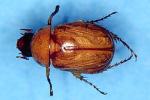
- Masked chafer (June beetle). Photo via UNL Turf.
-
- May/June beetle. Photo via UNL Turf.
JenREES 7-15-18
Crop Updates: A great deal of timely information was provided in this week’s CropWatch at http://cropwatch.unl.edu including information about high heat and pollination, applying fertilizer during pollination, western bean cutworm scouting, forecasted yields, etc. Please check it out!
Several called me asking about applying fertilizer during pollination. I shared that while
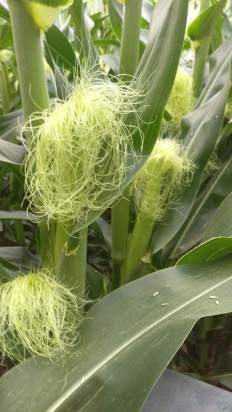
I wasn’t aware of research, I personally was concerned about anything potentially interfering with pollination and that I do recommend 30 lbs of N at brown silk if needed or if you were originally planning split nitrogen apps. This is based on research from Purdue sharing today’s hybrids use 30-40% of their total Nitrogen from flowering through maturity. After discussing with Dr. Tom Hoegemeyer, Adjunct UNL Professor of Practice, he offered the following insights: “Pollination mostly occurs between 8:30 a.m. and Noon. Thus, as a precaution, I would not run a pivot on pollinating corn from 6 a.m. to Noon. When the temperature is 90°F to 95°F, the pollen is killed by heat and is seldom viable past 2 p.m. That leaves lots of time to run pivots, apply N, etc. when it won’t harm pollination. Silks tend to be viable for three or four days at these temperatures, so if a plant isn’t pollinated one day, generally the next day will work just fine. (If nitrogen is needed), I’d recommend that nitrogen go on as soon as practical. Corn nitrogen use is very high during the pre-tassel growth phase and again at kernel growth, from one to three weeks post pollination. About seven to ten days post pollination (before brown silk) lower N will start causing kernel abortion and serious yield loss in corn.” The UNL recommendation for fertigation is to use 30 lb of N with 0.25″ of water or 50-60 lb of N with 0.50″ of water.
Last week also brought questions regarding thresholds and difficulty in finding Western Bean Cutworm egg masses with moth flights at their peak. You can view light trap data from UNL’s South Central Ag Lab thanks to Terry Devries at: https://scal.unl.edu/ltr2018.pdf. There’s also a great article in this week’s CropWatch on how to scout for them, insecticide options, and additional recommendations. Thresholds for western bean cutworm are 5-8% of corn plants in the field containing egg masses or larvae. Egg masses can be difficult to find during pollination with pollen hiding them. ‘Typically’ egg masses are found in the top third of the plant on the upper sides of leaves and near midribs or leaf axils. However, with higher heat, I tend to find them closer to the ears and have even seen masses laid on the ear husks and on the backsides of leaves (not common). While larvae are generally known to move up the plant to feed at the tassels, I’ve seen high heat force larvae into ears earlier. It typically takes 5-7 days for larvae to hatch and the egg masses turn purple just prior to hatching. A number of insecticide options are available for both aerial application and via chemigation; these products are listed in the CropWatch article.
With insecticide applications occurring in corn for both western bean cutworm and also corn rootworm beetles, many have also called or talked with me about the recommendation of fungicide applications. Right now, I haven’t found gray leaf spot above 3 leaves below the ear leaf in several counties. There’s been some mis-diagnosing bacterial leaf streak as gray leaf spot. Southern rust was just confirmed in a Kansas county this week, but we still have yet to confirm it in Nebraska. Even the longest residual products won’t get us through August if a fungicide application occurs now. I can appreciate that economics are tight so the thought is to save an additional application cost by applying a fungicide now with the insecticide. And, I can appreciate economics are tight regarding why apply a fungicide right now when disease pressure doesn’t warrant it? Perhaps, at least those of you with the ability to chemigate could consider waiting till disease pressure warrants it for your field, if it does. Always in the back of my mind is the need for late-season protection with southern rust eventually showing up and gray leaf spot often worse then.
My perspective is from a resistance management and research-based one. We have 5 total modes of action for fungicides with 2 of them being in nearly every fungicide product we use in corn, soybean, and wheat because they work against foliar fungal pathogens. At some point, our pathogens will also adapt, as we’ve seen our weeds and insects do…it would be like losing our ability to control gray leaf spot and southern rust similar to palmer amaranth on the weed side. In Nebraska, Dr. Tamra Jackson-Ziem’s research has not shown an automatic yield increase to fungicide application in the absence of disease. And, it has also not shown an automatic yield increase when applied at tassel. In a high heat and low disease year like 2012, there were no statistical yield differences with fungicide application vs. the untreated control. Even in years with some disease pressure such as 2008-2010, she found no statistical yield differences between when various products were applied from Tassel through Dough stages. In high disease years, her research shows the benefit of fungicide application for reduced disease pressure and increased stalk strength. Fungicides are great tools to help us with disease pressure and stalk strength. Just would encourage all of us to consider when we really need to apply them and to understand that research in Nebraska does not automatically show increased yields with the use of them or with the timing of Tassel/Silking vs. later in the year. Also, hybrids may vary in their response due to disease susceptibility and other factors. Not all her data is listed at this site, but you can view it for yourself at: https://go.unl.edu/ni3y.
Bagworms: I’ve been seeing shelter belts and various trees turning brown from heavy
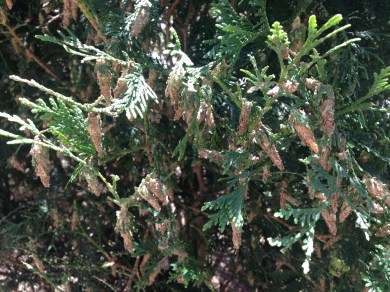
Severe bagworm infestation on arborvitae. Photo via Kelly Feehan, Extension Educator Platte Co.
bagworm infestations. Please be checking your trees if you are noticing them turning brown. Additional information can be found at: https://go.unl.edu/rgju.
JenREES 7-8-18
Crop Update: A few diseases started showing up the past few weeks in various portions of eastern and south central Nebraska. Phytophthora root rot in soybean is perhaps the

Phytophthora root and stem rot in soybean. Notice wilted plant with leaves hanging on turning yellow/brown. Also notice characteristic brown lesion from base of plant up a good six inches on this plant. This affected plant is surrounded by healthy plants.
most common in both areas. We normally think of this disease as seedling damping off and death; however, it can also affect plants later in the season. What surprised me was how much we are seeing it this year in higher ground and sidehills instead of the typical lower ground we often see it on. Dr. Loren Giesler, Extension Soybean Pathologist said that in situations where we’ve had dry conditions followed by heavy rains (as we have this year), especially on clayey or soils prone to compaction, Phytophthora can also affect plants. He has a few videos along with additional information at the following website: https://go.unl.edu/tdfh. Symptoms characteristic at these growth stages include wilting of plants during the day with leaves eventually turning yellow-brown-gray and remaining on the plants. Also, look for a brown stem lesion that goes from the soil line upward about 4-6″. Some of these plants are also snapping off at the soil line. For those experiencing Phytophthora this year, future management includes:
- Using resistant varieties including a combination of good partial resistance and an Rps gene. Partial resistance alone will not be as effective during early growth stages or under high disease pressure.
- Cultural practices include anything that can improve soil drainage and compaction.
- Seed treatment fungicides containing mefenoxam or metalaxyl should be used and you may need to consider a higher rate of them.
Regarding corn diseases, bacterial leaf streak (BLS) has greatly increased on more

Bacterial Leaf Streak (BLS) in corn. Lesions are elongated and skinny staying between the leaf veins, similar to gray leaf spot (gls). However, leaf margins are wavy and diagnostics under the microscope show the presence of bacterial streaming from the leaf veins. With gray leaf spot, there will be the presence of fungal spores. Thus, the importance of correct diagnosis when considering fungicide applications.
susceptible hybrids since rain events. Early lesions can look very similar to gray leaf spot, so it’s important to correctly identify the two. The margins of BLS are wavy vs. those of gray leaf spot are more blunt. Both can have yellow margins when backlit by the sun. Fungicides are not effective against BLS and hybrids do vary in their tolerance to this disease. It’s important to scout fields as we may see an increase in fungal diseases due to the humidity, leaf wetness, and recent rain events. Southern rust has taken awhile to develop in the southern U.S., which is somewhat unusual, yet many states have been in drought this year too. As of July 5th, southern rust has been confirmed in Georgia with one suspected sample in a Missouri county. You can watch the map at: http://ext.ipipe.org/ and follow @corndisease on Twitter for the latest on corn disease findings in the U.S.
Trees: With numerous wind storms, the following resource has a lot of great information regarding pruning storm damaged trees correctly and questions to ask tree care services regarding tree pruning: https://go.unl.edu/94fm.
Agronomy Youth Field Day: All youth ages 9-18 years old are invited to the 3rd Annual Agronomy Youth Field Day. Youth will have exciting educational experiences while discovering Science & Agronomy/ Irrigation / Mechanized Agricultural careers for producing Nebraska crops! The field day will be held Wednesday, August 8 from 9 a.m.-3 p.m. at Nebraska College of Technical Agriculture Educational Center in Curtis, NE.
Hands-on activities (for all age levels) will focus on pest management, equipment technology, crop growth, soil management, precision farming & center-pivot irrigation technology. Several Nebraska Extension Cropping & Water Systems and 4-H Youth Development Educators along with Nebraska College of Technical Agriculture in Curtis Agronomy / Ag Mechanics Department professors will be sharing the researched based information with the students.
Participants will gain important life skills while discovering the science behind producing Nebraska crops. The six-hour field day is a great opportunity for ALL the youth to learn more about the agronomy industry and increase their basic understanding of science, ag literacy, a technology & STEM while exploring careers. Parents/Adults are welcome and lunch will be provided.
Reserve your spot today by registering online at: https://go.unl.edu/agronomyyouthfieldday by August 3, 2018. For more information (or if trouble with registration) contact Nebraska Extension Frontier County at 308-367-4424 or email 4-H Educator Kathy Burr at kathy.burr@unl.edu.


 JenResources