
JenREES 1-6-19
It feels like a long time since I wrote! Being burned out, I wasn’t ready to reflect on 2018 in my previous column. Perhaps some of you felt that way too? There were plenty of challenges for agriculture in 2018. Grateful for breaks. Grateful for a new year! Grateful for good new hires in Extension to help with the work load throughout the State! As I reflect on the past several years, thank you for your support as I’ve done my best to cover a lot of counties to the best of my ability. Grateful for the opportunity to serve Nebraskans via Extension and to enjoy this work! And while it comes at the expense of our farmers, I’m grateful for the continual opportunity to learn with every new crop/pest problem. I know a few of you have wished these problems didn’t have to happen to you so I could learn! Yet I do appreciate the phone calls to work through situations with our farmers and ag industry professionals. While each year presents unique challenges, I’m always inspired by the resiliency of our farmers and those in the ag community. Looking forward to serving you in 2019!
Short Survey: In Extension, we always need to prove that what we do in our work brings value to those of you we serve. Would you please consider completing this short survey for me to provide feedback, specifically regarding my email newsletter, news column, any specific way I helped you last year, and ways I can improve in my Extension role in 2019? All feedback is anonymous. Please go to the following direct link: https://app2.sli.do/event/q2p1sedv/polls or you can also go to https://www.sli.do/ and enter the code 7708. Thank you for considering this!
York Ag Expo: Reminder of the York Ag Expo this week! Hoping to see many people come out to view the exhibits and also come to the educational sessions. I try to train people to RSVP for all my educational events, but walk-ins are always welcome. Chemigation is on January 9th from 9 a.m.-Noon with Steve Melvin. Then come out and hear the latest on the Farm Bill, Crop Insurance decisions, and Farm Taxes from 1-4 p.m. from Brad Lubben, Cory Walters, and Austin Duerfeldt. On January 10th, I will present private pesticide training from 9 a.m.-Noon. Then come out for residue and manure management from 1-4 p.m. with Mary Drewnoski, Michael Sindelar, Tim Mundorf, and myself. From 4-5 p.m. will be the keynote speaker Chad E. Colby. Agribusiness after-hours from 5-6 p.m. Ag appreciation lunch both days and all exhibitors and sponsors can be found at: https://yorkchamber.org/event/ag-expo/. Hope to see you there!
RUP Dicamba Training: On the Nebraska Department of Ag website, you will now see the list of UNL face-to-face trainings, the link to the UNL online dicamba training, and a list of certified applicators who have completed dicamba training. I took the online course on Friday so I could better answer questions. This year, it allows you to take one of two tracks: presentations by Dr. Bob Klein or Dr. Greg Kruger. You are also welcome to take both for more information. There are instructions with screenshots on the online dicamba training webpage: https://pested.unl.edu/dicamba-training-instructions. Some reminders regarding this, the applicator’s name and applicator ID number need to be listed when registering for the online course. Last year we had some wives complete the registration for husbands and then the wives were listed as certified and not the husbands. This year anyone applying RUP dicamba must complete approved RUP dicamba training and must also be a certified licensed pesticide applicator. Regarding face to face trainings, I am not having a dicamba training during the York AgExpo, but there are many options available that can be viewed on the NDA website. For that training, you will need to bring your certified applicator number. If you are a new pesticide applicator who hasn’t received a number yet, you will put ‘pending’.
York-Hamilton Cattlemen’s Banquet: The York-Hamilton County Cattlemen are planning their 71ST Annual Cattlemen’s Banquet for Tuesday January 29, 2019 at the Holthus Convention Center in York. Dave Thorell of Loomis, NE will be the featured entertainment. Dave Thorell is a regionally known speaker, avid agriculture advocate, humorist, story teller and was the voice of Agriculture News for over forty years on KRVN Radio. Thorell was elected into the Nebraska Broadcaster Hall of Fame. The Cattlemen will also recognize Rich Pearson of Hordville and Allen Roehrs of Bradshaw as Honored Guests for the evening for their contributions to the area livestock industry and the Cattlemen’s Association. The evening starts at 6:30 with social time, a Prime Rib meal at 7:00 with entertainment and recognition of honored guests to follow. Cattlemen’s Banquet tickets are $25 per person. Sponsorships are also available that include two banquet tickets and recognition at the banquet for $150. Cattlemen’s Banquet tickets can be purchased from any of the York-Hamilton County Cattlemen’s Directors including Brian Blase of Hordville; Brock Ekhoff and Terry Ross of Aurora; Jeff Underwood of Exeter; Allen Klute and Mark Klute of Hampton; David McDonald of Phillips, Jeff Meradith, Kim Regier and Josh Chrisman of York; Kim Siebert of Henderson, plus the Extension Offices in York County and Hamilton County.
JenREES 12-30-18
Happy New Year! The following are upcoming programs you may be interested in attending.
York Ag Expo: Hope to see you at this year’s York Ag Expo at the Holthus Convention Center in York January 9 and 10th! The list of sponsors and exhibitors can be viewed at: https://yorkchamber.org/event/ag-expo/. Educational sessions are being offered again at the Expo. On January 9th, Chemigation training (both initial and recertification) will begin at 9 a.m. There is no charge and please bring a calculator with you. If you are coming for initial training, I’d recommend you get the materials before-hand to look through and you can receive them from the Extension Office. At 1 p.m., Brad Lubben, Cory Walters, and Austin Duerfeldt with UNL will share the latest on the Farm Bill, Crop Insurance decisions, and Farm Tax information. Farm Credit Services of America will also share information. On January 10th, I will have a private pesticide training session at 9 a.m. Please bring your barcode letter from NDA if you have it and the cost is $40. Then at 1 p.m., Mary Drewnoski, Michael Sindelar, and I will discuss residue removal considerations via baling and grazing. Tim Mundorf with Central Valley Ag (CVA) will be sharing on the value of manure as well. At 4 p.m. on Thursday the 10th, Chad E. Colby, Ag Technologist and well known on Ag Twitter, will be the keynote speaker. He is being sponsored by CVA. This will be followed by the Celebrating Ag Social Hour sponsored by the Rural Radio Network from 5-7 p.m. Lunch will be served both days beginning at 11:30 a.m. and sponsored by Cornerstone Bank. Hope to see you there!
Pulse Crop Expo: There’s been quite an interest in pulse crops the past few years in Nebraska. Some growers are looking at pulse crops to change up labor requirements during the year, looking for a different market and price, or looking for another crop that allows cover crops to be planted and established after harvest. To learn about getting started with pulse crops or how to enhance your existing pulse production, don’t miss the 2019 Nebraska Pulse Crops Expo January 7 at the Holiday Inn in Kearney from 9 a.m. to 5 p.m. Lucas Haag, northwest area agronomist with Kansas State University, will be the keynote speaker, presenting on field pea growth and development and management of field peas at critical growth stages. Other presentations include research-based information on production practices, tillage, seeding rates, and irrigation. The 2019 NE Pulse Crops Expo is sponsored by the SARE (Sustainable Agriculture and Research Education), the Nebraska Environmental Trust, and pulse crops industry partners. There is no charge, but please register by going to: https://cropwatch.unl.edu/nebraska-pulse-crops-expo-registration or calling 402-318-1124.
Farmers and Ranchers Cow/Calf College: This annual program will be held at the U.S. Meat Animal Research Center and Great Plains Veterinary Education Center near Clay Center on January 14, 2019 with registration, coffee and donuts starting at 9:30 a.m. The program will run from 9:55 a.m. until 3:30 p.m. This program is sponsored by Nebraska Extension’s Farmers and Ranchers College and RSVP is needed for the noon meal. Speakers include: Welcome by Dr. Mark Boggess of USMARC and Dr. Dale Grotelueschen, Director of the Great Plains Veterinary Education Center; Mary Drewnoski with “To Graze or Not to Graze? Factors that Affect Risk Nitrate Toxicity in Annual Forages”; Rick Funston with “Increasing Production Efficiency”; Brandy VanDeWalle on “Family Farm Stress”; Amy Schmidt with “Top 3 Environmental Considerations During Short-Term Cow-Calf Confinement” and Dr. Kip Lukasiewicz on “Animal Husbandry Strategies to Improve One’s Efficiency”. Please pre-register by January 8th, to (402) 759-3712. Walk-ins are accepted, but may not get a lunch. You may also complete your registration online at http://go.unl.edu/farmersrancherscollege. Remember, your contact information is required to be on the U.S. MARC property, so pre-registration is helpful and will save you time at the door!
23rd Annual Great Plains Growers Conference: This conference will be held in St. Joseph, Missouri on January 10-12 for anyone interested in growing fruit, vegetable, hydroponics, cut flowers for production. Topics on Jan. 10 include: “Cover Crops and Soil Health”; “Food Safety Modernization Act (FSMA) Grower Training”; “Hops Potential”, “Selling Local Foods” and “Honey Bees & Beekeeping”. Concurrent sessions on Friday and Saturday Jan. 11 and 12 provide more than 50 presentations on a wealth of subjects. In addition to presentations on conventional and organic vegetable production, there will be tracks on tree and small fruit production; organic and conventional vegetable production; season extension; greenhouse and hydroponics; cut flowers and technology for growers. A full program, registration information and more information can be found at the website: www.greatplainsgrowersconference.org.
JenREES 12-23-18
Wishing everyone a wonderful Christmas and time to celebrate this special time of year with family and friends!
With the re-registration of the restricted use pesticide (RUP) dicamba products, I’ve been receiving questions regarding the training and label requirements. Dr. Rodrigo Werle who is now a weed scientist in Wisconsin put together a really nice blog post to help understand the new buffer label requirements at: http://www.wiscweeds.info/post/dicamba-buffer-requirements/.
RUP dicamba training can be obtained at the Crop Production Clinics (CPC), Nebraska Crop Management Conference (NCMC), Approved Industry Trainings, Extension Trainings, and via an online course. It is not built into our private applicator pesticide training, but many of us are offering it as an option on the same day and at the same location as pesticide training. There is no charge for dicamba training (unless you’re taking it at a program that requires a fee such as CPC and NCMC). You have to be a certified pesticide applicator to apply RUP dicamba this year and you need to provide your applicator number for dicamba training.
All information from the Nebraska Department of Ag including labels, best management practices, list of trainings and list of certified applicators who’ve taken the training, can be found at: http://www.nda.nebraska.gov/pesticide/dicamba.html. The online dicamba training (available after January 1, 2019) and additional informational resources from UNL can be found at: https://pested.unl.edu/dicamba.
I’ve been thinking about these dicamba buffer requirements in addition to how heavy palmer and other weeds often are on our endrows. Research shows that palmer is sensitive to red and natural light in triggering germination. Research and observation have shown incorporation of a small grain helps with reducing palmer amaranth germination early in the season, and if taken to grain, delays germination till after harvest of the small grain. Chris Proctor, Extension Educator, and I were talking and wondered if we should consider incorporating a small grain into our endrows (especially in soybean fields) or possibly even perennial grasses for situations that would be a better fit? I’m unsure how practical this is for every farmer or every situation, but in floating the idea with farmers as I’ve presented about palmer, it seems like it may work for some. We’ve seen from previous years the challenges with weather in being able to spray dicamba and herbicides in general. With the buffer requirements and the fact that endrows often have heavier weed pressure, I just wonder if we need to start looking at treating endrows differently. Would like to hear your thoughts on this and/or other ideas!
We also know from research at the University in Arkansas in greenhouse studies that palmer only took three generations to become resistant to dicamba. Considering three generations, it’s like saying dicamba is applied to soybean one year, corn the next year, and soybean again the following year with year 4 showing resistance developing. Dicamba is a great tool in our toolbox and palmer is perhaps our most difficult weed to control right now. Consider choosing which crops you will use dicamba on this next growing season and think through the next few years’ crop rotation and herbicide program on your different farms to help with selection pressure and resistance management.
Area Extension Dicamba Trainings:
- Jan. 21: York County, 5 p.m., 4-H Bldg, York
- Jan. 22: Thayer County, 5:30 p.m., Community Center, Davenport
- Feb. 5: Merrick County, 10:00 a.m., Fairgrounds, Central City
- Feb. 6: Hamilton County, 10:00 a.m., Fairgrounds, Aurora
- Feb. 7: Seward County, 11:30 a.m., Civic Center, Seward
- Feb. 12: Kearney County, 12:00 p.m., Fairgrounds, Minden
- Feb. 14: Webster County, 12:00 p.m., Community Center, Blue Hill
- Feb. 19: Franklin County, 1:30 p.m., Fairgrounds, Franklin
- Feb. 20: Clay County, 2:00 p.m., Fairgrounds, Clay Center
- Feb. 28: Nuckolls County, 10:00 a.m., Community Center, Nelson
- Mar. 5: Hamilton County, 10:00 a.m., Fairgrounds Aurora,
- Mar. 11: Adams County, 4:00 p.m., Fairgrounds, Hastings
- Mar. 12: Jefferson County, 10:00 a.m., Fairgrounds, Fairbury
- Mar. 13: Gage County, 10:00 a.m., Extension Office, Beatrice
- Mar. 14: Saline County, 10:00 a.m., Extension Office, Wilber
JenREES 12-16-18
This year we’ve seen quite an increase in baling of soybean residue in the area. I’ve also heard this in other parts of the State. Soybean residue can be used for bedding, or for feed as roughage or mixed with distiller’s grains. In speaking with farmers and livestock producers, there’s perhaps a number of reasons why we’re seeing an increase in soybean residue acres baled this year. While we’re not short on corn residue, the late harvest delayed baling of corn residue for some and they were looking for another forage source. Hay prices have been higher this fall and continue to increase, making soybean residue a less expensive alternative. Some crop growers may also have been seeking added income.
Some colleagues and I addressed questions we were receiving in a recent UNL CropWatch article. Questions have centered around the value of this residue. I’ve shared in previous articles that approximately 1 ton of corn/grain sorghum residue is produced for every 40 bushels. For soybeans, it takes 30 bushels to produce 1 ton of crop residue. So to give an example, a corn field averaging 240 bu/ac would result in approximately 6 tons of residue/acre. In comparison, a soybean field averaging 60 bu/ac would only produce 2 tons of residue/acre.
In general, there’s not too much difference in the amount of nutrients removed from corn vs. soybean residue.
- Corn (17 lbs N, 4 lb P2O5, 34 lb K2O, 3 lb S)
- Soybean (17 lbs N, 3 lbs P2O5, 13 lbs K2O, 2 lbs S)
To determine the value of these nutrients, one would need to know the current fertilizer nutrient price per pound. Value also includes maintaining soil properties, which is harder to place a value upon. Based on the research, it’s recommended to leave at least 2 tons/acre of residue in the field to maintain soil organic matter. More needs to be retained for many fields to prevent excessive soil erosion and some fields should not be harvested. In previous articles, I shared our best management practices to consider for removal of corn residue. In the corn field example above, 6 tons of residue are available. Removing 2-3 tons of residue still leaves 50% or more residue on this field. In comparison, the soybean field with 2 tons/acre of residue at harvest is already at the 2 ton/acre limit to maintain soil organic matter. Regular soybean residue removal is not recommended as it is expected to result in reduced organic matter and increased soil erosion.
Soybean residue is a lower quality feed than corn, sorghum, and wheat residue. Forage tests show a range of 35-38% total digestible nutrients (TDN) and 3.9-4% crude protein; these numbers are less than wheat residue. For comparison, forage tests from corn residue ranged from 47-54% TDN and 4.5-6.5% crude protein (sorghum residue would be similar). The highest edge of those ranges would be similar to average grass hay.
USDA showed a price of $50/ton for soybean residue. Assuming 88% dry matter (DM), then that is $162 to $189/ton of TDN with 4% crude protein. In comparison, corn residue bales were $60 to 65/ton. Assuming 83% DM and 50% TDN, corn residue is a better deal (on an energy basis) at $150 to $156/ton of TDN with 5-6% crude protein. For perspective, good grass hay is $85 to $100/ton. Assuming 88% DM and 55-60% TDN, it is $160 to $205/ton TDN. A true economic analysis would take into consideration the residue removal costs, nutrient removal, and potential for soil loss (even though it’s hard to put a value on that). The 2018 Nebraska Farm Custom Rates shows rates for cornstalk raking and baling. Soybean residue removal numbers aren’t provided.
As a source of dry matter, soybean stubble is a low cost source for feedlots. However, soybean stubble is less valuable than both corn and wheat baled residue on an energy basis. The reduced feed quality and higher cost of the feed value doesn’t justify the economics of baling and feeding soybean residue for cow-calf producers. From a short-term and long-term soil productivity perspective, including for soil and water conservation, soybean residue removal is not justified for agronomic and economic purposes. Factors such as late harvest delaying baling of corn residue, higher hay prices, and opportunity to sell soybean residue may have resulted in more soybean residue baling this year.
| OPERATION | STATE AVERAGE REPORTED COST |
|---|---|
| Shredding cornstalks | $16.20/acre |
| Raking cornstalks | $8.09/acre |
| Baling cornstalks, large round baler (average 1258 lbs/bale) |
$15.63/bale |
| Lifting/moving large round bales with tractor (average distance 1.54 miles) |
$2.85/bale |
References
eXtension Article. October 24, 2008. “What is the comparison between corn stalk bales, soybean bales and milo stalk bales?”
Nebraska Hay Summary. https://www.ams.usda.gov/market-news/hay-reports
Wortmann, Charles S., Robert N. Klein, and Charles A. Shapiro. 2012. Harvesting Crop Residues. Nebraska Extension NebGuide G1846.
Successful Farmer Series

My colleague, Tyler Williams in Lancaster County is again providing a series of programs for the successful farmer to start in January at the Lancaster County Extension Office or available online. All programs will run from 9-11:30 a.m. and be at the Lancaster Extension Education Center in Lincoln or can be viewed online at Lancaster.unl.edu/ag. A summary of the programs is provided below.
 Photo by Todd Trapani on Pexels.com
January 4 – Cover Cropping 2.0 taught by Justin McMechan, Extension Cropping Systems Specialist& Paul Jasa, Extension Engineer sponsored by Sustainable Ag Research and Education (SARE).
Session Description: Utilizing cover crops has been a popular topic for many workshops and conferences. This session will focus on the next level of cover crops beyond the basics. Justin McMechan will provide an overview of pest and beneficial insects in cover crop systems, as well as strategies and practices for mitigation the risk…
View original post 550 more words
JenREES 12-9-18
Next week I will resume the residue management topics. For this week, consider catching a UNL CropWatch podcast from Michael Sindelar, Extension Educator in Clay County. He interviews USDA-ARS scientists Marty Schmer and Virginia Jin who have conducted a great deal of corn residue baling research. You can listen to the podcast here: http://feeds.feedburner.com/NebraskaCropwatch. We haven’t traditionally had podcasts in CropWatch so Michael is focusing on this new effort.
A few weeks ago we had our South Central Ag Lab advisory committee meeting in Clay
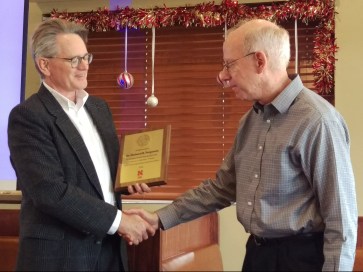
Dr. John Westra, Associate Director of Eastern Nebraska Research & Extension Center, awards Dr. Richard Ferguson with a plaque for his years of service.
Center. We’re blessed with the high quality research that takes place there under the guidance of researchers, technicians, and staff with great longevity there. One of those researchers has been Dr. Richard Ferguson, Extension Soil Fertility Specialist since 1985. The past few years he has served as the Interim Head for the UNL Department of Agronomy and Horticulture, and I appreciated how he still responded to Extension questions! Effective January 1, 2019, Richard will be serving as Vice Chancellor for the Rwanda Institute for Conservation Agriculture (RICA). As vice chancellor, Richard will provide direction for the institution, manage fiscal resources, recruit and select faculty and staff, lead development of research and extension programs, and oversee student recruitment. Opening in July 2019, the RICA is an English language institution dedicated to educating and inspiring a new generation of innovators in agriculture in Rwanda. Establishing the Institute is a joint effort of the Government of Rwanda and the Howard G. Buffett Foundation, with the University of Nebraska–Lincoln providing leadership in curriculum development and technical advising. There is a farewell reception to be held on December 13 at the Goodding Learning Center (Plant Sciences Hall) on UNL’s East Campus from 3-5 p.m. You are also invited to share on the online guest book if you’d like at: go.unl.edu/ferguson-farewell. A special thank you to Richard for his years of service to Nebraskans and beyond and we wish him all the best in this new endeavor!
Nebraska Soybean Day and Machinery Expo: You may also wish to catch the Nebraska Soybean Day and Machinery Expo to be held at the Fairgrounds in Wahoo, NE on December 13. This year’s program has a great lineup of speakers with the program running from 8:30 a.m. to 2:15 p.m. Dr. David Kohl, professor emeritus of Virginia Tech University, will identify financial and risk management factors that place a farm business in the upper 40% of profits and sustainability with practical steps to move into that zone. During his presentation, “Economic Update and Taking Care of Business,” Kohl also will share a domestic and global overview on the factors and transformative trends influencing customers’ financials.
Other presentations will include:
- New and Emerging Pests of Soybeans (primarily soybean gall midge) with Justin McMechan, Nebraska Extension crop protection and cropping systems specialist.
- What You Need to Know to Grow and Market Specialty Soybeans to Increase Your Profits with Darwin Rader, international sales and marketing management with Zeeland Farm Services in Des Moines.
-

Please click to enlarge.
Managing Soybeans in Storage — Is Poor Quality a Concern with Ken Hellevang, extension engineer, North Dakota State University.
- Nebraska Soybean Checkoff Update and Association Information with representatives of the Nebraska Soybean Board and Soybean Association.
Registration is at the door and includes a free lunch. For more information about the program contact Nebraska Extension Educator and Event Coordinator Keith Glewen at (800) 529-8030 or kglewen1@unl.edu. Attendees are encouraged to bring a can or two cans of nonperishable food items to donate to the food pantry. This program is sponsored by Nebraska Extension in the university’s Institute of Agriculture and Natural Resources, the Nebraska Soybean Board, Saunders County Soybean Growers Organization and private industry.

JenREES 12-2-18
Part 2 of my residue management series focuses on grazing corn residue. We’re blessed  in Nebraska to have corn, cattle, and ethanol with the distiller’s co-product…the golden triangle as it’s been dubbed. What’s interesting is that a huge feed resource in corn residue is under-utilized each year, with an estimated 52% of our state-wide corn residue being grazed or mechanically harvested.
Because a small amount of residue is removed, many fields in Nebraska have potential for grazing, except for the case of extreme slope and/or very low yields. Regarding stocking rates, Dr. Mary Drewnoski, Extension Beef Nutritionist shares, “Corn residue is about 10% husk and 34% leaf with the remaining residue being stalk and cob. Recommended stocking rates are based on the ability of a pregnant cow to maintain body weight without supplementation of protein or energy. The rates suggest that you can graze a 1200 lb cow for 30 days for every 100 bu. of corn grain produced. This would result in the cow consuming only about 12% to 15% of the corn residue in the field and nearly all would be husk with some leaf. Cob and stalk have less energy available.”
Compaction is the main concern I hear for not grazing. An increase in a soil’s bulk density and penetration resistance can be indicators of compaction. A summary of Nebraska research studies when corn residue was grazed at proper stocking rates has shown fall and winter grazing:
- do not significantly impact soil properties that would lead to compaction;
- don’t result in changes to soil organic matter, N, P, or K (just uneven distribution of the nutrients excreted back onto the land);
- results in maintained or increased yields; and
- increases soil microbial activity.
Grazing corn residue resulted in no detrimental effects on soil properties (sixteen years in silty clay loam soils) including bulk density and penetration resistance. Increase of surface roughness was observed where cattle congregated for water and during wet conditions when soil was thawed. An Iowa study indicated the surface roughness could impact seed placement for the following no-till crop but only found that in one location in one field studied. In another study of five Eastern Nebraska locations, penetration resistance was slightly increased in two of the locations but was below the threshold for impeding root growth and did not carry over into the next year. There were no yield differences between grazed and ungrazed treatments whether continuous corn (239 bu/ac for grazed and 223 bu/ac for ungrazed) or soybean (grazed 59 bu/ac and ungrazed 62 bu/ac) in the three years at those five locations. Sixteen years of fall grazed corn residue (November to February) resulted in a statistical soybean yield increase of 3.4 bu/ac in Eastern Nebraska. There was also an increase in the soil microbial community in the grazed treatments vs. ungrazed for those sixteen years. Under continuous corn in western Nebraska, five years of fall grazing corn residue did not statistically impact yields (154 bu/ac grazed vs. 148 bu/ac ungrazed).
Some have mentioned that the weather is not allowing them to till this fall. Perhaps cattle grazing is an option? Regarding the questions I’m receiving about this: The tenant in cash rent situation owns the stalks unless the landlord has specified otherwise in the written lease. Specify in the grazing lease who takes care of fence, water, and monitoring cattle. To help connect cattle and crop producers for utilizing residue and forage cover crops for grazing, there’s a free resource called The Crop Residue Exchange at https://cropresidueexchange.unl.edu/. After establishing a log-in account, growers can list cropland available for grazing by drawing out the plot of land available using an interactive map. They can then enter basic information about the type of residue, fencing situation, water availability, and dates available and provide their preferred contact information. Livestock producers can log in and search the database for cropland available for grazing within radius of a given location of interest. There’s also an ‘Other’ category where growers can list forage cover crops for grazing. Grazing rates are listed as either a ‘per acre’ basis or ‘rate/head/day’. An excel spreadsheet called the ‘Cornstalk Grazing Cow-Q-Later’ may be of help to determine rates at this site: https://go.unl.edu/2fb6. There’s more I’d like to share but for additional resources, please see my blog site at: http://jenreesources.com or contact your local Extension Office.
Of importance is to double check in-season and fall-applied herbicide labels for any grazing restrictions. These restrictions can also be found in the ‘Forage Feed Grazing Restrictions’ in the UNL Guide for Weed Management. The forage, feed, and grazing restriction only applies to the crop for which the herbicide was applied. When it comes to grazing cover crops planted into these residues, one must use the replant/rotation restriction guidelines found on the herbicide label and in the UNL Weed Guide: ‘Replant Options Rotation Restrictions’. If the label doesn’t specify any restrictions, then it should be ok. If you want to be on the safe side, a rule of thumb is to use the pre-harvest interval for the amount of time to wait before grazing stalks.
Resources:
- Crop Residue Exchange: https://cropresiduexchange.unl.edu
- Crop Residue Exchange Resources: https://cropresidueexchange.unl.edu/resources
- Grazing Crop Residues with Beef Cattle (excellent at explaining portion of crop residue, determining stocking rates, leasing rates, etc.)
- Cornstalk Grazing Cow-Q-Lator (excel spreadsheet guide for lease rates)
- Nutrient Removal by Cows Grazing Corn Residue, November 2018 CropWatch article
- Grazing Cornstalks Rental Agreement Considerations, 2016 Beef Article
- Renting Crop Residue: A Checklist for first-time renters, 2016 Beef Article
- Fillable leases: http://aglease101.org
- Grazing spring-calving cow-calf pairs on cornstalks-a producer’s perspective, November 2018 Beef Podcast
- Drewnoski et al. 2015. Effect of Corn Residue Removal on Subsequent Crop Yields. University of Nebraska-Lincoln Beef Report p 53-55.
- Rakkar et al. 2017. Effect of Long-term Corn Residue Grazing on Soil Properties. University of Nebraska-Lincoln Beef Report. p 50-52.
- Ulmer et al. 2017. Effect of Corn residue Grazing or Baling on Subsequent Crop Yield and Nutrient Removal. University of Nebraska-Lincoln Beef report p 46-49.
- Schmer et al. 2017. Corn Residue Use by Livestock in the United States. Agricultural & Environmental Letters.
Dr. Kohl Recap
 Kicking off the 2018-2019 Farmers & Ranchers College programming year with a full house was Dr. David Kohl, Professor Emeritus from Virginia Tech. As usual, he did an excellent job describing global risks which affect us and how those risks will affect the agricultural industry. International trade issues continue to emerge and it will be interesting to see how they play out. One of the things to watch closely is China’s “Belt & Road Initiative” which is an ambitious effort to improve regional cooperation and connectivity on a trans-continental scale with China and approximately 65 other countries. This is important to monitor because countries impacted in this Initiative account for about 30 percent of the global GDP and 60% of the world’s population.
In regards to energy economics, the U.S. is the world’s major energy producer. As there is a continued drive towards efficiency, there is also a push for…
View original post 631 more words


