Blog Archives
Storm Damage Update #1-Soybeans
It’s been five days and soybean fields that were the greatest affected by the storm are now near-brown. Planting some type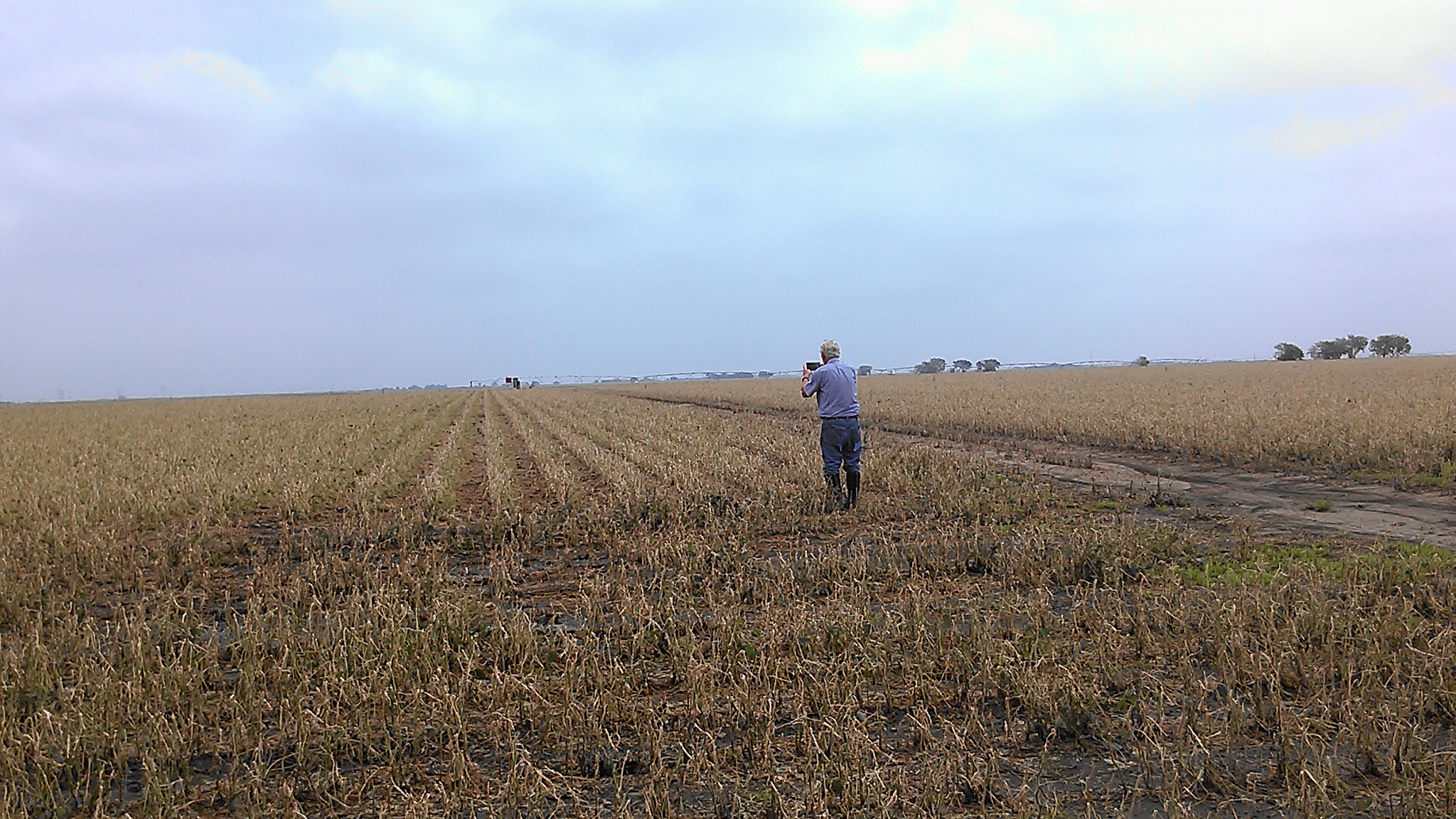 of cover crop in these fields can allow for grazing opportunities as well as reduced soil erosion as there are many months before planting season next year. I’ll talk more about cover crop research in another post.
For fields that still have some leaves and some green to them, there are several criteria to look at when assessing hail damage to soybeans. These include determining plant stand, percent leaf defoliation, percent nodes cut off or broken over, and amount of stem damage. Determining percent leaf defoliation and subsequent yield reduction based on growth stage in indeterminate soybeans can be seen in the chart below. Most of our soybeans were between R4-R5 which is a critical time for yield loss in soybean. The remaining charts can be found here.
| % Leaf Defoliation | |||||
| Growth Stage | 20% | 40% | 60% | 80% | 100% |
| % Yield Reduction | |||||
| V2 | 0 | 0 | 0 | 1 | 2 |
| V6 | 0 | 0 | 1 | 3 | 5 |
| R1 – R2 | 0 | 5 | 7 | 12 | 23 |
| R3 | 3 | 6 | 11 | 18 | 33 |
| R4 | 5 | 9 | 16 | 30 | 56 |
| R5 | 7 | 13 | 23 | 43 | 75 |
| R6 | 16 | 11 | 18 | 31 | 53 |
| R7 | 1 | 2 | 4 | 6 | 8 |
Dr. Jim Specht, UNL Soybean Physiologist, shared some recent research data that may be of interest. He said R5 is  also critical in that stem node number accrual (including new petioles with leaves and nodes on branches) ceases at R5. This occurs because the developing “sink” of newly developing seeds in the pods is a significant draw on the plant’s photosynthate. This draw is so powerful that very little other vegetative activity dependent on photosynthate is permitted.
With our current situation, Jim wasn’t sure if because of hailed off pods and seeds, if that “sink” to source signal would cease to exist resulting in new petioles and leaves. He didn’t think this would occur for two reasons:
1) Indeterminate main stem apices are not responsive to photoperiod induction, and might re-initiate new nodes, but since most of the indeterminate apical stem tips were hailed off in many fields, that possibility is unlikely.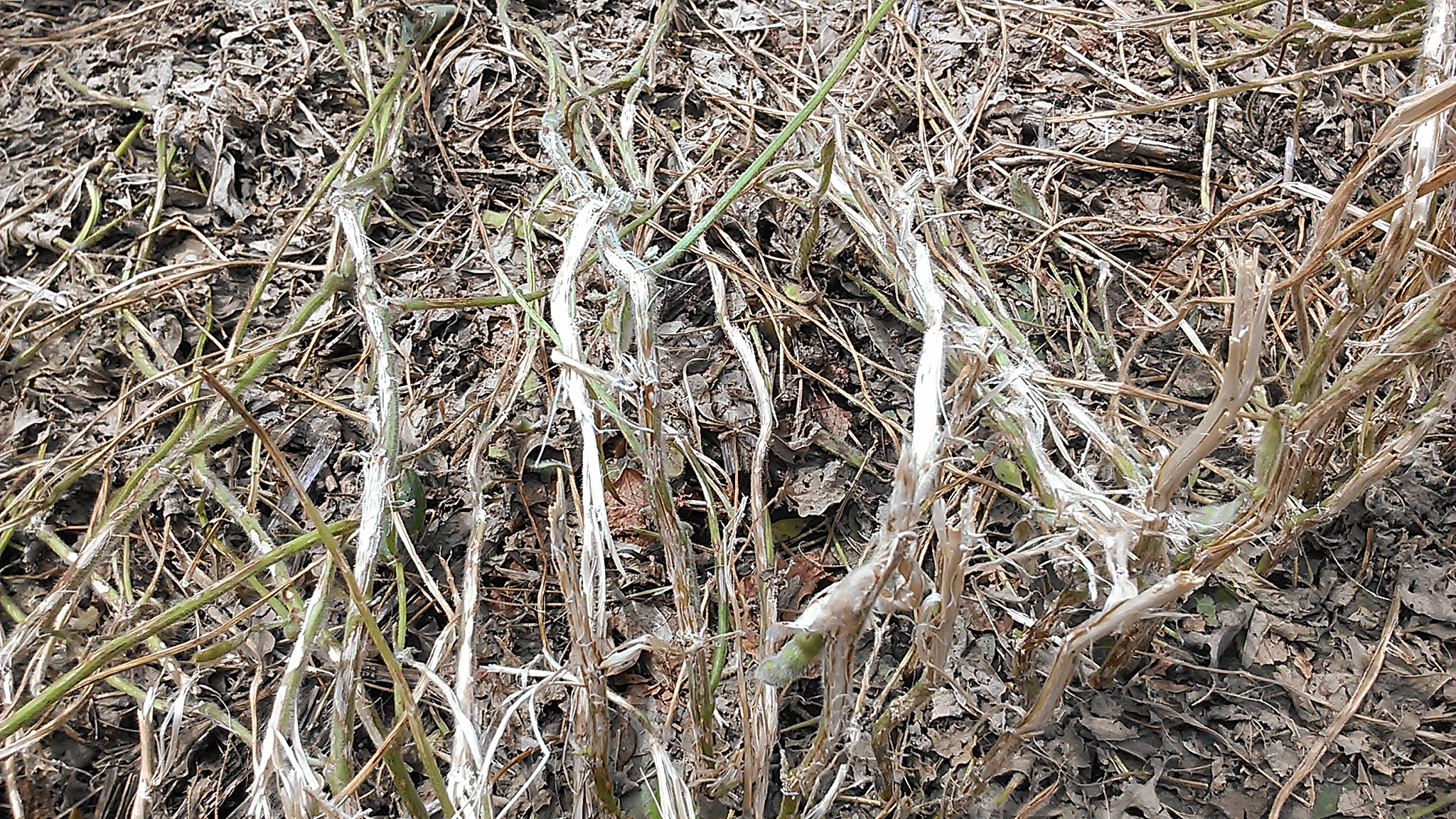
2) During stage V0 to V1, all original lateral meristems in nodes 0 on up to about stem node 6 were cell clusters committed to vegetative phase development such as branches. Photoperiod induction, which occurs as soon as soybean plants of the maturity groups grown in NE attain the V0-V1 period, transduces in all other single-cell meristems in the lateral apices to become flowers (not branches). Thus the reason why we typically see the first soybean flower on about the 6th node or so. No more branches will form at higher main stem nodes the rest of this season under this scenario.
Soybean lateral apices will continue to be programmed to become flowers, because the days are short at all times during the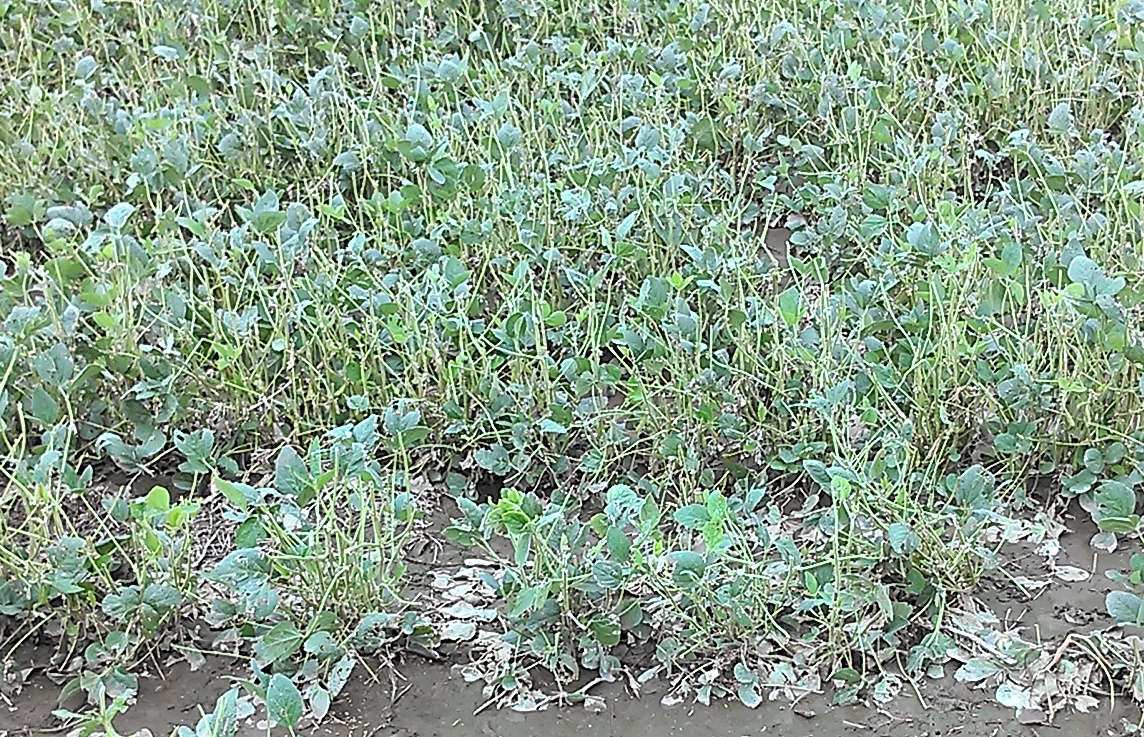 season from planting to maturity, for soybean varieties adapted to and sold in NE. Research has shown it takes about 28 to 32 days after the transduction of a lateral apical single cell (to transduce it into a floral pathway) before the flower tracing to that single cell appears. Any flowers appearing soon after the hailstorm would have had to have been cell clusters in transit before the hailstorm date (from a zero-day single cell transduction to a 28-32-day later observable flower). Thus, truly “new” flowers emanating from single-cell apical transduction to a floral state the day of the hailstorm would be appearing at the end of August or beg of September, and would not have sufficient time to become pods (with seeds) before the usual date of a fall frost.
Overall, Jim says at soybean stage (R5), it is hard for a soybean plant to recover from a hailstorm, and what recovery is possible is going to have to hurry given the approach of fall. Special thanks to Dr. Jim Specht for his insights into this post!
#Crop Update
While every growing season is unique and there’s an element of risk involved, this year seems to take the cake. 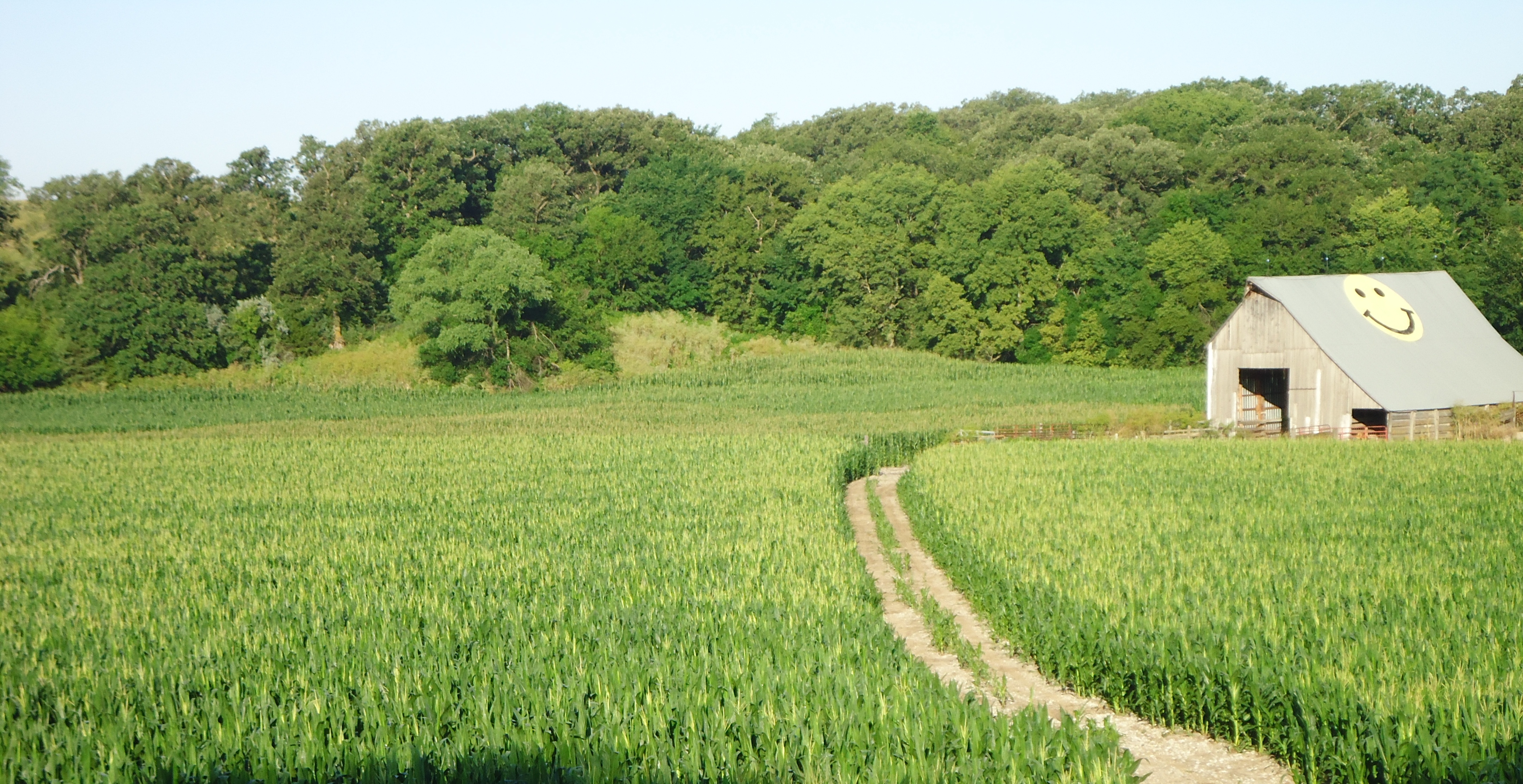

Drought conditions have affected much of Nebraska. In our area in south-central Nebraska particularly in our southern tier of counties, we’re seeing brown pastures and alfalfa that stopped growing. Wheat was harvested nearly a month early and yields range from 0-50 bu/acre depending on if it was hit by the hail storm Memorial Day weekend which totaled it out.
I’m unsure how many planting dates we currently have in Clay County! The spring planting season went so well with corn and many beans being planted in April. Soybeans planted in April that haven’t received hail are forming a nice canopy. Corn that hasn’t received hail should be tasseling by beginning of July. One Clay Co. field planted in March was only 3 leaves from tasseling when I took this picture this week and looks great (it’s probably 2 leaves by now!).  Adding another picture from a farmer friend Bob Huttes near Sprague, NE showing his field currently tasseled out and love the smiley face barn 🙂
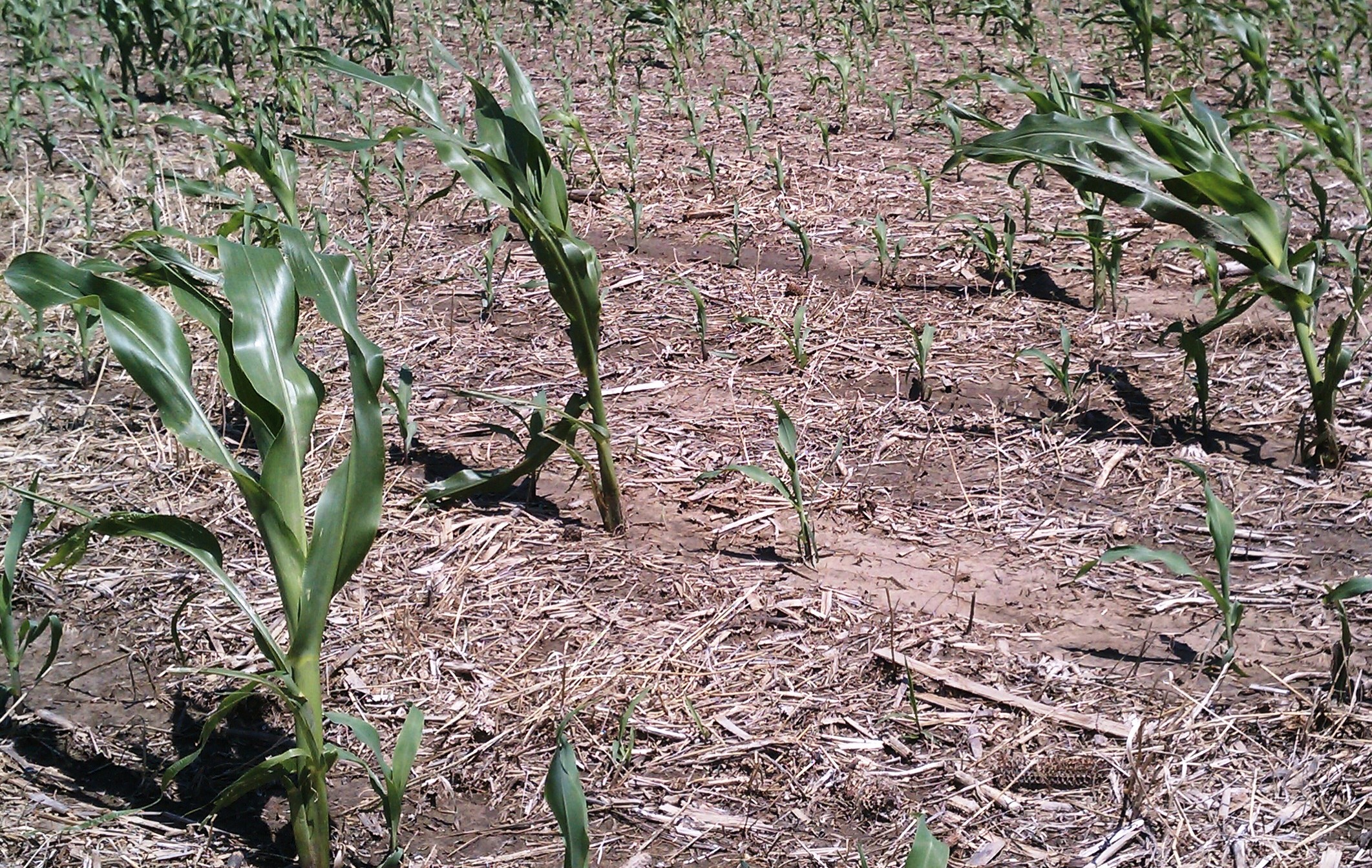
But then there’s the hail damaged fields. The hail pattern has been fairly similar all year for this area of the State with some producers receiving four consecutive hail events on their fields. Every week of May was spent helping our producers determine replant decisions, particularly for soybeans…leaving irrigated stands of 85K and dryland stands of 60-65K when beans were smaller before stem bruising was so severe later. We would leave a stand one week and end up needed to replant after the hail hit again the following week. Some farmers got through the first two hail storms but the Memorial Day weekend storm did them in. I never saw hail like where ground zero of this storm occurred. After replanting after that weekend, they received yet another hail storm last week with the wonderful, much needed deluge of rain we received in the county. My heart hurts for these farmers yet for the most part they have good attitudes and are making the most of it. That’s the way farming is…lots of risk, thus an abundance of faith and prayer is necessary too. One farmer I talked to has had hail on his house seven times this year (including prior to planting).
Pivots have also been running like crazy prior to the rain last Thursday night where we received 3.30-4.40 inches in the county. Installing watermark sensors for irrigation scheduling, we were able to show the farmers that there was truly moisture deeper in the soil profile and attempted to convince them to hold off. It’s a hard thing to hold off on  water when the neighbors are irrigating, but several farmers who didn’t irrigate told me they were able to let the rain soak in and their plants
  weren’t leaning after that rain because the ground wasn’t saturated prior to the rain event.


