Blog Archives
Plant #Soybeans Early for Increased Yields
While I got this posted in our CropWatch Web site, I didn’t get it on my blog till now! Hopefully this inspires many of you to get soybeans planted yet this week! 
Planters are rolling throughout the state and given the size of today’s equipment corn planting is rapidly progressing. Based on UNL research, we would encourage you to consider planting your soybeans as soon as possible—preferably before the end of April for the southern two-thirds of Nebraska and or the first week of May for the northern third of Nebraska. While evening temperatures have been low, consider the percent risk of frost for emerged plants not planted seeds. The above recommendation considers a 10% risk of frost 7-10 days after planting, the time when soybeans would most likely emerge.
Why plant early? Five years of UNL small plot and on-farm research has proven that early planted soybeans yield more than late planted beans—regardless of whether the spring has been cold and wet or warm and dry. Soybeans are a photoperiod-sensitive crop so the goal is to allow the plant to use the sun’s energy to accumulate as many nodes as possible as day length decreases after June 21. Nodes are important because that’s where pods, seeds, and ultimately yield are produced. The goal is to have the soybean canopy “green to the eye by the fourth of July!”. Thus the plants are absorbing all the sunlight possible not allowing any to be wasted by hitting the soil.
Table 1 shows how three years of on-farm research have resulted in an average of 3 bu/ac yield increase (with a range of 1-10 bu/ac depending on the year and the planting date range of early versus later planting). With today’s soybean prices, a 3 bu/ac yield increase adds up (see Table 2). We do recommend a fungicide/insecticide seed treatment to reduce the risk of damping off diseases and bean leaf beetles which tend to feed on early-planted soybeans.
Several previous CropWatch articles explain soybean planting date in more detail. Please see these for more information:
- For Increased Yields Plant Soybeans in Next Two Weeks
- Three Reasons Why Soybean Planting Date Matters
- Farm Research Shows Benefits of Planting Soybeans Early
- Risks and Caveats of Early Planting Soybeans
Table 1: Nebraska On-farm Research Early and Late Planted Soybean Yield Results (2008-2010)
|
Year |
Producer |
Date |
Reps |
Rainfed/ Irrigated |
Variety |
Row Spacing |
Yield (bu/acre) |
|
2008 |
SCAL Early |
Apr. 29 |
3 |
Irrigated |
Producers 286 |
30” |
67.2 |
|
2008 |
SCAL Late |
May 15 |
3 |
Irrigated |
Producers 286 |
30” |
65.8 |
|
2008 |
Seward Co. Early |
Apr. 30 |
3 |
Irrigated |
NC+ 2895 |
30” |
68.4 |
|
2008 |
Seward Co. Late |
May 19 |
3 |
Irrigated |
NC+ 2895 |
30” |
66.2 |
|
2008 |
York Co. Early |
Apr. 23 |
8 |
Irrigated |
Producers 286 |
30” |
66.9 |
|
2008 |
York co. Late |
May 14 |
8 |
Irrigated |
Producers 286 |
30” |
63.5 |
|
2008 |
Fillmore Co. Early |
Apr. 30 |
7 |
Irrigated |
Pioneer 93M11 |
30” |
81.0 |
|
2008 |
Fillmore Co. Late |
May 19 |
7 |
Irrigated |
Pioneer 93M11 |
30” |
77.5 |
|
2009 |
SCAL Early |
Apr. 27 |
4 |
Rainfed |
Pioneer 93M11 |
30” |
37.6+ |
|
2009 |
SCAL Late |
May 18 |
4 |
Rainfed |
Pioneer 93M11 |
30” |
37.2 |
|
2009 |
Saunders Co. Early |
May 3 |
6 |
Rainfed |
NC+ A63RR |
15” |
66.6 |
|
2009 |
Saunders Co. Late |
May 21 |
6 |
Rainfed |
NC+ A63RR |
15” |
65.1 |
|
2009 |
SCAL Early |
Apr. 27 |
4 |
Irrigated |
Pioneer 93M11 |
30” |
70.2 |
|
2009 |
SCAL Late |
May 18 |
4 |
Irrigated |
Pioneer 93M11 |
30” |
68.1 |
|
2009 |
Fillmore Co. Early |
Apr. 24 |
4 |
Irrigated |
Pioneer 93M11 |
30” |
69.5 |
|
2009 |
Fillmore Co. Late |
May 15 |
4 |
Irrigated |
Pioneer 93M11 |
30” |
68.4 |
|
2009 |
Seward Co. Early |
Apr. 24 |
4 |
Irrigated |
NC+ 2A63 |
30” |
73.2 |
|
2009 |
Seward Co. Late |
May 20 |
4 |
Irrigated |
NC+ 2A63 |
30” |
71.3 |
|
2009 |
York Co. Early |
Apr. 30 |
3 |
Irrigated |
NK 28B4 |
30” |
59.1 |
|
2009 |
York Co. Late |
May 15 |
3 |
Irrigated |
NK 28B4 |
30” |
58.6 |
|
2010 |
Saunders Co. Early |
Apr. 18 |
6 |
Rainfed |
Channel 2751 |
15” |
75.7 |
|
2010 |
Saunders Co. Late |
May 18 |
6 |
Rainfed |
Channel 2751 |
15” |
71.2 |
|
2010 |
Seward Co. Early |
Apr. 19 |
6 |
Irrigated |
Channel 3051RR |
30” |
72.0 |
|
2010 |
Seward Co. Late |
May 24 |
6 |
Irrigated |
Channel 3051RR |
30” |
62.3 |
|
|
Average Early |
|
|
|
|
|
70.0* |
|
|
Average Late |
|
|
|
|
|
67.1 |
*Statistically significant at 95% level.
+SCAL Rainfed was not included in the combined statistical analysis but Saunders Co. Rainfed was compared with irrigated yields from other locations.
Table 3: Economic Advantage to a 3 bu/ac Yield Increase Due to Early Soybean Planting Date
| Price of Soybeans | $ 7.00 | $ 8.00 | $ 9.00 | $ 10.00 | $ 11.00 | $ 12.00 | $ 13.00 | $ 14.00 |
| Economic Advantage | $ 21.00 | $ 24.00 | $ 27.00 | $ 30.00 | $ 33.00 | $ 36.00 | $ 39.00 | $ 42.00 |
Lawn, Garden, Spring
Well, this weekend I mowed my yard for the first time this spring-hard to believe for March! For two weeks I’ve been advising people to wait on fertilizing or applying crabgrass preventer on their lawns. It’s hard for me not to stop my vehicle everytime I see someone using a lawn spreader right now and ask them to wait! It’s too early to apply pre-emergent herbicides and fertilizer. Wait another month (till at least April 20) before the first fertilizer of 1 lb/1000 sq. ft is applied. At that same time, pre-emergence herbicides can also be applied. Wait to overseed Kentucky bluegrass lawns till April 1 and Fescue lawns till April 15. You can check out a calendar of recommendations for all things concerning your lawn at the following site: http://turf.unl.edu/lawncalendars.cfm. When overseeding winter-killed areas, core aerate or power rake the lawn prior to overseeding to encourage seed to soil contact for better germination. Also, don’t apply herbicides to areas where you have overseeded as this will affect the germination of new seedlings.
A timely meeting for lawn care has been scheduled and you can learn more by attending a Lawn Care for Home-Owners meeting Thursday, April 12 from 5:30-7:00 p.m. There is no charge and light refreshments will be provided. Learn about fertilizer labels and timing, calibrating your lawn spreader; irrigation timing for lawns; and calendars for lawn care maintenance. Please RSVP to the Clay County Extension Office at (402) 762-3644 or jrees2@unl.edu.
Garden: It’s been hard for me to resist the temptation to remove the winter mulch I had on my perennials and flower beds but in the event of frost which still is a good possibility, it may be good to leave it on awhile longer if new growth has not occurred. Kelly Feehan, UNL Extension Educator from Platte County advises if new growth is beginning to occur on your herbaceous perennials, to rake the leaves/mulch into a nearby pile. This allows the new growth to get acclimated to sunlight but allows 
I know some people have planted peas and potatoes. Check out the Vegetable Planting Guide that Gary Zoubek, UNL Extension Educator in York developed for suggested vegetable planting dates for our area: http://york.unl.edu/water-environment. Thursday, April 5th, Backyard Farmer returns for its 60th season on NET1 at 7:00 p.m.! Also, on Thursday, April 19th, we will have a workshop on Container Gardening Fun at the Clay County Fairgrounds from 5:30-7:00 p.m. More information to come! Please RSVP to jrees2@unl.edu or (402) 762-3644.
Cornhusker Economics Conference
The Cornhusker Economics Conference will focus on the ag outlook and management decisions for farmers and ranchers at  Clay Center on February 29th at the Clay County Activities Building at the Clay County Fairgrounds. The program will run from 10:00 a.m.-2:30 p.m. with registration beginning at 9:30 a.m. The conference will cover key topics affecting farm management and production decisions for 2012. It is offered by UNL Extension and the UNL Department of Agricultural Economics and is sponsored in part by funding from the Nebraska Soybean Board.
Dan O’Brien of Kansas State University will share his insight on grain and oilseed outlook and risk management decisions in today’s uncertain markets. While market volatility shows the need for sound hedging strategies, concerns about futures market performance and the recent MF Global bankruptcy affecting hedge margin accounts raise questions about the best path ahead for managing market risk. O’Brien will bring his experience and analysis of futures market performance to bear on the issues and discuss implications for producer decisions.
Shane Ellis, livestock marketing specialist at Iowa State University, will discuss the outlook for livestock markets and producer profitability. With outlook for meat demand and continued reductions in cattle supplies, the market fundamentals look strong, but must weigh against grain supplies and feed prices. Ellis will bring his expertise to the situation and provide guidance for producer marketing and production decisions in 2012.
The land market has also been moving in the past year and UNL Extension Educator Allan Vyhnalek will use his local knowledge and analysis to discuss land markets and leasing arrangements with implications for producer decisions. The closing session will feature a focus on agricultural policy and the direction for new farm programs. Brad Lubben, policy specialist, will discuss the policy outlook in Washington and the major policy developments that could affect agriculture in 2011. Then, Lubben will team with UNL Extension educators to discuss specific directions for the new farm bill and implications for farm programs, conservation programs, and risk management decisions.
There is a $25 registration fee to cover programming expenses for speakers, materials, and the noon meal. Please RSVP to Jenny Rees at the Clay County Extension Office at (402) 762-3644 or jrees2@unl.edu by Feb. 27 so we can obtain a meal count. Hope to see you at the excellent conference!
Visit from Chinese Agronomists
Last week I had a neat experience in speaking to a group of agronomists from China about Extension. They are in the U.S. for 10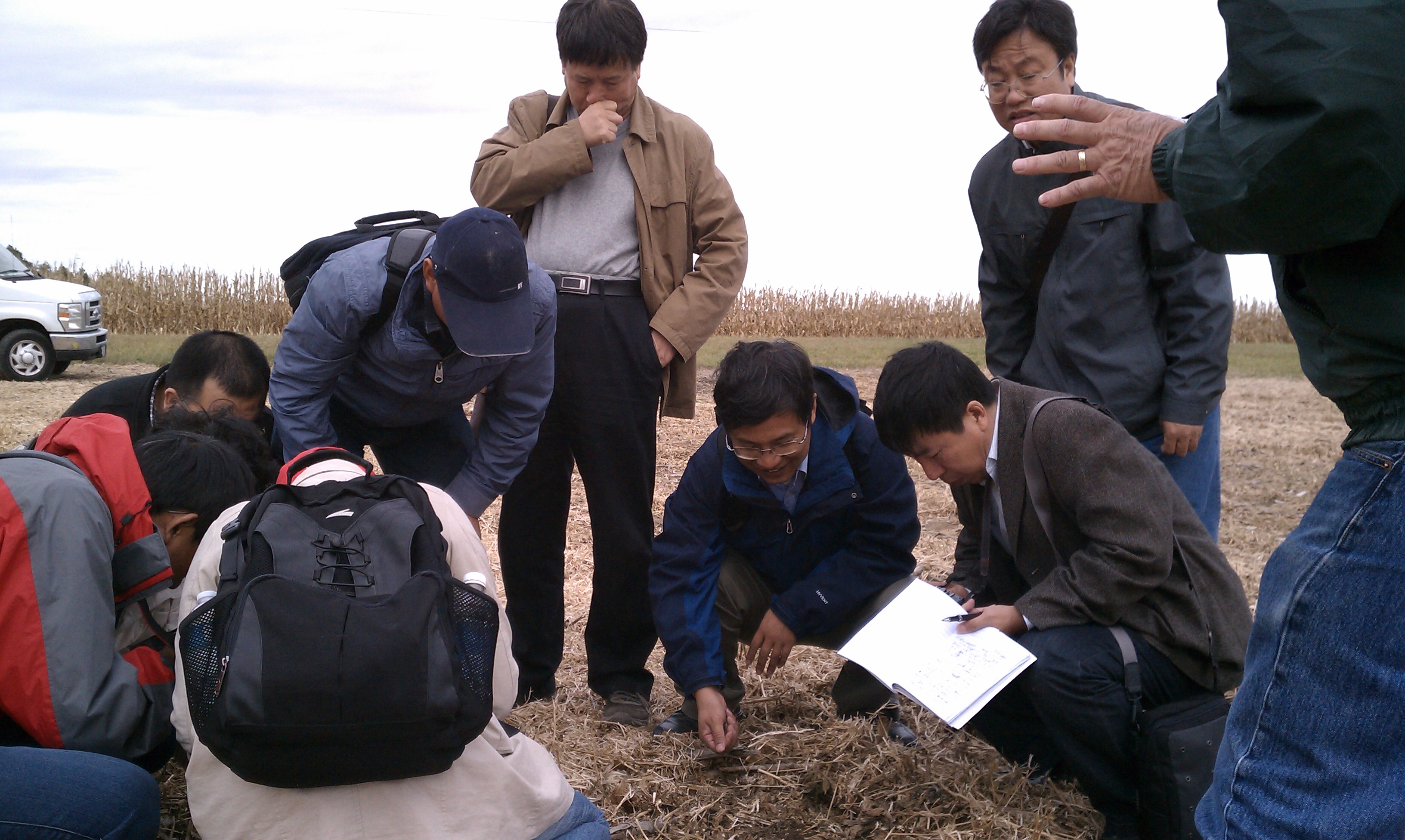 days and are interested in high yield corn production. I scrapped the presentation I had been asked to present as they had so many questions about our Extension system. So we started in a discussion…how do we set up a field day/meeting in Extension? How do we let farmers know about them? How do we decide what to talk about? Thus ensued a discussion of farming in China vs. farming in Nebraska. In China, many of the fields are hand-planted and less than 10% of their farmers have internet connectivity. In Nebraska, we’re seeing the trend of larger equipment and the majority of our farmers are connected to the internet. I suggested that they start with field days and meetings which shared the research-based information they are generating at their research sites. Advertise to farmers via word of mouth, radio, newspapers, direct mailings, or brochures/flyers left at common gathering spots. Once they have the people at the meetings, they can follow up with a survey to determine needs assessment for what the farmers would like to know more about in the future to determine future meeting topics.
Extension in Nebraska has greatly changed in my 7 years regarding how we share information. We are challenged today to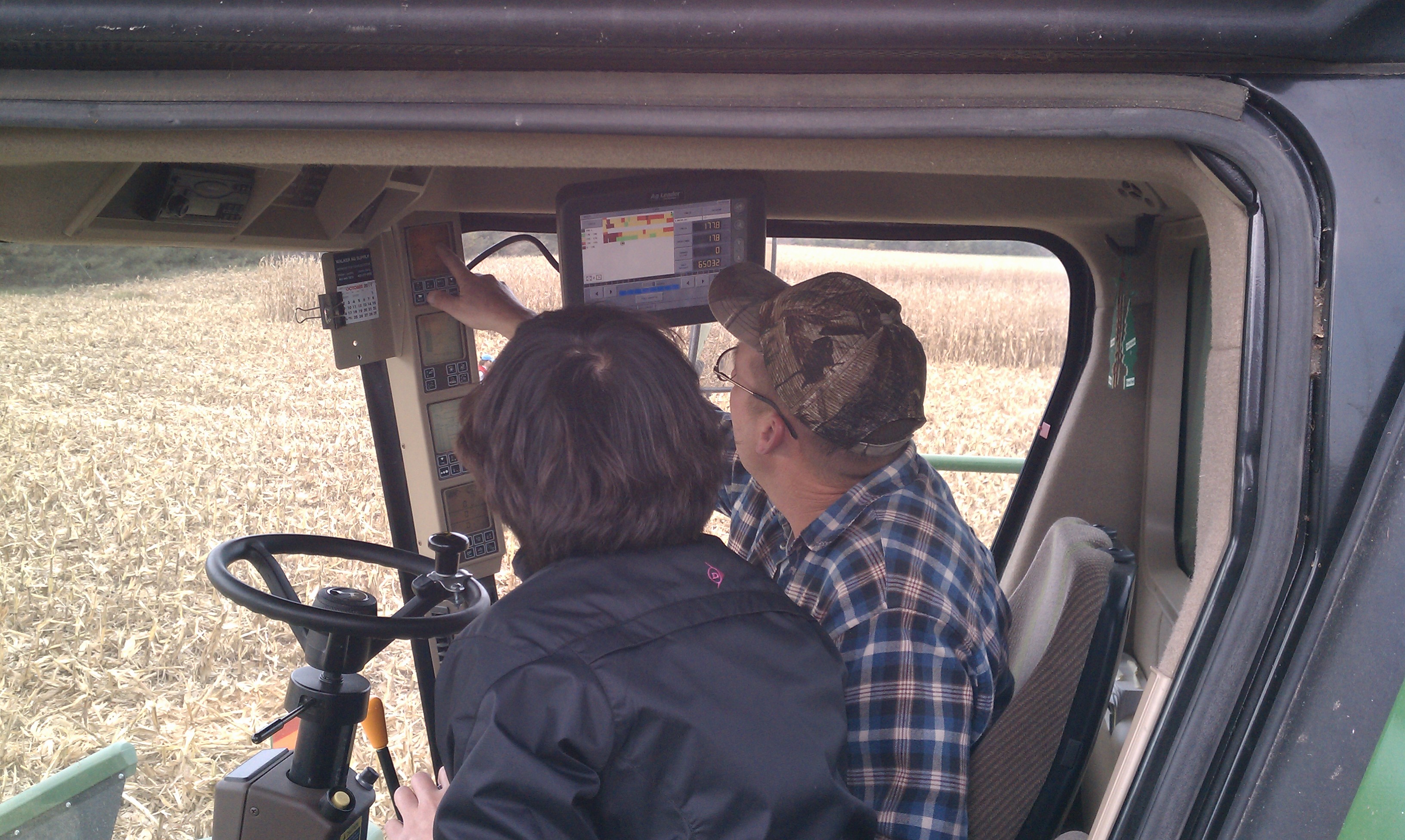 reach a broad audience who on one hand primarily finds information from newspapers to the other hand, primarily from the Web-and everywhere in between! This year, I’ve worked at trying to share the same information 7 different ways to reach a broader audience. I showed the agronomists from China the impact of the Web and social media in sharing information in Nebraska. They were amazed!
We then went on a tour where they were able to view harvest. It was fascinating watching them excitedly discuss and question no-till farming as they were digging through residue and in the soil. They also predicted corn yields by measuring and counting and comparing that to the combine yield monitor. Some enjoyed getting into the combines and learning about the precision ag tools available to farmers. It was a neat experience and I learned much from our visitors as well!


